REVIEW 5 major objections 5 minor 271 references
This paper argues that a unified structure-plus-reaction toolkit—antisymmetrized molecular dynamics for structure, the Glauber model for reaction cross sections, and finite-range distorted wave Born approximation (FRDWBA) for Coulomb breaku
Reviewed by Pith at T0; open to challenge. T0 means a machine referee read the full paper against a public rubric. the ladder, T0–T4 →
T0 review · deepseek-v4-flash
2026-08-01 06:53 UTC pith:XRBKBGFY
load-bearing objection A candid, internally honest review of the authors' own FRDWBA program; the halo and spin-parity claims are model-dependent because of the single-ℓ assumption and C²S=1, and the 'paradigm shift' framing oversells results whose final r-process abundances barely change. the 5 major comments →
Deformation, halo, and bubble structure: A paradigm shift of exotic phenomena in light to medium mass nuclei
The pith
A machine-rendered reading of the paper's core claim, the machinery that carries it, and where it could break.
Core claim
The central claim is that a weakly bound valence neutron can be described by its dominant low-ℓ component even in a deformed potential, so that the projectile ground-state wave function for 29Ne, 31Ne, 34Na, and 37Mg is well approximated by a spherical Woods-Saxon solution for ℓ=1, with deformation entering through the interaction potential. Using this wave function in the post-form FRDWBA, the authors reproduce measured one-neutron removal cross sections and parallel momentum distributions, concluding that each nucleus has a ground state with Jπ=3/2− and p-wave halo character. For two-neutron systems, hyperspherical three-body calculations with core+n and nn interactions predict Borromean h
What carries the argument
The load-bearing object is the FRDWBA reduced transition amplitude, factorized under the local momentum approximation into a dynamics integral (evaluated as a Bremsstrahlung integral) and a structure integral containing the projectile ground-state wave function and the fragment-fragment potential Vbc(r1), which carries axially symmetric quadrupole deformation (Eqs. 30-31). Because the structure part is separable, deformation can be varied in the potential without altering the dynamics, and the single-ℓ dominance approximation—lowest ℓ rules the asymptotic wave function when the separation energy tends to zero—lets the authors use a spherical single-ℓ wave function despite deformation. For th
Load-bearing premise
The single-ℓ dominance approximation: for very weakly bound valence neutrons, the lowest-ℓ component is assumed to dominate the asymptotic wave function even in a deformed potential, so the projectile ground state can be computed from a spherical Woods-Saxon well for one ℓ; if deformation-induced ℓ-mixing or core degrees of freedom are substantial, the extracted spin-parities and separation energies shift.
What would settle it
A precise Coulomb breakup measurement of 34Na on a lead target, combined with an independent mass measurement of its one-neutron separation energy: if the data cannot be fitted by the p-wave FRDWBA with any spectroscopic factor C²S ≤ 1 and a separation energy consistent with the mass value (0.17 ± 0.50 MeV), the single-ℓ approximation and the Jπ=2− halo assignment would be falsified. Similarly, if the extracted Sn for 37Mg using shell-model C²S=0.42 does not shift from 0.35 to 0.14 MeV as the paper predicts, the assumed relation between spectroscopic factor and breakup cross section breaks dow
If this is right
- If the assignments hold, 29Ne, 31Ne, 34Na, and 37Mg join the established club of p-wave one-neutron halos, and their ground-state spin-parities (Jπ=3/2−) can be used as fixed inputs for future shell-model and ab initio studies.
- The predicted Borromean halos 31F, 39Na, and 40Mg have calculable matter radii and reaction cross sections that can be tested at next-generation rare-isotope beam facilities.
- FRDWBA rates for neutron capture on weakly bound dripline nuclei should replace Hauser-Feshbach rates in r-process network calculations; doing so shifts local abundances by several orders of magnitude even when only a few reactions are changed.
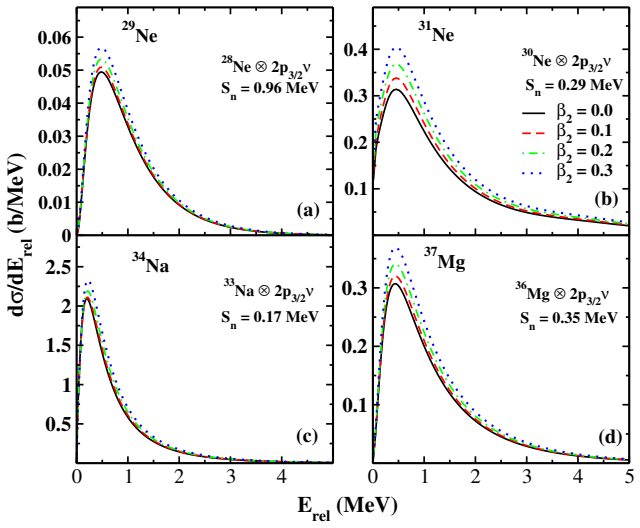
- The near-universal linear scaling between the relative-energy-spectrum peak and the one-neutron separation energy (slope ~1.01 across deformation values) provides a quick way to extract Sn for weakly bound deformed nuclei.
- Proton elastic scattering at the first diffraction peak can serve as a spectroscopic probe of diffuseness and thus of particle-hole configurations and bubble structure in these exotic nuclei.
Where Pith is reading between the lines
- The single-ℓ dominance approximation is the hinge of the paper's conclusions; if deformation-induced ℓ-mixing or neglected core degrees of freedom turn out to be significant in these deformed drip-line nuclei, the extracted spin-parities and separation energies could shift, so the framework's reach may be limited to the most weakly bound systems.
- The paper's own sensitivity analysis (Sn decreasing from 0.35 to 0.14 MeV when C²S goes from 1 to 0.42 in 37Mg) implies that spectroscopic factors are a larger source of uncertainty than deformation; future work should combine FRDWBA with structure models that supply both the single-particle wave function and the spectroscopic factor consistently.
- A testable extension is to apply the same toolkit to nuclei just outside the island of inversion, such as neutron-rich carbon and oxygen isotopes, to see whether the predicted p-wave dominance and halo signatures persist or fade as the separation energy increases.
- The r-process abundance shifts reported here come from replacing only five reaction rates; since direct-capture dominance likely extends to many other weakly bound species, the cumulative effect on final abundances could be larger than the 'few orders of magnitude' shown, a point the paper leaves implicit.
Editorial analysis
A structured set of objections, weighed in public.
Referee Report
Summary. This review proposes a unified framework for exotic structures in the island of inversion (N=20–28), combining antisymmetrized molecular dynamics (AMD) structure calculations with two reaction theories: the Glauber model for high-energy total reaction cross sections and the finite-range distorted wave Born approximation (FRDWBA) for Coulomb breakup. The paper applies this toolkit to claim one-neutron halo ground states with dominant p-wave (J^π=3/2^-) configurations for 29Ne, 31Ne, 34Na, and 37Mg; two-neutron Borromean halos for 29F, 31F, 39Na, and 40Mg; and to show that replacing Hauser-Feshbach (n,γ) rates with FRDWBA rates changes local r-process abundances by several orders of magnitude. The manuscript is unusually candid about its main approximations: it explicitly states that the single-ℓ dominance approximation is not fully self-consistent and that the C²S=1 spectroscopic assumption is an idealization. However, the impact of these approximations on the central structural and astrophysical claims is not quantified.
Significance. If validated, the paper would deliver a predictive AMD+FRDWBA/Glauber toolkit for dripline physics, with concrete experimental targets at FRIB, RIBF, and FAIR. The review's strengths include its honest treatment of uncertainties: Fig. 10 shows the explicit sensitivity of the extracted 37Mg separation energy to C²S and β2, and the Glauber calculations are parameter-free once densities are fixed. The predictions for 34Na and for two-neutron halos in 31F, 39Na, and 40Mg are falsifiable and timely. The weakness is that the load-bearing single-ℓ dominance approximation is tested only in a narrow sector (negative-parity ℓ=1,3,5 at β2=0.2) and no benchmark against more complete reaction frameworks (XCDCC, particle-rotor, or CDCC with core excitation) is provided. The C²S=1 assumption is shown by the paper's own analysis to shift extracted Sn values by a factor of ~2.5, which propagates into the halo classification and the astrophysical rates.
major comments (5)
- [Sec. 2.3, after Eq. (32)] The single-ℓ dominance approximation is the hinge of all FRDWBA conclusions. The text concedes the approach does not treat static deformation self-consistently, and Fig. 8 tests only negative-parity ℓ=1,3,5 at β2=0.2; it does not test s-wave (ℓ=0) mixing or dynamic core excitations. The consequences are visible in the paper's own results: Fig. 9 shows p- and s-wave cross sections overlapping within experimental bands for 29Ne and 31Ne, Table 6 gives a p-wave FWHM of 51 MeV/c vs. the measured 77(18) MeV/c for 31Ne, and Fig. 10 shows C²S-induced shifts. Please benchmark against an XCDCC or particle-rotor calculation for at least one nucleus (e.g., 31Ne) or provide a quantitative estimate of the systematic uncertainty from neglected ℓ-mixing. Without this, the J^π=3/2^- assignments and the extracted Sn values remain model-dependent.
- [Sec. 3.3.2, Fig. 10] The uniform C²S=1 assumption is adopted for all configurations despite the text citing shell-model values as low as 0.31 for 37Mg and breakup analyses giving 0.42. Fig. 10 shows that using C²S=0.42 instead of 1.0 changes the extracted 37Mg Sn from 0.35 MeV to 0.14 MeV, a factor ~2.5 shift. Because the extracted Sn values feed directly into the halo classification (low Sn is a prerequisite) and into the astrophysical rates of Sec. 4, this sensitivity must be propagated. The paper should either adopt literature C²S values where available or present C²S sensitivity plots for all four one-neutron halo candidates, not just 37Mg.
- [Table 6, Sec. 3.3.5] The calculated p-wave FWHM for 31Ne is 51.24 MeV/c (β2=0), while the measured inclusive width is 77(18) MeV/c on a carbon target. This is a ~40% discrepancy. The text notes the experimental widths are on carbon but does not address the target/mechanism mismatch: the measurements include nuclear breakup contributions, whereas the calculations are pure Coulomb breakup. Since narrow PMDs are a central halo signature, this discrepancy should be discussed quantitatively — e.g., an estimate of nuclear breakup contributions or an explicit statement that the comparison is only qualitative. The same caveat applies to the comparison with well-known halo nuclei such as 11Be.
- [Sec. 4.2, Figs. 20-22] The abstract claims the results demonstrate 'their role in the refinement of r-process nucleosynthesis models and elemental abundance predictions.' However, the network calculation modifies only five rates, and the paper itself states that 'the overall final abundance pattern remains largely unchanged.' Fig. 22 shows local changes up to a few orders of magnitude in the logarithmic ratio, but only for nuclei with low abundance. The claim should be qualified: the modified rates alter local isotopic abundances and can redirect flow near the drip line, but the global r-process pattern is stable under these replacements. Please soften the abstract and the concluding statements accordingly.
- [General — circularity and self-review] The review is to a large extent a summary of the authors' own program: the decisive methodological references [90,97,98,102,105-107,249] share authorship, and the quantities loop through the data — Woods-Saxon potentials are tuned to literature Sn values, and the cross sections are then compared with experimental data to re-extract Sn. The manuscript should explicitly delineate which inputs are taken from independent measurements and which are model outputs, and should discuss the extent to which the extracted Sn values are independent of the inputs used to generate the wave functions. This is a transparency issue that affects the reader's ability to assess the strength of the structural conclusions.
minor comments (5)
- [Fig. 8] Panel labels (a)-(d) are placed inside the panels. Consider moving them outside to avoid overlapping with the curves, especially the 29Ne and 31Ne panels where the labels sit near the x-axis.
- [Eq. (31)] The sign convention for β2 and the relation to the standard Bohr-Mottelson deformed potential should be stated explicitly. The text says β2 is the quadrupole deformation parameter, but the sign conventions matter for the comparison with, e.g., the Nilsson model.
- [Sec. 2.3] The adopted Woods-Saxon parameter values (r0, d, Vws) for each nucleus are scattered across the cited original papers. A summary table would make the review self-contained and help readers reproduce the calculations.
- [References] A number of the most load-bearing references (e.g., [90,97,98,102,105-107,249]) are by the authors themselves. Calling this out in a footnote or in the introduction would improve transparency.
- [Title and abstract] The phrase 'paradigm shift' in the title is stronger than the content supports; the paper presents a comprehensive toolkit and a set of candidly model-dependent applications. Consider softening the title to reflect the review's actual scope.
Circularity Check
No significant circularity: the review’s structural and astrophysical claims are checked against external data, and fitting steps are disclosed rather than mislabeled as predictions.
full rationale
The paper’s load-bearing results—FRDWBA Coulomb-breakup cross sections, extraction of one-neutron separation energies, two-neutron halo radii, and r-process abundance changes—are all compared with independent experimental data or are explicitly presented as sensitivity studies. The Woods–Saxon potential is tuned to literature separation energies, and the same separation energies are later re-extracted from cross-section comparisons; this is a disclosed analysis loop, not a claim that the extracted values are first-principles predictions. The paper explicitly states that ‘the extracted Sn values from Coulomb breakup data are intimately linked to the assumed C2S’ and shows how they shift with C2S and β2, so the model dependence is acknowledged rather than hidden. Similarly, the three-body force V3b is ‘adjusted freely to match the desired two-neutron separation energy s2n’, but the resulting matter radii are then compared to measured radii (e.g., for 29F), which is an independent check rather than a circular validation. The single-ℓ dominance approximation is justified by an in-paper numerical solution of the coupled-channel equation (Fig. 8) and by ANC calculations, not solely by the cited prior work; the limitation that static deformation is not treated self-consistently is also stated explicitly. Frequent self-citations occur because this is a review of the authors’ own program, but the decisive physics is either re-derived in the manuscript or benchmarked against external data, so the self-citations are not load-bearing in a way that makes the conclusions circular.
Axiom & Free-Parameter Ledger
free parameters (5)
- Spectroscopic factor C²S =
1.0 assumed (literature values 0.31–0.42)
- One-neutron separation energy Sn =
0.295 ± 0.055 MeV (31Ne, p-wave); 0.35 ± 0.06 MeV (37Mg)
- Quadrupole deformation β2 =
varied 0.0–0.5 in FRDWBA; β = 0.45–0.52 in AMD
- Woods-Saxon geometry (r0, d, Vws) =
values cited to references; 'adjusted according to the nucleus chosen for study'
- Three-body force strength V3b =
adjusted freely to match s2n
axioms (7)
- domain assumption Glauber adiabatic and eikonal approximations with parametrized NN profile function (Eqs. 13–18)
- domain assumption Lowest-ℓ dominance for weakly bound valence neutrons (Ref. [102])
- domain assumption Local momentum approximation with K magnitude fixed at R = 10 fm
- ad hoc to paper C²S = 1 for all valence configurations
- domain assumption Gogny D1S effective interaction for AMD
- domain assumption Inert-core approximation for Borromean three-body systems
- domain assumption Single-multipole (E1) dominance in extracting (n,γ) from Coulomb dissociation
read the original abstract
The emergence of exotic nuclear structures, such as deformation, one- and two-neutron halos, and bubble configurations, marks a paradigm shift in our understanding of light- to medium-mass nuclei far from stability, particularly near and within the island of inversion extending across $N=20-28$. In this review, we integrate microscopic structure calculations using the antisymmetrized molecular dynamics method with reaction theories such as the Glauber model for high-energy collisions, and highlight the use of the fully quantum mechanical finite-range distorted wave Born approximation for calculating both inclusive and exclusive Coulomb breakup observables for these medium mass systems. These theoretical frameworks enable precise probing of nuclear density profiles through observables such as total reaction cross sections, neutron removal cross sections, relative energy spectra, parallel momentum distributions, and angular distributions. Applications to several nuclei in the island of inversion reveal enhanced halo extensions, neutron-neutron correlations in Borromean nuclei, and central density depletions in bubbles, challenging traditional shell-model paradigms. Furthermore, the sensitivity of astrophysical reaction rates to these exotic inputs is explored, demonstrating their role in the refinement of r-process nucleosynthesis models and elemental abundance predictions. This unified approach not only bridges nuclear structure and reactions, but also highlights the driplines as frontiers for unraveling nuclear matter under extreme conditions, with implications for rare-isotope beam experiments and beyond.
Figures




Reference graph
Works this paper leans on
-
[1]
Tanihata, H
I. Tanihata, H. Toki, T. Kajino, Handbook of nuclear physics, 2023. doi:10.1007/ 978-981-19-6345-2
2023
-
[2]
W. Nazarewicz, L. G. Sobotka, The lessons learned from ephemeral nuclei, Physics Today 78 (2) (2025) 30–36. arXiv:https://pubs.aip.org/physicstoday/article-pdf/78/2/30/ 20370962/30\_1\_pt.yvjv.skzx.pdf, doi:10.1063/pt.yvjv.skzx. URL https://doi.org/10.1063/pt.yvjv.skzx
-
[3]
F. M. Nunes,Why are theorists excited about exotic nuclei?, Physics Today 74 (5) (2021) 34–
2021
-
[4]
J. Erler, N. Birge, M. Kortelainen, W. Nazarewicz, E. Olsen, A. M. Perhac, M. Stoitsov,The limits of the nuclear landscape, Nature 486 (7404) (2012) 509–512.doi:10.1038/nature11188. URL https://doi.org/10.1038/nature11188 54
-
[5]
G. G. Adamian, N. V. Antonenko, A. Diaz-Torres, S. Heinz,How to extend the chart of nuclides?, The European Physical Journal A 56 (2020) 47.doi:10.1140/epja/s10050-020-00046-7. URL https://doi.org/10.1140/epja/s10050-020-00046-7
-
[6]
D. S. Ahn, N. Fukuda, H. Geissel, N. Inabe, N. Iwasa, T. Kubo, K. Kusaka, D. J. Morrissey, D. Murai, T. Nakamura, M. Ohtake, H. Otsu, H. Sato, B. M. Sherrill, Y. Shimizu, H. Suzuki, H.Takeda, O.B.Tarasov, H.Ueno, Y.Yanagisawa, K.Yoshida,Locationoftheneutrondriplineat FluorineandNeon , Phys.Rev.Lett.123(2019)212501. doi:10.1103/PhysRevLett.123.212501. URL ...
-
[7]
D. S. Ahn, J. Amano, H. Baba, N. Fukuda, H. Geissel, N. Inabe, S. Ishikawa, N. Iwasa, T. Ko- matsubara, T. Kubo, K. Kusaka, D. J. Morrissey, T. Nakamura, M. Ohtake, H. Otsu, T. Sakak- ibara, H. Sato, B. M. Sherrill, Y. Shimizu, T. Sumikama, H. Suzuki, H. Takeda, O. B. Tarasov, H. Ueno, Y. Yanagisawa, K. Yoshida,Discovery of 39Na, Phys. Rev. Lett. 129 (202...
-
[8]
A. B. Balantekin, J. Carlson, D. J. Dean, G. M. Fuller, R. J. Furnstahl, M. Hjorth‐Jensen, R. V. F. Janssens, B. Li, W. Nazarewicz, F. M. Nunes, W. E. Ormand, S. Reddy, B. M. Sherrill, Nuclear theory and science of the facility for rare isotope beams, Modern Physics Letters A 29 (2014) 1430010. doi:10.1142/s0217732314300109
-
[9]
H. L. Crawford, K. Fossez, S. König, A. Spyrou, A vision for the science of rare iso- topes, Annual Review of Nuclear and Particle Science 74 (2024) 141–172. doi:10.1146/ annurev-nucl-121423-091501
2024
-
[10]
B. A. Brown, A. Gade, S. R. Stroberg, J. Escher, K. Fossez, P. Giuliani, C. Hoffman, W. Nazarewicz, C.-Y. Seng, A. Sorensen, N. Vassh, D. Bazin, W. Brown, M. Caprio, H. Craw- ford, P. Danielewicz, C. Drischler, R. García Ruiz, et al., Motivations for early high‐profile frib experiments, Journal of Physics G: Nuclear and Particle Physics 52 (2025) 050501.d...
-
[11]
Y. Ye, X. Yang, H. Sakurai, B. Hu,Physics of exotic nuclei, Nature Reviews Physics 7 (1) (2025) 21–37. doi:10.1038/s42254-024-00782-5. URL https://doi.org/10.1038/s42254-024-00782-5
-
[12]
NuPECC, NuPECC long range plan 2024 for European nuclear physics, arXiv preprint arXiv:2503.15575 (2025). arXiv:2503.15575
Pith/arXiv arXiv 2024
-
[13]
URL https://dst.gov.in/sites/default/files/MSV2035-NP-Final.pdf
Mega science vision 2035: Nuclear physics, final Report (December 2023). URL https://dst.gov.in/sites/default/files/MSV2035-NP-Final.pdf
2035
-
[14]
URL https://www.nishina.riken.jp/researcher/RIBFupgrade/RIBF_Upgrade_NCAC.pdf
RIBF Facility Upgrade Project, RIKEN Nishina Center for Accelerator-Based Science, Japan. URL https://www.nishina.riken.jp/researcher/RIBFupgrade/RIBF_Upgrade_NCAC.pdf
-
[15]
URL https://www.ukri.org/publications/stfc-nuclear-physics-advisory-panel-roadmap/
Science and Technology Facilities Council (STFC), UK Nuclear Physics Advisory Panel,UK nuclear physics roadmap 2024: the physics of nuclei, nuclear matter and nucleosynthesis , document accessed from UK Research and Innovation (UKRI) website (2024). URL https://www.ukri.org/publications/stfc-nuclear-physics-advisory-panel-roadmap/
2024
-
[16]
C. Andreoiu, S. Barkanova, G. Christian, A. Gezerlis, G. Huber, J. W. Martin, R. Sandapen, The 2027-2034 vision for nuclear physics in Canada, with an outlook to 2041(2026). arXiv: 55 2602.22464. URL https://arxiv.org/abs/2602.22464
arXiv 2027
-
[17]
J. Dobaczewski, I. Hamamoto, W. Nazarewicz, J. A. Sheikh,Nuclear shell structure at particle drip lines, Phys. Rev. Lett. 72 (1994) 981–984.doi:10.1103/PhysRevLett.72.981. URL https://link.aps.org/doi/10.1103/PhysRevLett.72.981
-
[18]
O. Sorlin, M. G. Porquet, Nuclear magic numbers: new features far from stability, Progress in Particle and Nuclear Physics 61 (2008) 602–673.doi:10.1016/j.ppnp.2008.05.001
-
[19]
K. Heyde, J. L. Wood,Shape coexistence in atomic nuclei, Rev. Mod. Phys. 83 (2011) 1467–1521. doi:10.1103/RevModPhys.83.1467. URL https://link.aps.org/doi/10.1103/RevModPhys.83.1467
-
[20]
H. Nishibata, S. Kanaya, T. Shimoda, A. Odahara, S. Morimoto, A. Yagi, H. Kanaoka, M. R. Pearson, C. D. P. Levy, M. Kimura, N. Tsunoda, T. Otsuka,Structure of31Mg: Shape coexistence revealed by β−γ spectroscopy with spin-polarized 31Na, Phys. Rev. C 99 (2019) 024322.doi: 10.1103/PhysRevC.99.024322. URL https://link.aps.org/doi/10.1103/PhysRevC.99.024322
-
[21]
B. P. Kay, C. R. Hoffman, A. O. Macchiavelli,Effect of weak binding on the apparent spin-orbit splitting in nuclei, Phys. Rev. Lett. 119 (2017) 182502.doi:10.1103/PhysRevLett.119.182502. URL https://link.aps.org/doi/10.1103/PhysRevLett.119.182502
-
[22]
J. Chen, Systematic trends in the spin-orbit splitting toward weak-binding, Frontiers in Physics 13 (2025). doi:10.3389/fphy.2025.1510848
arXiv 2025
-
[23]
Kahlbow, T
J. Kahlbow, T. Aumann, O. Sorlin, Y. Kondo, T. Nakamura, F. Nowacki, A. Revel, N. L. Achouri, H. Al Falou, L. Atar, H. Baba, K. Boretzky, C. Caesar, D. Calvet, H. Chae, N. Chiga, A. Corsi, F. Delaunay, A. Delbart, Q. Deshayes, Z. Dombrádi, C. A. Douma, Z. Elekes, I. Gašparić, J.-M. Gheller, J. Gibelin, A. Gillibert, M. N. Harakeh, A. Hirayama, M. Holl, A....
2024
-
[25]
A. S. Jensen, K. Riisager, D. V. Fedorov, E. Garrido,Structure and reactions of quantum halos, Rev. Mod. Phys. 76 (2004) 215–261.doi:10.1103/RevModPhys.76.215. URL https://link.aps.org/doi/10.1103/RevModPhys.76.215
-
[26]
A. Mutschler, A. Lemasson, O. Sorlin, D. Bazin, C. Borcea, R. Borcea, Z. Dombrádi, J.-P. Ebran, A. Gade, H. Iwasaki, E. Khan, A. Lepailleur, F. Recchia, T. Roger, F. Rotaru, D. Sohler, 56 M. Stanoiu, S. R. Stroberg, J. A. Tostevin, M. Vandebrouck, D. Weisshaar, K. Wimmer,A proton density bubble in the doubly magic 34Si nucleus, Nature Physics 13 (2) (2017...
-
[27]
T. Duguet, V. Somà, S. Lecluse, C. Barbieri, P. Navrátil,Ab initio calculation of the potential bubble nucleus 34Si, Phys. Rev. C 95 (2017) 034319.doi:10.1103/PhysRevC.95.034319. URL https://link.aps.org/doi/10.1103/PhysRevC.95.034319
-
[28]
U. C. Perera, A. V. Afanasjev,Bubble nuclei: Single-particle versus Coulomb interaction effects, Phys. Rev. C 106 (2022) 024321.doi:10.1103/PhysRevC.106.024321. URL https://link.aps.org/doi/10.1103/PhysRevC.106.024321
-
[29]
E. K. Warburton, J. A. Becker, B. A. Brown,Mass systematics for A = 29 − 44 nuclei: The deformed a∼32 region, Phys. Rev. C 41 (1990) 1147–1166.doi:10.1103/PhysRevC.41.1147. URL https://link.aps.org/doi/10.1103/PhysRevC.41.1147
-
[30]
C. Thibault, R. Klapisch, C. Rigaud, A. M. Poskanzer, R. Prieels, L. Lessard, W. Reisdorf,Direct measurement of the masses of11Li and 26−32Na with an on-line mass spectrometer, Phys. Rev. C 12 (1975) 644–657. doi:10.1103/PhysRevC.12.644. URL https://link.aps.org/doi/10.1103/PhysRevC.12.644
-
[31]
G. Huber, F. Touchard, S. Büttgenbach, C. Thibault, R. Klapisch, H. T. Duong, S. Liberman, J. Pinard, J. L. Vialle, P. Juncar, P. Jacquinot,Spins, magnetic moments, and isotope shifts of 21−31Na by high resolution laser spectroscopy of the atomicD1 line, Phys. Rev. C 18 (1978) 2342–2354. doi:10.1103/PhysRevC.18.2342. URL https://link.aps.org/doi/10.1103/P...
-
[34]
Détraz, D
C. Détraz, D. Guillemaud, G. Huber, R. Klapisch, M. Langevin, F. Naulin, C. Thibault, L. C. Carraz, F. Touchard,Beta decay of27−32Na and their descendants, Phys. Rev. C 19 (1979) 164–
1979
-
[35]
E. Caurier, F. Nowacki, A. Poves, J. Retamosa,Shell model study of the neutron rich isotopes from oxygen to silicon, Phys. Rev. C 58 (1998) 2033–2040.doi:10.1103/PhysRevC.58.2033. URL https://link.aps.org/doi/10.1103/PhysRevC.58.2033
-
[36]
E. Caurier, G. Martínez-Pinedo, F. Nowacki, A. Poves, A. P. Zuker,The shell model as a unified viewofnuclearstructure , Rev.Mod.Phys.77(2005)427–488. doi:10.1103/RevModPhys.77.427. URL https://link.aps.org/doi/10.1103/RevModPhys.77.427 57
-
[37]
T. Otsuka, A. Gade, O. Sorlin, T. Suzuki, Y. Utsuno,Evolution of shell structure in exotic nuclei, Rev. Mod. Phys. 92 (2020) 015002.doi:10.1103/RevModPhys.92.015002. URL https://link.aps.org/doi/10.1103/RevModPhys.92.015002
-
[38]
E. Caurier, F. Nowacki, A. Poves,Merging of the islands of inversion atN = 20 and N = 28 , Phys. Rev. C 90 (2014) 014302.doi:10.1103/PhysRevC.90.014302. URL https://link.aps.org/doi/10.1103/PhysRevC.90.014302
-
[39]
P. Doornenbal, H. Scheit, S. Takeuchi, N. Aoi, K. Li, M. Matsushita, D. Steppenbeck, H. Wang, H. Baba, H. Crawford, C. R. Hoffman, R. Hughes, E. Ideguchi, N. Kobayashi, Y. Kondo, J. Lee, S. Michimasa, T. Motobayashi, H. Sakurai, M. Takechi, Y. Togano, R. Winkler, K. Yoneda,In- beam γ-ray spectroscopy of34,36,38Mg: Merging theN=20 and N=28 shell quenching,...
-
[40]
URL https://doi.org/10.1063/PT.3.4748
arXiv:https://pubs.aip.org/physicstoday/article-pdf/74/5/34/10125461/34\_1\ _online.pdf, doi:10.1063/PT.3.4748. URL https://doi.org/10.1063/PT.3.4748
-
[41]
A. Ono, H. Horiuchi, T. Maruyama, A. Ohnishi,Antisymmetrized version of molecular dynamics with two-nucleon collisions and its application to heavy ion reactions, Progress of Theoretical Physics 87 (5) (1992) 1185–1206.arXiv:https://academic.oup.com/ptp/article-pdf/87/5/ 1185/5272175/87-5-1185.pdf, doi:10.1143/ptp/87.5.1185. URL https://doi.org/10.1143/pt...
-
[42]
A. Ono, H. Horiuchi, T. Maruyama, A. Ohnishi, Fragment formation studied with antisym- metrized version of molecular dynamics with two-nucleon collisions, Phys. Rev. Lett. 68 (1992) 2898–2900. doi:10.1103/PhysRevLett.68.2898. URL https://link.aps.org/doi/10.1103/PhysRevLett.68.2898
-
[43]
Y. Kanada-En’yo, M. Kimura, H. Horiuchi,Antisymmetrized molecular dynamics: a new insight into the structure of nuclei, Comptes Rendus Physique 4 (4) (2003) 497–520.doi:https://doi. org/10.1016/S1631-0705(03)00062-8. URL https://www.sciencedirect.com/science/article/pii/S1631070503000628
-
[44]
Kanada-En’yo, H
Y. Kanada-En’yo, H. Horiuchi, Structure of light unstable nuclei studied with antisym- metrized molecular dynamics, Progress of Theoretical Physics Supplement 142 (2001) 205–
2001
- [45]
-
[46]
D. L. Hill, J. A. Wheeler, Phys. Rev. 89 (1953) 1102–1145. doi:10.1103/PhysRev.89.1102, [link]. URL https://link.aps.org/doi/10.1103/PhysRev.89.1102 58
-
[47]
Y. Kanada-En’yo, M. Kimura, A. Ono,Antisymmetrized molecular dynamics and its applica- tions to cluster phenomena, Progress of Theoretical and Experimental Physics 2012 (1) (2012) 01A202. arXiv:https://academic.oup.com/ptep/article-pdf/2012/1/01A202/11578300/ pts001.pdf, doi:10.1093/ptep/pts001. URL https://doi.org/10.1093/ptep/pts001
-
[48]
R. Kanungo,Radii and Momentum Distribution of Unstable Nuclei, Springer Nature Singapore, Singapore, 2023, pp. 1081–1124.doi:10.1007/978-981-19-6345-2_66. URL https://doi.org/10.1007/978-981-19-6345-2_66
-
[49]
I. Tanihata, H. Hamagaki, O. Hashimoto, Y. Shida, N. Yoshikawa, K. Sugimoto, O. Yamakawa, T. Kobayashi, N. Takahashi,Measurements of interaction cross sections and nuclear radii in the light p-shell region, Phys. Rev. Lett. 55 (1985) 2676–2679.doi:10.1103/PhysRevLett.55.2676. URL https://link.aps.org/doi/10.1103/PhysRevLett.55.2676
-
[50]
A. Kohama, K. Iida, K. Oyamatsu,Difference between interaction cross sections and reaction cross sections, Phys. Rev. C 78 (2008) 061601.doi:10.1103/PhysRevC.78.061601. URL https://link.aps.org/doi/10.1103/PhysRevC.78.061601
-
[51]
I. Tanihata, H. Savajols, R. Kanungo,Recent experimental progress in nuclear halo structure studies, Prog. Part. Nucl. Phys. 68 (2013) 215–313. doi:https://doi.org/10.1016/j.ppnp. 2012.07.001. URL https://www.sciencedirect.com/science/article/pii/S0146641012001081
doi:10.1016/j.ppnp 2013
-
[52]
Bagchi, R
S. Bagchi, R. Kanungo, Y. K. Tanaka, H. Geissel, P. Doornenbal, W. Horiuchi, G. Hagen, T. Suzuki, N. Tsunoda, D. S. Ahn, H. Baba, K. Behr, F. Browne, S. Chen, M. L. Cortés, A. Estradé, N. Fukuda, M. Holl, K. Itahashi, N. Iwasa, G. R. Jansen, W. G. Jiang, S. Kaur, A. O. Macchiavelli, S. Y. Matsumoto, S. Momiyama, I. Murray, T. Nakamura, S. J. Novario, H. J...
2020
-
[54]
H. Masui, W. Horiuchi, M. Kimura,Two-neutron halo structure of31Fand a novel pairing antihalo effect, Phys. Rev. C 101 (2020) 041303.doi:10.1103/PhysRevC.101.041303. URL https://link.aps.org/doi/10.1103/PhysRevC.101.041303
- [55]
-
[56]
I. Tanihata, Nuclear Physics with RIB’s: How it all started, European Physical Journal Plus 131 (4) (2016) 90.doi:10.1140/epjp/i2016-16090-x
-
[57]
A. Ozawa, T. Suzuki, I. Tanihata,Nuclear size and related topics, Nucl. Phys. A 693 (1) (2001) 32–62, radioactive Nuclear Beams.doi:https://doi.org/10.1016/S0375-9474(01)01152-6. URL https://www.sciencedirect.com/science/article/pii/S0375947401011526 59
-
[58]
B. Abu-Ibrahim, Y. Suzuki,Utility of nucleon-target profile function in cross section calculations, Phys. Rev. C 61 (2000) 051601.doi:10.1103/PhysRevC.61.051601. URL https://link.aps.org/doi/10.1103/PhysRevC.61.051601
-
[59]
R. J. Glauber, Lectures in Theoretical Physics, edited by W. E. Brittin and L. G. Dunham, Interscience, New York, Vol. 1, p.315, 1959
1959
-
[60]
W. Horiuchi, Y. Suzuki, B. Abu-Ibrahim, A. Kohama,Erratum: Systematic analysis of reaction cross sections of carbon isotopes, Phys. Rev. C 76 (2007) 039903.doi:10.1103/PhysRevC.76. 039903. URL https://link.aps.org/doi/10.1103/PhysRevC.76.039903
-
[62]
W. Horiuchi, Y. Suzuki, B. Abu-Ibrahim, A. Kohama,Systematic analysis of reaction cross sec- tions of carbon isotopes, Phys. Rev. C 75 (2007) 044607.doi:10.1103/PhysRevC.75.044607. URL https://link.aps.org/doi/10.1103/PhysRevC.75.044607
-
[63]
J. A. Tostevin, J. S. Al-Khalili, Calculations of reaction cross sections for 19C at relativistic energies, Phys. Rev. C 59 (1999) R5–R8.doi:10.1103/PhysRevC.59.R5. URL https://link.aps.org/doi/10.1103/PhysRevC.59.R5
-
[64]
B. Abu-Ibrahim, W. Horiuchi, A. Kohama, Y. Suzuki,Reaction cross sections of carbon isotopes incident on a proton, Phys. Rev. C 77 (2008) 034607.doi:10.1103/PhysRevC.77.034607. URL https://link.aps.org/doi/10.1103/PhysRevC.77.034607
-
[65]
J. S. Al-Khalili, J. A. Tostevin,Matter radii of light halo nuclei, Phys. Rev. Lett. 76 (1996) 3903–
1996
-
[66]
B. Abu-Ibrahim, W. Horiuchi, A. Kohama, Y. Suzuki,Erratum: Reaction cross sections of carbon isotopes incident on a proton, Phys. Rev. C 80 (2009) 029903. doi:10.1103/PhysRevC.80. 029903. URL https://link.aps.org/doi/10.1103/PhysRevC.80.029903
-
[68]
W. Horiuchi, Y. Suzuki, P. Capel, D. Baye,Probing the weakly-bound neutron orbit of 31Ne with total reaction and one-neutron removal cross sections, Phys. Rev. C 81 (2010) 024606. doi:10.1103/PhysRevC.81.024606. URL https://link.aps.org/doi/10.1103/PhysRevC.81.024606
-
[69]
B. Abu-Ibrahim, S. Iwasaki, W. Horiuchi, A. Kohama, Y. Suzuki, Elastic and total reaction cross sections of oxygen isotopes in glauber theory, Journal of the Physical Society of Japan 78 (4) (2009) 044201–044201. doi:10.1143/jpsj.78.044201
-
[71]
T. Nagahisa, W. Horiuchi,Examination of the 22C radius determination with interaction cross sections, Phys. Rev. C 97 (2018) 054614.doi:10.1103/PhysRevC.97.054614. URL https://link.aps.org/doi/10.1103/PhysRevC.97.054614
-
[72]
S. M. Lenzi, A. Vitturi, F. Zardi, Systematic analysis of heavy-ion reaction data in terms of an eikonal approach: Elastic and inelastic scattering, Phys. Rev. C 40 (1989) 2114–2123.doi: 10.1103/PhysRevC.40.2114. URL https://link.aps.org/doi/10.1103/PhysRevC.40.2114
-
[73]
W. Horiuchi, Y. Suzuki,22C: An s-wave two-neutron halo nucleus, Phys. Rev. C 74 (2006) 034311. doi:10.1103/PhysRevC.74.034311. URL https://link.aps.org/doi/10.1103/PhysRevC.74.034311 60
-
[74]
Ray, Proton-nucleus total cross sections in the intermediate energy range, Phys
L. Ray, Proton-nucleus total cross sections in the intermediate energy range, Phys. Rev. C 20 (1979) 1857–1872. doi:10.1103/PhysRevC.20.1857. URL https://link.aps.org/doi/10.1103/PhysRevC.20.1857
-
[76]
K. Varga, S. C. Pieper, Y. Suzuki, R. B. Wiringa,Monte carlo integration in glauber model analysis of reactions of halo nuclei, Phys. Rev. C 66 (2002) 034611.doi:10.1103/PhysRevC.66. 034611. URL https://link.aps.org/doi/10.1103/PhysRevC.66.034611
-
[77]
S. M. Lenzi, F. Zardi, A. Vitturi, Multichannel approach to the glauber model for heavy-ion collisions, Phys. Rev. C 42 (1990) 2079–2092.doi:10.1103/PhysRevC.42.2079. URL https://link.aps.org/doi/10.1103/PhysRevC.42.2079
-
[78]
W. Horiuchi, Y. Suzuki, R. B. Wiringa,Glauber-theory calculations of high-energy nuclear scat- tering observables using variational monte carlo wave functions, Phys. Rev. Lett. 136 (2026) 202501. doi:10.1103/ppqx-yn59. URL https://link.aps.org/doi/10.1103/ppqx-yn59
-
[79]
W. Horiuchi, Y. Suzuki, R. B. Wiringa,Glauber-theory analysis of nuclear reactions on a12C target with variational monte carlo wave functions, Phys. Rev. C 113 (2026) 064601.doi:10. 1103/gcbk-s7tc. URL https://link.aps.org/doi/10.1103/gcbk-s7tc
-
[80]
Y. Suzuki, K. Yabana, R. G. Lovas, K. Varga, Structure and reactions of light exotic nuclei, Taylor & Francis, London, 2003.doi:10.4324/9780203168271
-
[81]
S. Hatakeyama, W. Horiuchi, Complete glauber calculations for proton–nucleus inelastic cross sections, Nuclear Physics A 985 (2019) 20–37.doi:10.1016/j.nuclphysa.2019.02.004
-
[82]
W. Horiuchi, S. Hatakeyama, S. Ebata, Y. Suzuki, Low-lying electric-dipole strengths of ca, ni, and sn isotopes imprinted on total reaction cross sections, Phys. Rev. C 96 (2017) 024605. doi:10.1103/PhysRevC.96.024605. URL https://link.aps.org/doi/10.1103/PhysRevC.96.024605
-
[83]
W. Horiuchi, T. Inakura, T. Nakatsukasa, Y. Suzuki, Systematic analysis of total reaction cross sections of unstable nuclei with glauber theory, Proceedings of the Conference on Advances in Radioactive Isotope Science (ARIS2014) (2015).doi:10.7566/jpscp.6.030079
-
[84]
Kanungo, A
R. Kanungo, A. Prochazka, W. Horiuchi, C. Nociforo, T. Aumann, D. Boutin, D. Cortina-Gil, B. Davids, M. Diakaki, F. Farinon, H. Geissel, R. Gernhäuser, J. Gerl, R. Janik, B. Jonson, B. Kindler, R. Knöbel, R. Krücken, M. Lantz, H. Lenske, Y. Litvinov, B. Lommel, K. Mahata, P. Maierbeck, A. Musumarra, T. Nilsson, C. Perro, C. Scheidenberger, B. Sitar, P. St...
2011
-
[85]
W. Horiuchi, Y. Suzuki, T. Inakura, Probing neutron-skin thickness with total reaction cross sections, Phys. Rev. C 89 (2014) 011601.doi:10.1103/PhysRevC.89.011601. URL https://link.aps.org/doi/10.1103/PhysRevC.89.011601 61
-
[86]
Estradé, R
A. Estradé, R. Kanungo, W. Horiuchi, F. Ameil, J. Atkinson, Y. Ayyad, D. Cortina-Gil, I. Dill- mann, A. Evdokimov, F. Farinon, H. Geissel, G. Guastalla, R. Janik, M. Kimura, R. Knöbel, J. Kurcewicz, Y. A. Litvinov, M. Marta, M. Mostazo, I. Mukha, C. Nociforo, H. J. Ong, S. Pietri, A. Prochazka, C. Scheidenberger, B. Sitar, P. Strmen, Y. Suzuki, M. Takechi...
2014
-
[87]
Kanungo, W
R. Kanungo, W. Horiuchi, G. Hagen, G. R. Jansen, P. Navratil, F. Ameil, J. Atkinson, Y. Ayyad, D. Cortina-Gil, I. Dillmann, A. Estradé, A. Evdokimov, F. Farinon, H. Geissel, G. Guastalla, R. Janik, M. Kimura, R. Knöbel, J. Kurcewicz, Y. A. Litvinov, M. Marta, M. Mostazo, I. Mukha, C. Nociforo, H. J. Ong, S. Pietri, A. Prochazka, C. Scheidenberger, B. Sita...
2016
-
[88]
Bagchi, R
S. Bagchi, R. Kanungo, W. Horiuchi, G. Hagen, T. Morris, S. R. Stroberg, T. Suzuki, F. Ameil, J. Atkinson, Y. Ayyad, D. Cortina‐Gil, I. Dillmann, A. Estradé, A. Evdokimov, F. Farinon, H. Geissel, G. Guastalla, R. Janik, S. Kaur, R. Knöbel, J. Kurcewicz, Y. A. Litvinov, M. Marta, M. Mostazo, I. Mukha, C. Nociforo, H. J. Ong, S. Piétri, A. Prochazka, C. Sch...
2019
discussion (0)
Sign in with ORCID, Apple, or X to comment. Anyone can read and Pith papers without signing in.