REVIEW 4 major objections 4 minor 84 references
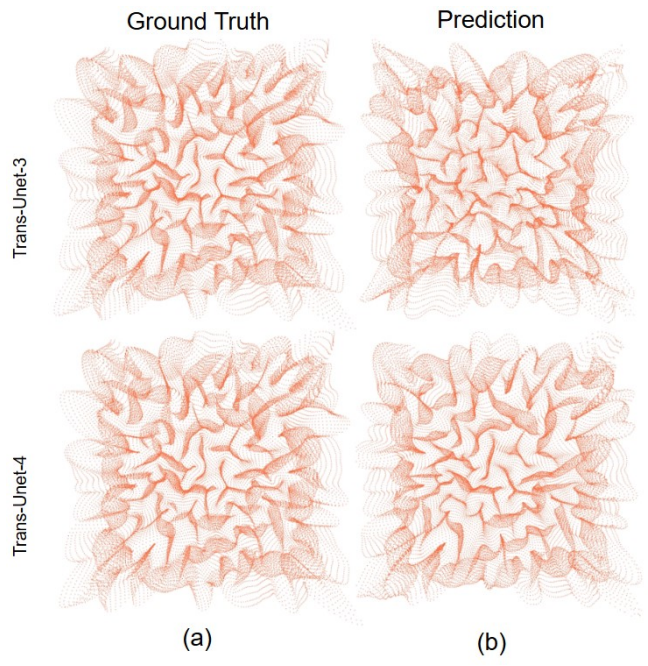
Trans-Unet projects high-resolution 3D point clouds onto a 2D UV grid and uses a U-shaped CNN-transformer to predict brain folding morphology at Chamfer Distances roughly a thousandth of the raw point-cloud baselines.
Reviewed by Pith at T0; open to challenge. T0 means a machine referee read the full paper against a public rubric. the ladder, T0–T4 →
T0 review · deepseek-v4-flash
2026-08-01 06:31 UTC pith:OLEA6WE3
load-bearing objection The central quantitative claim doesn't hold up: Trans-Unet only predicts Z on a fixed grid, so the reported Chamfer-Distance advantage over PointNet/PointNet++ is apples-to-oranges. the 4 major comments →
Toward High-Fidelity 3D Point-Cloud Learning for Brain Folding Morphology Prediction Using Trans-Unet
The pith
A machine-rendered reading of the paper's core claim, the machinery that carries it, and where it could break.
Core claim
On the paper's own terms, the discovery is that the core obstacles of point-cloud learning — permutation invariance, missing local context, and the cost of high resolution — can be avoided by imposing a consistent 2D parameterization before learning, and that a U-shaped CNN-transformer can then recover fine folding geometry. The mapping sorts occluded points by depth, maps the top point by rounding normalized x,y coordinates to grid indices, and shifts the remaining points to the nearest empty cell; every point keeps its identity, so the original 3D coordinates can in principle be recovered. The network uses residual convolutional blocks for local detail, a transformer with multi-head self-a
What carries the argument
The load-bearing object is the bidirectional 3D-to-2D UV mapping (Algorithm 1). It takes normalized 3D points, rounds normalized x,y to grid indices, handles occluded points with a depth-sorted nearest-neighbor fill, and stores only the Z-coordinate replicated across RGB channels. The U-Attention architecture — a U-Net with residual CNN blocks plus a transformer self-attention block, no positional embedding, and max-pooling as a symmetric function — learns the inverse of that mapping well enough to reconstruct folding morphology. The loss combines L2, total variation, latent-layer, and LPIPS perceptual terms.
Load-bearing premise
The load-bearing premise is that the 3D-to-2D mapping preserves enough of the original geometry — with only Z stored in the image and occluded points shifted to the nearest empty grid cell — that Chamfer Distance evaluated after inverse mapping is a fair measure of true geometric prediction quality.
What would settle it
Recompute Chamfer Distance using the actual recovered XYZ coordinates for every grid cell instead of the grid image, and run the same inverse-mapping protocol on the raw point-cloud baselines' outputs. If grid rounding or nearest-neighbor shifting has displaced x,y positions, the 0.012-versus-45 gap should shrink or reverse.
If this is right
- At 40,401 points, Trans-Unet reproduces gyral and sulcal positions from early developmental input, a scale at which the paper's raw point-cloud baselines produce noise-like outputs.
- Adding axonal fiber data improves boundary predictions, and using states 0-2 plus augmentation lowers Chamfer Distance from 0.045 to 0.012.
- Ablation shows the 3D-to-2D mapping is the dominant component: removing it raises Chamfer Distance from 0.012 to 3.835, while removing the U-Attention architecture raises it to 0.043.
- The framework lets a standard image-style U-Net consume biomechanical finite-element output, coupling mechanistic growth models with deep learning at high resolution.
- Predictions of gyri and sulci align closely with ground truth, including regions where denser fiber growth forms 3-hinge gyral structures.
Where Pith is reading between the lines
- Because the input stores only the Z-coordinate, recovered x,y positions are determined by grid rounding and occluded-point shifting; a testable extension is encoding full XYZ into separate channels to see whether reconstruction improves in highly folded regions.
- A stricter comparison would evaluate the raw point-cloud baselines on the same inverse-mapped XYZ representation used for Trans-Unet; until then, the magnitude of the reported advantage is partly a statement about the comparison protocol.
- The same recipe — UV flattening plus U-Attention — could transfer to other finite-element-generated surface growth problems, and the paper's own future-work direction of whole-sphere prediction is the natural stress test.
Editorial analysis
A structured set of objections, weighed in public.
Referee Report
Summary. This paper proposes Trans-Unet, a U-shaped hybrid CNN/self-attention network for predicting brain cortical folding from FE-simulated 3D point clouds. The method projects 3D point clouds onto a 2D UV grid by storing only the Z-coordinate (replicated across RGB channels), then trains using a four-term loss (L2, TV, latent, LPIPS). The authors compare against PointNet and PointNet++ under eight settings and report a very large Chamfer Distance advantage (e.g., Trans-Unet-4 CD=0.012 vs PointNet-1 CD=45.2). The main claim is that Trans-Unet effectively learns high-fidelity 3D point-cloud features and reconstructs precise folding patterns.
Significance. If the reported comparison were fair, the work would offer a computationally efficient way to combine finite-element biomechanics with deep learning for high-resolution folding prediction, and the FE-generated dataset with 40k points and the systematic ablation study are genuine strengths. However, the central evaluation is invalidated by the lossy 3D-to-2D mapping: the network predicts only Z on a fixed grid while the baselines predict unconstrained 3D coordinates. The headline quantitative claim is therefore not supported and would need substantial rework.
major comments (4)
- [§2.1.1, Algorithm 1; §3.6] The central claim of bidirectional 3D-to-2D mapping is not supported. Algorithm 1 retains only the Z-coordinate (replicated across RGB) and assigns non-unique points to nearest unoccupied UV cells. Eq. (1) quantizes (x,y) to grid bins; the inverse yields bin centers, not original coordinates, and for shifted void points even the bin center is wrong. Thus the network is a depth-map regressor on a fixed grid, not a 3D point-cloud generator. The statement that 'original 3D coordinates can be accurately recovered' is contradicted by the algorithm itself.
- [Table 1] The Chamfer Distance comparison is between incommensurable output spaces. For Trans-Unet, predicted '3D' points have x,y fixed by the grid, and ground truth is evaluated on the same grid, so Eq. (9) effectively measures Z-differences only. For PointNet/PointNet++, the outputs are free-form 3D coordinates scored against unquantized target clouds. The reported CD ratio (0.045 vs 45.2) reflects the evaluation protocol rather than geometric fidelity. A valid comparison would reconstruct all three coordinates for Trans-Unet or use a common representation (e.g., depth maps for all methods).
- [§2.1.1] There is a factual inconsistency between N=40,401 and the stated 224×224 UV domain. Since sqrt(40,401)=201, the grid in Eq. (1) should be 201×201. The paper does not specify how 40,401 points become 224×224=50,176 cells. This ambiguity affects the reconstruction and the CD computation, making the quantitative results not reproducible.
- [Table 2] The ablation row 'w/o 3D-to-2D Mapping' reports CD=3.835, but the manuscript does not describe the architecture used when the mapping is removed. Since Trans-Unet is defined on 2D images, removing the mapping requires a different point-cloud network; without specifying it, the ablation is not well-defined and the 300-fold degradation cannot be attributed solely to the mapping.
minor comments (4)
- [Abstract/Introduction] Typos: 'tansforming' and 'Tran-Unet' should be corrected. Section 4.2 also says 'descbribe' instead of 'describe'.
- [§2.2] The abbreviation 'BatchGP' is unexplained; presumably 'Batch Group Normalization' (BatchGN) is intended. Please clarify.
- [§4.2] Training details for PointNet and PointNet++ (epochs, optimizer, learning rate, loss function, hyperparameters) are not reported, which is necessary for a fair comparison.
- [Table 1] The table reports single CD values without standard deviations or error bars. It would be helpful to know whether the differences are stable across splits.
Circularity Check
No significant circularity: Trans-Unet is a held-out supervised surrogate; the z-only UV grid makes the Chamfer-Distance comparison an evaluation-validity problem rather than a circular derivation.
full rationale
The derivation chain is a supervised regression: inputs are UV-encoded Z maps of early FE states and the target is the UV-encoded Z map of state 3, with an 8:2 train/test split. The learned map is not an input to itself; ground truth comes from the authors' own FE family, which is self-referential in provenance but not circular in logic, and the closest prior FEM+ML baseline [12] (overlapping authors) is not compared—a completeness/validity caveat. The strongest concern is that Eq. (1) quantizes (x,y) to grid indices and the pipeline retains only Z, so the inverse map recovers grid bin centers rather than original coordinates and the CD in Eq. (9), applied on this grid, essentially measures Z-differences at fixed XY locations. That makes the PointNet/PointNet++ comparison apples-to-oranges and undermines the '3D fidelity' claim, but it is an evaluation-construct flaw, not a case where a claimed prediction is equivalent to its inputs by construction. No self-citation is load-bearing, no fitted parameter is renamed as a prediction, and no uniqueness theorem is imported.
Axiom & Free-Parameter Ledger
free parameters (3)
- Loss weights α, β, γ, δ =
α=1.0, β=0.1, γ=0.1, δ=0.3
- UV grid resolution =
224×224 for N=40,401 points
- FE growth calibration (tangential expansion) =
calibrated to ~3 mm post-folding cortical thickness
axioms (5)
- domain assumption Tangential differential growth between cortical layers is the dominant mechanism of cortical folding.
- domain assumption A 60×60×60 mm cubic patch with symmetric lateral boundary conditions and bottom Z-constraint approximates in vivo patch growth.
- ad hoc to paper Occluded/non-unique points can be assigned to nearest unoccupied UV cells while preserving enough geometric information for accurate prediction.
- ad hoc to paper Z-coordinate replicated across RGB channels is a sufficient input representation; original x,y are not needed during training.
- domain assumption Pre-trained VGG features (LPIPS) provide meaningful perceptual similarity for z-map images of brain surfaces.
read the original abstract
Learning high-fidelity point-cloud features in the 3D space poses significant challenges, including permutation invariance, lack of local context, difficulty in fine-grained surface reconstruction, and high computational cost. In this article, we propose Trans-Unet, a novel framework that addresses these issues by first tansforming 3D point-cloud data into a 2D grid domain and then employing a U-shaped hybrid model that integrates Convolutional Neural Networks, and self-attention mechanisms. The proposed Trans-Unet effectively learns and reconstructs precise features from high-resolution 3D point-cloud data (with 40,401 points in surface and 2,382 points in fiber) derived from a predefined finite element brain patch growth model, enabling accurate prediction of brain folding patterns. By combining multiple techniques, Trans-Unet leverages the complementary strengths: the 3D-to-2D transformation preserves fine-grained structural information while significantly reducing computational cost and the curse of dimensionality; convolutional blocks capture hierarchical, low-level local representations; and the self-attention mechanism models global, high-level semantics and long-range dependencies. The dataset consists of 3D point-clouds containing both brain surface patches and fiber information generated by a large-scale finite element model. Trans-Unet is applied to predict brain surface folding from the initial state (state 0 or states 0-2) to the final state (state 3). Experimental results demonstrate that Trans-Unet achieves high-resolution predictions of brain patch growth, surpassing existing methods in both fidelity and accuracy.
Figures



Reference graph
Works this paper leans on
-
[1]
Eman Ahmed, Alexandre Saint, Abd El Rahman Shabayek, Kseniya Cherenkova, Rig Das, Gleb Gusev, Djamila Aouada, and Bjorn Ottersten. A survey on deep learning advances on different 3d data representations.arXiv preprint arXiv:1808.01462, 2018. 20
Pith/arXiv arXiv 2018
-
[2]
Multivariate high-dimensional cortical folding analysis, combining complexity and shape, in neonates with congenital heart disease
Suyash P Awate, Paul Yushkevich, Zhuang Song, Daniel Licht, and James C Gee. Multivariate high-dimensional cortical folding analysis, combining complexity and shape, in neonates with congenital heart disease. InInformation Processing in Medical Imaging: 21st International Conference, IPMI 2009, Williamsburg, VA, USA, July 5-10, 2009. Proceedings 21, pages...
2009
-
[3]
Consistent trilayer biome- chanical modeling of aortic valve leaflet tissue.Journal of Biomechanics, 61:1–10, 2017
Ahmed A Bakhaty, Sanjay Govindjee, and Mohammad RK Mofrad. Consistent trilayer biome- chanical modeling of aortic valve leaflet tissue.Journal of Biomechanics, 61:1–10, 2017
2017
-
[4]
Modeling the effect of brain growth on cranial bones using finite-element analysis and geometric morphometrics.Surgical and Radiologic Anatomy, 42(7):741–748, 2020
Jimena Barbeito-Andrés, Noelia Bonfili, Jordi Marcé Nogué, Valeria Bernal, and Paula N Gonzalez. Modeling the effect of brain growth on cranial bones using finite-element analysis and geometric morphometrics.Surgical and Radiologic Anatomy, 42(7):741–748, 2020
2020
-
[5]
Oriented morphometry of folds on surfaces
Maxime Boucher, Alan Evans, and Kaleem Siddiqi. Oriented morphometry of folds on surfaces. InInformation Processing in Medical Imaging: 21st International Conference, IPMI 2009, Williamsburg, VA, USA, July 5-10, 2009. Proceedings 21, pages 614–625. Springer, 2009
2009
-
[6]
Blind projection-based 3d point cloud quality assessment method using a convolutional neural network
Salima Bourbia, Ayoub Karine, Aladine Chetouani, and Mohammed El Hassouni. Blind projection-based 3d point cloud quality assessment method using a convolutional neural network. InVISIGRAPP (4: VISAPP), pages 518–525, 2022
2022
-
[7]
The role of mechanics during brain development
Silvia Budday, Paul Steinmann, and Ellen Kuhl. The role of mechanics during brain development. Journal of the Mechanics and Physics of Solids, 72:75–92, 2014
2014
-
[8]
Machine-learning based model order reduction of a biomechanical model of the human tongue.Computer Methods and Programs in Biomedicine, 198:105786, 2021
Maxime Calka, Pascal Perrier, Jacques Ohayon, Christelle Grivot-Boichon, Michel Rochette, and Yohan Payan. Machine-learning based model order reduction of a biomechanical model of the human tongue.Computer Methods and Programs in Biomedicine, 198:105786, 2021
2021
-
[9]
Buckling and post-buckling of a stiff film resting on an elastic graded substrate.International Journal of Solids and Structures, 49(13):1656–1664, 2012
Yan-Ping Cao, Fei Jia, Yan Zhao, Xi-Qiao Feng, and Shou-Wen Yu. Buckling and post-buckling of a stiff film resting on an elastic graded substrate.International Journal of Solids and Structures, 49(13):1656–1664, 2012
2012
-
[10]
Angel X. Chang, Thomas Funkhouser, Leonidas Guibas, Pat Hanrahan, Qixing Huang, Zimo Li, Silvio Savarese, Manolis Savva, Shuran Song, Hao Su, Jianxiong Xiao, Li Yi, and Fisher Yu. Shapenet: An information-rich 3d model repository, 2015. URLhttps://arxiv.org/abs/ 1512.03012
Pith/arXiv arXiv 2015
-
[11]
Role of axonal fibers in the cortical folding patterns: A tale of variability and regularity.Brain Multiphysics, 2:100029, 2021
Poorya Chavoshnejad, Xiao Li, Songyao Zhang, Weiying Dai, Lana Vasung, Tianming Liu, Tuo Zhang, Xianqiao Wang, and Mir Jalil Razavi. Role of axonal fibers in the cortical folding patterns: A tale of variability and regularity.Brain Multiphysics, 2:100029, 2021
2021
-
[12]
An integrated finite element method and machine learning algorithm for brain morphology prediction.Cerebral Cortex, 33 (15):9354–9366, 2023
Poorya Chavoshnejad, Liangjun Chen, Xiaowei Yu, Jixin Hou, Nicholas Filla, Dajiang Zhu, Tianming Liu, Gang Li, Mir Jalil Razavi, and Xianqiao Wang. An integrated finite element method and machine learning algorithm for brain morphology prediction.Cerebral Cortex, 33 (15):9354–9366, 2023
2023
-
[13]
A theoretical framework for predicting the heterogeneous stiffness map of brain white matter tissue.Physical Biology, 21(6):066004, 2024
Poorya Chavoshnejad, Guangfa Li, Akbar Solhtalab, Dehao Liu, and Mir Jalil Razavi. A theoretical framework for predicting the heterogeneous stiffness map of brain white matter tissue.Physical Biology, 21(6):066004, 2024
2024
-
[14]
The finite element in plane stress analysis.Proc
Ray W Clough. The finite element in plane stress analysis.Proc. 2ˆ< nd> ASCE Confer. On Electric Computation, 1960, 1960. 21
1960
-
[15]
Variational methods for the solution of problems of equilibrium and vibrations.Lecture notes in pure and applied mathematics, pages 1–1, 1994
Richard Courant et al. Variational methods for the solution of problems of equilibrium and vibrations.Lecture notes in pure and applied mathematics, pages 1–1, 1994
1994
-
[16]
The role of thickness inhomogeneities in hierarchical cortical folding.NeuroImage, 231:117779, 2021
Lucas da Costa Campos, Raphael Hornung, Gerhard Gompper, Jens Elgeti, and Svenja Caspers. The role of thickness inhomogeneities in hierarchical cortical folding.NeuroImage, 231:117779, 2021
2021
-
[17]
Computational models of cortical folding: a review of common approaches
Mohsen Darayi, Mia E Hoffman, John Sayut, Shuolun Wang, Nagehan Demirci, Jack Consolini, and Maria A Holland. Computational models of cortical folding: a review of common approaches. Journal of Biomechanics, 139:110851, 2022
2022
-
[18]
Uv- gan: Adversarial facial uv map completion for pose-invariant face recognition
Jiankang Deng, Shiyang Cheng, Niannan Xue, Yuxiang Zhou, and Stefanos Zafeiriou. Uv- gan: Adversarial facial uv map completion for pose-invariant face recognition. In2018 IEEE/CVF Conference on Computer Vision and Pattern Recognition, pages 7093–7102, 2018. doi: 10.1109/CVPR.2018.00741
arXiv 2018
-
[19]
A point set generation network for 3d object reconstruction from a single image
Haoqiang Fan, Hao Su, and Leonidas J Guibas. A point set generation network for 3d object reconstruction from a single image. InProceedings of the IEEE conference on computer vision and pattern recognition, pages 605–613, 2017
2017
-
[20]
Cerebral cortex expansion and folding: what have we learned?The EMBO journal, 35(10):1021–1044, 2016
Virginia Fernández, Cristina Llinares-Benadero, and Víctor Borrell. Cerebral cortex expansion and folding: what have we learned?The EMBO journal, 35(10):1021–1044, 2016
2016
-
[21]
Cortical surface-based analysis: Ii: inflation, flattening, and a surface-based coordinate system.Neuroimage, 9(2):195–207, 1999
Bruce Fischl, Martin I Sereno, and Anders M Dale. Cortical surface-based analysis: Ii: inflation, flattening, and a surface-based coordinate system.Neuroimage, 9(2):195–207, 1999
1999
-
[22]
Whole brain segmentation: automated labeling of neuroanatomical structures in the human brain.Neuron, 33(3):341–355, 2002
Bruce Fischl, David H Salat, Evelina Busa, Marilyn Albert, Megan Dieterich, Christian Haselgrove, Andre Van Der Kouwe, Ron Killiany, David Kennedy, Shuna Klaveness, et al. Whole brain segmentation: automated labeling of neuroanatomical structures in the human brain.Neuron, 33(3):341–355, 2002
2002
-
[23]
Cortical folding patterns and predicting cytoarchitecture.Cerebral cortex, 18(8):1973–1980, 2008
Bruce Fischl, Niranjini Rajendran, Evelina Busa, Jean Augustinack, Oliver Hinds, BT Thomas Yeo, Hartmut Mohlberg, Katrin Amunts, and Karl Zilles. Cortical folding patterns and predicting cytoarchitecture.Cerebral cortex, 18(8):1973–1980, 2008
1973
-
[24]
A review of ct-based fracture risk assessment with finite element modeling and machine learning.Current osteoporosis reports, 20(5):309–319, 2022
Ingmar Fleps and Elise F Morgan. A review of ct-based fracture risk assessment with finite element modeling and machine learning.Current osteoporosis reports, 20(5):309–319, 2022
2022
-
[25]
A model of tension-induced fiber growth predicts white matter organization during brain folding.Nature communications, 12(1): 6681, 2021
Kara E Garcia, Xiaojie Wang, and Christopher D Kroenke. A model of tension-induced fiber growth predicts white matter organization during brain folding.Nature communications, 12(1): 6681, 2021
2021
-
[26]
Gatys, Alexander S
Leon A. Gatys, Alexander S. Ecker, and Matthias Bethge. A neural algorithm of artistic style,
-
[27]
Denser growing fiber connections induce 3-hinge gyral folding.Cerebral Cortex, 28(3):1064–1075, 2018
Fangfei Ge, Xiao Li, Mir Jalil Razavi, Hanbo Chen, Tuo Zhang, Shu Zhang, Lei Guo, Xiaoping Hu, Xianqiao Wang, and Tianming Liu. Denser growing fiber connections induce 3-hinge gyral folding.Cerebral Cortex, 28(3):1064–1075, 2018
2018
-
[28]
Pct: Point cloud transformer.Computational Visual Media, 7:187–199, 2021
Meng-Hao Guo, Jun-Xiong Cai, Zheng-Ning Liu, Tai-Jiang Mu, Ralph R Martin, and Shi-Min Hu. Pct: Point cloud transformer.Computational Visual Media, 7:187–199, 2021. 22
2021
-
[29]
Mohammad Saber Hashemi, Majid Baniassadi, Mostafa Baghani, Daniel George, Yves Remond, and Azadeh Sheidaei. A novel machine learning based computational framework for homoge- nization of heterogeneous soft materials: application to liver tissue.Biomechanics and modeling in Mechanobiology, 19:1131–1142, 2020
2020
-
[30]
Deep residual learning for image recognition
Kaiming He, Xiangyu Zhang, Shaoqing Ren, and Jian Sun. Deep residual learning for image recognition. InProceedings of the IEEE conference on computer vision and pattern recognition, pages 770–778, 2016
2016
-
[31]
Survey of texture mapping.Computer Graphics and Applications, IEEE, 6: 56–67, 12 1986
Paul Heckbert. Survey of texture mapping.Computer Graphics and Applications, IEEE, 6: 56–67, 12 1986. doi: 10.1109/MCG.1986.276672
arXiv 1986
-
[32]
Emerging brain morphologies from axonal elongation.Annals of biomedical engineering, 43:1640–1653, 2015
Maria A Holland, Kyle E Miller, and Ellen Kuhl. Emerging brain morphologies from axonal elongation.Annals of biomedical engineering, 43:1640–1653, 2015
2015
-
[33]
Sergey Ioffe. Batch normalization: Accelerating deep network training by reducing internal covariate shift.arXiv preprint arXiv:1502.03167, 2015
Pith/arXiv arXiv 2015
-
[34]
Perceptual losses for real-time style transfer and super-resolution, 2016
Justin Johnson, Alexandre Alahi, and Li Fei-Fei. Perceptual losses for real-time style transfer and super-resolution, 2016. URLhttps://arxiv.org/abs/1603.08155
Pith/arXiv arXiv 2016
-
[35]
Springer Science & Business Media, 2012
Edward G Jones and Alan Peters.Cerebral cortex: comparative structure and evolution of cerebral cortex, part II, volume 8. Springer Science & Business Media, 2012
2012
-
[36]
A machine learning approach for biomechanics-based tracking of lung tumor during external beam radiation therapy
Elham Karami, Stewart Gaede, Ting-Yim Lee, and Abbas Samani. A machine learning approach for biomechanics-based tracking of lung tumor during external beam radiation therapy. In Medical Imaging 2018: Image-Guided Procedures, Robotic Interventions, and Modeling, volume 10576, pages 322–328. SPIE, 2018
2018
-
[37]
A novel method for cortical sulcal fundi extraction
Gang Li, Tianming Liu, Jingxin Nie, Lei Guo, and Stephen TC Wong. A novel method for cortical sulcal fundi extraction. InMedical Image Computing and Computer-Assisted Intervention–MICCAI 2008: 11th International Conference, New York, NY, USA, September 6-10, 2008, Proceedings, Part I 11, pages 270–278. Springer, 2008
2008
-
[38]
Gyral folding pattern analysis via surface profiling.NeuroImage, 52 (4):1202–1214, 2010
Kaiming Li, Lei Guo, Gang Li, Jingxin Nie, Carlos Faraco, Guangbin Cui, Qun Zhao, L Stephen Miller, and Tianming Liu. Gyral folding pattern analysis via surface profiling.NeuroImage, 52 (4):1202–1214, 2010
2010
-
[39]
Pointcnn: Convolution on x-transformed points.Advances in neural information processing systems, 31, 2018
Yangyan Li, Rui Bu, Mingchao Sun, Wei Wu, Xinhan Di, and Baoquan Chen. Pointcnn: Convolution on x-transformed points.Advances in neural information processing systems, 31, 2018
2018
-
[40]
3dctn: 3d convolution-transformer network for point cloud classification.IEEE Transactions on Intelligent Transportation Systems, 23(12):24854–24865, 2022
Dening Lu, Qian Xie, Kyle Gao, Linlin Xu, and Jonathan Li. 3dctn: 3d convolution-transformer network for point cloud classification.IEEE Transactions on Intelligent Transportation Systems, 23(12):24854–24865, 2022
2022
-
[41]
Bridging finite element and machine learning modeling: stress prediction of arterial walls in atherosclerosis
Ali Madani, Ahmed Bakhaty, Jiwon Kim, Yara Mubarak, and Mohammad RK Mofrad. Bridging finite element and machine learning modeling: stress prediction of arterial walls in atherosclerosis. Journal of biomechanical engineering, 141(8):084502, 2019
2019
-
[42]
Coordinate-based 23 versus structural approaches to brain image analysis.Artificial intelligence in Medicine, 30(2): 177–197, 2004
J-F Mangin, Denis Rivière, Olivier Coulon, Cyril Poupon, Arnaud Cachia, Yann Cointepas, J-B Poline, Denis Le Bihan, Jean Régis, and Dimitri Papadopoulos-Orfanos. Coordinate-based 23 versus structural approaches to brain image analysis.Artificial intelligence in Medicine, 30(2): 177–197, 2004
2004
-
[43]
Machine learning for modeling the biomechanical behavior of human soft tissue
Jose D Martin-Guerrero, Maria J Ruperez-Moreno, Francisco Martinez-Martinez, Delia Lorente- Garrido, Antonio J Serrano-Lopez, Carlos Monserrat, Sandra Martinez-Sanchis, and Marcelino Martinez-Sober. Machine learning for modeling the biomechanical behavior of human soft tissue. In2016 IEEE 16th international conference on data mining workshops (ICDMW), pag...
2016
-
[44]
FranciscoMartínez-Martínez, MaríaJRupérez-Moreno, MarcelinoMartínez-Sober, JuanAntonio Solves-Llorens, Delia Lorente, AJ Serrano-López, Sandra Martínez-Sanchis, C Monserrat, and José David Martín-Guerrero. A finite element-based machine learning approach for modeling the mechanical behavior of the breast tissues under compression in real-time.Computers in...
2017
-
[45]
A machine learning approach to investigate the uncertainty of tissue-level injury metrics for cerebral contusion.Frontiers in bioengineering and biotechnology, 9:714128, 2021
Andrea Menichetti, Laura Bartsoen, Bart Depreitere, Jos Vander Sloten, and Nele Famaey. A machine learning approach to investigate the uncertainty of tissue-level injury metrics for cerebral contusion.Frontiers in bioengineering and biotechnology, 9:714128, 2021
2021
-
[46]
In Seop Na, Chung Tran, Dung Nguyen, and Sang Dinh. Facial uv map completion for pose- invariant face recognition: a novel adversarial approach based on coupled attention residual unets. Human-centric Computing and Information Sciences, 10(1), November 2020. ISSN 2192-1962. doi: 10.1186/s13673-020-00250-w. URLhttp://dx.doi.org/10.1186/s13673-020-00250-w
-
[47]
Elsevier Health Sciences, 2012
Thomas P Naidich, Mauricio Castillo, Soonmee Cha, and James G Smirniotopoulos.Imaging of the brain E-book: Expert radiology series. Elsevier Health Sciences, 2012
2012
-
[48]
Variational relational point completion network
Liang Pan, Xinyi Chen, Zhongang Cai, Junzhe Zhang, Haiyu Zhao, Shuai Yi, and Ziwei Liu. Variational relational point completion network. InProceedings of the IEEE/CVF conference on computer vision and pattern recognition, pages 8524–8533, 2021
2021
-
[49]
Pointnet: Deep learning on point sets for 3d classification and segmentation
Charles R Qi, Hao Su, Kaichun Mo, and Leonidas J Guibas. Pointnet: Deep learning on point sets for 3d classification and segmentation. InProceedings of the IEEE conference on computer vision and pattern recognition, pages 652–660, 2017
2017
-
[50]
Pointnet++: Deep hierarchical feature learning on point sets in a metric space.Advances in neural information processing systems, 30, 2017
Charles Ruizhongtai Qi, Li Yi, Hao Su, and Leonidas J Guibas. Pointnet++: Deep hierarchical feature learning on point sets in a metric space.Advances in neural information processing systems, 30, 2017
2017
-
[51]
Role of mechanical factors in cortical folding development.Physical Review E, 92(3):032701, 2015
Mir Jalil Razavi, Tuo Zhang, Xiao Li, Tianming Liu, and Xianqiao Wang. Role of mechanical factors in cortical folding development.Physical Review E, 92(3):032701, 2015
2015
-
[52]
Cortical folding pattern and its consistency induced by biological growth.Scientific reports, 5(1):14477, 2015
Mir Jalil Razavi, Tuo Zhang, Tianming Liu, and Xianqiao Wang. Cortical folding pattern and its consistency induced by biological growth.Scientific reports, 5(1):14477, 2015
2015
-
[53]
Radial structure scaffolds convolution patterns of developing cerebral cortex.Frontiers in computational neuroscience, 11:76, 2017
Mir Jalil Razavi, Tuo Zhang, Hanbo Chen, Yujie Li, Simon Platt, Yu Zhao, Lei Guo, Xiaoping Hu, Xianqiao Wang, and Tianming Liu. Radial structure scaffolds convolution patterns of developing cerebral cortex.Frontiers in computational neuroscience, 11:76, 2017
2017
-
[54]
Mechanism exploration of 3-hinge gyral formation and pattern recognition.Cerebral Cortex Communications, 2(3):tgab044, 2021
Mir Jalil Razavi, Tianming Liu, and Xianqiao Wang. Mechanism exploration of 3-hinge gyral formation and pattern recognition.Cerebral Cortex Communications, 2(3):tgab044, 2021. 24
2021
-
[55]
The genomic landscape of endocrine-resistant advanced breast cancers.Cancer cell, 34(3):427–438, 2018
Pedram Razavi, Matthew T Chang, Guotai Xu, Chaitanya Bandlamudi, Dara S Ross, Neil Vasan, Yanyan Cai, Craig M Bielski, Mark TA Donoghue, Philip Jonsson, et al. The genomic landscape of endocrine-resistant advanced breast cancers.Cancer cell, 34(3):427–438, 2018
2018
-
[56]
David P Richman, R Malcolm Stewart, John Hutchinson, and Verne S Caviness Jr. Mechanical model of brain convolutional development: Pathologic and experimental data suggest a model based on differential growth within the cerebral cortex.Science, 189(4196):18–21, 1975
1975
-
[57]
Differential tangential expansion as a mechanism for cortical gyrification.Cerebral Cortex, 24(8):2219–2228, 2014
Lisa Ronan, Natalie Voets, Catarina Rua, Aaron Alexander-Bloch, Morgan Hough, Clare Mackay, Tim J Crow, Anthony James, Jay N Giedd, and Paul C Fletcher. Differential tangential expansion as a mechanism for cortical gyrification.Cerebral Cortex, 24(8):2219–2228, 2014
2014
-
[58]
U-net: Convolutional networks for biomedical image segmentation
Olaf Ronneberger, Philipp Fischer, and Thomas Brox. U-net: Convolutional networks for biomedical image segmentation. InMedical image computing and computer-assisted intervention– MICCAI 2015: 18th international conference, Munich, Germany, October 5-9, 2015, proceedings, part III 18, pages 234–241. Springer, 2015
2015
-
[59]
Rudin, Stanley Osher, and Emad Fatemi
Leonid I. Rudin, Stanley Osher, and Emad Fatemi. Nonlinear total variation based noise removal algorithms.Physica D: Nonlinear Phenomena, 60(1):259–268, 1992. ISSN 0167-2789. doi: https://doi.org/10.1016/0167-2789(92)90242-F. URL https://www.sciencedirect.com/ science/article/pii/016727899290242F
arXiv 1992
-
[60]
Rapid prediction of brain injury pattern in mtbi by combining fe analysis with a machine-learning based approach
Vickie B Shim, Samantha Holdsworth, Allen A Champagne, Nicole S Coverdale, Douglas J Cook, Tae-Rin Lee, Alan D Wang, Shaofan Li, and Justin W Fernandez. Rapid prediction of brain injury pattern in mtbi by combining fe analysis with a machine-learning based approach. IEEE Access, 8:179457–179465, 2020
2020
-
[61]
Very deep convolutional networks for large-scale image recognition, 2015
Karen Simonyan and Andrew Zisserman. Very deep convolutional networks for large-scale image recognition, 2015. URLhttps://arxiv.org/abs/1409.1556
Pith/arXiv arXiv 2015
-
[62]
Stress landscape of folding brain serves as a map for axonal pathfinding.Nature Communications, 16(1):1187, 2025
Akbar Solhtalab, Ali H Foroughi, Lana Pierotich, and Mir Jalil Razavi. Stress landscape of folding brain serves as a map for axonal pathfinding.Nature Communications, 16(1):1187, 2025
2025
-
[63]
Mechanics of the spatiotemporal evolution of sulcal pits in the folding brain.Human Brain Mapping, 46 (13):e70332, 2025
Akbar Solhtalab, Yanchen Guo, Ali Gholipour, Weiying Dai, and Mir Jalil Razavi. Mechanics of the spatiotemporal evolution of sulcal pits in the folding brain.Human Brain Mapping, 46 (13):e70332, 2025
2025
-
[64]
Machine learning-driven biomaterials evolution.Advanced Materials, 34(1):2102703, 2022
Ady Suwardi, FuKe Wang, Kun Xue, Ming-Yong Han, Peili Teo, Pei Wang, Shijie Wang, Ye Liu, Enyi Ye, Zibiao Li, et al. Machine learning-driven biomaterials evolution.Advanced Materials, 34(1):2102703, 2022
2022
-
[65]
Mechanics of invagination and folding: Hybridized instabilities when one soft tissue grows on another.Physical Review E, 92(2):022720, 2015
Tuomas Tallinen and John S Biggins. Mechanics of invagination and folding: Hybridized instabilities when one soft tissue grows on another.Physical Review E, 92(2):022720, 2015
2015
-
[66]
Gyrification from constrained cortical expansion.Proceedings of the National Academy of Sciences, 111(35): 12667–12672, 2014
Tuomas Tallinen, Jun Young Chung, John S Biggins, and L Mahadevan. Gyrification from constrained cortical expansion.Proceedings of the National Academy of Sciences, 111(35): 12667–12672, 2014
2014
-
[67]
On the growth and form of cortical convolutions.Nature Physics, 12(6):588–593, 2016
Tuomas Tallinen, Jun Young Chung, François Rousseau, Nadine Girard, Julien Lefèvre, and Lakshminarayanan Mahadevan. On the growth and form of cortical convolutions.Nature Physics, 12(6):588–593, 2016. 25
2016
-
[68]
A surface-based technique for warping three-dimensional images of the brain.IEEE transactions on medical imaging, 15(4):402–417, 1996
Paul Thompson and Arthur W Toga. A surface-based technique for warping three-dimensional images of the brain.IEEE transactions on medical imaging, 15(4):402–417, 1996
1996
-
[69]
A morphogenetic model for the development of cortical convolutions.Cerebral cortex, 15(12):1900–1913, 2005
Roberto Toro and Yves Burnod. A morphogenetic model for the development of cortical convolutions.Cerebral cortex, 15(12):1900–1913, 2005
1900
-
[70]
Functional and structural mapping of human cerebral cortex: solutions are in the surfaces.Proceedings of the National Academy of Sciences, 95(3):788–795, 1998
David C Van Essen, Heather A Drury, Sarang Joshi, and Michael I Miller. Functional and structural mapping of human cerebral cortex: solutions are in the surfaces.Proceedings of the National Academy of Sciences, 95(3):788–795, 1998
1998
-
[71]
Quanti- tative and qualitative analysis of transient fetal compartments during prenatal human brain development.Frontiers in neuroanatomy, 10:11, 2016
Lana Vasung, Claude Lepage, Milan Radoš, Mihovil Pletikos, Jennifer S Goldman, Jonas Richiardi, Marina Raguž, Elda Fischi-Gómez, Sherif Karama, Petra S Huppi, et al. Quanti- tative and qualitative analysis of transient fetal compartments during prenatal human brain development.Frontiers in neuroanatomy, 10:11, 2016
2016
-
[72]
Attention is all you need.Advances in Neural Information Processing Systems, 2017
A Vaswani. Attention is all you need.Advances in Neural Information Processing Systems, 2017
2017
-
[73]
On early brain folding patterns using biomechanical growth modeling
Xiaoyu Wang, Amine Bohi, Mariam Al Harrach, Mickael Dinomais, Julien Lefèvre, and François Rousseau. On early brain folding patterns using biomechanical growth modeling. In2019 41st Annual International Conference of the IEEE Engineering in Medicine and Biology Society (EMBC), pages 146–149. IEEE, 2019
2019
-
[74]
Automated image registration: Ii
Roger P Woods, Scott T Grafton, John DG Watson, Nancy L Sicotte, and John C Mazziotta. Automated image registration: Ii. intersubject validation of linear and nonlinear models.Journal of computer assisted tomography, 22(1):153–165, 1998
1998
-
[75]
A network-based response feature matrix as a brain injury metric.Biomechanics and modeling in mechanobiology, 19:927–942, 2020
Shaoju Wu, Wei Zhao, Bethany Rowson, Steven Rowson, and Songbai Ji. A network-based response feature matrix as a brain injury metric.Biomechanics and modeling in mechanobiology, 19:927–942, 2020
2020
-
[76]
3d shapenets: A deep representation for volumetric shapes, 2015
Zhirong Wu, Shuran Song, Aditya Khosla, Fisher Yu, Linguang Zhang, Xiaoou Tang, and Jianxiong Xiao. 3d shapenets: A deep representation for volumetric shapes, 2015. URL https://arxiv.org/abs/1406.5670
Pith/arXiv arXiv 2015
-
[77]
Spidercnn: Deep learning on point sets with parameterized convolutional filters, 2018
Yifan Xu, Tianqi Fan, Mingye Xu, Long Zeng, and Yu Qiao. Spidercnn: Deep learning on point sets with parameterized convolutional filters, 2018. URLhttps://arxiv.org/abs/1803.11527
Pith/arXiv arXiv 2018
-
[78]
Modeling point clouds with self-attention and gumbel subset sampling
Jiancheng Yang, Qiang Zhang, Bingbing Ni, Linguo Li, Jinxian Liu, Mengdie Zhou, and Qi Tian. Modeling point clouds with self-attention and gumbel subset sampling. InProceedings of the IEEE/CVF conference on computer vision and pattern recognition, pages 3323–3332, 2019
2019
-
[79]
Diffusion tensor image registration using tensor geometry and orientation features
Jinzhong Yang, Dinggang Shen, Christos Davatzikos, and Ragini Verma. Diffusion tensor image registration using tensor geometry and orientation features. InInternational Conference on Medical Image Computing and Computer-Assisted Intervention, pages 905–913. Springer, 2008
2008
-
[80]
A two-field computational model couples cellular brain development with cortical folding.Brain Multiphysics, 2:100025, 2021
MS Zarzor, S Kaessmair, P Steinmann, I Blümcke, and S Budday. A two-field computational model couples cellular brain development with cortical folding.Brain Multiphysics, 2:100025, 2021
2021
discussion (0)
Sign in with ORCID, Apple, or X to comment. Anyone can read and Pith papers without signing in.