REVIEW 3 major objections 4 minor 1 cited by
A spinless spherical body in vacuum general relativity follows geodesics up to quadrupole order, but at hexadecapole order Weyl curvature drives it off geodesics.
Reviewed by Pith at T0; open to challenge. T0 means a machine referee read the full paper against a public rubric. the ladder, T0–T4 →
T0 review · deepseek-v4-flash
2026-08-01 04:58 UTC pith:L7AQZYRJ
load-bearing objection New hexadecapole result undermined by an unproved spinless-consistency argument; quadrupole part is solid. the 3 major comments →
When does a sphere fall like a point particle? Quadrupole universality and Weyl-driven hexadecapole deviations in vacuum general relativity
The pith
A machine-rendered reading of the paper's core claim, the machinery that carries it, and where it could break.
Core claim
The central claim is that spherical symmetry protects geodesic motion in vacuum general relativity only up to the quadrupole level: a spinless O(3)-symmetric test body, defined by invariance in the Tulczyjew-Dixon rest space, has a vanishing torque vector and a force built purely from Ricci contractions at quadrupole order, forcing geodesic motion when Rμν = 0. The octupole vanishes identically, but at hexadecapole order the torque vector still vanishes (so spinless motion stays consistent) while the force contains Riemann-squared terms that reduce to Weyl couplings in vacuum. Schwarzschild spacetime realizes this explicitly: the hexadecapole force has a nonzero radial component Fr ~ (8Jm −
What carries the argument
The calculations use Dixon's covariant multipole formalism for extended test bodies, with the Tulczyjew-Dixon spin supplementary condition fixing the center-of-mass worldline and an M-transported tetrad defining 'spherical' as O(3) invariance in the momentum rest space. The multipole moments are Riemann-type tensors; spherical symmetry reduces the quadrupole to two scalars (jm, js) and the hexadecapole to two scalars (Jm, Js), and the force and torque are expressed through tensor-extension identities for the metric. The key structural objects are the hexadecapole force formula—containing ∇∇R and R² terms—and the Melnikov function, which diagnoses separatrix splitting near the unstable circul
Load-bearing premise
The central claim assumes that a spinless body stays spinless at hexadecapole order—the paper verifies only that the torque vector (a projection of the full torque tensor) vanishes, not the full condition needed to keep the spin tensor exactly zero.
What would settle it
Compute the full hexadecapole torque tensor Nμν for the O(3)-symmetric body in Schwarzschild and check whether it equals −2p[μvν]; if it does not, the spin tensor cannot remain exactly zero and the 'spinless sector' dynamics used here is inconsistent, undermining the hexadecapole force, infall correction, and chaos claims. Alternatively, a direct numerical integration of the exact Dixon equations with spherical hexadecapole moments would settle whether the predicted nongeodesic drift appears.
If this is right
- In any Ricci-flat spacetime, a spinless spherical body's worldline is geodesic to quadrupole order regardless of the background's symmetries.
- Vacuum point-particle universality fails at hexadecapole order; the force is generically nonzero in vacuum, so internal structure can influence orbits in strong-field regions.
- In Schwarzschild, the leading correction to the infall proper time has a sign fixed by h = (4/15)(8Jm − 21Js), so simple matter (P ≪ ρ) falls slightly slower than a point particle.
- Time-dependent hexadecapole moments act as a periodic drive; Melnikov's criterion predicts transverse homoclinic splitting and chaotic layers for almost all driving frequencies.
- The torque vector vanishes at both quadrupole and hexadecapole order, which the paper interprets as dynamical consistency of the spinless sector at these orders.
Where Pith is reading between the lines
- If correct, extreme-mass-ratio inspirals in vacuum black-hole spacetimes could carry a weak, high-order imprint of a body's hexadecapole structure, potentially offering a way to constrain internal moment data from gravitational waves.
- The mechanism may extend beyond Schwarzschild: in Kerr spacetime the same Riemann-squared couplings would source Weyl-driven forces that depend on the background rotation, giving a new spin-dependent finite-size term for spherical bodies.
- The paper leaves open whether backreaction or the choice of centroid worldline reshuffles the hexadecapole force among multipole orders; a complementary calculation in another centroid convention could map how robust the nongeodesic effect is.
- The chaotic layer is local and transient near the separatrix; a natural follow-up is to estimate the lifetime of the homoclinic tangle before a trajectory plunges or scatters.
Editorial analysis
A structured set of objections, weighed in public.
Referee Report
Summary. The paper asks whether a spinless, spherically symmetric extended test body in vacuum general relativity follows a geodesic. Using Dixon's covariant multipole formalism, with spherical symmetry defined by O(3) invariance in the Tulczyjew-Dixon momentum rest space, the authors claim that at quadrupole order the force and torque vanish in any Ricci-flat spacetime, the octupole is forbidden by symmetry, and at hexadecapole order the torque vector still vanishes while the force generically becomes nonzero in vacuum through curvature-squared (Weyl) couplings. Two applications are given in Schwarzschild spacetime: a proper-time correction for radial infall and a Melnikov analysis showing chaotic layers for pulsating hexadecapole moments near the unstable circular orbit.
Significance. If the central claim is correct, the paper resolves an interesting structural question: spherical symmetry in vacuum GR protects geodesic motion only through quadrupole order, with the first deviation at n=4. The explicit algebraic formulas for the hexadecapole force and torque, Eqs. (46)-(47), are stated to be checked with Mathematica, and the Schwarzschild applications give concrete, falsifiable predictions (proper-time shift, homoclinic splitting). The authors also correctly stress the test-body, finite-multipole regime. However, the dynamical consistency of the spinless sector is not established: the paper infers consistency from vanishing of the torque vector N^μ, which is insufficient. Since this premise underlies the abstract and both applications, the result is not yet acceptable as stated.
major comments (3)
- The claim that the spinless sector remains dynamically consistent at hexadecapole order is a non-sequitur. With S^μν=0, Eq. (14) requires 0 = 2p^[μ v^ν] + N^μν, i.e. the full antisymmetric tensor N^μν must equal -2p^[μ v^ν] for some timelike v^μ. The paper only shows that the torque vector N^μ = -(1/2)ε^μναβ u_ν N_αβ vanishes, and explicitly notes that N^μν need not vanish. N^μ is a magnetic-type projection; its vanishing leaves the electric part of N^μν, which is the part entering Eq. (14), unconstrained. No computation of N^μν in the generic equatorial (L≠0) case is given. This step is load-bearing: the abstract, the statement 'the spinless sector remains dynamically consistent', and the Sec. V Melnikov application all rely on it. Please compute N^μν from Eqs. (47) and (51) and verify the required condition, or restrict the claims and revise the abstract and conclusions accordingly.
- The same logical gap appears in the quadrupole discussion. The authors find N^μν = (8/3)(j_m+j_s) R^[μ_λ u^ν]u^λ and then state that because the torque vector N^μ vanishes identically, S^μν=0 is a consistent solution of Eq. (14). This does not follow from N^μ=0. In vacuum N^μν=0 and the geodesic conclusion is safe, but the stronger statement made in the text is not justified. The argument should be corrected to distinguish the vacuum case from the non-vacuum case.
- The reduced system (67)-(68) and the Melnikov analysis assume S^μν=0 and use conserved p_t and p_ϕ derived from Eq. (33). If the spinless consistency condition from Eq. (14) is not satisfied, then no solution of the Dixon equations with S^μν=0 exists, and the phase-space system in (67)-(68) describes a trajectory that is not a physical Dixon trajectory. The Melnikov calculation, while perhaps correct as a statement about the reduced ODEs, would then not be a statement about extended-body motion. A direct check of the condition N^μν = -2p^[μ v^ν] in the equatorial L≠0 setting is mandatory before the chaos claim can be accepted.
minor comments (4)
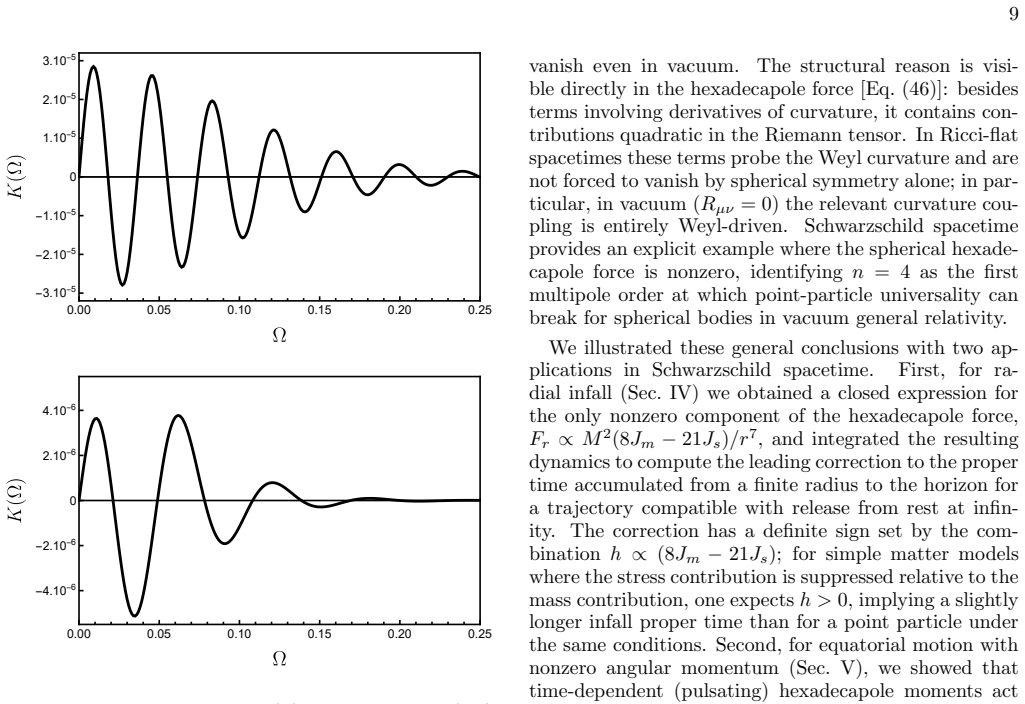
- The horizontal axis is unlabeled; specify the units of Ω and state the values of M, r_un, and any other parameters used in the plots. Also clarify how the 'broader numerical scans' were performed and whether the isolated zeros of K(Ω) are robust under changes of parameters.
- The statement that the Melnikov function 'takes the same factorized form obtained in [11]' is not self-contained. The derivation leading to M(τ0)=2cos(Ωτ0)K(Ω) should be shown or referenced with sufficient detail to allow independent verification.
- The choice of integration constant in m(r)=E+hM^2/(6r^6) is explained only briefly. Since E≡-p_t is the conserved energy, the identification E=m_0 for infall from rest at infinity should be stated explicitly and justified by the asymptotic normalization.
- The symmetrization notation for products of Kronecker deltas is ambiguous. Define the convention for δ(i1i2 δi3i4 ··· δi_{2ℓ-1}i_{2ℓ}) and the normalization, so that the numerical coefficients in A_{2ℓ} can be checked.
Circularity Check
No significant circularity; the central hexadecapole derivation is computed from Dixon's formalism with prescribed multipole moments, not fitted or self-referential.
full rationale
The paper's central result—the nonzero hexadecapole force in vacuum—is obtained by direct substitution of the O(3)-symmetric hexadecapole tensor (51) into Dixon's force and torque expressions (46)-(47). The multipole scalars J_m and J_s are prescribed inputs, not tuned to match any target trajectory; no parameter is fitted to the effects that are then presented as predictions. The Newtonian all-order cancellation is used only as an independent benchmark and is proved from harmonicity and isotropic moments in Appendix A. The quadrupole vacuum cancellation is an algebraic trace statement, supported by external references [17,18] rather than by the authors' own prior work. The only load-bearing self-citations are methodological: Sec. V says 'Following the same procedure as in [11]' to pass to the reduced Hamiltonian system and uses the standard sinusoidal Melnikov factorization from [11]; the new kernel K(Omega) in Eq. (77) is computed from the new hexadecapole force and is not identical to any input. The Note Added cites an independent concurrent derivation by Harte and Ramond, which weakens any concern that the central claim is an artefact of the authors' own framework. A skeptical correctness concern about whether the full torque tensor (not just the torque vector) permits S^mu nu=0 at hexadecapole order for L != 0 is a dynamical-consistency issue, not a circularity; it does not amount to a prediction being equivalent, by construction, to its input.
Axiom & Free-Parameter Ledger
free parameters (3)
- Quadrupole scalars j_m, j_s =
prescribed; not fitted
- Hexadecapole scalars J_m, J_s =
prescribed; e.g., J_s=0, J_m=J0(1+ε sin Ωτ)
- Pulsation drive J0, ε, Ω =
J0 small, 0<ε<1, Ω generic
axioms (6)
- domain assumption Dixon's multipole formalism provides the correct equations of motion for extended test bodies.
- domain assumption Test-body and small-body regime: backreaction neglected, body size much smaller than local curvature radius.
- domain assumption Tulczyjew-Dixon spin supplementary condition Sμν pν=0 selects the representative worldline.
- domain assumption Spherical symmetry = O(3) invariance of multipole tensors in the momentum rest space, represented in an M-transported tetrad.
- standard math Tensor-extension identities (Eqs. (20)-(21)) from Harte [14] are valid.
- ad hoc to paper Spinless ansatz Sμν=0 is dynamically consistent at hexadecapole order.
read the original abstract
We ask when a spinless spherical extended test body in vacuum general relativity moves as its point-particle counterpart. In Newtonian gravity, harmonicity of the external potential gives an all-order cancellation: in source-free regions all spherical multipole forces beyond the monopole vanish. Using Dixon's covariant multipole formalism, with spherical symmetry defined as $O(3)$ invariance in the Tulczyjew-Dixon momentum rest space, we show that the relativistic analogue holds through quadrupole order in any Ricci-flat spacetime. At this order the torque vector vanishes, the force reduces to Ricci contractions, and the representative worldline is geodesic; the spherical octupole is forbidden by symmetry. This universality, however, is not an all-order effacement principle. At hexadecapole (16-pole) order the torque vector still vanishes, so the spinless sector remains dynamically consistent, but curvature-squared terms generate Weyl-driven forces that can survive in vacuum. In Schwarzschild spacetime we compute the resulting force for radial infall and the invariant leading correction to the infall proper time. We also show that periodic modulations of the hexadecapole moments act as an internal drive: Melnikov's method gives transverse homoclinic splitting and local chaotic layers near the geodesic separatrix for generic driving frequencies. The analysis is restricted to the small-body regime of Dixon's finite multipole expansion.
Figures
Forward citations
Cited by 1 Pith paper
-
Quadrupolar tidal effects destroy the integrability of black hole geodesics: analytic proof and numerical evidence of chaos
Leading-order tidally induced quadrupoles destroy Kerr geodesic integrability: no polynomial deformation of the Carter constant is conserved for generic Love couplings and Kerr spin.
Reference graph
Works this paper leans on
-
[1]
Mathisson, Neue Mechanik materieller Systeme, Acta Phys
M. Mathisson, Neue Mechanik materieller Systeme, Acta Phys. Polon.6, 163 (1937)
1937
-
[2]
Papapetrou, Spinning test-particles in general relativ- ity
A. Papapetrou, Spinning test-particles in general relativ- ity. I, Proc. R. Soc. Lond. A209, 248 (1951)
1951
-
[3]
Tulczyjew, Motion of multipole particles in general relativity theory, Acta Phys
W. Tulczyjew, Motion of multipole particles in general relativity theory, Acta Phys. Polon.18, 393 (1959)
1959
-
[4]
W. G. Dixon, Dynamics of extended bodies in general relativity. I. Momentum and angular momentum, Proc. R. Soc. Lond. A314, 499 (1970)
1970
-
[5]
W. G. Dixon, Dynamics of extended bodies in general relativity. II. Moments of the charge-current vector, Proc. R. Soc. Lond. A319, 509 (1970)
1970
-
[6]
W. G. Dixon, Dynamics of extended bodies in general relativity. III. Equations of motion, Philos. Trans. R. Soc. Lond. A277, 59 (1974)
1974
-
[7]
A. I. Harte, Mechanics of extended masses in general rel- ativity, Class. Quantum Grav.29, 055012 (2012)
2012
-
[8]
Damour, The problem of motion in Newtonian and Einsteinian gravity, inThree Hundred Years of Gravita- tion, edited by S
T. Damour, The problem of motion in Newtonian and Einsteinian gravity, inThree Hundred Years of Gravita- tion, edited by S. W. Hawking and W. Israel (Cambridge University Press, Cambridge, England, 1987), pp. 128– 198
1987
-
[9]
C. M. Will, The confrontation between general relativity and experiment, Living Rev. Relativity17, 4 (2014)
2014
-
[10]
R. S. S. Vieira and R. A. Mosna, Homoclinic chaos in the Hamiltonian dynamics of extended test bodies, Chaos Solitons & Fractals163, 112541 (2022)
2022
-
[11]
R. A. Mosna, F. F. Rodrigues, and R. S. S. Vieira, Chaotic dynamics of a spinless axisymmetric extended body around a Schwarzschild black hole, Phys. Rev. D 106, 024016 (2022)
2022
-
[12]
F. de F. Rodrigues, R. A. Mosna, and R. S. S. Vieira, Chaotic dynamics of pulsating spheres orbiting black holes, Gen. Relativ. Gravit.56, 112 (2024)
2024
-
[13]
T. S. Amancio, R. A. Mosna, and R. S. S. Vieira, Chaotic orbital dynamics of pulsating stars around black holes surrounded by dark matter halos, Phys. Rev. D110, 124048 (2024)
2024
-
[14]
A. I. Harte, Effective stress-energy tensors, self-force and broken symmetry, Class. Quantum Grav.27, 135002 (2010)
2010
-
[15]
Ehlers and E
J. Ehlers and E. Rudolph, Dynamics of extended bod- ies in general relativity: center-of-mass description and quasirigidity, Gen. Relativ. Gravit.8, 197 (1977)
1977
-
[16]
Jeffreys, On isotropic tensors, Proc
H. Jeffreys, On isotropic tensors, Proc. Cambridge Phi- los. Soc.73, 173 (1973)
1973
-
[17]
A. I. Harte, Extended-body motion in black hole space- times: What is possible?, Phys. Rev. D102, 124075 (2020)
2020
-
[18]
A. I. Harte and D. Dwyer, Local symmetries as con- straints on the motion of freely falling extended bodies, Phys. Rev. D108, 124005 (2023)
2023
-
[19]
Wolfram Research, Inc.,Mathematica, Version 14.3, Champaign, IL (2025)
2025
-
[20]
Schutz,A First Course in General Relativity, 2nd ed
B. Schutz,A First Course in General Relativity, 2nd ed. (Cambridge University Press, Cambridge, England, 2009)
2009
-
[21]
Holmes, Poincar´ e, celestial mechanics, dynamical- systems theory and “chaos”, Phys
P. Holmes, Poincar´ e, celestial mechanics, dynamical- systems theory and “chaos”, Phys. Rep.193, 137 (1990)
1990
-
[22]
A. I. Harte and P. Ramond, Octupole moments and the non-universality of free-fall in general relativity, arXiv:2607.21314 [gr-qc] (2026)
Pith/arXiv arXiv 2026
discussion (0)
Sign in with ORCID, Apple, or X to comment. Anyone can read and Pith papers without signing in.