REVIEW 2 major objections 5 minor 152 references
These lectures argue that the spinfoam formalism provides a coherent, discretization-based path-integral quantization of gravity: exact and topological in three dimensions, and given in four dimensions by the EPRL model, where weakly impose
Reviewed by Pith at T0; open to challenge. T0 means a machine referee read the full paper against a public rubric. the ladder, T0–T4 →
T0 review · deepseek-v4-flash
2026-08-01 04:50 UTC pith:WHV6ZRPV
load-bearing objection A careful, honest lecture-notes review: the lower-dimensional derivations check out, and the only thing that should give a referee pause is the EPRL section's leading-order constraint fixing, which the paper itself flags only partially. the 2 major comments →
Les Houches lectures on Spinfoam Path Integrals
The pith
A machine-rendered reading of the paper's core claim, the machinery that carries it, and where it could break.
Core claim
The central claim is that the spinfoam construction yields a genuine quantum-gravity path integral. In three dimensions this is established: the Ponzano-Regge state sum is invariant under Pachner moves via the Biedenharn-Elliott identity, projects onto flat connections, and its 6j-symbols satisfy recursion relations that become the Wheeler-DeWitt equation in the semiclassical limit. In four dimensions, the paper argues that the EPRL vertex amplitude, built from the weak imposition of linear simplicity constraints, is the correct discrete path integral for Lorentzian quantum gravity. The construction embeds each SU(2) spin j into the SL(2,C) representation (p, k) = (γ(j+1), j), giving the Y_γ
What carries the argument
The load-bearing object is the Y_γ embedding map, which sends an SU(2) spin-j state into the SL(2,C) unitary representation labeled (p=γ(j+1), k=j) with γ the Immirzi parameter. This map implements the linear simplicity constraints weakly, in the sense that the constraint operators ⃗K − γ⃗L annihilate matrix elements on the embedded Hilbert subspace at leading order in large spins. The EPRL vertex amplitude then averages the embedded spin-network intertwiners over SL(2,C) group elements, producing a Lorentzian 4-simplex amplitude. In lower dimensions the analogous machinery is the 6j-symbol and the Biedenharn-Elliott identity, which enforce topological invariance under 3d Pachner moves.
Load-bearing premise
The load-bearing premise is that imposing the linear simplicity constraints only weakly, at leading order in large spins with the specific embedding p = γ(j+1), is the correct quantization of the second-class Plebanski constraints; if sub-leading corrections matter, the EPRL vertex is not a path integral for Einstein gravity.
What would settle it
A concrete falsifier: compute the EPRL vertex amplitude at finite spins under a 1-5 Pachner move of a 4d triangulation; if the amplitude changes, the model is not triangulation-independent and fails as a background-independent path integral for gravity.
If this is right
- If the EPRL model is correct, spinfoam amplitudes define transition amplitudes between loop-quantum-gravity spin-network states, providing a covariant path-integral formulation of quantum gravity.
- The 3d results are exact: Ponzano-Regge amplitudes are independent of the bulk triangulation, project onto flat connections, and Turaev-Viro extends them to include a cosmological constant.
- Large-spin asymptotics of the 6j-symbol reproduce the Regge action, so the spinfoam sum is a discrete path integral for gravity in the semiclassical regime.
- The EPRL construction recovers the LQG area spectrum A = γ√(j(j+1)), connecting the covariant and canonical quantization programs.
- The model is posed as a concrete computational object, opening numerical studies of black-to-white-hole transitions and the renormalization flow.
Where Pith is reading between the lines
- If the weak-constraint prescription survives sub-leading 1/j corrections, the Immirzi parameter acquires a sharp geometrical meaning as the boost-to-rotation ratio of the embedded representation; a measurement of the area spectrum would then test the embedding directly.
- The 3d Ising duality for Ponzano-Regge suggests that boundary dynamics of spinfoam models may be systematically mapped to statistical-mechanics models; an analogous duality for EPRL, if found, could make 4d amplitudes computationally tractable.
- The absence of a proven invariance under 4d bulk-triangulation deformation, noted in the paper, is the main gap: if the EPRL amplitude fails a Pachner-move test, the model may need modification such as q-deformation or a refinement prescription to define a continuum limit.
- A next-to-leading-order computation of the EPRL vertex, comparing its saddle-point action to the Regge action, would provide a sharp test of whether the weak simplicity constraints are sufficient or only an approximation.
Editorial analysis
A structured set of objections, weighed in public.
Referee Report
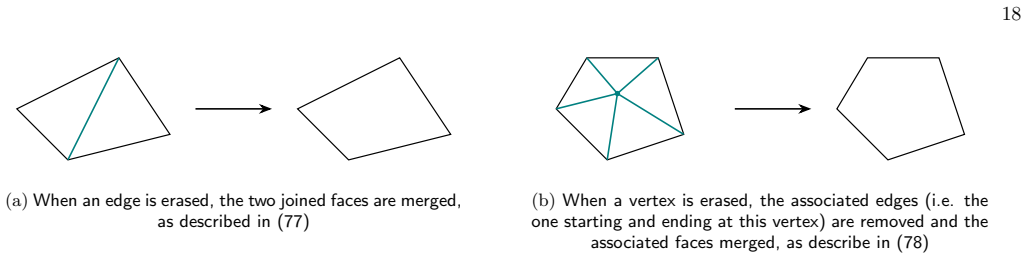
Summary. These Les Houches lecture notes present a pedagogical, dimension-by-dimension introduction to the spinfoam path-integral framework. Starting from the 1d path integral for quantum mechanics, the paper builds 2d BF spinfoam models (U(1) and SU(2)), the 3d Ponzano-Regge and Turaev-Viro state sums, and culminates in the 4d EPRL model for Lorentzian quantum gravity. The central claims are that the lower-dimensional models are exact topological state sums, that the EPRL amplitude is the current standard covariant LQG vertex arising from a weak imposition of the linear simplicity constraints, and that this 4d amplitude is well enough defined to be studied, computed and analysed.
Significance. If the result as presented stands, this is a valuable and largely self-contained review: the 1d Gaussian chain (eqs. 22-28) reproduces the Schrödinger propagator; the 2d face-merging and genus counting (eqs. 48, 74-86) give the Euler characteristic; the 3d Pachner-move invariance (eqs. 119-120) is shown explicitly; and the 4d section gives a transparent construction of the EPRL vertex (eq. 160) from the Y-gamma embedding. The paper is honest about open questions such as renormalization, triangulation symmetry, and the Wheeler-DeWitt representation. Its main strength is the explicit, checkable derivations in the lower-dimensional models and the clear pedagogical presentation of the current 4d candidate.
major comments (2)
- [§5.B, Eq. (156)] The sentence 'This uniquely fixes the sl(2,C) representation labels (p,k)' is contradicted by footnote 13, which immediately records the alternative embedding (k=j, p=γj). Since eqs. (154)-(155) are imposed only at leading order in j, both embeddings are admissible at the stated approximation order, and they differ at O(1) in p. Eq. (156) is therefore a choice, not a consequence. Because the Y-gamma map (158) and the vertex amplitude (160) use this choice for all finite j, the 4d model is not uniquely defined by the simplicity constraints alone. Please replace 'uniquely fixes' by an explicit convention statement and discuss the residual sub-leading ambiguity, e.g. its effect on the area spectrum (157) and the large-j asymptotics.
- [§5.B, final paragraph] The final paragraph acknowledges that there is no proven symmetry under bulk-triangulation deformation, no established renormalization flow, and no proven Wheeler-DeWitt/hamiltonian-constraint representation. In this context, the sentence 'This 4d quantum gravity path integral is thus ready to be studied, computed and analysed' is too strong if read as a statement of physical viability. Please rephrase to make clear that the EPRL model is a well-defined candidate amplitude whose semiclassical and continuum properties remain open. This is not a request for new calculations, but for a more careful framing of the status of the 4d construction.
minor comments (5)
- [§2, Eq. (29)] In the product of short-time propagators, the exponents should involve the interval lengths (τ_{n+1}-τ_n), not the total (τ_N-τ_0), and the signs in the exponents should be consistently negative (e^{-i...}) rather than positive as written.
- [§3.B, Eq. (67)] The convolution formula contains a stray 'e': δ(g^{-1} e G) should presumably read δ(g^{-1} G') or similar. Please correct.
- [§5.B, Eq. (158)] The domain of the Y-gamma map is written as R^{(γj,j)} but the definition just below says |j,m> maps to |(p=γ(j+1), k=j), j,m>. The notation should be R^{(γ(j+1),j)} to be consistent.
- [Footnote 13] Typo: 'preset lectures' should be 'present lectures'.
- [§3.C] Typo: 'Feynamn diagrams' should be 'Feynman diagrams'.
Circularity Check
No circularity: the review's derivations are externally benchmarked; the 4d EPRL fixing is an acknowledged ansatz, not a forced consequence.
full rationale
The paper is a pedagogical review. Its lower-dimensional derivations are self-contained and checked against external benchmarks: the 1d discretized path integral is verified against the operator propagator (eqs. 25-28); the 2d BF path integral is shown topological by face merging (eq. 48) and reproduces the Euler characteristic by counting (eqs. 74-79); the 3d Ponzano-Regge state-sum is proved invariant under Pachner moves via the Biedenharn-Elliott identity (eqs. 119-120), with the {6j} asymptotics matched to the Regge action. In the 4d section, the EPRL construction is presented as a constrained-BF quantization: the weak simplicity constraint (eq. 152) and its leading-order solution (eq. 156) are imposed modeling choices from the literature, not derived predictions. The paper itself flags the ambiguity in footnote 13, noting the alternative embedding (k=j, p=γj), and lists as open questions the renormalization flow, the bulk-triangulation symmetry, and the Wheeler-DeWitt/hamiltonian-constraint representation. Thus the central 4d claim is not circular; it is an underdetermined ansatz with acknowledged open issues. Self-citations by the authors (e.g. [3], [5], [6], [46], [55]) are to established peer-reviewed results and are not invoked to forbid alternatives, so they do not constitute load-bearing circularity.
Axiom & Free-Parameter Ledger
free parameters (3)
- Immirzi parameter gamma =
not fixed in the paper; free coupling of the Einstein-Cartan-Holst action
- GFT vertex coupling lambda =
unassigned formal expansion parameter
- q-deformation root-of-unity order r =
integer r >= 3, with Lambda = (2*pi/(r+2))^2
axioms (6)
- standard math Peter-Weyl theorem: matrix elements of SU(2) irreps form an orthonormal basis of L^2(SU(2)) with the stated orthogonality (eq. 7)
- domain assumption The path-ordered exponential (holonomy) is the correct discretized variable for the connection, and flatness F[A]=0 is equivalent to trivial holonomies around contractible loops
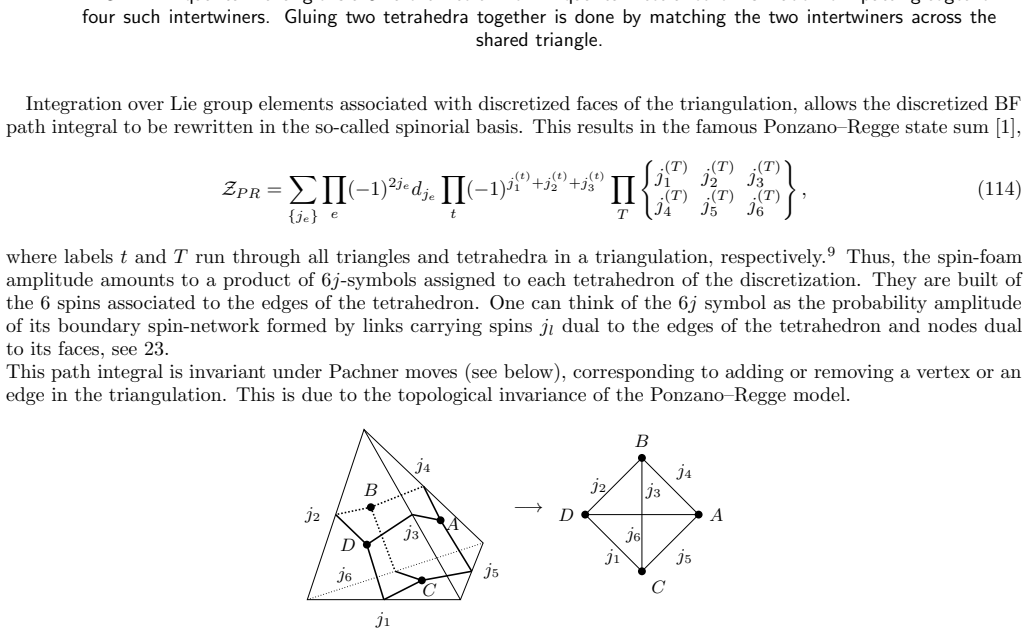
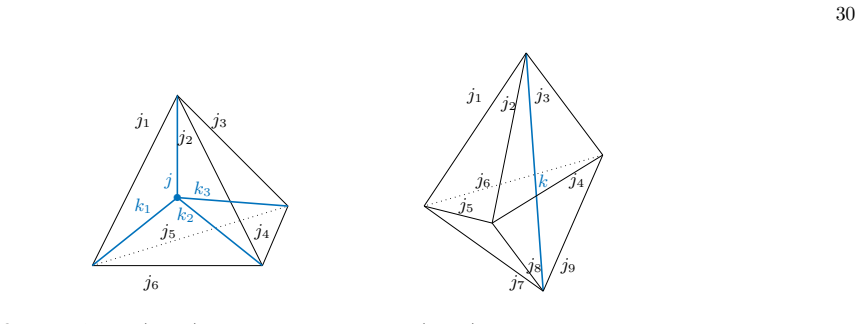
- standard math Biedenharn-Elliott identity and orthonormality of 6j-symbols imply invariance of the Ponzano-Regge state sum under (2-3) and (1-4) Pachner moves
- domain assumption The linear simplicity constraints K = gamma L, imposed weakly via <Phi|K-gamma L|Psi> = 0, are the correct quantization of the Plebanski second-class constraints, with leading-order fixing k = j, p = gamma(j+1)
- domain assumption Asymptotic large-spin 6j-symbols reproduce the Regge action (eq. 116), validating the interpretation of spinfoam amplitudes as discrete gravity path integrals
- standard math Independence of the partition function on the triangulation is equivalent to invariance under Pachner moves (Lickorish's theorem)
read the original abstract
In these lecture notes for the Les Houches School on Loop Quantum Gravity 2025, which took place in September 2025, we give a pedagogical review of the basics of the spinfoam framework for a quantum gravity path integral. While spin network states in loop quantum gravity describe the quantum geometry of the 3d space as dynamical networks of entangled quanta of volumes, spinfoams define transition amplitudes for those spin networks using the reformulation of general relativity as an "almost-topological" field theory and tools from quantum BF theory and topological state-sums. The lectures were a short format of three times one hour and a half, only allowing to cover the basics and offer a glimpse of more advanced lines of research. We introduce spin foam path integrals for increasing spacetime dimensions starting with 2d BF theory, then build up to 3d quantum gravity with the Ponzano-Regge state-sum and the Turaev-Viro invariant, and finally the quantization of general relativity in four dimensions.
Figures








Reference graph
Works this paper leans on
-
[1]
There is actually one divergent factor for each bulk point
The original definition of the Ponzano-Regge partition function is typically divergent, as soon as there is a point in the bulk triangulation. There is actually one divergent factor for each bulk point
-
[2]
theory of invariants
These divergences can be removed by fixing one spin around each bulk vertex, and more precisely by fixing the spins along a maximal tree on the triangulation. The identities above ensure that the final finite result does not depend on the chosen values for the spins or the choice of a maximal tree. This procedure is actually a true gauge theory of the tra...
2025
-
[3]
Semiclassical Limit of Racah Coefficients,
G. Ponzano and T. Regge, “Semiclassical Limit of Racah Coefficients,” pp 1-58 of Spectroscopic and Group Theoretical Methods in Physics. Block, F. (ed.). New York, John Wiley and Sons, Inc., 1968. (10, 1969)
1968
-
[4]
State sum invariants of 3-manifolds and quantum 6 j-symbols ,
V. G. Turaev and O. Y. Viro, “State sum invariants of 3-manifolds and quantum 6 j-symbols ,” Topology31(1992) 865–902
1992
-
[5]
LQG vertex with finite Immirzi parameter,
J. Engle, E. Livine, R. Pereira, and C. Rovelli, “LQG vertex with finite Immirzi parameter,” Nucl. Phys. B799(2008) 136–149,arXiv:0711.0146
Pith/arXiv arXiv 2008
-
[6]
Rovelli and F
C. Rovelli and F. Vidotto,Covariant Loop Quantum Gravity: An Elementary Introduction to Quantum Gravity and Spinfoam Theory. Cambridge Monographs on Mathematical Physics. Cambridge University Press, 11, 2014
2014
-
[7]
E. R. Livine,Spinfoam Models for Quantum Gravity: Overview. 3, 2024.arXiv:2403.09364
Pith/arXiv arXiv 2024
-
[8]
The Spinfoam Framework for Quantum Gravity,
E. R. Livine, “The Spinfoam Framework for Quantum Gravity,” other thesis, 10, 2010
2010
-
[9]
The Spin Foam Approach to Quantum Gravity,
A. Perez, “The Spin Foam Approach to Quantum Gravity,” Living Rev. Rel.16(2013) 3,arXiv:1205.2019
Pith/arXiv arXiv 2013
-
[10]
The new spin foam models and quantum gravity,
A. Perez, “The new spin foam models and quantum gravity,” Papers Phys.4(2012) 040004,arXiv:1205.0911
Pith/arXiv arXiv 2012
-
[11]
J. Engle and S. Speziale,Spin Foams: Foundations. 2023.arXiv:2310.20147
Pith/arXiv arXiv 2023
-
[12]
The microscopic dynamics of quantum space as a group field theory,
D. Oriti, “The microscopic dynamics of quantum space as a group field theory,” inFoundations of Space and Time: Reflections on Quantum Gravity, pp. 257–320. 10, 2011.arXiv:1110.5606
Pith/arXiv arXiv 2011
-
[13]
S. K. Asante, B. Dittrich, and S. Steinhaus,Spin Foams, Refinement Limit, and Renormalization. 2023. arXiv:2211.09578
Pith/arXiv arXiv 2023
-
[14]
P. Dona, M. Han, and H. Liu,Spinfoams and High-Performance Computing, pp. 1–38. 2023.arXiv:2212.14396
Pith/arXiv arXiv 2023
-
[15]
Introduction to SU(2) Recoupling Theory and Graphical Methods for Loop Quantum Gravity,
I. M¨ akinen, “Introduction to SU(2) Recoupling Theory and Graphical Methods for Loop Quantum Gravity,” arXiv:1910.06821
Pith/arXiv arXiv 1910
-
[16]
Closed formula for the matrix elements of the volume operator in canonical quantum gravity,
T. Thiemann, “Closed formula for the matrix elements of the volume operator in canonical quantum gravity,” J. Math. Phys.39(1998) 3347–3371,arXiv:gr-qc/9606091. 46
Pith/arXiv arXiv 1998
-
[17]
Simplification of the spectral analysis of the volume operator in loop quantum gravity,
J. Brunnemann and T. Thiemann, “Simplification of the spectral analysis of the volume operator in loop quantum gravity,” Class. Quant. Grav.23(2006) 1289–1346,arXiv:gr-qc/0405060
Pith/arXiv arXiv 2006
-
[18]
Semiclassical analysis of the Loop Quantum Gravity volume operator. I. Flux Coherent States,
C. Flori and T. Thiemann, “Semiclassical analysis of the Loop Quantum Gravity volume operator. I. Flux Coherent States,”arXiv:0812.1537
-
[19]
Bohr-Sommerfeld Quantization of Space,
E. Bianchi and H. M. Haggard, “Bohr-Sommerfeld Quantization of Space,” Phys. Rev. D86(2012) 124010, arXiv:1208.2228
Pith/arXiv arXiv 2012
-
[20]
Discreteness of area and volume in quantum gravity,
C. Rovelli and L. Smolin, “Discreteness of area and volume in quantum gravity,” Nucl. Phys. B442(1995) 593–622, arXiv:gr-qc/9411005. [Erratum: Nucl.Phys.B 456, 753–754 (1995)]
Pith/arXiv arXiv 1995
-
[21]
Loop quantum gravity and quanta of space: A Primer,
C. Rovelli and P. Upadhya, “Loop quantum gravity and quanta of space: A Primer,”arXiv:gr-qc/9806079
-
[22]
E. Bianchi and E. R. Livine,Loop Quantum Gravity and Quantum Information. 2023.arXiv:2302.05922
Pith/arXiv arXiv 2023
-
[23]
’Sum over surfaces’ form of loop quantum gravity,
M. P. Reisenberger and C. Rovelli, “’Sum over surfaces’ form of loop quantum gravity,” Phys. Rev. D56(1997) 3490–3508,arXiv:gr-qc/9612035
Pith/arXiv arXiv 1997
-
[24]
Barrett-Crane model from a Boulatov-Ooguri field theory over a homogeneous space,
R. De Pietri, L. Freidel, K. Krasnov, and C. Rovelli, “Barrett-Crane model from a Boulatov-Ooguri field theory over a homogeneous space,” Nucl. Phys. B574(2000) 785–806,arXiv:hep-th/9907154
Pith/arXiv arXiv 2000
-
[25]
Space-time as a Feynman diagram: The Connection formulation,
M. P. Reisenberger and C. Rovelli, “Space-time as a Feynman diagram: The Connection formulation,” Class. Quant. Grav.18(2001) 121–140,arXiv:gr-qc/0002095
Pith/arXiv arXiv 2001
-
[26]
Spin foams as Feynman diagrams,
M. Reisenberger and C. Rovelli, “Spin foams as Feynman diagrams,” in25th Johns Hopkins Workshop on Current Problems in Particle Theory: 2001: A Relativistic Spacetime Odyssey. Experiments and Theoretical Viewpoints on General Relativity and Quantum Gravity, pp. 431–448. 2, 2000.arXiv:gr-qc/0002083
Pith/arXiv arXiv 2001
-
[27]
Group field theory: An Overview,
L. Freidel, “Group field theory: An Overview,” Int. J. Theor. Phys.44(2005) 1769–1783,arXiv:hep-th/0505016
Pith/arXiv arXiv 2005
-
[28]
C. Rovelli, “The Basis of the Ponzano-Regge-Turaev-Viro-Ooguri quantum gravity model in the loop representation basis,” Phys. Rev. D48(1993) 2702–2707,arXiv:hep-th/9304164
Pith/arXiv arXiv 1993
-
[29]
Quantum gravity as topological quantum field theory,
J. W. Barrett, “Quantum gravity as topological quantum field theory,” J. Math. Phys.36(1995) 6161–6179, arXiv:gr-qc/9506070
Pith/arXiv arXiv 1995
-
[30]
J. C. Baez, “Spin foam models,” Class. Quant. Grav.15(1998) 1827–1858,arXiv:gr-qc/9709052
Pith/arXiv arXiv 1998
-
[31]
An Introduction to Spin Foam Models ofBFTheory and Quantum Gravity,
J. C. Baez, “An Introduction to Spin Foam Models ofBFTheory and Quantum Gravity,” Lect. Notes Phys.543 (2000) 25–93,arXiv:gr-qc/9905087
Pith/arXiv arXiv 2000
-
[32]
Ponzano-Regge model revisited I: Gauge fixing, observables and interacting spinning particles,
L. Freidel and D. Louapre, “Ponzano-Regge model revisited I: Gauge fixing, observables and interacting spinning particles,” Class. Quant. Grav.21(2004) 5685–5726,arXiv:hep-th/0401076
Pith/arXiv arXiv 2004
-
[33]
Ponzano-Regge model revisited III: Feynman diagrams and effective field theory,
L. Freidel and E. R. Livine, “Ponzano-Regge model revisited III: Feynman diagrams and effective field theory,” Class. Quant. Grav.23(2006) 2021–2062,arXiv:hep-th/0502106
Pith/arXiv arXiv 2006
-
[34]
J. W. Barrett and I. Naish-Guzman, “The Ponzano-Regge model,” Class. Quant. Grav.26(2009) 155014, arXiv:0803.3319
Pith/arXiv arXiv 2009
-
[35]
The Ponzano–Regge cylinder and propagator for 3d quantum gravity,
E. R. Livine, “The Ponzano–Regge cylinder and propagator for 3d quantum gravity,” Class. Quant. Grav.38(2021), no. 21, 215009,arXiv:2107.03264
Pith/arXiv arXiv 2021
-
[36]
Quantum gravity kinematics from extended TQFTs,
B. Dittrich and M. Geiller, “Quantum gravity kinematics from extended TQFTs,” New J. Phys.19(2017), no. 1, 013003,arXiv:1604.05195
Pith/arXiv arXiv 2017
-
[37]
Topological lattice models in four-dimensions,
H. Ooguri, “Topological lattice models in four-dimensions,” Mod. Phys. Lett. A7(1992) 2799–2810, arXiv:hep-th/9205090
Pith/arXiv arXiv 1992
-
[38]
A Categorical construction of 4-D topological quantum field theories,
L. Crane and D. Yetter, “A Categorical construction of 4-D topological quantum field theories,” 3, 1993. arXiv:hep-th/9301062
Pith/arXiv arXiv 1993
-
[39]
Spin foam diagrammatics and topological invariance,
F. Girelli, R. Oeckl, and A. Perez, “Spin foam diagrammatics and topological invariance,” Class. Quant. Grav.19 (2002) 1093–1108,arXiv:gr-qc/0111022
Pith/arXiv arXiv 2002
-
[40]
B. Bahr, F. Hellmann, W. Kaminski, M. Kisielowski, and J. Lewandowski, “Operator Spin Foam Models,” Class. Quant. Grav.28(2011) 105003,arXiv:1010.4787
Pith/arXiv arXiv 2011
-
[41]
Perfect discretization of reparametrization invariant path integrals,
B. Bahr, B. Dittrich, and S. Steinhaus, “Perfect discretization of reparametrization invariant path integrals,” Phys. Rev. D83(2011) 105026,arXiv:1101.4775
Pith/arXiv arXiv 2011
-
[42]
Perfect discretizations as a gateway to one-loop partition functions for 4D gravity,
S. K. Asante and B. Dittrich, “Perfect discretizations as a gateway to one-loop partition functions for 4D gravity,” JHEP05(2022) 172,arXiv:2112.03307
Pith/arXiv arXiv 2022
-
[43]
Discretization of 4D Poincar´ e BF theory: From groups to 2-groups,
F. Girelli and P. Tsimiklis, “Discretization of 4D Poincar´ e BF theory: From groups to 2-groups,” Phys. Rev. D106 (2022), no. 4, 046003,arXiv:2105.01817
Pith/arXiv arXiv 2022
-
[44]
Most general theory of 3d gravity: Covariant phase space, dual diffeomorphisms, and more,
M. Geiller, C. Goeller, and N. Merino, “Most general theory of 3d gravity: Covariant phase space, dual diffeomorphisms, and more,” JHEP02(2021) 120,arXiv:2011.09873
Pith/arXiv arXiv 2021
-
[45]
Lower Dimensional Gravity,
R. Jackiw, “Lower Dimensional Gravity,” Nucl. Phys. B252(1985) 343–356
1985
-
[46]
Gauge theories for gravity on a line,
R. Jackiw, “Gauge theories for gravity on a line,” Theor. Math. Phys.92(1992) 979–987,arXiv:hep-th/9206093
Pith/arXiv arXiv 1992
-
[47]
Gravitation and Hamiltonian Structure in Two Space-Time Dimensions,
C. Teitelboim, “Gravitation and Hamiltonian Structure in Two Space-Time Dimensions,” Phys. Lett. B126(1983) 41–45
1983
-
[48]
A New spinfoam vertex for quantum gravity,
E. R. Livine and S. Speziale, “A New spinfoam vertex for quantum gravity,” Phys. Rev. D76(2007) 084028, arXiv:0705.0674
Pith/arXiv arXiv 2007
-
[49]
Revisiting the Simplicity Constraints and Coherent Intertwiners,
M. Dupuis and E. R. Livine, “Revisiting the Simplicity Constraints and Coherent Intertwiners,” Class. Quant. Grav.28 (2011) 085001,arXiv:1006.5666
Pith/arXiv arXiv 2011
-
[50]
Spinors and Voros star-product for Group Field Theory: First Contact,
M. Dupuis, F. Girelli, and E. R. Livine, “Spinors and Voros star-product for Group Field Theory: First Contact,” Phys. Rev. D86(2012) 105034,arXiv:1107.5693
Pith/arXiv arXiv 2012
-
[51]
Holomorphic Simplicity Constraints for 4d Spinfoam Models,
M. Dupuis and E. R. Livine, “Holomorphic Simplicity Constraints for 4d Spinfoam Models,” Class. Quant. Grav.28 47 (2011) 215022,arXiv:1104.3683
Pith/arXiv arXiv 2011
-
[52]
Holomorphic Lorentzian Simplicity Constraints,
M. Dupuis, L. Freidel, E. R. Livine, and S. Speziale, “Holomorphic Lorentzian Simplicity Constraints,” J. Math. Phys. 53(2012) 032502,arXiv:1107.5274
Pith/arXiv arXiv 2012
-
[53]
3D Quantum Gravity and Effective Noncommutative Quantum Field Theory,
L. Freidel and E. R. Livine, “3D Quantum Gravity and Effective Noncommutative Quantum Field Theory,” Phys. Rev. Lett.96(2006) 221301,arXiv:hep-th/0512113
Pith/arXiv arXiv 2006
-
[54]
Noncommutative harmonic analysis, sampling theory and the Duflo map in 2+1 quantum gravity,
L. Freidel and S. Majid, “Noncommutative harmonic analysis, sampling theory and the Duflo map in 2+1 quantum gravity,” Class. Quant. Grav.25(2008) 045006,arXiv:hep-th/0601004
Pith/arXiv arXiv 2008
-
[55]
A Note on B-observables in Ponzano-Regge 3d Quantum Gravity,
E. R. Livine and J. P. Ryan, “A Note on B-observables in Ponzano-Regge 3d Quantum Gravity,” Class. Quant. Grav. 26(2009) 035013,arXiv:0808.0025
Pith/arXiv arXiv 2009
-
[56]
A New Spin Foam Model for 4d Gravity,
L. Freidel and K. Krasnov, “A New Spin Foam Model for 4d Gravity,” Class. Quant. Grav.25(2008) 125018, arXiv:0708.1595
Pith/arXiv arXiv 2008
-
[57]
Consistently Solving the Simplicity Constraints for Spinfoam Quantum Gravity,
E. R. Livine and S. Speziale, “Consistently Solving the Simplicity Constraints for Spinfoam Quantum Gravity,” EPL81 (2008), no. 5, 50004,arXiv:0708.1915
Pith/arXiv arXiv 2008
-
[58]
2-d manifold independent spin foam theory,
R. Livine, A. Perez, and C. Rovelli, “2-d manifold independent spin foam theory,”arXiv:gr-qc/0102051
-
[59]
Loop gravity and spin foam: Covariant methods for the nonperturbative quantization of general relativity,
E. R. Livine, “Loop gravity and spin foam: Covariant methods for the nonperturbative quantization of general relativity,” other thesis, 6, 2003
2003
-
[60]
(2+1)-Dimensional Gravity as an Exactly Soluble System,
E. Witten, “(2+1)-Dimensional Gravity as an Exactly Soluble System,” Nucl. Phys. B311(1988) 46
1988
-
[61]
Spin Foams and Canonical Quantization,
S. Alexandrov, M. Geiller, and K. Noui, “Spin Foams and Canonical Quantization,” SIGMA8(2012) 055, arXiv:1112.1961
Pith/arXiv arXiv 2012
-
[62]
Semi-classical Approximations to 3j and 6j Coefficients for Quantum Mechanical Coupling of Angular Momenta,
K. Schulten and R. G. Gordon, “Semi-classical Approximations to 3j and 6j Coefficients for Quantum Mechanical Coupling of Angular Momenta,” J. Math. Phys.16(1975) 1971–1988
1975
-
[63]
Exact Recursive Evaluation of 3J and 6J Coefficients for Quantum Mechanical Coupling of Angular Momenta,
K. Schulten and R. G. Gordon, “Exact Recursive Evaluation of 3J and 6J Coefficients for Quantum Mechanical Coupling of Angular Momenta,” J. Math. Phys.16(1975) 1961–1970
1975
-
[64]
Classical 6j-symbols and the tetrahedron,
J. Roberts, “Classical 6j-symbols and the tetrahedron,” Geom. Topol.3(1999), no. 1, 21–66,arXiv:math-ph/9812013
Pith/arXiv arXiv 1999
-
[65]
Asymptotics of 6j and 10j symbols,
L. Freidel and D. Louapre, “Asymptotics of 6j and 10j symbols,” Class. Quant. Grav.20(2003) 1267–1294, arXiv:hep-th/0209134
Pith/arXiv arXiv 2003
-
[66]
Dupuis,Spin Foam Models for Quantum Gravity and semi-classical limit
M. Dupuis,Spin Foam Models for Quantum Gravity and semi-classical limit. PhD thesis, Lyon, Ecole Normale Superieure, 2010.arXiv:1104.2765
Pith/arXiv arXiv 2010
-
[67]
Tunneling of quantum geometries in spinfoams,
P. Don` a, H. M. Haggard, C. Rovelli, and F. Vidotto, “Tunneling of quantum geometries in spinfoams,” Physical Review D109(May, 2024)
2024
-
[68]
Semiclassical limits of simplicial quantum gravity,
J. W. Barrett and T. J. Foxon, “Semiclassical limits of simplicial quantum gravity,” Class. Quant. Grav.11(1994) 543–556,arXiv:gr-qc/9310016
Pith/arXiv arXiv 1994
-
[69]
Semiclassical limits of extended Racah coefficients,
S. Davids, “Semiclassical limits of extended Racah coefficients,” J. Math. Phys.41(2000) 924–943, arXiv:gr-qc/9807061
Pith/arXiv arXiv 2000
-
[70]
Discrete and continuum approaches to three-dimensional quantum gravity,
H. Ooguri and N. Sasakura, “Discrete and continuum approaches to three-dimensional quantum gravity,” Mod. Phys. Lett. A6(1991) 3591–3600,arXiv:hep-th/9108006
Pith/arXiv arXiv 1991
-
[71]
Non-Perturbative 3D Quantum Gravity: Quantum Boundary States and Exact Partition Function,
C. Goeller, E. R. Livine, and A. Riello, “Non-Perturbative 3D Quantum Gravity: Quantum Boundary States and Exact Partition Function,” Gen. Rel. Grav.52(2020), no. 3, 24,arXiv:1912.01968
Pith/arXiv arXiv 2020
-
[72]
Ponzano-Regge model revisited II: Equivalence with Chern-Simons,
L. Freidel and D. Louapre, “Ponzano-Regge model revisited II: Equivalence with Chern-Simons,”arXiv:gr-qc/0410141
-
[73]
Simplicial moves on complexes and manifolds,
W. B. R. Lickorish, “Simplicial moves on complexes and manifolds,” Geometry and Topology Monographs2(1999), no. 299-320, 314,arXiv:math/9911256
Pith/arXiv arXiv 1999
-
[74]
Recurrence relations for spin foam vertices,
V. Bonzom, E. R. Livine, and S. Speziale, “Recurrence relations for spin foam vertices,” Class. Quant. Grav.27(2010) 125002,arXiv:0911.2204
Pith/arXiv arXiv 2010
-
[75]
Dirac’s discrete hypersurface deformation algebras,
V. Bonzom and B. Dittrich, “Dirac’s discrete hypersurface deformation algebras,” Class. Quant. Grav.30(2013) 205013,arXiv:1304.5983
Pith/arXiv arXiv 2013
-
[76]
Bubble divergences from cellular cohomology,
V. Bonzom and M. Smerlak, “Bubble divergences from cellular cohomology,” Lett. Math. Phys.93(2010) 295–305, arXiv:1004.5196
Pith/arXiv arXiv 2010
-
[77]
Bubble divergences from twisted cohomology,
V. Bonzom and M. Smerlak, “Bubble divergences from twisted cohomology,” Commun. Math. Phys.312(2012) 399–426,arXiv:1008.1476
Pith/arXiv arXiv 2012
-
[78]
The Hamiltonian constraint in 3d Riemannian loop quantum gravity,
V. Bonzom and L. Freidel, “The Hamiltonian constraint in 3d Riemannian loop quantum gravity,” Class. Quant. Grav. 28(2011) 195006,arXiv:1101.3524
Pith/arXiv arXiv 2011
-
[79]
A New Hamiltonian for the Topological BF phase with spinor networks,
V. Bonzom and E. R. Livine, “A New Hamiltonian for the Topological BF phase with spinor networks,” J. Math. Phys. 53(2012) 072201,arXiv:1110.3272
Pith/arXiv arXiv 2012
-
[80]
Quantum Field Theory and the Jones Polynomial,
E. Witten, “Quantum Field Theory and the Jones Polynomial,” Commun. Math. Phys.121(1989) 351–399
1989
discussion (0)
Sign in with ORCID, Apple, or X to comment. Anyone can read and Pith papers without signing in.