REVIEW 3 major objections 5 minor 55 references
A pure momentum-transfer coupling between dark matter and baryons, set by a single rate γ, suppresses small-scale clustering and is preferred over ΛCDM at more than 2σ once low-redshift S8 data are included.
Reviewed by Pith at T0; open to challenge. T0 means a machine referee read the full paper against a public rubric. the ladder, T0–T4 →
T0 review · deepseek-v4-flash
2026-08-01 04:48 UTC pith:FHF5IFGX
load-bearing objection Solid model construction and cross-code validation, but the claimed >2σ detection is not a real test against ΛCDM. the 3 major comments →
Dark matter-baryons elastic coupling
The pith
A machine-rendered reading of the paper's core claim, the machinery that carries it, and where it could break.
Core claim
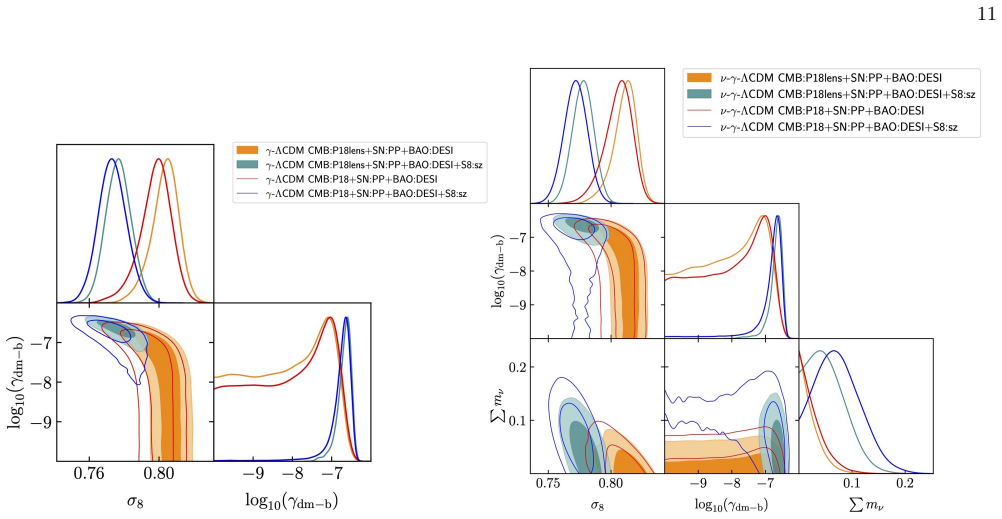
The central claim is that a pure momentum-transfer interaction between dark matter and baryons, with interaction rate Γm = γ a^{-2}, modifies only the Euler equations of the two fluids in linear perturbation theory. In the early universe the photon–baryon plasma's effective pressure is transmitted to dark matter, suppressing matter clustering on small scales and lowering σ8. The authors implement the model in CLASS, CAMB, and SymBoltz, confirm agreement among all three, and show that combining Planck CMB (including lensing), BAO, Pantheon+ supernovae, and the Planck SZ cluster S8 measurement yields log10γ = −6.73 (+0.26,+0.39 / −0.06,−0.50) at 68/95% C.L., a non-zero interaction at more than
What carries the argument
The central object is the dark matter–baryon momentum-transfer rate Γm = γ a^{-2}, with the coupled-density ratio Rm = ρb/ρdm, introduced by direct analogy with Thomson scattering. This single parameter γ carries the entire interaction: at first order it adds a drag term Γm(θdm − θb) to the baryon Euler equation and its reciprocal to the dark matter Euler equation, transmitting the photon–baryon pressure to dark matter and suppressing small-scale power.
Load-bearing premise
The entire early-time effect—and hence the reduced σ8 and the preference for γ≠0—depends on the assumed redshift scaling of the coupling, Γm = γ a^{-2}, with all microphysics collapsed into the constant γ; if a realistic dark matter–baryon scattering cross-section has a different velocity or density dependence, the predicted suppression of small-scale power changes or disappears.
What would settle it
A high-precision measurement of the matter power spectrum on scales k ≈ 1–10 h/Mpc (e.g., from CMB lensing or 21-cm tomography) that shows no suppression relative to ΛCDM at the level predicted for the preferred γ ≈ 10^-6.7 would rule out the coupling; concretely, absence of the predicted acoustic-oscillation feature in the CDM density contrast at k/h ≈ 10 Mpc^-1 would falsify the model.
If this is right
- The background expansion is identical to ΛCDM, so the inferred H0 is essentially unchanged while σ8 is lowered; the model can partially relieve the σ8/S8 tension without worsening the Hubble tension.
- Small-scale matter power is suppressed for k ≳ 1 h/Mpc, with no significant shift of the turnover scale, and for γ ~ 10^-6 the CDM density contrast develops acoustic oscillations at k/h ~ 10 Mpc^-1 that are absent in ΛCDM.
- Adding CMB lensing data strengthens the preference for a nonzero γ, shifting the posterior upward and increasing the significance from about 1σ to more than 2σ when the SZ S8 measurement is included.
- The interaction is not significantly degenerate with the sum of neutrino masses: in the ν-γΛCDM fit, γ and Σmν remain distinguishable, although a weak degeneracy appears when CMB lensing is excluded.
- The agreement among CLASS, CAMB, and SymBoltz validates the modified leading-order tight-coupling approximations used for the new interaction.
Where Pith is reading between the lines
- The sharp scale dependence of the predicted suppression (k ≳ 1 h/Mpc, growing toward k ~ 10 h/Mpc) gives a distinctive signature that future 21-cm or CMB-lensing measurements could separate from other σ8-relief mechanisms such as dark energy–dark matter couplings or massive neutrinos.
- The a^{-2} scaling of Γm is an assumption, not a derivation; a microphysical cross-section with a different velocity or density dependence would shift the scale of the suppression and could weaken or erase the preference for γ≠0, so the parameter constraint is conditional on that scaling law.
- The different significance between the SZ-based S8 (0.782±0.010) and DES Y6 S8 (0.789±0.012) suggests the >2σ preference hangs on the cluster-based constraint; an updated S8 measurement or a joint low-redshift likelihood would provide the decisive test.
Editorial analysis
A structured set of objections, weighed in public.
Referee Report
Summary. The paper introduces a phenomenological dark matter–baryon momentum-transfer coupling ('γΛCDM'), with interaction rate Γ_m = γ a^{-2} (Eq. 2.12), affecting only the first-order Euler equations. The authors derive the modified tight-coupling approximation, implement the model in CLASS, CAMB, and SymBoltz, and validate agreement across the three codes (Appendix B). They show that the coupling suppresses small-scale matter clustering and reduces σ8 while leaving the background cosmology and H0 unchanged. Using CMB (Planck PR4/2018 lensing), BAO (DESI), Pantheon+ supernovae, and low-redshift S8 measurements, they report an upper limit from CMB alone and claim a >2σ preference for γ≠0 when adding the SZ cluster-count S8 measurement (Eq. 4.1). The preference is weaker for the DES Y6 S8 constraint and for the model with free neutrino mass when CMB lensing is excluded.
Significance. If the claimed preference were robust, the model would provide a minimal, background-preserving mechanism to relieve the σ8 tension without worsening H0, and the cross-code implementation would be a useful technical contribution. The derivation and the numerical validation are careful, and the availability of modified public codes is an explicit strength. However, the headline detection is not statistically established as stated: the prior excludes γ=0, no model-comparison statistic is given, and the paper's own results show strong dataset-dependence. The value of the paper lies mainly in the model implementation, the TCA extension, and the exploration of the parameter space, rather than in the claimed detection.
major comments (3)
- [Section IV A, Eq. (4.1)] The statement 'the inclusion of S8,SZ favours a non-zero interaction at more than the 2-σ confidence level' is not supported by the reported statistics. The prior log10 γ∈[−10,−6] assigns zero prior mass to γ=0, the ΛCDM limit, so the 68/95% credible interval for log10 γ cannot be used to exclude γ=0. No Bayes factor, Δχ², AIC/DIC, or evidence ratio is presented. The interval only says that, within the assumed prior, small values of γ are disfavoured. The authors should rephrase the claim and perform a genuine model comparison, e.g., a prior containing a delta function at γ=0 or an evidence computation.
- [Section IV A, Tables I–II] The claimed preference is not robust across the dataset choices reported in the paper. With S8,DES the authors state that 'the ΛCDM scenario is not excluded'; with Baseline I (no CMB lensing) and free neutrino mass the significance drops to 'approximately the level of 1-σ'; and with Baseline II alone only an upper limit is obtained. The headline result therefore rests on a single S8 measurement (Planck SZ cluster counts) combined with CMB lensing. This fragility should be stated explicitly in the abstract and conclusions, and the robustness should be demonstrated by reporting the model-comparison statistic for each dataset combination.
- [Section II, Eq. (2.12); Section I] The interaction rate Γ_m = γ a^{-2} is an assumed phenomenological scaling, as the paper acknowledges ('we do not assume that this parametrization arises from a complete microscopic theory'). All quantitative constraints on γ and the inferred σ8 reduction depend on this fixed redshift scaling. If a microscopic DM–baryon cross-section has a different velocity or density dependence, the small-scale suppression and the fitted γ would change. The authors should at least state explicitly that the constraints are conditional on this scaling, and ideally test sensitivity to an alternative scaling, e.g., Γ_m ∝ a^{-3} or with an explicit velocity dependence.
minor comments (5)
- [Introduction] 'comic microwave background' should read 'cosmic microwave background'.
- [Abstract and Introduction] 'relay on' should be 'rely on' in the abstract and in the discussion of Boltzmann solvers.
- [Section IV] The definition of S8,DES appears to omit σ8; it should read S8 = σ8 (Ωm0/0.3)^0.5.
- [Eq. (2.16)] The displayed expression for Θ′_ph−b has difficult-to-parse bracketing; the term involving (θ_dm−θ_b) appears to be missing a closing bracket before O(τ_c^2). Please check.
- [Section II A] The TCA equations use Γ for Γ_m without a subscript; please make the notation consistent with Eqs. (2.12)–(2.13).
Circularity Check
No circular derivation; the γΛCDM prediction is self-contained, with a non-circular caveat about the prior excluding γ=0.
full rationale
The central derivation is not circular. The model is introduced as an explicit phenomenological coupling in the Euler equations: Eqs. (2.7)-(2.9) add ±Γ_m(θ_dm−θ_b) to the baryon and dark-matter Euler equations, with Γ_m=γa^-2 and Γ_m R_m=γa^-2 Ω_b/Ω_dm. The small-scale suppression of P(k) and the associated σ8 reduction follow from solving these modified perturbation equations; they are not imposed as output. The MCMC analysis then fits γ to external CMB, BAO, SN, and S8 likelihoods, so γ is a fitted parameter rather than a prediction renamed from the input. The self-citations to the authors' earlier αCDM [27] and βCDM [25] models are contextual and not load-bearing: the γΛCDM equations, TCA modifications, and cross-code validation against CLASS, CAMB, and SymBoltz are derived and checked within this paper. The strongest caveat is statistical rather than circular: the prior log10γ∈[−10,−6] assigns zero prior mass to γ=0, and no Bayes factor or Δχ² is reported, so the statement that S8 data 'favour a non-zero interaction' is a posterior statement within the interacting model, not a full model comparison with ΛCDM. This weakens the headline detection but does not make the physical derivation circular. Score 2 reflects the minor non-load-bearing self-citation and this prior-support caveat.
Axiom & Free-Parameter Ledger
free parameters (2)
- γ (DM-baryon coupling strength) =
log10γ = −6.73 +0.26+0.39 / −0.06−0.50 (Baseline II+S8,SZ); upper limit < −6.8 (95% CL) with Baseline II
- Σ mν (sum of neutrino masses, in ν-γΛCDM runs) =
95% upper limit <0.066 eV (Baseline II) and <0.118 eV (Baseline II+S8,SZ)
axioms (5)
- domain assumption FLRW background with standard Friedmann and continuity equations for all components; DM-baryon interaction affects only perturbations.
- domain assumption Baryons are tightly coupled to photons before recombination, providing an effective baryon sound speed c_s^2 and Thomson coupling Γ_T.
- ad hoc to paper The DM-baryon interaction rate scales as Γ_m = γ a^{-2} (and Γ_m R_m = γ a^{-2} Ω_b/Ω_dm).
- domain assumption The tight-coupling expansion to first order in τ_c remains valid with the new interaction terms.
- ad hoc to paper Priors log10γ∈[−10,−6] and Σmν∈[0,5].
invented entities (1)
-
Phenomenological DM–baryon momentum-transfer coupling (γ-coupling)
independent evidence
read the original abstract
We consider a cosmological model where dark matter and baryons interact via a pure momentum transfer. We present the foundations of the interaction and derive its main equations. In this framework, only the Euler equations for the two interacting components differ from those in the standard scenario. We also explain how this interaction relates with the common Tight-Coupling Approximation schemes typically used in many Boltzmann solver. After that, we implement the model in CLASS and CAMB Boltzmann solvers, which relay on those Tight-Coupling Approximation schemes and in SymBoltz, which is free from any approximation scheme. We demonstrate full consistency among all the implementations in the difference codes. We demonstrate how this type of interactions are useful regarding the $\sigma_8$ tension by producing a reduced clustering on smaller scales. Using cosmic microwave background, baryon acoustic oscillations, supernovae type Ia data and low-redshift constraints from Sunyaev-Zeldovich cluster counts and from DES year 6 results, we show the interacting scenario is mildly preferred when those low-redshift datasets are included.
Figures




Reference graph
Works this paper leans on
-
[1]
N. Aghanimet al.(Planck), Astron. Astrophys.641, A6 (2020), [Erratum: Astron.Astrophys. 652, C4 (2021)], arXiv:1807.06209 [astro-ph.CO]
Pith/arXiv arXiv 2020
-
[2]
M. Abdul Karimet al.(DESI), Phys. Rev. D112, 083515 (2025), arXiv:2503.14738 [astro-ph.CO]
Pith/arXiv arXiv 2025
-
[3]
Blomqvistet al.(eBOSS), Astron
M. Blomqvistet al.(eBOSS), Astron. Astrophys.629, A86 (2019), arXiv:1904.03430 [astro-ph.CO]
Pith/arXiv arXiv 2019
-
[4]
de Sainte Agatheet al.(eBOSS), Astron
V. de Sainte Agatheet al.(eBOSS), Astron. Astrophys.629, A85 (2019), arXiv:1904.03400 [astro-ph.CO]. 16
Pith/arXiv arXiv 2019
-
[5]
Moresco, (2024), arXiv:2412.01994 [astro-ph.CO]
M. Moresco, (2024), arXiv:2412.01994 [astro-ph.CO]
Pith/arXiv arXiv 2024
-
[6]
D. Scolnicet al., Astrophys. J.938, 113 (2022), arXiv:2112.03863 [astro-ph.CO]
Pith/arXiv arXiv 2022
-
[7]
D. Rubinet al., Astrophys. J.986, 231 (2025), arXiv:2311.12098 [astro-ph.CO]
Pith/arXiv arXiv 2025
-
[8]
T. M. C. Abbottet al.(DES), Astrophys. J. Lett.973, L14 (2024), arXiv:2401.02929 [astro-ph.CO]
Pith/arXiv arXiv 2024
-
[9]
B. Giblinet al., Astron. Astrophys.645, A105 (2021), arXiv:2007.01845 [astro-ph.CO]
Pith/arXiv arXiv 2021
-
[10]
T. M. C. Abbottet al.(DES), (2026), arXiv:2601.14559 [astro-ph.CO]
arXiv 2026
-
[11]
Martin, Comptes Rendus Physique13, 566 (2012), arXiv:1205.3365 [astro-ph.CO]
J. Martin, Comptes Rendus Physique13, 566 (2012), arXiv:1205.3365 [astro-ph.CO]
Pith/arXiv arXiv 2012
-
[12]
A. G. Adameet al.(DESI), JCAP02, 021 (2025), arXiv:2404.03002 [astro-ph.CO]
Pith/arXiv arXiv 2025
-
[13]
Di Valentinoet al.(CosmoVerse Network), Phys
E. Di Valentinoet al.(CosmoVerse Network), Phys. Dark Univ.49, 101965 (2025), arXiv:2504.01669 [astro-ph.CO]
Pith/arXiv arXiv 2025
-
[14]
I. Pantos and L. Perivolaropoulos, Physics of the Dark Universe52, 102286 (2026), arXiv:2602.12238 [astro-ph.CO]
arXiv 2026
-
[15]
C. Garc ´ ıa-Garc ´ ıa, M. Zennaro, G. Aric` o, D. Alonso, and R. E. Angulo, JCAP2024, 024 (2024), arXiv:2403.13794 [astro-ph.CO]
Pith/arXiv arXiv 2024
-
[16]
B. Wang, E. Abdalla, F. Atrio-Barandela, and D. Pav´ on, Rept. Prog. Phys.87, 036901 (2024), arXiv:2402.00819 [astro- ph.CO]
Pith/arXiv arXiv 2024
-
[17]
F. Simpson, Phys. Rev. D82, 083505 (2010), arXiv:1007.1034 [astro-ph.CO]
Pith/arXiv arXiv 2010
-
[18]
A. Pourtsidou, C. Skordis, and E. J. Copeland, Phys. Rev. D88, 083505 (2013), arXiv:1307.0458 [astro-ph.CO]
Pith/arXiv arXiv 2013
-
[19]
C. G. Boehmer, N. Tamanini, and M. Wright, Phys. Rev. D91, 123003 (2015), arXiv:1502.04030 [gr-qc]
Pith/arXiv arXiv 2015
-
[20]
A. Pourtsidou and T. Tram, Phys. Rev. D94, 043518 (2016), arXiv:1604.04222 [astro-ph.CO]
Pith/arXiv arXiv 2016
-
[21]
M. S. Linton, A. Pourtsidou, R. Crittenden, and R. Maartens, JCAP04, 043 (2018), arXiv:1711.05196 [astro-ph.CO]
Pith/arXiv arXiv 2018
-
[22]
M. Asghari, J. Beltr´ an Jim´ enez, S. Khosravi, and D. F. Mota, JCAP04, 042 (2019), arXiv:1902.05532 [astro-ph.CO]
Pith/arXiv arXiv 2019
-
[23]
F. N. Chamings, A. Avgoustidis, E. J. Copeland, A. M. Green, and A. Pourtsidou, Phys. Rev. D101, 043531 (2020), arXiv:1912.09858 [astro-ph.CO]
Pith/arXiv arXiv 2020
-
[24]
L. Amendola and S. Tsujikawa, JCAP06, 020 (2020), arXiv:2003.02686 [gr-qc]
Pith/arXiv arXiv 2020
-
[25]
J. Beltr´ an Jim´ enez, D. Bettoni, D. Figueruelo, and F. A. Teppa Pannia, JCAP08, 020 (2020), arXiv:2004.14661 [astro- ph.CO]
Pith/arXiv arXiv 2020
-
[26]
J. Beltr´ an Jim´ enez, D. Bettoni, D. Figueruelo, F. A. Teppa Pannia, and S. Tsujikawa, JCAP03, 085 (2021), arXiv:2012.12204 [astro-ph.CO]
Pith/arXiv arXiv 2021
-
[27]
Figuerueloet al., JCAP07, 022 (2021), arXiv:2103.01571 [astro-ph.CO]
D. Figuerueloet al., JCAP07, 022 (2021), arXiv:2103.01571 [astro-ph.CO]
Pith/arXiv arXiv 2021
-
[28]
M. S. Linton, R. Crittenden, and A. Pourtsidou, JCAP08, 075 (2022), arXiv:2107.03235 [astro-ph.CO]
Pith/arXiv arXiv 2022
-
[29]
J. Beltr´ an Jim´ enez, D. Bettoni, D. Figueruelo, F. A. Teppa Pannia, and S. Tsujikawa, Phys. Rev. D104, 103503 (2021), arXiv:2106.11222 [astro-ph.CO]
Pith/arXiv arXiv 2021
-
[30]
X. Liu, S. Tsujikawa, and K. Ichiki, Phys. Rev. D109, 043533 (2024), arXiv:2309.13946 [astro-ph.CO]
Pith/arXiv arXiv 2024
-
[31]
N. Cruickshank, R. Crittenden, K. Koyama, and M. Bruni, (2025), arXiv:2512.11639 [astro-ph.CO]
Pith/arXiv arXiv 2025
-
[32]
K. Aoki, J. Beltr´ an Jim´ enez, M. C. Pookkillath, and S. Tsujikawa, Phys. Rev. D113, 044053 (2026), arXiv:2504.17293 [astro-ph.CO]
arXiv 2026
-
[33]
E. Jensko, E. M. Teixeira, and V. Poulin, (2026), arXiv:2603.10622 [astro-ph.CO]
Pith/arXiv arXiv 2026
-
[34]
J. Beltr´ an Jim´ enez, K. Ichiki, X. Liu, F. A. Teppa Pannia, and S. Tsujikawa, (2026), arXiv:2603.15805 [astro-ph.CO]
Pith/arXiv arXiv 2026
-
[35]
M. Baldi and F. Simpson, Mon. Not. Roy. Astron. Soc.449, 2239 (2015), arXiv:1412.1080 [astro-ph.CO]
Pith/arXiv arXiv 2015
-
[36]
M. Baldi and F. Simpson, Mon. Not. Roy. Astron. Soc.465, 653 (2017), arXiv:1605.05623 [astro-ph.CO]
Pith/arXiv arXiv 2017
-
[37]
F. Ferlito, S. Vagnozzi, D. F. Mota, and M. Baldi, Mon. Not. Roy. Astron. Soc.512, 1885 (2022), arXiv:2201.04528 [astro-ph.CO]
Pith/arXiv arXiv 2022
-
[38]
J. Beltr´ an Jim´ enez, D. Figueruelo, D. F. Mota, and H. A. Winther, Astron. Astrophys.707, A269 (2026), arXiv:2510.12551 [astro-ph.CO]
arXiv 2026
-
[39]
V. Gluscevic and K. K. Boddy, Phys. Rev. Lett.121, 081301 (2018), arXiv:1712.07133 [astro-ph.CO]
Pith/arXiv arXiv 2018
-
[40]
K. K. Boddy and V. Gluscevic, Phys. Rev. D98, 083510 (2018), arXiv:1801.08609 [astro-ph.CO]
Pith/arXiv arXiv 2018
-
[41]
F.-Y. Cyr-Racine and K. Sigurdson, Phys. Rev. D83, 103521 (2011), arXiv:1012.0569 [astro-ph.CO]
Pith/arXiv arXiv 2011
-
[42]
D. Blas, J. Lesgourgues, and T. Tram, JCAP2011, 034 (2011), arXiv:1104.2933 [astro-ph.CO]
Pith/arXiv arXiv 2011
-
[43]
A. Lewis, A. Challinor, and A. Lasenby, Astrophys. J.538, 473 (2000), arXiv:astro-ph/9911177
Pith/arXiv arXiv 2000
-
[44]
Lesgourgues, arXiv e-prints , arXiv:1104.2932 (2011), arXiv:1104.2932 [astro-ph.IM]
J. Lesgourgues, arXiv e-prints , arXiv:1104.2932 (2011), arXiv:1104.2932 [astro-ph.IM]
Pith/arXiv arXiv 2011
-
[45]
H. Sletmoen, Astron. Astrophys.707, A128 (2026), arXiv:2509.24740 [astro-ph.CO]
arXiv 2026
-
[46]
Hu, Annals of Physics303, 203 (2003), arXiv:astro-ph/0210696 [astro-ph]
W. Hu, Annals of Physics303, 203 (2003), arXiv:astro-ph/0210696 [astro-ph]
Pith/arXiv arXiv 2003
-
[47]
J. Beltr´ an Jim´ enez, D. Figueruelo, and F. A. Teppa Pannia, Phys. Rev. D110, 023527 (2024), arXiv:2403.03216 [astro- ph.CO]
Pith/arXiv arXiv 2024
-
[48]
J. Torrado and A. Lewis, JCAP2021, 057 (2021), arXiv:2005.05290 [astro-ph.IM]
Pith/arXiv arXiv 2021
-
[49]
Cobaya: Bayesian analysis in cosmology,
J. Torrado and A. Lewis, “Cobaya: Bayesian analysis in cosmology,” Astrophysics Source Code Library, record ascl:1910.019 (2019), ascl:1910.019
1910
-
[50]
Y. Akramiet al.(Planck), Astron. Astrophys.643, A42 (2020), arXiv:2007.04997 [astro-ph.CO]
Pith/arXiv arXiv 2020
-
[51]
D. Broutet al., Astrophys. J.938, 110 (2022), arXiv:2202.04077 [astro-ph.CO]
Pith/arXiv arXiv 2022
-
[52]
N. Aghanimet al.(Planck), Astron. Astrophys.641, A8 (2020), arXiv:1807.06210 [astro-ph.CO]
Pith/arXiv arXiv 2020
-
[53]
P. A. R. Adeet al.(Planck), Astron. Astrophys.571, A20 (2014), arXiv:1303.5080 [astro-ph.CO]
Pith/arXiv arXiv 2014
-
[54]
Gelman and D
A. Gelman and D. B. Rubin, Statistical Science7, 457 (1992)
1992
-
[55]
Lewis, JCAP08, 025 (2025), arXiv:1910.13970 [astro-ph.IM]
A. Lewis, JCAP08, 025 (2025), arXiv:1910.13970 [astro-ph.IM]
Pith/arXiv arXiv 2025
discussion (0)
Sign in with ORCID, Apple, or X to comment. Anyone can read and Pith papers without signing in.