REVIEW 5 major objections 6 minor 25 references
A chunk-by-chunk, tree-guided framework reconstructs multi-page document hierarchies more accurately and cheaply than full-document attention or long-context LLMs.
Reviewed by Pith at T0; open to challenge. T0 means a machine referee read the full paper against a public rubric. the ladder, T0–T4 →
DOSA's tree-guided self-regressive chunking improves multi-page document hierarchy parsing by up to 4 F1 and 19 TEDS over prior methods on DocHieNet.
T0 review reviewed 2026-08-02 challenge →
load-bearing objection Tree-guided context is a genuinely clever idea, but it is only wired into inference, so the central claim about what drives the gains is not actually validated. the 5 major comments →
DOSA: A Tree-Guided, Self-Regressive Framework for Long Document Structure Analysis
The pith
A machine-rendered reading of the paper's core claim, the machinery that carries it, and where it could break.
The reading
Core claim
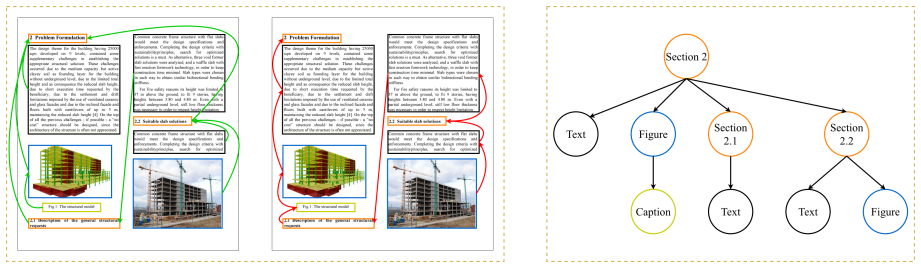
The central discovery is the rightmost-branch sufficiency invariant: because a depth-first traversal of the partial semantic tree matches document reading order, any page object in a later chunk that connects to an already-seen parent must attach to the tree's rightmost branch. This turns long-range cross-page dependency modeling into a sequence of bounded-size, in-chunk predictions, with a soft window across neighboring branches absorbing earlier errors. The in-chunk model fuses visual, semantic, category, and sizing features per object and predicts parent and predecessor jointly; the tree is updated online and guides the next chunk. Across five benchmarks, DOSA consistently improves over p
What carries the argument
The rightmost-branch sufficiency invariant—proved in the appendix—states that a later chunk's object can only have a parent on the rightmost branch of the partial tree. This invariant is the engine of the framework: it justifies feeding only a fixed-size window of structural context into the transformer, avoiding full-document attention and attention dilution. A branch-expanding soft window adds robustness by pulling in objects from the second- and third-rightmost branches when the window is not filled, mitigating the error propagation inherent in self-regressive decoding.
Load-bearing premise
The headline comparison assumes ground-truth reading order is available at inference to define chunk boundaries and place predicted nodes; when the model infers order itself, the TEDS advantage on the hardest benchmark drops from roughly 19 to 7 points.
What would settle it
Find a single ground-truth document where an object in a later chunk has a parent that is already present in the partial tree but does not lie on the rightmost branch; such a counterexample would refute the sufficiency proof in Appendix A.1, and the framework's advertised gains would fail on layouts that violate the invariant's depth-first reading-order assumption.
If this is right
- The same chunked, tree-guided decoding scheme applies to any task whose ground truth is a rooted ordered tree with a linear reading order—outlines, table-of-contents structures, or XML/JSON document hierarchies.
- A roughly 20-point TEDS gain on the hardest multi-page benchmark means the parsed tree can be used to set semantically meaningful chunk boundaries for retrieval-augmented generation and document retrieval, improving coherence downstream.
- At around 33M parameters, about a second per document on a single L4 GPU, and with per-chunk latency amortizable across parallel documents, the framework is a practical production option for long-document understanding.
- Because DOSA beats frontier long-context LLMs on structured reconstruction, the paper implies that explicit structural decoding outperforms generative prompting for hierarchy recovery, pointing future systems toward structure-aware inference.
Where Pith is reading between the lines
- The paper's error-accumulation analysis suggests a confidence-aware or dynamically sized context window could recover some of the ~12 TEDS points lost when reading order is inferred rather than given—an extension the authors do not pursue.
- The rightmost-branch invariant is specific to tree-structured relations; extending DOSA to citation or reference graphs would require generalizing 'rightmost branch' to a frontier set, something the paper's limitations section leaves open.
- Real deployments without a ground-truth reading order would need a reliable ordering predictor or joint training that up-weights ordering loss, since the ablations show ordering errors damage tree similarity far more than F1 (11.69 vs 1.07 points).
Editorial analysis
A structured set of objections, weighed in public.
Referee Report
Summary. The paper proposes DOSA, a chunk-based framework for document structure analysis that incrementally constructs a semantic tree and uses the tree's rightmost branches as context for processing later chunks. The central claim is that this tree-guided, self-regressive context selection enables efficient modeling of long-range cross-page dependencies, yielding large gains over prior work on DocHieNet (about 4 F1 points and 20 TEDS points over DHFormer) and outperforming LLM baselines. The paper includes a formal proof of the rightmost-branch sufficiency invariant, ablation studies isolating the contribution of tree-guided context, feature embedding ablations, and a comparison with LLMs.
Significance. If the reported results hold, DOSA offers a practical alternative to full-document attention for document hierarchy parsing, with a compact 33M-parameter model that outperforms both specialized document models and large multimodal LLMs. The paper ships a formal proof of the context-selection invariant and a clear ablation structure, and it evaluates on five benchmarks including the challenging DocHieNet. These are real strengths. However, the headline numbers rest on a single training run with an oracle reading order, and the main mechanism—tree-guided context—is only applied at inference, never during training, which raises a train/test shift that the paper does not address. The significance is therefore conditional on closing that gap and providing variance estimates.
major comments (5)
- [§4.2, §5.3, Appendix A.4] The central mechanism—tree-guided context selection—is applied only at inference. Appendix A.4 states that during training each chunk is treated as an individual unit, while §4.2 merges context objects from previous chunks only for inference. Consequently, the relation classifier in Eq. (3) is trained with a softmax over the N in-chunk candidates but evaluated over N+window_size candidates that include context objects. The model has never been trained to discriminate or select among out-of-chunk candidates, so the gains in Table 3 may reflect a different task at inference rather than the learned mechanism. Please either train with context (e.g., by sampling prior chunks as context) or provide analysis demonstrating that the classifier generalizes to out-of-chunk candidates (e.g., per-candidate-type accuracy, or a comparison with a model trained with context).
- [§5.2] The position encoding is normalized per chunk: page_no is relative to the chunk and is normalized by the total page count of that chunk. When context objects from a previous chunk are concatenated with the current chunk, their normalized page coordinates are on different scales (different denominators and reset page indices). The model therefore cannot correctly perceive absolute page distance between context and current objects, undermining the claimed cross-page dependency modeling. Please use absolute page numbers or a consistent normalization (e.g., by document length or a fixed maximum) and justify the choice.
- [Appendix A.3 and Tables 3–4] All reported results come from a single training run with a fixed random seed. The headline claim—a gain of ~4 F1 and ~20 TEDS over DHFormer on DocHieNet—has no variance estimate. Given the sensitivity to window size shown in Table 7 and the modest size of some ablations, a single run is insufficient to establish that the improvements are not partly due to seed noise. Please report mean and standard deviation over at least three seeds for the main results and key ablations.
- [§6.1, §6.6, Appendix A.3, A.6] The window size reporting is inconsistent: §6.1 states the context window size is 8, while Appendix A.3 says DocHieNet uses 16 and Table 3's sequential-window strategy uses 16. This makes it difficult to interpret the main results and ablations. Please state clearly which window size is used for each dataset and each reported table, and reconcile the main-text default with the appendix.
- [§6.4, Table 4] The headline comparison provides DOSA with ground-truth reading order at inference. Table 4 shows that with inferred ordering the TEDS advantage over DHFormer shrinks from ~19 to ~7.5 points. This is disclosed in the text, but the abstract and conclusion emphasize the 'nearly 20 TEDS' gain without this qualification. Since reading-order prediction is part of the task, the practical advantage is materially smaller; please clarify in the abstract and conclusion that the headline margin uses the oracle ordering.
minor comments (6)
- [Eq. (3)] The arg max over a softmax expression is visually awkward; consider defining the probability p_ij and then stating the prediction as arg max_j p_ij.
- [§5.2] The normalization of the position vector is described in prose; please give the exact formula (e.g., page_no / P_c, x1/W, y1/H) to avoid ambiguity.
- [Appendix A.4] The text says context is selected based on model predictions to avoid oracle information, but §6.4 says ground-truth ordering is used at inference. Clarify which parts of the input are oracle (ordering) and which are predicted (tree structure).
- [References] Some references lack venue or publication details (e.g., Longformer, LongLoRA, RAG-QA Arena). Please ensure all entries are complete.
- [Table 2] The LLM baseline versions (Gemini-2.5-Pro, GPT-5.2) are not dated; given rapid model evolution, specify the exact access date and version to allow reproducibility.
- [§6.6, Table 3] The sequential-window baseline retrieves the last 16 objects, but the default window size in §6.1 is 8. For a controlled comparison, all context strategies should use the same window size.
Circularity Check
No circular derivation: the rightmost-branch invariant is a structural proof, the relation classifier is a standard softmax, and the headline comparisons use an acknowledged oracle-order condition. Benchmark-tuned hyperparameters are an evaluation concern, not circularity.
full rationale
The paper's claimed derivation chain does not reduce any prediction to its inputs by construction. The central mechanism, tree-guided context selection, rests on the rightmost-branch sufficiency argument in Section 4.2 and Appendix A.1: if a child in chunk Ci has a parent in the partial tree Ti-1, the parent must lie on the rightmost branch. This is proved from the depth-first/reading-order correspondence and the chunk ordering, not assumed as a fitted or predicted quantity. The relation predictor in Eq. 3 is a standard softmax classifier over concatenated object embeddings; it is trained with focal loss and is not derived from the semantic tree in a way that would make its output equal to its input. The ablations in Table 3 compare context selection strategies on the same benchmark, and the optimal window size in Appendix A.3/A.6 is selected on DocHieNet; this is a hyperparameter-selection/generalizability concern, not a circular derivation, because the reported F1/TEDS numbers are not definitionally implied by the chosen window size. The use of ground-truth reading order for training and inference is explicitly disclosed in Section 6.4 and is a standard oracle evaluation condition, not a disguised output. There are no self-citations in the reference list, and no uniqueness theorem or ansatz is imported from the authors' prior work. The skeptical observation that tree-guided context is applied only at inference, and the page-number normalization mismatch when concatenating context objects, are train/test shift and implementation concerns rather than circularity under the stated criteria. Overall, the derivation is self-contained with respect to its inputs; the main risks are overfitting through benchmark-tuned hyperparameters and train/eval inconsistency, not circularity.
Axiom & Free-Parameter Ledger
free parameters (4)
- context_window_size =
16 for DocHieNet, 8 default (§6.1 vs A.3)
- max_objects_per_chunk =
256
- training_epochs =
100 default, 50 for HRDS/HRDH
- learning_rate_and_weight_decay =
5e-5, 1e-4
axioms (5)
- domain assumption Each page object (except root/first) has exactly one parent and one predecessor; the semantic tree is rooted and siblings are reading-ordered.
- domain assumption Chunk boundaries are prefixes of depth-first reading order, so earlier chunks contain only objects that appear earlier in the semantic tree.
- domain assumption Depth-first traversal of the semantic tree equals document reading order.
- domain assumption ResNet-50 and BERT feature representations contain enough visual/semantic signal to predict relations.
- domain assumption Ground-truth reading order is available at inference for the main reported results.
Cite this review
Pith. "Pith review of DOSA: A Tree-Guided, Self-Regressive Framework for Long Document Structure Analysis." pith.science (2026). https://pith.science/paper/QRFQEFAV
@misc{pith2026260722679,
  author       = {Pith},
  title        = {Pith review of: DOSA: A Tree-Guided, Self-Regressive Framework for Long Document Structure Analysis},
  year         = {2026},
  howpublished = {\url{https://pith.science/paper/QRFQEFAV}},
  note         = {Machine review of arXiv:2607.22679}
}
read the original abstract
In visually-rich documents, information is encoded not only in individual page objects such as tables, headers, and text blocks, but also in the structural relations among them, making document structure analysis fundamental to information retrieval and document understanding. However, accurately inferring such relations remains challenging in multi-page documents with long-range dependencies and heterogeneous layouts. To address this, we propose a tree-guided and self-regressive framework, termed DOcument Structure Analyzer (DOSA), for inferring relations among page objects and reconstructing document-level semantic trees. DOSA processes documents chunk-by-chunk, fusing visual, textual, and layout features for each page object and predicting hierarchical and ordering relations. The predicted relations are used to incrementally construct a semantic tree, which is then leveraged as structural context to guide inference on subsequent chunks. Experimental results on five benchmarks demonstrate the effectiveness of DOSA, with improvements of up to 4 F1 points and 19 TEDS points on DocHieNet, the most challenging multi-page hierarchy benchmark.
Figures


Reference graph
Works this paper leans on
-
[1]
2023 IEEE International Conference on Data Mining (ICDM) , pages=
Dsg: an end-to-end document structure generator , author=. 2023 IEEE International Conference on Data Mining (ICDM) , pages=. 2023 , organization=
2023
-
[2]
The Thirteenth International Conference on Learning Representations , year =
Chen, Yufan and Liu, Ruiping and Zheng, Junwei and Wen, Di and Peng, Kunyu and Zhang, Jiaming and Stiefelhagen, Rainer , title =. The Thirteenth International Conference on Learning Representations , year =
-
[3]
Proceedings of the AAAI Conference on Artificial Intelligence , volume=
Hrdoc: Dataset and baseline method toward hierarchical reconstruction of document structures , author=. Proceedings of the AAAI Conference on Artificial Intelligence , volume=
-
[4]
Proceedings of the 2024 Conference on Empirical Methods in Natural Language Processing , pages=
Dochienet: A large and diverse dataset for document hierarchy parsing , author=. Proceedings of the 2024 Conference on Empirical Methods in Natural Language Processing , pages=
2024
-
[5]
Proceedings of the AAAI Conference on Artificial Intelligence , volume=
Docparser: Hierarchical document structure parsing from renderings , author=. Proceedings of the AAAI Conference on Artificial Intelligence , volume=
-
[6]
Neural computation , volume=
Long short-term memory , author=. Neural computation , volume=. 1997 , publisher=
1997
-
[7]
Proceedings of the 28th ACM SIGKDD conference on knowledge discovery and data mining , pages=
Doclaynet: A large human-annotated dataset for document-layout segmentation , author=. Proceedings of the 28th ACM SIGKDD conference on knowledge discovery and data mining , pages=
-
[8]
arXiv preprint arXiv:1409.1259 , year=
On the properties of neural machine translation: Encoder-decoder approaches , author=. arXiv preprint arXiv:1409.1259 , year=
-
[9]
Pattern Recognition , volume=
Detect-order-construct: A tree construction based approach for hierarchical document structure analysis , author=. Pattern Recognition , volume=. 2024 , publisher=
2024
-
[10]
Proceedings of the 2025 Conference on Empirical Methods in Natural Language Processing , pages=
MultiDocFusion: Hierarchical and Multimodal Chunking Pipeline for Enhanced RAG on Long Industrial Documents , author=. Proceedings of the 2025 Conference on Empirical Methods in Natural Language Processing , pages=
2025
-
[11]
2017 , eprint=
Attention Is All You Need , author=. 2017 , eprint=
2017
-
[12]
arXiv preprint arXiv:2210.10340 , year=
The devil in linear transformer , author=. arXiv preprint arXiv:2210.10340 , year=
-
[13]
arXiv preprint arXiv:2407.13998 , year=
RAG-QA arena: Evaluating domain robustness for long-form retrieval augmented question answering , author=. arXiv preprint arXiv:2407.13998 , year=
-
[14]
arXiv preprint arXiv:2309.12307 , year=
Longlora: Efficient fine-tuning of long-context large language models , author=. arXiv preprint arXiv:2309.12307 , year=
-
[15]
arXiv preprint arXiv:2004.05150 , year=
Longformer: The long-document transformer , author=. arXiv preprint arXiv:2004.05150 , year=
Pith/arXiv arXiv 2004
-
[16]
2019 IEEE automatic speech recognition and understanding workshop (ASRU) , pages=
Hierarchical transformers for long document classification , author=. 2019 IEEE automatic speech recognition and understanding workshop (ASRU) , pages=. 2019 , organization=
2019
-
[17]
Proceedings of the IEEE conference on computer vision and pattern recognition , pages=
Feature pyramid networks for object detection , author=. Proceedings of the IEEE conference on computer vision and pattern recognition , pages=
-
[18]
Bert: Pre-training of deep bidirectional transformers for language understanding , author=. Proceedings of the 2019 conference of the North American chapter of the association for computational linguistics: human language technologies, volume 1 (long and short papers) , pages=
2019
-
[19]
Proceedings of the IEEE international conference on computer vision , pages=
Mask r-cnn , author=. Proceedings of the IEEE international conference on computer vision , pages=
-
[20]
Proceedings of the IEEE international conference on computer vision , pages=
Focal loss for dense object detection , author=. Proceedings of the IEEE international conference on computer vision , pages=
-
[21]
Proceedings of the IEEE conference on computer vision and pattern recognition , pages=
Deep residual learning for image recognition , author=. Proceedings of the IEEE conference on computer vision and pattern recognition , pages=
-
[22]
Proceedings of the thirteenth international conference on artificial intelligence and statistics , pages=
Understanding the difficulty of training deep feedforward neural networks , author=. Proceedings of the thirteenth international conference on artificial intelligence and statistics , pages=. 2010 , organization=
2010
-
[23]
International Conference on Learning Representations , year=
Decoupled Weight Decay Regularization , author=. International Conference on Learning Representations , year=
-
[24]
European conference on computer vision , pages=
Image-based table recognition: data, model, and evaluation , author=. European conference on computer vision , pages=. 2020 , organization=
2020
-
[25]
2019 International conference on document analysis and recognition (ICDAR) , pages=
Publaynet: largest dataset ever for document layout analysis , author=. 2019 International conference on document analysis and recognition (ICDAR) , pages=. 2019 , organization=
2019
This paper was first reviewed by deepseek-v4-flash on August 2, 2026.
discussion (0)
Sign in with ORCID, Apple, or X to comment. Anyone can read and Pith papers without signing in.