REVIEW 3 major objections 5 minor 128 references
The paper claims that inner-disk chemistry is already established in Class I/FS disks and that, after removing the effect of accretion luminosity, cold water and CO2 masses anti-correlate with disk radius, indicating icy pebble drift delive
Reviewed by Pith at T0; open to challenge. T0 means a machine referee read the full paper against a public rubric. the ladder, T0–T4 →
T0 review · deepseek-v4-flash
2026-08-01 04:22 UTC pith:C3KBIBVB
load-bearing objection First JWST/MIRI survey of embedded Class I/FS disks: genuinely new empirical data, but the pebble-drift interpretation leans on an uncalibrated Lacc conversion and a size-mismatched sample. the 3 major comments →
The JDISC Survey: Inner Disk Chemistry of Class I/FS Disks and Tentative Evidence for Early Pebble Drift
The pith
A machine-rendered reading of the paper's core claim, the machinery that carries it, and where it could break.
Core claim
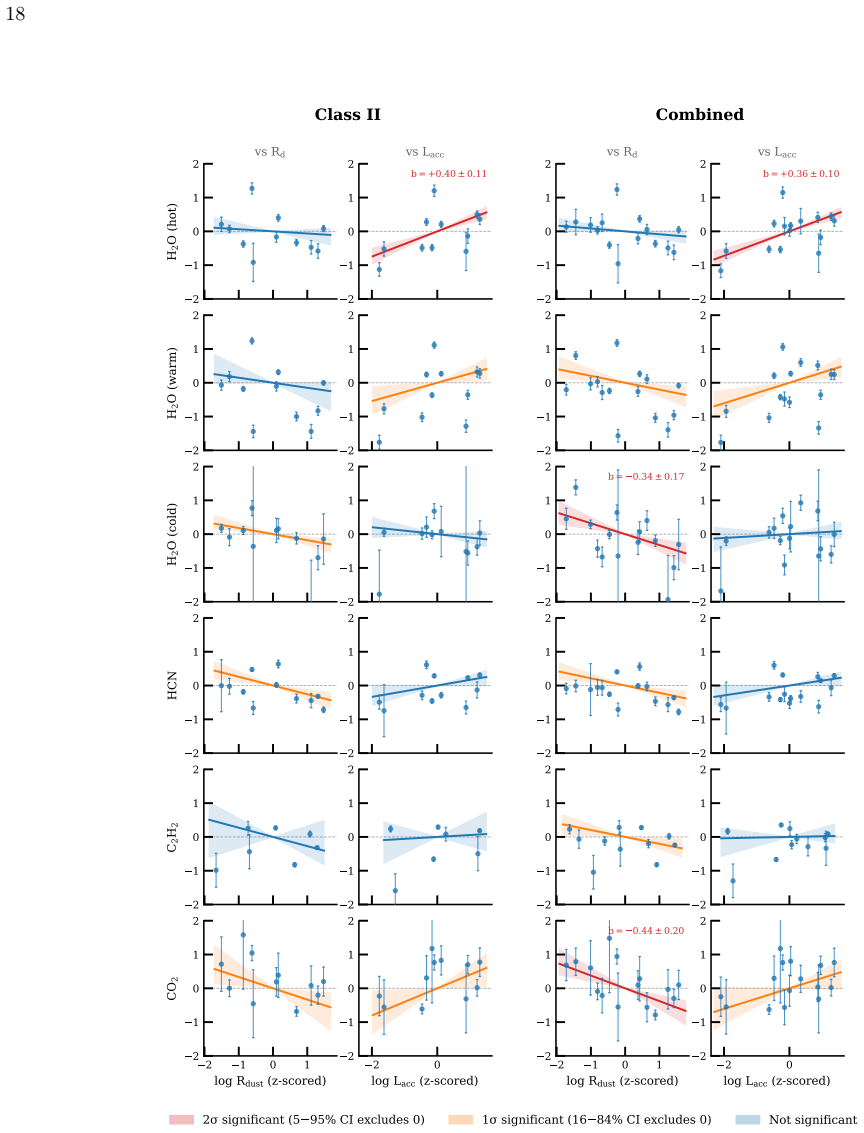
The central claim is that inner-disk chemistry is already well established in Class I/FS disks: at inclinations below 70°, water, HCN, C2H2, and CO2 are detected at rates and excitation conditions broadly comparable to Class II disks, placing the onset of chemically rich inner-disk environments earlier than previously characterized. The supporting statistical claim is that, once accretion luminosity is controlled for, cold water and CO2 observable masses anti-correlate with mm-dust disk radius (best-fit slopes -0.34 and -0.44, each excluding zero at the 2-sigma level in the combined sample), whereas hot water is insensitive to disk size. The authors argue that this dichotomy — hot water set
What carries the argument
The analysis relies on three components: (1) mid-infrared spectroscopy with JWST/MIRI resolving molecular rovibrational and rotational lines; (2) multi-component LTE slab modeling, which decomposes water into hot (~900 K), warm (~460 K), and cold (~200 K) components and retrieves temperature, column density, emitting area, and observable mass for each molecule; and (3) a multivariate weighted regression on standardized (z-scored) accretion luminosity and dust disk radius, which separates the two opposite-signed drivers and yields the partial slopes that isolate the pebble-drift signature. The underlying physical mechanism invoked is the inward drift of icy pebbles crossing successive snowlin
Load-bearing premise
The conversion from hydrogen recombination line (HI 10-7) luminosity to accretion luminosity, calibrated on older Class II stars, is assumed to hold for embedded Class I/FS sources; the paper states this conversion 'has not been calibrated for embedded systems,' so if it is systematically biased, the partial residuals that reveal the cold-water and CO2 anti-correlations could be artifacts.
What would settle it
Measure the accretion luminosity of a sample of Class I/FS sources with an independent method (e.g., modeling the UV/optical excess) and compare to the HI(10-7)-derived values; if the two disagree systematically as a function of disk size, the reported anti-correlations would need to be re-derived. Alternatively, a null result from a larger sample with matched disk-size distributions would falsify the evolutionary framework.
If this is right
- Inner-disk chemistry matures by the Class I stage, so planet-forming material is already chemically processed within the first million years.
- Compact disks should show systematically stronger cold water and CO2 emission at fixed accretion rate, giving a direct observational handle on which disks are currently experiencing efficient pebble drift.
- The CO2-to-water ratio should rise as disks age, because water is delivered first and CO2 later; tracking this ratio across bolometric temperature or age tests the proposed evolutionary sequence.
- Disk substructures (gaps) located between the water and CO2 snowlines should suppress cold water delivery without suppressing CO2, a prediction that can be checked with larger samples.
- Class I/FS disks with edge-on geometry will appear molecule-poor, so inclination must be accounted for in any census of embedded-disk chemistry.
Where Pith is reading between the lines
- The paper tabulates hydrogen recombination line luminosities so that any future recalibration of the accretion-luminosity conversion can be applied without re-observing; this makes the weakest assumption directly testable.
- A natural extension is to apply the same accretion-controlled regression to OH or rare isotopologues, which could separate thermal-production from drift-replenishment pathways more cleanly.
- If the pebble-drift interpretation holds, then the cold-water excess should correlate with the absence of millimeter substructure in individual disks, an ALMA-testable prediction not made in the paper.
- The framework implies that the terrestrial-planet-forming zones of compact disks are oxygen-enriched early on, which could leave imprints in the C/O ratios of forming planets; connecting to exoplanet atmospheric compositions would be a downstream consequence.
Editorial analysis
A structured set of objections, weighed in public.
Referee Report
Summary. The paper presents the first JWST MIRI/MRS chemical survey of Class I and Flat-Spectrum disks, targeting 16 Ophiuchus sources, and compares seven low-inclination (i<70°) objects with 12 low-mass Class II disks from the public JDISCS sample. Using empirical line luminosities, line ratios, and 0D LTE slab models, it finds that H2O, HCN, C2H2, and CO2 are detected at rates and excitation temperatures broadly similar to Class II disks, with a tentative cold-water excess (1.4σ) and colder CO2 (1.5σ) in Class I/FS sources. The central quantitative claim is the multivariate regression of Eq. (2): after controlling for HI-based accretion luminosity, cold H2O (b_Rd=-0.34) and CO2 (b_Rd=-0.44) masses anti-correlate with mm-dust disk radius at 2σ in the combined sample, while hot water scales with Lacc and is insensitive to disk size. This is interpreted as evidence for early inward pebble drift and a water-rich evolutionary phase before Class II.
Significance. If the underlying trends hold, the paper would provide an important observational benchmark: inner-disk molecular chemistry is already established in Class I/FS disks, and compact young disks are preferentially enriched in cold volatiles. The statistical toolkit is a genuine strength: censored Kendall tau incorporates upper limits, BH-FDR correction is applied (and none of the univariate tests survive it), bootstrap medians and power analyses are reported, and the HI line luminosities are tabulated so the Lacc conversion can be recomputed. The line images and velocity checks help exclude a dominant outflow contribution. The main risk is that the paper's most interesting quantitative conclusion depends on an admittedly uncalibrated HI(10-7)-to-Lacc conversion applied to embedded sources, combined with a small and non-overlapping sample. The paper is honest about this, but it does not quantify the vulnerability.
major comments (3)
- [§4.4.2, Eq. (2) and §5.4] The 2σ slopes b_Rd=-0.34 (cold water) and b_Rd=-0.44 (CO2) are the load-bearing quantitative evidence for the pebble-drift interpretation. These partial slopes assume the HI(10-7)-to-Lacc conversion is on the same scale for embedded Class I/FS and Class II sources; §5.4 states it 'has not been calibrated for embedded systems.' Since Class I/FS disks are systematically more compact (median Rd ~13 au vs ~54 au, Fig. 1), any class-dependent Lacc offset can masquerade as an Rd anti-correlation in the partial residuals. Please add a sensitivity analysis: apply a plausible range of offsets to the Class I/FS Lacc values in the combined regression and report the offset needed to bring b_Rd to zero, or include a class indicator in the regression to show the slopes are stable.
- [§4.4.2, Fig. 10] The 2σ combined-sample slopes are estimated from only 15 sources: 11 Class II with detected Lacc plus 4 Class I/FS with detected Lacc (Oph 3, 5, 7, 15). The Class II-only cold-water slope is not significant (b_Rd=-0.16), and none of the univariate censored Kendall tests survive BH-FDR. It is therefore critical to show that the combined result is not driven by the four Class I/FS points or by sample composition. Please report leave-one-out fits, a Class II-only regression with the same method, and a version with a class dummy. Without such tests, the claim that disk size—rather than evolutionary class—governs cold water and CO2 is under-supported.
- [§5.2 / Fig. 11] The evolutionary interpretation also uses Tbol as a relative age indicator and compares observed CO2/H2O(cold) ratios with Sellek et al. model tracks. The text acknowledges the data cannot distinguish gap scenarios, and the observed trend is only tentative. This is acceptable for an exploratory paper, but the conclusion should make clearer that the Tbol trend is not a statistically significant correlation and that the evolutionary sequence in Table 4 is a qualitative framework rather than a tested model.
minor comments (5)
- [§3.3] The Lacc calibration is cited as 'Tofflemire et al. 2025; Shridharan et al. 2026 and updated in Hyden et al. 2026 (in prep)'. The Hyden et al. in-prep reference does not appear in the reference list; please either add it or identify the version used.
- [§4.4.2] 'all 15 sources (after excluding Lacc upper limits)' is easy to misread: 11 Class II plus 4 Class I/FS. Please state the sample composition explicitly in the text or figure caption.
- [Table 1 / §2.1] For Oph 11-16 the stellar masses are adopted from McClure et al. (2010) and 'Ruiz-Rodriguez et al. in prep'; the in-prep citation should be resolved or replaced with a public reference where possible.
- [§3.4] The slab-model section correctly notes the area-column density degeneracy and the lower-limit nature of observable masses; it would help to state explicitly that the mass ratios used in Fig. 11 inherit that degeneracy, though the ratio is less sensitive to it.
- [Figure 11] The upper panel shows model tracks while the lower panel shows observed data on an age/Tbol axis. The caption should make clear that no direct quantitative fit to the tracks is made; the comparison is qualitative, as stated in the text.
Circularity Check
No significant circularity: empirical measurements are independent of the qualitative pebble-drift comparison; the main caveat is an uncalibrated Lacc conversion, which is a stated systematic uncertainty rather than a definitional reduction.
full rationale
The paper's derivation chain is empirical and self-contained. Molecular masses come from LTE slab fits to MIRI spectra; accretion luminosities are derived from a separate HI(10-7) line; dust disk radii are measured from mm continuum. These are independent observables, and the multivariate regression (Eq. 2) is a statistical description of their correlations, not a prediction fitted from the same quantity it claims to explain. The pebble-drift interpretation is qualitative and relied on external models (e.g., Sellek et al. 2025), which are not calibrated to the observed masses. Self-citations to the JDISCS pipeline and companion papers provide data-reduction and comparison-sample context but do not force the central anti-correlations. The paper explicitly acknowledges the one load-bearing assumption—that the HI(10-7)-to-Lacc conversion, calibrated on Class II/T Tauri stars, holds for embedded Class I/FS systems—as uncalibrated (Section 5.4). That is a legitimate systematic uncertainty and a possible source of bias, but it is not a circular reduction: nothing in the paper defines the target result in terms of itself. No fitted parameter is renamed as a prediction, no uniqueness theorem is imported from the authors, and no ansatz is smuggled in by citation. Therefore the paper has very low circularity burden, consistent with an honest exploratory survey.
Axiom & Free-Parameter Ledger
free parameters (3)
- HI(10-7)-to-Lacc empirical coefficients =
not listed (Tofflemire et al. 2025; Shridharan et al. 2026; Hyden et al. in prep)
- Extinction law normalization and exponent =
τ_ext = 0.085 λ^{-0.25} A_V; A_K = A_V/7.75
- Slab model prior ranges =
T_water: 500-1500/200-800/100-400 K; T_others: 100-2000 K; logN: 12-22; logA: -4 to 4
axioms (4)
- domain assumption The MIRI molecular emission in i<70° Class I/FS sources originates predominantly in the inner disk, not the envelope or outflow.
- domain assumption LTE 0D slab models reliably recover the observable molecular mass and excitation temperature of the line-emitting layer.
- domain assumption The Class II comparison sample, selected by M*≤0.7 Msun, is an appropriate evolutionary counterpart to the Class I/FS sample.
- domain assumption Literature AV values and the McClure (2009) extinction law are accurate for the Class I/FS sources.
read the original abstract
We present the first chemical survey of Class I and Flat-Spectrum (I/FS) disks using JWST MIRI/MRS, targeting sixteen sources in the Ophiuchus star-forming region. Through empirical line luminosity measurements and multi-component slab modeling, we characterize the molecular reservoir of these young systems and compare them to twelve Class II disks of similar stellar mass. Water, HCN, C$_2$H$_2$, and CO$_2$ are frequently detected in I/FS sources with inclinations $i < 70^{\circ}$, whereas edge-on systems show significantly suppressed emission. Compared to Class II disks, I/FS sources show suggestive---though not yet statistically significant---evidence for elevated cold water ($\sim$200\,K) mass and lower CO$_2$ excitation temperatures. Statistical analyses identify accretion luminosity as the primary correlate of molecular mass across both evolutionary stages. Once this dependence is removed, cold water and CO$_2$ masses anti-correlate with mm-dust disk radius, while hot water remains insensitive to disk size. These patterns are qualitatively consistent with pebble drift models that predict early water enrichment followed by delayed CO$_2$ delivery, suggesting an evolutionary progression from molecular-poor Class 0 sources, through water-rich Class I/FS disks, to Class II disks with reduced cold water excess. This work provides an initial evolutionary framework for disk chemistry that requires larger, multi-region samples to confirm.
Figures




Reference graph
Works this paper leans on
-
[1]
ALMA Partnership , Brogan , C. L., P \'e rez , L. M., et al. 2015, title The 2014 ALMA Long Baseline Campaign: First Results from High Angular Resolution Observations toward the HL Tau Region , , 808, L3, 10.1088/2041-8205/808/1/L3
-
[2]
Anderson , D. E., Blake , G. A., Cleeves , L. I., et al. 2021, title Observing Carbon and Oxygen Carriers in Protoplanetary Disks at Mid-infrared Wavelengths , , 909, 55, 10.3847/1538-4357/abd9c1
-
[3]
Andr \'e , P., Ward-Thompson , D., & Barsony , M. 1993, title Submillimeter Continuum Observations of Rho Ophiuchi A: The Candidate Protostar VLA 1623 and Prestellar Clumps , , 406, 122, 10.1086/172425
doi:10.1086/172425 1993
-
[4]
Andrews , S. M., Huang , J., P \'e rez , L. M., et al. 2018, title The Disk Substructures at High Angular Resolution Project (DSHARP). I. Motivation, Sample, Calibration, and Overview , , 869, L41, 10.3847/2041-8213/aaf741
-
[5]
M., Kamp , I., van Dishoeck , E
Arabhavi , A. M., Kamp , I., van Dishoeck , E. F., et al. 2026, title Molecular diagnostics for the mid-infrared emission of planet-forming disks. Carbon and oxygen elemental abundances , arXiv e-prints, arXiv:2602.16030, 10.48550/arXiv.2602.16030
-
[6]
Argyriou , I., Glasse , A., Law , D. R., et al. 2023, title JWST MIRI flight performance: The Medium-Resolution Spectrometer , , 675, A111, 10.1051/0004-6361/202346489
-
[7]
Arulanantham , N., Salyk , C., Pontoppidan , K., et al. 2025, title The JDISC Survey: Linking the Physics and Chemistry of Inner and Outer Protoplanetary Disk Zones , , 170, 67, 10.3847/1538-3881/addd01
-
[8]
Assani , K. D., Li , Z.-Y., Ramsey , J. P., et al. 2025, title Mid-infrared extinction curve for protostellar envelopes from JWST-detected embedded jet emission: The case of TMC1A , , 701, A175, 10.1051/0004-6361/202555016
-
[9]
Astropy Collaboration , Robitaille , T. P., Tollerud , E. J., et al. 2013, title Astropy: A community Python package for astronomy , , 558, A33, 10.1051/0004-6361/201322068
-
[10]
Astropy Collaboration , Price-Whelan , A. M., Sip o cz , B. M., et al. 2018, title The Astropy Project: Building an Open-science Project and Status of the v2.0 Core Package , , 156, 123, 10.3847/1538-3881/aabc4f
-
[11]
Astropy Collaboration , Price-Whelan , A. M., Lim , P. L., et al. 2022, title The Astropy Project: Sustaining and Growing a Community-oriented Open-source Project and the Latest Major Release (v5.0) of the Core Package , , 935, 167, 10.3847/1538-4357/ac7c74
-
[12]
Banzatti , A., Pascucci , I., Bosman , A. D., et al. 2020, title Hints for Icy Pebble Migration Feeding an Oxygen-rich Chemistry in the Inner Planet-forming Region of Disks , , 903, 124, 10.3847/1538-4357/abbc1a
-
[13]
Banzatti , A., Pontoppidan , K. M., Carr , J. S., et al. 2023, title JWST Reveals Excess Cool Water near the Snow Line in Compact Disks, Consistent with Pebble Drift , , 957, L22, 10.3847/2041-8213/acf5ec
-
[14]
Banzatti , A., Salyk , C., Pontoppidan , K. M., et al. 2025, title Water in Protoplanetary Disks with JWST-MIRI: Spectral Excitation Atlas and Radial Distribution from Temperature Diagnostic Diagrams and Doppler Mapping , , 169, 165, 10.3847/1538-3881/ada962
-
[15]
Baraffe , I., Homeier , D., Allard , F., & Chabrier , G. 2015, title New evolutionary models for pre-main sequence and main sequence low-mass stars down to the hydrogen-burning limit , , 577, A42, 10.1051/0004-6361/201425481
-
[16]
Benjamini, Y., & Hochberg, Y. 2018, title Controlling the False Discovery Rate: A Practical and Powerful Approach to Multiple Testing, Journal of the Royal Statistical Society: Series B (Methodological), 57, 289, 10.1111/j.2517-6161.1995.tb02031.x
arXiv 2018
-
[17]
Bhowmik , T., Cieza , L., Miley , J. M., et al. 2026, title The Ophiuchus DIsc Survey Employing ALMA (ODISEA). Substructures as a function of SED Class and disc mass in 100 systems , arXiv e-prints, arXiv:2604.19246, 10.48550/arXiv.2604.19246
-
[18]
Birnstiel , T., Klahr , H., & Ercolano , B. 2012, title A simple model for the evolution of the dust population in protoplanetary disks , , 539, A148, 10.1051/0004-6361/201118136
-
[19]
Bohlin , R. C., Hubeny , I., & Rauch , T. 2020, title New Grids of Pure-hydrogen White Dwarf NLTE Model Atmospheres and the HST/STIS Flux Calibration , , 160, 21, 10.3847/1538-3881/ab94b4
-
[20]
Booth , R. A., Clarke , C. J., Madhusudhan , N., & Ilee , J. D. 2017, title Chemical enrichment of giant planets and discs due to pebble drift , , 469, 3994, 10.1093/mnras/stx1103
-
[21]
Booth , R. A., & Ilee , J. D. 2019, title Planet-forming material in a protoplanetary disc: the interplay between chemical evolution and pebble drift , , 487, 3998, 10.1093/mnras/stz1488
-
[22]
D., Bruderer , S., & van Dishoeck , E
Bosman , A. D., Bruderer , S., & van Dishoeck , E. F. 2017, title CO _ 2 infrared emission as a diagnostic of planet-forming regions of disks , , 601, A36, 10.1051/0004-6361/201629946
-
[23]
W., Hollander, M., & Korwar, R
Brown, B. W., Hollander, M., & Korwar, R. M. 1974, title Nonparametric Tests of Independence for Censored Data with Application to Heart Transplant Studies, Reliability and Biometry: Statistical Analysis of Lifelength, 327
1974
-
[24]
Bruderer , S., Harsono , D., & van Dishoeck , E. F. 2015, title Ro-vibrational excitation of an organic molecule (HCN) in protoplanetary disks , , 575, A94, 10.1051/0004-6361/201425009
-
[25]
2025, JWST Calibration Pipeline , 1.20.2 Zenodo, 10.5281/zenodo.17515973
Bushouse , H., Eisenhamer , J., Dencheva , N., et al. 2025, JWST Calibration Pipeline , 1.20.2 Zenodo, 10.5281/zenodo.17515973
-
[26]
Carr , J. S., & Najita , J. R. 2008, title Organic Molecules and Water in the Planet Formation Region of Young Circumstellar Disks , Science, 319, 1504, 10.1126/science.1153807
-
[27]
S., & Najita, J
Carr, J. S., & Najita, J. R. 2011, title Organic Molecules and Water in the Inner Disks of T Tauri Stars , , 733, 102
2011
-
[28]
A., Ru \' z-Rodr \' guez , D., Hales , A., et al
Cieza , L. A., Ru \' z-Rodr \' guez , D., Hales , A., et al. 2019, title The Ophiuchus DIsc Survey Employing ALMA (ODISEA) - I: project description and continuum images at 28 au resolution , , 482, 698, 10.1093/mnras/sty2653
-
[29]
A., Gonz \'a lez-Ruilova , C., Hales , A
Cieza , L. A., Gonz \'a lez-Ruilova , C., Hales , A. S., et al. 2021, title The Ophiuchus DIsc Survey Employing ALMA (ODISEA) - III. The evolution of substructures in massive discs at 3-5 au resolution , , 501, 2934, 10.1093/mnras/staa3787
-
[30]
J., Tazzari , M., Juhasz , A., et al
Clarke , C. J., Tazzari , M., Juhasz , A., et al. 2018, title High-resolution Millimeter Imaging of the CI Tau Protoplanetary Disk: A Massive Ensemble of Protoplanets from 0.1 to 100 au , , 866, L6, 10.3847/2041-8213/aae36b
-
[31]
Colmenares , M. J., Bergin , E. A., Zhang , K., et al. 2026, title JWST/MIRI Hydrocarbon and Water Absorption in the Wind of a Young Disk: Signatures of Pebble Drift and Carbon Grain Sublimation , , 1002, 176, 10.3847/1538-4357/ae5e6a
-
[32]
2024, lifelines, survival analysis in Python, v0.29.0 Zenodo, 10.5281/zenodo.12549337
Davidson-Pilon, C. 2024, lifelines, survival analysis in Python, v0.29.0 Zenodo, 10.5281/zenodo.12549337
-
[33]
Deng, D., Pascucci, I., & Fernandes, R. B. 2025, title ysoisochrone: A Python package to estimate masses and ages for YSOs, Journal of Open Source Software, 10, 7493, 10.21105/joss.07493
-
[34]
Easterwood , W., Kalyaan , A., & Banzatti , A. 2024, title Water Enrichment from Pebble Drift in Disks with Gap-forming Planets , , 977, 21, 10.3847/1538-4357/ad891d
-
[35]
Est \`e ve , P., Tabone , B., Habart , E., et al. 2026, title Chemistry and IR emission of acetylene in planet-forming regions of T Tauri disks. Impact of elemental abundances and dust properties , arXiv e-prints, arXiv:2605.18062, 10.48550/arXiv.2605.18062
work page internal anchor Pith review Pith/arXiv arXiv doi:10.48550/arxiv.2605.18062 2026
-
[36]
Evans , Neal J., I., Dunham , M. M., J rgensen , J. K., et al. 2009, title The Spitzer c2d Legacy Results: Star-Formation Rates and Efficiencies; Evolution and Lifetimes , , 181, 321, 10.1088/0067-0049/181/2/321
-
[37]
Feiden , G. A. 2016, title Magnetic inhibition of convection and the fundamental properties of low-mass stars. III. A consistent 10 Myr age for the Upper Scorpius OB association , , 593, A99, 10.1051/0004-6361/201527613
-
[38]
Flaherty , K., Hughes , A. M., Simon , J. B., et al. 2020, title Measuring Turbulent Motion in Planet-forming Disks with ALMA: A Detection around DM Tau and Nondetections around MWC 480 and V4046 Sgr , , 895, 109, 10.3847/1538-4357/ab8cc5
-
[39]
Flaherty , K. M., Hughes , A. M., Rosenfeld , K. A., et al. 2015, title Weak Turbulence in the HD 163296 Protoplanetary Disk Revealed by ALMA CO Observations , , 813, 99, 10.1088/0004-637X/813/2/99
-
[40]
Foreman-Mackey , D., Hogg , D. W., Lang , D., & Goodman , J. 2013, title emcee: The MCMC Hammer , , 125, 306, 10.1086/670067
doi:10.1086/670067 2013
-
[41]
F., Caratti o Garatti , A., et al
Francis , L., van Dishoeck , E. F., Caratti o Garatti , A., et al. 2025, title JOYS: The [D/H] abundance derived from protostellar outflows across the Galactic disk measured with JWST , , 694, A174, 10.1051/0004-6361/202451629
-
[42]
Gasman , D., Temmink , M., van Dishoeck , E. F., et al. 2025, title MINDS: The influence of outer dust disc structure on the volatile delivery to the inner disc , , 694, A147, 10.1051/0004-6361/202452152
-
[43]
Grant , S. L., van Dishoeck , E. F., Tabone , B., et al. 2023, title MINDS. The Detection of ^ 13 CO _ 2 with JWST-MIRI Indicates Abundant CO _ 2 in a Protoplanetary Disk , , 947, L6, 10.3847/2041-8213/acc44b
-
[44]
L., Temmink , M., van Dishoeck , E
Grant , S. L., Temmink , M., van Dishoeck , E. F., et al. 2025, title MINDS: A transition from H _ 2 O to C _ 2 H _ 2 dominated disk spectra with decreasing stellar luminosity , , 702, A126, 10.1051/0004-6361/202555862
-
[45]
2025, title Early Planet Formation in Embedded Disks (eDisk)
Han , I., Kwon , W., Aso , Y., et al. 2025, title Early Planet Formation in Embedded Disks (eDisk). XVII. A Compact but Structured Keplerian Disk and Large-scale Streamers Revealed in the Class I Protostellar System IRAS 04169+2702 , , 993, 120, 10.3847/1538-4357/ade684
-
[46]
Harsono , D., Bjerkeli , P., van der Wiel , M. H. D., et al. 2018, title Evidence for the start of planet formation in a young circumstellar disk , Nature Astronomy, 2, 646, 10.1038/s41550-018-0497-x
-
[47]
Harsono , D., Bruderer , S., & van Dishoeck , E. F. 2015, title Volatile snowlines in embedded disks around low-mass protostars , , 582, A41, 10.1051/0004-6361/201525966
-
[48]
2024, title MINDS: The JWST MIRI Mid-INfrared Disk Survey , , 136, 054302, 10.1088/1538-3873/ad3455
Henning , T., Kamp , I., Samland , M., et al. 2024, title MINDS: The JWST MIRI Mid-INfrared Disk Survey , , 136, 054302, 10.1088/1538-3873/ad3455
-
[49]
Herczeg , G. J., Brown , J. M., van Dishoeck , E. F., & Pontoppidan , K. M. 2011, title Disks and outflows in CO rovibrational emission from embedded, low-mass young stellar objects , , 533, A112, 10.1051/0004-6361/201016246
-
[50]
Houge , A., Krijt , S., Banzatti , A., et al. 2025, title Smuggling unnoticed: towards a 2D view of water and dust delivery to the inner regions of protoplanetary discs , , 537, 691, 10.1093/mnras/staf057
-
[51]
Hsieh , C.-H., Arce , H. G., Maureira , M. J., et al. 2024, title The ALMA Legacy Survey of Class 0/I Disks in Corona australis, Aquila, chaMaeleon, oPhiuchus north, Ophiuchus, Serpens (CAMPOS). I. Evolution of Protostellar Disk Radii , , 973, 138, 10.3847/1538-4357/ad6152
-
[52]
Hsieh , C.-H., Arce , H. G., Maureira , M. J., et al. 2025, title CAMPOS: II. The onset of protostellar disk substructures and planet formation , , 700, A235, 10.1051/0004-6361/202555174
-
[53]
Huang , J., Andrews , S. M., Dullemond , C. P., et al. 2018, title The Disk Substructures at High Angular Resolution Project (DSHARP). II. Characteristics of Annular Substructures , , 869, L42, 10.3847/2041-8213/aaf740
-
[54]
Humes , O. A., Martin , A. C., Thomas , C. A., & Emery , J. P. 2024, title Comparative Mid-infrared Spectroscopy of Dark, Primitive Asteroids: Does Shared Taxonomic Class Indicate Shared Silicate Composition? , , 5, 108, 10.3847/PSJ/ad3a69
-
[55]
Hunter , J. D. 2007, title Matplotlib: A 2D Graphics Environment , Computing in Science and Engineering, 9, 90, 10.1109/MCSE.2007.55
-
[56]
Isobe , T., Feigelson , E. D., & Nelson , P. I. 1986, title Statistical Methods for Astronomical Data with Upper Limits. II. Correlation and Regression , , 306, 490, 10.1086/164359
doi:10.1086/164359 1986
-
[57]
G., Banzatti , A., Johnson , M
Jellison , E. G., Banzatti , A., Johnson , M. B., & Bruderer , S. 2024, title iSLAT: the Interactive Spectral-line Analysis Tool for JWST and Beyond , , 168, 99, 10.3847/1538-3881/ad6142
-
[58]
Kaeufer , T., Min , M., Woitke , P., Kamp , I., & Arabhavi , A. M. 2024, title Bayesian analysis of the molecular emission and dust continuum of protoplanetary disks , , 687, A209, 10.1051/0004-6361/202449936
-
[59]
Kalyaan , A., Pinilla , P., Krijt , S., Mulders , G. D., & Banzatti , A. 2021, title Linking Outer Disk Pebble Dynamics and Gaps to Inner Disk Water Enrichment , , 921, 84, 10.3847/1538-4357/ac1e96
-
[60]
Kalyaan , A., Pinilla , P., Krijt , S., et al. 2023, title The Effect of Dust Evolution and Traps on Inner Disk Water Enrichment , , 954, 66, 10.3847/1538-4357/ace535
-
[61]
Kelly , B. C. 2007, title Some Aspects of Measurement Error in Linear Regression of Astronomical Data , , 665, 1489, 10.1086/519947
doi:10.1086/519947 2007
-
[62]
Krijt , S., Kama , M., McClure , M., et al. 2023, title Chemical Habitability: Supply and Retention of Life's Essential Elements During Planet Formation , in Astronomical Society of the Pacific Conference Series, Vol. 534, Protostars and Planets VII, ed. S. Inutsuka , Y. Aikawa , T. Muto , K. Tomida , & M. Tamura , 1031, 10.48550/arXiv.2203.10056
-
[63]
Krijt , S., Banzatti , A., Zhang , K., et al. 2025, title Cosmic Cascades: How Disk Substructure Regulates the Flow of Water to Inner Planetary Systems , , 990, L72, 10.3847/2041-8213/adfbe3
-
[64]
S., Burkhardt , C., Budde , G., & Kleine , T
Kruijer , T. S., Burkhardt , C., Budde , G., & Kleine , T. 2017, title Age of Jupiter inferred from the distinct genetics and formation times of meteorites , Proceedings of the National Academy of Science, 114, 6712, 10.1073/pnas.1704461114
-
[65]
Lichtenberg , T., Dr a \.z kowska , J., Sch \"o nb \"a chler , M., Golabek , G. J., & Hands , T. O. 2021, title Bifurcation of planetary building blocks during Solar System formation , Science, 371, 365, 10.1126/science.abb3091
-
[66]
Long , F., Herczeg , G. J., Harsono , D., et al. 2019, title Compact Disks in a High-resolution ALMA Survey of Dust Structures in the Taurus Molecular Cloud , , 882, 49, 10.3847/1538-4357/ab2d2d
-
[67]
Luo , L., Pinilla , P., Pulgar \'e s , C., et al. 2026, title The ALMA Survey of Gas Evolution of PROtoplanetary Disks (AGE-PRO): Constraints on disk turbulence, fragmentation velocity, and inner pebble fluxes , , 10.1093/mnras/stag423
-
[68]
Mah , J., Savvidou , S., & Bitsch , B. 2024, title Mind the gap: Distinguishing disc substructures and their impact on the inner disc composition , , 686, L17, 10.1051/0004-6361/202450322
-
[69]
Mallaney , P., Banzatti , A., Salyk , C., et al. 2026, title Protoplanetary Disk Cavities with JWST-MIRI: A Dichotomy in Molecular Emission , , 998, 255, 10.3847/1538-4357/ae32f1
-
[70]
Manara , C. F., Ansdell , M., Rosotti , G. P., et al. 2023, title Demographics of Young Stars and their Protoplanetary Disks: Lessons Learned on Disk Evolution and its Connection to Planet Formation , in Astronomical Society of the Pacific Conference Series, Vol. 534, Protostars and Planets VII, ed. S. Inutsuka , Y. Aikawa , T. Muto , K. Tomida , & M. Tam...
-
[71]
McClure , M. 2009, title Observational 5-20 m Interstellar Extinction Curves Toward Star-Forming Regions Derived From Spitzer IRS Spectra , , 693, L81, 10.1088/0004-637X/693/2/L81
-
[72]
K., Furlan , E., Manoj , P., et al
McClure , M. K., Furlan , E., Manoj , P., et al. 2010, title The Evolutionary State of the Pre-main Sequence Population in Ophiuchus: A Large Infrared Spectrograph Survey , , 188, 75, 10.1088/0067-0049/188/1/75
-
[73]
M., Lai , S.-P., Bruderer , S., Harsono , D., & van Dishoeck , E
Murillo , N. M., Lai , S.-P., Bruderer , S., Harsono , D., & van Dishoeck , E. F. 2013, title A Keplerian disk around a Class 0 source: ALMA observations of VLA1623A , , 560, A103, 10.1051/0004-6361/201322537
-
[74]
R., Carr, J
Najita, J. R., Carr, J. S., Pontoppidan, K. M., et al. 2013, title The HCN-Water Ratio in the Planet Formation Region of Disks , , 766, 134
2013
-
[75]
Najita , J. R., & Kenyon , S. J. 2014, title The mass budget of planet-forming discs: isolating the epoch of planetesimal formation , , 445, 3315, 10.1093/mnras/stu1994
-
[76]
Narang , M., Pontoppidan , K. M., Salyk , C., et al. 2026, title Characterizing the Extended Molecular Hydrogen Winds in Protoplanetary Disks from the JWST Disk Infrared Spectroscopic Chemistry Survey , , 1004, 188, 10.3847/1538-4357/ae6c27
-
[77]
\"O berg , K. I., & Bergin , E. A. 2016, title Excess C/O and C/H in Outer Protoplanetary Disk Gas , , 831, L19, 10.3847/2041-8205/831/2/L19
-
[78]
I., Facchini , S., & Anderson , D
\"O berg , K. I., Facchini , S., & Anderson , D. E. 2023, title Protoplanetary Disk Chemistry , , 61, 287, 10.1146/annurev-astro-022823-040820
-
[79]
Ohashi , N., Tobin , J. J., J rgensen , J. K., et al. 2023, title Early Planet Formation in Embedded Disks (eDisk). I. Overview of the Program and First Results , , 951, 8, 10.3847/1538-4357/acd384
-
[80]
Ortiz-Le \'o n , G. N., Loinard , L., Dzib , S. A., et al. 2018, title Gaia-DR2 Confirms VLBA Parallaxes in Ophiuchus, Serpens, and Aquila , , 869, L33, 10.3847/2041-8213/aaf6ad
discussion (0)
Sign in with ORCID, Apple, or X to comment. Anyone can read and Pith papers without signing in.