REVIEW 3 major objections 5 minor 60 references
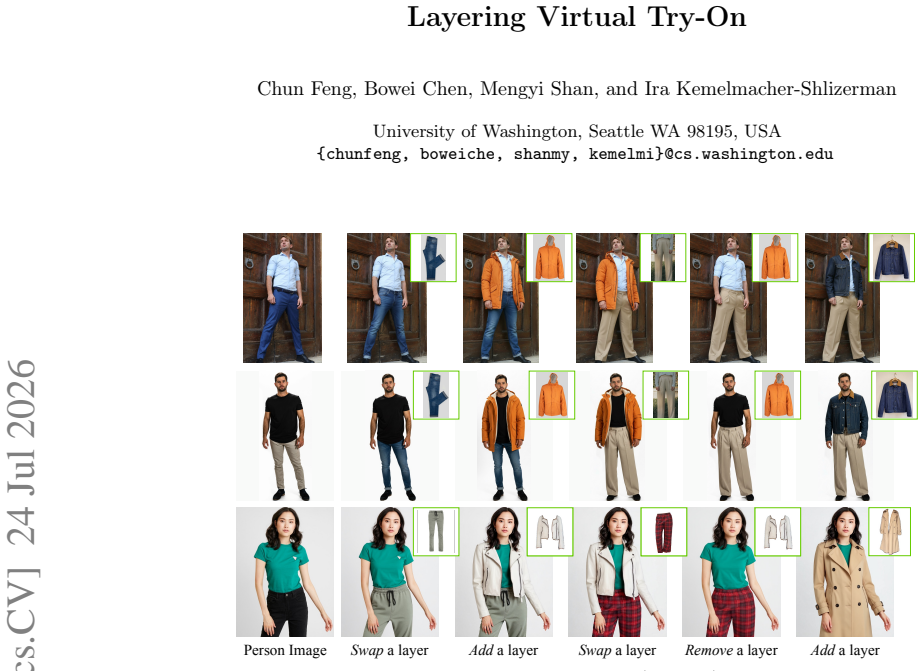
Virtual try-on can now add, remove, and swap clothing layers while preserving what is underneath, by splitting training into two stages: learning general try-on skills from videos, then learning layering logic from a small real dataset.
Reviewed by Pith at T0; open to challenge. T0 means a machine referee read the full paper against a public rubric. the ladder, T0–T4 →
T0 review · deepseek-v4-flash
2026-08-01 04:07 UTC pith:V5LDMR7D
load-bearing objection The task definition and two-stage pipeline are genuinely new and the ablations back the story, but the private LVTON benchmark's train/test overlap risk makes the headline SOTA claim uninterpretable until the split is clarified. the 3 major comments →
Layering Virtual Try-On
The pith
A machine-rendered reading of the paper's core claim, the machinery that carries it, and where it could break.
Core claim
The paper claims that the failure of direct fine-tuning on scarce, pose-variant layering data is not a data-quantity problem but a task-decomposition problem. By disentangling LVTON into general VTON priors and specific layering knowledge, the model can acquire deformation and identity skills from abundant videos (29,151 synthetic pairs from 362 videos) and then learn add/remove/swap logic from only 5,768 real training pairs. Temporal reversal—reversing a dressing sequence into an undressing sequence—doubles the real data and teaches removal. The resulting model outperforms prior mask-free and commercial baselines on the LVTON benchmark and, after task-specific fine-tuning, achieves the best
What carries the argument
The central mechanism is a mask-free, pose-misaligned training-pair construction from videos. For each video with a constant outfit, frames are segmented and re-clothed by an inpainting model; training pairs pair one inpainted frame (source person) with a different frame (target pose and garment). Because the garment source and target pose come from different frames, the model must learn true deformation and placement rather than pixel copying. Stage 2 adds a temporal-reversal augmentation over real layering videos to teach addition and removal, and both stages fine-tune the same pre-trained image-editing diffusion transformer with low-rank adapters.
Load-bearing premise
The results assume the test set is fully disjoint from the training set at the level of people and outfits; the paper only says both come from the same 60 videos and never states that subjects or clips were separated.
What would settle it
Compute overlap between stage-2 training and test frames using face or outfit-level identity matching across all 5,768 training pairs and 532 test pairs; if any test frame shares a subject or outfit with a training pair, the reported LVTON gains are inflated. Re-splitting the data at the video level and rerunning the main comparison would settle whether the margin survives.
If this is right
- Sequential edits become possible: add, remove, or swap one layer at a time while inner layers remain, enabling an outfit-customization loop.
- The stage-one video-mining recipe provides a scalable way to obtain pose-variant, mask-free try-on training data without manual pairing, attacking the data bottleneck for any mask-free try-on task.
- Because stage-one priors transfer zero-shot to standard benchmarks, a single general try-on model can serve both layering and classic single-garment replacement, reducing the need for task-specific datasets.
- Fine-tuning on only a few thousand real pairs suffices once general priors are in place, suggesting data-efficient deployment for new garment interactions.
- Reversal augmentation teaches removal from addition-only footage, effectively doubling available supervision for undressing operations.
Where Pith is reading between the lines
- If the train/test split of the new benchmark is not separated at video or subject level, the headline LVTON gains could partly reflect memorization of the same outfits seen in fine-tuning; a held-out-subject test would be a sharper check.
- The decomposition suggests a testable scaling law: performance should saturate once stage-one data supplies rich deformation priors, so adding more synthetic videos has diminishing returns—already hinted by the 4x saturation point in the paper's ablation.
- Because stage-one artifacts come from upstream segmentation and inpainting, automated filtering or higher-quality synthesis tools could directly improve the priors without changing the two-stage architecture.
- The purely 2D model lacks explicit geometric reasoning, so extending the same two-stage logic to multi-view or 3D layered representations is a natural next step, though it would require volumetric constraints not present here.
Editorial analysis
A structured set of objections, weighed in public.
Referee Report
Summary. The paper introduces Layering Virtual Try-On (LVTON), a task formulation, a private benchmark, and a two-stage training method. Stage 1 learns general VTON priors from a large synthetic dataset generated automatically from fashion videos via segmentation and inpainting, with pose-variant training pairs. Stage 2 fine-tunes the model on a small real-world layering dataset, augmented by temporal reversal, to teach add/remove/swap composition logic. The authors report state-of-the-art results on their LVTON benchmark, state-of-the-art results on VITON-HD and DressCode when fine-tuned, and zero-shot transfer for the stage-1 model. They also propose a Masked Preservation Score (MPS) for layer-specific evaluation and provide extensive ablations and qualitative results.
Significance. If the claims hold, this is a meaningful contribution: the LVTON task is practically important, the two-stage disentanglement is a sensible and data-efficient strategy, and the video-based synthetic data pipeline is scalable and well described. The ablations in Table 4 support the central architectural intuition, and the public-benchmark results (Table 2) provide independent evidence that the learned priors transfer. The paper is generally well written and includes candid limitations in Sec. 5 and Appendices D, F, and G. However, the headline LVTON state-of-the-art claim rests on a private benchmark whose train/test split is not demonstrably clean, and a key hyperparameter is selected on that same benchmark. These issues are fixable but currently prevent full acceptance.
major comments (3)
- [Sec. 4.1, App. B.2/C] The LVTON benchmark split is not specified with respect to subjects, outfits, or videos. The paper states that 5,768 training pairs and 532 test pairs come from the same 60 videos, and Appendix B.2 describes temporal clustering and frame sampling within videos, but nowhere states that test videos, subjects, outfits, or temporal clusters are disjoint from training. If a test frame shares a person, outfit, or video with a training pair, Table 1 and the user study measure near-duplicate reconstruction or per-subject recall rather than layering generalization. Please specify the exact split protocol at the video/subject/outfit level, and ideally release the benchmark or identity metadata. Also report confidence intervals or bootstrapped error bars for the 532-image test set; the current table has none.
- [Fig. 9, Sec. 4.5] The 4.0x stage-1/stage-2 data ratio is selected using the LVTON benchmark itself, and the paper does not describe a separate validation split. Because the same test set appears to have influenced this hyperparameter, the reported LVTON SOTA numbers are optimistically biased. Please clarify whether a held-out validation set was used, or re-run the comparison with a proper train/validation/test partitioning and report the selected ratio on the validation set.
- [Appendix E, Sec. 4.3] The MPS metric's LPIPS normalization is not standard. Zeroing out non-mask regions and scaling the global average by H*W/|Munchanged| can bias the result because zero-padding affects convolutional receptive fields and VGG feature statistics. The reported improvement (SSIM +0.005, LPIPS -0.006) is small and no significance testing is provided. Please provide a more principled masked-LPIPS formulation or justify the normalization carefully, and report confidence intervals for the MPS comparison.
minor comments (5)
- [Table 3, Sec. 4.3] The user study used 30 participants. Please report recruitment details, rating scales, and inter-rater agreement or variance.
- [Fig. 9] The figure legend is unclear; it is difficult to tell which curve corresponds to SSIM and which to LPIPS. Please add explicit labels or a legend.
- [Appendix A] Training step counts and the single-GPU setup are useful. Please also report wall-clock training time and approximate total GPU hours.
- [Sec. 5, App. G] The limitation that the stage-2 dataset contains only female subjects in indoor scenes is important and should be stated earlier in the paper, as it tempers the in-the-wild generalization claim in Sec. 4.4.
- [Sec. 4.2, Table A1] The 'Previous SOTA' row in Table A1 lacks a citation; please specify which method it refers to.
Circularity Check
LVTON SOTA claim is partially self-referential: the 4.0x stage-1/stage-2 ratio is chosen on the LVTON benchmark itself, and the 532 test pairs come from the same 60 videos as the 5,768 training pairs with no stated split. External VITON-HD/DressCode results keep the core method independently grounded.
specific steps
-
fitted input called prediction
[Sec. 4.5, Fig. 9; Tab. 1]
"Ablation study on stage 1 data scale using the LVTON benchmark. The curves illustrate SSIM and LPIPS as a function of the data ratio between stage 1 and stage 2. ... We adopt the saturation point of 4.0x (green star) as the optimal configuration."
The 4.0x stage-1/stage-2 data ratio is selected by evaluating on the LVTON benchmark, and the final model ('Ours') is then evaluated on the same benchmark in Tab. 1. Thus the headline LVTON SOTA is obtained with a hyperparameter fitted to the test set; the result is partly forced by construction rather than an independent prediction.
-
other
[Sec. 4.1; Sec. 3.2; Appendix C]
"we curate a real-world LVTON dataset of 5,768 training pairs and 532 test pairs from 60 videos ... We partition video frames into temporal clusters {C1, C2, ..., CK} ... we sample a source frame Fi in Cm and a target frame Fj in Cm+1 from adjacent clusters to form the training tuple."
Training and test pairs are described as coming from the same 60 videos and are constructed by the same clustering/sampling procedure. The paper never states that test videos, subjects, outfits, or temporal clusters are disjoint from training. If a test frame shares a person/outfit/video with a training pair, the LVTON benchmark measures near-duplicate reconstruction or memorization of stage-2 data rather than layering generalization, so the claimed SOTA on LVTON partially reduces to fitting the training videos.
full rationale
The two-stage derivation itself is not circular: stage 1 builds mask-free, pose-variant synthetic pairs from videos and inpainting; stage 2 fine-tunes on real layering pairs; ablations and zero-shot evaluation on VITON-HD/DressCode provide independent evidence that the stage-1 priors transfer. No load-bearing self-citation or imported uniqueness theorem is present. However, the headline 'state-of-the-art on our LVTON benchmark' is weakened by two evaluation-level circularities: the key data-ratio hyperparameter is selected on the LVTON benchmark itself, and the benchmark's test pairs are drawn from the same 60 videos as the stage-2 training pairs with no stated split. These issues affect the self-benchmarked claim but not the external-benchmark results, so the circularity is partial rather than total.
Axiom & Free-Parameter Ledger
free parameters (5)
- Stage 1 to Stage 2 data ratio =
4.0x (green star)
- LoRA rank and alpha =
r=32, alpha=32
- Upper/lower body segmentation ratio =
0.7 / 0.3
- VLM sliding-window size W =
6 frames
- Blur-detection Laplacian threshold =
unspecified ("predefined threshold")
axioms (6)
- domain assumption Fashion videos contain long stretches where a single subject wears the same outfit while changing pose.
- domain assumption The VLM sliding-window detector correctly partitions real videos into stable outfit clusters.
- domain assumption SAM2 segmentation and the Flux Kontext inpainting model are accurate enough that noisy synthetic pairs can be filtered by hand without biasing the learned prior.
- domain assumption Stage 2 fine-tuning on a small real dataset removes the synthetic-to-real domain gap introduced by Stage 1.
- standard math Standard denoising objective and LoRA fine-tuning of Qwen-Image-Edit preserve pre-trained editing ability while learning the new task.
- domain assumption FID/KID on a 532-image test set is a meaningful comparison even though the paper says absolute FID is inflated.
invented entities (2)
-
LVTON benchmark (5,768 train / 532 test pairs from 60 videos)
no independent evidence
-
Masked Preservation Score (MPS)
no independent evidence
read the original abstract
In the real world, fashion is about layering: adding a jacket over a shirt, or a sequence of adding and removing layers, rather than just a single-layer swap. This fundamental real-world task remains a challenge in existing Virtual Try-On (VTON) methods, which excel at single-layer replacement but are not designed to layer or de-layer an existing outfit. This paper proposes Layering Virtual Try-On (LVTON), a layering benchmark and method that preserves an existing outfit while enabling sequential layering. We find that current VTON paradigms are fundamentally ill-equipped for LVTON, as their reliance on cloth-agnostic representations and single-item datasets discards essential layering context. Our key insight is that the LVTON challenge must be disentangled into two distinct competencies: (1) General VTON Priors (e.g., deformation, identity preservation) and (2) Specific Layering Knowledge (e.g., layering order and occlusion reasoning). First, our model obtains general VTON priors by being trained on data produced by an automatic data generation pipeline that synthesizes samples from fashion videos via segmentation and inpainting. Second, the model is fine-tuned on a small, dedicated LVTON dataset to learn the layering logic. Our method achieves state-of-the-art results on our LVTON benchmark and demonstrates superior generalizability on traditional VTON benchmarks, setting new state-of-the-art results when fine-tuned and exhibiting zero-shot capabilities.
Figures


Reference graph
Works this paper leans on
-
[1]
In: Proceedings of the Asian Conference on Computer Vision
Aggarwal, A., Wang, J., Hogue, S., Ni, S., Budagavi, M., Guo, X.: Layered-garment net: Generating multiple implicit garment layers from a single image. In: Proceedings of the Asian Conference on Computer Vision. pp. 3000–3017 (2022)
2022
-
[2]
Bai, S., Chen, K., Liu, X., Wang, J., Ge, W., Song, S., Dang, K., Wang, P., Wang, S., Tang, J., et al.: Qwen2. 5-vl technical report. arXiv preprint arXiv:2502.13923 (2025)
Pith/arXiv arXiv 2025
-
[3]
arXiv preprint arXiv:2408.07009 (2024)
Baldridge, J., Bauer, J., Bhutani, M., Brichtova, N., Bunner, A., Castrejon, L., Chan, K., Chen, Y., Dieleman, S., Du, Y., et al.: Imagen 3. arXiv preprint arXiv:2408.07009 (2024)
arXiv 2024
-
[4]
1 kontext: Flow matching for in- context image generation and editing in latent space
Batifol, S., Blattmann, A., Boesel, F., Consul, S., Diagne, C., Dockhorn, T., English, J., English, Z., Esser, P., Kulal, S., et al.: Flux. 1 kontext: Flow matching for in- context image generation and editing in latent space. arXiv e-prints pp. arXiv–2506 (2025)
2025
-
[5]
arXiv preprint arXiv:1801.01401 (2018)
Bińkowski, M., Sutherland, D.J., Arbel, M., Gretton, A.: Demystifying mmd gans. arXiv preprint arXiv:1801.01401 (2018)
Pith/arXiv arXiv 2018
-
[6]
In: Proceedings of the 45th International ACM SIGIR Conference on Research and Development in Information Retrieval
Bonifacio, L., Abonizio, H., Fadaee, M., Nogueira, R.: Inpars: Unsupervised dataset generation for information retrieval. In: Proceedings of the 45th International ACM SIGIR Conference on Research and Development in Information Retrieval. pp. 2387–2392 (2022)
2022
-
[7]
arXiv preprint arXiv:2509.23951 (2025)
Cao, S., Chen, H., Chen, P., Cheng, Y., Cui, Y., Deng, X., Dong, Y., Gong, K., Gu, T., Gu, X., et al.: Hunyuanimage 3.0 technical report. arXiv preprint arXiv:2509.23951 (2025)
Pith/arXiv arXiv 2025
-
[8]
In: European Conference on Computer Vision
Chen, M., Chen, X., Zhai, Z., Ju, C., Hong, X., Lan, J., Xiao, S.: Wear-any-way: Manipulable virtual try-on via sparse correspondence alignment. In: European Conference on Computer Vision. pp. 124–142. Springer (2024)
2024
-
[9]
In: Proceedings of the IEEE/CVF conference on computer vision and pattern recognition
Choi, S., Park, S., Lee, M., Choo, J.: Viton-hd: High-resolution virtual try-on via misalignment-aware normalization. In: Proceedings of the IEEE/CVF conference on computer vision and pattern recognition. pp. 14131–14140 (2021)
2021
-
[10]
In: European Conference on Computer Vision
Choi, Y., Kwak, S., Lee, K., Choi, H., Shin, J.: Improving diffusion models for authentic virtual try-on in the wild. In: European Conference on Computer Vision. pp. 206–235. Springer (2024)
2024
-
[11]
arXiv preprint arXiv:2407.15886 (2024)
Chong, Z., Dong, X., Li, H., Zhang, S., Zhang, W., Zhang, X., Zhao, H., Jiang, D., Liang, X.: Catvton: Concatenation is all you need for virtual try-on with diffusion models. arXiv preprint arXiv:2407.15886 (2024)
Pith/arXiv arXiv 2024
-
[12]
arXiv preprint arXiv:2507.06261 (2025)
Comanici, G., Bieber, E., Schaekermann, M., Pasupat, I., Sachdeva, N., Dhillon, I., Blistein, M., Ram, O., Zhang, D., Rosen, E., et al.: Gemini 2.5: Pushing the frontier with advanced reasoning, multimodality, long context, and next generation agentic capabilities. arXiv preprint arXiv:2507.06261 (2025)
Pith/arXiv arXiv 2025
-
[13]
arXiv preprint arXiv:2508.08488 (2025)
Deria, A., Mahapatra, D., Bozorgtabar, B., Chakraborty, M., Chakraborty, S., Roy, S.: Muga-vton: Multi-garment virtual try-on via diffusion transformers with prompt customization. arXiv preprint arXiv:2508.08488 (2025)
Pith/arXiv arXiv 2025
-
[14]
IEEE Access11, 47304–47320 (2023)
Eigenschink, P., Reutterer, T., Vamosi, S., Vamosi, R., Sun, C., Kalcher, K.: Deep generative models for synthetic data: A survey. IEEE Access11, 47304–47320 (2023)
2023
-
[15]
In: Forty-first international conference on machine learning (2024) 16 C
Esser, P., Kulal, S., Blattmann, A., Entezari, R., Müller, J., Saini, H., Levi, Y., Lorenz, D., Sauer, A., Boesel, F., et al.: Scaling rectified flow transformers for high-resolution image synthesis. In: Forty-first international conference on machine learning (2024) 16 C. Feng et al
2024
-
[16]
Fan, L., Chen, K., Krishnan, D., Katabi, D., Isola, P., Tian, Y.: Scaling laws of synthetic images for model training... for now. In: Proceedings of the IEEE/CVF Conference on Computer Vision and Pattern Recognition. pp. 7382–7392 (2024)
2024
-
[17]
arXiv preprint arXiv:2508.13632 (2025)
Feng, Y., Zhang, L., Cao, H., Chen, Y., Feng, X., Cao, J., Wu, Y., Wang, B.: Omnitry: Virtual try-on anything without masks. arXiv preprint arXiv:2508.13632 (2025)
Pith/arXiv arXiv 2025
-
[18]
arXiv preprint arXiv:2403.12803 (2024)
Fu, Y., Chen, C., Qiao, Y., Yu, Y.: Dreamda: Generative data augmentation with diffusion models. arXiv preprint arXiv:2403.12803 (2024)
Pith/arXiv arXiv 2024
-
[19]
In: Proceedings of the 31st ACM International Conference on Multimedia
Gou, J., Sun, S., Zhang, J., Si, J., Qian, C., Zhang, L.: Taming the power of diffusion models for high-quality virtual try-on with appearance flow. In: Proceedings of the 31st ACM International Conference on Multimedia. pp. 7599–7607 (2023)
2023
-
[20]
arXiv preprint arXiv:2501.15891 (2025)
Guo, H., Zeng, B., Song, Y., Zhang, W., Zhang, C., Liu, J.: Any2anytryon: Leverag- ing adaptive position embeddings for versatile virtual clothing tasks. arXiv preprint arXiv:2501.15891 (2025)
Pith/arXiv arXiv 2025
-
[21]
Hammoud, H.A.A.K., Itani,H., Pizzati, F.,Torr, P., Bibi, A., Ghanem,B.: Synthclip: Are we ready for a fully synthetic clip training? arXiv preprint arXiv:2402.01832 (2024)
Pith/arXiv arXiv 2024
-
[22]
Advances in neural information processing systems30(2017)
Heusel, M., Ramsauer, H., Unterthiner, T., Nessler, B., Hochreiter, S.: Gans trained by a two time-scale update rule converge to a local nash equilibrium. Advances in neural information processing systems30(2017)
2017
-
[23]
In: Proceedings of the 61st Annual Meeting of the Association for Computational Linguistics (Volume 1: Long Papers)
Honovich, O., Scialom, T., Levy, O., Schick, T.: Unnatural instructions: Tuning language models with (almost) no human labor. In: Proceedings of the 61st Annual Meeting of the Association for Computational Linguistics (Volume 1: Long Papers). pp. 14409–14428 (2023)
2023
-
[24]
ICLR1(2), 3 (2022)
Hu, E.J., Shen, Y., Wallis, P., Allen-Zhu, Z., Li, Y., Wang, S., Wang, L., Chen, W., et al.: Lora: Low-rank adaptation of large language models. ICLR1(2), 3 (2022)
2022
-
[25]
In: ACM SIGGRAPH 2024 conference papers
Huang, B., Yu, Z., Chen, A., Geiger, A., Gao, S.: 2d gaussian splatting for geomet- rically accurate radiance fields. In: ACM SIGGRAPH 2024 conference papers. pp. 1–11 (2024)
2024
-
[26]
Huang, Y., Zhang, P., Liu, R., Liang, J.: Can generated images serve as a viable modality for text-centric multimodal learning? arXiv preprint arXiv:2506.17623 (2025)
arXiv 2025
-
[27]
In: Proceedings of the IEEE/CVF Conference on Computer Vision and Pattern Recognition
Jafarian, Y., Park, H.S.: Learning high fidelity depths of dressed humans by watching social media dance videos. In: Proceedings of the IEEE/CVF Conference on Computer Vision and Pattern Recognition. pp. 12753–12762 (2021)
2021
-
[28]
arXiv preprint arXiv:2411.10499 (2024)
Jiang, B., Hu, X., Luo, D., He, Q., Xu, C., Peng, J., Zhang, J., Wang, C., Wu, Y., Fu, Y.: Fitdit: Advancing the authentic garment details for high-fidelity virtual try-on. arXiv preprint arXiv:2411.10499 (2024)
Pith/arXiv arXiv 2024
-
[29]
arXiv preprint arXiv:2303.04132 (2023)
Josifoski, M., Sakota, M., Peyrard, M., West, R.: Exploiting asymmetry for synthetic training data generation: Synthie and the case of information extraction. arXiv preprint arXiv:2303.04132 (2023)
Pith/arXiv arXiv 2023
-
[30]
In: Proceedings of the IEEE/CVF conference on computer vision and pattern recognition
Kim, J., Gu, G., Park, M., Park, S., Choo, J.: Stableviton: Learning semantic correspondence with latent diffusion model for virtual try-on. In: Proceedings of the IEEE/CVF conference on computer vision and pattern recognition. pp. 8176–8185 (2024)
2024
-
[31]
ACM Transactions on Graphics (TOG)42(6), 1–13 (2023)
Lee, D., Kang, H., Lee, I.K.: Clothcombo: Modeling inter-cloth interaction for draping multi-layered clothes. ACM Transactions on Graphics (TOG)42(6), 1–13 (2023)
2023
-
[32]
In: European Conference on Computer Vision
Lee, S., Gu, G., Park, S., Choi, S., Choo, J.: High-resolution virtual try-on with mis- alignment and occlusion-handled conditions. In: European Conference on Computer Vision. pp. 204–219. Springer (2022)
2022
-
[33]
In: Proceedings of the Computer Vision and Pattern Recognition Conference
Li, N., Shih, K.J., Plummer, B.A.: Enhancing virtual try-on with synthetic pairs and error-aware noise scheduling. In: Proceedings of the Computer Vision and Pattern Recognition Conference. pp. 21238–21247 (2025)
2025
-
[34]
arXiv preprint arXiv:2502.10663 (2025)
Li, R., Jin, X., et al.: Real: Realism evaluation of text-to-image generation models for effective data augmentation. arXiv preprint arXiv:2502.10663 (2025)
Pith/arXiv arXiv 2025
-
[35]
arXiv preprint arXiv:2012.02952 (2020)
Liu, R., Xu, G., Jia, C., Ma, W., Wang, L., Vosoughi, S.: Data boost: Text data augmentation through reinforcement learning guided conditional generation. arXiv preprint arXiv:2012.02952 (2020)
Pith/arXiv arXiv 2012
-
[36]
arXiv preprint arXiv:1711.05101 (2017)
Loshchilov, I., Hutter, F.: Decoupled weight decay regularization. arXiv preprint arXiv:1711.05101 (2017)
Pith/arXiv arXiv 2017
-
[37]
In: Proceedings of the 31st ACM international conference on multimedia
Morelli, D., Baldrati, A., Cartella, G., Cornia, M., Bertini, M., Cucchiara, R.: Ladi- vton: Latent diffusion textual-inversion enhanced virtual try-on. In: Proceedings of the 31st ACM international conference on multimedia. pp. 8580–8589 (2023)
2023
-
[38]
In: Proceedings of the IEEE/CVF conference on computer vision and pattern recognition
Morelli, D., Fincato, M., Cornia, M., Landi, F., Cesari, F., Cucchiara, R.: Dress code: High-resolution multi-category virtual try-on. In: Proceedings of the IEEE/CVF conference on computer vision and pattern recognition. pp. 2231–2235 (2022)
2022
-
[39]
arXiv preprint arXiv:2009.10195 (2020)
Ng, N., Cho, K., Ghassemi, M.: Ssmba: Self-supervised manifold based data aug- mentation for improving out-of-domain robustness. arXiv preprint arXiv:2009.10195 (2020)
Pith/arXiv arXiv 2009
-
[40]
arXiv preprint arXiv:2408.00714 (2024)
Ravi, N., Gabeur, V., Hu, Y.T., Hu, R., Ryali, C., Ma, T., Khedr, H., Rädle, R., Rolland, C., Gustafson, L., et al.: Sam 2: Segment anything in images and videos. arXiv preprint arXiv:2408.00714 (2024)
Pith/arXiv arXiv 2024
-
[41]
In: Proceedings of the IEEE/CVF Conference on Computer Vision and Pattern Recognition
Shivashankar, C., Miller, S.: Semantic data augmentation with generative models. In: Proceedings of the IEEE/CVF Conference on Computer Vision and Pattern Recognition. pp. 863–873 (2023)
2023
-
[42]
arXiv preprint arXiv:1409.1556 (2014)
Simonyan, K., Zisserman, A.: Very deep convolutional networks for large-scale image recognition. arXiv preprint arXiv:1409.1556 (2014)
Pith/arXiv arXiv 2014
-
[43]
arXiv preprint arXiv:2407.16224 (2024)
Sun, K., Cao, J., Wang, Q., Tian, L., Zhang, X., Zhuo, L., Zhang, B., Bo, L., Zhou, W., Zhang, W., et al.: Outfitanyone: Ultra-high quality virtual try-on for any clothing and any person. arXiv preprint arXiv:2407.16224 (2024)
Pith/arXiv arXiv 2024
-
[44]
Advances in Neural Information Processing Systems36, 48382–48402 (2023)
Tian, Y., Fan, L., Isola, P., Chang, H., Krishnan, D.: Stablerep: Synthetic images from text-to-image models make strong visual representation learners. Advances in Neural Information Processing Systems36, 48382–48402 (2023)
2023
-
[45]
In: Proceedings of the IEEE/CVF winter conference on applications of computer vision
Valvano, G., Agostino, A., De Magistris, G., Graziano, A., Veneri, G.: Controllable image synthesis of industrial data using stable diffusion. In: Proceedings of the IEEE/CVF winter conference on applications of computer vision. pp. 5354–5363 (2024)
2024
-
[46]
arXiv preprint arXiv:2504.13078 (2025)
Velioglu, R., Bevandic, P., Chan, R., Hammer, B.: Enhancing person-to-person virtual try-on with multi-garment virtual try-off. arXiv preprint arXiv:2504.13078 (2025)
Pith/arXiv arXiv 2025
-
[47]
In: Proceedings of the AAAI Conference on Artificial Intelligence
Wang, S., Feng, Y., Lan, T., Yu, N., Bai, Y., Xu, R., Wang, H., Xiong, C., Savarese, S.: Text2data: Low-resource data generation with textual control. In: Proceedings of the AAAI Conference on Artificial Intelligence. vol. 39, pp. 21252–21260 (2025)
2025
-
[48]
In: Pro- ceedings of the 61st annual meeting of the association for computational linguistics (volume 1: long papers)
Wang, Y., Kordi, Y., Mishra, S., Liu, A., Smith, N.A., Khashabi, D., Hajishirzi, H.: Self-instruct: Aligning language models with self-generated instructions. In: Pro- ceedings of the 61st annual meeting of the association for computational linguistics (volume 1: long papers). pp. 13484–13508 (2023)
2023
-
[49]
IEEE transactions on image processing 13(4), 600–612 (2004) 18 C
Wang, Z., Bovik, A.C., Sheikh, H.R., Simoncelli, E.P.: Image quality assessment: from error visibility to structural similarity. IEEE transactions on image processing 13(4), 600–612 (2004) 18 C. Feng et al
2004
-
[50]
arXiv preprint arXiv:2508.02324 (2025)
Wu, C., Li, J., Zhou, J., Lin, J., Gao, K., Yan, K., Yin, S.m., Bai, S., Xu, X., Chen, Y., et al.: Qwen-image technical report. arXiv preprint arXiv:2508.02324 (2025)
Pith/arXiv arXiv 2025
-
[51]
In: Proceedings of the IEEE/CVF conference on computer vision and pattern recognition
Xie, Z., Huang, Z., Dong, X., Zhao, F., Dong, H., Zhang, X., Zhu, F., Liang, X.: Gp-vton: Towards general purpose virtual try-on via collaborative local-flow global-parsing learning. In: Proceedings of the IEEE/CVF conference on computer vision and pattern recognition. pp. 23550–23559 (2023)
2023
-
[52]
arXiv preprint arXiv:2601.05853 (2026)
Xu, Y., Dingliana, J.: Layergs: Decomposition and inpainting of layered 3d human avatars via 2d gaussian splatting. arXiv preprint arXiv:2601.05853 (2026)
arXiv 2026
-
[53]
In: Proceedings of the AAAI Conference on Artificial Intelligence
Xu, Y., Gu, T., Chen, W., Chen, A.: Ootdiffusion: Outfitting fusion based latent diffusion for controllable virtual try-on. In: Proceedings of the AAAI Conference on Artificial Intelligence. vol. 39, pp. 8996–9004 (2025)
2025
-
[54]
arXiv preprint arXiv:2004.11546 (2020)
Yang, Y., Malaviya, C., Fernandez, J., Swayamdipta, S., Bras, R.L., Wang, J.P., Bha- gavatula, C., Choi, Y., Downey, D.: Generative data augmentation for commonsense reasoning. arXiv preprint arXiv:2004.11546 (2020)
Pith/arXiv arXiv 2004
-
[55]
In: Proceedings of the IEEE/CVF International Conference on Computer Vision
Yang, Z., Zeng, A., Yuan, C., Li, Y.: Effective whole-body pose estimation with two-stages distillation. In: Proceedings of the IEEE/CVF International Conference on Computer Vision. pp. 4210–4220 (2023)
2023
-
[56]
arXiv preprint arXiv:2304.08821 (2023)
Yin, Y., Kaddour, J., Zhang, X., Nie, Y., Liu, Z., Kong, L., Liu, Q.: Ttida: Con- trollable generative data augmentation via text-to-text and text-to-image models. arXiv preprint arXiv:2304.08821 (2023)
Pith/arXiv arXiv 2023
-
[57]
In: Proceedings of the IEEE conference on computer vision and pattern recognition
Zhang, R., Isola, P., Efros, A.A., Shechtman, E., Wang, O.: The unreasonable effectiveness of deep features as a perceptual metric. In: Proceedings of the IEEE conference on computer vision and pattern recognition. pp. 586–595 (2018)
2018
-
[58]
arXiv preprint arXiv:2405.00448 (2024)
Zhang, X., Lin, E., Li, X., Luo, Y., Kampffmeyer, M., Dong, X., Liang, X.: Mmtryon: Multi-modal multi-reference control for high-quality fashion generation. arXiv preprint arXiv:2405.00448 (2024)
Pith/arXiv arXiv 2024
-
[59]
In: Proceedings of the IEEE/CVF Conference on Computer Vision and Pattern Recognition
Zhu, L., Li, Y., Liu, N., Peng, H., Yang, D., Kemelmacher-Shlizerman, I.: M&m vto: Multi-garment virtual try-on and editing. In: Proceedings of the IEEE/CVF Conference on Computer Vision and Pattern Recognition. pp. 1346–1356 (2024) A. IMPLEMENTATION DETAILS 19 This supplementary material provides details on implementation specifics and deeper methodologi...
2024
-
[60]
deform-and-place
for5 , 000steps. For the traditional benchmarks [9,38], stage 1 is also trained for20 , 000steps, while stage 2 is fine-tuned for3, 000steps. We report results using the last checkpoint for all experiments and use a single NVIDIA H200 GPU. Our implementation is built using PyTorch (version2.7.0+cu128). B Dataset Curation Details This section provides a de...
discussion (0)
Sign in with ORCID, Apple, or X to comment. Anyone can read and Pith papers without signing in.