REVIEW 2 major objections 5 minor 39 references
To hold success rate fixed, required demonstrations grow super-exponentially as target precision nears a system-defined limit c.
Reviewed by Pith at T0; open to challenge. T0 means a machine referee read the full paper against a public rubric. the ladder, T0–T4 →
T0 review · deepseek-v4-flash
2026-08-01 03:33 UTC pith:SB55EJJS
load-bearing objection An interesting empirical scaling law for precision in manipulation, but the central claim that c is target-SR-independent is enforced by the fitting protocol rather than tested. the 2 major comments →
The Curse of Precision: A Data Scaling Law for High-Precision Robotic Manipulation
The pith
A machine-rendered reading of the paper's core claim, the machinery that carries it, and where it could break.
Core claim
Across three simulated manipulation tasks, the paper reports the precision scaling law log(N) = m/(P−c)+n: at a fixed target success rate, the number of demonstrations N needed to reach precision P grows super-exponentially as P approaches the system's limit precision c. The authors find that a single shared c fits data for three different target success rates in each task, leading them to interpret c not as a fixed property of the task geometry but as an emergent capability of the whole agent—sensors, expert data, and task complexity. Ablations on a peg-insertion task support this: removing the wrist camera raises c from 2.35 mm to 3.85 mm; switching to a less ambiguous expert demonstration
What carries the argument
The paper's central object is the precision scaling identity log(N) = m/(P−c)+n, in which P is the task precision (a tolerance in millimeters), N is the number of demonstrations, and c is the 'limit precision'—the best precision the system can ever reach, in the same units as P. The identity does two kinds of work: it converts the intuitive 'curse of precision' (each extra decimal of accuracy costs vastly more data) into a quantitative prediction, and it turns c into a scalar that summarizes the entire agent's capability. The empirical method couples two fits: a per-P power law for failure rate versus data, and then a single global c chosen to maximize the coefficient of determination across
Load-bearing premise
The paper assumes that the limit precision c is a single constant for the system regardless of the target success rate, because it fits one shared c across all target success-rate curves; if c actually shifts with the target success rate, the interpretation of c as an intrinsic capability metric collapses.
What would settle it
Estimate c independently for two different target success rates, e.g., 0.5 and 0.9, using fresh data at several precision levels; if the two fitted c values differ beyond statistical uncertainty, the claim that c is a single system-level constant fails.
If this is right
- With c fitted from a few experiments, engineers can predict the demonstration budget needed for any target precision before running a large data collection.
- Because c changes with system components, it provides a quantitative, directly comparable capability metric for sensor suites, expert policies, and task formulations.
- The super-exponential growth near c implies that brute-force data scaling is an inefficient path to sub-millimeter reliability; improving system components is the lever that moves the limit.
- The law holds across image-based assembly and a state-based dynamic task, indicating it may generalize beyond a single task family.
Where Pith is reading between the lines
- If c is truly independent of the target success rate, a short data sweep at one moderate precision could be used to extrapolate the full data/precision frontier, letting teams A/B test hardware or data changes without exhaustive full-scale training.
- The form log N ∝ 1/(P−c) suggests a 'precision frontier' analogous to compute-efficient frontiers: for any budget of demonstrations, there is an optimal precision to target, and pushing past it wastes data.
- A direct testable extension: on physical hardware, c should track measurable system noise—sensor resolution, control latency, and calibration error—so it could become a standard benchmark number reported alongside robot setups.
- Demonstration clarity lowering c more than expert success rate hints that automatic data cleaning or demonstration editing could be a cheaper route to precision than collecting more or better teleoperation data.
Editorial analysis
A structured set of objections, weighed in public.
Referee Report
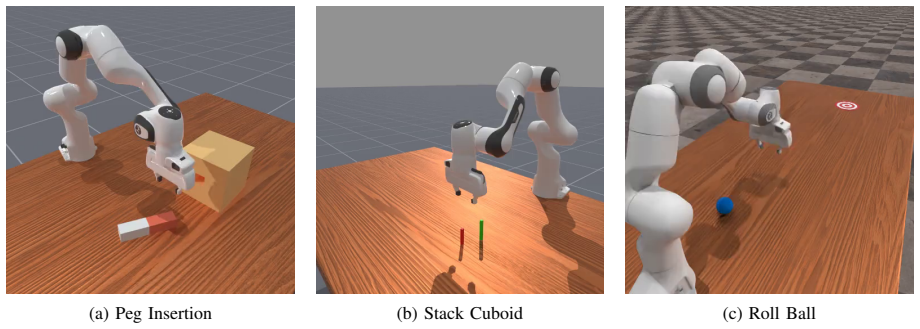
Summary. The paper proposes a 'precision scaling law' for imitation learning in closed-world manipulation: for a fixed target success rate, the number of demonstrations N required grows super-exponentially as the task precision P approaches a limit c, modeled as log(N) = m/(P − c) + n. The authors further claim that c is not a fixed physical constant but an intrinsic, target-SR-independent property of the whole agent system (sensors, expert, task complexity). The law is validated in ManiSkill3 on Peg Insertion, Stack Cuboid, and Roll Ball, with power-law SR-vs-N fits used to interpolate N at target SRs, and a shared-c grid search used to fit the precision law. Ablations on Peg Insertion show c varying with observation modality, expert strategy, and task complexity.
Significance. If the central claim holds, c would be a practically useful, quantitative system-capability metric and the scaling law would give a predictive tool for data requirements in high-precision tasks. The paper also makes a useful conceptual shift from open-world scaling-for-breadth to closed-world scaling-for-precision. Positive features include high in-sample R² values across three tasks and several ablations, a clear demonstration that the law fails for an under-capacity model (R² = 0.22 vs 0.99), and a falsifiable functional form. However, the load-bearing claim that c is independent of target success rate is not actually tested—it is imposed by the fitting protocol—and the supporting statistics rest on single training runs and on N values obtained by interpolation/extrapolation from prior fits. These issues are fixable, but they currently weaken the empirical support for the paper's headline interpretation.
major comments (2)
- [IV-A, 'Policy Training Sweep' and 'Curve Fitting'] Each (N, P) data point corresponds to a single training run, yet the precision-law fits use N values obtained by interpolating or extrapolating the SR power-law fits from those same single runs. No seed variance is reported, and uncertainties from the first-stage fits are never propagated into the second-stage estimates of N or c. With only 4–6 precision levels per task, a single outlier run could materially change a, b, and hence the inferred N and c. The authors should either run multiple seeds (at least 3) or use a bootstrap/joint-fitting procedure to report confidence intervals on c and on the predicted N. They should also state explicitly which target-SR N values are interpolated versus extrapolated; extrapolation beyond the observed SR range (e.g., SR = 0.9 when the largest N only reaches lower SRs) would be a serious concern.
- [IV-B and IV-C, Tables II and III] The reported R² values are in-sample and are computed on the same data used to select c by grid search. This is not a predictive validation of the law, and it does not distinguish the proposed 1/(P−c) form from other flexible two- or three-parameter curves. Since the stated practical value of the law is prediction (Section V), the authors should provide a held-out test, e.g., fit on a subset of precision levels and predict N at the remaining levels, or report leave-one-precision-out cross-validated error. Such a test would also strengthen the ablations in Table III, which otherwise share the same circular fitting protocol.
minor comments (5)
- [IV-C, 'Impact of Observation Modality'] Typo: 'disabling the wrist-mounted camer' should be 'camera'.
- [II-A] The phrase 'these two axes of scaling, Breadth and Depth, are largely orthogonal' is clear, but 'Depth' is used informally. Consider defining it once in the introduction to avoid confusion with the U-Net model capacity discussion in IV-D.
- [IV-A, Table I] For Roll Ball, P is described as the radius of the target region, but Table I uses mm. That is fine, but the range 35–200 mm is very different from the peg/stack ranges; the text should make explicit that the absolute scale of c is task-dependent and not comparable across tasks.
- [V, Limitations] The simulation-only scope is appropriately acknowledged. The paper would be stronger if the authors also noted that Diffusion Policy is a single algorithm choice and that c may depend on the learning algorithm, not only on sensors and expert.
- [Figure 2] Panel (d)–(f) would benefit from showing the raw (P, N) points with error bars, rather than only the linearized fit lines, so readers can assess scatter and extrapolation regions.
Circularity Check
Shared-c grid-search fit enforces the target-SR independence of c; the central 'validation' restates the fitting constraint rather than testing it.
specific steps
-
self definitional
[Section IV-A 'Curve Fitting'; interpreted in Section IV-B 'Precision Scaling Law']
"We then performed a grid search for a single c value that maximized the sum of the coefficients of determination (R2) across all three targetSR curves. This enforces the hypothesis that c is a constant property of the system, independent of the target success rate."
The paper's load-bearing claim is that c is an intrinsic, target-SR-independent system property. That claim is not tested: the fitting protocol chooses the single c that makes all three target-SR curves as linear as possible in the (P, log N) plane, and the near-perfect R² values in Table II are computed on the same curves used for this grid search. The data are never allowed to exhibit an SR-dependent c; 'validation' is a restatement of the enforced constraint. A genuine test would estimate c separately for each target SR (or on held-out precision levels) and check whether the values agree.
-
fitted input called prediction
[Section IV-A 'Curve Fitting' → Section IV-B 'Precision Scaling Law']
"we first estimated the data size N required to reach different target success rates (e.g., 0.5, 0.7, 0.9) for eachP by interpolating or extrapolating from the fitted linear models of the Success Rate Scaling Law."
The N values entering the precision-law fit are not direct measurements; they are themselves predictions of the success-rate power-law fits from the same training runs. Fitting log(N) = m/(P-c) + n to these derived N values and then reporting the resulting R² as a validation of the precision law is an in-sample consistency check, not an independent confirmation. The empirical content lies mainly in the fact that the assumed functional form can fail (as in the standard-capacity Roll Ball case), not in the high R² values reported after the free parameter c and derived N are optimized.
full rationale
The derivation is not circular in the sense of being mathematically identical to its inputs: the proposed reciprocal form log(N) ∝ 1/(P−c) is not tautological, and the paper reports a case (standard-capacity Roll Ball) where it fails, so the law has residual empirical content. However, the paper's most novel interpretive claim—that c is an intrinsic system property independent of target success rate—is enforced by construction. A single c is grid-searched to maximize the sum of R² across all three target-SR curves, and the same curves are then cited as validation. The paper also fits the precision law to N values that were already interpolated/extrapolated from the success-rate power laws, so the 'perfect' precision-law fits are largely an in-sample description of previously fitted quantities. These features make the central quantitative claim partially circular, though the cross-configuration ordering of c values (wrist camera, expert strategy, task complexity) remains an independently meaningful empirical pattern. No load-bearing self-citation or imported uniqueness theorem is present. Score 6: one central 'prediction' reduces by construction to the fitting constraint, but the law's functional form is not forced.
Axiom & Free-Parameter Ledger
free parameters (3)
- Per-(task, precision) power-law slope a and intercept b =
e.g., Peg Insertion P=4: a=-0.19, b=1.35; P=10: a=-0.72, b=5.08 (Table I)
- Per-(task, target-SR) precision-law slope m and intercept n =
e.g., Peg Insertion SR=0.5: m=8.59, n=7.62; SR=0.9: m=28.62, n=7.42 (Table II)
- Limit precision c =
Peg baseline 2.35 mm; Stack Cuboid 2.75 mm; Roll Ball 20.3 mm; ablations: Expert-2 1.27, no-wrist 3.85, low-randomizatio
axioms (6)
- domain assumption Failure rate scales as a power law with data at fixed precision: log(1−SR)=a log N+b.
- ad hoc to paper The precision scaling law has the functional form log(N)=m/(P−c)+n with a single c shared across target success rates.
- ad hoc to paper c is independent of the target success rate.
- domain assumption SAPIEN/ManiSkill3 simulation faithfully represents precision-relevant contact physics.
- domain assumption The fixed Diffusion Policy architecture with sufficient capacity is an adequate learner for all tasks.
- domain assumption Training only on successful expert trajectories is a valid data-generation choice.
invented entities (1)
-
Limit precision c
no independent evidence
read the original abstract
While scaling laws for imitation learning have primarily focused on generalization in open-world settings, the relationship between data and precision in closed-world tasks like robotic assembly remains largely unexplored. This paper systematically investigates this relationship and introduces a novel scaling law. We find that to achieve a fixed success rate, the required number of demonstrations $N$ grows super-exponentially as the target precision $P$ approaches a limit $c$. This relationship is accurately captured by the model $\log(N) \propto 1/(P-c)$. Crucially, we reveal that the limit precision $c$ is not a static physical constant of the task but an emergent property of the entire agent system, including its sensors and expert policy. Through experiments on canonical manipulation tasks, we validate this law and demonstrate that improving system components, such as adding a wrist camera or using a more effective expert, measurably lowers $c$, thus expanding the system's achievable precision. Our work provides a new theoretical framework for precision in robotics and a quantitative metric to evaluate system capabilities. Furthermore, these findings provide a practical methodology for guiding the development and debugging of high-precision manipulation systems.
Figures


Reference graph
Works this paper leans on
-
[1]
Scaling laws for neural language models,
J. Kaplan, S. McCandlish, T. Henighan, T. B. Brown, B. Chess, R. Child, S. Gray, A. Radford, J. Wu, and D. Amodei, “Scaling laws for neural language models,”arXiv preprint arXiv:2001.08361, 2020
Pith/arXiv arXiv 2001
-
[2]
Language models are few-shot learners,
T. B. Brown, B. Mann, N. Ryder, M. Subbiah, J. Kaplan, P. Dhari- wal, A. Neelakantan, P. Shyam, G. Sastry, A. Askell, S. Agarwal, A. Herbert-V oss, G. Krueger, T. Henighan, R. Child, A. Ramesh, D. M. Ziegler, J. Wu, C. Winter, C. Hesse, M. Chen, E. Sigler, M. Litwin, S. Gray, B. Chess, J. Clark, C. Berner, S. McCandlish, A. Radford, I. Sutskever, and D. A...
Pith/arXiv arXiv 2005
-
[3]
Scaling vision transformers,
X. Zhai, A. Kolesnikov, N. Houlsby, and L. Beyer, “Scaling vision transformers,” inProceedings of the IEEE/CVF Conference on Com- puter Vision and Pattern Recognition (CVPR), June 2022, pp. 12 104– 12 113
2022
-
[4]
Deep learning scaling is predictable, empirically,
J. Hestness, S. Narang, N. Ardalani, G. Diamos, H. Jun, H. Kianinejad, M. A. Patwary, Y . Yang, and Y . Zhou, “Deep learning scaling is predictable, empirically,”arXiv preprint arXiv:1712.00409, 2017
Pith/arXiv arXiv 2017
-
[5]
Data scaling laws in imitation learning for robotic manipulation,
F. Lin, Y . Hu, P. Sheng, C. Wen, J. You, and Y . Gao, “Data scaling laws in imitation learning for robotic manipulation,”arXiv preprint arXiv:2410.18647, 2024
Pith/arXiv arXiv 2024
-
[6]
Rt-1: Robotics transformer for real-world control at scale,
A. Brohan, N. Brown, J. Carbajal, Y . Chebotar, J. Dabis, C. Finn, K. Gopalakrishnan, K. Hausman, A. Herzog, J. Hsu, J. Ibarz, B. Ichter, A. Irpan, T. Jackson, S. Jesmonth, N. Joshi, R. Julian, D. Kalashnikov, Y . Kuang, I. Leal, K.-H. Lee, S. Levine, Y . Lu, U. Malla, D. Manjunath, , I. Mordatch, O. Nachum, C. Parada, J. Peralta, E. Perez, K. Pertsch, J....
Pith/arXiv arXiv 2022
-
[7]
Rt- 2: Vision-language-action models transfer web knowledge to robotic control,
A. Brohan, N. Brown, J. Carbajal, Y . Chebotar, X. Chen, K. Choro- manski, T. Ding, D. Driess, A. Dubey, C. Finn, P. Florenceet al., “Rt- 2: Vision-language-action models transfer web knowledge to robotic control,”arXiv preprint arXiv:2307.15818, 2023
Pith/arXiv arXiv 2023
-
[8]
Open x-embodiment: Robotic learning datasets and rt-x models,
A. Padalkaret al., “Open x-embodiment: Robotic learning datasets and rt-x models,”arXiv preprint arXiv:2310.08864, 2023
Pith/arXiv arXiv 2023
-
[9]
Siciliano and O
B. Siciliano and O. Khatib, Eds.,Springer Handbook of Robotics, 2nd ed. Springer, 2016
2016
-
[10]
A unified approach for motion and force control of robot manipulators: The operational space formulation,
O. Khatib, “A unified approach for motion and force control of robot manipulators: The operational space formulation,”IEEE Journal on Robotics and Automation, vol. 3, no. 1, pp. 43–53, 1987
1987
-
[11]
Impedance control: An approach to manipulation, part i: Theory,
N. Hogan, “Impedance control: An approach to manipulation, part i: Theory,”Journal of Dynamic Systems, Measurement, and Control, vol. 107, no. 1, pp. 1–7, 1985
1985
-
[12]
Maniskill3: Gpu parallelized robotics simulation and rendering for generalizable embodied ai,
S. Tao, F. Xiang, A. Shukla, Y . Qin, X. Hinrichsen, X. Yuan, C. Bao, X. Lin, Y . Liu, T. kai Chan, Y . Gao, X. Li, T. Mu, N. Xiao, A. Gurha, V . N. Rajesh, Y . W. Choi, Y .-R. Chen, Z. Huang, R. Calandra, R. Chen, S. Luo, and H. Su, “Maniskill3: Gpu parallelized robotics simulation and rendering for generalizable embodied ai,”Robotics: Science and Systems, 2025
2025
-
[13]
Socratic models: Composing zero-shot mul- timodal reasoning with language,
A. Zeng, M. Attarian, B. Ichter, K. Choromanski, A. Wong, S. Welker, F. Tombari, A. Purohit, M. S. Ryoo, V . Sindhwani, J. Lee, V . Van- houcke, and P. Florence, “Socratic models: Composing zero-shot mul- timodal reasoning with language,”arXiv preprint arXiv:2204.00598, 2022
Pith/arXiv arXiv 2022
-
[14]
Octo: An open-source generalist robot policy,
Octo Model Team, D. Ghosh, H. Walke, K. Pertsch, K. Black, O. Mees, S. Dasari, J. Hejna, C. Xu, J. Luo, T. Kreiman, Y . Tan, P. Sanketi, Q. Vuong, T. Xiao, D. Sadigh, C. Finn, and S. Levine, “Octo: An open-source generalist robot policy,”arXiv preprint arXiv:2405.12213, 2024
Pith/arXiv arXiv 2024
-
[15]
Robonet: Large-scale multi-robot learning,
S. Dasari, F. Ebert, S. Tian, S. Nair, B. Bucher, K. Schmeckpeper, S. Singh, S. Levine, and C. Finn, “Robonet: Large-scale multi-robot learning,” inProceedings of the Conference on Robot Learning, ser. Proceedings of Machine Learning Research, L. P. Kaelbling, D. Kragic, and K. Sugiura, Eds., vol. 100. PMLR, 30 Oct–01 Nov 2020, pp. 885–897
2020
-
[16]
S. Reed, K. Zolna, E. Parisotto, S. G. Colmenarejo, A. Novikov, G. Barth-Maron, M. Gimenez, Y . Sulsky, J. Kay, J. T. Springenberg, T. Eccles, J. Bruce, A. Razavi, A. Edwards, N. Heess, Y . Chen, R. Hadsell, O. Vinyals, M. Bordbar, and N. de Freitas, “A generalist agent,”arXiv preprint arXiv:2205.06175, 2022
Pith/arXiv arXiv 2022
-
[17]
R. M. Murray, Z. Li, and S. S. Sastry,A mathematical introduction to robotic manipulation. CRC press, 1994
1994
-
[18]
Hybrid position/force control of manipulators,
M. H. Raibert and J. J. Craig, “Hybrid position/force control of manipulators,”Journal of dynamic systems, measurement, and control, vol. 103, no. 2, pp. 126–133, 1981
1981
-
[19]
Reinforcement learning in robotics: A survey,
J. Kober, J. A. Bagnell, and J. Peters, “Reinforcement learning in robotics: A survey,”The International Journal of Robotics Research, vol. 32, no. 11, pp. 1238–1274, 2013
2013
-
[20]
Learning from demonstration,
S. Schaal, “Learning from demonstration,” inAdvances in Neural Information Processing Systems 9. Cambridge, MA: MIT Press, 1997, pp. 1040–1046
1997
-
[21]
A survey of robot learning from demonstration,
B. D. Argall, S. Chernova, M. Veloso, and B. Browning, “A survey of robot learning from demonstration,”Robotics and autonomous systems, vol. 57, no. 5, pp. 469–483, 2009
2009
-
[22]
Deep reinforcement learning for high precision assembly tasks,
T. Inoue, G. De Magistris, A. Munawar, T. Yokoya, and R. Tachibana, “Deep reinforcement learning for high precision assembly tasks,” in 2017 IEEE/RSJ International Conference on Intelligent Robots and Systems (IROS). IEEE, 2017, pp. 819–825
2017
-
[23]
Learning latent plans from play,
C. Lynch, M. Khansari, T. Xiao, V . Kumar, J. Tompson, S. Levine, and P. Sermanet, “Learning latent plans from play,” inProceedings of the Conference on Robot Learning (CoRL), 2019
2019
-
[24]
Model-agnostic meta-learning for fast adaptation of deep networks,
C. Finn, P. Abbeel, and S. Levine, “Model-agnostic meta-learning for fast adaptation of deep networks,” inProceedings of the 34th International Conference on Machine Learning, ser. Proceedings of Machine Learning Research, D. Precup and Y . W. Teh, Eds., vol. 70. PMLR, 06–11 Aug 2017, pp. 1126–1135
2017
-
[25]
Waypoint-based imitation learning for robotic manipulation,
L. X. Shi, A. Sharma, T. Z. Zhao, and C. Finn, “Waypoint-based imitation learning for robotic manipulation,”7th Conference on Robot Learning (CoRL 2023), 2023
2023
-
[26]
Perceiver-actor: A multi-task transformer for robotic manipulation,
M. Shridhar, L. Manuelli, and D. Fox, “Perceiver-actor: A multi-task transformer for robotic manipulation,” inCoRL, 2022
2022
-
[27]
Vima: General robot manipulation with multimodal prompts,
Y . Jiang, A. Gupta, Z. Zhang, G. Wang, Y . Dou, Y . Chen, L. Fei- Fei, A. Anandkumar, Y . Zhu, and L. Fan, “Vima: General robot manipulation with multimodal prompts,” inInternational Conference on Machine Learning, 2023
2023
-
[28]
Imitation learning for high precision peg-in-hole tasks,
S. Gubbi, S. N. Y . Kolathaya, and B. Amrutur, “Imitation learning for high precision peg-in-hole tasks,” in2020 6th International Conference on Control, Automation and Robotics (ICCAR), 2020, pp. 1–6
2020
-
[29]
From imitation to refinement – residual rl for precise visual assembly,
L. L. Ankile, A. Simeonov, I. Shenfeld, M. T. Villasevil, and P. Agrawal, “From imitation to refinement – residual rl for precise visual assembly,”arXiv preprint arXiv:2407.16677, 2024
Pith/arXiv arXiv 2024
-
[30]
Domain randomization for transferring deep neural networks from simulation to the real world,
J. Tobin, R. Fong, A. Ray, J. Schneider, W. Zaremba, and P. Abbeel, “Domain randomization for transferring deep neural networks from simulation to the real world,” in2017 IEEE/RSJ International Con- ference on Intelligent Robots and Systems (IROS). IEEE, 2017, pp. 23–30
2017
-
[31]
Sim-to-real via sim- to-sim: Data-efficient robotic grasping via randomized-to-canonical adaptation networks,
S. James, P. Wohlhart, M. Kalakrishnan, D. Kalashnikov, A. Irpan, J. Ibarz, S. Levine, R. Hadsell, and K. Bousmalis, “Sim-to-real via sim- to-sim: Data-efficient robotic grasping via randomized-to-canonical adaptation networks,” inThe IEEE Conference on Computer Vision and Pattern Recognition (CVPR), June 2019
2019
-
[32]
Fast robust peg-in- hole insertion with continuous visual servoing,
R. Haugaard, J. Langaa, C. Sloth, and A. Buch, “Fast robust peg-in- hole insertion with continuous visual servoing,” inProceedings of the 2020 Conference on Robot Learning, vol. 155, PMLR. PMLR, 2021, pp. 1696–1705
2020
-
[33]
Juicer: Data- efficient imitation learning for robotic assembly,
L. Ankile, A. Simeonov, I. Shenfeld, and P. Agrawal, “Juicer: Data- efficient imitation learning for robotic assembly,”arXiv preprint arXiv:2402.14833, 2024
Pith/arXiv arXiv 2024
-
[34]
Precise and dexterous robotic manipulation via human-in-the-loop reinforcement learning,
J. Luo, C. Xu, J. Wu, and S. Levine, “Precise and dexterous robotic manipulation via human-in-the-loop reinforcement learning,”arXiv preprint arXiv:2410.21845, 2024
Pith/arXiv arXiv 2024
-
[35]
SAPIEN: A simulated part-based interactive environment,
F. Xiang, Y . Qin, K. Mo, Y . Xia, H. Zhu, F. Liu, M. Liu, H. Jiang, Y . Yuan, H. Wang, L. Yi, A. Chang, L. J. Guibas, and H. Su, “SAPIEN: A simulated part-based interactive environment,” inProceedings of the IEEE/CVF Conference on Computer Vision and Pattern Recognition (CVPR), 2020
2020
-
[36]
Diffusion Policy: Visuomotor Policy Learning via Action Diffusion,
C. Chi, S. Feng, Y . Du, Z. Xu, E. Cousineau, B. Burchfiel, and S. Song, “Diffusion Policy: Visuomotor Policy Learning via Action Diffusion,” inProceedings of Robotics: Science and Systems, Daegu, Republic of Korea, July 2023
2023
-
[37]
Deep residual learning for image recognition,
K. He, X. Zhang, S. Ren, and J. Sun, “Deep residual learning for image recognition,” inProceedings of the IEEE conference on computer vision and pattern recognition, 2016
2016
-
[38]
U-net: Convolutional networks for biomedical image segmentation,
O. Ronneberger, P. Fischer, and T. Brox, “U-net: Convolutional networks for biomedical image segmentation,” inMedical Image Computing and Computer-Assisted Intervention – MICCAI 2015, ser. Lecture Notes in Computer Science, vol. 9351. Springer International Publishing, 2015, pp. 234–241
2015
-
[39]
Denoising diffusion probabilistic models,
J. Ho, A. Jain, and P. Abbeel, “Denoising diffusion probabilistic models,”arXiv preprint arXiv:2006.11239, 2020
Pith/arXiv arXiv 2006
discussion (0)
Sign in with ORCID, Apple, or X to comment. Anyone can read and Pith papers without signing in.