REVIEW 3 major objections 4 minor 62 references
Bayesian parameter estimation of the O4a detector network's loudest sub-solar-mass search triggers finds three compatible with a compact binary containing a sub-solar-mass companion — and none of them is a claimed detection.
Reviewed by Pith at T0; open to challenge. T0 means a machine referee read the full paper against a public rubric. the ladder, T0–T4 →
T0 review · deepseek-v4-flash
2026-08-01 03:32 UTC pith:UQN7X4YX
load-bearing objection Useful, honest parameter-estimation follow-up on LVK sub-solar triggers; the 'three sub-solar candidates' count leans on one prior-dominated event, but the paper is transparent enough to survive a serious referee. the 3 major comments →
Parameter Estimation on LIGO-Virgo-KAGRA O4a Binary Merger Triggers with Sub-solar Mass Components
The pith
A machine-rendered reading of the paper's core claim, the machinery that carries it, and where it could break.
Core claim
On the paper's own terms, the discovery is that Bayesian parameter estimation, applied to the loudest sub-threshold triggers of the O4a sub-solar-mass search, reproduces the search pipelines' chirp masses for five of seven triggers, and three of those five (2023-09-14, 2023-07-19, and 2023-10-14) are consistent with a compact binary whose secondary lies at roughly 0.22–0.27 solar masses. The two other well-measured triggers would be light neutron-star–black-hole binaries. The estimates for the 2023-10-14 trigger required the chirp-mass prior to be narrowed to 0.5–0.6 solar masses after the broad prior failed, so its sub-solar secondary is not independently measured. The paper makes no detect
What carries the argument
QuickCBC — a Bayesian parameter-estimation algorithm using parallel-tempered Markov chain Monte Carlo with iterative glitch subtraction and on-source estimation of the noise power spectral density, employing IMRPhenomD waveform templates. It produces posteriors for source-frame component masses, detector-frame chirp mass, luminosity distance, effective spin, and per-detector signal-to-noise ratios. Supporting diagnostics include single-detector analyses with narrowed chirp-mass priors, SNR-squared accumulation as a function of frequency, and WDM-wavelet-based stationarity and Gaussianity tests applied to long (up to 512 s) stretches of data.
Load-bearing premise
The load-bearing premise is that the search pipelines' detector-frame chirp masses for these sub-threshold triggers are essentially correct — most sharply for 2023-10-14, where the broad prior failed and the analysis was re-run with the chirp mass constrained to 0.5–0.6 solar masses, so the inferred 0.23-solar-mass secondary is not independently measured.
What would settle it
Re-run QuickCBC on the 2023-10-14 trigger with a broad chirp-mass prior (e.g., 0.25–2.6 solar masses) and check whether the posterior still concentrates near mc ≈ 0.55 solar masses with a sub-solar secondary; if the posterior becomes multimodal or migrates away, the sub-solar claim for that trigger rests entirely on the prior and is falsified. Similarly, the 2023-07-19 candidate is falsifiable if improved subtraction of the spectral lines in the Hanford data shifts its recovered secondary mass above one solar mass.
If this is right
- If any of the three sub-solar candidates is a genuine gravitational-wave signal, the secondary object would be difficult to explain by ordinary stellar evolution, making a primordial black hole the natural interpretation.
- The five-of-seven agreement between Bayesian estimates and pipeline chirp masses means the loudest sub-threshold candidates of the O4a sub-solar search are well characterized, not mere pipeline artifacts.
- The injection study establishes a practical threshold: network signal-to-noise ratios of roughly 8 (about 6 per detector) are needed for parameter estimation to recover the true masses of such low-mass systems; single-detector analyses need about 8.
- If these candidates are real, improved detector sensitivity and more observing time should bring the same systems back at higher significance, or else place stronger exclusion limits on sub-solar compact-object populations.
Where Pith is reading between the lines
- Editorial clarification: the abstract's count of three sub-solar candidates among the four re-analyzed external triggers does not match the appendix's mass estimates — two are sub-solar, one is a neutron-star binary, and one produced unusable estimates; the paper's core O4a conclusions are unaffected.
- A discriminating follow-up would search these candidates for tidal-deformation or tidal-disruption signatures: a point-like primordial black hole would show none, while a sub-solar neutron star or exotic object would leave finite-size effects in the waveform.
- Population-level follow-up is the natural next step: if a sub-solar binary population exists, its mass and spin distribution could be mapped onto primordial-black-hole formation models, including the QCD-epoch enhancement near one solar mass.
- The prior-dependence of the 2023-10-14 result suggests a methodological caution: future sub-solar parameter estimation should report results under multiple chirp-mass priors to quantify how much of a sub-solar conclusion is driven by the prior rather than the data.
Editorial analysis
A structured set of objections, weighed in public.
Referee Report
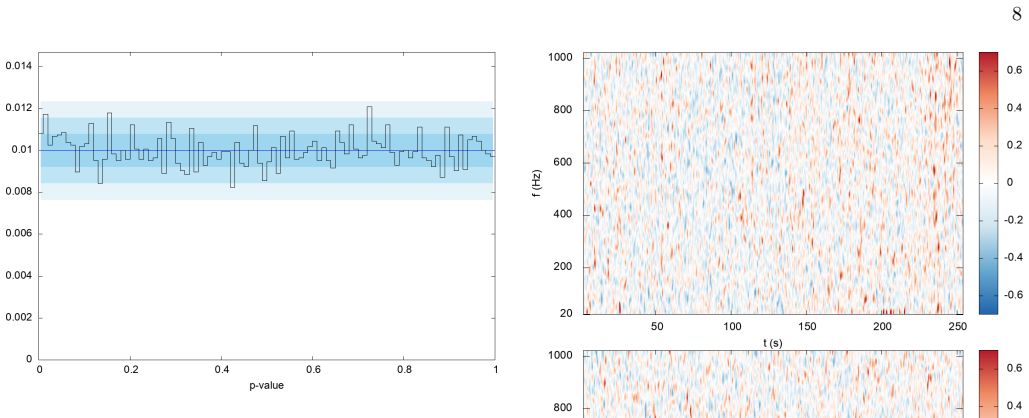
Summary. This paper performs Bayesian parameter estimation with the QuickCBC algorithm on the seven most significant O4a sub-solar-mass compact-binary triggers reported by LVK, plus three additional triggers from independent groups and one O3 trigger. For five of the seven O4a triggers the authors obtain informative posteriors; they report that three of these five have a sub-solar-mass secondary component (2023-09-14, 2023-07-19, 2023-10-14), while two resemble neutron star–black hole binaries. They also characterize data quality via WDM-based stationarity/Gaussianity tests and present an injection study establishing that a network SNR of about 8 is needed for reliable parameter recovery. The paper is explicitly framed as a non-detection study and presents the sub-solar candidates as compatible with, but not evidence for, primordial black holes.
Significance. If the sub-solar classification of three O4a triggers were robust, this would be an interesting contribution to the primordial-black-hole literature because it demonstrates that targeted sub-threshold triggers can be characterized well enough to probe the sub-solar mass range. The paper is transparent about the non-detection status, openly discusses the need for constrained priors, and provides reproducible analysis based on open data, QuickCBC, and a clear injection study. The data-quality diagnostics are a useful addition. However, the central 'three triggers' claim depends on one event whose posterior is prior-dominated and whose single-detector consistency check is problematic. With appropriate qualification or additional analysis, the paper can still be a valuable methods-oriented study, but in its current form the headline enumeration exceeds what the evidence supports.
major comments (3)
- [Sec. IV, Table III] The claim that three O4a triggers have sub-solar-mass components includes 2023-10-14 08:15:06.33, for which the combined-analysis parameter estimation failed with the broad chirp-mass prior (0.25–2.6 M☉) and produced results only after the prior was constrained to 0.5–0.6 M☉. The resulting posterior chirp mass, mc = 0.55659 ± 0.0004, is essentially the center of that prior, which was itself chosen from the search-trigger value mc = 0.550. Consequently, the sub-solar m2 ≈ 0.23 M☉ reported for this trigger is not independently measured; it is a prior-dominated result. The paper acknowledges the prior restriction, but the abstract and conclusions state without qualification that 'three of the triggers' may contain a sub-solar component. This is a load-bearing quantitative claim and should be revised—either by reclassifying 2023-10-14 as a prior-dependent candidate, or by providing additiona
- [Sec. IV A, Table VI] For 2023-10-14 08:15:06.33, the H1-only and combined H1–L1 analyses are not consistent. The H1-only primary mass is 1.287 +0.436/−0.375 M☉, while the combined analysis gives 2.173 +0.346/−0.313 M☉; these 68% intervals do not overlap at all. The H1-only and L1-only secondary masses (0.309 +0.095/−0.061 and 0.211 +0.016/−0.024 M☉) also overlap only marginally. The text states that the estimates are 'in decent agreement' and that only the H1 primary is 'somewhat smaller,' which is not supported by the numbers. This is especially problematic because 2023-10-14 is the same event that required a narrow, trigger-informed prior. The single-detector consistency check therefore does not provide independent support for the sub-solar interpretation of this event.
- [Sec. IV A] The single-detector consistency checks for the other two sub-solar candidates also restrict the chirp-mass prior to narrow windows around the search-trigger values: 0.67–0.69 M☉ for 2023-09-14 and 0.33–0.38 M☉ for 2023-07-19. Since the prior is centered on the trigger, these runs cannot independently validate the chirp mass; they only demonstrate that the data are consistent with the trigger value conditional on that value being correct. The paper should state this limitation explicitly when these checks are used to support the sub-solar classification, rather than presenting them as confirmation of the parameter-estimation results.
minor comments (4)
- [Abstract] Grammar: 'a compact binary systems' should be 'compact binary systems' or 'a compact binary system.'
- [Sec. IV] In the paragraph after Table III, 'the SNR2(f) accumulation is consisten with' contains a typo: 'consisten' should be 'consistent.'
- [Sec. V] The text and figures refer to 'the trigger at 2020-03-08 18:05:53.02 UTC' as a sub-solar candidate in a section on O4a data. This is an O3 trigger studied later in Appendix A; for clarity, label it as O3 in the data-quality discussion to avoid confusion.
- [General] The notation 'The L VK' appears with an extra space in several places; use 'LVK' or 'LIGO-Virgo-KAGRA' consistently. Also, Table III has formatting inconsistencies in the χ_eff columns that make some entries hard to parse.
Circularity Check
Sub-solar classification of the 2023-10-14 trigger is prior-dominated: the chirp-mass prior was narrowed to the search trigger value, entailing a sub-solar secondary, and single-detector checks reuse the same prior.
specific steps
-
fitted input called prediction
[Sec. IV (Results), paragraph on the 2023-10-14 08:15:06.33 UTC trigger; compare Table I (mc=0.550) with Table III (mc PE=0.55659).]
"For the trigger 2023-10-14 08:15:06.33 UTC and using this chirp mass prior we were unable to generate good parameter estimation results. We do note that when the prior was constrained to 0.5 M⊙ ≤ mc ≤0.6 M⊙ we could produce results. This trigger is estimated to be a binary with compact objects of m1 ∼2.17 M⊙ and m2 ∼0.23 M⊙."
The broad prior (0.25–2.6 M⊙) failed; the analysis was rerun with mc restricted to a 0.1 M⊙ window centered on the search-trigger value mc=0.550 M⊙ (Table I). The resulting PE chirp mass mc=0.55659±0.0004 (Table III) is essentially the prior. Moreover, any binary with mc≤0.6 M⊙ has its secondary mass at most ~0.69 M⊙ (equal-mass limit), so the claimed m2≈0.23 M⊙ sub-solar secondary is already guaranteed by the prior, not measured independently. Presenting this as PE support for a sub-solar component is therefore a fitted input called a prediction.
-
fitted input called prediction
[Sec. IV A (Analysis of single detector data), chirp-mass priors for individual detectors; Conclusions.]
"To aide in this effort we restrict the prior on the chirp mass. ... For the trigger at 2023-10-14 08:15:06.33 UTC ... the prior range for the chirp mass is 0.50 M⊙ < mc <0.60 M⊙."
The single-detector 'consistency' checks restrict the chirp-mass prior to narrow windows around each trigger's mc (0.67–0.69 for 2023-09-14, 0.33–0.38 for 2023-07-19, 0.50–0.60 for 2023-10-14). The recovered mc values are then close to the prior by construction, so agreement between combined and single-detector analyses does not independently validate the chirp mass. The paper itself concedes 'we have had to narrow the prior on the chirp mass' in the Conclusions; this makes the single-detector check a circular validation rather than external support.
full rationale
The central claim that three O4a triggers may contain a sub-solar-mass component rests on three events in Table II. For two of them (2023-09-14 and 2023-07-19) the combined H1–L1 analysis used the broad chirp-mass prior 0.25–2.6 M⊙, so their low secondary masses are not simply forced by the prior; those provide independent (though sub-threshold) support. The third event, 2023-10-14, is different: the broad-prior run failed and was replaced by a run with mc constrained to 0.5–0.6 M⊙, i.e., centered on the search-trigger value 0.550 M⊙. Since any binary with mc≤0.6 M⊙ has a secondary below ~0.69 M⊙, the 'sub-solar component' conclusion for this trigger is entailed by the prior; the reported mc posterior (0.55659) is nearly identical to the prior, and the single-detector checks use the same narrow prior windows. Thus only two of the three headline events independently support the sub-solar classification; the third is prior-dominated. This is a correctness risk in the headline count, not a fatal flaw: the paper is transparent about the prior restriction, explicitly stops short of claiming a detection, and the injection study plus agreement with independent analyses (e.g., SSM200308) show the methodology is not vacuous. Self-citations to QuickCBC [34] are not load-bearing circularity because the code is tested via signal injections and against external triggers. Overall, one of the three 'predictions' reduces by construction, giving partial circularity (score 6).
Axiom & Free-Parameter Ledger
free parameters (2)
- Chirp-mass prior for 2023-10-14 combined analysis =
0.5–0.6 M☉
- Chirp-mass priors for single-detector consistency runs =
e.g., 0.67–0.69, 0.33–0.38, 0.34–0.38, 0.50–0.60, 0.2–0.4, 1.2–1.4 M☉
axioms (4)
- domain assumption Post-glitch-removal noise is wide-sense stationary and Gaussian over 128–512 s stretches
- domain assumption IMRPhenomD waveforms are sufficiently accurate for sub-solar, small-q, low-chirp-mass systems
- ad hoc to paper Search-pipeline trigger parameters (time, chirp mass, masses) are accurate enough to serve as priors when broad-prior PE fails
- standard math QuickCBC parallel-tempered MCMC converges to the posterior
read the original abstract
The LIGO-Virgo-KAGRA collaboration has reported the results for searches for sub-solar mass components in compact binary coalescence during observing run O4a. No detection candidates were identified, but the most significant seven triggers were reported. We present the results of Bayesian parameter inference on these triggers. Five of the triggers show agreement between the Bayesian parameter estimation and the search pipeline trigger. Our results show that three of the triggers may contain a possible sub-solar mass component. Parameter estimation indicates that the other two events, if real, would be neutron star - black hole binaries. The remaining two triggers do not provide informative parameter estimation. We also study three O4a compact binary coalescence triggers, and one O3 trigger, that have been noted by three other groups, and our parameter estimation indicates that three of these may contain a sub-solar mass component. We study the data quality associated with these triggers. Finally, we discuss the challenges for parameter estimation on compact binary coalescence events containing a sub-solar mass component: long signal duration, possible small chirp masses, possible small mass ratios, and data quality issues over potentially hundreds of seconds of data.
Figures






Reference graph
Works this paper leans on
-
[1]
Aasiet al.(LIGO Scientific), Advanced LIGO, Class
J. Aasiet al.(LIGO Scientific), Advanced LIGO, Class. Quant. Grav.32, 074001 (2015), arXiv:1411.4547 [gr-qc]
Pith/arXiv arXiv 2015
-
[2]
F. Acerneseet al.(VIRGO), Advanced Virgo: a second- generation interferometric gravitational wave detector, Class. Quant. Grav.32, 024001 (2015), arXiv:1408.3978 [gr-qc]
Pith/arXiv arXiv 2015
-
[3]
T. Akutsuet al.(KAGRA), Overview of KAGRA: Detec- tor design and construction history, PTEP2021, 05A101 (2021), arXiv:2005.05574 [physics.ins-det]
arXiv 2021
-
[4]
GWTC-5.0: Observations from the Second Part of the Fourth LIGO-Virgo-KAGRA Observing Run and Updates to the Gravitational-Wave Transient Catalog, arXiv (2026), arXiv:2605.27225 [gr-qc]
Pith/arXiv arXiv 2026
-
[5]
Abacet al.(LIGO Scientific, VIRGO, KAGRA), 13 TABLE X
N. Abacet al.(LIGO Scientific, VIRGO, KAGRA), 13 TABLE X. Presented are the parameter estimation results for the LIGO trigger at 2023-11-09 23:54:56.048 UTC [36]. The data from only one detector are analyzed. The chirp massm c is for the detector frame, while the component massesm 1 and m2 are from the source frame. Detectorm c (M⊙)m 1 (M⊙)m 2 (M⊙)χ eff D...
Pith/arXiv arXiv 2023
-
[6]
B. P. Abbottet al.(LIGO Scientific, Virgo), GW170817: Observation of Gravitational Waves from a Binary Neu- tron Star Inspiral, Phys. Rev. Lett.119, 161101 (2017), arXiv:1710.05832 [gr-qc]
Pith/arXiv arXiv 2017
-
[7]
B. P. Abbottet al.(LIGO Scientific, Virgo), GW190425: Observation of a Compact Binary Coalescence with To- tal Mass∼3.4M ⊙, Astrophys. J. Lett.892, L3 (2020), arXiv:2001.01761 [astro-ph.HE]
Pith/arXiv arXiv 2020
-
[8]
Abbottet al.(LIGO Scientific, KAGRA, VIRGO), Observation of Gravitational Waves from Two Neutron FIG
R. Abbottet al.(LIGO Scientific, KAGRA, VIRGO), Observation of Gravitational Waves from Two Neutron FIG. 14. Posterior distributions for the detector frame com- ponent masses,m 1 andm 2, for the trigger at 2023-07-19 11:50:50.27 UTC. The estimates come from analyzing only the data from L1, only from H1, and analyzing H1 and L1 together. Star–Black Hole Co...
Pith/arXiv arXiv 2023
-
[9]
A. G. Abacet al.(LIGO Scientific, KAGRA, VIRGO), Observation of Gravitational Waves from the Coalescence of a 2.5–4.5 M ⊙ Compact Object and a Neutron Star, Astrophys. J. Lett.970, L34 (2024), arXiv:2404.04248 [astro-ph.HE]
Pith/arXiv arXiv 2024
-
[10]
R. Abbottet al.(LIGO Scientific, Virgo), GW190814: Gravitational Waves from the Coalescence of a 23 Solar Mass Black Hole with a 2.6 Solar Mass Compact Object, Astrophys. J. Lett.896, L44 (2020), arXiv:2006.12611 [astro-ph.HE]
Pith/arXiv arXiv 2020
-
[11]
Abbottet al.(LIGO Scientific), Search for gravita- 14 FIG
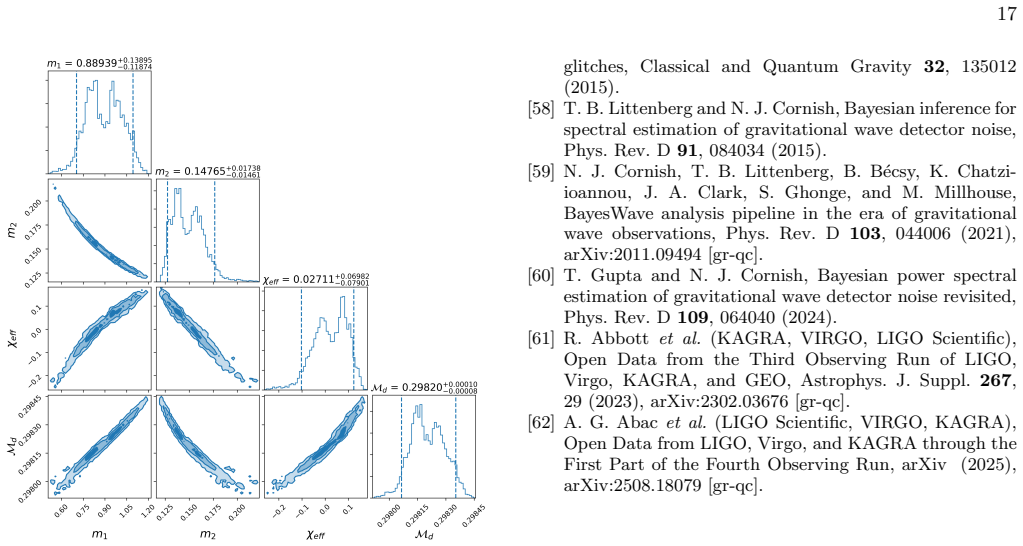
B. Abbottet al.(LIGO Scientific), Search for gravita- 14 FIG. 15. A corner plot for the trigger at 2023-10- 14 08:15:06.33 UTC showing the source frame component masses,m 1 andm 2, the effective spinχ eff , and the detec- tor frame chirp massm c. tional waves from primordial black hole binary coales- cences in the galactic halo, Phys. Rev. D72, 082002 (20...
Pith/arXiv arXiv 2023
-
[12]
B. P. Abbottet al.(LIGO Scientific, Virgo), Search for Subsolar-Mass Ultracompact Binaries in Advanced LIGO’s First Observing Run, Phys. Rev. Lett.121, 231103 (2018), arXiv:1808.04771 [astro-ph.CO]
Pith/arXiv arXiv 2018
-
[13]
B. P. Abbottet al.(LIGO Scientific, Virgo), Search for Subsolar Mass Ultracompact Binaries in Advanced LIGO’s Second Observing Run, Phys. Rev. Lett.123, 161102 (2019), arXiv:1904.08976 [astro-ph.CO]
Pith/arXiv arXiv 2019
-
[14]
R. Abbottet al.(LIGO Scientific, VIRGO, KAGRA), Search for Subsolar-Mass Binaries in the First Half of Advanced LIGO’s and Advanced Virgo’s Third Ob- serving Run, Phys. Rev. Lett.129, 061104 (2022), arXiv:2109.12197 [astro-ph.CO]
Pith/arXiv arXiv 2022
-
[15]
R. Abbottet al.(L VK), Search for subsolar-mass black hole binaries in the second part of Advanced LIGO’s and Advanced Virgo’s third observing run, Mon. Not. Roy. Astron. Soc.524, 5984 (2023), [Er- ratum: Mon.Not.Roy.Astron.Soc. 526, 6234 (2023)], arXiv:2212.01477 [astro-ph.HE]
Pith/arXiv arXiv 2023
-
[16]
A. G. Abacet al.(LIGO Scientific, VIRGO, KA- GRA), Searches for Binary Mergers with Sub-solar Mass Components in Data from the First Part of LIGO– Virgo–KAGRA’s Fourth Observing Run, arXiv (2026), arXiv:2605.05444 [astro-ph.HE]
Pith/arXiv arXiv 2026
-
[17]
B. Carr, S. Clesse, J. Garc ´ ıa-Bellido, M. R. S. Hawkins, and F. K¨ uhnel, Observational Evidence for Primordial Black Holes: A Positivist Perspective, Phys. Rept.1054, 1 (2024), arXiv:2306.03903 [astro-ph.CO]
Pith/arXiv arXiv 2024
-
[18]
Hawking, Gravitationally collapsed objects of very low FIG
S. Hawking, Gravitationally collapsed objects of very low FIG. 16. The SNR 2 of the signal as a function of frequency for the 2023-10-14 08:15:06.33 UTC trigger. The black line is calculated from the data (d|h). The blue line corresponds to a draw from the likelihood (h|h). The blue region are the ±1σerrors on the SNR 2 estimation. mass, Mon. Not. Roy. As...
2023
-
[19]
B. J. Carr and S. W. Hawking, Black Holes in the Early Universe, Mon. Not. Roy. Astron. Soc.168, 399 (1974)
1974
-
[20]
B. Carr, F. K¨ uhnel, and M. Sandstad, Primordial Black Holes as Dark Matter, Phys. Rev. D94, 083504 (2016), arXiv:1607.06077 [astro-ph.CO]
Pith/arXiv arXiv 2016
-
[21]
B. Carr and F. K¨ uhnel, Primordial Black Holes as Dark Matter: Recent Developments, Ann. Rev. Nucl. Part. Sci. 70, 355 (2020), arXiv:2006.02838 [astro-ph.CO]
Pith/arXiv arXiv 2020
-
[22]
A. Escriv` a, F. K¨ uhnel, and Y. Tada, Primor- dial Black Holes, inBlack Holes in the Era of Gravitational-Wave Astronomy(Elsevier, 2024) pp. 261– 377, arXiv:2211.05767 [astro-ph.CO]
Pith/arXiv arXiv 2024
-
[23]
E. Mediavilla, J. Jim´ enez-Vicente, J. A. Mu˜ noz, H. Vives- Arias, and J. Calder´ on-Infante, Limits on the Mass and Abundance of Primordial Black Holes from Quasar Gravitational Microlensing, Astrophys. J. Lett.836, L18 (2017), arXiv:1702.00947 [astro-ph.CO]
Pith/arXiv arXiv 2017
-
[24]
A. Kashlinsky, R. G. Arendt, J. Mather, and S. H. Mose- ley, Tracing the First Stars with Fluctuations of the Cosmic Infrared Background, Nature438, 45 (2005), arXiv:astro-ph/0511105
Pith/arXiv arXiv 2005
-
[25]
N. Cappelluti, A. Kashlinsky, R. G. Arendt, A. Comastri, G. G. Fazio, A. Finoguenov, G. Hasinger, J. C. Mather, T. Miyaji, and S. H. Moseley, Cross-correlating Cosmic IR and X-ray Background Fluctuations: Evidence of Sig- nificant Black Hole Populations among the CIB Sources, Astrophys. J.769, 68 (2013), arXiv:1210.5302 [astro- ph.CO]
Pith/arXiv arXiv 2013
-
[26]
G. Hasinger, Illuminating the Dark Ages: Cosmic Back- grounds from Accretion onto Primordial Black Hole Dark Matter, JCAP07, 022, arXiv:2003.05150 [astro-ph.CO]. 15 FIG. 17. Posterior distributions for the detector frame com- ponent masses,m 1 andm 2, for the trigger at 2023-10-14 08:15:06.33 UTC. The estimates come from analyzing only the data from L1, o...
Pith/arXiv arXiv 2003
-
[27]
S. Carniani, K. Hainline, F. D’Eugenio, D. Eisenstein, P. Jakobsen,et al., Spectroscopic Confirmation of Two Luminous Galaxies at a Redshift of 14, Nature633, 318 (2024), arXiv:2405.18485 [astro-ph.GA]
Pith/arXiv arXiv 2024
-
[28]
L. J. Furtak, I. Labb´ e, A. Zitrin, J. E. Greene, P. Dayal, I. Chemerynska, V. Kokorev, T. B. Miller, A. D. Gould- ing, A. de Graaff,et al., A High Black-Hole-to-Host Mass Ratio in a Lensed AGN in the Early Universe, Nature 628, 57 (2024), arXiv:2308.05735 [astro-ph.GA]
Pith/arXiv arXiv 2024
-
[29]
I. Juodˇ zbalis, C. Marconcini, F. D’Eugenio, R. Maiolino, A. Marconi, H. ¨Ubler, J. Scholtz, X. Ji, S. Arribas, J. S. Bennett,et al., A Direct Black Hole Mass Measurement in a Little Red Dot at the Epoch of Reionization (2025), arXiv:2508.21748 [astro-ph.GA]
Pith/arXiv arXiv 2025
-
[30]
R. Maiolino, H. ¨Ubler, F. D’Eugenio, J. Scholtz, I. Juodzbalis, X. Ji, M. Perna, V. Bromm, P. Dayal, S. Koudmani,et al., A Black Hole in a Near-pristine Galaxy 700 Million Years after the Big Bang (2025), arXiv:2505.22567 [astro-ph.GA]
Pith/arXiv arXiv 2025
- [31]
-
[32]
B. Carr, S. Clesse, J. Garc ´ ıa-Bellido, and F. K¨ uhnel, Cosmic Conundra Explained by Thermal History and Primordial Black Holes, Phys. Dark Univ.31, 100755 (2021), arXiv:1906.08217 [astro-ph.CO]
Pith/arXiv arXiv 2021
-
[33]
N. Christensen and R. Meyer, Parameter estimation with gravitational waves, Rev. Mod. Phys.94, 025001 (2022), arXiv:2204.04449 [gr-qc]
Pith/arXiv arXiv 2022
-
[34]
N. J. Cornish, Rapid and Robust Parameter Inference for Binary Mergers, Phys. Rev. D103, 104057 (2021), FIG. 18. A corner plot for the trigger at 2023-11-09 23:54:56.048 UTC showing the source frame component masses,m 1 andm 2, the effective spinχ eff , and the detec- tor frame chirp massm c. arXiv:2101.01188 [gr-qc]
Pith/arXiv arXiv 2021
-
[35]
A. G. Abacet al.(LIGO Scientific, VIRGO, KAGRA), GWTC-4.0: Updating the Gravitational-Wave Tran- sient Catalog with Observations from the First Part of the Fourth LIGO-Virgo-KAGRA Observing Run, arXiv (2025), arXiv:2508.18082 [gr-qc]
Pith/arXiv arXiv 2025
-
[36]
W. Niuet al., GW231109 235456: A Sub-threshold Bi- nary Neutron Star Merger in the LIGO-Virgo-KAGRA O4a Observing Run?, arXiv (2025), arXiv:2509.09741 [astro-ph.HE]
arXiv 2025
-
[37]
K. Kacanja, K. Soni, A. Akyuz, and A. H. Nitz, Search for Sub-Solar Mass Binaries in the First Part of LIGO’s Fourth Observing Run, arXiv (2026), arXiv:2602.12115 [astro-ph.HE]
arXiv 2026
-
[38]
M. Prunier, G. Morr´ as, J. F. N. Siles, S. Clesse, J. Garc ´ ıa- Bellido, and E. Ruiz Morales, Analysis of the subsolar- mass black hole candidate SSM200308 from the second part of the third observing run of Advanced LIGO-Virgo, Phys. Dark Univ.46, 101582 (2024), arXiv:2311.16085 [gr-qc]
Pith/arXiv arXiv 2024
-
[39]
N. E. Wolfe, S. Vitale, and C. Talbot, Too small to fail: characterizing sub-solar mass black hole mergers with gravitational waves, JCAP11, 039, arXiv:2305.19907 [astro-ph.HE]
- [40]
-
[41]
C. Hannaet al., Binary tree approach to template place- ment for searches for gravitational waves from com- pact binary mergers, Phys. Rev. D108, 042003 (2023), arXiv:2209.11298 [gr-qc]
Pith/arXiv arXiv 2023
-
[42]
Joshiet al., How Many Times Should We Matched 16 FIG
P. Joshiet al., How Many Times Should We Matched 16 FIG. 19. The SNR 2 of the signal as a function of frequency for the 2023-11-09 23:54:56.048 UTC trigger. The black line is calculated from the data (d|h). The blue line corresponds to a draw from the likelihood (h|h). The blue region are the ±1σerrors on the SNR 2 estimation. Filter Gravitational Wave Da...
Pith/arXiv arXiv 2023
-
[43]
Joshiet al., New Methods for Offline GstLAL Analy- ses, arXiv (2025), arXiv:2506.06497 [gr-qc]
P. Joshiet al., New Methods for Offline GstLAL Analy- ses, arXiv (2025), arXiv:2506.06497 [gr-qc]
Pith/arXiv arXiv 2025
-
[44]
F. Aubinet al., The MBTA pipeline for detecting com- pact binary coalescences in the third LIGO–Virgo ob- serving run, Class. Quant. Grav.38, 095004 (2021), arXiv:2012.11512 [gr-qc]
Pith/arXiv arXiv 2021
-
[45]
C. All´ en´ eet al., The MBTA pipeline for detecting compact binary coalescences in the fourth LIGO-Virgo- KAGRA observing run, Class. Quant. Grav.42, 105009 (2025), arXiv:2501.04598 [gr-qc]
Pith/arXiv arXiv 2025
-
[46]
G. S. Davies, T. Dent, M. T´ apai, I. Harry, C. McIsaac, and A. H. Nitz, Extending the PyCBC search for gravitational waves from compact binary mergers to a global network, Phys. Rev. D102, 022004 (2020), arXiv:2002.08291 [astro-ph.HE]
Pith/arXiv arXiv 2020
-
[47]
A. G. Abacet al.(LIGO Scientific, VIRGO, KA- GRA), GWTC-4.0: Methods for Identifying and Char- acterizing Gravitational-wave Transients, arXiv (2025), arXiv:2508.18081 [gr-qc]
Pith/arXiv arXiv 2025
-
[48]
S. Khan, S. Husa, M. Hannam, F. Ohme, M. P¨ urrer, X. Jim´ enez Forteza, and A. Boh´ e, Frequency-domain gravitational waves from nonprecessing black-hole bi- naries. II. A phenomenological model for the ad- vanced detector era, Phys. Rev. D93, 044007 (2016), arXiv:1508.07253 [gr-qc]
Pith/arXiv arXiv 2016
-
[49]
S. Husa, S. Khan, M. Hannam, M. P¨ urrer, F. Ohme, X. Jim´ enez Forteza, and A. Boh´ e, Frequency-domain gravitational waves from nonprecessing black-hole bina- ries. I. New numerical waveforms and anatomy of the sig- FIG. 20. Posterior distributions for the detector frame com- ponent masses,m 1 andm 2, for the trigger at 2023-11-09 23:54:56.048 UTC. The ...
Pith/arXiv arXiv 2023
-
[50]
A. Buonanno, B. Iyer, E. Ochsner, Y. Pan, and B. S. Sathyaprakash, Comparison of post-Newtonian templates for compact binary inspiral signals in gravitational-wave detectors, Phys. Rev. D80, 084043 (2009), arXiv:0907.0700 [gr-qc]
Pith/arXiv arXiv 2009
-
[51]
M. Boyle, D. A. Brown, and L. Pekowsky, Comparison of high-accuracy numerical simulations of black-hole bi- naries with stationary phase post-Newtonian template waveforms for Initial and Advanced LIGO, Class. Quant. Grav.26, 114006 (2009), arXiv:0901.1628 [gr-qc]
Pith/arXiv arXiv 2009
-
[52]
Cotesta, S
R. Cotesta, S. Marsat, and M. P¨ urrer, Frequency-domain reduced-order model of aligned-spin effective-one-body waveforms with higher-order modes, Phys. Rev. D101, 124040 (2020)
2020
-
[53]
Isoyama, R
S. Isoyama, R. Sturani, and H. Nakano, Post-newtonian templates for gravitational waves from compact binary inspirals, inHandbook of Gravitational Wave Astronomy, edited by C. Bambi, S. Katsanevas, and K. D. Kokkotas (Springer Singapore, Singapore, 2020) pp. 1–49
2020
-
[54]
R. H. Swendsen and J.-S. Wang, Replica monte carlo sim- ulation of spin-glasses, Phys. Rev. Lett.57, 2607 (1986)
1986
-
[55]
B. M¨ uller, A. Heger, and J. Powell, The minimum neu- tron star mass in neutrino-driven supernova explosions (2025), arXiv:2407.08407 [astro-ph.HE]
Pith/arXiv arXiv 2025
-
[56]
Y.-X. Chen and B. D. Metzger, Gravitational In- stability and Fragmentation in Collapsar Disks Sup- ports the Formation of Sub-Solar Neutron Stars (2025), arXiv:2508.17183 [astro-ph.HE]
Pith/arXiv arXiv 2025
-
[57]
N. J. Cornish and T. B. Littenberg, Bayeswave: Bayesian inference for gravitational wave bursts and instrument 17 FIG. 21. A corner plot for the trigger at 2023-08-14 00:43:53.584 UTC showing the source frame component masses,m 1 andm 2, the effective spinχ eff , and the detec- tor frame chirp massm c. glitches, Classical and Quantum Gravity32, 135012 (2015)
2023
-
[58]
T. B. Littenberg and N. J. Cornish, Bayesian inference for spectral estimation of gravitational wave detector noise, Phys. Rev. D91, 084034 (2015)
2015
-
[59]
N. J. Cornish, T. B. Littenberg, B. B´ ecsy, K. Chatzi- ioannou, J. A. Clark, S. Ghonge, and M. Millhouse, BayesWave analysis pipeline in the era of gravitational wave observations, Phys. Rev. D103, 044006 (2021), arXiv:2011.09494 [gr-qc]
Pith/arXiv arXiv 2021
-
[60]
Gupta and N
T. Gupta and N. J. Cornish, Bayesian power spectral estimation of gravitational wave detector noise revisited, Phys. Rev. D109, 064040 (2024)
2024
-
[61]
R. Abbottet al.(KAGRA, VIRGO, LIGO Scientific), Open Data from the Third Observing Run of LIGO, Virgo, KAGRA, and GEO, Astrophys. J. Suppl.267, 29 (2023), arXiv:2302.03676 [gr-qc]
Pith/arXiv arXiv 2023
-
[62]
A. G. Abacet al.(LIGO Scientific, VIRGO, KAGRA), Open Data from LIGO, Virgo, and KAGRA through the First Part of the Fourth Observing Run, arXiv (2025), arXiv:2508.18079 [gr-qc]. 18 FIG. 22. The SNR 2 of the signal as a function of frequency for the 2023-08-14 00:43:53.584 UTC trigger. The black line is calculated from the data (d|h). The blue line corres...
Pith/arXiv arXiv 2025
discussion (0)
Sign in with ORCID, Apple, or X to comment. Anyone can read and Pith papers without signing in.