REVIEW 3 major objections 4 minor 60 references
A vision-language model can improve its own visual reasoning by learning to reproduce its clean-image predictions on deliberately corrupted images, needing no ground-truth labels, rewards, or a separate teacher model.
Reviewed by Pith at T0; open to challenge. T0 means a machine referee read the full paper against a public rubric. the ladder, T0–T4 →
T0 review · deepseek-v4-flash
2026-08-01 03:32 UTC pith:YF74KT6Y
load-bearing objection Plausible self-distillation recipe with a clean derivation, but the headline OOD gains need a dedup check before you trust them. the 3 major comments →
Self-Boosting Vision-Language Models with Noisy Student On-Policy Self-Distillation
The pith
A machine-rendered reading of the paper's core claim, the machinery that carries it, and where it could break.
Core claim
The central claim is that prediction discrepancies between clean and corrupted inputs are a sufficient self-supervision signal for improving vision-language models. In NOPD, the model samples a response under a corrupted image, then minimizes the KL divergence from its own distribution on the clean image (with stop-gradient), so the clean branch acts as the teacher. Because the loss is token-level and on-policy, it provides dense feedback without labels, rewards, or external teachers. On a 2.1K-sample geometry training set, NOPD improved a 7B VLM by 20 points on the validation split and 7.4 points on MathVista, and in a broader study it improved all tested models on most of 12 benchmarks. Th
What carries the argument
The load-bearing object is the NOPD loss, L = E_{y~pi_theta(·|q,T(x))} KL[pi_theta(y|q,T(x)) || stopgrad(pi_theta(y|q,x))], where T is an image corruption (Gaussian noise, downsampling, or gamma). Reverse KL is chosen over forward KL and Jensen-Shannon divergence. The paper derives the gradient as a contrastive policy gradient: tokens whose probabilities diverge most between corrupted and clean inputs receive larger updates. The mechanism is that asymmetric input distributions create a privileged-information transfer: the clean branch is the teacher, the corrupted branch is the student, and no external data enters.
Load-bearing premise
The load-bearing premise is that the model's predictions on clean images are a reliable training target; if the base model is systematically wrong, the self-generated teacher is wrong too, and NOPD would preserve or reinforce those errors rather than correct them.
What would settle it
Take a VLM and a set of images where its clean-image answers are known to be confidently wrong (e.g., visual illusions or adversarially shifted object attributes). Train NOPD on those images. If accuracy on a ground-truth benchmark does not improve, or if the model's corrupt-input predictions converge to the wrong clean answer, that would show the method only consolidates existing knowledge and cannot supply the missing signal. More directly: measure the accuracy of the clean-branch 'teacher' before and after training; if student accuracy never exceeds teacher accuracy on the training distribu
If this is right
- If NOPD works as claimed, VLM post-training no longer depends on human annotations, frontier-model distillations, or verifiable-reward pipelines; any unlabeled image-question pairs can in principle be used.
- The method matches or exceeds reinforcement learning with verifiable rewards and on-policy distillation on visual reasoning benchmarks, suggesting self-distillation can substitute for external supervision in at least some reasoning settings.
- Because gains transfer out of distribution (e.g., trained on geometry, improved on MathVista and MMMU-Pro), self-training on corrupted images may improve general visual perception and robustness.
- The observed reasoning compression means inference efficiency improves alongside accuracy, which matters for deployment cost.
- The method generalizes across multiple model families and domains (general VQA, chart understanding, and captioning), so it may be a drop-in post-training recipe.
Where Pith is reading between the lines
- A natural testable extension is to apply the same clean-versus-corrupted self-distillation to other modalities (audio, video, or text with token-level corruptions), since the mechanism only requires an asymmetric input perturbation; the paper restricts itself to vision.
- Because the clean branch is the only source of truth, NOPD's ceiling may be the base model's own knowledge: it can sharpen and stabilize what the model already knows, but it cannot add facts or skills the model lacks. Broad gains on held-out benchmarks would then reflect consolidation rather than new capability.
- If that interpretation is right, NOPD could be combined with verifiable rewards or occasional labeled data to lift the teacher's ceiling; the paper's own combination with a privileged-input self-distillation variant hints at this direction.
- Since the paper reports that rollout diversity does not drive the gains, the mechanism may be a form of invariance learning, which would predict that gains are largest on tasks where the base model's errors are perceptual rather than knowledge-based.
Editorial analysis
A structured set of objections, weighed in public.
Referee Report
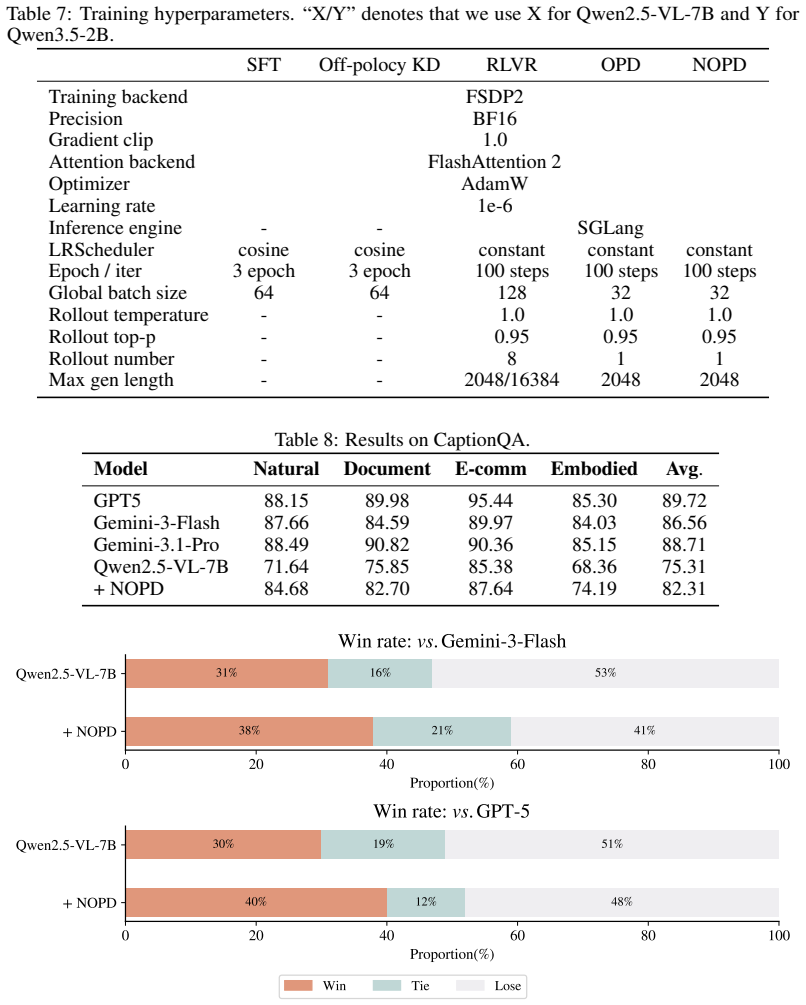
Summary. The paper proposes NOPD (Noisy Student On-Policy Self-Distillation), a post-training method for vision-language models in which a single model acts as both student and teacher. The teacher is the model's own prediction on a clean image (with stop-gradient), and the student is trained on a corrupted version of the image using a reverse-KL objective (Eq. 6). The method requires no ground-truth answers, external teacher models, or verifiable rewards. Experiments in Sec. 4.1 compare NOPD with SFT, off-policy KD, RLVR, and OPD on five visual-reasoning benchmarks for two base models; Sec. 4.3 extends to three models on 12 benchmarks; Sec. C reports captioning results. The paper claims that NOPD matches or outperforms methods that use external supervision, generalizes out-of-distribution, and simultaneously compresses reasoning length.
Significance. If the central empirical claim holds, NOPD is significant: it would demonstrate that a VLM can improve itself purely from consistency between clean and corrupted inputs, with no external supervision, and can match methods that use rewards or external teachers. The paper has several genuine strengths: the method is precisely specified; the gradient derivation in Sec. C is explicit and appears correct; the comparison set (SFT, KD, RLVR, OPD) is appropriate; and the ablations cover loss type, teacher-update strategy, generation length, corruption type, and rollout diversity. The scalability experiment on MMK12 and the multi-model/multi-task results in Sec. 4.3 also go beyond a single benchmark. However, the empirical claims currently rest on single-run point estimates and on out-of-distribution evaluations whose independence from the training set is not demonstrated.
major comments (3)
- [Sec. 4.1 / Table 1] The headline out-of-distribution generalization claim is not established because no deduplication is reported between the Geometry3K training split and the MathVista/MathVision evaluation sets. MathVista is an aggregation of existing visual-math benchmarks and is known to contain geometry problems of the Geometry3K type. Since NOPD uses images and questions only as unlabeled inputs, any overlap would directly train the model's clean-branch predictions on eval-like inputs, inflating the reported 7.4-point MathVista gain and the larger gains in Table 4. Section A.1 lists only the vision-modality restriction as a limitation and does not mention this validity risk. Please report exact or near-duplicate overlap statistics (e.g., image hashing, question-text matching) between every training mixture and every evaluation set, or evaluate on a verified disjoint subset.
- [Tables 1, 3, 4] All reported results are single-run point estimates without error bars or significance tests. The central claim that NOPD matches or outperforms RLVR and OPD, and the cross-model generalization shown in Table 4, depend on differences that may be within run-to-run variance. For example, the Qwen3.5-2B gains range from 0.6 to 4.8 points on relatively small benchmark subsets, and even avg@16 evaluation has sampling variance. Please provide multiple seeds (at least three) or otherwise report variance/confidence intervals for the main comparisons, especially in the 2.1K-sample Geometry3K experiments.
- [Eq. (6) / Sec. 4.1] The self-teacher premise — that the clean-image prediction is a trustworthy target — is never directly tested. Because the teacher is the same model's own output, systematic errors in the base model are preserved, and the 20-point in-domain Geometry3K-val gain could partly reflect improved agreement with the clean branch on near-training-distribution inputs rather than improved task competence. Please add an analysis that compares teacher accuracy and student accuracy before/after training, and include a control such as clean-to-clean self-distillation under the same training procedure to isolate the role of input corruption.
minor comments (4)
- [Sec. 3 / Eq. (6)] The notation overloads y: y denotes both the sampled response and the argument of the distribution πθ(y|q,·). This makes the equation hard to parse. Consider writing the student distribution as πθ(·|q,T(x)) and making the sampling explicit outside the KL.
- [Table 1] The header row concatenates benchmark and split names ambiguously (e.g., 'test val testmini'). Please spell out the splits or use separate sub-headers for each benchmark.
- [Sec. 4.2] The text says the loss is computed over the full vocabulary, then states 'we only transfer last-layer teacher hidden states and recompute logits on the fly.' Clarify whether the reported numbers correspond exactly to Eq. (6) or to this recomputation variant, and whether the recomputation changes the effective loss.
- [Sec. 4.3] The same deduplication concern raised for Sec. 4.1 applies to the larger mixture. If overlap statistics are added for the preliminary experiments, please also provide them for the general-domain mixture used in Table 4.
Circularity Check
No circularity: NOPD is a consistency objective with an untested but non-circular self-teacher; reported gains are empirical and not forced by construction.
full rationale
The only apparent self-reference is Eq. (6), where the teacher is the same network's clean-input prediction with stop-gradient. This is a standard self-distillation/consistency objective: it defines a training loss, not a derived prediction whose target is a function of the result, and nothing in the loss forces the reported accuracy numbers. The improvement claims are measured on held-out splits and external benchmarks, so they are not equivalent to the method's inputs by construction. The paper does not rely on a load-bearing self-citation or an imported uniqueness theorem; the MathVista citation [28] is a benchmark reference by a co-author, but the benchmark is an externally available evaluation set and its use is not a circular argument. A real validity concern is that Sec. 4.1 reports OOD gains on MathVista/MathVision after training on Geometry3K without reporting deduplication, and A.1 does not mention this. That is a data-leakage/external-validity risk, not a circular step under the definitions here.
Axiom & Free-Parameter Ledger
free parameters (3)
- Image corruption hyperparameters =
noise σ ∈ {0.08,0.12,0.18,0.26,0.38}; gamma γ ~ U[0.5,2]; downsample factor 2 or 4
- Max generation length for student rollouts =
2048 tokens
- Training steps =
100 (Geometry3K), 200 (MMK12), +1000 (mixed 129K set)
axioms (3)
- domain assumption Clean-image predictions are a reliable teacher signal (more accurate than corrupted-image predictions).
- domain assumption Image corruptions (noise, gamma, downsample) preserve task-relevant information.
- standard math Score-function identity and the zero-mean property of E[∇ log π] are used to simplify the gradient (Eq. 8).
read the original abstract
Post-training enables vision-language models (VLMs) to understand human instructions and perform various downstream tasks. Current post-training methods usually rely on human-annotated data, distillation from external models, reinforcement learning with human feedback, or verifiable answers. This limits their ability to improve without external supervision. To tackle this, we propose NOPD (Noisy Student On-Policy Self-Distillation), a simple yet effective self-distillation approach that improves VLMs without any external models or ground-truth answers. Our key insight is that prediction discrepancies between clean and corrupted inputs naturally induce a self-supervision signal. In NOPD, the model learns from corrupted inputs while using its own predictions under clean inputs as token-level supervision. We show the effectiveness of NOPD on five visual reasoning tasks; it can match and even outperform reinforcement learning approaches or distillation from external models. Notably, when trained with 2.1K samples from Geometry3K, NOPD improves Qwen2.5-VL-7B by 20 points on its validation set. It also shows generalization on out-of-distribution test sets and achieves 7.4 point gains on MathVista. Furthermore, we demonstrate that NOPD is a general approach to enhance VLMs, achieving improvements across three models on 12 benchmarks.
Figures


Reference graph
Works this paper leans on
-
[1]
On-policy distillation of language models: Learning from self-generated mistakes
Rishabh Agarwal, Nino Vieillard, Yongchao Zhou, Piotr Stanczyk, Sabela Ramos Garea, Matthieu Geist, and Olivier Bachem. On-policy distillation of language models: Learning from self-generated mistakes. InICLR, 2024
2024
-
[2]
Qwen3-vl technical report.arXiv preprint arXiv:2511.21631, 2025
Shuai Bai, Yuxuan Cai, Ruizhe Chen, Keqin Chen, Xionghui Chen, Zesen Cheng, Lianghao Deng, Wei Ding, Chang Gao, Chunjiang Ge, et al. Qwen3-vl technical report.arXiv preprint arXiv:2511.21631, 2025
Pith/arXiv arXiv 2025
-
[3]
Shuai Bai, Keqin Chen, Xuejing Liu, Jialin Wang, Wenbin Ge, Sibo Song, Kai Dang, Peng Wang, Shijie Wang, Jun Tang, Humen Zhong, Yuanzhi Zhu, Mingkun Yang, Zhaohai Li, Jianqiang Wan, Pengfei Wang, Wei Ding, Zheren Fu, Yiheng Xu, Jiabo Ye, Xi Zhang, Tianbao Xie, Zesen Cheng, Hang Zhang, Zhibo Yang, Haiyang Xu, and Junyang Lin. Qwen2.5-vl technical report. a...
Pith/arXiv arXiv 2025
-
[4]
An augmented benchmark dataset for geometric question answering through dual parallel text encoding
Jie Cao and Jing Xiao. An augmented benchmark dataset for geometric question answering through dual parallel text encoding. InProceedings of the 29th international conference on computational linguistics, pages 1511–1520, 2022
2022
-
[5]
Are we on the right way for evaluating large vision-language models? InNeurIPS, 2024
Lin Chen, Jinsong Li, Xiaoyi Dong, Pan Zhang, Yuhang Zang, Zehui Chen, Haodong Duan, Jiaqi Wang, Yu Qiao, Dahua Lin, and Feng Zhao. Are we on the right way for evaluating large vision-language models? InNeurIPS, 2024
2024
-
[6]
Caparena: Benchmarking and analyzing detailed image captioning in the llm era
Kanzhi Cheng, Wenpo Song, Jiaxin Fan, Zheng Ma, Qiushi Sun, Fangzhi Xu, Chenyang Yan, Nuo Chen, Jianbing Zhang, and Jiajun Chen. Caparena: Benchmarking and analyzing detailed image captioning in the llm era. InACL, 2025
2025
-
[7]
Enhancing large vision language models with self-training on image comprehension
Yihe Deng, Pan Lu, Fan Yin, Ziniu Hu, Sheng Shen, Quanquan Gu, James Zou, Kai-Wei Chang, and Wei Wang. Enhancing large vision language models with self-training on image comprehension. InNeurIPS, 2024
2024
-
[8]
Self-boosting large language models with synthetic preference data
Qingxiu Dong, Li Dong, Xingxing Zhang, Zhifang Sui, and Furu Wei. Self-boosting large language models with synthetic preference data. InICLR, 2025
2025
-
[9]
Gemini 3 pro: the frontier of vision ai
Rohan Doshi. Gemini 3 pro: the frontier of vision ai. https://blog.google/ innovation-and-ai/technology/developers-tools/gemini-3-pro-vision/ , De- cember 2025. Google Blog
2025
-
[10]
Blink: Multimodal large language models can see but not perceive
Xingyu Fu, Yushi Hu, Bangzheng Li, Yu Feng, Haoyu Wang, Xudong Lin, Dan Roth, Noah A Smith, Wei-Chiu Ma, and Ranjay Krishna. Blink: Multimodal large language models can see but not perceive. InECCV, 2024
2024
-
[11]
Jiahui Gao, Renjie Pi, Jipeng Zhang, Jiacheng Ye, Wanjun Zhong, Yufei Wang, Lanqing Hong, Jianhua Han, Hang Xu, Zhenguo Li, et al. G-llava: Solving geometric problem with multi-modal large language model.arXiv preprint arXiv:2312.11370, 2023
Pith/arXiv arXiv 2023
-
[12]
Making the v in vqa matter: Elevating the role of image understanding in visual question answering
Yash Goyal, Tejas Khot, Douglas Summers-Stay, Dhruv Batra, and Devi Parikh. Making the v in vqa matter: Elevating the role of image understanding in visual question answering. In CVPR, 2017
2017
-
[13]
MiniLLM: Knowledge distillation of large language models
Yuxian Gu, Li Dong, Furu Wei, and Minlie Huang. MiniLLM: Knowledge distillation of large language models. InICLR, 2024
2024
-
[14]
Reinforced self-training (rest) for language modeling.arXiv preprint arXiv:2308.08998, 2023
Caglar Gulcehre, Tom Le Paine, Srivatsan Srinivasan, Ksenia Konyushkova, Lotte Weerts, Abhishek Sharma, Aditya Siddhant, Alex Ahern, Miaosen Wang, Chenjie Gu, et al. Reinforced self-training (rest) for language modeling.arXiv preprint arXiv:2308.08998, 2023
Pith/arXiv arXiv 2023
-
[15]
Deepseek-r1 incentivizes reasoning in llms through reinforcement learning.Nature, 645(8081):633–638, 2025
Daya Guo, Dejian Yang, Haowei Zhang, Junxiao Song, Peiyi Wang, Qihao Zhu, Runxin Xu, Ruoyu Zhang, Shirong Ma, Xiao Bi, et al. Deepseek-r1 incentivizes reasoning in llms through reinforcement learning.Nature, 645(8081):633–638, 2025
2025
-
[16]
Yinghui He, Simran Kaur, Adithya Bhaskar, Yongjin Yang, Jiarui Liu, Narutatsu Ri, Liam Fowl, Abhishek Panigrahi, Danqi Chen, and Sanjeev Arora. Self-distillation zero: Self-revision turns binary rewards into dense supervision.arXiv preprint arXiv:2604.12002, 2026. 10
Pith/arXiv arXiv 2026
-
[17]
Benchmarking neural network robustness to common corruptions and perturbations
Dan Hendrycks and Thomas Dietterich. Benchmarking neural network robustness to common corruptions and perturbations. InICLR, 2019
2019
-
[18]
Distilling the knowledge in a neural network
Geoffrey Hinton, Oriol Vinyals, and Jeff Dean. Distilling the knowledge in a neural network. arXiv preprint arXiv:1503.02531, 2015
Pith/arXiv arXiv 2015
-
[19]
Wenyi Hong, Wenmeng Yu, Xiaotao Gu, Guo Wang, Guobing Gan, Haomiao Tang, Jiale Cheng, Ji Qi, Junhui Ji, Lihang Pan, et al. Glm-4.5 v and glm-4.1 v-thinking: Towards versatile multimodal reasoning with scalable reinforcement learning.arXiv preprint arXiv:2507.01006, 2025
Pith/arXiv arXiv 2025
-
[20]
Reinforcement learning via self-distillation.arXiv preprint arXiv:2601.20802, 2026
Jonas Hübotter, Frederike Lübeck, Lejs Behric, Anton Baumann, Marco Bagatella, Daniel Marta, Ido Hakimi, Idan Shenfeld, Thomas Kleine Buening, Carlos Guestrin, et al. Reinforcement learning via self-distillation.arXiv preprint arXiv:2601.20802, 2026
Pith/arXiv arXiv 2026
-
[21]
Hudson and Christopher D
Drew A. Hudson and Christopher D. Manning. Gqa: A new dataset for real-world visual reasoning and compositional question answering. InCVPR, 2019
2019
-
[22]
Mehran Kazemi, Hamidreza Alvari, Ankit Anand, Jialin Wu, Xi Chen, and Radu Soricut. Geomverse: A systematic evaluation of large models for geometric reasoning.arXiv preprint arXiv:2312.12241, 2023
Pith/arXiv arXiv 2023
-
[23]
Sequence-level knowledge distillation
Yoon Kim and Alexander M Rush. Sequence-level knowledge distillation. InEMNLP, 2016
2016
-
[24]
Multimodal arxiv: A dataset for improving scientific comprehension of large vision-language models
Lei Li, Yuqi Wang, Runxin Xu, Peiyi Wang, Xiachong Feng, Lingpeng Kong, and Qi Liu. Multimodal arxiv: A dataset for improving scientific comprehension of large vision-language models. InACL, 2024
2024
-
[25]
Visual instruction tuning
Haotian Liu, Chunyuan Li, Qingyang Wu, and Yong Jae Lee. Visual instruction tuning. In NeurIPS, 2023
2023
-
[26]
Noisyrollout: Reinforcing visual reasoning with data augmentation
Xiangyan Liu, Jinjie Ni, Zijian Wu, Chao Du, Longxu Dou, Haonan Wang, Tianyu Pang, and Michael Qizhe Shieh. Noisyrollout: Reinforcing visual reasoning with data augmentation. In NeurIPS, 2025
2025
-
[27]
Mmbench: Is your multi-modal model an all-around player? InECCV, 2024
Yuan Liu, Haodong Duan, Yuanhan Zhang, Bo Li, Songyang Zhang, Wangbo Zhao, Yike Yuan, Jiaqi Wang, Conghui He, Ziwei Liu, et al. Mmbench: Is your multi-modal model an all-around player? InECCV, 2024
2024
-
[28]
Mathvista: Evaluating mathematical reasoning of foundation models in visual contexts
Pan Lu, Hritik Bansal, Tony Xia, Jiacheng Liu, Chunyuan Li, Hannaneh Hajishirzi, Hao Cheng, Kai-Wei Chang, Michel Galley, and Jianfeng Gao. Mathvista: Evaluating mathematical reasoning of foundation models in visual contexts. InICLR, 2024
2024
-
[29]
Inter-gps: Interpretable geometry problem solving with formal language and symbolic reasoning
Pan Lu, Ran Gong, Shibiao Jiang, Liang Qiu, Siyuan Huang, Xiaodan Liang, and Song-Chun Zhu. Inter-gps: Interpretable geometry problem solving with formal language and symbolic reasoning. InACL, 2021
2021
-
[30]
Chartqa: A benchmark for question answering about charts with visual and logical reasoning
Ahmed Masry, Xuan Long Do, Jia Qing Tan, Shafiq Joty, and Enamul Hoque. Chartqa: A benchmark for question answering about charts with visual and logical reasoning. InACL, 2022
2022
-
[31]
Chartqapro: A more diverse and challenging benchmark for chart question answering
Ahmed Masry, Mohammed Saidul Islam, Mahir Ahmed, Aayush Bajaj, Firoz Kabir, Aaryaman Kartha, Md Tahmid Rahman Laskar, Mizanur Rahman, Shadikur Rahman, Mehrad Shahmo- hammadi, et al. Chartqapro: A more diverse and challenging benchmark for chart question answering. InACL, 2025
2025
-
[32]
Fanqing Meng, Lingxiao Du, Zongkai Liu, Zhixiang Zhou, Quanfeng Lu, Daocheng Fu, Tiancheng Han, Botian Shi, Wenhai Wang, Junjun He, et al. Mm-eureka: Exploring the frontiers of multimodal reasoning with rule-based reinforcement learning.arXiv preprint arXiv:2503.07365, 2025
Pith/arXiv arXiv 2025
-
[33]
2 olmo 2 furious.arXiv preprint arXiv:2501.00656, 2024
Team OLMo, Pete Walsh, Luca Soldaini, Dirk Groeneveld, Kyle Lo, Shane Arora, Akshita Bhagia, Yuling Gu, Shengyi Huang, Matt Jordan, et al. 2 olmo 2 furious.arXiv preprint arXiv:2501.00656, 2024. 11
Pith/arXiv arXiv 2024
-
[34]
Training language models to follow instructions with human feedback
Long Ouyang, Jeffrey Wu, Xu Jiang, Diogo Almeida, Carroll Wainwright, Pamela Mishkin, Chong Zhang, Sandhini Agarwal, Katarina Slama, Alex Gray, John Schulman, Jacob Hilton, Fraser Kelton, Luke Miller, Maddie Simens, Amanda Askell, Peter Welinder, Paul Christiano, Jan Leike, and Ryan Lowe. Training language models to follow instructions with human feedback...
2022
-
[35]
Learning transferable visual models from natural language supervision
Alec Radford, Jong Wook Kim, Chris Hallacy, Aditya Ramesh, Gabriel Goh, Sandhini Agarwal, Girish Sastry, Amanda Askell, Pamela Mishkin, Jack Clark, et al. Learning transferable visual models from natural language supervision. InICML, 2021
2021
-
[36]
Direct preference optimization: Your language model is secretly a reward model
Rafael Rafailov, Archit Sharma, Eric Mitchell, Christopher D Manning, Stefano Ermon, and Chelsea Finn. Direct preference optimization: Your language model is secretly a reward model. InNeurIPS, 2023
2023
-
[37]
Zhihong Shao, Peiyi Wang, Qihao Zhu, Runxin Xu, Junxiao Song, Xiao Bi, Haowei Zhang, Mingchuan Zhang, YK Li, Yang Wu, et al. Deepseekmath: Pushing the limits of mathematical reasoning in open language models.arXiv preprint arXiv:2402.03300, 2024
Pith/arXiv arXiv 2024
-
[38]
Liyan Tang, Grace Kim, Xinyu Zhao, Thom Lake, Wenxuan Ding, Fangcong Yin, Prasann Singhal, Manya Wadhwa, Zeyu Leo Liu, Zayne Sprague, et al. Chartmuseum: Testing visual reasoning capabilities of large vision-language models.arXiv preprint arXiv:2505.13444, 2025
arXiv 2025
-
[39]
Kimi Team, Tongtong Bai, Yifan Bai, Yiping Bao, SH Cai, Yuan Cao, Y Charles, HS Che, Cheng Chen, Guanduo Chen, et al. Kimi k2. 5: Visual agentic intelligence.arXiv preprint arXiv:2602.02276, 2026
Pith/arXiv arXiv 2026
-
[40]
Cambrian-1: A fully open, vision-centric exploration of multimodal LLMs
Shengbang Tong, Ellis L Brown II, Penghao Wu, Sanghyun Woo, ADITHY A JAIRAM IYER, Sai Charitha Akula, Shusheng Yang, Jihan Yang, Manoj Middepogu, Ziteng Wang, Xichen Pan, Rob Fergus, Yann LeCun, and Saining Xie. Cambrian-1: A fully open, vision-centric exploration of multimodal LLMs. InNeurPS, 2024
2024
-
[41]
Learning using privileged information: Similarity control and knowledge transfer.Journal of Machine Learning Research, 16(61):2023–2049, 2015
Vladimir Vapnik and Rauf Izmailov. Learning using privileged information: Similarity control and knowledge transfer.Journal of Machine Learning Research, 16(61):2023–2049, 2015
2023
-
[42]
Measuring multimodal mathematical reasoning with MATH-vision dataset
Ke Wang, Junting Pan, Weikang Shi, Zimu Lu, Houxing Ren, Aojun Zhou, Mingjie Zhan, and Hongsheng Li. Measuring multimodal mathematical reasoning with MATH-vision dataset. In NeurIPS, 2024
2024
-
[43]
Charxiv: Charting gaps in realistic chart understanding in multimodal LLMs
Zirui Wang, Mengzhou Xia, Luxi He, Howard Chen, Yitao Liu, Richard Zhu, Kaiqu Liang, Xindi Wu, Haotian Liu, Sadhika Malladi, Alexis Chevalier, Sanjeev Arora, and Danqi Chen. Charxiv: Charting gaps in realistic chart understanding in multimodal LLMs. InNeurIPS, 2024
2024
-
[44]
Dai, and Quoc V Le
Jason Wei, Maarten Bosma, Vincent Zhao, Kelvin Guu, Adams Wei Yu, Brian Lester, Nan Du, Andrew M. Dai, and Quoc V Le. Finetuned language models are zero-shot learners. InICLR, 2022
2022
-
[45]
Chi, Quoc V Le, and Denny Zhou
Jason Wei, Xuezhi Wang, Dale Schuurmans, Maarten Bosma, brian ichter, Fei Xia, Ed H. Chi, Quoc V Le, and Denny Zhou. Chain of thought prompting elicits reasoning in large language models. InNeurIPS, 2022
2022
-
[46]
Captionqa: Is your caption as useful as the image itself?arXiv preprint arXiv:2511.21025, 2025
Shijia Yang, Yunong Liu, Bohan Zhai, Ximeng Sun, Zicheng Liu, Emad Barsoum, Manling Li, and Chenfeng Xu. Captionqa: Is your caption as useful as the image itself?arXiv preprint arXiv:2511.21025, 2025
Pith/arXiv arXiv 2025
-
[47]
Scaling text-rich image understanding via code-guided synthetic multimodal data generation
Yue Yang, Ajay Patel, Matt Deitke, Tanmay Gupta, Luca Weihs, Andrew Head, Mark Yatskar, Chris Callison-Burch, Ranjay Krishna, Aniruddha Kembhavi, and Christopher Clark. Scaling text-rich image understanding via code-guided synthetic multimodal data generation. InACL, 2025
2025
-
[48]
DAPO: An open-source LLM reinforcement learning system at scale
Qiying Yu, Zheng Zhang, Ruofei Zhu, Yufeng Yuan, Xiaochen Zuo, YuYue, Weinan Dai, Tiantian Fan, Gaohong Liu, Juncai Liu, LingJun Liu, Xin Liu, Haibin Lin, Zhiqi Lin, Bole Ma, Guangming Sheng, Yuxuan Tong, Chi Zhang, Mofan Zhang, Ru Zhang, Wang Zhang, Hang Zhu, Jinhua Zhu, Jiaze Chen, Jiangjie Chen, Chengyi Wang, Hongli Yu, Yuxuan Song, 12 Xiangpeng Wei, H...
2025
-
[49]
Self-rewarding language models
Weizhe Yuan, Richard Yuanzhe Pang, Kyunghyun Cho, Xian Li, Sainbayar Sukhbaatar, Jing Xu, and Jason E Weston. Self-rewarding language models. InICML, 2024
2024
-
[50]
Mmmu: A massive multi-discipline multimodal understanding and reasoning benchmark for expert agi
Xiang Yue, Yuansheng Ni, Kai Zhang, Tianyu Zheng, Ruoqi Liu, Ge Zhang, Samuel Stevens, Dongfu Jiang, Weiming Ren, Yuxuan Sun, Cong Wei, Botao Yu, Ruibin Yuan, Renliang Sun, Ming Yin, Boyuan Zheng, Zhenzhu Yang, Yibo Liu, Wenhao Huang, Huan Sun, Yu Su, and Wenhu Chen. Mmmu: A massive multi-discipline multimodal understanding and reasoning benchmark for exp...
2024
-
[51]
Mmmu-pro: A more robust multi-discipline multimodal understanding benchmark
Xiang Yue, Tianyu Zheng, Yuansheng Ni, Yubo Wang, Kai Zhang, Shengbang Tong, Yuxuan Sun, Botao Yu, Ge Zhang, Huan Sun, Yu Su, Wenhu Chen, and Graham Neubig. Mmmu-pro: A more robust multi-discipline multimodal understanding benchmark. InACL, 2025
2025
-
[52]
STar: Bootstrapping reasoning with reasoning
Eric Zelikman, Yuhuai Wu, Jesse Mu, and Noah Goodman. STar: Bootstrapping reasoning with reasoning. InNeurIPS, 2022
2022
-
[53]
ReST-MCTS*: LLM self-training via process reward guided tree search
Dan Zhang, Sining Zhoubian, Ziniu Hu, Yisong Yue, Yuxiao Dong, and Jie Tang. ReST-MCTS*: LLM self-training via process reward guided tree search. InNeurIPS, 2024
2024
-
[54]
Lmms-eval: Reality check on the evaluation of large multimodal models
Kaichen Zhang, Bo Li, Peiyuan Zhang, Fanyi Pu, Joshua Adrian Cahyono, Kairui Hu, Shuai Liu, Yuanhan Zhang, Jingkang Yang, Chunyuan Li, et al. Lmms-eval: Reality check on the evaluation of large multimodal models. InNAACL, 2025
2025
-
[55]
Songming Zhang, Xue Zhang, Tong Zhang, Bojie Hu, Yufeng Chen, and Jinan Xu. Kdflow: A user-friendly and efficient knowledge distillation framework for large language models.arXiv preprint arXiv:2603.01875, 2026
Pith/arXiv arXiv 2026
-
[56]
Siyan Zhao, Zhihui Xie, Mengchen Liu, Jing Huang, Guan Pang, Feiyu Chen, and Aditya Grover. Self-distilled reasoner: On-policy self-distillation for large language models.arXiv preprint arXiv:2601.18734, 2026
Pith/arXiv arXiv 2026
-
[57]
Group sequence policy optimization.arXiv preprint arXiv:2507.18071, 2025
Chujie Zheng, Shixuan Liu, Mingze Li, Xiong-Hui Chen, Bowen Yu, Chang Gao, Kai Dang, Yuqiong Liu, Rui Men, An Yang, et al. Group sequence policy optimization.arXiv preprint arXiv:2507.18071, 2025. 13 A Limitations and Social Impact A.1 Limitations. We propose NOPD, an effective self-boosting approach that improves VLMs without external information. The on...
Pith/arXiv arXiv 2025
-
[58]
- Therefore, AP:P D= 2 : 1 and CP:P E= 2 : 1
**Identify the properties of the medians and centroid:** - The medians of a triangle intersect at the centroid P , which divides each median into a ratio of 2:1. - Therefore, AP:P D= 2 : 1 and CP:P E= 2 : 1 . 2. **Determine the lengths of the segments:** - Given P E= 1.5 and P D= 2, we can find P Dand P Ein terms of the total length of the median. - Since...
-
[59]
**Set up the equation using the total length of the chordP Q:** - Since P Q=P T+T Q: P Q= 3x−4 2 + 3x−4 2 = 3x−4
-
[60]
**Solve for x:** - We know P Q= 3x−4 and from the diagram, P Q= 16 (since T and U are midpoints and the total length is twice the segment from the center to the midpoint of the chord). - Set up the equation: 3x−4 = 16 - Solve forx: 3x= 20 x= 20 3 Therefore, the value ofxis 20 3 .✘ NOPD To solve for x in the given problem, we need to use the properties of ...
discussion (0)
Sign in with ORCID, Apple, or X to comment. Anyone can read and Pith papers without signing in.