REVIEW 2 major objections 4 minor 99 references
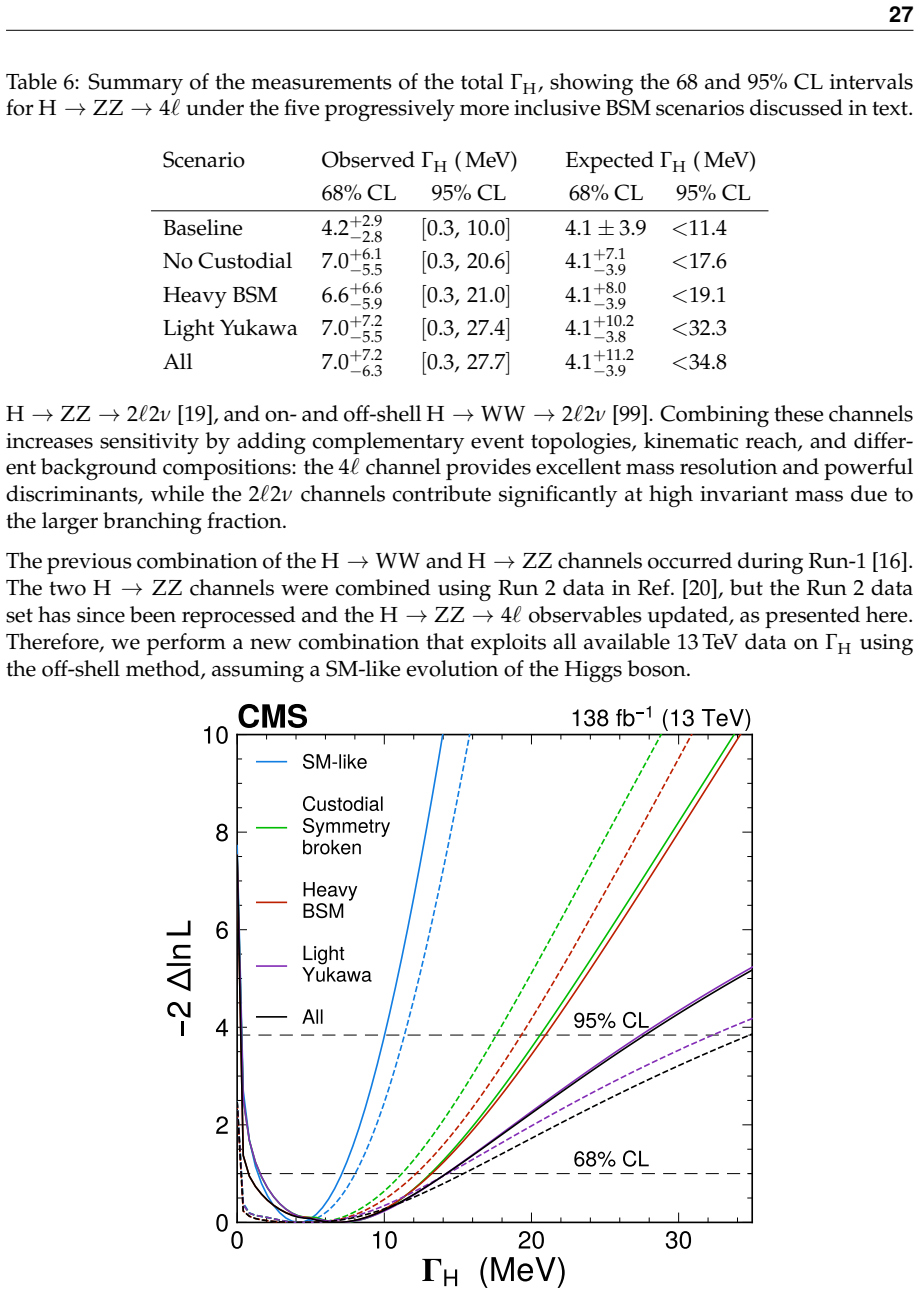
Off-shell Higgs production in 13 TeV proton-proton collisions gives a width of 5.1^{+2.0}_{-1.8} MeV, excludes zero off-shell at >5σ, and bounds a composite-Higgs scale above 870 GeV.
Reviewed by Pith at T0; open to challenge. T0 means a machine referee read the full paper against a public rubric. the ladder, T0–T4 →
T0 review · deepseek-v4-flash
2026-07-31 23:40 UTC pith:CXDRAAAO
load-bearing objection A detailed, internally consistent CMS off-shell Higgs paper with several genuinely new results; the width and 5σ claim rest on a defensible but not fully tested K-factor universality assumption, worth referee scrutiny but not a fatal flaw. the 2 major comments →
Off-shell Higgs boson measurements: Yukawa couplings, self-coupling, compositeness, and width
The pith
A machine-rendered reading of the paper's core claim, the machinery that carries it, and where it could break.
Core claim
The central claim is that the off-shell method works and is robust: the ratio identity σ_on ∝ g^2/Γ_H versus σ_off ∝ g^2 lets the data separate the Higgs width from production and decay couplings by comparing event rates and shapes on and off the mass shell. In the four-lepton channel and in combination with the two-lepton-two-neutrino H→ZZ and H→WW channels, the paper finds Γ_H=5.1^{+2.0}_{-1.8} MeV and excludes the no-off-shell hypothesis at more than 5 standard deviations. It then demonstrates that allowing beyond-standard-model effects—CP-even and CP-odd heavy-quark loop contributions, modified Z/W couplings, and light-quark Yukawa enhancements—degrades the width constraint only mildly,
What carries the argument
The load-bearing object is the off-shell method, built on the ratio identity between on-shell and off-shell cross sections: σ_on ∝ g_p² g_d² / Γ_H while σ_off ∝ g_p² g_d². Because the off-shell rate is independent of the width, a simultaneous fit to the on-shell peak and the m4ℓ>220 GeV off-shell tail breaks the degeneracy between Γ_H and couplings. The analysis realizes this with the matrix-element likelihood approach, which compresses event kinematics into discriminants D_sig and D_int that separate signal from background and isolate the signal–background interference; the interference is what makes off-shell Higgs production observable. A merging procedure reduces the two discriminants pl
Load-bearing premise
The load-bearing premise is that the higher-order QCD corrections computed for the gluon-fusion Higgs signal also describe the continuum gg→ZZ background and the signal–background interference above m4ℓ=220 GeV within the assigned ~10% uncertainty; if the true corrections deviate more, the central width and the >5σ off-shell exclusion would shift.
What would settle it
Compute the full next-to-next-to-leading-order QCD corrections to gg→ZZ production including signal–background interference in the m4ℓ>220 GeV region; if the resulting K-factor deviates from the gluon-fusion Higgs signal K-factor by more than about 10%, the reported Γ_H and the >5σ significance would need to be revised. A shorter test: with future data, compare the width extracted from the four-lepton channel alone with the H→WW-dominated two-lepton-two-neutrino channels; a significant discrepancy would signal that the common K-factor approximation is breaking down.
If this is right
- The measured width Γ_H=5.1^{+2.0}_{-1.8} MeV (95% CL [1.7, 9.3] MeV) is consistent with the standard-model prediction of 4.1 MeV, leaving little room for invisible or undetected Higgs decay modes beyond the standard model.
- The exclusion of zero off-shell production at more than 5σ confirms that the Higgs signal–background interference in ZZ/WW production is real, validating the off-shell method as a standard measurement tool.
- The Λ_H>870 GeV limit means that if the Higgs is composite, its internal structure must be smaller than about 0.23 zeptometers, pushing compositeness dynamics beyond the TeV scale.
- Light-quark Yukawa couplings can be constrained without imposing |κ_Z|≤1 or custodial symmetry; the off-shell data restore the sensitivity that is lost when those assumptions are dropped.
- Profiling beyond-standard-model effects in the gluon-fusion loop and in HVV couplings weakens the width constraint only modestly, so a future width measurement remains a robust probe: either new physics appears in the fit or a strong constraint on Γ_H remains.
Where Pith is reading between the lines
- If the off-shell method holds up with more data, the Higgs width uncertainty could drop below about 1 MeV at a future high-luminosity collider, making the interference shape a precision observable for small beyond-standard-model loops and CP structure.
- The weak κ_λ constraint from off-shell production, though far less sensitive than double-Higgs searches, is independent and shape-based; global fits combining both will help resolve degeneracies in the Higgs potential.
- The Λ_H bound implies that composite-Higgs models attempting to solve the hierarchy problem must place their new strong dynamics above roughly the TeV scale, shifting attention to higher-mass signatures at future colliders.
- Because the width extraction degrades gracefully under profiled beyond-standard-model parameters, the off-shell method could become a standard cross-check in global effective-field-theory fits, constraining combinations of operators that on-shell measurements alone cannot separate.
Editorial analysis
A structured set of objections, weighed in public.
Referee Report
Summary. The paper presents CMS Run 2 measurements of off-shell Higgs boson production using 138 fb^-1 of 13 TeV data, with on- and off-shell information combined through the likelihood model of Eq. (9). The analysis extracts the Higgs boson total width under a hierarchy of BSM assumptions, sets a 95% CL lower bound on a composite-Higgs form-factor scale (Λ_H > 870 GeV), constrains CP-even and CP-odd heavy-quark loop couplings, light-quark Yukawa modifiers, and the trilinear self-coupling modifier κ_λ, and combines H→ZZ→4ℓ, H→ZZ→2ℓ2ν, and H→WW→2ℓ2ν channels to obtain Γ_H = 5.1^{+2.0}_{-1.8} MeV with a 95% CL interval of 1.7–9.3 MeV. The paper also reports that the no-off-shell-H hypothesis (μ_off = 0) is excluded at more than 5 standard deviations, compared with an expected significance of 2.9 standard deviations.
Significance. If the results are correct, this is a significant experimental advance: it validates the off-shell interference method on a large Run 2 dataset, gives the most general CMS width constraint to date, and provides the first direct off-shell bounds on composite Higgs compositeness and the first off-shell κ_λ constraint. The paper is unusually transparent about its likelihood construction, template-based parameterization, systematic assignments, and pseudo-experiment coverage; the HEPData record and the explicit Eq. (9) parameterization are strengths. The main caveat is that the headline width and 5σ significance depend on an approximation for the higher-order QCD corrections to the gg→ZZ background and to the signal–background interference, as detailed below. This is a correctness-risk concern rather than an inconsistency, and it is addressable with additional validation studies.
major comments (2)
- [Sec. 3, paragraph beginning "While the NNLO-to-LO K-factor calculation...", and Eq. (9)] The width extraction and the μ_off=0 significance are controlled by the interference term P_int in Eq. (9). The paper applies the NNLO-to-LO K-factor and the uniform N3LO normalization factor derived for the ggH signal to the gg→ZZ background and to the signal–background interference. The only quantitative support is that NLO-to-LO K-factors for background and interference agree with the signal within about 10% for m4ℓ>220 GeV, and an ad hoc 10% background uncertainty with square-root scaling for the interference is assigned. This does not cover possible m4ℓ-dependent NNLO shape differences in the high-mass tail that drives the fit. The observed >5σ excess versus 2.9σ expected makes this modeling choice consequential. I request: (i) a demonstration of how alternate K-factor shapes, scale variations, or a full NNLO-based uncertainty for background/interference shift Γ_H and the μ_off=0 si
- [Sec. 12, Fig. 14, Table 7; also Sec. 7] The observed significance for μ_off=0 exceeds 5σ while the expected significance is 2.9σ. The text attributes this difference to a statistical fluctuation, citing pseudo-experiments and noting that deficits in signal-enriched regions favor greater destructive interference. Since the same fluctuation is also invoked to explain the finite Λ_H best-fit in Sec. 7, this attribution should be documented more explicitly. I ask the authors to show the expected distribution of significances from pseudo-experiments, to provide a fit with independent μ_off for ggH and EW production, and to report the significance obtained after removing the most signal-like category or high-mass bin. This would separate a genuine statistical fluctuation from a systematic mismodeling of the interference contribution, which is the part of the model with the least direct higher-order QCD validation.
minor comments (4)
- [Abstract and Sec. 12] The abstract says 'combined analysis of the H→ZZ and H→WW channels', but the body uses H→ZZ→4ℓ, H→ZZ→2ℓ2ν, and H→WW→2ℓ2ν. Please specify the final states consistently.
- [Eq. (10) and Table 2] The notation for CP-odd couplings is inconsistent: the text and tables use both 'eκ' and 'κ̃'. Please unify the symbol and define it once in the text.
- [Fig. 3] The right-panel axes are labeled 'Dsig × Dint', but the analysis uses the MILOMERGE-compressed one-dimensional discriminant. Please clarify in the caption that the displayed quantity is a visualization of the compressed discriminant, not a direct product used in the fit.
- [Table 1] The hyphens in the 95% CL columns are explained only in the caption as 'none of the tested hypotheses can be excluded'. This is fine, but please state it explicitly in the table itself or in the main text for readability.
Circularity Check
No significant circularity: all headline quantities are likelihood-fit outputs against an independent SM null; self-citations are references to prior measured results and public tools, not load-bearing assumptions that define the derivation.
full rationale
The claimed derivation chain is self-contained as an experimental likelihood analysis. The central relations are Eq. (1), giving the on/off-shell production scalings, and Eq. (9), the likelihood in which mu_off, Gamma_H, and the coupling modifiers enter as free parameters; the null hypothesis mu_off=0 is a physical scenario, not an input fitted from data. The quoted results (Gamma_H = 5.1 MeV, Lambda_H > 870 GeV, kappa_lambda, light-quark Yukawa constraints, mu_off) are outputs of profile-likelihood fits to the observed 4-lepton and 2l2nu data, not fitted inputs renamed as predictions. The on-shell parameterization from Ref. [25] and the JHU/MELA/MCFM matrix-element framework are previously published, externally benchmarked tools and measurements; citing them does not reduce the present derivation to a self-citation chain, because the paper does not import the central values from those references but instead re-fits the data with these parameterizations. The most load-bearing modeling assumption is the K-factor universality described in Section 3: the signal NNLO-to-LO K-factor and N3LO normalization are applied to the gg->ZZ background and to the signal-background interference, justified by approximate NLO agreement at the ~10% level, with explicit additional uncertainties assigned. This is a genuine systematic limitation and a correctness risk, but it is not circular: it is an external estimate used to model background and interference, not an input that defines the measured quantities. The paper also explicitly attributes the observed-versus-expected significance gap to a statistical fluctuation rather than to a construction in the model. No equation or fitted parameter reduces to its own input by definition. Accordingly, no circular step is identified.
Axiom & Free-Parameter Ledger
free parameters (11)
- Γ_H =
5.1 +2.0 −1.8 MeV (68% CL)
- Λ_H =
>870 GeV at 95% CL (on+off-shell)
- κ_λ =
2 +17 −15 (68% CL), 95% [-21, 27]
- µ_off =
1.24 +0.49 −0.45
- κ_Z, κ_W =
free in No Custodial scenarios; see Table 6
- κ_t =
-1.00 +0.44 −0.73 with custodial; see Table 2
- κ_Q =
0.10 +0.33 −0.48; see Table 2
- κ̃_t =
0.00 ± 0.51; see Table 2
- κ̃_Q =
0.00 ± 0.28; see Table 2
- κ_u,d,s,c =
see Table 3; e.g. κ_u = 0.0 ± 1.7×10^3 (all free)
- Form-factor exponent n =
n=1 (n=2 equivalent for a single vertex)
axioms (6)
- domain assumption NNLO-to-LO K-factor universality for ggH signal, gg→ZZ background, and signal–background interference in m4ℓ>220 GeV
- domain assumption Composite-Higgs form factor F(q^2) = [1/(1+|q^2|/Λ_H^2)]^n
- domain assumption SMEFT single-operator interpretation for κλ (O_6) and for light-quark Yukawa operators
- domain assumption Heavy quark Q as a generic proxy for any BSM colored state in the ggH loop
- domain assumption On-shell parameterization of Eqs. (11)–(12) and m_H = 125.38 GeV taken from CMS Ref. [25]
- domain assumption Pseudo-experiments validate the −2ΔlnL = 0.99/3.84 interval definitions
invented entities (1)
-
Heavy BSM quark Q
no independent evidence
read the original abstract
Measurements of Higgs boson production in the off-shell region are presented, using the four-lepton decay channel. Data from proton-proton collisions at the CERN LHC, collected by the CMS experiment and corresponding to an integrated luminosity of 138 fb$^{-1}$ at a center-of-mass energy of 13 TeV, are utilized. The first direct test of composite Higgs boson models is performed, with a lower limit on the compositeness scale $\Lambda_\mathrm{H}$ set at 870 GeV at the 95% confidence level. Tests of gluon-fusion production within the standard model effective field theory framework are performed. The first constraint on the Higgs boson self-coupling in the off-shell region is obtained. By combining on- and off-shell measurements, the analysis sets the tightest constraints to date on light-quark Yukawa couplings, while relaxing assumptions such as the bound on the Higgs boson coupling to vector bosons, thereby providing more model-independent results. Constraints on the Higgs boson width are provided while accounting for a range of beyond-the-standard-model effects, including both light and heavy particles in the gluon-fusion production loop, as well as modified couplings to vector bosons. A combined analysis of the H$\to$ZZ and PH$\to$WW channels is performed to improve sensitivity to the Higgs boson width, yielding $\Gamma_\mathrm{H}$ = 5.1$^{+2.0}_{-1.8}$ MeV. The scenario of no off-shell Higgs boson production is excluded at a confidence level exceeding 5 standard deviations.
Figures



Reference graph
Works this paper leans on
-
[1]
Partial-symmetries of weak interactions
S. L. Glashow, “Partial-symmetries of weak interactions”,Nucl. Phys.22(1961) 579, doi:10.1016/0029-5582(61)90469-2
-
[2]
Broken symmetry and the mass of gauge vector mesons
F. Englert and R. Brout, “Broken symmetry and the mass of gauge vector mesons”,Phys. Rev. Lett.13(1964) 321,doi:10.1103/PhysRevLett.13.321
-
[3]
Broken symmetries, massless particles and gauge fields
P . W. Higgs, “Broken symmetries, massless particles and gauge fields”,Phys. Lett.12 (1964) 132,doi:10.1016/0031-9163(64)91136-9
-
[4]
Broken symmetries and the masses of gauge bosons
P . W. Higgs, “Broken symmetries and the masses of gauge bosons”,Phys. Rev. Lett.13 (1964) 508,doi:10.1103/PhysRevLett.13.508
-
[5]
Global conservation laws and massless particles
G. S. Guralnik, C. R. Hagen, and T. W. B. Kibble, “Global conservation laws and massless particles”,Phys. Rev. Lett.13(1964) 585,doi:10.1103/PhysRevLett.13.585
-
[6]
S. Weinberg, “A model of leptons”,Phys. Rev. Lett.19(1967) 1264, doi:10.1103/PhysRevLett.19.1264
-
[7]
Weak and electromagnetic interactions
A. Salam, “Weak and electromagnetic interactions”, inElementary particle physics: relativistic groups and analyticity, N. Svartholm, ed., p. 367. Almqvist & Wiksell, Stockholm, 1968
1968
-
[8]
ATLAS Collaboration, “Observation of a new particle in the search for the standard model Higgs boson with the ATLAS detector at the LHC”,Phys. Lett. B716(2012) 1, doi:10.1016/j.physletb.2012.08.020,arXiv:1207.7214
Pith/arXiv arXiv 2012
-
[9]
Observation of a new boson at a mass of 125 GeV with the CMS experiment at the LHC
CMS Collaboration, “Observation of a new boson at a mass of 125 GeV with the CMS experiment at the LHC”,Phys. Lett. B716(2012) 30, doi:10.1016/j.physletb.2012.08.021,arXiv:1207.7235. 32
Pith/arXiv arXiv 2012
-
[10]
Observation of a new boson with mass near 125 GeV in pp collisions at √s=7 and 8 TeV
CMS Collaboration, “Observation of a new boson with mass near 125 GeV in pp collisions at √s=7 and 8 TeV”,JHEP06(2013) 081, doi:10.1007/JHEP06(2013)081,arXiv:1303.4571
Pith/arXiv arXiv 2013
-
[11]
ATLAS and CMS Collaborations, “Combined measurement of the Higgs boson mass in pp collisions at √s=7 and 8 TeV with the ATLAS and CMS experiments”,Phys. Rev. Lett. 114(2015) 191803,doi:10.1103/PhysRevLett.114.191803,arXiv:1503.07589
Pith/arXiv arXiv 2015
-
[12]
ATLAS Collaboration, “Combined measurement of the Higgs boson mass from the H →γγand H→ZZ ∗ →4ℓdecay channels with the ATLAS detector using √s= 7, 8 and 13 TeV pp collision data”,Phys. Rev. Lett.131(2023) 251802, doi:10.1103/PhysRevLett.131.251802,arXiv:2308.04775
Pith/arXiv arXiv 2023
-
[13]
Constraints on the Higgs boson width from off-shell production and decay to Z-boson pairs
CMS Collaboration, “Constraints on the Higgs boson width from off-shell production and decay to Z-boson pairs”,Phys. Lett. B736(2014) 64, doi:10.1016/j.physletb.2014.06.077,arXiv:1405.3455
Pith/arXiv arXiv 2014
-
[14]
ATLAS Collaboration, “Constraints on the off-shell higgs boson signal strength in the high-mass ZZ and WW final states with the ATLAS detector”,Eur. Phys. J. C75(2015) 335,doi:10.1140/epjc/s10052-015-3542-2,arXiv:1503.01060
Pith/arXiv arXiv 2015
-
[15]
Limits on the Higgs boson lifetime and width from its decay to four charged leptons
CMS Collaboration, “Limits on the Higgs boson lifetime and width from its decay to four charged leptons”,Phys. Rev. D92(2015) 072010, doi:10.1103/PhysRevD.92.072010,arXiv:1507.06656
Pith/arXiv arXiv 2015
-
[16]
CMS Collaboration, “Search for Higgs boson off-shell production in proton-proton collisions at 7 and 8 TeV and derivation of constraints on its total decay width”,JHEP09 (2016) 051,doi:10.1007/JHEP09(2016)051,arXiv:1605.02329
Pith/arXiv arXiv 2016
-
[17]
ATLAS Collaboration, “Constraints on off-shell Higgs boson production and the Higgs boson total width in ZZ→4ℓand ZZ→2ℓ2νfinal states with the ATLAS detector”, Phys. Lett. B786(2018) 223,doi:10.1016/j.physletb.2018.09.048, arXiv:1808.01191
Pith/arXiv arXiv 2018
-
[18]
CMS Collaboration, “Measurements of the Higgs boson width and anomalous HVV couplings from on-shell and off-shell production in the four-lepton final state”,Phys. Rev. D99(2019) 112003,doi:10.1103/PhysRevD.99.112003,arXiv:1901.00174
Pith/arXiv arXiv 2019
-
[19]
Measurement of the Higgs boson width and evidence of its off-shell contributions to ZZ production
CMS Collaboration, “Measurement of the Higgs boson width and evidence of its off-shell contributions to ZZ production”,Nature Phys.18(2022) 1329, doi:10.1038/s41567-022-01682-0,arXiv:2202.06923
Pith/arXiv arXiv 2022
-
[20]
CMS Collaboration, “Measurement of the Higgs boson mass and width using the four-lepton final state in proton-proton collisions at √s=13 TeV”,Phys. Rev. D111 (2025) 092014,doi:10.1103/PhysRevD.111.092014,arXiv:2409.13663
Pith/arXiv arXiv 2025
-
[21]
Constraining the Higgs boson width with ZZ production at the LHC
F. Caola and K. Melnikov, “Constraining the Higgs boson width with ZZ production at the LHC”,Phys. Rev. D88(2013) 054024,doi:10.1103/PhysRevD.88.054024, arXiv:1307.4935
Pith/arXiv arXiv 2013
-
[22]
Inadequacy of zero-width approximation for a light Higgs boson signal
N. Kauer and G. Passarino, “Inadequacy of zero-width approximation for a light Higgs boson signal”,JHEP08(2012) 116,doi:10.1007/JHEP08(2012)116, arXiv:1206.4803. References 33
Pith/arXiv arXiv 2012
-
[23]
Bounding the Higgs width at the LHC using full analytic results for gg→e −e+µ−µ+
J. M. Campbell, R. K. Ellis, and C. Williams, “Bounding the Higgs width at the LHC using full analytic results for gg→e −e+µ−µ+”,JHEP04(2014) 060, doi:10.1007/JHEP04(2014)060,arXiv:1311.3589
Pith/arXiv arXiv 2014
-
[24]
Precise values of running quark and lepton masses in the standard model
G.-y. Huang and S. Zhou, “Precise values of running quark and lepton masses in the standard model”,Phys. Rev. D103(2021) 016010, doi:10.1103/PhysRevD.103.016010,arXiv:2009.04851
Pith/arXiv arXiv 2021
-
[25]
Search forγH production and constraints on the Yukawa couplings of light quarks to the Higgs boson
CMS Collaboration, “Search forγH production and constraints on the Yukawa couplings of light quarks to the Higgs boson”,Phys. Rev. D112(2025) 112001, doi:10.1103/6s8n-pvmy,arXiv:2502.05665
arXiv 2025
-
[26]
Off-shell Higgs production at the LHC as a probe of the trilinear Higgs coupling
U. Haisch and G. Koole, “Off-shell Higgs production at the LHC as a probe of the trilinear Higgs coupling”,JHEP02(2022) 030,doi:10.1007/JHEP02(2022)030, arXiv:2111.12589
Pith/arXiv arXiv 2022
-
[27]
CMS Collaboration, “Constraints on the Higgs boson self-coupling from the combination of single and double Higgs boson production in proton-proton collisions at√s=13 TeV”,Phys. Lett. B861(2025) 139210, doi:10.1016/j.physletb.2024.139210,arXiv:2407.13554
arXiv 2025
-
[28]
Review on composite Higgs models
O. Witzel, “Review on composite Higgs models”,PoS LATTICE2018(2019) 006, doi:10.22323/1.334.0006,arXiv:1901.08216
Pith/arXiv arXiv 2019
-
[29]
Higgs to b b from vector boson fusion for high-scale physics
T. Han, S. C. I. Leung, and M. Low, “Higgs to b b from vector boson fusion for high-scale physics”,Phys. Rev. D109(2024) 115028,doi:10.1103/PhysRevD.109.115028, arXiv:2305.01010
Pith/arXiv arXiv 2024
-
[30]
HEPData record for this analysis, 2026.doi:10.17182/hepdata.181167
-
[31]
The CMS experiment at the CERN LHC
CMS Collaboration, “The CMS experiment at the CERN LHC”,JINST3(2008) S08004, doi:10.1088/1748-0221/3/08/S08004
-
[32]
Development of the CMS detector for the CERN LHC Run 3
CMS Collaboration, “Development of the CMS detector for the CERN LHC Run 3”, JINST19(2024) P05064,doi:10.1088/1748-0221/19/05/P05064, arXiv:2309.05466
Pith/arXiv arXiv 2024
-
[33]
CMS Collaboration, “The CMS trigger system”,JINST12(2017) P01020, doi:10.1088/1748-0221/12/01/P01020,arXiv:1609.02366
Pith/arXiv arXiv 2017
-
[34]
Performance of the CMS Level-1 trigger in proton-proton collisions at √s=13 TeV
CMS Collaboration, “Performance of the CMS Level-1 trigger in proton-proton collisions at √s=13 TeV”,JINST15(2020) P10017,doi:10.1088/1748-0221/15/10/P10017, arXiv:2006.10165
Pith/arXiv arXiv 2020
-
[35]
Performance of the CMS high-level trigger during LHC Run 2
CMS Collaboration, “Performance of the CMS high-level trigger during LHC Run 2”, JINST19(2024) P11021,doi:10.1088/1748-0221/19/11/P11021, arXiv:2410.17038
Pith/arXiv arXiv 2024
-
[36]
Technical proposal for the phase-II upgrade of the CMS detector
CMS Collaboration, “Technical proposal for the phase-II upgrade of the CMS detector”, CMS Technical proposal CERN-LHCC-2015-010, CMS-TDR-15-02, 2015
2015
-
[37]
Electron and photon reconstruction and identification with the CMS experiment at the CERN LHC
CMS Collaboration, “Electron and photon reconstruction and identification with the CMS experiment at the CERN LHC”,JINST16(2021) P05014, doi:10.1088/1748-0221/16/05/p05014,arXiv:2012.06888. 34
Pith/arXiv arXiv 2021
-
[38]
ECAL 2016 refined calibration and Run 2 summary plots
CMS Collaboration, “ECAL 2016 refined calibration and Run 2 summary plots”, CMS Detector Performance Note CMS-DP-2020-021, 2020
2016
-
[39]
CMS Collaboration, “Performance of the CMS muon detector and muon reconstruction with proton-proton collisions at √s=13 TeV”,JINST13(2018) P06015, doi:10.1088/1748-0221/13/06/p06015,arXiv:1804.04528
Pith/arXiv arXiv 2018
-
[40]
The anti-kT jet clustering algorithm
M. Cacciari, G. P . Salam, and G. Soyez, “The anti-kT jet clustering algorithm”,JHEP04 (2008) 063,doi:10.1088/1126-6708/2008/04/063,arXiv:0802.1189
Pith/arXiv arXiv 2008
-
[41]
M. Cacciari, G. P . Salam, and G. Soyez, “FastJet user manual”,Eur. Phys. J. C72(2012) 1896,doi:10.1140/epjc/s10052-012-1896-2,arXiv:1111.6097
Pith/arXiv arXiv 2012
-
[42]
Jet energy scale and resolution in the CMS experiment in pp collisions at 8 TeV
CMS Collaboration, “Jet energy scale and resolution in the CMS experiment in pp collisions at 8 TeV”,JINST12(2017) P02014, doi:10.1088/1748-0221/12/02/P02014,arXiv:1607.03663
Pith/arXiv arXiv 2017
-
[43]
CMS Collaboration, “Measurements of production cross sections of the Higgs boson in the four-lepton final state in proton-proton collisions at √s=13 TeV”,Eur. Phys. J. C81 (2021) 488,doi:10.1140/epjc/s10052-021-09200-x,arXiv:2103.04956
Pith/arXiv arXiv 2021
-
[44]
T. Sj ¨ostrand et al., “An introduction to PYTHIA 8.2”,Comput. Phys. Commun.191(2015) 159,doi:10.1016/j.cpc.2015.01.024,arXiv:1410.3012
Pith/arXiv arXiv 2015
-
[45]
Extraction and validation of a new set of CMS PYTHIA8 tunes from underlying-event measurements
CMS Collaboration, “Extraction and validation of a new set of CMS PYTHIA8 tunes from underlying-event measurements”,Eur. Phys. J. C80(2020) 4, doi:10.1140/epjc/s10052-019-7499-4,arXiv:1903.12179
Pith/arXiv arXiv 2020
-
[46]
Unbiased global determination of parton distributions and their uncertainties at NNLO and at LO
NNPDF Collaboration, “Unbiased global determination of parton distributions and their uncertainties at NNLO and at LO”,Nucl. Phys. B855(2012) 153, doi:10.1016/j.nuclphysb.2011.09.024,arXiv:1107.2652
Pith/arXiv arXiv 2012
-
[47]
GEANT4 Collaboration, “GEANT4 — a simulation toolkit”,Nucl. Instrum. Meth. A506 (2003) 250,doi:10.1016/S0168-9002(03)01368-8
-
[48]
MCFM for the Tevatron and the LHC
J. M. Campbell and R. K. Ellis, “MCFM for the Tevatron and the LHC”,Nucl. Phys. Proc. Suppl.205-206(2010) 10,doi:10.1016/j.nuclphysbps.2010.08.011, arXiv:1007.3492
Pith/arXiv arXiv 2010
-
[49]
Vector boson pair production at the LHC
J. M. Campbell, R. K. Ellis, and C. Williams, “Vector boson pair production at the LHC”, JHEP07(2011) 018,doi:10.1007/JHEP07(2011)018,arXiv:1105.0020
Pith/arXiv arXiv 2011
-
[50]
Higgs constraints from vector boson fusion and scattering
J. M. Campbell and R. K. Ellis, “Higgs constraints from vector boson fusion and scattering”,JHEP04(2015) 030,doi:10.1007/JHEP04(2015)030, arXiv:1502.02990
Pith/arXiv arXiv 2015
-
[51]
Spin determination of single-produced resonances at hadron colliders
Y. Gao et al., “Spin determination of single-produced resonances at hadron colliders”, Phys. Rev. D81(2010) 075022,doi:10.1103/PhysRevD.81.075022, arXiv:1001.3396
Pith/arXiv arXiv 2010
-
[52]
Spin and parity of a single-produced resonance at the LHC
S. Bolognesi et al., “Spin and parity of a single-produced resonance at the LHC”,Phys. Rev. D86(2012) 095031,doi:10.1103/PhysRevD.86.095031,arXiv:1208.4018
Pith/arXiv arXiv 2012
-
[53]
Constraining anomalous HVV interactions at proton and lepton colliders
I. Anderson et al., “Constraining anomalous HVV interactions at proton and lepton colliders”,Phys. Rev. D89(2014) 035007,doi:10.1103/PhysRevD.89.035007, arXiv:1309.4819. References 35
Pith/arXiv arXiv 2014
-
[54]
A. V . Gritsan, R. R¨ontsch, M. Schulze, and M. Xiao, “Constraining anomalous Higgs boson couplings to the heavy flavor fermions using matrix element techniques”,Phys. Rev. D94(2016) 055023,doi:10.1103/PhysRevD.94.055023,arXiv:1606.03107
Pith/arXiv arXiv 2016
-
[55]
A. V . Gritsan et al., “New features in the JHU generator framework: constraining Higgs boson properties from on-shell and off-shell production”,Phys. Rev. D102(2020) 056022, doi:10.1103/PhysRevD.102.056022,arXiv:2002.09888
Pith/arXiv arXiv 2020
-
[56]
Constraining anomalous Higgs boson couplings to virtual photons
J. Davis et al., “Constraining anomalous Higgs boson couplings to virtual photons”, Phys. Rev. D105(2022) 096027,doi:10.1103/PhysRevD.105.096027, arXiv:2109.13363
Pith/arXiv arXiv 2022
-
[57]
PHANTOM: a Monte Carlo event generator for six parton final states at high energy colliders
A. Ballestrero et al., “PHANTOM: a Monte Carlo event generator for six parton final states at high energy colliders”,Comput. Phys. Commun.180(2009) 401, doi:10.1016/j.cpc.2008.10.005,arXiv:0801.3359
Pith/arXiv arXiv 2009
-
[58]
Matching NLO QCD computations with parton shower simulations: the POWHEG method
S. Frixione, P . Nason, and C. Oleari, “Matching NLO QCD computations with parton shower simulations: the POWHEG method”,JHEP11(2007) 070, doi:10.1088/1126-6708/2007/11/070,arXiv:0709.2092
Pith/arXiv arXiv 2007
-
[59]
Higgs production via gluon fusion in the POWHEG approach in the SM and in the MSSM
E. Bagnaschi, G. Degrassi, P . Slavich, and A. Vicini, “Higgs production via gluon fusion in the POWHEG approach in the SM and in the MSSM”,JHEP02(2012) 088, doi:10.1007/JHEP02(2012)088,arXiv:1111.2854
Pith/arXiv arXiv 2012
-
[60]
NLO Higgs boson production via vector-boson fusion matched with shower in POWHEG
P . Nason and C. Oleari, “NLO Higgs boson production via vector-boson fusion matched with shower in POWHEG”,JHEP02(2010) 037,doi:10.1007/JHEP02(2010)037, arXiv:0911.5299
Pith/arXiv arXiv 2010
-
[61]
HW±/HZ + 0 and 1 jet at NLO with the POWHEG BOX interfaced to GoSam and their merging within MiNLO
G. Luisoni, P . Nason, C. Oleari, and F. Tramontano, “HW±/HZ + 0 and 1 jet at NLO with the POWHEG BOX interfaced to GoSam and their merging within MiNLO”,JHEP10 (2013) 083,doi:10.1007/JHEP10(2013)083,arXiv:1306.2542
Pith/arXiv arXiv 2013
-
[62]
Higgs boson production in association with top quarks in the POWHEG BOX
H. B. Hartanto, B. Jager, L. Reina, and D. Wackeroth, “Higgs boson production in association with top quarks in the POWHEG BOX”,Phys. Rev. D91(2015) 094003, doi:10.1103/PhysRevD.91.094003,arXiv:1501.04498
Pith/arXiv arXiv 2015
-
[63]
A new method for combining NLO QCD with shower Monte Carlo algorithms
P . Nason, “A new method for combining NLO QCD with shower Monte Carlo algorithms”,JHEP11(2004) 040,doi:10.1088/1126-6708/2004/11/040, arXiv:hep-ph/0409146
Pith/arXiv arXiv 2004
-
[64]
A general framework for implementing NLO calculations in shower Monte Carlo programs: the POWHEG BOX
S. Alioli, P . Nason, C. Oleari, and E. Re, “A general framework for implementing NLO calculations in shower Monte Carlo programs: the POWHEG BOX”,JHEP06(2010) 043, doi:10.1007/JHEP06(2010)043,arXiv:1002.2581
Pith/arXiv arXiv 2010
-
[65]
S. Catani and M. Grazzini, “An NNLO subtraction formalism in hadron collisions and its application to Higgs boson production at the LHC”,Phys. Rev. Lett.98(2007) 222002, doi:10.1103/PhysRevLett.98.222002,arXiv:hep-ph/0703012
Pith/arXiv arXiv 2007
-
[66]
NNLO predictions for the Higgs boson signal in the H→WW→ℓνℓν and H→ZZ→4ℓdecay channels
M. Grazzini, “NNLO predictions for the Higgs boson signal in the H→WW→ℓνℓν and H→ZZ→4ℓdecay channels”,JHEP02(2008) 043, doi:10.1088/1126-6708/2008/02/043,arXiv:0801.3232
Pith/arXiv arXiv 2008
-
[67]
Heavy-quark mass effects in Higgs boson production at the LHC
M. Grazzini and H. Sargsyan, “Heavy-quark mass effects in Higgs boson production at the LHC”,JHEP09(2013) 129,doi:10.1007/JHEP09(2013)129, arXiv:1306.4581. 36
Pith/arXiv arXiv 2013
-
[68]
Handbook of LHC Higgs cross sections: 4. Deciphering the nature of the Higgs sector
LHC Higgs Cross Section Working Group, “Handbook of LHC Higgs cross sections: 4. Deciphering the nature of the Higgs sector”,CERN Y ellow Rep. Monogr.2(2017) 1, doi:10.23731/CYRM-2017-002,arXiv:1610.07922
Pith/arXiv arXiv 2017
-
[69]
QCD corrections to ZZ production in gluon fusion at the LHC
F. Caola, K. Melnikov, R. R ¨ontsch, and L. Tancredi, “QCD corrections to ZZ production in gluon fusion at the LHC”,Phys. Rev. D92(2015) 094028, doi:10.1103/PhysRevD.92.094028,arXiv:1509.06734
Pith/arXiv arXiv 2015
-
[70]
Production of two Z-bosons in gluon fusion in the heavy top quark approximation
K. Melnikov and M. Dowling, “Production of two Z-bosons in gluon fusion in the heavy top quark approximation”,Phys. Lett. B744(2015) 43, doi:10.1016/j.physletb.2015.03.030,arXiv:1503.01274
Pith/arXiv arXiv 2015
-
[71]
Two loop correction to interference in gg→ZZ
J. M. Campbell, R. K. Ellis, M. Czakon, and S. Kirchner, “Two loop correction to interference in gg→ZZ”,JHEP08(2016) 011,doi:10.1007/JHEP08(2016)011, arXiv:1605.01380
Pith/arXiv arXiv 2016
-
[72]
F. Caola et al., “QCD corrections to vector boson pair production in gluon fusion including interference effects with off-shell Higgs at the LHC”,JHEP07(2016) 087, doi:10.1007/JHEP07(2016)087,arXiv:1605.04610
Pith/arXiv arXiv 2016
-
[73]
J. Alwall et al., “The automated computation of tree-level and next-to-leading order differential cross sections, and their matching to parton shower simulations”,JHEP07 (2014) 079,doi:10.1007/JHEP07(2014)079,arXiv:1405.0301
Pith/arXiv arXiv 2014
-
[74]
R. V . Harlander, S. Liebler, and H. Mantler, “SusHi: A program for the calculation of Higgs production in gluon fusion and bottom-quark annihilation in the standard model and the MSSM”,Comput. Phys. Commun.184(2013) 1605, doi:10.1016/j.cpc.2013.02.006,arXiv:1212.3249
Pith/arXiv arXiv 2013
-
[75]
ZZ production at the LHC: Fiducial cross sections and distributions in NNLO QCD
M. Grazzini, S. Kallweit, and D. Rathlev, “ZZ production at the LHC: Fiducial cross sections and distributions in NNLO QCD”,Phys. Lett. B750(2015) 407, doi:10.1016/j.physletb.2015.09.055,arXiv:1507.06257
Pith/arXiv arXiv 2015
-
[76]
Vector-boson pair production at the LHC to O(α3)accuracy
A. Bierweiler, T. Kasprzik, and J. H. K ¨uhn, “Vector-boson pair production at the LHC to O(α3)accuracy”,JHEP12(2013) 071,doi:10.1007/JHEP12(2013)071, arXiv:1305.5402
Pith/arXiv arXiv 2013
-
[77]
Particle-flow reconstruction and global event description with the CMS detector
CMS Collaboration, “Particle-flow reconstruction and global event description with the CMS detector”,JINST12(2017) P10003,doi:10.1088/1748-0221/12/10/P10003, arXiv:1706.04965
Pith/arXiv arXiv 2017
-
[78]
XGBoost: A scalable tree boosting system
T. Chen and C. Guestrin, “XGBoost: A scalable tree boosting system”, 2016. arXiv:1603.02754.doi:10.1145/2939672.2939785
Pith/arXiv arXiv 2016
-
[79]
CMS Collaboration, “Measurements of inclusive and differential cross sections for the Higgs boson production and decay to four-leptons in proton-proton collisions at√s=13 TeV”,JHEP08(2023) 040,doi:10.1007/JHEP08(2023)040, arXiv:2305.07532
Pith/arXiv arXiv 2023
-
[80]
Pileup mitigation at CMS in 13 TeV data
CMS Collaboration, “Pileup mitigation at CMS in 13 TeV data”,JINST15(2020) P09018, doi:10.1088/1748-0221/15/09/P09018,arXiv:2003.00503
Pith/arXiv arXiv 2020
discussion (0)
Sign in with ORCID, Apple, or X to comment. Anyone can read and Pith papers without signing in.