REVIEW 5 major objections 10 minor 71 references
Joint continuous multi-scale human motion control and discrete contact commands can generate real-time upper-body videos where a person both moves and controllably changes nearby object states.
Reviewed by Pith at T0; open to challenge. T0 means a machine referee read the full paper against a public rubric. the ladder, T0–T4 →
T0 review · grok-4.5
2026-07-30 20:24 UTC pith:KXL3LTR7
load-bearing objection Solid real-time upper-body HOI video system with a clean continuous/discrete control split; the “world model” label and same-pipeline synthetic eval are the main overreaches. the 5 major comments →
Real-Time Human-Centric World Modeling for Upper-Body Human-Object Interaction
The pith
A machine-rendered reading of the paper's core claim, the machinery that carries it, and where it could break.
Core claim
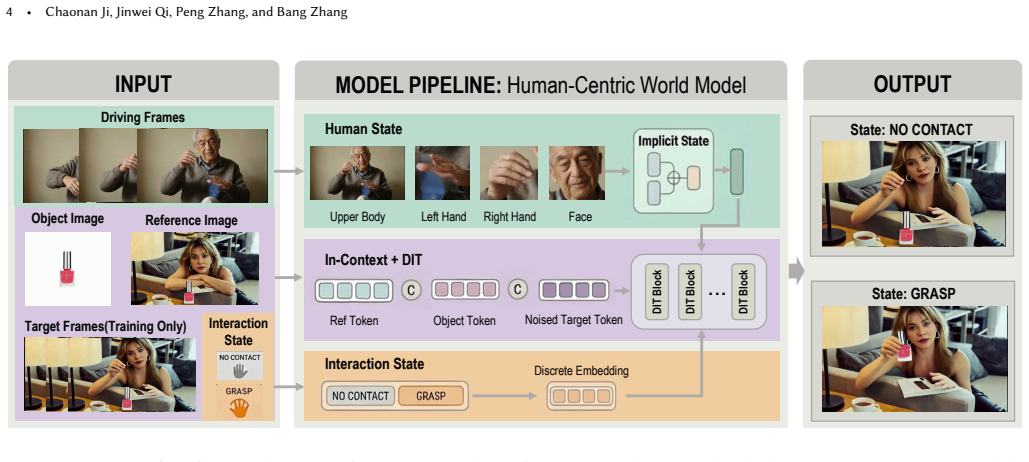
Person-centered upper-body scene evolution can be synthesized in real time by jointly conditioning a video generator on a unified multi-scale implicit human-state latent and a language-encoded discrete interaction-state command. The human state captures coordinated body, hand, and face dynamics without explicit retargeting; the interaction state switches contact relations such as no contact versus grasp under similar motion, so the model controls both how the person moves and how nearby objects change.
What carries the argument
Continuous–discrete joint control: a multi-scale implicit human state s_h formed by fusing upper-body, left-hand, right-hand, and face motion latents with reference features, plus a discrete interaction state s_o drawn from a tiny language-encoded set {no contact, grasp}, both fed to the generator as ŷ = G(x_ref, x_obj, s_h, s_o).
Load-bearing premise
That training and testing mostly on videos and labels produced by the same synthetic rendering pipeline, with only two scene-agnostic contact labels, is enough to claim realistic controllable hand–object coordination and local scene-state changes in the wild.
What would settle it
Run the same driving motion and object reference on held-out real (not pipeline-synthesized) upper-body videos with both grasp and no-contact labels: if hand–object contact, object identity, and user-controllable state switches collapse relative to the paper’s synthetic test set, the central claim does not hold outside that generative distribution.
If this is right
- Interactive agents and telepresence can switch grasp versus no-contact online without rewriting free-form prompts.
- Fine hand and face motion can be driven cross-identity from multi-scale latents without skeleton retargeting errors.
- Streaming 25 FPS generation on two H100-class GPUs becomes a practical target for person-centered local world models.
- A small closed set of interaction-state commands can replace entangled text for contact-aware video control.
Where Pith is reading between the lines
- Extending the discrete state set beyond two labels (place, push, release) is the natural next stress test of whether language-as-command stays stable.
- If real-video fine-tuning fails to match synthetic held-out scores, the method may be more a controllable renderer of generative data than a world model of physical contact.
- The same continuous–discrete split could transfer to egocentric or full-body settings where viewpoint and locomotion also change scene state.
Editorial analysis
A structured set of objections, weighed in public.
Referee Report
Summary. The manuscript presents a video generation system for upper-body human–object interaction framed as a "human-centric local world model." Control is factored into (i) a continuous human-state latent built by multi-scale motion encoding — separate ViT encoders for upper body, left/right hand (shared weights), and face regions, fused and implicitly retargeted to the reference identity via an attention decoder (§3.2, Eqs. 3–4) — and (ii) a discrete interaction state s_o ∈ {no contact, grasp} encoded as fixed T5 text phrases (§3.3). Interaction supervision comes from a fully synthetic pipeline (Z-Image references, Qwen-VL object crops, Qwen3 prompts, Wan2.2-14B-I2V videos, VL filtering; ~30K labeled samples). Training is two-stage (§3.5): human-state pretraining on >3M upper-body videos with flow matching + RePA + keypoint auxiliary losses, then interaction learning with the motion encoder frozen. The model is distilled via CausVid + Self-Forcing to 4-step causal sampling, claiming 25 FPS streaming at 512×512 with ~1000 ms latency on two H100s. Experiments (Tab. 1) compare against Wan-Animate, Wan2.2-TI2V-5B, Humo, MAI, VACE on FVD/tLPIPS/CLIP-I/OQ/HandSIM/FaceSIM/IdentitySIM plus a user study.
Significance. If the claims hold, this is a useful systems contribution: streaming human-driven interaction generation at 25 FPS with ~1 s latency and explicit, switchable contact control is a practical step toward interactive avatars and telepresence, and most prior work offers either motion control or text prompting, not both. Specific strengths worth crediting: the discrete-state-as-command design is simple, scene-agnostic, and directly falsifiable via a compliance rate; the multi-scale implicit latent with a shared hand encoder and implicit retargeting is a coherent extension of prior latent-motion work; training is unusually well specified (λ_rep=0.1, λ_kp=10, stage step counts, GPU counts, 45-frame clips); and the promised release of the 30K state-labeled interaction dataset would benefit the community. The "world model" framing, however, currently exceeds what a two-state contact controller demonstrates.
major comments (5)
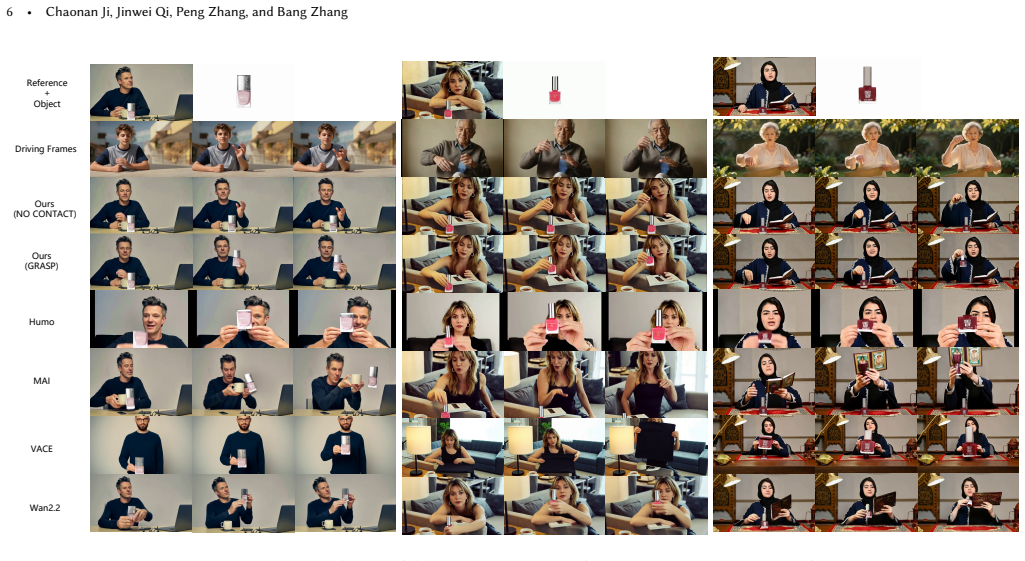
- [§4.2, Tab. 1] The 100-clip interaction test set is produced by the same generative pipeline (Z-Image references, Qwen-VL crops, Qwen3 prompts, Wan2.2-14B-I2V, VL filtering) that created the Stage-II training data. Disjoint identities/objects/prompts do not make this an independent sample: the FVD/tLPIPS/CLIP-I/OQ ground truth is Wan2.2-14B output, i.e., the teacher distribution the model was trained to match, while the baselines are not so matched. Gains may reflect distribution matching rather than more realistic interaction. Please add at least one off-pipeline evaluation: real upper-body HOI footage, held-out clips from a different video generator, or human/VLM contact-plausibility ratings on real reference images.
- [§4.1, Tab. 1] (i) HandSIM/FaceSIM are reported only against Wan-Animate ('–' for all other baselines); if these require motion-GT alignment that text-driven baselines cannot satisfy, state this and consider per-task tables. (ii) Each baseline's conditioning (driving video? object image? prompt source?) is unspecified, so the user-study axes TF/AF are not interpretable. (iii) The text claims 'favorable performance,' but MAI beats Ours on FVD (152.7 vs 154.1), tLPIPS (0.176 vs 0.178), and VQ (3.91 vs 3.82); this should be acknowledged rather than elided. (iv) The user study reports no rater count, clip count, protocol (Likert vs pairwise), or significance testing.
- [§4.4, Fig. 8] The discrete interaction state is the paper's central control contribution, yet its effect is shown only qualitatively in Fig. 8. A state-compliance rate (commanded s_o vs realized contact, using the authors' own Qwen-VL filter or human raters) over the test set would directly test the claim and is cheap to compute. Mid-stream state switching — the motivating real-time use case — is unquantified (frames-to-effect, failure modes). The 'grasp-by-default' bias of the w/o-text variant should also be quantified; the label balance of the 30K dataset is not reported.
- [§3.4, Tab. 1] The manuscript never states whether Tab. 1 reports the 20-step teacher or the 4-step distilled student. Since the headline claim couples real-time streaming with improved fidelity, the distillation cost must be measured: report FVD/tLPIPS/HandSIM before and after CausVid + Self-Forcing, plus resolution, sliding-window size, and how the two H100s are used (single stream vs sharded). If Tab. 1 is the teacher, the deployed system's quality at 25 FPS is currently unverified.
- [§4.2] The 100 reenactment driving videos come from SpeakerVid-5M, which also supplies Stage-I training clips, and no decontamination statement is given. If any test video or near-duplicate appears in training, the HandSIM/FaceSIM/IdentitySIM gains over Wan-Animate partly reflect memorization. Please confirm exclusion or re-evaluate on a disjoint motion source.
minor comments (10)
- [Title, §1, §5] Title/abstract/§5: the 'world model' framing is stronger than what is demonstrated — the interaction state has cardinality 2, and there is no persistence, memory, or scene-state evolution beyond contact switching. Either demonstrate additional scene states (e.g., object displacement persisting after release) or temper the framing to 'controllable interaction generation.'
- [§1] Second paragraph ends with a dangling citation list ('...contact and object manipulation. [Bhatnagar et al. 2022; ...]') not attached to any grammatical claim.
- [§4.1, Tab. 1] HandSIM/FaceSIM are defined as per-frame MSE distances to tracked coefficients but named 'SIM' (similarity) and tabulated with ↓; rename (e.g., HandMSE) or define the direction explicitly.
- [§4.1] OQ is a custom composite (product of object dynamics score and object DINO consistency). Justify the product form, report the two components separately, and give the metric's range; absolute differences (0.147 vs 0.151) are small and no variance is given.
- [§3.5] L_kp 'predicts target 2D keypoints from the implicit motion variable' — specify which tensor is decoded (z_b/z_lh/z_rh/z_f or s_h), which keypoints (body/hand/face), and which detector supplies supervision.
- [§3.4, Fig. 1] Give a breakdown of the ~1000 ms end-to-end latency (motion encoding, 4 DiT steps, VAE decode) and distinguish first-frame from steady-state latency; also reconcile '25 FPS on two H100 GPUs' (abstract/§3.4) with 'on H100 GPUs' (contributions).
- [Fig. 10 vs §3.3] Streaming demos use Gemini-generated references while the training pipeline uses Z-Image; comment on robustness to reference-image source, since references in-the-wild will differ from both.
- [§3.2, Eq. (4), Fig. 2] State the shape/token layout of s_h as injected into the DiT (Fig. 2 shows in-context tokens; Eq. 4 gives a spatial feature map), and how noised target tokens attend to it.
- [passim] Typographical: 'changes, Overall' (comma splice, §1); 'Discrete Interaction State' heading lacks a period (§4.4); inconsistent 'Fig.7'/'Fig. 8' spacing; abstract rendering of the emphasized states lost spacing ('asno contactorgrasp').
- [§3.3] The dataset release promise (§3.3) is welcome; please also state whether code, the distilled model, and the evaluation splits will be released, and report the 30K dataset's grasp/no-contact label balance.
Circularity Check
No derivation circularity: empirical video-generation method with standard train/eval, not a self-reducing prediction chain.
full rationale
This is a systems/method paper for controllable upper-body human–object video generation. Its load-bearing claims are architectural and empirical (multi-scale implicit human-state latents fused from body/hands/face; language-encoded discrete interaction commands {no contact, grasp}; two-stage training; CausVid/Self-Forcing distillation to 25 FPS), not first-principles derivations or parameter fits renamed as predictions. Equations (1)–(4) define an encoder–generator pipeline s_h = E(d), ŷ = G(x_ref, x_obj, s_h, s_o) and a multi-scale fusion s_h = D(f_ref, z_b, z_lh, z_rh, z_f); they do not equate a reported metric to a free parameter by construction. Stage-I/II objectives (L_FM + auxiliaries, then L_FM) are ordinary supervised/flow-matching losses. Baselines (Wan-Animate, Wan2.2, Humo, MAI, VACE) and metrics (FVD, tLPIPS, CLIP-I, HandSIM, FaceSIM, user study) are external comparisons, not self-justifying uniqueness theorems. Overlap with Wan-Animate authorship is normal prior-work citation and does not force the central continuous–discrete control claim. Training and held-out evaluation both use the authors’ synthetic HOI pipeline (§3.3, §4.2) is a generalization/validity risk, not circularity in the derivation sense: no quoted step reduces a “prediction” to its fitted input. No steps match the enumerated circularity kinds.
Axiom & Free-Parameter Ledger
free parameters (5)
- lambda_rep (RePA loss weight) =
0.1
- lambda_kp (keypoint loss weight) =
10
- Stage I / II step counts and data mix =
100K then 10K steps
- Distilled sampling steps and windowing =
4 steps; 25 FPS on 2×H100 at 512²
- Motion latent bottleneck dimension
axioms (6)
- ad hoc to paper Upper-body interactive generation is adequately factored into a continuous human-state latent s_h = E(d) and a discrete interaction command s_o ∈ {no contact, grasp} with ŷ = G(x_ref, x_obj, s_h, s_o).
- domain assumption Multi-scale region crops (body, left/right hand, face via MediaPipe) encoded by separate ViTs and fused with reference patches capture coordinated fine-grained dynamics better than a single global latent, without explicit retargeting.
- ad hoc to paper Language-encoded fixed phrases are sufficient interaction-state commands and are not entangled open-ended semantic prompts.
- domain assumption Synthetic videos from Z-Image + Qwen-VL/Qwen3 + Wan2.2-14B-I2V with VL filtering provide valid supervision for discrete contact control.
- domain assumption Flow-matching DiT training plus CausVid/Self-Forcing distillation preserves interaction controllability at 4-step streaming inference.
- standard math Standard deep learning / transformer / flow-matching optimization mathematics holds for the reported objectives L_FM, L_RePA, L_kp.
invented entities (3)
-
Human-centric local world model (upper-body interactive generation framing)
no independent evidence
-
Continuous–discrete joint control scheme (unified multi-scale human state + language discrete interaction state)
no independent evidence
-
Dedicated HOI rendering/supervision pipeline with aligned discrete state labels (~30K samples)
no independent evidence
read the original abstract
We present a real-time human-centric world model for upper-body interactive generation, aiming to synthesize coherent local world dynamics centered on a person, where coordinated body, hand, and facial motions evolve jointly with controllable human-object discrete interaction. To this end, we adopt a continuous-discrete joint control scheme with two complementary components: a continuous human state and a discrete interaction state. For continuous human-state control, we introduce a unified implicit representation based on multi-scale motion encoding, in which motion latents from the upper body, hands, and face are fused into a shared latent space. This multi-scale design improves expressiveness across different spatial scales, captures fine-grained human dynamics more effectively, and enables direct control without explicit retargeting. For discrete object interaction-state control, we represent object contact using a small set of language-encoded discrete interaction states, where text serves as an explicit interaction-state command, such as \emph{no contact} or \emph{grasp}, rather than an open-ended generation prompt, and we further construct a dedicated rendering pipeline for human-object interaction data to supervise such discrete interaction states. By combining continuous implicit human-state control with discrete interaction-state control, our model enables precise modeling of how a person moves and interacts with the local environment, including controllable changes to nearby scene states. Finally, we distill the model for efficient streaming real-time inference, achieving 25 FPS on two H100 GPUs. Experiments demonstrate improved fine-grained motion fidelity, more realistic hand-object coordination, and effective real-time interaction, establishing a practical step beyond motion reproduction toward real-time human-centric world modeling.
Figures





Reference graph
Works this paper leans on
-
[1]
Crandall and Chen Yu , title =
Sven Bambach and Stefan Lee and David J. Crandall and Chen Yu , title =. 2015. 2015 , url =. doi:10.1109/ICCV.2015.226 , timestamp =
-
[3]
Arpit Mittal and Andrew Zisserman and Philip H. S. Torr , editor =. Hand detection using multiple proposals , booktitle =. 2011 , url =. doi:10.5244/C.25.75 , timestamp =
-
[6]
GanHand: Predicting Human Grasp Affordances in Multi-Object Scenes , booktitle =
Enric Corona and Albert Pumarola and Guillem Aleny. GanHand: Predicting Human Grasp Affordances in Multi-Object Scenes , booktitle =. 2020 , url =. doi:10.1109/CVPR42600.2020.00508 , timestamp =
arXiv 2020
-
[7]
Black and Krikamol Muandet and Siyu Tang , editor =
Korrawe Karunratanakul and Jinlong Yang and Yan Zhang and Michael J. Black and Krikamol Muandet and Siyu Tang , editor =. Grasping Field: Learning Implicit Representations for Human Grasps , booktitle =. 2020 , url =. doi:10.1109/3DV50981.2020.00043 , timestamp =
arXiv 2020
-
[8]
Jiaxin Lu and Hao Kang and Haoxiang Li and Bo Liu and Yiding Yang and Qixing Huang and Gang Hua , editor =. Computer Vision -. 2024 , url =. doi:10.1007/978-3-031-72855-6\_24 , timestamp =
-
[10]
Yufei Ye and Xueting Li and Abhinav Gupta and Shalini De Mello and Stan Birchfield and Jiaming Song and Shubham Tulsiani and Sifei Liu , title =. 2023 , url =. doi:10.1109/CVPR52729.2023.02153 , timestamp =
arXiv 2023
-
[11]
Mengqi Zhang and Yang Fu and Zheng Ding and Sifei Liu and Zhuowen Tu and Xiaolong Wang , title =. 2024 , url =. doi:10.1109/CVPR52733.2024.00814 , timestamp =
arXiv 2024
-
[13]
Jiaman Li and Alexander Clegg and Roozbeh Mottaghi and Jiajun Wu and Xavier Puig and C. Karen Liu , editor =. Controllable Human-Object Interaction Synthesis , booktitle =. 2024 , url =. doi:10.1007/978-3-031-72940-9\_4 , timestamp =
-
[14]
Grasp as You Say: Language-guided Dexterous Grasp Generation , booktitle =
Yi. Grasp as You Say: Language-guided Dexterous Grasp Generation , booktitle =. 2024 , url =
2024
-
[16]
Jianzhu Guo and Dingyun Zhang and Xiaoqiang Liu and Zhizhou Zhong and Yuan Zhang and Pengfei Wan and Di Zhang , title =. CoRR , volume =. 2024 , url =. doi:10.48550/ARXIV.2407.03168 , eprinttype =. 2407.03168 , timestamp =
-
[17]
The Thirteenth International Conference on Learning Representations,
Xiaochen Zhao and Hongyi Xu and Guoxian Song and You Xie and Chenxu Zhang and Xiu Li and Linjie Luo and Jinli Suo and Yebin Liu , title =. The Thirteenth International Conference on Learning Representations,. 2025 , url =
2025
-
[18]
Follow-Your-Emoji: Fine-Controllable and Expressive Freestyle Portrait Animation , booktitle =
Yue Ma and Hongyu Liu and Hongfa Wang and Heng Pan and Yingqing He and Junkun Yuan and Ailing Zeng and Chengfei Cai and Heung. Follow-Your-Emoji: Fine-Controllable and Expressive Freestyle Portrait Animation , booktitle =. 2024 , url =. doi:10.1145/3680528.3687587 , timestamp =
arXiv 2024
-
[19]
Guoxian Song and Hongyi Xu and Xiaochen Zhao and You Xie and Tianpei Gu and Zenan Li and Chenxu Zhang and Linjie Luo , editor =. X-UniMotion: Animating Human Images with Expressive, Unified and Identity-Agnostic Motion Latents , booktitle =. 2025 , url =. doi:10.1145/3757377.3763952 , timestamp =
arXiv 2025
-
[20]
Li Hu and Guangyuan Wang and Zhen Shen and Xin Gao and Dechao Meng and Lian Zhuo and Peng Zhang and Bang Zhang and Liefeng Bo , title =. CoRR , volume =. 2025 , url =. doi:10.48550/ARXIV.2502.06145 , eprinttype =. 2502.06145 , timestamp =
-
[21]
2025 , eprint=
Wan-Animate: Unified Character Animation and Replacement with Holistic Replication , author=. 2025 , eprint=
2025
-
[22]
2026 , eprint=
Kling-MotionControl Technical Report , author=. 2026 , eprint=
2026
-
[23]
Zhufeng Xu and Xuan Gao and Feng. IM-Animation: An Implicit Motion Representation for Identity-decoupled Character Animation , journal =. 2026 , url =. doi:10.48550/ARXIV.2602.07498 , eprinttype =. 2602.07498 , timestamp =
-
[24]
Zhixue Fang and Xu He and Songlin Tang and Haoxian Zhang and Qingfeng Li and Xiaoqiang Liu and Pengfei Wan and Kun Gai , title =. CoRR , volume =. 2026 , url =. doi:10.48550/ARXIV.2602.03796 , eprinttype =. 2602.03796 , timestamp =
-
[25]
Lizhen Wang and Yongming Zhu and Zhipeng Ge and Youwei Zheng and Longhao Zhang and Tianshu Hu and Shiyang Qin and Mingshuang Luo and Jiaxu Zhang and Xin Chen and Yulong Wang and Zerong Zheng and Jianwen Jiang and Chao Liang and Weifeng Chen and Xing Wang and Yuan Zhang and Mingyuan Gao , title =. CoRR , volume =. 2026 , url =. doi:10.48550/ARXIV.2601.1010...
-
[26]
Yutong Bai and Danny Tran and Amir Bar and Yann LeCun and Trevor Darrell and Jitendra Malik , title =. CoRR , volume =. 2025 , url =. doi:10.48550/ARXIV.2506.21552 , eprinttype =. 2506.21552 , timestamp =
-
[27]
2025 , eprint=
Re-HOLD: Video Hand Object Interaction Reenactment via adaptive Layout-instructed Diffusion Model , author=. 2025 , eprint=
2025
-
[28]
Dennis and Ashley Edwards and Jack Parker
Jake Bruce and Michael D. Dennis and Ashley Edwards and Jack Parker. Genie: Generative Interactive Environments , booktitle =. 2024 , url =
2024
-
[29]
Matrix-Game 2.0: An Open-Source, Real-Time, and Streaming Interactive World Model , journal =
Xianglong He and Chunli Peng and Zexiang Liu and Boyang Wang and Yifan Zhang and Qi Cui and Fei Kang and Biao Jiang and Mengyin An and Yangyang Ren and Baixin Xu and Hao. Matrix-Game 2.0: An Open-Source, Real-Time, and Streaming Interactive World Model , journal =. 2025 , url =. doi:10.48550/ARXIV.2508.13009 , eprinttype =. 2508.13009 , timestamp =
-
[30]
Jiaqi Li and Junshu Tang and Zhiyong Xu and Longhuang Wu and Yuan Zhou and Shuai Shao and Tianbao Yu and Zhiguo Cao and Qinglin Lu , title =. CoRR , volume =. 2025 , url =. doi:10.48550/ARXIV.2506.17201 , eprinttype =. 2506.17201 , timestamp =
-
[31]
Yuanpeng Tu and Hao Luo and Xi Chen and Xiang Bai and Fan Wang and Hengshuang Zhao , title =. CoRR , volume =. 2025 , url =. doi:10.48550/ARXIV.2506.09995 , eprinttype =. 2506.09995 , timestamp =
-
[32]
Hao He and Yinghao Xu and Yuwei Guo and Gordon Wetzstein and Bo Dai and Hongsheng Li and Ceyuan Yang , title =. CoRR , volume =. 2024 , url =. doi:10.48550/ARXIV.2404.02101 , eprinttype =. 2404.02101 , timestamp =
-
[33]
Zeyinzi Jiang and Zhen Han and Chaojie Mao and Jingfeng Zhang and Yulin Pan and Yu Liu , title =. CoRR , volume =. 2025 , url =. doi:10.48550/ARXIV.2503.07598 , eprinttype =. 2503.07598 , timestamp =
-
[34]
2026 , eprint=
LTX-2: Efficient Joint Audio-Visual Foundation Model , author=. 2026 , eprint=
2026
-
[35]
2025 , eprint=
HunyuanVideo: A Systematic Framework For Large Video Generative Models , author=. 2025 , eprint=
2025
-
[36]
Youliang Zhang and Zhengguang Zhou and Zhentao Yu and Ziyao Huang and Teng Hu and Sen Liang and Guozhen Zhang and Ziqiao Peng and Shunkai Li and Yi Chen and Zixiang Zhou and Yuan Zhou and Qinglin Lu and Xiu Li , title =. CoRR , volume =. 2026 , url =. doi:10.48550/ARXIV.2602.01538 , eprinttype =. 2602.01538 , timestamp =
-
[37]
The Thirteenth International Conference on Learning Representations,
Zhuoyi Yang and Jiayan Teng and Wendi Zheng and Ming Ding and Shiyu Huang and Jiazheng Xu and Yuanming Yang and Wenyi Hong and Xiaohan Zhang and Guanyu Feng and Da Yin and Yuxuan Zhang and Weihan Wang and Yean Cheng and Bin Xu and Xiaotao Gu and Yuxiao Dong and Jie Tang , title =. The Thirteenth International Conference on Learning Representations,. 2025 , url =
2025
-
[38]
Amir Bar and Gaoyue Zhou and Danny Tran and Trevor Darrell and Yann LeCun , title =. 2025 , url =. doi:10.1109/CVPR52734.2025.01472 , timestamp =
arXiv 2025
-
[39]
Ziyi Xu and Ziyao Huang and Juan Cao and Yong Zhang and Xiaodong Cun and Qing Shuai and Yuchen Wang and Linchao Bao and Jintao Li and Fan Tang , title =. CoRR , volume =. 2024 , url =. doi:10.48550/ARXIV.2411.17383 , eprinttype =. 2411.17383 , timestamp =
-
[40]
Zhenzhi Wang and Jiaqi Yang and Jianwen Jiang and Chao Liang and Gaojie Lin and Zerong Zheng and Ceyuan Yang and Dahua Lin , title =. CoRR , volume =. 2025 , url =. doi:10.48550/ARXIV.2506.09984 , eprinttype =. 2506.09984 , timestamp =
-
[41]
Liyang Chen and Tianxiang Ma and Jiawei Liu and Bingchuan Li and Zhuowei Chen and Lijie Liu and Xu He and Gen Li and Qian He and Zhiyong Wu , title =. CoRR , volume =. 2025 , url =. doi:10.48550/ARXIV.2509.08519 , eprinttype =. 2509.08519 , timestamp =
-
[42]
2026 , eprint=
Advancing Open-source World Models , author=. 2026 , eprint=
2026
-
[43]
Tianxing Xu and Zixuan Wang and Guangyuan Wang and Li Hu and Zhongyi Zhang and Peng Zhang and Bang Zhang and Song. CoRR , volume =. 2026 , url =. doi:10.48550/ARXIV.2602.22960 , eprinttype =. 2602.22960 , timestamp =
-
[44]
2026 , eprint=
PointWorld: Scaling 3D World Models for In-The-Wild Robotic Manipulation , author=. 2026 , eprint=
2026
-
[45]
2025 , eprint=
From Slow Bidirectional to Fast Autoregressive Video Diffusion Models , author=. 2025 , eprint=
2025
-
[46]
2024 , eprint=
Improved Distribution Matching Distillation for Fast Image Synthesis , author=. 2024 , eprint=
2024
-
[47]
2025 , eprint=
Self Forcing: Bridging the Train-Test Gap in Autoregressive Video Diffusion , author=. 2025 , eprint=
2025
-
[48]
2026 , eprint=
Causal Forcing: Autoregressive Diffusion Distillation Done Right for High-Quality Real-Time Interactive Video Generation , author=. 2026 , eprint=
2026
-
[49]
First Order Motion Model for Image Animation , booktitle =
Aliaksandr Siarohin and St. First Order Motion Model for Image Animation , booktitle =. 2019 , url =
2019
-
[50]
International Conference on 3D Vision (3DV) , year=
Collaborative Regression of Expressive Bodies using Moderation , author=. International Conference on 3D Vision (3DV) , year=
-
[51]
Chong Mou and Xintao Wang and Liangbin Xie and Yanze Wu and Jian Zhang and Zhongang Qi and Ying Shan , editor =. T2I-Adapter: Learning Adapters to Dig Out More Controllable Ability for Text-to-Image Diffusion Models , booktitle =. 2024 , url =. doi:10.1609/AAAI.V38I5.28226 , timestamp =
-
[54]
2018 , eprint=
Learning to Detect Human-Object Interactions , author=. 2018 , eprint=
2018
-
[55]
Petrov and Cristian Sminchisescu and Christian Theobalt and Gerard Pons
Bharat Lal Bhatnagar and Xianghui Xie and Ilya A. Petrov and Cristian Sminchisescu and Christian Theobalt and Gerard Pons. 2022 , url =. doi:10.1109/CVPR52688.2022.01547 , timestamp =
arXiv 2022
-
[56]
Xianghui Xie and Bharat Lal Bhatnagar and Gerard Pons. Computer Vision -. 2022 , url =. doi:10.1007/978-3-031-20086-1\_8 , timestamp =
-
[57]
DexMV: Imitation Learning for Dexterous Manipulation from Human Videos , booktitle =
Yuzhe Qin and Yueh. DexMV: Imitation Learning for Dexterous Manipulation from Human Videos , booktitle =. 2022 , url =. doi:10.1007/978-3-031-19842-7\_33 , timestamp =
-
[58]
Yu. DexYCB:. 2021 , url =. doi:10.1109/CVPR46437.2021.00893 , timestamp =
arXiv 2021
-
[59]
Guibas and Mustafa Mukadam and Abhinav Gupta and Shubham Tulsiani , title =
Kaichun Mo and Leonidas J. Guibas and Mustafa Mukadam and Abhinav Gupta and Shubham Tulsiani , title =. 2021. 2021 , url =. doi:10.1109/ICCV48922.2021.00674 , timestamp =
arXiv 2021
-
[60]
Ha, David and Schmidhuber, Jürgen , title =. 2018 , copyright =. doi:10.5281/ZENODO.1207631 , url =
-
[61]
Anthony Hu and Lloyd Russell and Hudson Yeo and Zak Murez and George Fedoseev and Alex Kendall and Jamie Shotton and Gianluca Corrado , title =. CoRR , volume =. 2023 , url =. doi:10.48550/ARXIV.2309.17080 , eprinttype =. 2309.17080 , timestamp =
-
[62]
2023 , eprint=
Consistency Models , author=. 2023 , eprint=
2023
-
[63]
2026 , eprint=
LOME: Learning Human-Object Manipulation with Action-Conditioned Egocentric World Model , author=. 2026 , eprint=
2026
-
[64]
Follow Your Pose: Pose-Guided Text-to-Video Generation Using Pose-Free Videos , booktitle =
Yue Ma and Yingqing He and Xiaodong Cun and Xintao Wang and Siran Chen and Xiu Li and Qifeng Chen , editor =. Follow Your Pose: Pose-Guided Text-to-Video Generation Using Pose-Free Videos , booktitle =. 2024 , url =. doi:10.1609/AAAI.V38I5.28206 , timestamp =
-
[65]
Lizhen Wang and Zhurong Xia and Tianshu Hu and Pengrui Wang and Pengfei Wang and Zerong Zheng and Ming Zhou , title =. CoRR , volume =. 2025 , url =. doi:10.48550/ARXIV.2506.10568 , eprinttype =. 2506.10568 , timestamp =
-
[66]
2019 , eprint=
MediaPipe: A Framework for Building Perception Pipelines , author=. 2019 , eprint=
2019
-
[67]
2021 , eprint=
An Image is Worth 16x16 Words: Transformers for Image Recognition at Scale , author=. 2021 , eprint=
2021
-
[68]
2021 , eprint=
Masked Autoencoders Are Scalable Vision Learners , author=. 2021 , eprint=
2021
-
[69]
2025 , eprint=
Z-Image: An Efficient Image Generation Foundation Model with Single-Stream Diffusion Transformer , author=. 2025 , eprint=
2025
-
[70]
2025 , eprint=
Qwen3-VL Technical Report , author=. 2025 , eprint=
2025
-
[71]
2025 , eprint=
Qwen3 Technical Report , author=. 2025 , eprint=
2025
-
[72]
arXiv preprint arXiv:2503.20314 , year=
Wan: Open and Advanced Large-Scale Video Generative Models , author=. arXiv preprint arXiv:2503.20314 , year=
-
[73]
2025 , eprint=
DINOv3 , author=. 2025 , eprint=
2025
-
[74]
2025 , eprint=
SpeakerVid-5M: A Large-Scale High-Quality Dataset for Audio-Visual Dyadic Interactive Human Generation , author=. 2025 , eprint=
2025
-
[75]
2026 , eprint=
Hand2World: Autoregressive Egocentric Interaction Generation via Free-Space Hand Gestures , author=. 2026 , eprint=
2026
-
[76]
2023 , eprint=
DreamBooth: Fine Tuning Text-to-Image Diffusion Models for Subject-Driven Generation , author=. 2023 , eprint=
2023
-
[77]
Ni and Heung
Hao Zhang and Feng Li and Shilong Liu and Lei Zhang and Hang Su and Jun Zhu and Lionel M. Ni and Heung. The Eleventh International Conference on Learning Representations,. 2023 , url =
2023
-
[78]
Reconstructing Hands in 3
Pavlakos, Georgios and Shan, Dandan and Radosavovic, Ilija and Kanazawa, Angjoo and Fouhey, David and Malik, Jitendra , booktitle=. Reconstructing Hands in 3
-
[79]
ArcFace: Additive Angular Margin Loss for Deep Face Recognition , volume=
Deng, Jiankang and Guo, Jia and Yang, Jing and Xue, Niannan and Kotsia, Irene and Zafeiriou, Stefanos , year=. ArcFace: Additive Angular Margin Loss for Deep Face Recognition , volume=. IEEE Transactions on Pattern Analysis and Machine Intelligence , publisher=. doi:10.1109/tpami.2021.3087709 , number=
arXiv 2021
discussion (0)
Sign in with ORCID, Apple, or X to comment. Anyone can read and Pith papers without signing in.