REVIEW 42 references
State-of-the-art face and gait models fail under native low-resolution long-range capture even though they succeed with optical zoom.
Reviewed by Pith at T0; open to challenge. T0 means a machine referee read the full paper against a public rubric. the ladder, T0–T4 →
A 70-subject public long-range face+gait dataset and protocols show SOTA models collapse on native low-res and elevated 100 m probes despite strong optical-zoom performance.
T0 review reviewed 2026-07-30 challenge →
load-bearing objection Useful public long-range face+gait resource with honest baselines; the 3F “chance-line” claim is mathematically inconsistent with the reported EERs and needs fixing.
GaitFace: A Multimodal Dataset for Long-Range Person Identification
The pith
A machine-rendered reading of the paper's core claim, the machinery that carries it, and where it could break.
The reading
Core claim
Current state-of-the-art face and gait architectures that work well on high-quality or optically assisted imagery fail under the native low-resolution, elevated-viewpoint, multi-session conditions of long-range outdoor surveillance. GaitFace’s public pre-enrollment-to-probe protocols make that systemic gap measurable and reproducible.
What carries the argument
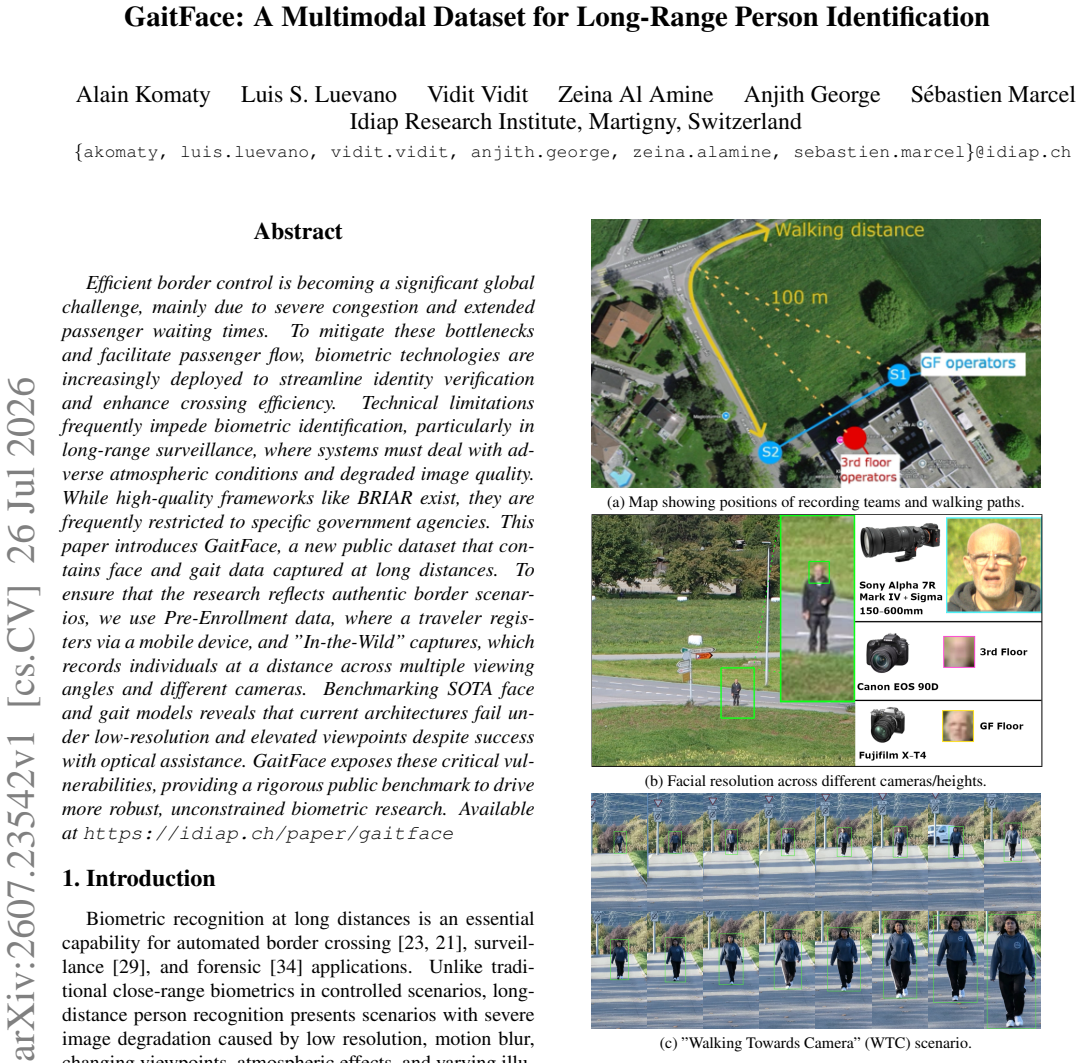
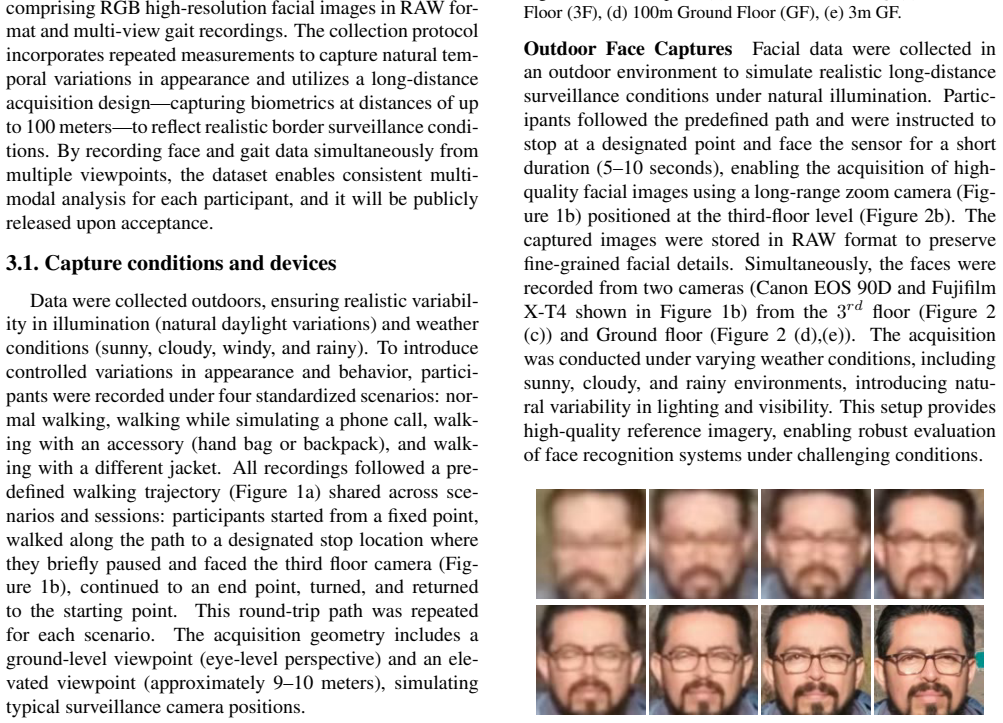
GaitFace: a 70-subject, two-session multimodal collection that pairs controlled mobile pre-enrollment faces with simultaneous long-distance outdoor face (optical-zoom HQ and native LQ) and multi-view gait recordings under clothing, accessory, and phone-use covariates.
Load-bearing premise
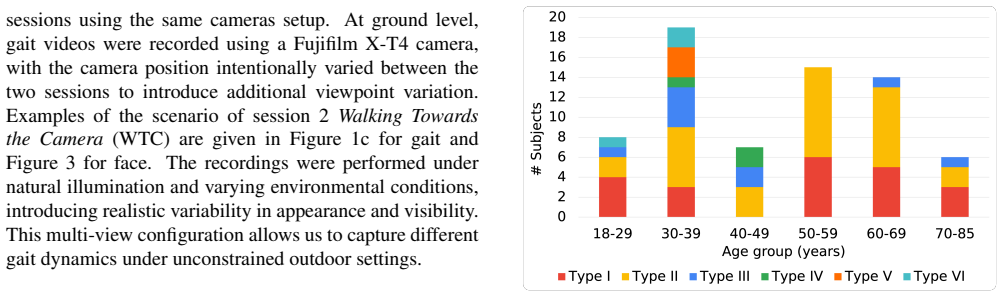
That seventy volunteers on one outdoor path over two days, with a lighter-skin-tone skew and a gait gallery limited to one normal-walk session, are enough to stand for authentic border scenarios and support claims of systemic model failure.
What would settle it
A new face model, gait model, or face–gait fusion system that, using only the mobile pre-enrollment gallery, reaches high true-match rates on the 100 m ground-floor and third-floor low-quality face protocols and on the G2 viewpoint-shift gait protocol would disprove the claimed systemic vulnerability.
If this is right
- Public GaitFace gives academic and commercial labs a reproducible long-range face-plus-gait benchmark that restricted collections do not.
- With today’s architectures, optical zoom remains necessary for reliable face recognition near 100 m; native low-resolution pipelines are not yet ready.
- Elevated (third-floor) placements drive face verification near chance, so camera geometry is a first-class design variable.
- Gait models trained on short-range data do not transfer to long-range multi-view outdoor probes with clothing and carried-object changes.
- Face–gait fusion is the natural next step for recovering identity when either cue alone is degraded by distance.
Where Pith is reading between the lines
- The large domain gap between existing short-range gait training sets and GaitFace’s long-range outdoor probes implies that simply scaling current silhouette or RGB backbones will not close the gap without new long-range pretraining data.
- Lightweight models sometimes outperforming heavier ones on severe low-resolution probes suggests that capacity and high-frequency feature reliance can become liabilities under extreme degradation.
- Agencies already using mobile pre-enrollment could adopt the paper’s HQ-versus-LQ protocol split as an immediate acceptance test for vendor long-range systems.
- The fixed path and pause-and-face instruction may understate the difficulty of fully unconstrained crowd flow at real borders.
Editorial analysis
A structured set of objections, weighed in public.
Circularity Check
No circularity: empirical dataset release and external-model benchmarking; no derivation reduces to its own inputs.
full rationale
GaitFace is a dataset-and-benchmark paper, not a first-principles derivation. Enrollment/probe protocols, gallery design (one normal-walk session), and multi-view covariates are stipulated experimental choices, not quantities derived from the reported metrics. Face and gait results are produced by evaluating publicly pretrained external models (AdaFace IR50/IR101 on WebFace, LV-Face on Glint360K, EdgeFace on WebFace12M, GaitBase/DeepGaitV2 on GREW, GaitGL on CASIA-B, BiggerGait on CCPG) with operational thresholds calibrated on IJB-C, not fitted to GaitFace targets. Citing EdgeFace (overlapping authors) is ordinary prior-work reuse among several baselines and is not load-bearing for any uniqueness or forced-result claim. There is no self-definitional identity, no fitted-input-called-prediction, and no uniqueness theorem imported from the authors. Any correctness concerns (e.g., 3F EER vs. AUC≈0.5 inconsistency) are outside circularity scope.
Axiom & Free-Parameter Ledger
free parameters (2)
- Operational FMR thresholds (1%, 0.1%, 0.01%) calibrated on IJB-C =
FMR ∈ {1%, 0.1%, 0.01%} on IJB-C
- Probe frame counts and enrollment sample sizes (1/3/10/20/40) =
As in Table 2 and Fig. 6
axioms (5)
- domain assumption ISO/IEC 19795-style FMR/FNMR and closed-set Rank-1/CMC are the right figures of merit for long-range border identification difficulty.
- domain assumption Mobile frontal enrollment plus outdoor path probes with clothing/bag/phone and two heights adequately proxy authentic border pre-enrollment and surveillance.
- domain assumption Gait gallery may be only one normal-walk session because high-quality remote gait enrollment is impractical.
- domain assumption Public pretrained face/gait weights without GaitFace fine-tuning are fair SOTA baselines for exposing vulnerabilities.
- ad hoc to paper Standard silhouette extraction / face detection at extreme low resolution preserves identity signal enough for model comparison.
invented entities (1)
-
GaitFace dataset and its HQ/LQ/GF/3F/WTC and G1/G2 protocols
independent evidence
Cite this review
Pith. "Pith review of GaitFace: A Multimodal Dataset for Long-Range Person Identification." pith.science (2026). https://pith.science/paper/CZF5XPQX
@misc{pith2026260723542,
  author       = {Pith},
  title        = {Pith review of: GaitFace: A Multimodal Dataset for Long-Range Person Identification},
  year         = {2026},
  howpublished = {\url{https://pith.science/paper/CZF5XPQX}},
  note         = {Machine review of arXiv:2607.23542}
}
read the original abstract
Efficient border control is becoming a significant global challenge, mainly due to severe congestion and extended passenger waiting times. To mitigate these bottlenecks and facilitate passenger flow, biometric technologies are increasingly deployed to streamline identity verification and enhance crossing efficiency. Technical limitations frequently impede biometric identification, particularly in long-range surveillance, where systems must deal with adverse atmospheric conditions and degraded image quality. While high-quality frameworks like BRIAR exist, they are frequently restricted to specific government agencies. This paper introduces GaitFace, a new public dataset that contains face and gait data captured at long distances. To ensure that the research reflects authentic border scenarios, we use Pre-Enrollment data, where a traveler registers via a mobile device, and "In-the-Wild" captures, which records individuals at a distance across multiple viewing angles and different cameras. Benchmarking SOTA face and gait models reveals that current architectures fail under low-resolution and elevated viewpoints despite success with optical assistance. GaitFace exposes these critical vulnerabilities, providing a rigorous public benchmark to drive more robust, unconstrained biometric research.
Figures



Reference graph
Works this paper leans on
-
[1]
X. An, X. Zhu, Y . Gao, Y . Xiao, Y . Zhao, Z. Feng, L. Wu, B. Qin, M. Zhang, D. Zhang, and Y . Fu. Partial fc: Training 10 million identities on a single machine. In2021 IEEE/CVF International Conference on Computer Vision Workshops (ICCVW), pages 1445–1449, 2021
2021
-
[2]
H. M. L. Aung, C. Pluempitiwiriyawej, K. Hamamoto, and S. Wangsiripitak. Multimodal biometrics recognition using a deep convolutional neural network with transfer learning in surveillance videos.Computation, 10(7), 2022
2022
-
[3]
Z. Cheng, X. Zhu, and S. Gong. Low-Resolution Face Recognition.arXiv preprint arXiv:1811.08965, pages 1–16, nov 2018
Pith/arXiv arXiv 2018
-
[4]
Z. Cheng, X. Zhu, and S. Gong. Surveillance face recogni- tion challenge.arXiv preprint arXiv:1804.09691, 2018
Pith/arXiv arXiv 2018
-
[5]
Cornett, J
D. Cornett, J. Brogan, N. Barber, D. Aykac, S. Baird, N. Burchfield, C. Dukes, A. Duncan, R. Ferrell, J. God- dard, G. Jager, M. Larson, B. Murphy, C. Johnson, I. Shelley, N. Srinivas, B. Stockwell, L. Thompson, M. Yohe, R. Zhang, S. Dolvin, H. J. Santos-Villalobos, and D. S. Bolme. Expand- ing accurate person recognition to new altitudes and ranges: The ...
2023
-
[6]
European Parliament and Council of the European Union. Regulation (eu) 2016/679 of the european parliament and of the council of 27 april 2016 on the protection of natural per- sons with regard to the processing of personal data and on the free movement of such data, and repealing directive 95/46/ec (general data protection regulation), 2016
2016
-
[7]
C. Fan, S. Hou, Y . Huang, and S. Yu. Exploring deep models for practical gait recognition.arXiv preprint arXiv:2303.03301, 2023
Pith/arXiv arXiv 2023
-
[8]
C. Fan, J. Liang, C. Shen, S. Hou, Y . Huang, and S. Yu. Opengait: Revisiting gait recognition towards better prac- ticality. InProceedings of the IEEE/CVF conference on computer vision and pattern recognition, pages 9707–9716, 2023
2023
-
[9]
H. Fu, W. Kang, Y . Zhang, and M. S. Shakeel. Fusion of gait and face for human identification at the feature level. InBiometric Recognition: 16th Chinese Conference, CCBR 2022, Beijing, China, November 11–13, 2022, Proceedings, page 475–483, Berlin, Heidelberg, 2022. Springer-Verlag
2022
-
[10]
X. Geng, L. Wang, M. Li, Q. Wu, and K. Smith-Miles. Adap- tive fusion of gait and face for human identification in video. InProceedings of the 2008 IEEE Workshop on Applications of Computer Vision, W ACV ’08, page 1–6, USA, 2008. IEEE Computer Society
2008
-
[11]
George, C
A. George, C. Ecabert, H. O. Shahreza, K. Kotwal, and S. Marcel. Edgeface: Efficient face recognition model for edge devices.IEEE Transactions on Biometrics, Behavior, and Identity Science, 6(2):158–168, 2024
2024
-
[12]
Grgic, K
M. Grgic, K. Delac, and S. Grgic. Scface — surveil- lance cameras face database.Multimedia Tools Appl., 51(3):863–879, Feb. 2011
2011
-
[13]
G ¨unther, P
M. G ¨unther, P. Hu, C. Herrmann, C. H. Chan, M. Jiang, S. Yang, A. R. Dhamija, D. Ramanan, J. Beyerer, J. Kit- tler, M. A. Jazaery, M. I. Nouyed, G. Guo, C. Stankiewicz, and T. E. Boult. Unconstrained face detection and open-set face recognition challenge. In2017 IEEE International Joint Conference on Biometrics (IJCB), pages 697–706, 2017
2017
-
[14]
X. Guo, Z. Zhu, T. Yang, B. Lin, J. Huang, J. Deng, G. Huang, J. Zhou, and J. Lu. Gait recognition in the wild: A large-scale benchmark and nas-based baseline.IEEE Trans- actions on Pattern Analysis and Machine Intelligence, 2025
2025
-
[15]
Y . Guo, L. Zhang, Y . Hu, X. He, and J. Gao. Ms-celeb-1m: A dataset and benchmark for large-scale face recognition. ArXiv, abs/1607.08221, 2016
Pith/arXiv arXiv 2016
-
[16]
Gupta and V
V . Gupta and V . K. Sharma. Skin typing: Fitzpatrick grading and others.Clinics in Dermatology, 37(5):430–436, 2019. The Color of Skin
2019
-
[17]
Hsu and K.-T
H.-J. Hsu and K.-T. Chen. Droneface: An open dataset for drone research. InProceedings of the 8th ACM on Multi- media Systems Conference, MMSys’17, page 187–192, New York, NY , USA, 2017. Association for Computing Machin- ery
2017
-
[18]
G. B. Huang, M. Mattar, T. Berg, and E. Learned-Miller. Labeled Faces in the Wild: A Database forStudying Face Recognition in Unconstrained Environments. InWorkshop on Faces in ’Real-Life’ Images: Detection, Alignment, and Recognition, Marseille, France, Oct. 2008. Erik Learned- Miller and Andras Ferencz and Fr´ed´eric Jurie
2008
-
[19]
A. Kale, A. Roychowdhury, and R. Chellappa. Fusion of gait and face for human identification. In2004 IEEE Inter- national Conference on Acoustics, Speech, and Signal Pro- cessing, volume 5, pages V–901, 2004
2004
-
[20]
N. D. Kalka, B. Maze, J. A. Duncan, K. OrConnor, S. El- liott, K. Hebert, J. Bryan, and A. K. Jain. Ijb-s: Iarpa janus surveillance video benchmark.2018 IEEE 9th International Conference on Biometrics Theory, Applications and Systems (BTAS), pages 1–9, 2018
2018
-
[21]
Khan and M
N. Khan and M. Efthymiou. The use of biometric technology at airports: The case of customs and border protection (cbp). International Journal of Information Management Data In- sights, 1(2):100049, 2021
2021
-
[22]
M. Kim, A. K. Jain, and X. Liu. Adaface: Quality adaptive margin for face recognition. InProceedings of the IEEE/CVF conference on computer vision and pattern recognition, pages 18750–18759, 2022
2022
-
[23]
R. D. Labati, A. Genovese, E. Mu ˜noz, V . Piuri, F. Scotti, and G. Sforza. Biometric recognition in automated border control: A survey.ACM Comput. Surv., 49(2), June 2016
2016
-
[24]
W. Li, S. Hou, C. Zhang, C. Cao, X. Liu, Y . Huang, and Y . Zhao. An in-depth exploration of person re-identification and gait recognition in cloth-changing conditions. InPro- ceedings of the IEEE/CVF Conference on Computer Vision and Pattern Recognition (CVPR), pages 13824–13833, June 2023
2023
-
[25]
B. Lin, S. Zhang, M. Wang, L. Li, and X. Yu. Gaitgl: Learning discriminative global-local feature representations for gait recognition.arXiv preprint arXiv:2208.01380, 2022
Pith/arXiv arXiv 2022
-
[26]
F. Liu, N. Chimitt, L. Guo, J. Jain, A. Kane, M. Kim, W. Rob- bins, Y . Su, D. Ye, X. Zhang, J. Zhu, S. Satyakam, C. Perry, S. H. Chan, A. Ross, H. Shi, Z. Wang, A. Jain, and X. Liu. Person recognition at altitude and range: Fusion of face, body shape and gait, 2025
2025
-
[27]
L. S. Luevano, L. Chang, H. M ´endez-V´azquez, Y . Mart´ınez- D´ıaz, and M. Gonz ´alez-Mendoza. A study on the perfor- mance of unconstrained very low resolution face recognition: Analyzing current trends and new research directions.IEEE Access, 9:75470–75493, 2021
2021
-
[28]
Maity, M
S. Maity, M. Abdel-Mottaleb, and S. S. Asfour. Multimodal low resolution face and frontal gait recognition from surveil- lance video.Electronics, 10(9), 2021
2021
-
[29]
Martinez-Diaz, H
Y . Martinez-Diaz, H. Mendez-Vazquez, L. S. Luevano, L. Chang, and M. Gonzalez-Mendoza. Lightweight Low- Resolution Face Recognition for Surveillance Applications . In2020 25th International Conference on Pattern Recog- nition (ICPR), pages 5421–5428, Los Alamitos, CA, USA, Jan. 2021. IEEE Computer Society
2021
-
[30]
Mart´ınez-D´ıaz, M
Y . Mart´ınez-D´ıaz, M. Nicol ´as-D´ıaz, H. M ´endez-V´azquez, L. S. Luevano, L. Chang, M. Gonzalez-Mendoza, and L. E. Sucar. Benchmarking lightweight face architectures on spe- cific face recognition scenarios.Artificial Intelligence Re- view, 54(8):6201–6244, Dec. 2021
2021
-
[31]
Maze et al
B. Maze et al. Iarpa janus benchmark-c: Face dataset and protocol. In2018 International Conference on Biometrics (ICB), 2018
2018
-
[32]
Muramatsu, H
D. Muramatsu, H. Iwama, Y . Makihara, and Y . Yagi. Multi- view multi-modal person authentication from a single walk- ing image sequence. In2013 International Conference on Biometrics (ICB), pages 1–8, 2013
2013
-
[33]
M. Oquab, T. Darcet, T. Moutakanni, H. V o, M. Szafraniec, V . Khalidov, P. Fernandez, D. Haziza, F. Massa, A. El- Nouby, et al. Dinov2: Learning robust visual features with- out supervision.arXiv preprint arXiv:2304.07193, 2023
Pith/arXiv arXiv 2023
-
[34]
Seckiner, X
D. Seckiner, X. Mallett, P. Maynard, D. Meuwly, and C. Roux. Forensic gait analysis — morphometric assessment from surveillance footage.Forensic Science International, 296:57–66, 2019
2019
-
[35]
E. D. P. Supervisor.AI Act Regulation (EU) 2024/1689 - Regulation (EU) 2024/1689 of the European Parliament and of the Council of 13 June 2024 laying down harmonised rules on artificial intelligence and amending Regulations (EC) No 300/2008, (EU) No 167/2013, (EU) No 168/2013, (EU) 2018/858, (EU) 2018/1139 and (EU) 2019/2144 and Directives 2014/90/EU, (EU...
2024
-
[36]
Z.-Y . Wang, Z. Shao, A. Nanduri, B. Pal, L. McDaniel, J. Chen, and R. Chellappa. Combo-gait: Unified trans- former framework for multi-modal gait recognition and at- tribute analysis, 2026
2026
-
[37]
D. Ye, C. Fan, Z. Huang, C. Luo, J. Li, S. Yu, and X. Liu. Biggergait: Unlocking gait recognition with layer-wise rep- resentations from large vision models.arXiv preprint arXiv:2505.18132, 2025
Pith/arXiv arXiv 2025
-
[38]
D. Yi, Z. Lei, S. Liao, and S. Li. Learning face representation from scratch.ArXiv, abs/1411.7923, 2014
Pith/arXiv arXiv 2014
-
[39]
J. You, S. Li, Y . Sun, J. Wei, M. Guo, C. Feng, and J. Ran. Lvface: Progressive cluster optimization for large vision models in face recognition. InProceedings of the IEEE/CVF International Conference on Computer Vision, pages 11840– 11849, 2025
2025
-
[40]
S. Yu, D. Tan, and T. Tan. A framework for evaluating the effect of view angle, clothing and carrying condition on gait recognition. In18th international conference on pattern recognition (ICPR’06), volume 4, pages 441–444. IEEE, 2006
2006
-
[41]
Zheng, X
J. Zheng, X. Liu, W. Liu, L. He, C. Yan, and T. Mei. Gait recognition in the wild with dense 3d representations and a benchmark. InIEEE Conference on Computer Vision and Pattern Recognition (CVPR), 2022
2022
-
[42]
Z. Zhu, G. Huang, J. Deng, Y . Ye, J. Huang, X. Chen, J. Zhu, T. Yang, J. Lu, D. Du, et al. Webface260m: A benchmark unveiling the power of million-scale deep face recognition. InProceedings of the IEEE/CVF Conference on Computer Vision and Pattern Recognition, pages 10492–10502, 2021
2021
This paper was first reviewed by grok-4.5 on July 30, 2026.
discussion (0)
Sign in with ORCID, Apple, or X to comment. Anyone can read and Pith papers without signing in.