REVIEW 5 major objections 8 minor 23 references
Neonatal Hypoxic-ischaemic Encephalopathy Classification from the EEG and HRV Signals Using a Conformer based Masked Autoencoder
T0 review · 5 major / 8 minor · reviewed 2026-07-30 · grok-4.5
Pith's one-line read Pretraining a Conformer masked autoencoder on thousands of hours of unlabelled EEG and HRV yields transferable features that classify neonatal HIE severity from limited expert labels.
desk verdict Solid held-out SSL engineering for neonatal HIE grading; EEG gains look real, HRV “surpasses” claim is thin once infant clustering is considered. read the letter →
The pith
A machine-rendered reading of the paper's core claim, the machinery that carries it, and where it could break.
The reading
What carries the argument
MAEConformer: a masked autoencoder whose encoder is a Conformer (self-attention plus depthwise convolution on visible tokens only, with relative position embeddings and global response normalization), trained to reconstruct masked patches under MSE plus a mask-aware multi-resolution STFT loss and a uniformity regularizer.
What would settle it
Re-label a held-out cohort at true five-minute resolution (or with continuous severity scores) and check whether epoch-level AUCs and the claimed pretrain-to-scratch gap collapse when window labels no longer match the hour grade.
Extended reading notes
Core claim
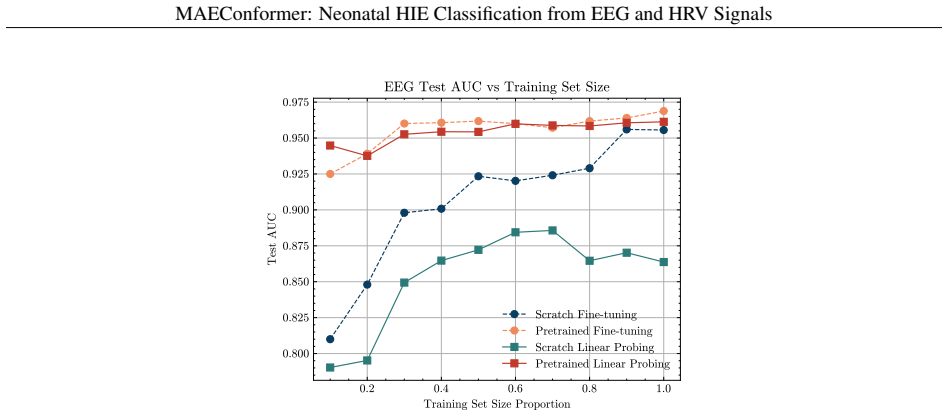
Modality-specific MAEConformer models pretrained on 6,030 h of unlabelled EEG and 4,868 h of unlabelled HRV learn representations that, after linear probing or fine-tuning on limited expert labels, achieve test AUCs of 97.19% (binary) and 96.56% (four-class) on held-out EEG HIE severity classification and 82.42% on HRV binary classification, outperforming the paper’s supervised convolutional and self-supervised Transformer baselines on those tasks.
Load-bearing premise
Every overlapping five-minute window can safely inherit the expert’s single one-hour HIE grade, and majority or margin aggregation recovers the true epoch decision even if severity or artefacts change inside the hour.
Editorial extensions
If this is right
- Large unlabelled NICU EEG/HRV archives can be turned into reusable encoders that need only small expert sets for HIE grading.
- EEG binary and four-class HIE decisions become feasible at the reported AUCs without training deep nets from scratch on scarce labels.
- HRV alone, though weaker than EEG, can support continuous severity screening where full EEG is unavailable.
- Adding multi-resolution spectral reconstruction to MAE pretraining is presented as a transferable recipe for other long non-stationary biosignals.
- Partial unfreezing of only the top encoder layers is offered as the practical fine-tune recipe when labelled HRV is small.
Reading between the lines
- The same pretrained encoders could be probed for related NICU endpoints (seizure burden, cooling response, two-year outcome) without new large labelled corpora.
- If window-level expert grades were collected, the method could move from hour-level triage toward near-real-time severity tracking.
- Joint EEG–HRV pretraining or late fusion may close part of the remaining gap between HRV-only and EEG-only AUCs.
- Sites with only single-channel or lower-quality EEG could still benefit because the pipeline trains channels independently and reports single-channel capability.
Signed reviews
Editorial analysis
A structured set of objections, weighed in public.
Referee Report
Summary. The paper proposes MAEConformer, a masked autoencoder with a Conformer encoder/decoder and a mask-aware multi-resolution STFT auxiliary loss, pretrained separately on 6,030 h of unlabelled EEG and 4,868 h of unlabelled HRV from the ANSeR2 cohort. The pretrained encoders are evaluated by linear probing and (partial) fine-tuning on expert-graded HIE severity classification, with testing on the independent ANSeR1 cohort. Reported test AUCs are 97.19% (binary) and 96.56% (four-class) for EEG and 82.42% (binary, linear probe) for HRV, compared against adapted MAE baselines (MAETransformer, MAEFHRFormer) and published supervised baselines. Ablations cover model capacity, patch size, decoder type, positional embedding, GRN vs BN, classifier heads, and loss components; scaling curves, attention-entropy/distance diagnostics, UMAP visualizations, and a per-infant clinical trajectory example are provided. Code is publicly released.
Significance. If the results hold, this is a useful contribution to neonatal neurocritical care ML: a clean train/test separation at the cohort level (pretraining and downstream training on ANSeR2 only; ANSeR1 held out entirely), multi-seed reporting, honest linear-probe vs fine-tune comparisons, label-scaling curves against from-scratch training, and public code for reproducibility. The MR-STFT ablation (Table 5f: linear-probe AUC drops from 0.9603 to 0.8753 without it) is a genuinely informative result for MAE pretraining on physiological signals, and the EEG point estimates, if replicated, would be state of the art on this benchmark. The HRV side is more modest and the paper mostly says so. The main risks to the contribution are statistical rather than methodological: the superiority claims rest on seed-level error bars while the evaluation units are clustered within a modest number of infants, and parts of the abstract/conclusion overstate what Table 4 supports.
major comments (5)
- [§4.3, Tables 2–4 and Figs. 9–10] All reported ± values are standard deviations over random seeds/splits, but the evaluation units (338 EEG / 215 HRV one-hour epochs) are clustered within ~91 and ~58 infants respectively (up to 5 epochs each), and the 5-minute windows within an epoch overlap by 50% (EEG) or 80% (HRV). Seed-level variance measures optimization stochasticity, not the sampling variability of the AUC, which is the relevant uncertainty for the superiority claims and is plausibly 1–2 AUC points at this cohort size. This is load-bearing for the HRV claim: the linear-probe margin over MAETransformer is 0.8242 vs 0.8161 (Table 4), almost certainly within clustered-sampling noise. Please add infant-level (cluster) bootstrap confidence intervals, or a paired cluster-resampled comparison between MAEConformer and each baseline, for Tables 2–4. The EEG gaps (e.g., 96.56 vs 93.82/92.74) will likely survive this analysi
- [Abstract and §6 (Conclusion); Table 4] The abstract and conclusion state that MAE-HRV 'surpass[es] both self-supervised Transformer-based and supervised convolutional baselines.' Table 4 does not support this as written: under fine-tuning, MAETransformer achieves the higher AUC (0.8113 vs 0.8041), and the best overall HRV result belongs to the weakly supervised HRVConformer (0.8323), as the paper itself notes in §4.3. The supported statement is narrower — that the MAEConformer linear probe marginally exceeds the adapted MAETransformer linear probe (subject to the uncertainty quantification requested above) and approaches HRVConformer with ~7× fewer labelled epochs. Please rewrite the abstract/§6 claims to match Table 4, and foreground the data-efficiency argument, which is the defensible and interesting part.
- [§4.3, Table 2] The key EEG comparison against the supervised FCN (AUC 0.9328) is a single number imported from Yu et al. [2023] with no variance estimate, so no paired or even approximate statistical comparison is possible; moreover the FCN reports higher accuracy (0.869 vs 0.8639) than MAEConformer, so the text's 'consistently outperforms the other five baselines across all metrics' is inaccurate as stated (the authors do note the accuracy exception for fine-tune, but the sentence as written overclaims). Since the FCN is the strongest supervised reference and shares the authors' pipeline, please either re-run it under the same multi-seed protocol used for the MAE models or clearly qualify the comparison as cross-paper and single-run.
- [§3.2 and §3.5] Every 5-minute window inherits its parent one-hour expert grade, and with 50%/80% overlap the windows are highly correlated both as training samples and as evaluation units. If severity or artefact content varies within the hour, both the pretraining distribution and the classification targets are misaligned with the true clinical state, and epoch-level majority-vote/margin aggregation may mask this. The authors acknowledge the annotation is an 'overall assessment of the one-hour epoch,' but no sensitivity analysis is offered. At minimum, please report results with non-overlapping windows (or a coarser overlap) to show the metrics are not inflated by window correlation, and discuss the label-inheritance assumption explicitly as a limitation.
- [§4.3, HRV baseline construction] The paper reports that MAEFHRFormer and MAETransformer exhibited representation collapse on HRV and could only be made to train by replacing their decoders with Conformer blocks and adding the MR-STFT loss — i.e., the two headline components of the proposed method. The resulting HRV comparison is therefore partially self-referential: it compares the full method against a hybrid that already contains the method's decoder and loss, and the one remaining difference (Conformer vs Transformer encoder) yields a 0.8-point linear-probe gap. Please (i) clarify whether the baseline collapse is architectural or an optimization/hyperparameter artifact (e.g., learning rate, mask ratio for the lower-dimensional HRV signal), and (ii) temper the framing of the HRV baseline comparison accordingly.
minor comments (8)
- [Title page] The author list contains a duplicated name ('Shuwen Yu†1,2, Shuwen Yu 1,2').
- [§3.1] The two paragraphs describing the unlabelled pretraining set repeat the same 6,030/4,868 epoch counts almost verbatim; please merge. Also state explicitly whether the 'separate hold-out cohort reserved for future validation' is disjoint from ANSeR1/ANSeR2 as used here.
- [§3.4.2, Eq. (5)–(7)] The notation X_ℓ(x) vs X[ℓ,k] is used inconsistently, and the aggregation over frequency bins in Eq. (5) (the L1 norm) versus the frame weighting in Eq. (6) could be stated more explicitly. Values of β_c and ε are not reported; please add them to Table 1 or the training details.
- [Table 5/Table 6 captions] 'Default settings are marked with grey' — the shading is not discernible in the preprint rendering; use bold or a dagger instead. Also, the ablation rows are single runs (no seed variance), which should be stated.
- [§4.2.1, Fig. 5] The explanation that fine-tuning only the FCN head underperforms linear probing 'due to the reduced capacity of the FCN head compared with the linear probe classifier' is counterintuitive as phrased (the FCN head is typically larger than a linear head); please clarify what is being compared.
- [§5.1, Figs. 11–12] Attention-entropy/distance conclusions are drawn from 'representative runs... selected based on stable, non-pathological entropy patterns.' This selection criterion risks circularity; please either show all seeds or pre-register the selection rule.
- [Throughout] Typos and grammar: 'fintune' (§5.2), 'MAConformer' (§5.1), 'not effected' (should be 'affected', §4.4), 'The main contribution of this work are' (§1), 'even through' for 'even though' (§4.4, §5.3), 'HRV ,' spacing (§2.2).
- [§4.1] Hyperparameters were selected with Optuna on the ANSeR2 validation set via a KNN probe; please state the search budget and confirm no ANSeR1 data informed any selection step.
Circularity Check
No derivation circularity: empirical SSL transfer on a held-out cohort; only minor non-load-bearing self-baselines.
-
self citation load bearing
[§4.3 Tables 2–4; baselines Yu et al. 2023 FCN, Yu et al. 2026 HRVConformer]
"The first one employed the fully convolutional network (FCN) directly processing on the raw EEG signal Yu et al. [2023]. ... The best overall performance is achieved by the weakly supervised HRVConformer, closely followed by MAEConformer under linear probe setting."
Mild only: comparison baselines and HRV preprocessing come from overlapping authors on the same ANSeR cohorts. This is normal lab continuity, not a uniqueness premise that forces the MAEConformer AUCs. Central numbers remain held-out empirical measurements, so the step is not load-bearing circularity.
full rationale
MAEConformer is an empirical representation-learning paper. The pretraining objective (masked MSE + uniformity + MR-STFT on unlabelled ANSeR2) does not encode HIE grades; downstream labels enter only at linear-probe/fine-tune time; test metrics are reported on a separate infant cohort (ANSeR1). Absolute AUCs are therefore not algebraically forced by the inputs. Author-overlapping citations (Yu et al. FCN 2023; HRVConformer 2026; shared ANSeR preprocessing) appear only as supervised baselines and pipeline continuity, not as uniqueness theorems or fitted parameters renamed as predictions. No self-definitional loop, no fitted-input-as-prediction, and no ansatz smuggled in as external fact. Score 1 only for routine cumulative-lab self-baselines that are not load-bearing for the central claim.
Assumptions & free parameters
free parameters (6)
- mask_ratio =
0.4 EEG; 0.3 HRV
- alpha_MRSTFT / alpha_unif =
EEG 0.6 / 0.2; HRV 0.3 / 0.3
- STFT window set and min mask weight delta =
EEG (4,8,16,32)s; HRV +64s; delta=0.4
- patch_size, d_model, depth, heads, conv kernel =
10 s patch; d=256; 6 layers; 16 heads; dw-conv k=7 (default Table 1)
- HRV noise STD threshold and overlap =
STD~0.12 s; 80% overlap
- partial fine-tune depth (HRV) =
top 2 layers
assumptions (5)
- domain assumption Masked reconstruction on unlabelled physiological windows yields features that transfer to HIE severity with little labelled data.
- domain assumption Murray et al. one-hour EEG grades (and binary/4-class collapses for TH need) are the appropriate supervision target for windowed models.
- domain assumption HIE is sufficiently global that single-channel concatenated training is valid and multi-channel context can be ignored at input.
- ad hoc to paper Relative position embeddings plus depthwise conv on visible-only sequences do not critically distort temporal topology for representation learning.
- standard math Standard backprop optimization, attention, and STFT analysis are well-defined and stable under the stated normalizations.
invented entities (2)
-
MAEConformer
-
Mask-aware MR-STFT loss
Cite this review
Pith. "Pith review of Neonatal Hypoxic-ischaemic Encephalopathy Classification from the EEG and HRV Signals Using a Conformer based Masked Autoencoder." pith.science (2026). https://pith.science/paper/YXGNO7PY
@misc{pith2026260723554,
  author       = {Pith},
  title        = {Pith review of: Neonatal Hypoxic-ischaemic Encephalopathy Classification from the EEG and HRV Signals Using a Conformer based Masked Autoencoder},
  year         = {2026},
  howpublished = {\url{https://pith.science/paper/YXGNO7PY}},
  note         = {Machine review of arXiv:2607.23554}
}
read the original abstract
In this paper, we propose the MAEConformer, a novel self-supervised learning framework that combines the Conformer architecture with the Masked Autoencoder (MAE) paradigm for large-scale representation learning from unlabelled electroencephalography (EEG) and heart rate variability (HRV) signals. By integrating convolutional operations with Transformer-based self-attention, MAEConformer effectively captures both local temporal patterns and long-range contextual dependencies in physiological time series. To enhance reconstruction fidelity and representation quality, a multi-resolution short-time Fourier transform (MR-STFT) loss is incorporated alongside the reconstruction objective, enabling the model to jointly learn temporal and spectral characteristics across multiple scales. Modality-specific EEG and HRV MAEConformer models were pretrained on 6,030h and 4,868h of unlabelled recordings, respectively, and subsequently transferred to expert-annotated downstream tasks. Experimental results demonstrate that the learned representations provide strong transferability and data efficiency. In EEG-based hypoxic ischemic encephalopathy (HIE) severity classification, the pretrained MAE-EEG model achieved test AUCs of 97.19% and 96.56% for binary and four-class classification tasks, respectively, outperforming a range of state-of-the-art supervised and self-supervised baselines. On the HRV-based HIE severity classification task, MAE-HRV achieved a test AUC of 82.42%, surpassing both self-supervised Transformer-based and supervised convolutional baselines. These findings demonstrate the effectiveness of MAEConformer for learning robust and transferable representations across multiple physiological modalities.
Figures


Figures from the paper (13 more)




Reference graph
Works this paper leans on
-
[2023]
ISSN 2296-2360. doi:10.3389/fped.2023.1138062. Iliana Bersani, Fiammetta Piersigilli, Diego Gazzolo, Francesca Campi, Immacolata Savarese, Andrea Dotta, Pietro Paolo Tamborrino, Cinzia Auriti, and Corrado Di Mambro. Heart rate variability as possible marker of brain damage in neonates with hypoxic ischemic encephalopathy: A systematic review.European Jour...
arXiv 2023
-
[8]
ISSN 1662-5161. doi:10.3389/fnhum.2021.653659. Hsiang-Yun Sherry Chien, Hanlin Goh, Christopher M. Sandino, and Joseph Y . Cheng. MAEEG: Masked Auto-encoder for EEG Representation Learning, October
arXiv 2021
-
[9]
doi:10.1016/j.bspc.2024.106131
ISSN 17468094. doi:10.1016/j.bspc.2024.106131. Zhi-Qin John Xu, Yaoyu Zhang, and Yanyang Xiao. Training behavior of deep neural network in frequency domain. In International Conference on Neural Information Processing, pages 264–274. Springer,
arXiv 2024
-
[10]
IEEE. ISBN 978-1-6654-2812-5. doi:10.1109/ICCV48922.2021.01366. Xihao Piao, Zheng Chen, Taichi Murayama, Yasuko Matsubara, and Yasushi Sakurai. Fredformer: Frequency Debiased Transformer for Time Series Forecasting. InProceedings of the 30th ACM SIGKDD Conference on Knowledge Discovery and Data Mining, pages 2400–2410, Barcelona Spain, August
arXiv 2021
-
[11]
ACM. ISBN 979-8-4007-0490-1. doi:10.1145/3637528.3671928. Ran Liu, Ellen L. Zippi, Hadi Pouransari, Chris Sandino, Jingping Nie, Hanlin Goh, Erdrin Azemi, and Ali Moin. Frequency-Aware Masked Autoencoders for Multimodal Pretraining on Biosignals, April
-
[18]
ACM. ISBN 979-8-4007-0490-1. doi:10.1145/3637528.3671600. 24 MAEConformer: Neonatal HIE Classification from EEG and HRV Signals Ioannis Kakogeorgiou, Spyros Gidaris, Bill Psomas, Yannis Avrithis, Andrei Bursuc, Konstantinos Karantzalos, and Nikos Komodakis. What to hide from your students: Attention-guided masked image modeling. InEuropean Conference on C...
-
[20]
How Mask Matters: Towards Theoretical Understandings of Masked Autoencoders
Qi Zhang, Yifei Wang, and Yisen Wang. How Mask Matters: Towards Theoretical Understandings of Masked Autoencoders. In36th Conference on Neural Information Processing Systems (NeurIPS 2022),
2022
-
[21]
Masked Image Model- ing with Local Multi-Scale Reconstruction
Haoqing Wang, Yehui Tang, Yunhe Wang, Jianyuan Guo, Zhi-Hong Deng, and Kai Han. Masked Image Model- ing with Local Multi-Scale Reconstruction. In2023 IEEE/CVF Conference on Computer Vision and Pattern Recognition (CVPR), pages 2122–2131, Vancouver, BC, Canada, June 2023b. IEEE. ISBN 979-8-3503-0129-8. doi:10.1109/CVPR52729.2023.00211. Zhenda Xie, Zheng Zh...
arXiv 2023
Show all 23 references
-
[22]
ISBN 978-1-6654-6946-3
IEEE. ISBN 978-1-6654-6946-3. doi:10.1109/CVPR52688.2022.00943. Christoph Feichtenhofer, Haoqi Fan, Yanghao Li, and Kaiming He. Masked Autoencoders As Spatiotemporal Learners. Advances in Neural Information Processing Systems 35 (NeurIPS 2022),
2022
-
[23]
doi:10.3390/technologies11060151
ISSN 2227-7080. doi:10.3390/technologies11060151. Kimia Rezaei, Sean R. Mathieson, Gordon Lightbody, Geraldine B. Boylan, and William P. Marnane. A Deep Learning Approach to Grading Neonatal Hypoxic-Ischemic Encephalopathy Using ECG Spectrograms*. In2025 47th Annual Internatio...
-
[24]
Colin Raffel, Noam Shazeer, Adam Roberts, Katherine Lee, Sharan Narang, Michael Matena, Yanqi Zhou, Wei Li, and Peter J Liu
doi:10.1109/EMBC58623.2025.11253390. Colin Raffel, Noam Shazeer, Adam Roberts, Katherine Lee, Sharan Narang, Michael Matena, Yanqi Zhou, Wei Li, and Peter J Liu. Exploring the limits of transfer learning with a unified text-to-text transformer.Journal of machine learning resea...
2025
-
[2003]
doi:10.1016/S0029-7844(03)00574-X
ISSN 00297844. doi:10.1016/S0029-7844(03)00574-X. Pola Kosteczko, Patrycja Maria Pelczar, Magdalena Kosanowska, Klaudia Ko´sla, and Adrianna Wieleba. Therapeutic hypothermia as a form of neonatal hypoxic-ischemic encephalopathy neuroprotection and novel therapeutic options. Jo...
-
[2005]
doi:10.1109/TBME.2005.844028
ISSN 0018-9294. doi:10.1109/TBME.2005.844028. Adriana N Vest, Giulia Da Poian, Qiao Li, Chengyu Liu, Shamim Nemati, Amit J Shah, and Gari D Clifford. An open source benchmarked toolbox for cardiovascular waveform and interval analysis.Physiological Measurement, 39(10): 105004, October
2005
-
[2009]
doi:10.1542/peds.2008-2190
ISSN 0031-4005, 1098-4275. doi:10.1542/peds.2008-2190. Shuwen Yu, William P Marnane, Geraldine B Boylan, and Gordon Lightbody. Hrvconformer: Neonatal hypoxic- ischemic encephalopathy classification from the heart rate signals.arXiv preprint arXiv:2605.26190,
2008 arXiv
-
[2011]
22 MAEConformer: Neonatal HIE Classification from EEG and HRV Signals doi:10.1053/j.nainr.2011.07.004
ISSN 15273369. 22 MAEConformer: Neonatal HIE Classification from EEG and HRV Signals doi:10.1053/j.nainr.2011.07.004. G Hankins. Defining the pathogenesis and pathophysiology of neonatal encephalopathy and cerebral palsy.Obstetrics & Gynecology, 102(3):628–636, September
2011 doi
-
[2015]
doi:10.1038/pr.2015.28
ISSN 0031-3998, 1530-0447. doi:10.1038/pr.2015.28. Xiang Li, Wenhai Wang, Lingfeng Yang, and Jian Yang. Uniform Masking: Enabling MAE Pre-training for Pyramid- based Vision Transformers with Locality, May 2022a. Gang Li, Heliang Zheng, Daqing Liu, Chaoyue Wang, Bing Su, and Ch...
2015 doi
-
[2018]
doi:10.1088/1361-6579/aae021
ISSN 1361-6579. doi:10.1088/1361-6579/aae021. Robert M. Goulding, Nathan J. Stevenson, Deirdre M. Murray, Vicki Livingstone, Peter M. Filan, and Geraldine B. Boy- lan. Heart rate variability in hypoxic ischemic encephalopathy: Correlation with EEG grade and 2-y neurodevelopmen...
-
[2019]
doi:10.1136/archdischild-2018-315624
ISSN 1359-2998, 1468-2052. doi:10.1136/archdischild-2018-315624. Andreea M Pavel, Janet M Rennie, Linda S De Vries, Mats Blennow, Adrienne Foran, Divyen K Shah, Ronit M Pressler, Olga Kapellou, Eugene M Dempsey, Sean R Mathieson, Elena Pavlidis, Alexander C Van Huffelen, Vicki...
-
[2020]
doi:10.1016/S2352-4642(20)30239-X
ISSN 23524642. doi:10.1016/S2352-4642(20)30239-X. Deirdre M. Murray, Geraldine B. Boylan, Cornelius A. Ryan, and Sean Connolly. Early EEG Findings in Hypoxic- Ischemic Encephalopathy Predict Outcomes at 2 Years.Pediatrics, 124(3):e459–e467, September
-
[2021]
doi:10.1007/s00431-020-03882-3
ISSN 0340-6199, 1432-1076. doi:10.1007/s00431-020-03882-3. Federico Del Pup and Manfredo Atzori. Applications of self-supervised learning to biomedical signals: A survey.IEEE Access, 11:144180–144203,
-
[2022]
Masked Autoencoders with Multi- Window Local-Global Attention Are Better Audio Learners
Sarthak Yadav, Sergios Theodoridis, Lars Kai Hansen, and Zheng-Hua Tan. Masked Autoencoders with Multi- Window Local-Global Attention Are Better Audio Learners. InThe Twelfth International Conference on Learning Representations, ICLR 2024, Vienna, Austria, May 7-11,
2024
-
[2024]
ISBN 978-3-031-61572-6
Springer Nature Switzerland. ISBN 978-3-031-61572-6. doi:10.1007/978-3-031-61572-6_7. Ya Zhou, Xiaolin Diao, Yanni Huo, Yang Liu, Xiaohan Fan, and Wei Zhao. Masked Transformer for Electrocardiogram Classification, April
-
[2025]
Self-supervised time series representation learning via cross reconstruction transformer.IEEE Transactions on Neural Networks and Learning Systems, 35(11):16129–16138, 2023b
Wenrui Zhang, Ling Yang, Shijia Geng, and Shenda Hong. Self-supervised time series representation learning via cross reconstruction transformer.IEEE Transactions on Neural Networks and Learning Systems, 35(11):16129–16138, 2023b. Guoxin Wang, Qingyuan Wang, Ganesh Neelakanta I...
2023
Reviewed July 30, 2026 · model on record in the stance chip above.
Discussion (0). Continue with ORCID to comment.