REVIEW 1 major objections 7 minor 86 references
Non-reciprocal couplings between multi-component fields are RG-irrelevant, so critical dynamics stays equilibrium Model A even when the ordered phase oscillates.
Reviewed by Pith at T0; open to challenge. T0 means a machine referee read the full paper against a public rubric. the ladder, T0–T4 →
T0 review · grok-4.5
2026-07-31 19:57 UTC pith:CEZ6AU4Y
load-bearing objection Clean U(n) RG showing non-reciprocity flows to Model A for all n; the result is solid inside that symmetry, and the broader slogan needs the caveat the author already half-owns. the 1 major comments →
Non-Reciprocal yet Equilibrium Critical Dynamics
The pith
A machine-rendered reading of the paper's core claim, the machinery that carries it, and where it could break.
Core claim
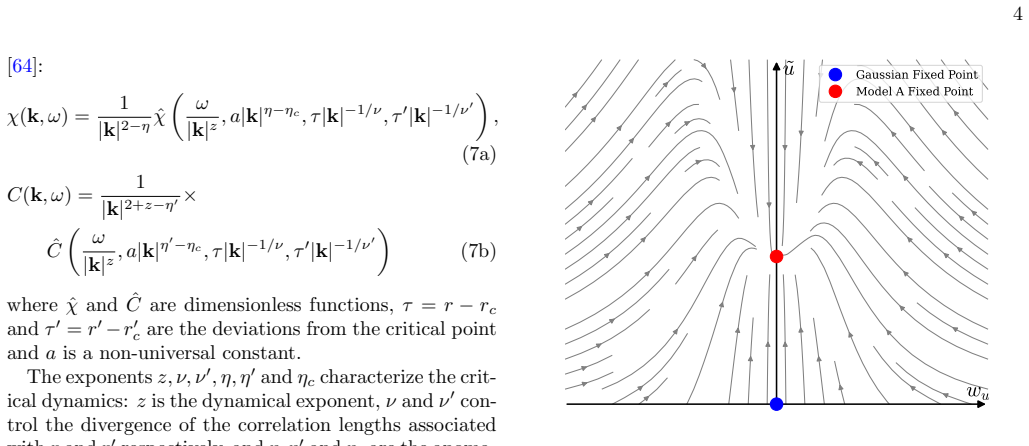
To lowest order in ε = 4 − d, the non-reciprocal couplings of two U(n)-symmetric n-vector fields are RG-irrelevant. The stable fixed point is the equilibrium Model A fixed point with 2n components (ũ*_R = 3ε / 2(n+4), w*_u,R = w*_D,R = 0), so the critical exponents coincide with Model A even though the transition is into a homogeneously oscillating non-equilibrium state.
What carries the argument
Field-theoretic renormalization group of the noisy multi-component complex Ginzburg–Landau equation obtained when two Model A fields share identical Hamiltonians H and H' (enforcing U(n)). The dimensionless ratios w_u = u'/u and w_D = D'/D measure non-reciprocity; their beta functions drive them to zero at the stable fixed point.
Load-bearing premise
The reciprocal and non-reciprocal sectors are forced to have the same functional form, which locks in U(n) symmetry and keeps the complex structure intact under renormalization; distinct couplings that break that symmetry are left unanalyzed.
What would settle it
A controlled simulation or higher-loop RG of two non-reciprocally coupled multi-component (XY or Heisenberg) fields that either finds a stable fixed point with nonzero non-reciprocal ratios, or measures critical exponents that clearly depart from 2n-component Model A.
If this is right
- Critical slowing down and response near the ordering transition of non-reciprocal XY or Heisenberg-like models should match equilibrium Model A with 2n components.
- Non-reciprocity shows up only as a subleading drive exponent controlling resonant frequency, not as a change of universality class.
- At criticality an effective O(2n) symmetry emerges and detailed balance is restored in the scaling sense (η = η').
- Whether non-reciprocity produces new classes depends on the symmetry implementation, not on non-reciprocity by itself.
Where Pith is reading between the lines
- Breaking U(n) by giving reciprocal and non-reciprocal sectors independent couplings (as the outlook suggests) is the natural next stress test and could restore relevance of non-reciprocity.
- The contrast with biquadratic O(n)×O(n) non-reciprocal models implies that linear non-reciprocity plus large continuous symmetry is specially protective of equilibrium criticality.
- Experimental or numerical searches for non-equilibrium critical exponents in active or living systems may need to check symmetry content before attributing deviations to non-reciprocity alone.
Editorial analysis
A structured set of objections, weighed in public.
Referee Report
Summary. The manuscript studies the critical dynamics of two n-vector order parameters coupled non-reciprocally via a Levi-Civita structure (Eq. 1), with Hamiltonians H and H' of identical functional form (Eqs. 2a-2b), so that the model has U(n) symmetry and reduces to a noisy multi-component complex Ginzburg-Landau equation (Eqs. 4). Using an MSRJD field theory with minimal subtraction in d = 4 - epsilon, the author computes one-loop beta functions for the dimensionless quartic coupling and the non-reciprocal ratios w_u, w_D (with the w_D flow obtained at two loops, SM Eqs. 58), finds the stable fixed point to be the equilibrium Model A fixed point with w*_u = w*_D = 0 (Eq. 9), and obtains exponents (Eqs. 10) that coincide with Model A for a 2n-component order parameter, plus a subleading non-reciprocal exponent eta_c. An exact large-n analysis (SM Sec. III) recovers the equilibrium spherical-model exponents. The headline claim: non-reciprocity of this form is RG-irrelevant for all n, and the transition into the oscillatory non-equilibrium ordered state remains in the equilibrium Model A universality class. The internal calculation appears sound and I verified the epsilon-expansion coefficients in Eqs. (10a,b,d) against the standard O(N=2n) Model A results.
Significance. If it holds, this is a useful negative/clarifying result: it delineates which implementations of non-reciprocity do not yield new universality classes, complementing the O(n1)xO(n2) biquadratic models of Refs. 38-39 where non-reciprocity is relevant. Strengths: the calculation is fully explicit (propagators, causality conventions, Z-factors, beta functions given in the SM, with Mathematica-assisted integrals cited); the exponents agree analytically with Model A O(2n) values upon substitution N=2n; and an independent exact large-n solution recovers equilibrium spherical-model exponents with uncorrected nu' — a nontrivial consistency check. The identification of the effective theory with a noisy multi-component complex Ginzburg-Landau equation, and of the subleading drive exponent eta_c controlling the resonant response, is also valuable. The main limitation is one of scope rather than execution: the result lives in the fine-tuned U(n)-symmetric coupling subspace, and the paper's own outlook acknowledges this.
major comments (1)
- The irrelevance result is established only on the U(n)-invariant coupling subspace: the identical functional form of H and H' in Eqs. (2a-2b) forces the non-reciprocity into the imaginary parts of the same couplings, and the beta-functions (SM Eqs. 58) are computed only there. The RG eigenvalues of U(n)-breaking operators — distinct quartics u1 != u2, a biquadratic v(phi1^2)(phi2^2), or primed couplings differing in structure from unprimed ones, i.e. the generic O(n)xO(n) situation — are never computed. This matters concretely: for the reciprocal version of this anisotropy, the classic Aharony analysis of coupled phi^4 models shows the isotropic O(2n) fixed point is stable to interspecies anisotropy only when alpha_{2n} > 0, which fails for 2n >= 4 at small epsilon (marginally at 2n=4). Thus for the very cases advertised as physical motivation (n=2 XY, n=3 Heisenberg), the emergent O(2n)
minor comments (7)
- Ref. 64: 'See Supplemental Material at []' is a placeholder; the URL must be filled in before publication.
- SM Eq. (61)-(62) and main text: stability of the Model A fixed point is asserted via 'one can show that [the stability matrix] has no negative eigenvalues.' The three eigenvalues of Lambda (Eq. 59) at the fixed point should be displayed explicitly, at least in the SM — they also quantify the crossover rate at which non-reciprocity disappears, which is physically interesting.
- Eq. (9): it would reassure readers to state the normalization relating u* = 3epsilon/(2(n+4)) to the standard Model A O(N=2n) fixed-point value (6epsilon/(N+8)); the factor-of-two difference presumably traces to the complex-field vertex convention (u/3 vs u/4!) and should be made explicit.
- Eq. (10e): nu' retaining its mean-field value to all orders checked is notable. Since r' can be gauged away (SM, discussion after Eq. (19)), a sentence clarifying whether the uncorrected nu' is a consequence of that redundancy (rather than a coincidence) would strengthen the interpretation; likewise for the large-n result nu' = 1/2 (SM Eq. 92).
- SM Eq. (29): Z_{tau'} contains the ratio tau/tau', which is singular at criticality; the remark that this flow 'need not be captured' is terse and deserves one or two sentences of justification.
- Notation/typography: the citation alternates between 'Hohenberg and Halperin' and 'Halperin and Hohenberg' (abstract/intro vs. Ref. 44); the use of dotless-i for the imaginary unit is unusual and could be stated at first use; in the SM paragraph after Eq. (19), 'the critical behavior is then strictly controlled by r alone' reads awkwardly given that r' is retained.
- Fig. 1: the flow diagram is restricted to w_D = 0; since w_D has its own flow at O(u^2) (SM Eq. 58c), a brief note in the caption on why the w_D=0 slice is representative (or a second panel) would help.
Circularity Check
No circularity: fixed points and exponents are outputs of explicit one- and two-loop β-functions, not inputs renamed as predictions.
full rationale
The central claim—that non-reciprocal ratios w_u and w_D are RG-irrelevant and the stable fixed point is equilibrium Model A with 2n components—is obtained by constructing the MSRJD action from the Langevin equations, computing Z-factors from one- and two-loop diagrams (SM Eqs. 26–56), forming the β-functions (SM Eqs. 58), and solving β_ũ=β_wu=β_wD=0. The only infrared-stable root below d=4 is ũ*_R=3ε/(2(n+4)), w*_u,R=w*_D,R=0 (SM Eqs. 60–62); the Wilson functions at that point then yield the quoted exponents (SM Eqs. 76). Nothing in that chain is fitted to data, defined in terms of the target exponents, or forced by a self-citation uniqueness theorem. Recovery of Model A when w=0 is a consistency check, not a smuggled ansatz. Prior n=1 and Model A literature are used as external benchmarks. The modeling restriction to identical H and H' (U(n) subspace) is a scope/assumption issue, not circularity of the derivation within that model. steps is empty.
Axiom & Free-Parameter Ledger
axioms (6)
- domain assumption Martin–Siggia–Rose–Janssen–De Dominicis mapping from Langevin equations to a renormalizable dynamical field theory with the stated response and correlation vertices.
- domain assumption Upper critical dimension d_c=4 and controlled expansion in ε=4−d with minimal subtraction capture the universal critical dynamics of the model.
- ad hoc to paper Reciprocal and non-reciprocal sectors share the same functional form of H and H' (identical mass, diffusion, quartic structure up to primed couplings), enforcing U(n) and complex-conjugate pair structure under RG.
- domain assumption Stability requires u'D'>0 so the ordered oscillatory phase has no finite-wavelength instability.
- domain assumption Gaussian white noise with equal strength on both fields; no conserved densities or additional reversible mode-coupling terms beyond the non-reciprocal drive written in H'.
- standard math Standard one- and two-loop diagrammatics and Gamma-function regularization of momentum integrals are valid for extracting Z-factors and β-functions.
read the original abstract
Non-reciprocal interactions find broad applicability in non-equilibrium and living systems. Their canonical implementation involves asymmetric couplings between two entities, which generally induce spatio-temporal patterns and time-dependent steady states that break time-translational invariance, representing a clear deviation from equilibrium physics. Although their phenomenology is well understood, whether non-reciprocal interactions induce new universality classes, and if so, under what conditions, remains an open question. In the present work, we perform a field-theoretic renormalization group (RG) analysis of the dynamics of two non-reciprocally coupled $n$-vector order parameters possessing a $U(n)$ symmetry, generalizing previous results to order parameters with multiple components, a feature that has been shown to generate novel non-equilibrium critical behavior in certain non-reciprocal systems. To lowest order in $\epsilon = 4-d$, we find that the non-reciprocal coupling is RG-irrelevant, and the critical behavior is governed by the equilibrium fixed point of the Model A universality class of Hohenberg and Halperin with $2n$ vector components, even though the transition is into a non-equilibrium state. Our results demonstrate that non-reciprocity alone may not be sufficient to induce novel universality classes.
Figures
Reference graph
Works this paper leans on
-
[1]
Z. You, A. Baskaran, and M. C. Marchetti, Nonreciproc- ity as a generic route to traveling states, Proc. Natl. Acad. Sci. U.S.A.117, 19767 (2020)
2020
-
[2]
Fruchart, R
M. Fruchart, R. Hanai, P. B. Littlewood, and V. Vitelli, Non-reciprocal phase transitions, Nature592, 363 (2021)
2021
-
[3]
Shankar, A
S. Shankar, A. Souslov, M. J. Bowick, M. C. Marchetti, and V. Vitelli, Topological active matter, Nat. Rev. Phys. 4, 380 (2022)
2022
-
[4]
Brauns and M
F. Brauns and M. C. Marchetti, Nonreciprocal pattern formation of conserved fields, Phys. Rev. X14, 021014 (2024)
2024
-
[5]
Y. Avni, M. Fruchart, D. Martin, D. Seara, and V. Vitelli, Dynamical phase transitions in the nonrecip- rocal ising model, Phys. Rev. E111, 034124 (2025)
2025
-
[6]
Y. Avni, M. Fruchart, D. Martin, D. Seara, and V. Vitelli, Nonreciprocal ising model, Phys. Rev. Lett. 134, 117103 (2025)
2025
-
[7]
Garcia Lorenzana, A
G. Garcia Lorenzana, A. Altieri, G. Biroli, M. Fruchart, and V. Vitelli, Nonreciprocal spin-glass transition and aging, Phys. Rev. Lett.135, 187402 (2025)
2025
-
[8]
M. K. Johnsrud and R. Golestanian, State diagram of the non-reciprocal Cahn–Hilliard model and the effects of symmetry, J. Stat. Mech.: Theory Exp.2025(12), 123204
2025
-
[9]
S. Saha, J. Agudo-Canalejo, and R. Golestanian, Scalar Active Mixtures: The Nonreciprocal Cahn-Hilliard Model, Phys. Rev. X10, 041009 (2020)
2020
-
[10]
Y. Duan, J. Agudo-Canalejo, R. Golestanian, and B. Mahault, Phase coexistence in nonreciprocal quorum- sensing active matter, Phys. Rev. Res.7, 013234 (2025)
2025
-
[11]
Dinelli, J
A. Dinelli, J. O’Byrne, A. Curatolo,et al., Non- reciprocity across scales in active mixtures, Nat. Com- mun.14, 7035 (2023)
2023
-
[12]
Cocconi, H
L. Cocconi, H. Alston, and T. Bertrand, Active bound states arising from transiently nonreciprocal pair inter- actions, Phys. Rev. Res.5, 043032 (2023)
2023
-
[13]
M. J. Bowick, N. Fakhri, M. C. Marchetti, and S. Ra- maswamy, Symmetry, thermodynamics, and topology in active matter, Phys. Rev. X12, 010501 (2022)
2022
-
[14]
Bandini, D
G. Bandini, D. Venturelli, S. A. M. Loos, A. Jelic, and A. Gambassi, The XY model with vision cone: Non-reciprocal vs. reciprocal interactions, J. Stat. Mech. 2025, 053205 (2025)
2025
-
[15]
S. A. M. Loos, S. H. L. Klapp, and T. Martynec, Long- range order and directional defect propagation in the nonreciprocalXYmodel with vision cone interactions, Phys. Rev. Lett.130, 198301 (2023)
2023
-
[16]
Rouzaire, D
Y. Rouzaire, D. J. G. Pearce, I. Pagonabarraga, and D. Levis, Nonreciprocal interactions reshape topological defect annihilation, Phys. Rev. Lett.134, 167101 (2025)
2025
-
[17]
Dopierala, H
D. Dopierala, H. Chat´ e, X.-q. Shi, and A. Solon, In- escapable anisotropy of nonreciprocal xy models, Phys. Rev. Lett.135, 088302 (2025)
2025
-
[18]
Popli, A
P. Popli, A. Maitra, and S. Ramaswamy, Ordering and defect cloaking in nonreciprocal lattice xy models, Phys. Rev. Lett.135, 088303 (2025)
2025
-
[19]
Z.-Y. Liu, B. Zheng, L.-L. Nian, and L. Xiong, Dy- namic approach to the two-dimensional nonreciprocal X Y model with vision cone interactions, Phys. Rev. E111, 014131 (2025)
2025
-
[20]
Risler, J
T. Risler, J. Prost, and F. J¨ ulicher, Universal Critical Behavior of Noisy Coupled Oscillators, Phys. Rev. Lett. 93, 175702 (2004)
2004
-
[21]
Risler, J
T. Risler, J. Prost, and F. J¨ ulicher, Universal critical behavior of noisy coupled oscillators: A renormalization group study, Phys. Rev. E72, 016130 (2005)
2005
-
[22]
Osat and R
S. Osat and R. Golestanian, Non-reciprocal multifarious self-organization, Nat. Nanotechnol.18, 79 (2023)
2023
-
[23]
Nadolny, C
T. Nadolny, C. Bruder, and M. Brunelli, Nonreciprocal 6 synchronization of active quantum spins, Phys. Rev. X 15, 011010 (2025)
2025
-
[24]
K. L. Kreienkamp and S. H. L. Klapp, Synchronization and exceptional points in nonreciprocal active polar mix- tures, Commun. Phys.8, 307 (2025)
2025
-
[25]
Daviet, C
R. Daviet, C. P. Zelle, A. Asadollahi, and S. Diehl, Kardar-parisi-zhang scaling in time-crystalline matter, Phys. Rev. Lett.135, 047101 (2025)
2025
-
[26]
Hanai, Nonreciprocal Frustration: Time Crystalline Order-by-Disorder Phenomenon and a Spin-Glass-like State, Phys
R. Hanai, Nonreciprocal Frustration: Time Crystalline Order-by-Disorder Phenomenon and a Spin-Glass-like State, Phys. Rev. X14, 011029 (2024)
2024
-
[27]
Daviet, C
R. Daviet, C. P. Zelle, A. Rosch, and S. Diehl, Nonequi- librium Criticality at the Onset of Time-Crystalline Or- der, Phys. Rev. Lett.132, 167102 (2024)
2024
-
[28]
C. P. Zelle, R. Daviet, A. Rosch, and S. Diehl, Universal phenomenology at critical exceptional points of nonequi- librium O(n) models, Phys. Rev. X14, 021052 (2024)
2024
-
[29]
Reichenbach, M
T. Reichenbach, M. Mobilia, and E. Frey, Mobility pro- motes and jeopardizes biodiversity in rock–paper–scissors games, Nature448, 1046 (2007)
2007
-
[30]
Vicsek and A
T. Vicsek and A. Zafeiris, Collective motion, Phys. Rep. 517, 71 (2012)
2012
-
[31]
Bain and D
N. Bain and D. Bartolo, Dynamic response and hydro- dynamics of polarized crowds, Science363, 46 (2019)
2019
-
[32]
S. Chen, D. E. G¨ okmen, M. Fruchart, M. Krumbein, P. Silberzan, V. Yashunsky, and V. Vitelli, Chirality across scales in tissue dynamics (2025), arXiv:2506.12276 [cond-mat.soft]
Pith/arXiv arXiv 2025
-
[33]
Theveneau, B
E. Theveneau, B. Steventon, E. Scarpa, S. Garcia, X. Trepat, A. Streit, and R. Mayor, Chase-and-run be- tween adjacent cell populations promotes directional col- lective migration, Nat. Cell Biol.15, 763 (2013)
2013
-
[34]
Paoluzzi, M
M. Paoluzzi, M. Leoni, and M. C. Marchetti, Information and motility exchange in collectives of active particles, Soft Matter16, 6317 (2020)
2020
-
[35]
Scheibner, A
C. Scheibner, A. Souslov, D. Banerjee, P. Sur´ owka, W. T. M. Irvine, and V. Vitelli, Odd elasticity, Nat. Phys. 16, 475 (2020)
2020
-
[36]
Fossati, C
M. Fossati, C. Scheibner, M. Fruchart, and V. Vitelli, Odd elasticity and topological waves in active surfaces, Phys. Rev. E109, 024608 (2024)
2024
-
[37]
Fruchart, C
M. Fruchart, C. Scheibner, and V. Vitelli, Odd viscosity and odd elasticity, Annu. Rev. Condens. Matter Phys. 14, 471 (2023)
2023
-
[38]
J. T. Young, A. V. Gorshkov, M. Foss-Feig, and M. F. Maghrebi, Nonequilibrium Fixed Points of Coupled Ising Models, Phys. Rev. X10, 011039 (2020)
2020
-
[39]
J. T. Young, A. V. Gorshkov, and M. Maghrebi, Nonequilibrium universality of the nonreciprocally cou- pledo(n 1)×o(n 2) model, Phys. Rev. E113, 034132 (2026)
2026
-
[40]
Pisegna, S
G. Pisegna, S. Saha, and R. Golestanian, Emergent po- lar order in nonpolar mixtures with nonreciprocal inter- actions, Proc. Natl. Acad. Sci. U.S.A.121, e2407705121 (2024)
2024
-
[41]
E. Sezik and G. Pruessner, Critical dynamics of non-reciprocally coupled conserved systems (2026), arXiv:2605.11892 [cond-mat.stat-mech]
Pith/arXiv arXiv 2026
-
[42]
G. G. Lorenzana, D. Martin, Y. Avni, D. S. Seara, M. Fruchart, G. Biroli, and V. Vitelli, When is non- reciprocity relevant? (2025), arXiv:2509.17972 [cond- mat.stat-mech]
Pith/arXiv arXiv 2025
-
[43]
U. C. T¨ auber and S. Diehl, Perturbative Field- Theoretical Renormalization Group Approach to Driven- Dissipative Bose-Einstein Criticality, Phys. Rev. X4, 021010 (2014)
2014
-
[44]
P. C. Hohenberg and B. I. Halperin, Theory of dynamic critical phenomena, Rev. Mod. Phys.49, 435 (1977)
1977
-
[45]
M. Akritidis, A. Garc´ es, A. Vasilopoulos, M. Carosi, D. Levis, and N. G. Fytas, Fate of the ising uni- versality class under nonreciprocal interactions (2026), arXiv:2606.06981 [cond-mat.stat-mech]
Pith/arXiv arXiv 2026
-
[46]
K. E. Bassler and B. Schmittmann, Critical Dynamics of Nonconserved Ising-Like Systems, Phys. Rev. Lett.73, 3343 (1994)
1994
-
[47]
Chen and G
L. Chen and G. Pruessner, Numerical investigation of the brownianq= 2 potts model, Phys. Rev. Res.7, 033295 (2025)
2025
-
[48]
M. Scandolo, J. Pausch, M. E. Cates, and L. D. Carlo, Non-equilibrium coupling to a diffusing density breaks ising universality (2026), arXiv:2607.02661 [cond- mat.stat-mech]
Pith/arXiv arXiv 2026
-
[49]
Guislain and E
L. Guislain and E. Bertin, Collective oscillations in a three-dimensional spin model with non-reciprocal inter- actions, J. Stat. Mech.2024, 093210 (2024)
2024
-
[50]
L. M. Sieberer, S. D. Huber, E. Altman, and S. Diehl, Nonequilibrium functional renormalization for driven- dissipative Bose-Einstein condensation, Phys. Rev. B89, 134310 (2014)
2014
-
[51]
L. M. Sieberer, S. D. Huber, E. Altman, and S. Diehl, Dynamical critical phenomena in driven-dissipative sys- tems, Phys. Rev. Lett.110, 195301 (2013)
2013
-
[52]
Garc ´ ıa-Morales and K
V. Garc ´ ıa-Morales and K. Krischer, The complex Ginzburg-Landau equation: an introduction, Contemp. Phys.53, 79 (2012)
2012
-
[53]
Aranson and L
I. Aranson and L. Kramer, The World of the Com- plex Ginzburg-Landau Equation, Rev. Mod. Phys.74, 99 (2002)
2002
-
[54]
P. C. Martin, E. D. Siggia, and H. A. Rose, Statistical dy- namics of classical systems, Phys. Rev. A8, 423 (1973)
1973
-
[55]
Janssen, On a Lagrangean for classical field dynam- ics and renormalization group calculations of dynamical critical properties, Z
H.-K. Janssen, On a Lagrangean for classical field dynam- ics and renormalization group calculations of dynamical critical properties, Z. Phys. B23, 377 (1976)
1976
-
[56]
Bausch, H
R. Bausch, H. K. Janssen, and H. Wagner, Renormal- ized field theory of critical dynamics, Z. Phys. B24, 113 (1976)
1976
-
[58]
H. K. Janssen, On the renormalized field theory of non- linear critical relaxation, inFrom Phase Transitions to Chaos(World Scientific, Singapore, 1992) pp. 68–91
1992
-
[59]
Notably, the correlation length exponentν ′ associated with the non-reciprocal parameterr ′ retains its mean-field value, in contrast toνwhich is corrected at orderϵ
for a 2n−component real order parameter, consistent with the emergentO(2n) at the fixed point. Notably, the correlation length exponentν ′ associated with the non-reciprocal parameterr ′ retains its mean-field value, in contrast toνwhich is corrected at orderϵ. We also observe thatη−η c >0 for alln, so that at large length scales the equilibrium contribut...
-
[60]
U. C. T¨ auber,Critical Dynamics: A Field Theory Ap- proach to Equilibrium and Non-Equilibrium Scaling Be- havior(Cambridge University Press, Cambridge, 2014)
2014
-
[61]
Cardy,Scaling and Renormalization in Statistical Physics(Cambridge University Press, Cambridge, 1996)
J. Cardy,Scaling and Renormalization in Statistical Physics(Cambridge University Press, Cambridge, 1996)
1996
-
[62]
Zinn-Justin,Quantum Field Theory and Critical Phe- nomena; 4th ed., International series of monographs on physics (Clarendon Press, Oxford, 2002)
J. Zinn-Justin,Quantum Field Theory and Critical Phe- nomena; 4th ed., International series of monographs on physics (Clarendon Press, Oxford, 2002)
2002
-
[65]
See Supplemental Material at [] for further analytical de- tails, which includes Refs
-
[66]
M. C. Cross and P. C. Hohenberg, Pattern formation 7 outside of equilibrium, Rev. Mod. Phys.65, 851 (1993)
1993
-
[67]
Kuramoto,Chemical Oscillations, Waves, and Turbu- lence, Springer Series in Synergetics, Vol
Y. Kuramoto,Chemical Oscillations, Waves, and Turbu- lence, Springer Series in Synergetics, Vol. 19 (Springer- Verlag, Berlin, 1984)
1984
-
[68]
De Dominicis, E
C. De Dominicis, E. Br´ ezin, and J. Zinn-Justin, Field- theoretic techniques and critical dynamics. i. ginzburg- landau stochastic models without energy conservation, Phys. Rev. B12, 4945 (1975)
1975
-
[69]
Specifically, in our caseϕ 1 →cos(θ)ϕ 1 −sin(θ)ϕ 2 and ϕ2 →cos(θ)ϕ 2 + sin(θ)ϕ1 for constantθis a valid trans- formation whereas it is not in the model considered in Refs. [39]
-
[70]
Watanabe and H
H. Watanabe and H. Murayama, Redundancies in Nambu-Goldstone Bosons, Phys. Rev. Lett.110, 181601 (2013)
2013
-
[71]
H. B. Nielsen and S. Chadha, On how to count Goldstone bosons, Nucl. Phys. B105, 445 (1976)
1976
-
[72]
Non-Reciprocal yet Equilibrium Critical Dynamics
M. Moshe and J. Zinn-Justin, Quantum field theory in the large N limit: A review, Phys. Rep.385, 69 (2003). Supplementary Material for “Non-Reciprocal yet Equilibrium Critical Dynamics" Emir Sezik 1,∗ 1Department of Mathematics, Imperial College London, South Kensington, London SW7 2AZ, United Kingdom (Dated: July 28, 2026) CONTENTS I. Mean-Field Analysis...
2003
-
[73]
Specifically, we first use a Feynman parameterization to rewrite the wave-vector integral,J , in Eq
+ (1−˚ıwD)(q1 +q 2)2 + 3τ /D+˚ıτ′/D .(36) Using several Feynman parameterizations, the wave-vector integrals can be evaluated. Specifically, we first use a Feynman parameterization to rewrite the wave-vector integral,J , in Eq. (36) as J = Z 1 0 dx (1 +x) 2 Z đdq1 1 q2 1 +τ /D Z đdq2 1 (q2 2 +τ /D) q2 2 + 21−˚ıxwD 1+x q1 ·q 2 +q 2 1 + τ D 1+2x+ ˚ıτ′/τ x 1...
-
[74]
+ (1−˚ıwD)(q1 +q 2 +k) 2 + 3τ /D+˚ıτ′/D (51) Using similar Feynman parameterizations, the wave-vector integrals in Eq. (51) can be evaluated to give: I ab b(k, ω) =δab n+ 1 9 D(1 +w 2 u)˜u2Γ(3−d) Z 1 0 dx (1 +x) 2 (1 +x) 2 x(1 +˚ıwD)(2 +x(1−˚ıwD)) 2−d/2 × Z 1 0 dyy 1−d/2 1 −˚ıω D α2(x, y) +k2β2(x, y) +τ D m2(x, y) 3−d (52) where α2(x, y) = y(1 +x) 2 +x(1 ...
-
[75]
García-Morales and K
V. García-Morales and K. Krischer, The complex Ginzburg-Landau equation: an introduction, Contemp. Phys.53, 79 (2012). 17
2012
-
[76]
U. C. Täuber,Critical Dynamics: A Field Theory Approach to Equilibrium and Non-Equilibrium Scaling Behavior(Cam- bridge University Press, Cambridge, 2014)
2014
-
[77]
Zinn-Justin,Quantum Field Theory and Critical Phenomena; 4th ed., International series of monographs on physics (Clarendon Press, Oxford, 2002)
J. Zinn-Justin,Quantum Field Theory and Critical Phenomena; 4th ed., International series of monographs on physics (Clarendon Press, Oxford, 2002)
2002
-
[78]
M. L. Bellac and G. Barton,Quantum and statistical Field Theory(Oxford University Press, 1992)
1992
-
[79]
D. J. Amit and V. Martin-Mayor,Field Theory, the Renormalization Group, and Critical Phenomena, 3rd ed. (World Scientific, Singapore, 2005)
2005
-
[80]
Janssen, On a Lagrangean for classical field dynamics and renormalization group calculations of dynamical critical properties, Z
H.-K. Janssen, On a Lagrangean for classical field dynamics and renormalization group calculations of dynamical critical properties, Z. Phys. B23, 377 (1976)
1976
-
[81]
Bausch, H
R. Bausch, H. K. Janssen, and H. Wagner, Renormalized field theory of critical dynamics, Z. Phys. B24, 113 (1976)
1976
-
[82]
Janssen, Renormalized field theory of the critical dynamics of O(n)-symmetric systems, Z
H.-K. Janssen, Renormalized field theory of the critical dynamics of O(n)-symmetric systems, Z. Phys. B26, 187 (1977)
1977
-
[83]
H. K. Janssen, On the renormalized field theory of nonlinear critical relaxation, inFrom Phase Transitions to Chaos(World Scientific, Singapore, 1992) pp. 68–91
1992
discussion (0)
Sign in with ORCID, Apple, or X to comment. Anyone can read and Pith papers without signing in.