REVIEW 3 major objections 7 minor 60 references
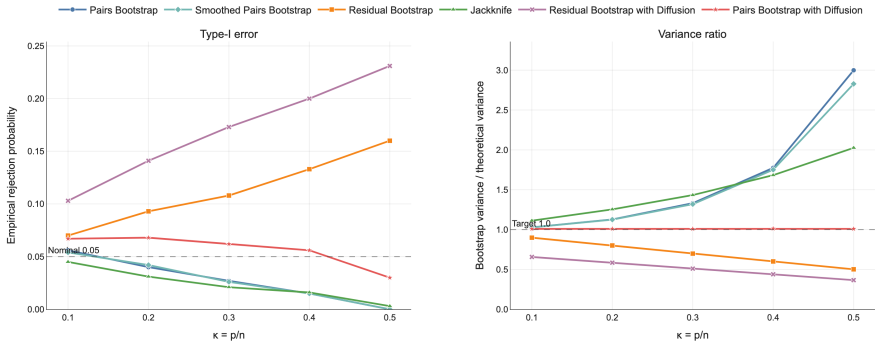
A diffusion pairs bootstrap can recover the right OLS variance in high dimensions when classical pairs and residual bootstraps systematically miscalibrate.
Reviewed by Pith at T0; open to challenge. T0 means a machine referee read the full paper against a public rubric. the ladder, T0–T4 →
T0 review · grok-4.5
2026-07-31 18:04 UTC pith:B5QDGN2X
load-bearing objection Solid theory paper: pathwise score control for diffusion pairs bootstrap, clean W4 counterexamples, and real calibration gains; the MLP experiments sit outside the Lipschitz/score assumption. the 3 major comments →
Diffusion Bootstrap for High-Dimensional Linear Models
The pith
A machine-rendered reading of the paper's core claim, the machinery that carries it, and where it could break.
Core claim
Diffusion pairs bootstrap—drawing bootstrap pairs from a learned reverse diffusion on the joint observations—achieves variance consistency for OLS linear contrasts when the learned score tracks the true score along the Ornstein–Uhlenbeck path with vanishing integrated fourth-moment error and controlled Lipschitz score error. That pathwise score control yields density-ratio and Gram lower-tail bounds that terminal W4 convergence cannot supply, and the result covers strongly log-concave designs with well-conditioned covariance in the proportional regime p/n → κ ∈ (0,1).
What carries the argument
Pathwise score approximation along the OU reverse SDE/Fokker–Planck flow: integrated L4 score error plus a uniform Lipschitz bound on the score error, used to get χ² control of generated versus true laws and polynomial lower tails on the generated Gram matrix (hence inverse-moment bounds for bootstrap OLS variance).
Load-bearing premise
The fitted diffusion score must stay close to the true score along the entire noise path, with a uniform Lipschitz bound on the error; the variance theorems stand or fall with that condition, which is proven only for structured model classes, not for arbitrary neural denoisers.
What would settle it
Train the paper’s diffusion pairs procedure under a strongly log-concave proportional design where the integrated pathwise score error and Lipschitz bound can be checked or forced to fail; if variance ratios stay near one when the score condition holds and blow up or stay biased when it fails—while W4 remains small—the central claim is supported or refuted.
If this is right
- Classical pairs bootstrap conservatism and residual bootstrap anti-conservatism in the proportional regime need not be inevitable if the joint law is learned rather than resampled empirically.
- Bootstrap validity for OLS variance can be reduced to score estimation quality along the diffusion path, separating generative accuracy from Gram geometry control.
- n-atomic estimators (including the empirical measure) cannot be W4-consistent for high-dimensional Gaussians, while structured scores can still be estimated at rate about log(p)/n.
- Diffusion residual bootstrap is not a substitute: fitted residuals are already variance-shrunk by high-dimensional projection, so learning their law cannot restore the true error scale.
- The same architecture can improve calibration for i.i.d. non-Gaussian designs and reduce (but not always erase) distortion under heterogeneous elliptical designs.
Where Pith is reading between the lines
- If pathwise score control is the real bottleneck, diagnostics that monitor reverse-drift stability or generated Gram lower tails may be more informative than terminal sample-quality scores alone.
- The counterexamples suggest a broader template: any generative bootstrap whose samples can place vanishing mass on nearly singular designs may fail variance calibration despite good average distributional metrics.
- Extending the theory beyond Gaussian noise and strong log-concavity would likely hinge on replacing the uniform Poincaré/log-Sobolev and one-dimensional small-ball inputs, not on changing the pairs-versus-residual distinction.
- Practitioners using diffusion bootstrap for other M-estimators would still need inverse-moment or anti-concentration control specific to those estimating equations.
Editorial analysis
A structured set of objections, weighed in public.
Referee Report
Summary. The manuscript proposes a "diffusion pairs bootstrap" for linear models: rather than resampling observed pairs (X_i, Y_i) from the empirical distribution, it trains a diffusion model on the joint observations and draws bootstrap samples from the terminal law of the learned reverse OU process. The motivation is the well-documented failure of classical pairs and residual bootstraps in the proportional regime p/n → κ ∈ (0,1), where they exhibit opposite variance distortions. The paper proves: (i) fixed-p variance and distributional consistency (Theorem 2.12, Corollary 2.13) under strong log-concavity of the target plus an integrated L^q score-approximation assumption with local Lipschitz control (Assumption 2.6); (ii) proportional-regime variance consistency for OLS contrasts under strongly log-concave designs with general well-conditioned covariance and Gaussian noise (Theorem 3.10), via a χ² density-ratio analysis of the Fokker–Planck equations, anti-concentration, and Gram-matrix lower-tail bounds; (iii) attainability of the score assumptions for structured classes (Gaussian, AR(1), fixed-rank perturbations, a product exponential family) with minimax risk bounds of order log p/n (Theorems 4.1, 4.3); (iv) counterexamples showing terminal W_4 convergence alone does not imply variance consistency (§5); and (v) simulations across ten design/error combinations showing improved variance and Type I error calibration relative to classical bootstraps.
Significance. If the results hold, the paper makes a solid contribution at the intersection of bootstrap theory and generative modeling. Its strengths are concrete: (i) a variance-consistency theorem in the proportional regime for a clearly defined new procedure, stated conditionally on explicit score assumptions rather than on unverifiable closeness of the fitted law; (ii) elementary and convincing counterexamples (§5) showing terminal W4 convergence is insufficient — a falsifiable, load-bearing clarification of why the diffusion structure matters; (iii) minimax-type upper bounds of order log p/n for integrated score risk in structured classes, establishing non-vacuity of the assumptions; and (iv) experiments benchmarked against independent theoretical quantities (Wishart 1/{n(1−κ)} and elliptical m_λ(κ)/n) rather than against quantities defined from the fitted diffusion itself. The main limitation is that the practical MLP-based procedure used in all experiments lies outside the verified assumption class; the paper is honest about this but should foreground it more.
major comments (3)
- [§3, Assumption 3.3; §4; §7] Theorem 3.10 is conditional on Assumption 3.3, in particular (4): sup_{0≤t≤Tn} Lip(e_{n,t}) ≤ L⋆ < 1/4 with probability → 1. This uniform-in-time Lipschitz control is load-bearing — it drives the absorption in Lemmas D.2–D.4 that yields sup_r χ²(ρ̂_{n,r},ρ_{n,r}) = o_p(1), which Lemma D.8 then lifts to the M-fold product law to transfer the Gram lower tail. Section 4 verifies the pair (integrated L⁴ error, Lipschitz threshold) only for structured plug-in score classes (Gaussian, AR(1), fixed-rank, product exponential family with δ_NG small). The experiments (§7, Table 2) train an MLP DDPM: a fixed SiLU network is globally Lipschitz for fixed weights, but its constant is training-dependent, and vanishing denoising loss does not imply a dimension-free bound below L⋆. Thus the implemented procedure is outside the theorem — an applicability gap, not an inconsistency, and Remark 3.4 acknowled
- [§3, Assumption 3.1(5)] Item 5 of Assumption 3.1 states that the joint distribution 'belongs to a class for which a fitted score can satisfy Assumption 3.3.' Since Theorem 3.10 already imposes Assumption 3.3 directly, this item is redundant as stated and reads as assuming part of the conclusion inside the model assumption. Please either remove it or restate it as a remark clarifying that §4 provides sufficient classes; as written it blurs what is a distributional assumption versus a score-estimation assumption.
- [§D.1, proof of Theorem 3.10] The variance-ratio target is Var(c_n^T β̂) = σ²_n E[c_n^T S_n^{-1} c_n], of exact order n^{-1}; the proof of Theorem 3.10 shows both the conditional-response term and the conditional-mean term match at o_p(n^{-1}). The mean-term argument (Efron–Stein plus Sherman–Morrison, pp. 86–88) requires E_{bµ}|r_n(X)|⁸ = O_p(1) and E_{bµ}‖X‖⁸₂ = O_p(p⁴_n), obtained via conditional Jensen against χ². These steps are compressed relative to the care given elsewhere; since the ratio conclusion is sensitive to getting o_p(n^{-1}) rather than O_p(n^{-1}) here, please expand the justification of (121) and the display following (122), in particular the bound |h*_1| ≤ |X*_1^T a*_{-1}| and the uniformity of the leave-one-out negative moments over the n deletions.
minor comments (7)
- [Abstract] Abstract: 'terminalW 4' — missing space/math delimiter. Also, the phrase 'in settings not covered by our theory' would be more informative if it named the specific gap (score-error Lipschitz control for generic learned denoisers).
- [§2, Remark 2.9; §A.3] Remark 2.9 excludes discretization error, but the experiments use a 200-step DDPM. Please add a remark connecting the continuous-time theory to the discrete sampler, or a small sensitivity check over the number of sampling steps.
- [§7.2 and §A.5] For the i.i.d. Laplace design the benchmark 1/{n(1−κ)} is used (§A.5: 'the same first-order benchmark'). Please justify that c^T(X^TX)^{-1}c concentrates at 1/(n(1−κ)) for i.i.d. non-Gaussian entries, with a citation, since this is not the Wishart calculation used for the Gaussian case.
- [§A.4] The jackknife uses a Gaussian interval while all bootstrap procedures use percentile intervals (§A.4). Please note this asymmetry, as it affects the Type I error comparison across methods.
- [§1.4, Tables 4–6] Notation: λ is overloaded — radial multiplier λ_i in elliptical designs, spike parameter in the fixed-rank class, threshold λ_n, and the constant λ⋆ of (3). Table 6 partially flags this; please disambiguate in the text where collisions occur (e.g., §6 and §7.2 vs. §4.1).
- [§1, Figure 1] Figure 1 appears in §1 before any method definitions; the caption should at least name the procedures plotted (pairs, residual, jackknife, smoothed pairs, diffusion pairs, diffusion residual) and define the variance-ratio denominator.
- [§3, Remark 3.6; §7] Theorem 3.10 requires Gaussian regression noise (Assumption 3.1(1)) while the experiments include Laplace errors; Remark 3.6 sketches an extension to strongly log-concave noise. Please state explicitly in §7 that the Laplace-error experiments are outside the proved result, to avoid the reader over-reading 'generally improves Type I error calibration.'
Circularity Check
No significant circularity: variance consistency is derived from external assumptions (log-concavity, pathwise score error, OU/Fokker–Planck control), not forced by fitted normalizations or self-citation.
full rationale
The load-bearing chain is conditional and non-circular. Theorems 2.12 and 3.10 assume score approximation along the OU path (Assumptions 2.6 / 3.3) plus strong log-concavity and well-conditioned design, then derive bootstrap variance consistency via reverse-SDE coupling, Fokker–Planck density-ratio / χ² control, Gram lower tails, and inverse-moment bounds. Those conclusions are not built into the score-error hypothesis: Section 5 explicitly separates terminal W₄ closeness from variance consistency with counterexamples where W₄→0 but bootstrap variance diverges. Section 4 only shows that the score assumption is attainable for structured plug-in classes (Gaussian, AR(1), fixed-rank, product exponential family); it does not redefine the variance theorem in terms of those estimators. Experiments compare bootstrap variance ratios to independent Wishart / elliptical benchmarks 1/{n(1−κ)} or m_λ(κ)/n, not to quantities fitted from the diffusion model. There is no self-definitional loop, no fitted-input-as-prediction, and no load-bearing self-citation uniqueness claim. The known applicability gap (MLP denoisers vs. Assumption 3.3) is an external verification issue, not internal circularity.
Axiom & Free-Parameter Ledger
free parameters (3)
- Diffusion architecture and training hyperparameters =
Table 2 defaults (e.g. lr=1e-4, 200 steps)
- Smoothed pairs bandwidth h =
0.05
- Score Lipschitz threshold L⋆ and absorption constants λ⋆ =
L⋆<1/4 (constraint)
axioms (5)
- domain assumption Target joint law is uniformly strongly log-concave (fixed-p: Assump. 2.2; high-d design potential with m Σ_n^{-1} ⪯ ∇²V_n ⪯ m̄ Σ_n^{-1} and c_Σ I ⪯ Σ_n ⪯ C_Σ I).
- domain assumption Regression noise is Gaussian, independent of X, with variance in a fixed compact interval (Assump. 3.1).
- ad hoc to paper Integrated L^4 score error →_p 0 along the OU path and Lip(e_{n,t}) uniformly small with probability →1 (Assumps. 2.6, 3.3).
- domain assumption Noise schedule bounds and T_n→∞ with d_n e^{-2T_n}→0; continuous-time reverse SDE analysis without discretization error.
- standard math Classical Wishart / elliptical fixed-point variance benchmarks for simulation denominators.
invented entities (1)
-
Diffusion pairs bootstrap (terminal law of learned reverse OU as pairs resampling distribution)
independent evidence
read the original abstract
Classical bootstrap methods can behave poorly in high-dimensional linear models: the pairs bootstrap often yields overly conservative inference, whereas the residual bootstrap can be anti-conservative, reflecting systematic failures in variance calibration. We propose a diffusion-based pairs bootstrap that replaces the empirical joint distribution with a learned generative law. We establish variance consistency under a score approximation assumption, using complementary SDE and PDE arguments. Counterexamples show that terminal $W_4$ convergence alone is insufficient for variance consistency. Experiments indicate that diffusion pairs bootstrap improves variance calibration and generally improves Type~I error calibration, including in settings not covered by our theory.
Figures


Reference graph
Works this paper leans on
-
[1]
The Annals of Statistics , volume=
Bootstrap Methods: Another Look at the Jackknife , author=. The Annals of Statistics , volume=. 1979 , publisher=
1979
-
[2]
Journal of Machine Learning Research , volume=
Can we trust the bootstrap in high-dimensions? The case of linear models , author=. Journal of Machine Learning Research , volume=
-
[3]
arXiv preprint arXiv:2602.17052 , year=
Generative modeling for the bootstrap , author=. arXiv preprint arXiv:2602.17052 , year=
-
[4]
A festschrift for Erich L
Bootstrapping regression models with many parameters , author=. A festschrift for Erich L. Lehmann , pages=. 1983 , publisher=
1983
-
[5]
Beyond parametrics in interdisciplinary research: Festschrift in honor of Professor Pranab K
Bootstrapping the Grenander estimator , author=. Beyond parametrics in interdisciplinary research: Festschrift in honor of Professor Pranab K. Sen , volume=. 2008 , publisher=
2008
-
[6]
Scandinavian Journal of Statistics , volume=
Confidence intervals in monotone regression , author=. Scandinavian Journal of Statistics , volume=. 2024 , publisher=
2024
-
[7]
Journal of Machine Learning Research , volume=
Breaking the curse of dimensionality with convex neural networks , author=. Journal of Machine Learning Research , volume=
-
[8]
International Conference on Machine Learning , pages=
Diffusion models are minimax optimal distribution estimators , author=. International Conference on Machine Learning , pages=. 2023 , organization=
2023
-
[9]
International Conference on Machine Learning , pages=
Score approximation, estimation and distribution recovery of diffusion models on low-dimensional data , author=. International Conference on Machine Learning , pages=. 2023 , organization=
2023
-
[10]
arXiv preprint arXiv:2402.08082 , year=
Score-based generative models break the curse of dimensionality in learning a family of sub-Gaussian probability distributions , author=. arXiv preprint arXiv:2402.08082 , year=
-
[11]
arXiv preprint arXiv:2011.13456 , year=
Score-based generative modeling through stochastic differential equations , author=. arXiv preprint arXiv:2011.13456 , year=
Pith/arXiv arXiv 2011
-
[12]
IEEE transactions on pattern analysis and machine intelligence , volume=
Diffusion models in vision: A survey , author=. IEEE transactions on pattern analysis and machine intelligence , volume=. 2023 , publisher=
2023
-
[13]
Statistics & Probability Letters , volume=
Bootstrapping for multivariate linear regression models , author=. Statistics & Probability Letters , volume=. 2018 , publisher=
2018
-
[14]
The annals of statistics , pages=
Bootstrapping regression models , author=. The annals of statistics , pages=. 1981 , publisher=
1981
-
[15]
The annals of statistics , volume=
Some asymptotic theory for the bootstrap , author=. The annals of statistics , volume=. 1981 , publisher=
1981
-
[16]
The annals of statistics , volume=
Bootstrap and wild bootstrap for high dimensional linear models , author=. The annals of statistics , volume=. 1993 , publisher=
1993
-
[17]
Diffusion schr
De Bortoli, Valentin and Thornton, James and Heng, Jeremy and Doucet, Arnaud , journal=. Diffusion schr
-
[18]
International Conference on Machine Learning , pages=
Improved analysis of score-based generative modeling: User-friendly bounds under minimal smoothness assumptions , author=. International Conference on Machine Learning , pages=. 2023 , organization=
2023
-
[19]
Journal of machine learning research , volume=
Wasserstein convergence guarantees for a general class of score-based generative models , author=. Journal of machine learning research , volume=
-
[20]
arXiv preprint arXiv:2208.05314 , year=
Convergence of denoising diffusion models under the manifold hypothesis , author=. arXiv preprint arXiv:2208.05314 , year=
-
[21]
arXiv preprint arXiv:2602.10587 , year=
Deep Bootstrap , author=. arXiv preprint arXiv:2602.10587 , year=
-
[22]
Communications on Pure and Applied Mathematics , volume=
The smallest singular value of a random rectangular matrix , author=. Communications on Pure and Applied Mathematics , volume=
-
[23]
17th International Symposium on Mathematical Theory of Networks and Systems, 2006: MTNS 2006 , year=
Log-concave observers , author=. 17th International Symposium on Mathematical Theory of Networks and Systems, 2006: MTNS 2006 , year=
2006
-
[24]
arXiv preprint arXiv:2209.11215 , year=
Sampling is as easy as learning the score: theory for diffusion models with minimal data assumptions , author=. arXiv preprint arXiv:2209.11215 , year=
-
[25]
International Conference on Algorithmic Learning Theory , pages=
Convergence of score-based generative modeling for general data distributions , author=. International Conference on Algorithmic Learning Theory , pages=. 2023 , organization=
2023
-
[26]
arXiv preprint arXiv:2401.17958 , year=
Convergence analysis for general probability flow odes of diffusion models in wasserstein distances , author=. arXiv preprint arXiv:2401.17958 , year=
-
[27]
arXiv preprint arXiv:2404.00551 , year=
Convergence of continuous normalizing flows for learning probability distributions , author=. arXiv preprint arXiv:2404.00551 , year=
-
[28]
arXiv preprint arXiv:2311.13584 , year=
On diffusion-based generative models and their error bounds: The log-concave case with full convergence estimates , author=. arXiv preprint arXiv:2311.13584 , year=
-
[29]
Optimal Transport: Old and New , series =
Villani, C. Optimal Transport: Old and New , series =
-
[30]
2019 , publisher=
Probability: theory and examples , author=. 2019 , publisher=
2019
-
[31]
Generalization of an inequality by
Otto, Felix and Villani, C. Generalization of an inequality by. Journal of Functional Analysis , volume=. 2000 , publisher=
2000
-
[32]
The Thirty Seventh Annual Conference on Learning Theory , pages=
Optimal score estimation via empirical bayes smoothing , author=. The Thirty Seventh Annual Conference on Learning Theory , pages=. 2024 , organization=
2024
-
[33]
arXiv preprint arXiv:2508.03210 , year=
Convergence of deterministic and stochastic diffusion-model samplers: A simple analysis in wasserstein distance , author=. arXiv preprint arXiv:2508.03210 , year=
-
[34]
SIAM journal on matrix analysis and applications , volume=
Eigenvalues and condition numbers of random matrices , author=. SIAM journal on matrix analysis and applications , volume=. 1988 , publisher=
1988
-
[35]
Journal of Functional Analysis , volume =
Figalli, Alessio , title =. Journal of Functional Analysis , volume =
-
[36]
Electronic Journal of Probability , volume=
Well-posedness of multidimensional diffusion processes with weakly differentiable coefficients , author=. Electronic Journal of Probability , volume=
-
[37]
2009 , publisher=
Markov processes: characterization and convergence , author=. 2009 , publisher=
2009
-
[38]
Bakry, Dominique and Gentil, Ivan and Ledoux, Michel , title =
-
[39]
2005 , publisher=
Gradient flows: in metric spaces and in the space of probability measures , author=. 2005 , publisher=
2005
-
[40]
, title =
Gilbarg, David and Trudinger, Neil S. , title =
-
[41]
IEEE transactions on pattern analysis and machine intelligence , volume=
Novel uncertainty quantification through perturbation-assisted sample synthesis , author=. IEEE transactions on pattern analysis and machine intelligence , volume=. 2024 , publisher=
2024
-
[42]
arXiv preprint arXiv:2508.13890 , year=
Diffusion-Driven High-Dimensional Variable Selection , author=. arXiv preprint arXiv:2508.13890 , year=
-
[43]
arXiv preprint arXiv:2601.16120 , year=
Synthetic Augmentation in Imbalanced Learning: When It Helps, When It Hurts, and How Much to Add , author=. arXiv preprint arXiv:2601.16120 , year=
-
[44]
Journal of the Royal Statistical Society Series B: Statistical Methodology , volume=
Doubly robust conditional independence testing with generative neural networks , author=. Journal of the Royal Statistical Society Series B: Statistical Methodology , volume=. 2026 , publisher=
2026
-
[45]
Communications in Partial Differential Equations , volume=
Existence and uniqueness of solutions to Fokker--Planck type equations with irregular coefficients , author=. Communications in Partial Differential Equations , volume=. 2008 , publisher=
2008
-
[46]
Acta Sci
On logarithmic concave measures and functions , author=. Acta Sci. Math. , volume=
-
[47]
Random Structures & Algorithms , volume=
The geometry of logconcave functions and sampling algorithms , author=. Random Structures & Algorithms , volume=. 2007 , publisher=
2007
-
[48]
Diffusions hypercontractives , author=. S. 1985 , publisher=
1985
-
[49]
arXiv preprint arXiv:2606.26053 , year=
When Does Synthetic Data Augmentation Improve Score-Based Imbalanced Classification? , author=. arXiv preprint arXiv:2606.26053 , year=
-
[50]
Biometrika , volume=
The bootstrap: to smooth or not to smooth? , author=. Biometrika , volume=. 1987 , publisher=
1987
-
[51]
The Annals of Statistics , pages=
On smoothing and the bootstrap , author=. The Annals of Statistics , pages=. 1989 , publisher=
1989
-
[52]
arXiv preprint arXiv:2505.03432 , year=
Wasserstein convergence of score-based generative models under semiconvexity and discontinuous gradients , author=. arXiv preprint arXiv:2505.03432 , year=
-
[53]
arXiv preprint arXiv:2501.02298 , year=
Beyond log-concavity and score regularity: Improved convergence bounds for score-based generative models in w2-distance , author=. arXiv preprint arXiv:2501.02298 , year=
-
[54]
arXiv preprint arXiv:2505.04417 , year=
Localized diffusion models for high dimensional distributions generation , author=. arXiv preprint arXiv:2505.04417 , year=
-
[55]
1 , author=
Non-homogeneous boundary value problems and applications: Vol. 1 , author=. 2012 , publisher=
2012
-
[56]
Quasilinear elliptic-parabolic differential equations , author=. Math. z , volume=
-
[57]
Probability Theory and Related Fields , volume=
Asymptotics for high dimensional regression M-estimates: fixed design results , author=. Probability Theory and Related Fields , volume=. 2018 , publisher=
2018
-
[58]
The Annals of Statistics , volume=
Exact minimax risk for linear least squares, and the lower tail of sample covariance matrices , author=. The Annals of Statistics , volume=. 2022 , publisher=
2022
-
[59]
Journal of the American Statistical Association , volume=
Inference in linear regression models with many covariates and heteroscedasticity , author=. Journal of the American Statistical Association , volume=. 2018 , publisher=
2018
-
[60]
, title =
Hu, Feifang and Zidek, James V. , title =. Biometrika , volume =. 1995 , month =
1995
discussion (0)
Sign in with ORCID, Apple, or X to comment. Anyone can read and Pith papers without signing in.