REVIEW 4 major objections 9 minor 39 references
Budgeted congestion-aware rerouting can cut fleet delay and origin-side inequity on real city networks without replanning every vehicle.
Reviewed by Pith at T0; open to challenge. T0 means a machine referee read the full paper against a public rubric. the ladder, T0–T4 →
T0 review · grok-4.5
2026-07-31 17:47 UTC pith:525J54FE
load-bearing objection Solid multi-city audit of length- and origin-conditioned delay inequity, plus a simple budgeted rerouter that clearly wins in Manhattan; the “strongest joint profile on three cities” claim is softer once you notice city-tuned (K,R) on the reported ρ=1 condition and ~2% Chicago/SF margins. the 4 major comments →
Unequal Trips, Unequal Places: Diagnosing and Mitigating Delay Inequity in Autonomous Vehicle Fleet Coordination
The pith
A machine-rendered reading of the paper's core claim, the machinery that carries it, and where it could break.
Core claim
On three real-city networks under matched taxi demand, trip-length inequity is pervasive but direction-dependent, and residual spatial inequity grows with demand and is consistently larger by origin than by destination; SPARE’s delay-prioritized, congestion-responsive rerouting under an explicit per-review budget then delivers the strongest joint efficiency–fairness profile among the compared coordinators while keeping online route updates bounded.
What carries the argument
SPARE (SPatially Aware RErouting): every K steps it assigns at most R replans to the vehicles with largest accumulated delay and recomputes their guide paths on edge weights that add recently observed node waiting pressure to free-flow length, with a per-review optimality guarantee for that selection and path choice and at most R⌊T/K⌋ extra shortest-path computations.
Load-bearing premise
All trips are released at once on fixed lane-based capacities with historical taxi origin–destination patterns standing in for autonomous fleet demand; if real staggered arrivals or time-varying capacity change who waits where, both the inequity picture and SPARE’s gains can shrink or reorder.
What would settle it
Rerun the same three-city protocol with staggered real-time trip releases (or time-varying capacities) at matched load and check whether SPARE still leads the joint overhead / mean-slowdown / length-group / origin–destination SI Pareto front against the same six baselines.
If this is right
- Fleet averages alone are insufficient evaluation: trip-length and origin-conditioned residual slowdown should be reported alongside overhead.
- Origin regions are the higher-leverage geography for spotting and correcting coordination delay under congestion.
- Bounded, delay-prioritized online rerouting can improve efficiency and fairness together without invoking full-fleet replanning at every step.
- Review interval and reroute budget become explicit city-level controls on the delay–compute trade-off rather than hidden hyperparameters.
- Static assignment and priority-only fairness interventions leave execution-time route exposure unaddressed, so residual origin inequity can persist.
Where Pith is reading between the lines
- Operators could treat origin-zone residual slowdown as a live service-level dashboard metric and trigger SPARE-style budget only when it crosses a threshold.
- The same budgeted waiting-pressure idea may transfer to mixed human–AV fleets if only the controllable subset is eligible for the R slots.
- If staggered demand weakens the signal, hybrid designs that blend short-horizon waiting fields with predicted inflow might be the natural next stress test.
- City-specific (K, R) tuning implies deployment needs local calibration rather than a universal default.
Editorial analysis
A structured set of objections, weighed in public.
Referee Report
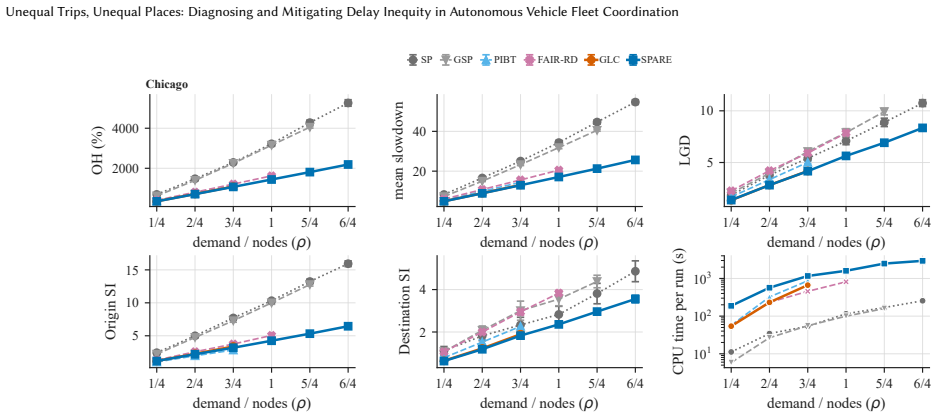
Summary. The paper audits how coordination delay is distributed in city-scale AV fleets on three real networks (Manhattan, Chicago, San Francisco) with official taxi demand, normalized as ρ=N/|V| and averaged over ten matched OD subsamples. Using slowdown, a length-decile disparity metric (LGD), and a length-residualized spatial-inequity metric by origin/destination zone (Eq. 1), it finds (i) trip-length inequity is pervasive but its direction depends on city and coordinator, and (ii) after conditioning on free-flow length, spatial inequity grows with demand and is consistently larger by origin than destination. It then proposes SPARE: every K steps, up to R vehicles with the largest accumulated delay are rerouted by Dijkstra on edge weights 1+c[v], where c is a geometrically decayed waiting field. A per-review selection/reroute optimality statement and an R⌊T/K⌋ bound on extra shortest-path computations are proved (Thm 4.1). Against six baselines plus an ITAP-α sweep, SPARE is reported best on all five outcome metrics in Manhattan and SF and best-on-balance in Chicago at ρ=1, with nested ablations, load-ratio sweeps, parameter sweeps, and trip-level inequality case studies.
Significance. If the results hold, the diagnostic contribution is genuinely useful: the length-residualized SI design addresses an obvious confound, and the origin-vs-destination asymmetry growing with demand is a clean, falsifiable finding replicated across three cities and three coordinators. Methodologically the paper is stronger than typical empirical systems submissions: ten matched OD subsamples with reported mean±SD, a six-baseline suite spanning assignment and MAPF plus an ITAP-α fairness sweep, a nested ablation, load-ratio scalability, CPU-time reporting with honest OOT admissions for TAP/ITAP, and an explicit bound on online planning work. Theorem 4.1 is modest but honestly scoped as a per-review decision guarantee rather than a performance guarantee. SPARE's Manhattan gains are decisive (OH 180.7 vs GLC 256.5) and the budgeted-rerouting mechanism is practical. The concerns below target the evidentiary basis of the Chicago/SF margins and the calibration of the mechanism narrative, not the overall research direction.
major comments (4)
- [§5 'Implementation details', §5.3, Table 2] SPARE's operating point is 'one fixed, city-specific operating point selected from the sweeps in Section 5.3,' and those sweeps are run at ρ=1 — the same condition, and apparently the same ten fixed subsamples, as the Table 2 headline comparison, while baselines use off-the-shelf settings. The margins this asymmetry affects are small outside Manhattan: Chicago OH 1436.3 vs GLC 1463.4 (~1.9%), SF 303.2 vs 310.3 (~2.3%), and PIBT already beats SPARE on Chicago O-SI (3.825 vs 4.163). Figures 10–11 show overhead varying by comparable amounts across the (K,R) sweep itself. Please select (K,R) on a held-out condition (a different ρ, or disjoint OD draws at ρ=1) and re-report Table 2 at that point, or demonstrate that the SPARE–GLC gap holds across the full sweep rather than at the selected point. Manhattan's ~30% gap is not at risk; the Chicago/SF edge is.
- [§5.2 and Table 4 vs §4/abstract] The ablation does not support the 'delay-prioritized intervention' half of the design story outside Chicago. In Manhattan, w/o delay ranking matches SPARE on OH (182.3 vs 180.7) and is better on O-SI (0.553 vs 0.561); in SF it is within ~1% on all five metrics. Only Chicago shows a large delay-ranking effect (1581.6→1436.3). The §5.2 claim that rerouting's gains 'depend on where reroutes are sent and which vehicles receive them,' and the abstract/§4 framing of delay-prioritized selection as a co-equal mechanism, are therefore contradicted on Manhattan O-SI and unsupported in SF; the congestion-responsive routing carries the gains there. The numbers themselves are reported, so this is calibration, not concealment — please align the prose with Table 4 and explain why delay ranking matters only in Chicago.
- [§3.1 protocol (simultaneous release, static capacity)] All trips are released at t=0 with static lane-derived capacities, and this regime underlies both the audit (Figs. 1–3) and the evaluation (Tables 2–5). SPARE's stated rationale — reacting to waiting pressure observed during execution — presumes congestion that forms dynamically; staggered real-time arrivals could change who waits where and shrink or reorder the measured gains and the SI-growth trend. The Limitations paragraph acknowledges the abstraction, but the abstract-level diagnosis claims are stated without that scope. Please add one robustness run with staggered release (e.g., departures spread over a warm-up window) on at least one city, covering the Fig. 3 trend and a Table-2-style comparison, or explicitly scope all diagnosis claims to the simultaneous-release regime.
- [§5.1, Table 2 statistical reporting] The protocol promises '95% confidence intervals unless otherwise stated,' but Tables 2–7 report mean±population SD. More importantly, all methods receive identical OD draws, so the natural analysis is paired. The joint-profile conclusion on two cities rests on differences of a few percent (Chicago OH, the Chicago LGD tie at 5.672, SF OH/O-SI). Please report paired confidence intervals — or per-subsample SPARE−GLC differences — for these key cells; this would also show whether SPARE wins consistently across draws or through a few favorable ones, and would sharpen the comparison independently of the operating-point question above.
minor comments (9)
- [§2.1 / §3.1] Node occupancy capacity is never given a value (edge capacities come from lane counts; traversal takes exactly one step). Please state node capacities and how node vs edge contention interact in ResolveStep.
- [Eq. (1) and §5.4] G+ ('represented zones') in Eq. (1) and the 'eligible' regions behind W/B in §5.4 are undefined. Give the inclusion threshold and a sensitivity check (e.g., trip-count weighting or a minimum-count cutoff), since an unweighted zone-level std can be driven by sparse zones.
- [Table 4] Manhattan 'w/o delay ranking' reports O-SI 0.553±0.004 — an order of magnitude tighter than every other O-SI entry (e.g., SPARE ±0.042). Please verify this SD.
- [Table 2, Chicago] GLC and SPARE LGD are identical to three decimals (5.672) while their SDs differ; please report one more digit or confirm the tie is real at higher precision.
- [§4.1] The waiting-field decay is fixed at 1/2 per review with no justification or sweep; since K varies, the effective memory of c changes with K. At minimum, note this coupling and its sensitivity.
- [§3.1 Methods] How are TAP/ITAP static assignments instantiated in the discrete capacity-constrained simulator (fixed guide paths through ResolveStep)? Please state this, and note in §5.1.1 that with TAP OOT the Chicago/SF comparison involves five completed baselines, not six.
- [§3.1 Data] Networks are built by 'one city-agnostic pipeline' from OSM, but no snapshot date, simplification rules, or code release are given; releasing code and derived networks would make the matched-subsample protocol reproducible.
- [Theorem 4.1] Thm 4.1 is correct but immediate (top-m selection; Dijkstra on positive weights). The text disclaims performance guarantees appropriately, yet the abstract phrase 'per-review decision guarantee' invites over-reading; consider 'per-review optimality of the selection and reroute steps.'
- [Figures 5, 10, 11] The dual-axis K- and R-sweep panels are dense, and the 'reference markers' said to identify the displayed setting are not identifiable as rendered. Please annotate the chosen operating point explicitly on each sweep.
Circularity Check
No significant circularity: empirical systems paper with definitional per-review guarantees and external-baseline evaluation.
full rationale
SPARE’s core objects (Eqs. 2–4) are explicit online optimization definitions—select the m_q most-delayed vehicles and recompute shortest paths under a frozen waiting-weight snapshot—not quantities fitted to the fairness metrics and then re-presented as predictions. Theorem 4.1 only restates those definitions (argmax of τ_i; Dijkstra minimizer of C_wq; at most R⌊T/K⌋ extra shortest-path calls) and the paper explicitly disclaims any claim that a single reroute must improve realized travel time or SI. The diagnostic audit and main tables compare against six external baselines on public taxi OD and OSM networks under matched draws; there is no load-bearing self-citation, uniqueness theorem imported from the authors, or ansatz smuggled in via prior own work. City-specific (K, R) operating points chosen from sensitivity sweeps at the same ρ=1 used in Table 2 are ordinary hyperparameter selection on the evaluation regime, not a circular derivation of the claimed joint efficiency–fairness result. The paper is self-contained against external benchmarks.
Axiom & Free-Parameter Ledger
free parameters (4)
- review interval K =
city-specific; sweep reference K=15 with R=400
- reroute budget R =
city-specific; sweep reference R=400 with K=15
- waiting-field geometric decay 1/2 =
1/2
- length-bin count B=10 =
10
axioms (6)
- domain assumption Discrete-time movement on a directed graph with fixed node/edge capacities from lane counts; one edge advance or wait per step.
- ad hoc to paper All trips released simultaneously at t=0 as the default stress test.
- domain assumption Guide-path adaptation separates from capacity-feasible ResolveStep; experiments instantiate resolver with GLC.
- domain assumption Free-flow shortest-path time ℓ_i is the right conditioner for comparable trips when defining residual slowdown and SI.
- domain assumption Historical taxi OD spatial imbalance is a valid demand proxy for AV fleet coordination evaluation.
- standard math Nonnegative edge weights w=1+c_q[v] make Dijkstra a correct minimizer of C_wq.
invented entities (3)
-
SPARE budgeted online coordination policy
no independent evidence
-
Node waiting field c[v] and cumulative delay counters τ_i
no independent evidence
-
Length-group disparity (LGD) and residual spatial inequity (SI_o/SI_d)
no independent evidence
read the original abstract
City-scale autonomous vehicle fleet coordinators are typically optimized for aggregate travel time, yet fleet averages conceal how delay is distributed across trips and regions. We conduct a distributional audit on three real-city road-network and taxi-demand datasets from Manhattan, Chicago, and San Francisco. The audit reveals pervasive trip-length inequity whose direction depends on the city and coordinator. After accounting for trip length, spatial inequity becomes more pronounced as demand grows and is consistently stronger when trips are grouped by origin rather than destination. These findings motivate SPatially Aware RErouting (SPARE), a budgeted online coordination framework that assigns limited replanning capacity to delayed vehicles and redirects them using recently observed waiting pressure. SPARE provides a per-review decision guarantee and explicitly bounds online route updates. Experiments on all three datasets against six representative baselines show that SPARE delivers the strongest joint efficiency-fairness performance while retaining city-scale scalability. The results demonstrate that bounded congestion-responsive rerouting improves performance and equity without full-fleet replanning.
Figures




Reference graph
Works this paper leans on
-
[1]
Aditi Anand, Dildar Ali, and Suman Banerjee. 2026. Fairness Driven Multi-Agent Path Finding Problem.arXiv preprint arXiv:2601.10123(2026)
arXiv 2026
-
[2]
Weiye Chen, Yiqun Xie, Xiaowei Jia, Erhu He, Han Bao, Bang An, and Xun Zhou. 2024. Referee-meta-learning for fast adaptation of locational fairness. In Proceedings of the AAAI Conference on Artificial Intelligence, Vol. 38. 21949–21957
2024
-
[3]
Zhe Chen, Daniel Harabor, Jiaoyang Li, and Peter J Stuckey. 2024. Traffic flow optimisation for lifelong multi-agent path finding. InProceedings of the AAAI Conference on Artificial Intelligence, Vol. 38. 20674–20682
2024
-
[4]
City of Chicago. 2026. Taxi Trips (2013–2023). Chicago Data Portal. Ac- cessed: 2026-07-23. https://data.cityofchicago.org/Transportation/Taxi-Trips- 2013-2023-/wrvz-psew
2026
-
[5]
Mark S Daskin. 1985. Urban transportation networks: Equilibrium analysis with mathematical programming methods
1985
-
[6]
Zhen Dong, Haiping Wang, Zhe Chen, Chen Long, Yuning Peng, Yuan Liu, Fuxun Liang, Jian Zhou, Yiping Chen, Fan Zhang, et al. 2026. The neural city: A next- generation spatio-temporal intelligence paradigm for urban holistic governance. The Innovation7, 2 (2026)
2026
-
[7]
Cynthia Dwork, Moritz Hardt, Toniann Pitassi, Omer Reingold, and Richard Zemel. 2012. Fairness through awareness. InProceedings of the 3rd innovations in theoretical computer science conference. 214–226
2012
-
[8]
Yuchen Fang, Yuxuan Liang, Bo Hui, Zezhi Shao, Liwei Deng, Xu Liu, Xinke Jiang, and Kai Zheng. 2025. Efficient large-scale traffic forecasting with transformers: A spatial data management perspective. InProceedings of the 31st ACM SIGKDD Conference on Knowledge Discovery and Data Mining V. 1. 307–317
2025
-
[9]
Fan Gao, Jingjing Hao, Zhitao Li, Chunyang Han, Jinjun Tang, and Chuyun Zhao. 2026. Understanding inequality in ride-hailing service: an investigation of matching and pickup time.Transportation53, 1 (2026), 229–256
2026
-
[10]
Sreenivas Gollapudi, Kostas Kollias, Alkmini Sgouritsa, and Ali Kemal Sinop
-
[11]
Moritz Hardt, Eric Price, and Nathan Srebro. 2016. Equality of opportunity in supervised learning.arXiv preprint arXiv:1610.02413(2016)
Pith/arXiv arXiv 2016
-
[12]
Olaf Jahn, Rolf H Möhring, Andreas S Schulz, and Nicolás E Stier-Moses. 2005. System-optimal routing of traffic flows with user constraints in networks with congestion.Operations research53, 4 (2005), 600–616
2005
-
[13]
Devansh Jalota, Kiril Solovey, Matthew Tsao, Stephen Zoepf, and Marco Pavone
-
[14]
Jiechuan Jiang and Zongqing Lu. 2019. Learning fairness in multi-agent systems. Advances in Neural Information Processing Systems32 (2019)
2019
-
[15]
Peizhong Ju, Arnob Ghosh, and Ness Shroff. 2023. Achieving fairness in multi- agent MDP using reinforcement learning. InThe Twelfth International Conference on Learning Representations
2023
-
[16]
Kristofer D Kusano, John M Scanlon, Yin-Hsiu Chen, Timothy L McMurry, Tilia Gode, and Trent Victor. 2025. Comparison of Waymo Rider-Only crash rates by crash type to human benchmarks at 56.7 million miles.Traffic Injury Prevention 26, sup1 (2025), S8–S20
2025
-
[17]
Zhenhui Jessie Li. 2026. Local Rules, Global Efficiency: Emergent Coordination on Large-Scale Road Networks. InProceedings of the 32nd ACM SIGKDD Conference on Knowledge Discovery and Data Mining V.2(Jeju Island, Republic of Korea) (KDD ’26). ACM, New York, NY, USA. doi:10.1145/3770855.3818071
arXiv 2026
-
[18]
Gengyu Lin, Zhengyang Zhou, Qihe Huang, Kuo Yang, Shifen Cheng, and Yang Wang. 2024. FairSTG: Countering performance heterogeneity via collaborative sample-level optimization.IEEE Transactions on Mobile Computing24, 5 (2024), 4153–4168
2024
-
[19]
Kaixiang Lin, Renyu Zhao, Zhe Xu, and Jiayu Zhou. 2018. Efficient large-scale fleet management via multi-agent deep reinforcement learning. InProceedings of the 24th ACM SIGKDD international conference on knowledge discovery & data mining. 1774–1783
2018
-
[20]
Ninareh Mehrabi, Fred Morstatter, Nripsuta Saxena, Kristina Lerman, and Aram Galstyan. 2021. A survey on bias and fairness in machine learning.ACM computing surveys (CSUR)54, 6 (2021), 1–35
2021
-
[21]
New York City Taxi and Limousine Commission. 2026. TLC Trip Record Data. Data portal. Accessed: 2026-07-23. https://www.nyc.gov/site/tlc/about/tlc-trip- record-data.page
2026
-
[22]
Keisuke Okumura, Manao Machida, Xavier Défago, and Yasumasa Tamura. 2022. Priority inheritance with backtracking for iterative multi-agent path finding. Artificial Intelligence310 (2022), 103752
2022
-
[23]
Robert W Rosenthal. 1973. A class of games possessing pure-strategy Nash equilibria.International journal of game theory2, 1 (1973), 65–67
1973
-
[24]
Tim Roughgarden and Éva Tardos. 2002. How bad is selfish routing?Journal of the ACM (JACM)49, 2 (2002), 236–259
2002
-
[25]
San Francisco Municipal Transportation Agency. 2026. Taxi Trips. DataSF Open Data Portal. Accessed: 2026-07-23. https://data.sfgov.org/Transportation/Taxi- Trips/m8hk-2ipk
2026
-
[26]
Dingyuan Shi, Yongxin Tong, Zimu Zhou, Bingchen Song, Weifeng Lv, and Qiang Yang. 2021. Learning to assign: Towards fair task assignment in large-scale ride hailing. InProceedings of the 27th ACM SIGKDD Conference on Knowledge Discovery & Data Mining. 3549–3557
2021
-
[27]
Roni Stern, Nathan Sturtevant, Ariel Felner, Sven Koenig, Hang Ma, Thayne Walker, Jiaoyang Li, Dor Atzmon, Liron Cohen, TK Kumar, et al. 2019. Multi- agent pathfinding: Definitions, variants, and benchmarks. InProceedings of the international symposium on combinatorial search, Vol. 10. 151–158
2019
-
[28]
Jiahui Sun, Haiming Jin, Zhaoxing Yang, Lu Su, and Xinbing Wang. 2022. Optimiz- ing long-term efficiency and fairness in ride-hailing via joint order dispatching and driver repositioning. InProceedings of the 28th ACM SIGKDD conference on knowledge discovery and data mining. 3950–3960
2022
-
[29]
John Glen Wardrop and James Ivor Whitehead. 1952. Correspondence. some theoretical aspects of road traffic research.Proceedings of the institution of civil engineers1, 5 (1952), 767–768
1952
-
[30]
Hua Wei, Chacha Chen, Guanjie Zheng, Kan Wu, Vikash Gayah, Kai Xu, and Zhenhui Li. 2019. Presslight: Learning max pressure control to coordinate traffic signals in arterial network. InProceedings of the 25th ACM SIGKDD international conference on knowledge discovery & data mining. 1290–1298
2019
-
[31]
Cathy Wu, Aboudy Kreidieh, Eugene Vinitsky, and Alexandre M Bayen. 2017. Emergent behaviors in mixed-autonomy traffic. InConference on robot learning. PMLR, 398–407
2017
-
[32]
Kan Wu, Jianrong Ding, Jingli Lin, Guanjie Zheng, Yi Sun, Jie Fang, Tu Xu, Yongdong Zhu, and Baojing Gu. 2025. Big-data empowered traffic signal control could reduce urban carbon emission.Nature Communications16, 1 (2025), 2013
2025
-
[33]
Zhe Xu, Zhixin Li, Qingwen Guan, Dingshui Zhang, Qiang Li, Junxiao Nan, Chunyang Liu, Wei Bian, and Jieping Ye. 2018. Large-scale order dispatch in on- demand ride-hailing platforms: A learning and planning approach. InProceedings of the 24th ACM SIGKDD international conference on knowledge discovery & data mining. 905–913
2018
-
[34]
An Yan and Bill Howe. 2020. Fairness-aware demand prediction for new mobility. InProceedings of the AAAI Conference on Artificial Intelligence, Vol. 34. 1079–1087
2020
-
[35]
Sean Bin Yang, Jilin Hu, Chenjuan Guo, Bin Yang, and Christian S Jensen. 2023. Lightpath: Lightweight and scalable path representation learning. InProceedings of the 29th ACM SIGKDD Conference on Knowledge Discovery and Data Mining. 2999–3010
2023
-
[36]
Zhaoxing Yang, Haiming Jin, Guiyun Fan, Min Lu, Yiran Liu, Xinlang Yue, Hao Pan, Zhe Xu, Guobin Wu, Qun Li, et al. 2024. Rethinking order dispatching in online ride-hailing platforms. InProceedings of the 30th ACM SIGKDD conference on knowledge discovery and data mining. 3863–3873
2024
-
[37]
Yu Zheng, Licia Capra, Ouri Wolfson, and Hai Yang. 2014. Urban computing: concepts, methodologies, and applications.ACM Transactions on Intelligent Systems and Technology (TIST)5, 3 (2014), 1–55. 9 Nicole Hu, Mingtao Zhang, Haoyang Li, Chen Jason Zhang, and Qing Li A Additional Spatial-Diagnostic Figures Figure 2 shows GLC across all three cities, and Fig...
2014
-
[2023]
Balancing fairness and efficiency in traffic routing via interpolated traffic assignment.Autonomous Agents and Multi-Agent Systems37, 2 (2023), 32
2023
-
[2025]
InProceedings of the 24th International Conference on Autonomous Agents and Multiagent Systems
Fairness and Optimality in Routing. InProceedings of the 24th International Conference on Autonomous Agents and Multiagent Systems. 923–931
discussion (0)
Sign in with ORCID, Apple, or X to comment. Anyone can read and Pith papers without signing in.