REVIEW 2 major objections 7 minor 40 references
Software engineering PhD students want to communicate their research, but anxiety, unclear audiences, and weak institutional support keep most of that motivation from turning into practice.
Reviewed by Pith at T0; open to challenge. T0 means a machine referee read the full paper against a public rubric. the ladder, T0–T4 →
T0 review · grok-4.5
2026-07-31 16:08 UTC pith:2J7PUD44
load-bearing objection Solid first empirical map of how SE PhDs experience science communication; the aspiration–practice story is real in this sample, but volunteer bias likely inflates how universal the “strong motivation” pole is. the 2 major comments →
Motivations and Barriers to Communicating Software Engineering Research: Insights from Early Career Researchers
The pith
A machine-rendered reading of the paper's core claim, the machinery that carries it, and where it could break.
Core claim
Early-career software engineering researchers are strongly motivated to communicate—for collaboration and networking, professional recognition, societal impact and topic advocacy, skill development, training, practical resources, and social-emotional support—but translating that motivation into action is routinely constrained by audience uncertainty, channel fragmentation, social and cultural dynamics, mental-wellbeing pressures, negative experiences, personal disposition, and limited institutional guidance. The result is a persistent tension between aspiration and practice that calls for context-sensitive support rather than one-size-fits-all outreach advice.
What carries the argument
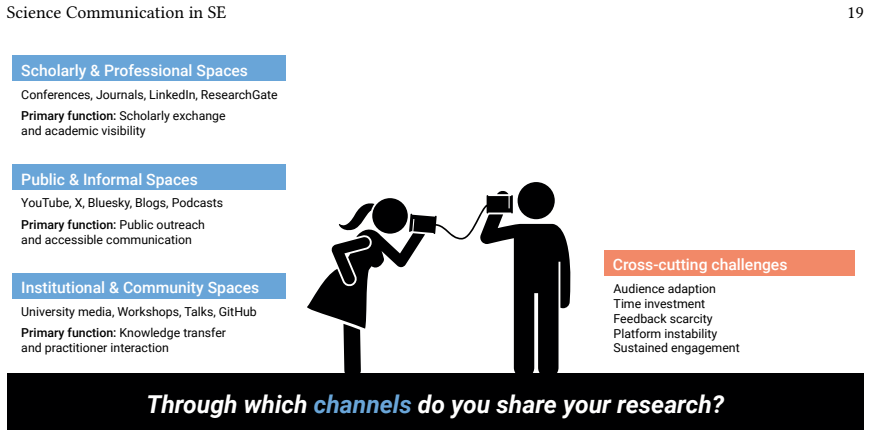
Hybrid deductive–inductive thematic analysis of 18 semi-structured interviews, organized into three interconnected thematic maps—motivations (eight themes), communication channels (scholarly/professional, public/informal, institutional/community), and barriers (nine themes)—that jointly surface the aspiration–practice tension.
Load-bearing premise
That patterns from 18 PhD students mostly recruited via major conference doctoral symposiums are a solid enough base to speak for early-career software engineering researchers and to design support across diverse settings.
What would settle it
Interview or survey a broader SE PhD sample that includes students who never appear at top doctoral symposiums and check whether the same high motivation plus the same barrier profile (audience uncertainty, mental wellbeing, weak institutional guidance) still dominates; if motivation collapses or barriers look qualitatively different, the central aspiration–practice claim does not generalize.
If this is right
- Doctoral education in software engineering should treat communication training—audience adaptation, storytelling, online engagement—as core skill development, not an optional extra.
- Supervisors and communities need structured mentorship on when, where, and how to share research so students are not left to learn by trial and error.
- Institutions and evaluation systems should recognize communication labor as real scholarly work rather than invisible add-on effort.
- Support must address psychological safety and cultural differences, not only technical writing or platform tips.
- Channel strategy should be designed around distinct spaces (scholarly, public, institutional) instead of assuming one platform fits all audiences.
Where Pith is reading between the lines
- If the visibility–vulnerability tension is structural, interventions that only teach ‘how to post’ without reducing social risk will underperform.
- SE’s industry-facing, conference-heavy culture may make practitioner feedback scarcity a sharper barrier than in fields with clearer public audiences.
- Recruiting mainly symposium-accepted students may understate barriers for less visible PhDs, so the real support gap could be larger than reported.
- Making communication count in hiring and funding decisions would test whether the aspiration–practice gap shrinks when incentives align.
Editorial analysis
A structured set of objections, weighed in public.
Referee Report
Summary. The paper reports a semi-structured interview study with 18 software engineering PhD students (16 recruited via ICSE/FSE 2024–25 Doctoral Symposium author lists, 2 pilots from personal networks), analyzed with hybrid deductive–inductive thematic analysis. It addresses three RQs — motivations, channels, barriers — and produces thematic maps: eight motivation themes (51 codes), nine barrier themes (45 codes), and a three-space channel taxonomy (scholarly/professional, public/informal, institutional/community). The central interpretive claim is an aspiration–practice tension: participants are broadly motivated (most themes supported by 16–17/18) yet constrained by audience uncertainty, channel fragmentation, mental-wellbeing and socio-cultural barriers, and limited institutional guidance. The discussion frames this as a 'visibility–vulnerability tension' and 'invisible labor,' and derives implications (mentorship, training, recognition mechanisms, psychological safety). Methodologically the study is competent for its genre: dual coding with iterative reconciliation, member checking (7/18 respondents), a Zenodo replication package, saturation discussion, and a reasonably candid threats-to-validity section.
Significance. If the findings hold, this is a useful empirical baseline: it is, as the authors argue, the first interview study of how early-career SE researchers perceive and practice science communication, and it produces actionable input for doctoral training, mentorship design, and recognition mechanisms. The visibility–vulnerability tension (§5.2) and the three-space channel taxonomy (§5.3) are plausible analytic contributions that later work can test. Strengths worth naming: a public replication package on Zenodo, member checking with participants, dual independent coding with reconciliation for the first eight interviews, explicit threats-to-validity discussion including the pilot-asymmetry issue (§3.4 Construct Validity), and appropriately hedged language about exploratory scope in §5.6. The main risk to significance is not internal inconsistency but sampling: the empirical base is 18 self-selected volunteers from an already research-visible pool, which bounds how far the community-level framing (and especially the §6 premise that 'strong motivation [is] already in place') can travel.
major comments (2)
- [§3.2, §3.4 (External Validity), §6 (Conclusion)] The concluding sentence — 'With strong motivation already in place, fostering the right conditions can help PhD students more fully realize their potential as communicators' — depends on motivation being widespread in the SE PhD population. But the evidence for that comes from 16 volunteers out of 108 contacted Doctoral Symposium authors (a ~15% response rate) for an interview explicitly about science communication, plus 2 network-recruited pilots. Volunteer self-selection on topic engagement is a well-documented mechanism in survey and interview methodology, and the ~85% who declined plausibly include the least motivated and most time-pressed students — precisely the population the barrier findings and support recommendations concern. §3.4 addresses pool-level selection (acceptance into DS tracks) but never discusses within-pool self-selection, and the response rate is not reported anyw
- [§3.1–3.2 (recruitment and pilots), §4 (pooled counts)] The mitigation offered for selection effects is that ICSE/FSE Doctoral Symposia have 'relatively high acceptance rates,' but no numbers or citations are given, and high acceptance of submissions does not speak to acceptance into the interview study. Relatedly, the two pilots were recruited from the authors' personal networks (§3.1), a different sampling frame, yet are pooled into all prevalence counts (§4) on the grounds that 'no substantial changes were made to the study design.' The manuscript itself notes (§3.4, Construct Validity) that pilots were not exposed to two questions added afterward, which asymmetrically depresses prevalence for at least the Career Advancement theme. Please either report the DS acceptance-rate evidence, present the prevalence counts with and without pilots, or present the pilots' contribution qualitatively separately. This is fixable without new data collect
minor comments (7)
- [§4.3 / Fig. 4] Figures 3 and 5 report participant support per theme, but Figure 4 (channels) gives no prevalence counts, making RQ2's evidence harder to weigh than RQ1/RQ3. Adding per-channel participant counts (or noting why they are not meaningful) would help.
- [§3.3 (coding procedure)] After interview 8, the remaining interviews were coded independently by one author each with theme reconciliation afterward (§3.3). That is defensible for reflexive thematic analysis, but the paper would be stronger if it stated this choice explicitly (e.g., citing Braun & Clarke's position on inter-rater reliability) rather than leaving readers to infer why no agreement statistic is reported.
- [§3.3.1 (member checking)] Member checking drew responses from only 7/18 participants — itself a self-selected subset (§3.3.1). The text acknowledges this; one additional sentence noting that non-responders may have felt the maps did not represent them would make the limitation concrete rather than pro forma.
- [§4.4.5, §4.4.8, §4.2.8, Fig. 2] Several typos in §4: '9 put out of our 18 participants' (§4.4.5, Language barriers), 'Skills & Compentencies' (§4.2.8), heading 'A version to social media' should read 'Aversion to social media' (§4.4.8), 'yong researcher' (§4.4.8), 'yong'/'Phd Year' in Fig. 2 axis. Please proofread §4 carefully.
- [§4.4 (intro paragraph)] The opening of §4.4 says barriers were reported 'as mentioned by most participants,' but the immediately preceding counts (10, 11, 7 of 18) mix majority and minority; tighten the wording to match the numbers.
- [§4.4.5 vs. §4.4 intro] §4.4.5 reports '10 out of 18 participants talked about various spectrum of cultural barriers' while §4.4's intro says 'Ten out of the 18 participants mentioned language, cultural differences, and social anxiety' — it is unclear whether these are the same ten or overlapping sets. Clarify the counting basis.
- [§2/§5.2] Related work would benefit from situating the findings against the broader ECR science-communication literature (e.g., Mason & Merga [23] is cited but the comparison of findings — e.g., self-efficacy sources vs. your visibility–vulnerability tension — is thin). A short comparative paragraph in §5.2 would sharpen the contribution claim.
Circularity Check
No circularity: empirical interview themes are induced from transcripts, not derived by construction from inputs or self-citation.
full rationale
This paper is a qualitative interview study (n=18 SE PhD students) using hybrid deductive–inductive thematic analysis of semi-structured transcripts to report motivations, channels, and barriers. There is no derivation chain, fitted parameter, uniqueness theorem, or first-principles prediction that could collapse into its inputs. Related-work citations include prior author papers on SE science communication (e.g., Wyrich et al. on “silent scientists,” LinkedIn dissemination, and teaching communication), but those citations frame the research gap and discussion; the load-bearing claims (theme maps, prevalence counts such as 16–17/18 for several motivation themes, and the aspiration–practice tension) are grounded in the coded interview data and member checking, not reduced by definition or equation to those prior works. Selection-bias and self-selection concerns affect external validity and prevalence interpretation, not circularity of a derivation. Honest finding: score 0; no circular steps.
Axiom & Free-Parameter Ledger
axioms (4)
- domain assumption Semi-structured interviews plus hybrid thematic analysis can validly recover shared motivations, channels, and barriers for science communication practice.
- domain assumption Science communication is a socio-technical, multi-channel practice beyond one-way deficit dissemination, and is relevant to SE impact.
- ad hoc to paper PhD students accepted to ICSE/FSE Doctoral Symposia are informative informants about early-career SE research communication, despite selection effects.
- domain assumption Participant self-report in interviews, supplemented by partial member checking, adequately represents lived barriers such as anxiety and institutional neglect.
invented entities (2)
-
Visibility–vulnerability tension (analytic framing)
no independent evidence
-
Three channel spaces (scholarly/professional, public/informal, institutional/community)
no independent evidence
read the original abstract
Science communication is increasingly becoming a part of modern research careers, involving researchers to disseminate knowledge, engage broader communities, and increase the societal impact of their work. Despite its growing importance, little is known about how early-career software engineering researchers perceive and navigate science communication in practice. In this paper, we investigate how PhD students in software engineering experience science communication. We conducted semi-structured interviews with 18 doctoral candidates from diverse international backgrounds. Using thematic analysis, we examine three interconnected dimensions: motivations, communication channels, and barriers. Our findings reveal a strong tension between aspiration and practice. Participants were highly motivated to engage in science communication due to opportunities for collaboration, professional recognition, broader impact, and advocacy for themselves and their research. However, translating these motivations into action was frequently constrained by social anxiety, uncertainty regarding appropriate audiences and communication venues, limited feedback mechanisms, insufficient institutional guidance, and challenges associated with navigating an increasingly fragmented communication landscape. Our findings highlight the need for tailored, balanced support systems that empower software engineering PhD students to engage in science communication effectively and confidently across diverse cultural and institutional environments. We outline practical implications that offer initial guidance for addressing these challenges in future work.
Figures



Reference graph
Works this paper leans on
-
[1]
Marianne Achiam, Martin Grünfeld, Sabrina Vitting-Seerup, Jacob Thorek Jensen, and Louise Whiteley. 2025. Towards a terroir approach to science communication and its evidencing.Journal of Science Communication24, 07 (2025), Y01. doi:10.22323/161120251104104659
-
[2]
Martin W. Bauer. 2009. The evolution of public understanding of science—discourse and comparative evidence.Science, Technology and Society14, 2 (2009), 221–240. doi:10.1177/097172180901400202
-
[3]
John C. Besley, Anthony D. Dudo, Shupei Yuan, and Niveen Abi Ghannam. 2016. Qualitative interviews with science communication trainers about communication objectives and goals.Science Communication38, 3 (2016), 356–381. doi:10.1177/1075547016645640
-
[4]
Besley, Kathryn O’Hara, and Anthony Dudo
John C. Besley, Kathryn O’Hara, and Anthony Dudo. 2019. Strategic science communication as planned behavior: Understanding scientists’ willingness to choose specific tactics.PLoS ONE14, 10 (2019), e0224039. doi:10.1371/journal.pone.0224039
-
[5]
danah boyd. 2010. Social network sites as networked publics: Affordances, dynamics, and implications. InA Networked Self: Identity, Community, and Culture on Social Network Sites, Zizi Papacharissi (Ed.). Routledge, New York, NY, USA, 39–58. doi:10.4324/9780203876527-8
-
[6]
Virginia Braun and Victoria Clarke. 2006. Using thematic analysis in psychology.Qualitative Research in Psychology3, 2 (2006), 77–101. doi:10.1191/ 1478088706qp063oa
2006
-
[7]
Massimiano Bucchi and Brian Trench. 2016. Science communication and science in society: A conceptual review in ten keywords.Tecnoscienza7, 2 (2016), 151–168. doi:10.6092/issn.2038-3460/17333
-
[8]
Terry W. Burns, D. John O’Connor, and Susan M. Stocklmayer. 2003. Science communication: a contemporary definition.Public Understanding of Science12, 2 (2003), 183–202. doi:10.1177/09636625030122004
-
[9]
Simona Cerrato, Valentina Daelli, Helena Pertot, and Olga Puccioni. 2018. The public-engaged scientists: Motivations, enablers and barriers.Research for All2, 2 (2018), 313–322. doi:10.18546/RFA.02.2.09
-
[10]
Motivations and Barriers to Communicating Software Engineering Research: Insights from PhD Students
Shalini Chakraborty, Marvin Wyrich, Sven Apel, and Sebastian Baltes. 2026. Replication Package for “Motivations and Barriers to Communicating Software Engineering Research: Insights from PhD Students”. doi:10.5281/zenodo.21396210
-
[11]
Sarah R. Davies and Maja Horst. 2016.Science Communication: Culture, Identity and Citizenship. Palgrave Macmillan, London, UK. doi:10.1057/978- 1-137-50366-4
-
[12]
Kitchenham, and Magne Jørgensen
Tore Dybå, Barbara A. Kitchenham, and Magne Jørgensen. 2005. Evidence-Based Software Engineering for Practitioners.IEEE Softw.22, 1 (2005), 58–65. doi:10.1109/MS.2005.6
-
[13]
Tore Dybå, Dag IK Sjøberg, and Daniela S Cruzes. 2012. What works for whom, where, when, and why? On the role of context in empirical software engineering. InProceedings of the ACM-IEEE international symposium on Empirical software engineering and measurement. ACM, 19–28
2012
-
[14]
Gunther Eysenbach. 2009. Infodemiology and infoveillance: framework for an emerging set of public health informatics methods to analyze search, communication and publication behavior on the Internet.Journal of Medical Internet Research11, 1 (2009), e11. doi:10.2196/jmir.1157
-
[15]
Luiza Carolina Miranda Garcia, Fabricio Herpich, Cleidson R. B. de Souza, and Andréa Sabedra Bordin. 2025. Science Communication of Brazilian Software Engineering Research on LinkedIn. InProceedings of the 39th Brazilian Symposium on Software Engineering (SBES). Sociedade Brasileira de Computação, Porto Alegre, Brazil, 249–259. doi:10.5753/sbes.2025.9915
arXiv 2025
-
[16]
Susan K. Gardner. 2008. Fitting the mold of graduate school: A qualitative study of socialization in doctoral education.Innovative Higher Education 33, 2 (2008), 125–138. doi:10.1007/s10755-008-9068-x
-
[17]
Vahid Garousi, Markus Borg, and Markku Oivo. 2020. Practical relevance of software engineering research: synthesizing the community’s voice. Empirical Software Engineering25, 3 (2020), 1687–1754
2020
-
[18]
2015.Factors affecting public engagement by researchers: A study on behalf of a Consortium of UK public research funders
Becky Hamlyn, Martin Shanahan, Hannah Lewis, Ellen O’Donoghue, Tim Hanson, and Kevin Burchell. 2015.Factors affecting public engagement by researchers: A study on behalf of a Consortium of UK public research funders. Technical Report. TNS-BMRB. https://wellcome.ac.uk/sites/default/ files/wtp060033_0.pdf Report wtp060033, commissioned by a consortium of UK...
2015
-
[19]
Vladimir Ivanov, Alan Rogers, Giancarlo Succi, Jooyong Yi, and Vasilii Zorin. 2017. What do software engineers care about? gaps between research and practice. InProceedings of the 2017 11th Joint Meeting on Foundations of Software Engineering (ESEC/FSE). Association for Computing Machinery, New York, NY, USA, 890–895. doi:10.1145/3106237.3117778
arXiv 2017
-
[20]
Heiko Koziolek. 2026. Dear researchers: The invisible work.Journal of Systems and Software(2026), 112922
2026
-
[21]
Ralitsa R. Madsen. 2019. Scientific impact and the quest for visibility.The FEBS Journal286, 20 (2019), 3968–3974. doi:10.1111/febs.15043
-
[22]
Sabitri Majhi, Lili Sahu, and Kabita Behera. 2023. Practices for enhancing research visibility, citations and impact: review of literature.Aslib Journal of Information Management75, 6 (11 2023), 1280–1305. arXiv:https://www.emerald.com/ajim/article-pdf/75/6/1280/362660/ajim-11-2023-532.pdf doi:10.1108/AJIM-11-2023-532
-
[23]
Shannon Mason and Margaret Merga. 2022. Communicating research in academia and beyond: sources of self-efficacy for early career researchers. Higher Education Research & Development41, 6 (2022), 2006–2019. doi:10.1080/07294360.2021.1945545
arXiv 2022
-
[24]
Tommi Mikkonen, Casper Lassenius, Tomi Männistö, Markku Oivo, and Janne Järvinen. 2018. Continuous and collaborative technology transfer: Software engineering research with real-time industry impact.Information and Software Technology95 (2018), 34–45
2018
-
[25]
2017.Communicating Science Effectively: A Research Agenda
National Academies of Sciences, Engineering, and Medicine. 2017.Communicating Science Effectively: A Research Agenda. National Academies Press, Washington, DC, USA. doi:10.17226/23674
-
[26]
David Nicholas, Hamid R. Jamali, Eti Herman, Anthony Watkinson, Abdullah Abrizah, Blanca Rodríguez-Bravo, Cherifa Boukacem-Zeghmouri, Jie Xu, Marzena Świgoń, and Tatiana Polezhaeva. 2020. A global questionnaire survey of the scholarly communication attitudes and behaviours of early Manuscript submitted to ACM 38 Chakraborty et al. career researchers.Learn...
-
[27]
Jongsoon Park and Joseph L. Gabbard. 2018. Factors that affect scientists’ knowledge sharing behavior in health and life sciences research communities.Comput. Hum. Behav.78, C (Jan. 2018), 326–335. doi:10.1016/j.chb.2017.09.017
-
[28]
Hans Peter Peters. 2013. Gap between science and media revisited: Scientists as public communicators.Proceedings of the National Academy of Sciences110, Supplement 3 (2013), 14102–14109. doi:10.1073/pnas.1212745110
-
[29]
Ellen Poliakoff and Thomas L. Webb. 2007. What factors predict scientists’ intentions to participate in public engagement of science activities? Science Communication29, 2 (2007), 242–263. doi:10.1177/1075547007308009
-
[30]
Gema Rodríguez-Pérez, Reza Nadri, and Meiyappan Nagappan. 2021. Perceived diversity in software engineering: a systematic literature review. Empirical Software Engineering26, 5 (2021), 102
2021
-
[31]
Bente Schøning, Torkjel M. Sandanger, Sarah E. Rosenbaum, and Charlotte Wien. 2025. Health researchers’ voluntary science-communication with non-academics: motivations, barriers, and practices.Frontiers in Communication10 (2025), 1564491. doi:10.3389/fcomm.2025.1564491
arXiv 2025
-
[32]
Dag I. K. Sjøberg, Tore Dybå, and Magne Jørgensen. 2007. The Future of Empirical Methods in Software Engineering Research. InWorkshop on the Future of Software Engineering (FOSE 2007), at ICSE 2007. IEEE Computer Society, Los Alamitos, CA, USA, 358–378. doi:10.1109/FOSE.2007.30
-
[33]
Social Sciences Feminist Network Research Interest Group. 2017. The burden of invisible work in academia: Social inequalities and time use in five university departments.Humboldt Journal of Social Relations39 (2017), 228–245. https://digitalcommons.humboldt.edu/hjsr/vol1/iss39/21/
2017
-
[34]
Jeffrey W. Treem and Paul M. Leonardi. 2013. Social media use in organizations: Exploring the affordances of visibility, editability, persistence, and association.Annals of the International Communication Association36, 1 (2013), 143–189. doi:10.1080/23808985.2013.11679130
arXiv 2013
-
[35]
Brian Trench. 2008. Towards an Analytical Framework of Science Communication Models. InCommunicating Science in Social Contexts: New Models, New Practices, Donghong Cheng, Michel Claessens, Toss Gascoigne, Jenni Metcalfe, Bernard Schiele, and Shunke Shi (Eds.). Springer Netherlands, Dordrecht, The Netherlands, 119–135. doi:10.1007/978-1-4020-8598-7_7
-
[36]
Greg Wilson, Jorge Aranda, Michael Hoye, and Brittany Johnson. 2024. Experience Report: It Will Never Work in Theory.IEEE Softw.41, 3 (2024), 80–82. doi:10.1109/MS.2024.3362649
arXiv 2024
-
[37]
Shomir Wilson. 2025. NLP Meets the World: Toward Improving Conversations With the Public About Natural Language Processing Research.CoRR abs/2507.10559 (2025). arXiv:2507.10559 https://arxiv.org/abs/2507.10559
Pith/arXiv arXiv 2025
-
[38]
Marvin Wyrich and Justus Bogner. 2024. Beyond Self-Promotion: How Software Engineering Research Is Discussed on LinkedIn. InProceedings of the 46th International Conference on Software Engineering: Software Engineering in Society (ICSE-SEIS). Association for Computing Machinery, New York, NY, USA, 85–95. doi:10.1145/3639475.3640113
arXiv 2024
-
[39]
Marvin Wyrich, Christof Tinnes, Sebastian Baltes, and Sven Apel. 2025. The Silent Scientist: When Software Research Fails to Reach Its Audience. Commun. ACM68, 11 (2025), 24–27. doi:10.1145/3735507
doi:10.1145/3735507 2025
-
[40]
Marvin Wyrich and Stefan Wagner. 2023. Teaching Computer Science Students to Communicate Scientific Findings More Effectively. In45th IEEE/ACM International Conference on Software Engineering: Software Engineering Education and Training (ICSE-SEET). IEEE, Los Alamitos, CA, USA, 107–114. doi:10.1109/ICSE-SEET58685.2023.00017 Manuscript submitted to ACM
arXiv 2023
discussion (0)
Sign in with ORCID, Apple, or X to comment. Anyone can read and Pith papers without signing in.