REVIEW 4 major objections 6 minor 84 references
Occluded Oculus: Operationalizing Stylistic Obscurement
T0 review · 4 major / 6 minor · reviewed 2026-08-04 · deepseek-v4-flash
Pith's one-line read Invisible Unicode alone fools an authorship attribution system
desk verdict A real but overgeneralized ablation: Injection flips stylo attribution at maximal dose, but the 'necessary and sufficient' claim needs re-scoping. read the letter →
The pith
A machine-rendered reading of the paper's core claim, the machinery that carries it, and where it could break.
The reading
What carries the argument
The load-bearing object is the Injection module, a combination of three sub-techniques: Liminal Injection (inserting zero-width Unicode characters inside words), Doppelgänger Injection (replacing letters with visually identical homoglyphs from other scripts, such as Latin 'o' to Cyrillic 'о'), and Surrealist Injection (deliberate alternate spellings such as 'emphasise' for 'emphasize'). Applied at maximal intensity so that nearly every word is affected, these characters survive into the token stream that a standard stylometry classifier reads, inflating the distance between the attacked text and the author's known samples while leaving the text visually near-unchanged to a human reader. The
What would settle it
Re-run the ablation after sanitizing the Injection variants by stripping zero-width characters and mapping homoglyphs to canonical Latin forms; if attribution returns to the true author, the observed effect depends entirely on the surface artifacts. Separately, increase the dose of each non-Injection component (longer translation chains, stronger paraphrase models, more LLM rewrites) across many documents; if any such variant flips an attribution, the claim that Injection is unique and sufficient collapses.
Extended reading notes
Core claim
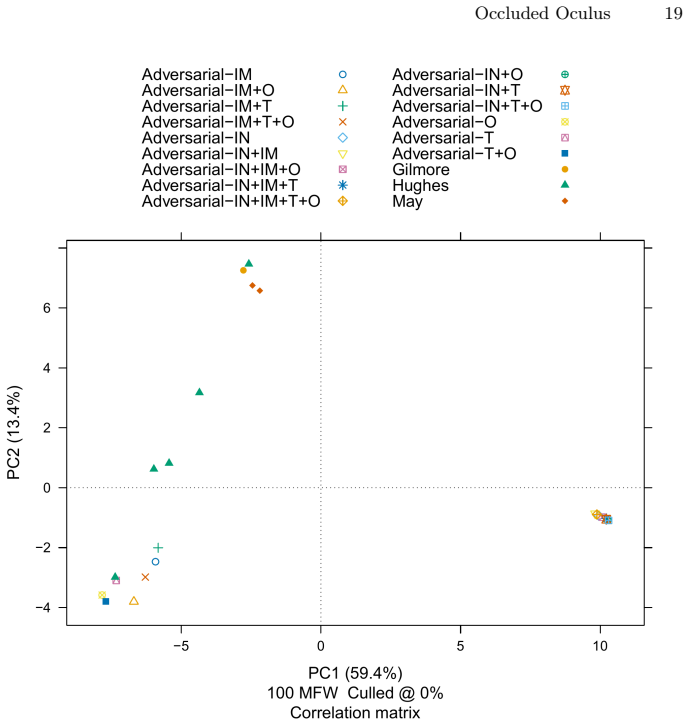
The paper's central claim, stated in the conclusion, is that the Injection module alone can reverse an authorship attribution: in the ablation, the Hughes text altered only by Injection was re-attributed to May by the classifier, whereas none of the non-Injection combinations (Translation, Imitation, Obfuscation, and their pairwise or triple combinations) produced a misattribution. The authors interpret this as demonstrating that Injection is both necessary and sufficient for a successful adversarial attack on authorship attribution in this test setting, and that the other techniques at best contribute a small additional buffer.
Load-bearing premise
The comparison treats a single fixed dose of each technique — one translation chain, one LLM rewrite, one paraphrase pass, and maximal injection — as a fair measure of each component's power, and assumes the resulting ranking carries over from one test document to other texts and settings.
Editorial extensions
If this is right
- Injection alone is sufficient: a text modified only by Injection is misattributed, so even without translation, imitation, or paraphrasing, the attack flips authorship in the study's setup.
- Removing Injection from every combination restored correct attribution, so in this setting Injection is necessary; a defensive pipeline that strips or canonicalizes the injected characters would neutralize the attack.
- Injection-modified texts cluster tightly together stylometrically, meaning the attack leaves a detectable trace; anonymity in practice would require many users adopting the same modifications so that the group resembles a crowd.
- The paper advocates defense-in-depth: even though Injection is the decisive component, layering Translation, Imitation, and Obfuscation is advisable as a robustness measure against partial countermeasures.
Reading between the lines
- Inference: the main-text ranking Injection > Imitation > Obfuscation > Translation is sensitive to the chosen doses and text lengths; the appendix's full-text runs reverse Obfuscation and Translation, so the hierarchy should not be read as a fixed law of technique strength.
- Inference: a natural extension is to sweep the 'dose' of each non-Injection component — longer translation chains, stronger paraphrase models, more LLM rewrite iterations — to find the threshold at which any of them could alone flip an attribution; the paper's own admission that such variants 'might have performed better' points in that direction.
- Inference: the practical arms race implied by the paper is between injection tooling and platform data hygiene, since Unicode-aware preprocessing, character-level feature extraction, and platform-level sanitation are listed as trivially neutralizing the attack.
- Inference: the sufficiency claim rests on a single test document and a small corpus; re-running the ablation across many authors, genres, and text lengths would reveal whether the effect is general or an artifact of this particular classifier and corpus.
Editorial analysis
A structured set of objections, weighed in public.
Referee Report
Summary. The paper presents an ablation study of a four-component adversarial stylometry attack, TraceTarnish, whose components are Translation (round-trip machine translation), Imitation (LLM rewrite), Obfuscation (PEGASUS paraphrasing), and Injection (zero-width Unicode characters, homoglyph substitution, and spelling conversion). Using stylo::classify() on a small cypherpunk corpus — training texts by Gilmore, Hughes, and May, with Hughes's A Cypherpunk's Manifesto as the test text and its 15 ablated variants as test inputs — the authors report that only variants containing Injection produce a misattribution (Hughes’s text assigned to May). They conclude that Injection is the most effective component and, in §3.4, state that the ablation confirms Injection is “both necessary and sufficient for a successful adversarial attack on authorship attribution.” The paper also includes full-text re-runs, imposters() and crossv() analyses, and distance metric formulas in appendices.
Significance. If the central claim were properly scoped, the paper would provide a useful empirical data point: a standard, off-the-shelf stylometric classifier is vulnerable to Unicode-based injection in at least one realistic near-duplicate test scenario. The strengths of the paper are that the evaluation uses an external tool (stylo::classify()) and a public cypherpunk corpus, and that the appendices report full distance tables and multiple classifier variants, which aids reproducibility. The authors also candidly acknowledge several limitations, including defenses in §1.7 and dose-related caveats in the Figure 12 caption. The main weakness is the gap between a narrow, single-text, fixed-dose experiment and the broad “necessary and sufficient” conclusion; once that gap is addressed, the finding is of moderate interest for adversarial stylometry and text-privacy research.
major comments (4)
- [Abstract and §3.4] The claim that Injection is “necessary and sufficient for a successful adversarial attack” goes beyond the evidence. The experiment uses one test document (Hughes's A Cypherpunk's Manifesto), a three-author training corpus, one classifier function, and a single realization of each component. In Table 1, the Injection-only variant (Adversarial-IN) is classified as May, but the margin is narrow: the nearest May distance is 2.6731 versus 2.7861 for the nearest Hughes text, a gap of 0.113 with no repeated trials or confidence intervals. “Necessary” is an unsupported universal negative; “sufficient” is demonstrated only for this particular text/classifier configuration.
- [§1.1 and Figure 12 caption] The ablation compares components at unequal doses. §1.1 states that Injection is applied at “maximal levels” (almost every word receives zero-width characters, all visible characters receive homoglyphs, and alternate spellings are replaced), whereas Translation is a single English→Spanish→German→English chain, Imitation is a single LLM pass with one prompt, and Obfuscation is a single PEGASUS pass. The Figure 12 caption concedes that a longer translation chain, a different paraphrasing method, or a more thorough prompt “might have performed better.” The reported hierarchy Injection > Imitation > Obfuscation > Translation is therefore a statement about the chosen fixed doses, not about the techniques in general.
- [Appendix A.4 vs §2.1/§3.4] There is an internal inconsistency in the component ranking. The main text (§2.1, §3.4) ranks Obfuscation above Translation, but the Figure 16 caption in Appendix A.4 reports that with full texts “the actual ranking of techniques is Injection>Imitation>Translation>Obfuscation,” informed by the crossv() confusion matrices and imposters() scores. This directly contradicts the unqualified main-text hierarchy and the abstract's “most effective approach” framing. The authors should either reconcile the two rankings or present the main-text result as conditional on text length and experimental setup.
- [Appendix A.3] The imposters() configuration as written appears to test the original Hughes text against the adversarially modified variants: the text says the test parameter is “Hughes_CypherpunkManifesto.txt” and the candidate.set is “the collection of adversarially modified versions.” If that is what was run, the scores do not answer whether an adversarial text is attributed to Hughes; they answer the reverse question. Since Table 4 is used in the Figure 16 caption as evidence for the component ranking, this needs clarification or correction.
minor comments (6)
- [Table 1] Table 1 does not state which distance metric (e.g., delta, wurzburg, cosine) and feature set were used for the classify() run. The formulas in Appendix C are not explicitly linked to the table, which makes the results harder to interpret and reproduce.
- [Appendix C] The mathematical formulas are rendered as inline text (e.g., “1 m Pm i=1”) and are difficult to read. They should be typeset as display equations.
- [Appendix A.3, Table 4] The first column of Table 4 is labeled “Distance Measure” but the entries are adversarial-variant names such as “Adversarial-IM delta.” The label should be something like “Adversarial variant / distance measure.”
- [Figure 12] The Figure 12 caption is a lengthy paragraph that contains substantive caveats affecting the central interpretation. These caveats belong in the main text, not buried in a figure caption.
- [§1.7] The paper states that preprocessing can “trivially render the Injection component inert,” but no sanitization or defense experiment is run. This is a missed opportunity; a simple stripping/normalization comparison would strengthen the claims about the attack's robustness.
- [References] The reference list includes “Cited on Page 44” annotations, but the manuscript pages are not numbered in the provided version. These page references should be updated or removed.
Circularity Check
No load-bearing circularity; Injection's apparent necessity is an empirical ablation result against an external classifier, though its generalizability is limited by unequal component dosing.
full rationale
The paper's derivation chain is an empirical ablation, not a derivation from fitted parameters or from the paper's own definitions. Each component is operationally defined in Section 1.1, and the dependent measure is stylo::classify() applied to an external corpus of Gilmore, Hughes, and May texts (Section 1.3, Figure 5). The central conclusion in Section 3.4 that Injection is 'both necessary and sufficient' follows from observed classification outcomes: only Injection-containing variants were re-attributed to May, and no non-Injection variant produced a misattribution. This is an externally falsifiable experimental result, not a tautology. The strongest critique—that the comparison doses are unequal (Translation is one EN→ES→DE→EN chain, Imitation is one LLM pass, Obfuscation is one PEGASUS pass, while Injection is applied at maximal levels), and that Appendix A.4's full-text crossv()/imposters() results change the non-Injection ranking—is a threat to external validity and generalizability, not circularity, because the result does not reduce to its inputs by construction. The self-citations to Dilworth [21–24] are used only to establish the attack's lineage and prior imposters()-based results; the current study's central claim is evaluated against an independent tool and corpus, so the self-citations are not load-bearing. There is no fitted parameter renamed as a prediction, no uniqueness theorem imported from the authors, and no ansatz smuggled in via citation. The honest finding is no significant circularity.
Assumptions & free parameters
free parameters (2)
- Injection intensity (maximal) =
100% homoglyph substitution; zero-width chars in almost every word
- Translation chain =
English→Spanish→German→English
assumptions (3)
- domain assumption stylo::classify() with default settings is a representative stylometric system for evaluating the attack
- domain assumption One test document (A Cypherpunk's Manifesto) and two non-target authors suffice to establish a stable technique ranking
- domain assumption Platforms will accept multilingual text and retain zero-width characters (practical feasibility)
Cite this review
Pith. "Pith review of Occluded Oculus: Operationalizing Stylistic Obscurement." pith.science (2026). https://pith.science/paper/Z6LPXBJA
@misc{pith2026260724411,
  author       = {Pith},
  title        = {Pith review of: Occluded Oculus: Operationalizing Stylistic Obscurement},
  year         = {2026},
  howpublished = {\url{https://pith.science/paper/Z6LPXBJA}},
  note         = {Machine review of arXiv:2607.24411}
}
abstract
What did it take for Hermes, the devout messenger of the Olympian gods, to slay Argus Panoptes, the multi-eyed giant of Greek myth? As the perfect guardian, Panoptes' legion of ever-watchful eyes proved difficult -- but not impossible -- to defeat. The centerpiece of Hermes' strategy was obfuscation and sabotage. Posing as a shepherd, Hermes sealed each of Panoptes' eyes -- eyes that would otherwise have alerted the fearsome giant to Hermes' plot -- and vanquished him. The moral of the story: when a challenger must surmount a formidable foe -- one far greater in stature and vastly more equipped -- crafty maneuvers are not merely advisable but indispensable for victory. In this work, the "challenger" is a collective leveraging adversarial tactics to overcome the "multi-eyed giant" of stylometric systems and surveillance apparatuses. To successfully claw back the privacy siphoned by the multi-eyed giant, the challenger must carefully evaluate their plan of attack, $\textit{TraceTarnish}$, and determine what does and does not work to anonymize the authorship of text. To that end, we conduct an ablation study of $\textit{TraceTarnish}$ to better understand which module -- Translation, Obfuscation, Imitation, or Injection -- best confounds a stylometric system. Our results indicate that the most effective approach was Injection, meaning that inserting zero-width Unicode characters, homoglyphs, and intentional misspellings neutralizes the indefatigable eyes long enough to claim the head of the all-seeing giant.
Figures


Figures from the paper (13 more)




Reference graph
Works this paper leans on
-
[1]
Protect the Children
Age Verification Won’t “Protect the Children”,https://www.eff.org/pages/ag e-verification-wont-protect-childrenCited on Page 12
-
[2]
Bootstrap Consensus Networks,https://computationalstylistics.github.io/ projects/bootstrap-networks/Cited on Page 44
-
[3]
Cosine Delta Distance (aka Wurzburg Distance),https://search.r-project.o rg/CRAN/refmans/stylo/html/dist.wurzburg.htmlCited on Page 46
-
[4]
Distance-based classifier,https://search.r-project.org/CRAN/refmans/stylo/ html/perform.delta.htmlCited on Page 44
-
[5]
Min-Max Distance (aka Ruzicka Distance),https://search.r-project.org/CRA N/refmans/stylo/html/dist.minmax.htmlCited on Page 46
-
[6]
Principal component analysis (4 2026),https://carpentries-incubator.githu b.io/high-dimensional-stats-r/04-principal-component-analysis.html Cited on Page 44
2026
-
[7]
2486039,https://dl.acm.org/doi/10.1145/2486001.2486039Cited on Page 12
Adib, F., Katabi, D.: See through walls with WiFi! ACM SIGCOMM Computer Communication Review43, 75–86 (9 2013).https://doi.org/10.1145/2534169. 2486039,https://dl.acm.org/doi/10.1145/2486001.2486039Cited on Page 12
arXiv 2013
-
[8]
In: 2014 IEEE Symposium on Security and Privacy
Afroz, S., Islam, A.C., Stolerman, A., Greenstadt, R., McCoy, D.: Doppelg¨ anger Finder: Taking Stylometry to the Underground. In: 2014 IEEE Symposium on Security and Privacy. pp. 212–226. IEEE (5 2014).https://doi.org/10.1109/SP .2014.21,https://ieeexplore.ieee.org/document/6956566Cited on Page 12
arXiv 2014
Show all 84 references
-
[9]
Entropy21, 355 (4 2019).https://doi.org/10.3390/e21040355,https://pmc.ncbi.nlm.nih.g ov/articles/PMC7514839/Cited on Pages 7 and 45
Ahvanooey, M.T., Li, Q., Hou, J., Rajput, A.R., Chen, Y.: Modern Text Hiding, Text Steganalysis, and Applications: A Comparative Analysis. Entropy21, 355 (4 2019).https://doi.org/10.3390/e21040355,https://pmc.ncbi.nlm.nih.g ov/articles/PMC7514839/Cited on Pages 7 and 45
2019 doi
-
[10]
Alajaji, R.: Lawmakers Want to Ban VPNs–And They Have No Idea What They’re Doing (11 2025),https://www.eff.org/deeplinks/2025/11/lawmakers-want-b an-vpns-and-they-have-no-idea-what-theyre-doingCited on Page 12
2025
-
[11]
Alsobeh, A.M., Alkurdi, R.M., Darwish, O.: MIA-Bench: Quantifying the Phase TransitionofUserRe-IdentificationfromSparseSocialMediaText.In:Proceedings of the 17th International Conference on Information and Communication Systems. pp. 1–10. ACM (5 2026).https://doi.org/10.1145/3...
2026
-
[12]
htmlCited on Page 44
Bhandari, G.: K-Nearest Neighbors (KNN) Using R (3 2025),https://rstudio-p ubs-static.s3.amazonaws.com/1281653_abef48360410417ab37ada1086fb22d7. htmlCited on Page 44
2025
-
[13]
ACM Transactions on Information and System Security15, 1–22 (11 2012).https://doi.org/10.114 5/2382448.2382450,https://dl.acm.org/doi/abs/10.1145/2382448.2382450 Cited on Page 45
Brennan, M., Afroz, S., Greenstadt, R.: Adversarial stylometry: Circumventing authorship recognition to preserve privacy and anonymity. ACM Transactions on Information and System Security15, 1–22 (11 2012).https://doi.org/10.114 5/2382448.2382450,https://dl.acm.org/doi/abs/10....
2012
-
[14]
93% match
Brodkin, J.: Man sues Florida cops over arrest spurred by “93% match” in facial recognition (6 2026),https://arstechnica.com/tech-policy/2026/06/man-jai led-due-to-faulty-face-recognition-says-florida-cops-ignored-other-e vidence/Cited on Page 12
2026
-
[15]
Brozovsky, E.: How Language Nerds Solve Crimes (1 2024),https://www.pbs.or g/video/how-language-nerds-solve-crimes-n34x31/Cited on Page 45
2024
-
[16]
Buckley, M.: One Step Forward, Two Steps Back: CA’s AB 1856 Exempts Open Source But Expands Age-Gating (5 2026),https://www.eff.org/deeplinks/20 26/05/one-step-forward-two-steps-back-cas-ab-1856-exempts-open-sourc e-expands-age-gatingCited on Page 12
2026
-
[17]
In: Proceedings of the 18th ACM Workshop on Artificial Intelligence and Security
Castagnaro, A., Salviati, U., Conti, M., Pajola, L., Pizzi, S.: The Hidden Threat in Plain Text: Attacking RAG Data Loaders. In: Proceedings of the 18th ACM Workshop on Artificial Intelligence and Security. pp. 170–181. ACM (10 2025). https://doi.org/10.1145/3733799.3762976,ht...
2025
-
[18]
In: Findings of the Association for Computa- tional Linguistics: EMNLP 2023
Cooper, P., Surdeanu, M., Blanco, E.: Hiding in Plain Sight: Tweets with Hate Speech Masked by Homoglyphs. In: Findings of the Association for Computa- tional Linguistics: EMNLP 2023. pp. 2922–2929. Association for Computational Linguistics (2023).https://doi.org/10.18653/v1/2...
2023 doi
-
[19]
Cox, J.: This Company Will Add Phone, AirPod, and Smartwatch Trackers to License Plate Readers (6 2026),https://www.404media.co/this-company-wil l-add-phone-airpod-and-smartwatch-trackers-to-license-plate-readers/ Cited on Page 12
2026
-
[20]
Cyphers, B.: Inside Fog Data Science, the Secretive Company Selling Mass Surveil- lance to Local Police (8 2022),https://www.eff.org/deeplinks/2022/08/insi de-fog-data-science-secretive-company-selling-mass-surveillance-loc al-policeCited on Page 12
2022
-
[21]
Dilworth, R.: Tuning for TraceTarnish: Techniques, Trends, and Testing Tangible Traits (12 2025),https://arxiv.org/abs/2512.03465Cited on Page 2
2025 arXiv
-
[22]
Dilworth, R.: Unveiling Unicode’s Unseen Underpinnings in Undermining Author- ship Attribution (10 2025),https://arxiv.org/abs/2508.15840Cited on Page 2
2025 arXiv
-
[23]
Dilworth, R.: Hijacking Text Heritage: Hiding the Human Signature through Ho- moglyphic Substitution (5 2026),https://arxiv.org/abs/2604.10271Cited on Pages 2 and 10
2026 arXiv
-
[24]
Dilworth, R.: StegoStylo: Squelching Stylometric Scrutiny through Steganographic Stitching (1 2026),https://arxiv.org/abs/2601.09056Cited on Pages 2 and 10
2026 arXiv
-
[25]
Pervert Glasses
Dupr´ e, M.H.: The Backlash Is So Strong That People With “Pervert Glasses” Are Afraid to Use Them in Public (7 2026),https://futurism.com/future-society /backlash-meta-pervert-glasses-afraidCited on Page 12
2026
-
[26]
Occluded Oculus 27
Eder, M.: Custom distance measures (8 2015),https://computationalstylistic s.github.io/blog/custom_distances/Cited on Page 46. Occluded Oculus 27
2015
-
[27]
The R Journal8, 107 (2016).https://doi.org/10.326 14/RJ-2016-007,https://journal.r-project.org/articles/RJ-2016-007/R J-2016-007.pdfCited on Pages 10 and 45
Eder, M., Rybicki, J., Kestemont, M.: Stylometry with R: A Package for Compu- tational Text Analysis. The R Journal8, 107 (2016).https://doi.org/10.326 14/RJ-2016-007,https://journal.r-project.org/articles/RJ-2016-007/R J-2016-007.pdfCited on Pages 10 and 45
2016
-
[28]
Eder, M., Rybicki, J., Kestemont, M., Pielstroem, S.: Package ‘stylo’ (5 2026), https://cran.r- project.org/web/packages/stylo/stylo.pdfCited on Page 10
2026
-
[29]
In: Calzolari, N., Kan, M.Y., Hoste, V., Lenci, A., Sakti, S., Xue, N
Emmery, C., Miotto, M., Kramp, S., Kleinberg, B.: SOBR: A Corpus for Stylom- etry, Obfuscation, and Bias on Reddit. In: Calzolari, N., Kan, M.Y., Hoste, V., Lenci, A., Sakti, S., Xue, N. (eds.) Proceedings of the 2024 Joint International Conference on Computational Linguistics...
2024
-
[30]
Evert, S., Proisl, T., Jannidis, F., Reger, I., Pielstr¨ om, S., Sch¨ och, C., Vitt, T.: Understanding and explaining Delta measures for authorship attribution. Digital Scholarship in the Humanities32, ii4–ii16 (12 2017).https://doi.org/10.1093/ llc/fqx023,https://www.research...
2017
-
[31]
Feder, J.: How Flock Cameras Wrongly Tracked Me for Days Over ‘Stolen’ Plates and Sent Police After Me (7 2026),https://www.thedrive.com/news/how-flock -cameras-wrongly-tracked-me-for-days-over-stolen-plates-and-sent-pol ice-after-meCited on Page 12
2026
-
[32]
In: Proceedings of the 2024 Conference on Empirical Methods in Natural Language Processing
Fisher, J., Hallinan, S., Lu, X., Gordon, M.L., Harchaoui, Z., Choi, Y.: StyleRemix: Interpretable Authorship Obfuscation via Distillation and Perturbation of Style Elements. In: Proceedings of the 2024 Conference on Empirical Methods in Natural Language Processing. pp. 4172–4...
2024 doi
-
[33]
In: The 23rd IEEE Conference on Decision and Control
Gilmore, J.F.: Knowledge base systems in computer aided technology. In: The 23rd IEEE Conference on Decision and Control. pp. 586–590 (1984).https://doi.or g/10.1109/CDC.1984.272069Cited on Page 11
1984
-
[34]
Goodin, D.: Beware of ads that use inaudible sound to link your phone, TV, tablet, and PC (11 2015),https://arstechnica.com/tech-policy/2015/11/beware-o f-ads-that-use-inaudible-sound-to-link-your-phone-tv-tablet-and-pc/ Cited on Page 12
2015
-
[35]
Goodin, D.: Fed up with vibe coders, dev sneaks data-nuking prompt injection into their code (5 2026),https://arstechnica.com/security/2026/05/fed-up-wit h-vibe-coders-dev-sneaks-data-nuking-prompt-injection-into-their-cod e/Cited on Page 12
2026
-
[36]
Guariglia, M.: Flock’s Gunshot Detection Microphones Will Start Listening for Human Voices (10 2025),https://www.eff.org/deeplinks/2025/10/flocks-g unshot-detection-microphones-will-start-listening-human-voicesCited on Page 12
2025
-
[37]
28 Robert Dilworth
Guariglia, M., Quintin, C., Maass, D.: Add Bluetooth to the Long List of Border Surveillance Technologies (5 2024),https://www.eff.org/deeplinks/2024/0 5/add-bluetooth-long-list-border-surveillance-technologiesCited on Page 12. 28 Robert Dilworth
2024
-
[38]
Hamid, S.: EFF’s Investigations Expose Flock Safety’s Surveillance Abuses: 2025 in Review (12 2025),https://www.eff.org/deeplinks/2025/12/effs-investi gations-expose-flock-safetys-surveillance-abuses-2025-reviewCited on Page 12
2025
-
[39]
Huang, B., Chen, C., Shu, K.: Can Large Language Models Identify Authorship? In: Findings of the Association for Computational Linguistics: EMNLP 2024. pp. 445–460. Association for Computational Linguistics (2024).https://doi.org/10 .18653/v1/2024.findings-emnlp.26,https://acl...
2024
-
[40]
Hughes, E.: A Cypherpunk’s Manifesto (3 1993),https://erichughes.org/Cited on Page 11
1993
-
[41]
NetWorker1(3), 38– 50 (Nov 1997).https://doi.org/10.1145/344509.344546,https://doi.org/10 .1145/344509.344546Cited on Page 11
Hughes, E.: A long-term perspective on electronic commerce. NetWorker1(3), 38– 50 (Nov 1997).https://doi.org/10.1145/344509.344546,https://doi.org/10 .1145/344509.344546Cited on Page 11
1997
-
[42]
In: Proceedings
Hughes, E.: Component technologies: avoiding the herd mentality. In: Proceedings. The Twenty-Second Annual International Computer Software and Applications Conference (Compsac ’98) (Cat. No.98CB 36241). pp. 598– (1998).https://doi. org/10.1109/CMPSAC.1998.716731Cited on Page 11
1998
-
[43]
In: 1999 Proceedings
Hughes, E.: Persistent enterprise components: improving the availability of legacy systems. In: 1999 Proceedings. Fourth International Workshop on Object-Oriented Real-Time Dependable Systems. pp. 95–100 (1999).https://doi.org/10.1109/ WORDS.1999.806566Cited on Page 11
1999
-
[44]
Linux J.1999(63es), 18–es (Jul 1999), https://dl.acm.org/doi/10.5555/327906.327924Cited on Page 11
Hughes, E.: The Point Really is Free Beer. Linux J.1999(63es), 18–es (Jul 1999), https://dl.acm.org/doi/10.5555/327906.327924Cited on Page 11
1999
-
[45]
Ingraham, C.: Police Have Reportedly Used License Plate Readers to Stalk Ro- mantic Interests at Least 24 Times in Recent Years (4 2026),https://ij.org/p olice-have-reportedly-used-license-plate-readers-to-stalk-romantic-i nterests-at-least-14-times-in-recent-years/Cited on Page 12
2026
-
[46]
Ireland, I.: ‘We Are Not Expendable’: Southaven Residents Fight xAI’s Plan for 41 Gas Turbines to Power Musk’s Grok (3 2026),https://www.mississippifre epress.org/xai-faces-fierce-opposition-over-southaven-mississippi-pow er-plant-permit/Cited on Page 14
2026
-
[47]
In: Proceedings of the Fifth Workshop on Privacy in Natural Language Processing
Kandula, H., Karakos, D., Qiu, H., Ulicny, B.: Improving Authorship Privacy: Adaptive Obfuscation with the Dynamic Selection of Techniques. In: Proceedings of the Fifth Workshop on Privacy in Natural Language Processing. pp. 137–142. Association for Computational Linguistics (...
2024 doi
-
[48]
Kestemont, M., Stover, J., Koppel, M., Karsdorp, F., Daelemans, W.: Authen- ticating the writings of Julius Caesar. Expert Systems with Applications63, 86–96 (11 2016).https://doi.org/10.1016/j.eswa.2016.06.029,https: //www.pure.ed.ac.uk/ws/files/38106536/Stover_et_al_2016_ESA...
2016
-
[49]
Artifi- cial Intelligence Review58, 89 (1 2025).https://doi.org/10.1007/s10462-024 -11071-z,https://link.springer.com/article/10.1007/s10462-024-11071-z Cited on Page 15
Khan, J., Ahmad, K., Jagatheesaperumal, S.K., Sohn, K.A.: Textual variations in social media text processing applications: challenges, solutions, and trends. Artifi- cial Intelligence Review58, 89 (1 2025).https://doi.org/10.1007/s10462-024 -11071-z,https://link.springer.com/a...
2025 doi
-
[50]
and Abroad: 2025 in Review (12 2025),https://www.eff.org/deeplinks/2025/12/defending-encryption-us-a nd-abroad-2025-reviewCited on Page 12
Klosowski, T.: Defending Encryption in the U.S. and Abroad: 2025 in Review (12 2025),https://www.eff.org/deeplinks/2025/12/defending-encryption-us-a nd-abroad-2025-reviewCited on Page 12. Occluded Oculus 29
2025
-
[51]
Kocher, M., Savoy, J.: Distance measures in author profiling. Information Process- ing & Management53, 1103–1119 (9 2017).https://doi.org/10.1016/j.ipm.20 17.04.004,https://www.sciencedirect.com/science/article/abs/pii/S030 6457316306495Cited on Page 46
2017 doi
-
[52]
Koebler, J.: City Learns Flock Accessed Cameras in Children’s Gymnastics Room as a Sales Pitch Demo, Renews Contract Anyway (4 2026),https://www.404med ia.co/city-learns-flock-accessed-cameras-in-childrens-gymnastics-roo m-as-a-sales-pitch-demo-renews-contract-anyway/Cited on Page 12
2026
-
[53]
Koebler, J.: With Ring, American Consumers Built a Surveillance Dragnet (2 2026),https://www.404media.co/with-ring-american-consumers-built-a -surveillance-dragnet/Cited on Page 12
2026
-
[54]
In: CHI Conference on Human Factors in Computing Systems
Lee, H.N., Ashok, V.: Impact of Out-of-Vocabulary Words on the Twitter Ex- perience of Blind Users. In: CHI Conference on Human Factors in Computing Systems. pp. 1–20. ACM (4 2022).https://doi.org/10.1145/3491102.3501958, https://dl.acm.org/doi/10.1145/3491102.3501958Cited on Page 14
2022
-
[55]
Liu, C.J., Quintin, C.: The FCC’s Spam Call Proposal Is Just a Data Collection Scheme (6 2026),https://www.eff.org/deeplinks/2026/06/fccs-spam-call-p roposal-just-data-collection-schemeCited on Page 12
2026
-
[56]
In: 2024 IEEE/CVF Winter Conference on Applications of Computer Vision (WACV)
Liu, F., Ashbaugh, R., Chimitt, N., Hassan, N., Hassani, A., Jaiswal, A., Kim, M., Mao, Z., Perry, C., Ren, Z., Su, Y., Varghaei, P., Wang, K., Chan, S., Ross, A., Shi, H., Wang, Z., Jain, A., Liu, X.: FarSight: A Physics-Driven Whole-Body Biometric System at Large Distance an...
2024
-
[57]
eff.org/deeplinks/2026/05/more-license-plate-reader-mission-creep-sch ool-residency-verification-background?language=esCited on Page 12
Maass, D., Alajaji, R.: More License Plate Reader Mission Creep: School Residency Verification, Background Checks, and Noise Complaints (5 2026),https://www. eff.org/deeplinks/2026/05/more-license-plate-reader-mission-creep-sch ool-residency-verification-background?language=es...
2026
-
[58]
Majka, M.: Introduction to naivebayes package (3 2024),https://cran.r-proje ct.org/web//packages/naivebayes/vignettes/intro_naivebayes.pdfCited on Page 44
2024
-
[59]
IEEE Transactions on Electron Devices26(1), 2–9 (1979).https://doi.org/10 .1109/T-ED.1979.19370Cited on Page 11
May, T.C., Woods, M.: Alpha-particle-induced soft errors in dynamic memories. IEEE Transactions on Electron Devices26(1), 2–9 (1979).https://doi.org/10 .1109/T-ED.1979.19370Cited on Page 11
1979
-
[60]
In: 16th International Reliability Physics Symposium
May, T.C., Woods, M.H.: A New Physical Mechanism for Soft Errors in Dynamic Memories. In: 16th International Reliability Physics Symposium. pp. 33–40 (1978). https://doi.org/10.1109/IRPS.1978.362815Cited on Page 11
1978
-
[61]
(4 2026),https://www.washin gtonpost.com/opinions/interactive/2026/04/26/artificial-intelligenc e-could-kill-anonymity-online/Cited on Page 12
McArdle, M.: Will AI end anonymity? I tested it. (4 2026),https://www.washin gtonpost.com/opinions/interactive/2026/04/26/artificial-intelligenc e-could-kill-anonymity-online/Cited on Page 12
2026
-
[62]
McGruder, C.H., VanDerMeer, B.W.: The 1916 PhD Thesis of Johannes Droste and the Discovery of Gravitational Repulsion (1 2018),https://arxiv.org/abs/ 1801.07592Cited on Page 15
1916 arXiv
-
[63]
Textbooks5, 136–137 (2017),https://digitalcommons.usu.e du/oer_textbooks/5/Cited on Page 1
Mellenthin, J., Shapiro, S.O.: Mythology Unbound: An Online Textbook for Clas- sical Mythology. Textbooks5, 136–137 (2017),https://digitalcommons.usu.e du/oer_textbooks/5/Cited on Page 1
2017
-
[64]
30 Robert Dilworth
Meyer, D.: Support Vector Machines (12 2025),https://cran.r-project.org/w eb/packages/e1071/vignettes/svmdoc.pdfCited on Page 44. 30 Robert Dilworth
2025
-
[65]
Mouselimis, L.: Functionality of the ClusterR package (12 2025),https://cran.r -project.org/web/packages/ClusterR/vignettes/the_clusterR_package.ht mlCited on Page 44
2025
-
[66]
Mullin, J.: The KIDS Act Would Require Age Checks To Get Online (6 2026), https://www.eff.org/deeplinks/2026/06/kids-act-would-require-age-che cks-get-onlineCited on Page 12
2026
-
[68]
Page, A.: Unstyle: A Tool for Circumventing Modern Techniques of Authorship Attribution (2015),https://github.com/pagea/unstyle/blob/master/doc/the sis.pdfCited on Page 16
2015
-
[69]
Pilkington, E.: Rise of ‘voiceprint’ ID technology has privacy campaigners con- cerned (10 2014),https://www.theguardian.com/technology/2014/oct/13/r ise-voiceprint-id-technology-privacy-campaigners-concernedCited on Page 12
2014
-
[70]
Prahlow, S.P., Cohle, S., Shattuck, B., Prahlow, J.A.: Homicides Disguised as Staged Suicides. Academic Forensic Pathology10, 104–112 (6 2020).https: //doi.org/10.1177/1925362120956855,https://pmc.ncbi.nlm.nih.gov/a rticles/PMC7691936/,Content Warning:This article contains gra...
2020 doi
-
[71]
Quintin, C., Greenberg, W.: Meet Rayhunter: A New Open Source Tool from EFF to Detect Cellular Spying (3 2025),https://www.eff.org/deeplinks/2025/03/ meet-rayhunter-new-open-source-tool-eff-detect-cellular-spyingCited on Page 12
2025
-
[72]
In: Proceedings of the 20th Interna- tional Database Engineering & Applications Symposium on - IDEAS ’16
Rizzo, S.G., Bertini, F., Montesi, D.: Content-preserving Text Watermarking through Unicode Homoglyph Substitution. In: Proceedings of the 20th Interna- tional Database Engineering & Applications Symposium on - IDEAS ’16. pp. 97–104. ACM Press (2016).https://doi.org/10.1145/29...
2016
-
[73]
Rumi: New ChatGPT Models Seem to Leave Watermarks on Text (4 2025),https: //www.rumidocs.com/newsroom/new-chatgpt-models-seem-to-leave-waterma rks-on-textCited on Page 45
2025
-
[74]
Sarrat, T., Finn, T.: Surveillance Psychology: Ethical Risks of Continuous Be- havioral Monitoring with AI in Schools and Workplaces. ResearchGate (1 2025), https://www.researchgate.net/profile/Tom-Sarrat/publication/39163551 8_SURVEILLANCE_PSYCHOLOGY_ETHICAL_RISKS_OF_CONTINUO...
2025
-
[75]
Springer Cham (9 2020).https://doi.org/10.1007/978-3-0 30-53360-1Cited on Pages 2 and 32
Savoy, J.: Machine Learning Methods for Stylometry: Authorship Attribution and Author Profiling. Springer Cham (9 2020).https://doi.org/10.1007/978-3-0 30-53360-1Cited on Pages 2 and 32
2020 doi
-
[76]
Occluded Oculus 31
Shane, T.S., Mylius, S., Hobbs, H.: Scheming in the wild: detecting real-world AI scheming incidents with open-source intelligence (4 2026),https://arxiv.org/ab s/2604.09104Cited on Page 23. Occluded Oculus 31
2026 arXiv
-
[77]
Journal of Quantitative Linguistics18, 63–88 (2 2011)
Smith, P.W.H., Aldridge, W.: Improving Authorship Attribution: Optimizing Bur- rows’ Delta Method*. Journal of Quantitative Linguistics18, 63–88 (2 2011). https://doi.org/10.1080/09296174.2011.533591,https://www.tandfonl ine.com/doi/abs/10.1080/09296174.2011.533591Cited on Page 46
2011
-
[78]
In: 2025 Second International Conference on Pioneering Developments in Computer Science & Digital Technolo- gies (IC2SDT)
Srivastava, A.K., Bhatia, L., Pandey, V., Sharma, A.K.: AI-Driven Cross-Genre Authorship Impersonation: A Forensic Challenge. In: 2025 Second International Conference on Pioneering Developments in Computer Science & Digital Technolo- gies (IC2SDT). pp. 350–355 (2025).https://d...
2025
-
[79]
Stanik¯ unas, D., Mandravickait˙ e, J., Krilaviˇ cius, T.: Comparison of distance and similarity measures for stylometric analysis of Lithuanian texts. Proceedings of the International Conference for Young Researchers in Informatics, Mathematics and Engineering1852, 1–7 (4 201...
2017
-
[80]
Thereallo: Claude Code Is Steganographically Marking Requests (6 2026),https: //thereallo.dev/blog/claude-code-prompt-steganographyCited on Page 45
2026
-
[81]
(7 2026),https: //agentic.tracebit.com/context-bombs/Cited on Page 24
Tracebit: Context Bombs: stopping AI attackers in their tracks. (7 2026),https: //agentic.tracebit.com/context-bombs/Cited on Page 24
2026
-
[82]
Tripathy, M.: The Cognitive Fingerprint: LLM-Resistant Cross-Domain Threat Actor Attribution via Temporal-Syntactic Fusion (3 2026).https://doi.org/10 .36227/techrxiv.177272729.99887126/v1,https://www.techrxiv.org/doi/f ull/10.36227/techrxiv.177272729.99887126/v1Cited on Page 13
2026
-
[83]
vmfunc, MDL, Dziurwa: the watchers: how openai, the US government, and per- sona built an identity surveillance machine that files reports on you to the feds (2 2026),https://vmfunc.re/blog/personaCited on Page 25
2026
-
[84]
Wilkins, J.: Man Trapped in Dystopian Nightmare Thanks to AI Surveillance Cameras Flagging His Every Move (4 2026),https://futurism.com/future-soc iety/flock-ai-surveillance-coloradoCited on Page 12
2026
-
[85]
wherever humans produce structured text—be it prose, code, or even spreadsheet formulas—individual habits leak through
Woodbridge, J., Anderson, H.S., Ahuja, A., Grant, D.: Detecting Homoglyph At- tacks with a Siamese Neural Network (5 2018),https://arxiv.org/abs/1805.0 9738Cited on Page 7. Appendix A Full-Text Classification andstylo Visualization Results [They] tried to conjure up a face...b...
2018
Reviewed August 4, 2026 · model on record in the stance chip above.
Discussion (0). Continue with ORCID to comment.