REVIEW 18 references
Communication Security via Temporal Dependency
T0 review · reviewed 2026-07-31 · grok-4.5
Pith's one-line read Wireless security can come from chaining transmissions so one eavesdropper miss locks future packets, without shared keys or a better channel.
desk verdict Clever temporal-dependency framing and solid rank analysis, but the linear state-embedding map quietly kills the combinatorial resync claim that carries half the abstract. read the letter →
The pith
A machine-rendered reading of the paper's core claim, the machinery that carries it, and where it could break.
The reading
What carries the argument
State-chained RLNC: the binary dummy-location state of block b+1 is secret-shared into D statistically indistinguishable dummy packets of block b; correct recovery of that state is required to interpret block b+1, so rank deficiency relative to the state vector turns one miss into persistent asynchronization.
What would settle it
Show that an eavesdropper with full protocol knowledge can, after decoding a full-rank block, identify the dummy-packet subset (or recover the next state) without exhaustive C(N,D) search—e.g., by a statistical, semantic, or learned separator that works on the paper’s dummy construction—or measure τ_asy well above one second under the stated worst-case intentional-interference setup.
Extended reading notes
Core claim
Temporal dependency can serve as a security resource: by embedding each block’s interpretation state in the dummy packets of the previous block via state-chained RLNC, a single eavesdropper synchronization failure propagates indefinitely, so future blocks remain uninterpretable even when fully decoded, without shared keys or channel advantage. With transmit-power and intentional-interference optimization, the expected time to first asynchronization is sub-second even when the eavesdropper’s channel is arbitrarily strong, and resynchronization requires exhaustive search over combinations of dummy packets.
Load-bearing premise
Dummy packets must be fully indistinguishable from real data packets, so the eavesdropper cannot spot them by statistics, protocol checks, or learning and is forced into brute-force search over all dummy subsets.
Editorial extensions
If this is right
- Infrastructure-less, emergency, and highly dynamic networks can obtain ongoing secrecy without key management or guaranteed channel advantage.
- Security shifts from hiding bits to protecting interpretation: successful decoding no longer implies usable content once asynchronization has occurred.
- Intentional interference can bound eavesdropper packet success even when her channel gain tends to infinity, yielding a designable upper bound on time to first asynchronization.
- Raising block size N or dummy count D multiplies the eavesdropper’s resynchronization cost combinatorially while trading off throughput.
- After the first miss, confidentiality becomes self-sustaining through the communication process itself, without later key refresh.
Reading between the lines
- The same temporal-dependency principle could be realized with non-RLNC carriers (e.g., other rateless or stateful codes) wherever a recoverable state can be hidden in prior transmissions.
- Long ACK delays remain a practical pressure point; interleaving or shorter feedback loops look like natural next engineering levers the numerics already hint at.
- If application-layer formats ever leak dummy structure, the framework’s security collapses to ordinary coding secrecy—so deployment would need traffic morphing or encryption that truly equalizes dummy and data distributions.
- A hybrid with lightweight cryptography could use temporal dependency as a fallback when keys are compromised or unavailable, rather than as a full replacement.
Editorial analysis
A structured set of objections, weighed in public.
Circularity Check
No significant circularity: asynchronization probability, timing, and complexity are derived from rank/reception combinatorics and then optimized as objectives, not fitted or defined as the claimed outputs.
full rationale
The load-bearing chain is constructive and self-contained. Theorem 1 gives Bob’s full-rank time PDF from random-matrix rank counts over GF(2) and Bernoulli receptions; Theorem 2 averages the event s ∉ row(E_T′) over Bob’s decoding time, ACK delay, and Eve’s shared/private packets using the helper functions Φ, Θ, Ψ. Corollary 1 then sets τ_asy = τ_q/P_asy × (N + 1.6/P_B + E[T_ack]) by a geometric first-success argument; Corollary 2 multiplies the same incidence rate by the binomial search cost C(N,D). Problems P1/P2 minimize that derived τ_asy subject to throughput, latency, and τ_cmp constraints; the reported sub-second figures are numerical optima under stated (N,D,α,P,Ω) parameters, not identities forced by a fit. Dummy-packet indistinguishability (III-B) is an explicit modeling assumption, not a quantity defined from the security metric it is meant to support. There is no self-citation uniqueness theorem, no parameter fitted to data and re-labeled a prediction, and no renaming of a known empirical law. (A separate correctness concern—that a linear L in (11) might admit a linear-algebra shortcut to the dummy set—does not make the derivation circular; it would falsify an assumption, not collapse Eq. X to Eq. Y by construction.)
Assumptions & free parameters
free parameters (6)
- N, D (block size and dummy count) =
e.g. D=N/4 in P2 plots
- α (intentional interference power fraction) =
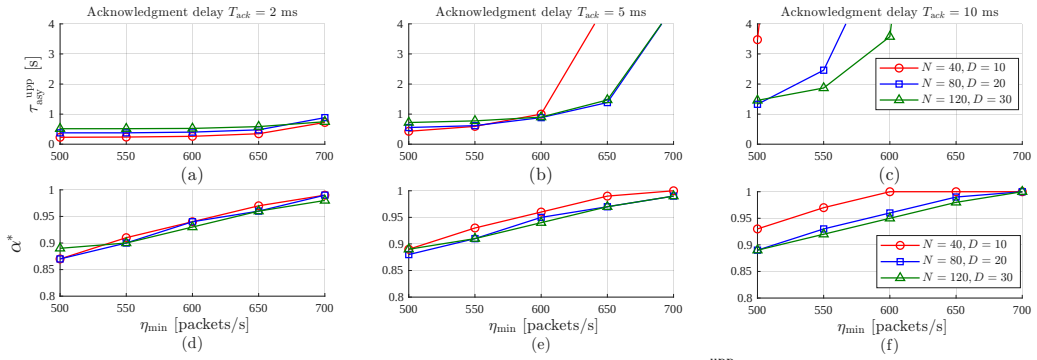
α* ≈ 0.8–1.0 depending on η_min
- P / P_max transmit power =
P_max=1 W; P* often ~0.01–0.2 W in Fig. 6
- T_ack / f_ACK (acknowledgment delay model) =
2, 5, 10 ms in simulations
- C_E (Eve combinations per second) =
10^12 / s
- R_t, τ_q, n, σ^2, Ω_B =
as in §VI
assumptions (6)
- ad hoc to paper Dummy packets are statistically and semantically indistinguishable from original packets; no protocol, statistical, or ML test identifies incomplete dummy subsets.
- domain assumption Eve is passive, knows full protocol/coding/ACKs/keys/CSI_AB, and may have arbitrarily better channel; Alice has no CSI.
- domain assumption Packet success probabilities equal Rayleigh SINR outage under capacity-achieving coding; intentional interference acts as noise; co-located AN implies Ω_AN≈Ω.
- standard math Binary RLNC over GF(2) with i.i.d. Bern(0.5) coding coefficients; rank evolution as in random matrix counting.
- domain assumption First-block state s^(1) is public; security begins only after a later asynchronization incidence.
- standard math Blocks are i.i.d. so time to first asynchronization is geometric with success probability P_asy.
invented entities (2)
-
Temporal dependency as a security resource
-
State-chained RLNC synchronization state s^(b)
Cite this review
Pith. "Pith review of Communication Security via Temporal Dependency." pith.science (2026). https://pith.science/paper/67UDWFEF
@misc{pith2026260724578,
  author       = {Pith},
  title        = {Pith review of: Communication Security via Temporal Dependency},
  year         = {2026},
  howpublished = {\url{https://pith.science/paper/67UDWFEF}},
  note         = {Machine review of arXiv:2607.24578}
}
read the original abstract
Communication security has traditionally been built upon one of two external resources: shared secret keys or a communication advantage over the eavesdropper. However, many practical wireless scenarios, including infrastructure-less, emergency, and highly dynamic networks, cannot guarantee either resource, motivating the need for a new communication security principle. This paper introduces a new communication security paradigm that exploits temporal dependency as a security resource. Unlike conventional secrecy techniques that prevent an eavesdropper from recovering transmitted bits, the proposed paradigm allows packet decoding but prevents correct interpretation by making original and dummy packets computationally indistinguishable. Rather than protecting individual transmissions, successive transmissions are intentionally coupled so that future communication depends on correctly interpreting previous ones. As one realization, we develop a state-chained random linear network coding (RLNC) framework in which the synchronization state required to interpret each transmission block is embedded in the previous block. Therefore, synchronization failures propagate across future transmissions, resulting in persistent eavesdropper asynchronization. We analytically characterize the probability and persistence of eavesdropper asynchronization, together with the computational complexity of resynchronization, and develop transmission strategies based on transmit power and intentional-interference optimization. Numerical results demonstrate sub-second eavesdropper asynchronization under a worst- case adversarial model with no channel advantage, no secret assumptions, complete protocol knowledge, and an arbitrarily stronger eavesdropper.
Figures


Figures from the paper (4 more)


Reference graph
Works this paper leans on
-
[1]
A method for obtaining digital signatures and public-key cryptosystems,
R. L. Rivest, A. Shamir, and L. Adleman, “A method for obtaining digital signatures and public-key cryptosystems,”Commun. ACM, vol. 21, no. 2, pp. 120–126, Feb. 1978
1978
-
[2]
The wire-tap channel,
A. D. Wyner, “The wire-tap channel,”Bell Syst. Tech. J., vol. 54, no. 8, pp. 1355–1387, Oct. 1975
1975
-
[3]
The secrecy capacity of the Gaussian wiretap channel with rate-limited help at the decoder,
S. Loyka and N. Merhav, “The secrecy capacity of the Gaussian wiretap channel with rate-limited help at the decoder,” inProc. IEEE Int. Symp. Inf. Theory (ISIT), Espoo, Finland, Jun. 2022, pp. 1040–1045
2022
-
[4]
A survey on artificial noise for physical layer security: Opportunities, technologies, guidelines, advances, and trends,
H. Niu, Y . Xiao, X. Lei, J. Chen, Z. Xiao, M. Li, and C. Yuen, “A survey on artificial noise for physical layer security: Opportunities, technologies, guidelines, advances, and trends,”IEEE Commun. Surveys Tuts., vol. 28, p. 341–381, Sep. 2025
2025
-
[5]
Secure transmit beamforming for radar-communication system without eavesdropper CSI,
D. Luo, Z. Ye, B. Si, and J. Zhu, “Secure transmit beamforming for radar-communication system without eavesdropper CSI,”IEEE Trans. V eh. Technol., vol. 71, no. 9, pp. 9794–9804, Sep. 2022
2022
-
[6]
Encryption-aware PHY security: Optimal cooperative jamming and achievable rates,
M. H. Zadeh, T. Sadig, M. Maleki, N. H. Tran, and H. R. Bahrami, “Encryption-aware PHY security: Optimal cooperative jamming and achievable rates,”IEEE Commun. Lett., vol. 30, no. 2, pp. 407–411, Feb. 2026
2026
-
[7]
Non-adaptive coding for two-way wiretap channel with or without cost constraints,
M. Hayashi and Y . Chen, “Non-adaptive coding for two-way wiretap channel with or without cost constraints,”IEEE Trans. Inf. Theory, vol. 70, no. 7, pp. 4611–4633, Jul. 2024
2024
-
[8]
Secure communication over fading channels,
Y . Liang, H. V . Poor, and S. Shamai, “Secure communication over fading channels,”IEEE Trans. Inf. Theory, vol. 54, no. 6, pp. 2470–2492, Jun. 2008
2008
Show all 18 references
-
[9]
On intercept probability mini- mization under sparse random linear network coding,
A. Tassi, R. J. Piechocki, and A. Nix, “On intercept probability mini- mization under sparse random linear network coding,”IEEE Trans. V eh. Technol., vol. 68, no. 6, pp. 6137–6141, 2019
2019
-
[10]
The impact of partial packet recovery on the inherent secrecy of random linear coding,
I. Chatzigeorgiou, “The impact of partial packet recovery on the inherent secrecy of random linear coding,” inProc. IEEE 95th V eh. Technol. Conf. (VTC2022-Spring), Helsinki, Finland, Jun. 2022, pp. 1–6
2022
-
[11]
A Multi- Scenario Authenticated Key Exchange Scheme With Forward Secrecy for Fog-Enabled V ANETs,
G. Yu, Q. Li, H. Mao, A. A. Abd El-Latif, and J. J. Rodrigues, “A Multi- Scenario Authenticated Key Exchange Scheme With Forward Secrecy for Fog-Enabled V ANETs,”IEEE Trans. V eh. Technol., vol. 74, no. 1, pp. 831–846, Jan 2025
2025
-
[12]
A conditional privacy-preserving mutual authentication protocol with fine-grained for- ward and backward security in IoV,
H. Xiong, T. Yao, Y . Zhao, L. Gong, and K.-H. Yeh, “A conditional privacy-preserving mutual authentication protocol with fine-grained for- ward and backward security in IoV,”IEEE Trans. Intell. Transp. Syst., vol. 25, no. 11, pp. 15 493–15 511, Nov. 2024
2024
-
[13]
New directions in cryptography,
W. Diffie and M. E. Hellman, “New directions in cryptography,” Nov. 1976, vol. 22, no. 6, pp. 644–654
1976
-
[14]
SoK: SSL and HTTPS: Revisiting past challenges and evaluating certificate trust model enhancements,
J. Clark and P. C. Van Oorschot, “SoK: SSL and HTTPS: Revisiting past challenges and evaluating certificate trust model enhancements,” in Proc. IEEE Symp. Security Privacy (SP), San Francisco, CA, USA, May 2013, pp. 511–525
2013
-
[15]
A survey on X. 509 public-key infrastructure, certificate revocation, and their modern implementation on blockchain and ledger technologies,
S. Khan, F. Luo, Z. Zhang, F. Ullah, andet al., “A survey on X. 509 public-key infrastructure, certificate revocation, and their modern implementation on blockchain and ledger technologies,”IEEE Commun. Surveys Tuts., vol. 25, no. 4, pp. 2529–2568, Fourthquarter 2023
2023
-
[16]
Algorithms for quantum computation: Discrete Logarithms and Factoring,
P. W. Shor, “Algorithms for quantum computation: Discrete Logarithms and Factoring,” inProc. 35th Annu. Symp. F ound. Comput. Sci. (FOCS), Santa Fe, NM, USA, Nov. 1994, pp. 124–134
1994
-
[17]
Traffic morphing: An efficient defense against statistical traffic analysis
C. V . Wright, S. E. Coull, and F. Monrose, “Traffic morphing: An efficient defense against statistical traffic analysis.” inNDSS, vol. 9, 2009
2009
-
[18]
A discussion and review of network steganography,
J. O. Seo, S. Manoharan, and A. Mahanti, “A discussion and review of network steganography,” inProc. IEEE 14th Int. Conf. Dependable, Auton. Secure Comput. (DASC), 14th Int. Conf. Pervasive Intell. Comput. (PiCom), 2nd Int. Conf. Big Data Intell. Comput. (DataCom), Cyber Sci. ...
2016
Reviewed July 31, 2026 · model on record in the stance chip above.
Discussion (0). Continue with ORCID to comment.