REVIEW 3 major objections 4 minor 64 references
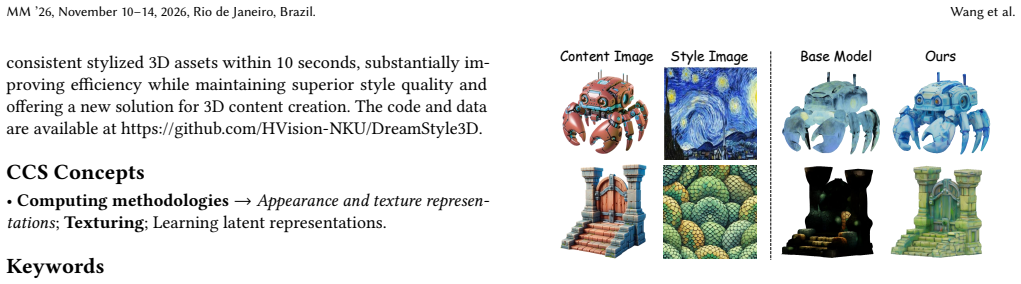
A dual-attention design generates stylized 3D assets in 10 seconds by keeping geometry and style separate.
Reviewed by Pith at T0; open to challenge. T0 means a machine referee read the full paper against a public rubric. the ladder, T0–T4 →
A new model generates stylized 3D objects in about 10 seconds by separating style from geometry inside a native 3D diffusion model.
T0 review reviewed 2026-08-04 challenge →
load-bearing objection A fast native-3D stylization method that's likely a real engineering advance, but its quality claim is weakened by a benchmark built from the same two-stage pipeline it claims to beat. the 3 major comments →
DreamStyle3D: Efficient 3D Stylized Asset Generation via Dual-Attention Disentanglement
The pith
A machine-rendered reading of the paper's core claim, the machinery that carries it, and where it could break.
The reading
Core claim
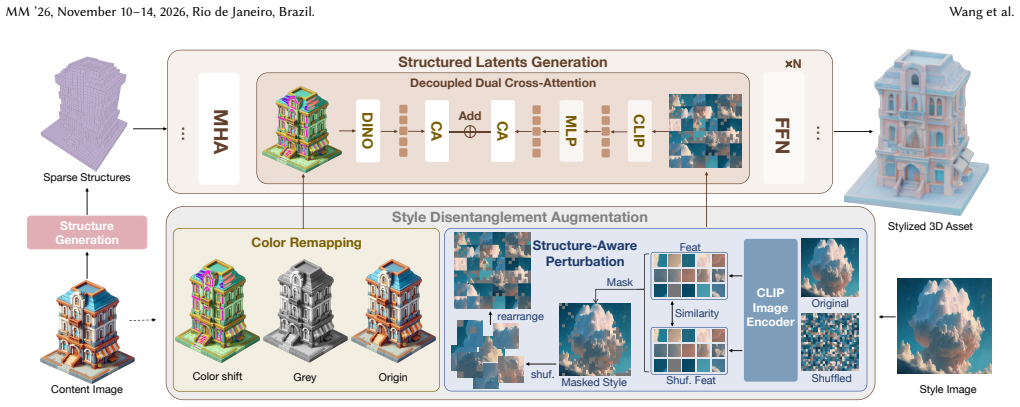
The central claim is that style and geometry are distinct modalities that should be processed by separate attention branches: one branch conditions on structural features extracted from the content image, and the other on high-level style features extracted from the style image, with their outputs summed. This decoupling, together with data augmentations that strip structural cues from style images and color cues from content images, allows a native 3D diffusion model to learn style transfer directly in structured latent space. The authors show that this approach outperforms existing 3D stylization methods on content-preservation and style-consistency metrics while being roughly two orders o
What carries the argument
The Decoupled Dual Cross-Attention module: latent tokens are transformed into queries, and two parallel attention computations run with geometry features and style features as separate key-value sets, with outputs added element-wise. A trainable projection aligns style features to the geometry feature space, and only the style branch and projection are fine-tuned. The companion Style Disentanglement Augmentation perturbs the style image by masking and shuffling structure-sensitive patches, and remaps the content image's foreground colors, to keep the two branches from learning spurious correlations.
Load-bearing premise
The training and evaluation rely on a dataset whose 'ground-truth' stylized 3D assets are generated by an automated two-stage pipeline and filtered with automated scores; if those model-generated references contain systematic stylization or geometry errors, the claimed superiority over two-stage pipelines is partly built into the benchmark.
What would settle it
Take a small set of stylized 3D assets that have been verified by human artists (or produced by a high-quality independent method) and compare DreamStyle3D against the two-stage baselines using those references; if the method no longer leads on reference-based metrics such as PSNR, SSIM, and LPIPS, the advantage is an artifact of the model-generated ground truth.
If this is right
- If the approach is correct, stylized 3D assets for games, animation, and AR/VR can be produced in seconds rather than minutes, making interactive design loops feasible.
- Direct native-3D stylization avoids error accumulation from separate 2D stylization and 3D reconstruction stages, so style and geometry stay aligned across all viewpoints.
- The released 15K triplet dataset provides a standardized training and evaluation resource for future 3D stylization research.
- Because only the style branch is trained, the method can be adapted to new style references without modifying the backbone generation model.
Where Pith is reading between the lines
- The disentanglement principle is likely transferable to other latent-based 3D generators, since it only adds parallel cross-attention branches.
- The quantitative advantage over two-stage pipelines may partly reflect the fact that the evaluation ground truth was itself produced by a two-stage pipeline; an evaluation against human-verified stylized assets would be a stronger test.
- The reported 10-second generation time is for a specific GPU and 50 sampling steps; wall-clock speed on consumer hardware or with more steps could differ substantially.
Editorial analysis
A structured set of objections, weighed in public.
Referee Report
Summary. The paper presents DreamStyle3D, a native 3D stylization framework built on the TRELLIS SLAT-based generative model. It introduces a Decoupled Dual Cross-Attention (DDCA) module that separates DINO-based geometric conditioning from CLIP-based style conditioning, together with a Style Disentanglement Augmentation strategy (structure-aware perturbation of style images and color remapping of content images) to improve disentanglement. To address the lack of 3D stylization data, the authors construct an automated dataset of about 15K (content, style, stylized-3D-asset) triplets by applying OmniStyle 2D stylization and Hunyuan3D-2.1 lifting, followed by filtering. Experiments compare DreamStyle3D with StyleTex, 3D-style-LRM, MV-Adapter, Hunyuan3D-2.1, and TRELLIS variants, reporting source-image metrics, reference-based metrics, VLM scores, a user study, and inference time. The main claims are that DreamStyle3D achieves superior style fidelity and geometric consistency, is about 96x faster than StyleTex and 3x faster than MV-Adapter/3D-style-LRM, and can generate a stylized 3D asset in about 10 seconds.
Significance. If the claims hold, the paper makes a useful contribution: it demonstrates that stylization can be performed directly in native 3D latent space with a lightweight fine-tuning of the attention branches, avoiding multi-view inconsistency and slow test-time optimization. The proposed dataset, code release, and speed advantage are valuable assets for the community. The qualitative results, especially in Figs. 5 and 6, are visually consistent with the claim of better style-geometry balance. However, the quantitative superiority claim is not fully established because the training supervision and a substantial part of the evaluation reference data are generated by the same two-stage pipeline that the paper argues against. The contribution is therefore significant conditional on the validity of the dataset and the independence of the evaluation.
major comments (3)
- [Sec. 4, Appendix B, Table 2] The training triplets and the reference-based ground truths in Table 2 are both produced by the same OmniStyle→Hunyuan3D-2.1 two-stage pipeline that the paper claims to outperform. Filtering via Eq. (13) selects outputs of that pipeline; it does not provide an independent gold standard. Thus Table 2 rewards DreamStyle3D for imitating the criticized pipeline, and the Sec. 5.3 claim of a 'better balance' over two-stage methods is partly built into the benchmark. Please re-evaluate on human-verified or artist-created stylized 3D assets, or provide a detailed per-case user study comparing directly against the two-stage pipeline with quantitative scores.
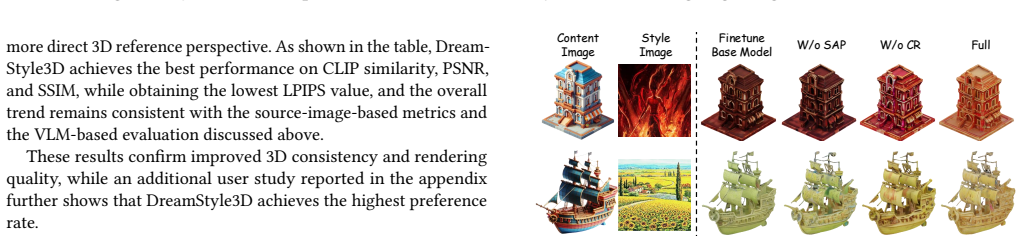
- [Sec. 5.4, Table 3] The ablation deltas are very small: CLIP moves 79.488→80.096 and AdaIN 91.948→91.682, and no error bars, confidence intervals, or significance tests are reported. These differences may be noise. The claim that Structure-Aware Perturbation and Color Remapping 'lead to the best overall performance' needs repeated-seed runs with variance reporting or a statistical test. The same lack of uncertainty quantification affects Tables 1 and 2.
- [Sec. 5.1, Table 1] The source-image metrics are partially aligned with the architecture: DINO and CLIP are the very encoders used as geometric and style conditioners. Higher CLIP/DINO scores for the proposed method may partly reflect that the model was trained to optimize these representations, not necessarily better generalizable style preservation. Please add a more independent automatic evaluation (e.g., a generic perceptual similarity to human-judged stylized references) and make the user study more comprehensive (currently only a single preference rate over five cases is reported in Fig. 11).
minor comments (4)
- [Sec. 3.4] The values of the free hyperparameters (mask retention ratio r, patch sizes, color remapping probabilities p_orig/p_gray, quantization bins L, shift range S, weight alpha in Eq. (12), and CFG strength/steps) are not reported. Please provide them for reproducibility.
- [Sec. 5.1] Inference time is reported as '~10s' but the hardware, warm-up protocol, and whether this includes mesh extraction and texture baking are unspecified. State these details so the speed comparison is reproducible.
- [Appendix C.1, Fig. 10] The two-stage comparisons in Fig. 10 (Hunyuan3D-2.1 + OmniStyle, Hunyuan3D-2.1 + OmniGen2) are qualitative only. Adding their CLIP/DINO/Gram/AdaIN/VLM scores would make the comparison quantitative and address the concern directly.
- [General] There are several typos and notation inconsistencies, e.g., Eq. (1) formatting, 'Latent Generation & Versatile Outputs' in Sec. 3.1, and undefined 'shuf.' in Fig. 3. A careful proofread is recommended.
Circularity Check
Benchmark circularity: Table 2's 'ground-truth' stylized 3D assets are outputs of the same OmniStyle→Hunyuan3D two-stage pipeline the paper claims to outperform; training on the same filtered distribution makes the reference-based comparison partially self-confirming.
specific steps
-
self definitional
[Sec. 4 (Dataset Curation); Sec. 5.1 (Evaluation); Appendix C.1]
"Each pair is processed by the OmniStyle [40] model to generate stylized 2D images, which are further lifted into 3D using the Hunyuan3D-2.1 [14] model ... The rendered images of the stylized 3D assets from the test set are used as reference renders for supplementary reference-based evaluation. ... This is also why we adopt a similar two-stage pipeline in our dataset construction."
The reference-based evaluation in Table 2 compares generated renders against the 'ground-truth stylized 3D assets from the test set.' Those assets were produced by exactly the two-stage pipeline the paper claims to supersede: OmniStyle performs 2D stylization and Hunyuan3D-2.1 lifts the result to 3D (Sec. 4, App. B). DreamStyle3D is trained on 11K triplets drawn from the same filtered distribution, so its Table 2 scores measure fidelity to the criticized pipeline's output distribution, not to an independent stylized-3D gold standard. The Appendix C.1 defense—offline filtering—does not remove the circularity: filtering selects good outputs of that pipeline; it does not validate them against an external criterion. Hence the 'better balance' claim in Sec. 5.3 is partially built into the bench
full rationale
DreamStyle3D is an empirical fine-tuning of the TRELLIS SLAT diffusion model with decoupled dual cross-attention and a standard CFM loss (Eq. 7); there is no derivation chain whose output is equivalent to its input. No load-bearing self-citation was found: the authors' prior works cited (K-LoRA, AgeBooth, Tar3D, AR123) are contextual, and the base model TRELLIS is an external prior with available code, not a self-referential uniqueness argument. The concrete circularity is in the benchmark. Sec. 4 and App. B build the 15K triplet dataset by running OmniStyle (2D style transfer) and Hunyuan3D-2.1 (image-to-3D lift), filtering with CAS/Gram and Eq. 13. Sec. 5.1 then uses the test split of these same model-generated assets as 'ground-truth' references for Table 2. Since DreamStyle3D is trained on 11K triplets from the same filtered pipeline distribution, the reference-based CLIP/PSNR/SSIM/LPIPS scores largely measure how well it imitates the criticized two-stage pipeline. Appendix C.1 explicitly acknowledges the resemblance ('this is also why we adopt a similar two-stage pipeline in our dataset construction') and defends it only by offline filtering; filtering selects good outputs of that pipeline and does not provide an independent gold standard. This makes the 'better balance' claim in Sec. 5.3 partially built into the benchmark. However, Table 1's source-image metrics (CLIP/DINO/Gram/AdaIN), the VLM score, and the small user study are not reference-based and offer some independent evidence; the 10-second speed claim is also independent of this bias. Hence partial circularity, score 5.
Axiom & Free-Parameter Ledger
free parameters (7)
- style mask retention ratio r =
not reported
- style patch sizes (14x14 and second-shuffle size) =
14x14; second size not reported
- color remapping probabilities p_orig, p_gray =
not reported
- color quantization bins L and shift range S =
not reported
- 2D candidate selection weight alpha =
0.3
- 3D filtering thresholds =
aesthetic < 4.5 and CLIP < 0.6
- inference CFG strength and sampling steps =
CFG 5, 50 steps
axioms (6)
- domain assumption DINO features encode geometry while CLIP features encode style
- domain assumption TRELLIS structured latent (SLAT) representations can faithfully decode stylized geometry and appearance
- domain assumption OmniStyle stylized 2D images lifted by Hunyuan3D-2.1 constitute valid 3D stylization ground truth
- domain assumption Spatial shuffling preserves texture-dominant statistics while destroying structural alignment
- domain assumption Qwen3.5 VLM scores correlate with human perceptual quality
- domain assumption CLIP, DINO, Gram, and AdaIN metrics measure the intended geometry-preservation and style-fidelity axes
Cite this review
Pith. "Pith review of DreamStyle3D: Efficient 3D Stylized Asset Generation via Dual-Attention Disentanglement." pith.science (2026). https://pith.science/paper/GPKUETHI
@misc{pith2026260724721,
  author       = {Pith},
  title        = {Pith review of: DreamStyle3D: Efficient 3D Stylized Asset Generation via Dual-Attention Disentanglement},
  year         = {2026},
  howpublished = {\url{https://pith.science/paper/GPKUETHI}},
  note         = {Machine review of arXiv:2607.24721}
}
read the original abstract
With the growth of gaming, animation, and virtual reality industries, the demand for efficient generation of stylized 3D assets is rapidly increasing. However, existing approaches still struggle to jointly preserve style fidelity, geometric consistency, and generation efficiency, as most of them still rely on indirect 2D-to-3D stylization pipelines. This motivates a native 3D stylization framework that can explicitly disentangle style from geometry while remaining efficient. To this end, we propose DreamStyle3D, an efficient framework for stylized 3D asset generation built on a Decoupled Dual Cross-Attention mechanism. Our method explicitly separates geometric and stylistic features to enable efficient style injection while preserving structural consistency, and further adopts a lightweight training strategy to enhance style consistency and model generalization. In addition, we build an automated data pipeline and construct a dataset of about 15K content-style-stylized triplets for training and evaluation. Extensive experiments demonstrate that our DreamStyle3D can generate high-fidelity, geometrically consistent stylized 3D assets within 10 seconds, substantially improving efficiency while maintaining superior style quality and offering a new solution for 3D content creation. The project is available at https://github.com/NK-JittorCV/nk-3D/tree/main/models/DreamStyle3D.
Figures





Reference graph
Works this paper leans on
-
[1]
Bolin Chen, Baoquan Zhao, Haoran Xie, Yi Cai, Qing Li, and Xudong Mao. 2025. Consislora: Enhancing content and style consistency for lora-based style transfer. arXiv preprint arXiv:2503.10614(2025)
Pith/arXiv arXiv 2025
-
[2]
Rui Chen, Yongwei Chen, Ningxin Jiao, and Kui Jia. 2023. Fantasia3d: Disentan- gling geometry and appearance for high-quality text-to-3d content creation. In Proceedings of the IEEE/CVF international conference on computer vision. 22246– 22256
2023
-
[3]
Matt Deitke, Ruoshi Liu, Matthew Wallingford, Huong Ngo, Oscar Michel, Aditya Kusupati, Alan Fan, Christian Laforte, Vikram Voleti, Samir Yitzhak Gadre, et al
-
[4]
Yarden Frenkel, Yael Vinker, Ariel Shamir, and Daniel Cohen-Or. 2024. Implicit style-content separation using b-lora. InEuropean Conference on Computer Vision. Springer, 181–198
2024
-
[5]
Leon A Gatys, Alexander S Ecker, and Matthias Bethge. 2016. Image style transfer using convolutional neural networks. InProceedings of the IEEE conference on computer vision and pattern recognition. 2414–2423
2016
-
[6]
Jingbo Gong, Yikai Wang, Yushi Lan, Yuhao Wan, Ziheng Ouyang, Rui Zhao, Ming-Ming Cheng, Qibin Hou, and Chen Change Loy. 2026. Direct 3D-Aware Object Insertion via Decomposed Visual Proxies.arXiv preprint arXiv:2606.06601 (2026)
Pith/arXiv arXiv 2026
-
[7]
Xianglong He, Zi-Xin Zou, Chia-Hao Chen, Yuan-Chen Guo, Ding Liang, Chun Yuan, Wanli Ouyang, Yan-Pei Cao, and Yangguang Li. 2025. SparseFlex: High- Resolution and Arbitrary-Topology 3D Shape Modeling. InProceedings of the IEEE/CVF International Conference on Computer Vision (ICCV). 14822–14833
2025
-
[8]
Amir Hertz, Andrey Voynov, Shlomi Fruchter, and Daniel Cohen-Or. 2024. Style aligned image generation via shared attention. InProceedings of the IEEE/CVF Conference on Computer Vision and Pattern Recognition. 4775–4785
2024
-
[9]
Jonathan Ho, Ajay Jain, and Pieter Abbeel. 2020. Denoising diffusion probabilistic models.Advances in neural information processing systems33 (2020), 6840–6851
2020
-
[10]
Jonathan Ho and Tim Salimans. 2022. Classifier-free diffusion guidance.arXiv preprint arXiv:2207.12598(2022)
Pith/arXiv arXiv 2022
-
[11]
Yicong Hong, Kai Zhang, Jiuxiang Gu, Sai Bi, Yang Zhou, Difan Liu, Feng Liu, Kalyan Sunkavalli, Trung Bui, and Hao Tan. 2023. Lrm: Large reconstruction model for single image to 3d.arXiv preprint arXiv:2311.04400(2023)
Pith/arXiv arXiv 2023
-
[12]
Xun Huang and Serge Belongie. 2017. Arbitrary style transfer in real-time with adaptive instance normalization. InProceedings of the IEEE international conference on computer vision. 1501–1510
2017
-
[13]
Zehuan Huang, Yuan-Chen Guo, Haoran Wang, Ran Yi, Lizhuang Ma, Yan-Pei Cao, and Lu Sheng. 2025. Mv-adapter: Multi-view consistent image generation made easy. InProceedings of the IEEE/CVF International Conference on Computer Vision. 16377–16387
2025
-
[14]
Team Hunyuan3D, Shuhui Yang, Mingxin Yang, Yifei Feng, Xin Huang, Sheng Zhang, Zebin He, Di Luo, Haolin Liu, Yunfei Zhao, et al. 2025. Hunyuan3D 2.1: From Images to High-Fidelity 3D Assets with Production-Ready PBR Material. arXiv preprint arXiv:2506.15442(2025)
Pith/arXiv arXiv 2025
-
[15]
Justin Johnson, Alexandre Alahi, and Li Fei-Fei. 2016. Perceptual losses for real- time style transfer and super-resolution. InEuropean conference on computer vision. Springer, 694–711
2016
-
[16]
Zeqiang Lai, Yunfei Zhao, Haolin Liu, Zibo Zhao, Qingxiang Lin, Huiwen Shi, Xianghui Yang, Mingxin Yang, Shuhui Yang, Yifei Feng, et al. 2025. Hunyuan3D 2.5: Towards High-Fidelity 3D Assets Generation with Ultimate Details.arXiv preprint arXiv:2506.16504(2025)
Pith/arXiv arXiv 2025
-
[17]
Yaron Lipman, Ricky TQ Chen, Heli Ben-Hamu, Maximilian Nickel, and Matt Le
-
[18]
Jia Liu, Changlin Li, Qirui Sun, Jiahui Ming, Chen Fang, Jue Wang, Bing Zeng, and Shuaicheng Liu. 2024. Ada-adapter: Fast few-shot style personlization of diffusion model with pre-trained image encoder.arXiv preprint arXiv:2407.05552 (2024)
Pith/arXiv arXiv 2024
-
[19]
Ruoshi Liu, Rundi Wu, Basile Van Hoorick, Pavel Tokmakov, Sergey Zakharov, and Carl Vondrick. 2023. Zero-1-to-3: Zero-shot one image to 3d object. In Proceedings of the IEEE/CVF international conference on computer vision. 9298– 9309
2023
-
[20]
Ilya Loshchilov and Frank Hutter. 2017. Decoupled weight decay regularization. arXiv preprint arXiv:1711.05101(2017)
Pith/arXiv arXiv 2017
-
[21]
Oscar Michel, Roi Bar-On, Richard Liu, Sagie Benaim, and Rana Hanocka. 2022. Text2mesh: Text-driven neural stylization for meshes. InProceedings of the IEEE/CVF conference on computer vision and pattern recognition. 13492–13502
2022
-
[22]
Maxime Oquab, Timothée Darcet, Théo Moutakanni, Huy Vo, Marc Szafraniec, Vasil Khalidov, Pierre Fernandez, Daniel Haziza, Francisco Massa, Alaaeldin El- Nouby, et al. 2023. Dinov2: Learning robust visual features without supervision. arXiv preprint arXiv:2304.07193(2023)
Pith/arXiv arXiv 2023
-
[23]
Ziheng Ouyang, Zhen Li, and Qibin Hou. 2025. K-lora: Unlocking training-free fusion of any subject and style loras.arXiv preprint arXiv:2502.18461(2025)
Pith/arXiv arXiv 2025
-
[24]
Ziheng Ouyang, Yiren Song, Yaoli Liu, Shihao Zhu, Qibin Hou, Ming-Ming Cheng, and Mike Zheng Shou. 2026. The consistency critic: Correcting inconsistencies in generated images via reference-guided attentive alignment. InProceedings of the IEEE/CVF Conference on Computer Vision and Pattern Recognition. 2035–2046
2026
-
[25]
Ipek Oztas, Duygu Ceylan, and Aysegul Dundar. 2025. 3D Stylization via Large Reconstruction Model. InProceedings of the Special Interest Group on Computer Graphics and Interactive Techniques Conference Conference Papers. 1–11
2025
-
[26]
Dustin Podell, Zion English, Kyle Lacey, Andreas Blattmann, Tim Dockhorn, Jonas Müller, Joe Penna, and Robin Rombach. 2024. Sdxl: Improving latent diffusion models for high-resolution image synthesis. InInternational Conference on Learning Representations, Vol. 2024. 1862–1874
2024
-
[27]
Ben Poole, Ajay Jain, Jonathan T Barron, and Ben Mildenhall. 2022. Dreamfusion: Text-to-3d using 2d diffusion.arXiv preprint arXiv:2209.14988(2022)
Pith/arXiv arXiv 2022
-
[28]
Qwen Team. 2026. Qwen3.5: Towards Native Multimodal Agents. https://qwen. ai/blog?id=qwen3.5
2026
-
[29]
Alec Radford, Jong Wook Kim, Chris Hallacy, Aditya Ramesh, Gabriel Goh, Sandhini Agarwal, Girish Sastry, Amanda Askell, Pamela Mishkin, Jack Clark, et al. 2021. Learning transferable visual models from natural language supervision. InInternational conference on machine learning. PmLR, 8748–8763
2021
-
[30]
Nataniel Ruiz, Yuanzhen Li, Varun Jampani, Yael Pritch, Michael Rubinstein, and Kfir Aberman. 2023. Dreambooth: Fine tuning text-to-image diffusion models for subject-driven generation. InProceedings of the IEEE/CVF conference on computer vision and pattern recognition. 22500–22510
2023
-
[31]
Viraj Shah, Nataniel Ruiz, Forrester Cole, Erika Lu, Svetlana Lazebnik, Yuanzhen Li, and Varun Jampani. 2024. Ziplora: Any subject in any style by effectively merging loras. InEuropean Conference on Computer Vision. Springer, 422–438
2024
-
[32]
Ruoxi Shi, Hansheng Chen, Zhuoyang Zhang, Minghua Liu, Chao Xu, Xinyue Wei, Linghao Chen, Chong Zeng, and Hao Su. 2023. Zero123++: a single image to consistent multi-view diffusion base model.arXiv preprint arXiv:2310.15110 (2023)
Pith/arXiv arXiv 2023
-
[33]
Yichun Shi, Peng Wang, Jianglong Ye, Mai Long, Kejie Li, and Xiao Yang. 2023. Mvdream: Multi-view diffusion for 3d generation.arXiv preprint arXiv:2308.16512 (2023)
Pith/arXiv arXiv 2023
-
[34]
Karen Simonyan and Andrew Zisserman. 2014. Very deep convolutional networks for large-scale image recognition.arXiv preprint arXiv:1409.1556(2014)
Pith/arXiv arXiv 2014
-
[35]
Bingjie Song, Xin Huang, Ruting Xie, Xue Wang, and Qing Wang. 2024. Style3D: Attention-guided Multi-view Style Transfer for 3D Object Generation.arXiv preprint arXiv:2412.03571(2024)
Pith/arXiv arXiv 2024
-
[36]
Jiaming Song, Chenlin Meng, and Stefano Ermon. 2020. Denoising diffusion implicit models.arXiv preprint arXiv:2010.02502(2020)
Pith/arXiv arXiv 2020
-
[37]
Stefan Stojanov, Anh Thai, and James M Rehg. 2021. Using shape to categorize: Low-shot learning with an explicit shape bias. InProceedings of the IEEE/CVF conference on computer vision and pattern recognition. 1798–1808
2021
-
[38]
Qwen Team. 2025. Qwen3 Technical Report. arXiv:2505.09388 [cs.CL] https: //arxiv.org/abs/2505.09388
Pith/arXiv arXiv 2025
-
[39]
Haofan Wang, Matteo Spinelli, Qixun Wang, Xu Bai, Zekui Qin, and Anthony Chen. 2024. Instantstyle: Free lunch towards style-preserving in text-to-image generation.arXiv preprint arXiv:2404.02733(2024)
Pith/arXiv arXiv 2024
-
[40]
Ye Wang, Ruiqi Liu, Jiang Lin, Fei Liu, Zili Yi, Yilin Wang, and Rui Ma. 2025. OmniStyle: Filtering High Quality Style Transfer Data at Scale. InProceedings of the Computer Vision and Pattern Recognition Conference. 7847–7856
2025
-
[41]
Zhou Wang, Alan C Bovik, Hamid R Sheikh, and Eero P Simoncelli. 2004. Image quality assessment: from error visibility to structural similarity.IEEE transactions on image processing13, 4 (2004), 600–612
2004
-
[42]
Zhouxia Wang, Xintao Wang, Liangbin Xie, Zhongang Qi, Ying Shan, Wenping Wang, and Ping Luo. 2023. Styleadapter: A unified stylized image generation model.arXiv preprint arXiv:2309.01770(2023)
Pith/arXiv arXiv 2023
-
[43]
Chenyuan Wu, Pengfei Zheng, Ruiran Yan, Shitao Xiao, Xin Luo, Yueze Wang, Wanli Li, Xiyan Jiang, Yexin Liu, Junjie Zhou, Ze Liu, Ziyi Xia, Chaofan Li, Haoge Deng, Jiahao Wang, Kun Luo, Bo Zhang, Defu Lian, Xinlong Wang, Zhongyuan Wang, Tiejun Huang, and Zheng Liu. 2025. OmniGen2: Exploration to Advanced Multimodal Generation.arXiv preprint arXiv:2506.18871(2025)
Pith/arXiv arXiv 2025
-
[44]
Shaojin Wu, Mengqi Huang, Yufeng Cheng, Wenxu Wu, Jiahe Tian, Yiming Luo, Fei Ding, and Qian He. 2025. Uso: Unified style and subject-driven generation via disentangled and reward learning.arXiv preprint arXiv:2508.18966(2025)
Pith/arXiv arXiv 2025
-
[45]
Shuang Wu, Youtian Lin, Feihu Zhang, Yifei Zeng, Jingxi Xu, Philip Torr, Xun Cao, and Yao Yao. 2024. Direct3d: Scalable image-to-3d generation via 3d latent diffusion transformer.Advances in Neural Information Processing Systems37 (2024), 121859–121881
2024
-
[46]
Jianfeng Xiang, Zelong Lv, Sicheng Xu, Yu Deng, Ruicheng Wang, Bowen Zhang, Dong Chen, Xin Tong, and Jiaolong Yang. 2025. Structured 3d latents for scalable MM ’26, November 10–14, 2026, Rio de Janeiro, Brazil. Wang et al. and versatile 3d generation. InProceedings of the Computer Vision and Pattern Recognition Conference. 21469–21480
2025
-
[47]
Zhiyu Xie, Yuqing Zhang, Xiangjun Tang, Yiqian Wu, Dehan Chen, Gongsheng Li, and Xiaogang Jin. 2024. Styletex: Style image-guided texture generation for 3d models.ACM Transactions on Graphics (TOG)43, 6 (2024), 1–14
2024
-
[48]
Peng Xing, Haofan Wang, Yanpeng Sun, Qixun Wang, Xu Bai, Hao Ai, Renyuan Huang, and Zechao Li. 2024. Csgo: Content-style composition in text-to-image generation.arXiv preprint arXiv:2408.16766(2024)
Pith/arXiv arXiv 2024
-
[49]
Xuancheng Xu, Gengyun Jia, and Bing-Kun Bao. 2026. Disco-LoRA: Disentangled Composition of Content, Style, and Motion for Multi-concept Video Customiza- tion.arXiv preprint arXiv:2606.26668(2026)
Pith/arXiv arXiv 2026
-
[50]
Xuancheng Xu, Yaning Li, Sisi You, and Bing-Kun Bao. 2026. Smrabooth: Subject and motion representation alignment for customized video generation. InPro- ceedings of the IEEE/CVF Conference on Computer Vision and Pattern Recognition. 16130–16141
2026
-
[51]
Xuancheng Xu, Ming Tao, and Bing-Kun Bao. 2025. Clgc: Continuous layout guid- ance for consistent text-to-video editing. In2025 IEEE International Conference on Multimedia and Expo (ICME). IEEE, 1–6
2025
-
[52]
Yuteng Ye, Zheng Zhang, Qinchuan Zhang, Di Wang, Youjia Zhang, Wenxiao Zhang, Wei Yang, and Yuan Liu. 2025. Jigsaw3D: Disentangled 3D Style Transfer via Patch Shuffling and Masking.arXiv preprint(2025)
2025
-
[53]
Zixuan Ye, Huijuan Huang, Xintao Wang, Pengfei Wan, Di Zhang, and Wenhan Luo. 2025. Stylemaster: Stylize your video with artistic generation and translation. InProceedings of the Computer Vision and Pattern Recognition Conference. 2630– 2640
2025
-
[54]
Longwen Zhang, Ziyu Wang, Qixuan Zhang, Qiwei Qiu, Anqi Pang, Haoran Jiang, Wei Yang, Lan Xu, and Jingyi Yu. 2024. Clay: A controllable large-scale generative model for creating high-quality 3d assets.ACM Transactions on Graphics (TOG) 43, 4 (2024), 1–20
2024
-
[55]
Richard Zhang, Phillip Isola, Alexei A Efros, Eli Shechtman, and Oliver Wang
-
[56]
Xuying Zhang, Yutong Liu, Yangguang Li, Renrui Zhang, Yufei Liu, Kai Wang, Wanli Ouyang, Zhiwei Xiong, Peng Gao, Qibin Hou, et al. 2025. Tar3d: Creating high-quality 3d assets via next-part prediction. InProceedings of the IEEE/CVF International Conference on Computer Vision. 5134–5145
2025
-
[57]
Xuying Zhang, Bo-Wen Yin, Yuming Chen, Zheng Lin, Yunheng Li, Qibin Hou, and Ming-Ming Cheng. 2024. Temo: Towards text-driven 3d stylization for multi- object meshes. InProceedings of the ieee/cvf conference on computer vision and pattern recognition. 19531–19540
2024
-
[58]
Xuying Zhang, Yupeng Zhou, Kai Wang, Yikai Wang, Zhen Li, Shaohui Jiao, Daquan Zhou, Qibin Hou, and Ming-Ming Cheng. 2025. Ar-1-to-3: Single image to consistent 3d object via next-view prediction. InProceedings of the IEEE/CVF International Conference on Computer Vision. 26273–26283
2025
-
[59]
Zibo Zhao, Zeqiang Lai, Qingxiang Lin, Yunfei Zhao, Haolin Liu, Shuhui Yang, Yifei Feng, Mingxin Yang, Sheng Zhang, Xianghui Yang, et al. 2025. Hunyuan3d 2.0: Scaling diffusion models for high resolution textured 3d assets generation. arXiv preprint arXiv:2501.12202(2025)
Pith/arXiv arXiv 2025
-
[60]
Shihao Zhu, Bohan Cao, Ziheng Ouyang, Zhen Li, Peng-Tao Jiang, and Qibin Hou. 2025. AgeBooth: Controllable Facial Aging and Rejuvenation via Diffusion Models.arXiv preprint arXiv:2510.05715(2025)
arXiv 2025
-
[61]
Shihao Zhu, Ziheng Ouyang, Yijia Kang, Qilong Wang, Mi Zhou, Bo Li, Ming- Ming Cheng, and Qibin Hou. 2026. Mixture of Style Experts for Diverse Image Stylization.arXiv preprint arXiv:2603.16649(2026). DreamStyle3D: Efficient 3D Stylized Asset Generation via Dual-Attention Disentanglement MM ’26, November 10–14, 2026, Rio de Janeiro, Brazil. Appendix This ...
arXiv 2026
-
[2018]
InProceedings of the IEEE conference on computer vision and pattern recognition
The unreasonable effectiveness of deep features as a perceptual metric. InProceedings of the IEEE conference on computer vision and pattern recognition. 586–595
-
[2022]
Flow matching for generative modeling.arXiv preprint arXiv:2210.02747 (2022)
Pith/arXiv arXiv 2022
-
[2023]
Objaverse-xl: A universe of 10m+ 3d objects.Advances in Neural Information Processing Systems36 (2023), 35799–35813
2023
This paper was first reviewed by deepseek-v4-flash on August 4, 2026.
discussion (0)
Sign in with ORCID, Apple, or X to comment. Anyone can read and Pith papers without signing in.