REVIEW 3 major objections 6 minor 36 references
The paper establishes that a rectangular time projection chamber inside a dipole magnet can measure two-proton correlation functions in radioactive-beam heavy-ion collisions, once track merging and splitting are removed with an elliptical r
Reviewed by Pith at T0; open to challenge. T0 means a machine referee read the full paper against a public rubric. the ladder, T0–T4 →
T0 review · deepseek-v4-flash
2026-08-02 04:27 UTC pith:4YYEWNQ2
load-bearing objection Solid feasibility demonstration for femtoscopy with SπRIT TPC; the track-merging cut is under-validated but the central claim is plausible. the 3 major comments →
Femtoscopy Measurement with SπRIT TPC in Radioactive BeamHeavy-ion Collisions
The pith
A machine-rendered reading of the paper's core claim, the machinery that carries it, and where it could break.
Core claim
The central claim is that the corrected experimental proton-proton correlation function from the SπRIT TPC in 270 MeV/u 132Sn+124Sn radioactive-beam collisions is physically meaningful and matches earlier p-p femtoscopy results: a positive correlation peak near 20 MeV/c from the attractive S-wave nuclear force and an anti-correlation at very small relative momenta. The paper further claims that the TPC's angular acceptance has negligible influence on the correlation function, and that the six selection cuts varied in the systematic study produce controllable uncertainties, largest at low relative momenta. On this basis the authors assert that rectangular TPCs inside dipole magnets can succes
What carries the argument
The load-bearing correction is a track-merging/splitting filter built from two geometric separations computed for every proton pair: Δx, the distance between the two trajectories in the plane perpendicular to the magnetic field at the endpoint of the shorter track, and Δy, the corresponding separation along the field direction. Both are derived from track curvature, length, and emission angle. Pairs falling inside an ellipse with semi-axes 4 cm (Δx) and 1 cm (Δy) are discarded. The filter removes the non-uniform reconstruction efficiency at small track separation and is the step that turns a distorted low-relative-momentum correlation function into the expected physical shape.
Load-bearing premise
The analysis assumes that a single fixed ellipse with semi-axes of 4 cm in Δx and 1 cm in Δy separates all track-merging and track-splitting artifacts from genuine close proton pairs; if that boundary is misplaced, the low-relative-momentum correlation function is biased rather than corrected.
What would settle it
Run a full detector simulation with known track-merging and track-splitting probabilities injected into the same 132Sn+124Sn events, then apply the identical elliptical cut. If the simulated Δx−Δy distribution still shows non-uniform efficiency inside the accepted region, or if the reconstructed correlation function does not reproduce the injected input, the correction is incomplete. A cheaper check: vary the ellipse semi-axes by more than ±5% and see whether the 20 MeV/c peak shifts beyond the quoted systematic band.
If this is right
- The p-p correlation function in 132Sn+124Sn at 270 MeV/u is usable at low relative momenta, where the attractive S-wave peak and the low-momentum suppression appear.
- The track-correction method transfers to other rectangular TPCs inside dipole magnets, not just this one.
- No additional angular acceptance cut is needed for p-p femtoscopy in this detector, since varying the coverage leaves the correlation function unchanged.
- The systematic uncertainty framework, combining six selection-criteria variations in quadrature, gives a template for reporting femtoscopy results from this TPC.
- Femtoscopy with radioactive beams becomes practical, opening access to isospin-asymmetric source sizes relevant to the symmetry energy.
Where Pith is reading between the lines
- The same elliptical-cut method could be applied to other pair types (proton-deuteron, deuteron-deuteron, pion pairs) in the same data, provided the Δx/Δy resolution for each species is verified; the chosen ellipse may need species-dependent sizes.
- Because the systematic check only varied the ellipse by ±5%, a stricter test would scan the semi-axes over a wider range or make the cut momentum-dependent; if the 20 MeV/c peak moves outside uncertainty, the fixed-cut assumption would need revision.
- If the corrected p-p correlation is fitted with a source model, the resulting source size as a function of centrality and isospin asymmetry could be compared with transport-model predictions, offering a new probe of the symmetry energy.
Editorial analysis
A structured set of objections, weighed in public.
Referee Report
Summary. The paper reports the first femtoscopy measurement using the SπRIT TPC in radioactive beam collisions, focusing on the proton-proton correlation function in 270 MeV/u 132Sn+124Sn. A track merging/splitting correction is proposed, implemented as a hard rejection of pairs inside a fixed ellipse in the (Δx, Δy) separation space. The authors also study the effect of TPC angular acceptance and establish a six-criterion systematic uncertainty framework. The corrected correlation function shows a peak near 20 MeV/c and suppression at low relative momenta, which the authors interpret as the expected attractive S-wave and anti-correlation features, leading to the conclusion that the SπRIT TPC is suitable for femtoscopy measurements.
Significance. If the central claim is valid, this paper demonstrates a new capability: femtoscopy with a rectangular TPC inside a dipole magnet for radioactive beam heavy-ion collisions, which is relevant for isospin-dependent studies of the nuclear equation of state. The proposed correction scheme is generic and could be adopted by other rectangular TPC experiments (e.g., CEE). The paper also provides a systematic uncertainty framework, which is a useful methodological contribution. The main strength is that the paper ships an experimentally measured p-p correlation function with the expected qualitative features, and it explicitly quantifies several sources of systematic uncertainty. However, the validity of the central feasibility claim rests on the track-merging/splitting correction, which is data-driven and not yet validated by a closure test; this is the main risk to the significance of the result.
major comments (3)
- [Sec. 4, Fig. 7] The track merging/splitting correction is implemented as a hard rejection of all pairs with (Δx, Δy) inside an ellipse with semi-axes 4 cm (Δx) and 1 cm (Δy), with these parameters chosen from the measured Δx–Δy distribution of the same data set. No Monte Carlo closure test is provided to demonstrate that this cut removes all reconstruction artifacts while retaining true close pairs. Since low-k* pairs have similar velocities and therefore small track separations, the elliptical cut can preferentially remove the physical signal; the ±5% variation in Sec. 6 only probes local sensitivity and cannot validate the rejection strategy itself. This is load-bearing because the claimed physical features in Fig. 10 (the ~20 MeV/c peak and low-k* suppression) are produced by this correction. Please add a closure test, e.g., embedding known p-p correlations into simulated TPC events with realistic tr
- [Sec. 5, Fig. 8] The claim that TPC angular acceptance has a negligible impact on the p-p correlation function is based on a visual comparison of curves for different phi cuts. No quantitative metric (e.g., χ²/ndf, bin-by-bin residuals normalized to statistical errors) is given, and the statistical precision of each acceptance sample is not reported. Since the paper explicitly states that 'no additional angular acceptance cuts are applied' on the basis of this study, the claim should be supported by a quantitative comparison, e.g., a table of bin-by-bin differences divided by the combined statistical and systematic uncertainty, or a fit of the source size under different acceptances.
- [Sec. 6, Eq. (5)] The systematic uncertainty framework sums six criteria in quadrature, but it does not include a term representing the uncertainty of the track-merging/splitting correction strategy itself. The ±5% variations of Δx and Δy are local sensitivity tests around the chosen ellipse parameters; they do not test the assumption that a hard rejection with a fixed elliptical shape is the correct model. Given that this correction is the key novel element and directly shapes the low-k* region where systematic uncertainties are largest, the framework should either incorporate a systematic component for the rejection model (e.g., from a closure test or a comparison with an alternative correction method) or explicitly justify why such a component is negligible.
minor comments (6)
- [Sec. 4] The phrase 'track merging and track splitting correction methods' is grammatically awkward; recommend 'track merging and track splitting correction method' if a single method is described, or clarify the plural.
- [Fig. 2] The labels in panels (b) and (c) use 'pdt' and '3He4He' without spaces; this is hard to read and could be confused with a single species. Please add clear separators or legends.
- [Fig. 9(a)] The table of selection criteria and variation ranges is embedded as an image and is difficult to read. Please reproduce this information as a proper table in the text, listing each criterion, its nominal value, and the lower/upper variation bounds.
- [Eq. (3)] Please specify explicitly the large-k* fitting range used to constrain the normalization constant A, and whether A is fit globally or per-bin. This is relevant for reproducibility.
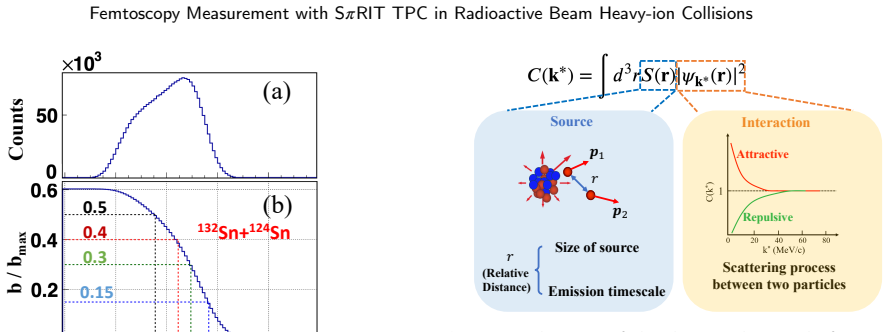
- [Sec. 2, Eq. (1)] The centrality mapping uses the hard-sphere model b_max = 1.15(A_P^{1/3}+A_T^{1/3}). Please state the systematic uncertainty in b/b_max from this model choice, or cite a reference justifying it for this reaction.
- [References] The citation 'SpiRITGithub' (https://github.com/SpiRIT-Collaboration/SpiRITROOT) should be formatted as a standard software citation with author(s), year, and version/access date, rather than appearing in the author list of the experiment.
Circularity Check
No significant circularity: the reported femtoscopy measurement is self-contained; the data-driven track-merging cut raises systematic-bias concerns but does not reduce the result to its inputs by construction.
full rationale
The paper is an experimental measurement rather than a derivation of a predicted quantity from a fitted input. The correlation function is constructed via Eq. (3), C_exp(k*) = A N_same/N_mix, where A is a normalization constant fixed at large k*; this does not determine the shape of the correlation function, and the physical features (the ~20 MeV/c attractive peak and low-k* anti-correlation) come from the measured N_same/N_mix ratio, not from the normalization. The track merging/splitting correction in Sec. 4 is an elliptical rejection cut with semi-axes chosen from the measured Δx–Δy distribution and TPC resolution, and its influence is quantified in Sec. 6 by varying the cut parameters by ±5%. While this data-driven cut could bias the low-k* region—and no Monte Carlo closure test is shown—the final correlation function is not mathematically equivalent to the chosen cut parameters; the cut removes pairs but does not by itself set the shape of the correlation function. The theoretical formula Eq. (4) is used only to interpret the measured CF, not to generate it. Consistency with previous p-p femtoscopy results is checked against external references (Wang et al. 2022; STAR/Adamczyk et al. 2015), which are independent evidence. Self-citations in the paper concern detector characterization and prior SπRIT analyses; they are not load-bearing for the central feasibility claim. The absence of a closure test and the hand-chosen nature of the elliptical cut are legitimate experimental systematic concerns, but they are not circularity under the definitions used here.
Axiom & Free-Parameter Ledger
free parameters (3)
- Track-merging rejection ellipse semi-axes (Δx, Δy) =
4 cm, 1 cm
- Correlation normalization constant A =
not quoted (set by requiring C_exp → 1 at large k*)
- Systematic variation range (±5%) =
±5%; integer cuts ±1; massHCalib ±10% of full range
axioms (5)
- standard math Event-mixing reference N_mix correctly represents the uncorrelated pair spectrum.
- standard math The measured correlation function is related to the source and the two-particle scattering wave function via Eq. (4).
- domain assumption Track reconstruction (Riemann fit/RAVE) supplies vertex and track parameters accurate enough for the Δx, Δy correction.
- domain assumption Hard-sphere model and multiplicity–impact-parameter mapping in Eqs. (1)–(2) describe the centrality selection.
- ad hoc to paper A fixed elliptical rejection region (semi-axes 4 cm in Δx, 1 cm in Δy) removes all track merging/splitting artifacts without over-removing true close pairs.
read the original abstract
Femtoscopy is a powerful tool for exploring the dynamic emitting structure in heavy-ion collisions, while radioactive beam heavy-ion collisions enable the investigation of nuclear matter under extreme isospin conditions. Here, we successfully perform femtoscopy measurements using the S$\pi$RIT Time Projection Chamber (TPC). A dedicated correction scheme for track merging and splitting is proposed, which is well applicable to rectangular TPCs housed inside dipole magnets and effectively improves the reconstructed correlation functions at small relative momenta. Focusing on the proton-proton (p-p) correlation function in the 270 MeV/u $^{132}\text{Sn}+^{124}\text{Sn}$ system, we successfully apply the track merging and splitting correction; additionally, the TPC angular acceptance exhibits a negligible impact on the correlation function. A systematic uncertainty quantification framework is established. The experimental results of the p-p correlation function confirm the feasibility of the S$\pi$RIT TPC for femtoscopy measurements and provide technical support for high-precision femtoscopy studies using rectangular TPCs in radioactive beam heavy-ion collisions.
Figures




Reference graph
Works this paper leans on
-
[1]
Physics Reports , volume=
Recent progress and new challenges in isospin physics with heavy-ion reactions , author=. Physics Reports , volume=. 2008 , publisher=
2008
-
[2]
Huth, S. and others. Constraining Neutron-Star Matter with Microscopic and Macroscopic Collisions. Nature. 2022. doi:10.1038/s41586-022-04750-w. arXiv:2107.06229
Pith/arXiv arXiv 2022
-
[3]
and Kumar, Rohit and Horowitz, Charles J
Tsang, Chun Yuen and Tsang, ManYee Betty and Lynch, William G. and Kumar, Rohit and Horowitz, Charles J. Determination of the equation of state from nuclear experiments and neutron star observations. Nature Astron. 2024. doi:10.1038/s41550-023-02161-z. arXiv:2310.11588
Pith/arXiv arXiv 2024
-
[4]
Circumstantial Evidence for a Soft Nuclear Symmetry Energy at Suprasaturation Densities
Xiao, Zhigang and Li, Bao-An and Chen, Lie-Wen and Yong, Gao-Chan and Zhang, Ming. Circumstantial Evidence for a Soft Nuclear Symmetry Energy at Suprasaturation Densities. Phys. Rev. Lett. 2009. doi:10.1103/PhysRevLett.102.062502. arXiv:0808.0186
Pith/arXiv arXiv 2009
-
[5]
Tam, Chi-Kin and Chaj e cki, Zbigniew and Danielewicz, Pawe and Nzabahimana, Pierre. Source function from two-particle correlation function through entropy-regularized Richardson-Lucy deblurring. Phys. Rev. C. 2025. doi:10.1103/zfly-38pk. arXiv:2502.09478
Pith/arXiv arXiv 2025
-
[6]
Xu, Junhuai and Qin, Zhi and Zou, Renjie and Si, Dawei and Xiao, Sheng and Tian, Baiting and Wang, Yijie and Xiao, Zhigang. Imaging Freeze-Out Sources and Extracting Strong Interaction Parameters in Relativistic Heavy-Ion Collisions. Chin. Phys. Lett. 2025. doi:10.1088/0256-307X/42/3/031401. arXiv:2411.08718
Pith/arXiv arXiv 2025
-
[7]
Wang, Y. J. and others. Large amplification of the isospin-dependence of proton emitting source size in radioactive heavy-ion collisions: a signal of n-p correlation. 2026. arXiv:2604.25107
Pith/arXiv arXiv 2026
-
[8]
Verde, G. and Danielewicz, P. and Lynch, W. G. and Brown, D. A. and Gelbke, C. K. and Tsang, M. B. Probing transport theories via two proton source imaging. Phys. Rev. C. 2003. doi:10.1103/PhysRevC.67.034606. arXiv:nucl-ex/0301013
Pith/arXiv arXiv 2003
-
[9]
Zhang, Haojie and Xu, Junhuai and Li, Pengcheng and Qin, Zhi and Si, Dawei and Wang, Yijie and Wang, Yongjia and Li, Qingfeng and Xiao, Zhigang. Probing the three-dimensional emission source and neutron skin via - correlations in heavy-ion collisions. Phys. Rev. C. 2026. doi:10.1103/jdsn-p3v4. arXiv:2510.20554
arXiv 2026
-
[10]
The emission order of hydrogen isotopes via correlation functions in 30 MeV/u Ar+Au reactions
Wang, Yijie and others. The emission order of hydrogen isotopes via correlation functions in 30 MeV/u Ar+Au reactions. Phys. Lett. B. 2022. doi:10.1016/j.physletb.2021.136856. arXiv:2112.02210
arXiv 2022
-
[11]
Duan, X. and others. Emission time chronology of He3 relative to hydrogen isotopes in Zn64+Au197 collisions at 35 MeV/u. Phys. Rev. C. 2026. doi:10.1103/fwz6-mr5t
-
[12]
Si, Dawei and others. Extracting Neutron-Neutron Interaction Strength and Spatiotemporal Dynamics of Neutron Emission from the Two-Particle Correlation Function. Phys. Rev. Lett. 2025. doi:10.1103/PhysRevLett.134.222301. arXiv:2501.09576
Pith/arXiv arXiv 2025
-
[13]
SAMURAI in its operation phase for RIBF users , journal =. 2016 , issn =. doi:https://doi.org/10.1016/j.nimb.2016.02.056 , url =
-
[14]
Shane, R. and others. S RIT: A time-projection chamber for symmetry-energy studies. Nucl. Instrum. Meth. A. 2015. doi:10.1016/j.nima.2015.01.026. arXiv:1409.6343
Pith/arXiv arXiv 2015
-
[15]
Tangwancharoen, S. and others. A Gating Grid Driver for Time Projection Chambers. Nucl. Instrum. Meth. A. 2017. doi:10.1016/j.nima.2017.02.001. arXiv:1612.06708
arXiv 2017
-
[16]
Estee, J. and others. Extending the dynamic range of electronics in a Time Projection Chamber. Nucl. Instrum. Meth. A. 2019. doi:10.1016/j.nima.2019.162509
arXiv 2019
-
[17]
Barney, J. and others. The S RIT time projection chamber. Rev. Sci. Instrum. 2021. doi:10.1063/5.0041191. arXiv:2005.10806
Pith/arXiv arXiv 2021
-
[18]
Lasko, P. and others. KATANA - a charge-sensitive triggering system for the S RIT experiment. Nucl. Instrum. Meth. A. 2017. doi:10.1016/j.nima.2017.03.006. arXiv:1610.06682
Pith/arXiv arXiv 2017
-
[19]
Isobe, T. and others. Application of the Generic Electronics for Time Projection Chamber (GET) readout system for heavy Radioactive isotope collision experiments. Nucl. Instrum. Meth. A. 2018. doi:10.1016/j.nima.2018.05.022
-
[20]
Lee, J. W. and others. Charged particle track reconstruction with S RIT Time Projection Chamber. Nucl. Instrum. Meth. A. 2020. doi:10.1016/j.nima.2020.163840. arXiv:2001.04820
arXiv 2020
-
[21]
S RITROOT Software, https://github.com/SpiRIT-Collaboration/SpiRITROOT/tree/33821f0
SpiRITGithub. S RITROOT Software, https://github.com/SpiRIT-Collaboration/SpiRITROOT/tree/33821f0
-
[22]
Tsang, C. Y. and others. Space charge effects in the S RIT time projection chamber. Nucl. Instrum. Meth. A. 2020. doi:10.1016/j.nima.2020.163477. arXiv:1912.11045
arXiv 2020
-
[23]
Source function from two-particle correlations through deblurring: p-p and d - pairs
Nzabahimana, Pierre and Danielewicz, Pawel and Verde, Giuseppe. Source function from two-particle correlations through deblurring: p-p and d - pairs. Nuovo Cim. C. 2024. doi:10.1393/ncc/i2025-25039-8
-
[24]
RAVE: A detector-independent toolkit to reconstruct vertices
Waltenberger, Wolfgang. RAVE: A detector-independent toolkit to reconstruct vertices. IEEE Trans. Nucl. Sci. 2011. doi:10.1109/TNS.2011.2119492
arXiv 2011
-
[25]
Robust circle reconstruction with the Riemann fit
Fr. Robust circle reconstruction with the Riemann fit. J. Phys. Conf. Ser. 2018. doi:10.1088/1742-6596/1085/4/042004
-
[26]
Estee, J. and others. Probing the Symmetry Energy with the Spectral Pion Ratio. Phys. Rev. Lett. 2021. doi:10.1103/PhysRevLett.126.162701. arXiv:2103.06861
Pith/arXiv arXiv 2021
-
[27]
Kaneko, M. and others. Rapidity distributions of Z=1 isotopes and the nuclear symmetry energy from Sn+Sn collisions with radioactive beams at 270 MeV/nucleon. Phys. Lett. B. 2021. doi:10.1016/j.physletb.2021.136681
arXiv 2021
-
[28]
Lee, J. W. and others. Isoscaling in central Sn+Sn collisions at 270 MeV/u. Eur. Phys. J. A. 2022. doi:10.1140/epja/s10050-022-00851-2. arXiv:2211.02837
arXiv 2022
-
[29]
Tsang, C. Y. and others. Constraining nucleon effective masses with flow and stopping observables from the S RIT experiment. Phys. Lett. B. 2024. doi:10.1016/j.physletb.2024.138661. arXiv:2312.06678
arXiv 2024
-
[30]
Femtoscopy in relativistic heavy ion collisions
Lisa, Michael Annan and Pratt, Scott and Soltz, Ron and Wiedemann, Urs. Femtoscopy in relativistic heavy ion collisions. Ann. Rev. Nucl. Part. Sci. 2005. doi:10.1146/annurev.nucl.55.090704.151533. arXiv:nucl-ex/0505014
arXiv 2005
-
[31]
Adamczyk, L. and others. Measurement of Interaction between Antiprotons. Nature. 2015. doi:10.1038/nature15724. arXiv:1507.07158
Pith/arXiv arXiv 2015
-
[32]
Lisa, Michael A. and Gong, W. G. and Gelbke, C. K. and Lynch, W. G. Event-mixing analysis of two-proton correlation functions. Phys. Rev. C. 1991. doi:10.1103/PhysRevC.44.2865
-
[33]
Kopylov, G. I. Like particle correlations as a tool to study the multiple production mechanism. Phys. Lett. B. 1974. doi:10.1016/0370-2693(74)90263-9
-
[34]
Aboona, B. E. and others. Light nuclei femtoscopy and baryon interactions in 3 GeV Au+Au collisions at RHIC. Phys. Lett. B. 2025. doi:10.1016/j.physletb.2025.139412. arXiv:2410.03436
arXiv 2025
-
[35]
Adams, J. and others. Pion interferometry in Au+Au collisions at S(NN)**(1/2) = 200-GeV. Phys. Rev. C. 2005. doi:10.1103/PhysRevC.71.044906. arXiv:nucl-ex/0411036
Pith/arXiv arXiv 2005
-
[36]
A miniature prototype of Time Projection Chambers for CSR External-Target Experiment
Yang, Yuansheng and others. A miniature prototype of Time Projection Chambers for CSR External-Target Experiment. JINST. 2024. doi:10.1088/1748-0221/19/04/T04007
discussion (0)
Sign in with ORCID, Apple, or X to comment. Anyone can read and Pith papers without signing in.