REVIEW 4 major objections 7 minor 62 references
Syntriod recovers Keplerian orbital periods from as few as five radial-velocity points by matching data to a library of phase-domain templates, staying accurate where classical periodograms fail.
Reviewed by Pith at T0; open to challenge. T0 means a machine referee read the full paper against a public rubric. the ladder, T0–T4 →
T0 review · grok-4.5
2026-07-31 05:40 UTC pith:EYEBZWTT
load-bearing objection Solid pre-solver package with real sparse-regime gains over LS; the 94%/83% headline rates are optimistic (two-guess, mostly noise-free) but the method and open code still hold up. the 4 major comments →
Syntriod: A Robust Initial Parameter Estimator for Radial Velocity Curve Solutions Beyond Conventional Sampling Limits
The pith
A machine-rendered reading of the paper's core claim, the machinery that carries it, and where it could break.
Core claim
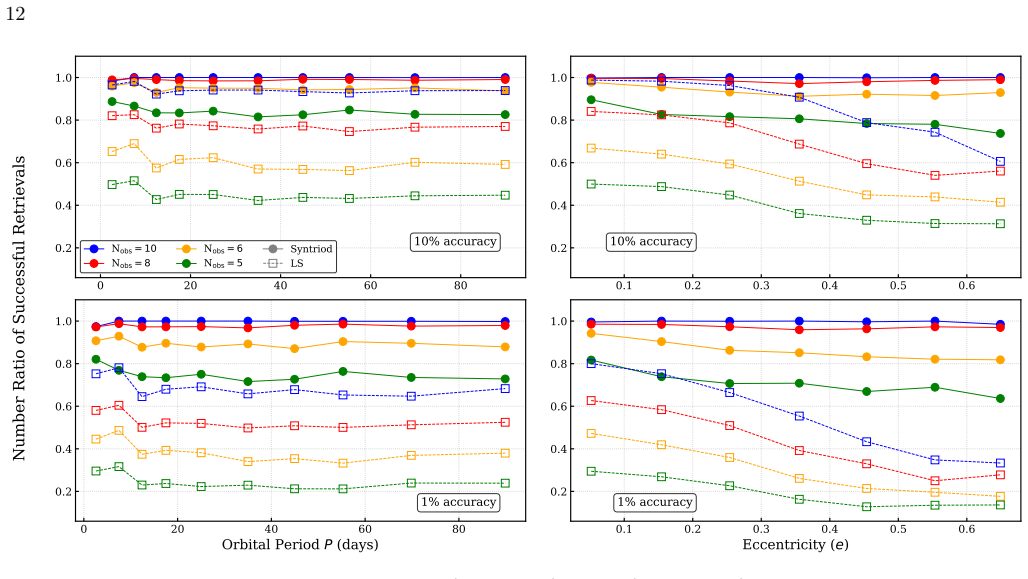
Matching sparse radial-velocity observations to a library of normalized Keplerian templates in orbital-phase space yields reliable initial orbital parameters, including periods accurate to order 10^{-3} for N_obs ≥ 8, success rates near 94 percent at N_obs = 6 and near 83 percent at N_obs = 5, while classical Lomb–Scargle periodograms become alias-dominated; below N_obs = 5 the same framework recovers mass ratio and systemic velocity from linear SB2 relations at high success rates.
What carries the argument
Syntriod: an adaptive orbital-phase-domain template matcher that scores observations against a precomputed library of Keplerian RV morphologies (e, ω grids), refined by an effective likelihood with phase-coverage, eccentricity, and trend penalties, plus an auxiliary harmonic periodogram (PSin) and dual-candidate reporting when N_obs < 7.
Load-bearing premise
The headline sparse-data success rates treat a recovery as correct if either of two returned candidate periods is close enough, and the main synthetic tests use noise-free velocities, so the quoted percentages partly rest on a two-guess allowance and idealized data.
What would settle it
Re-run the 10,000-orbit recovery campaign with realistic measurement noise and count only the single top-ranked period: if success at N_obs = 6 falls near or below Lomb–Scargle levels, or if randomly thinned real binaries no longer match literature periods, the central claim fails.
If this is right
- Orbit-fitting pipelines can seed MCMC or nested sampling from Syntriod guesses instead of fixing or narrowly restricting the period.
- Large spectroscopic surveys with few epochs per star can still extract usable initial periods and, for SB2s, mass ratios and systemic velocities.
- Eccentric and long-baseline systems that defeat sine-based periodograms become tractable for automated first-pass characterization.
- When photometry already supplies the period, two to four RV epochs can still yield dynamical mass-ratio and γ constraints.
- Runtime of seconds per system makes the method practical as a survey-scale pre-solver.
Where Pith is reading between the lines
- The same phase-domain library idea could be extended to multi-planet or hierarchical triple RV signals if the template set is enlarged to superposed Keplerians.
- Coupling Syntriod’s point estimates directly to a lightweight importance sampler might give approximate uncertainties without a full MCMC chain.
- Survey pipelines that already store sparse Gaia or LAMOST RVs could batch-run Syntriod to flag high-priority SB2 follow-up targets by recovered q.
Editorial analysis
A structured set of objections, weighed in public.
Referee Report
Summary. The manuscript presents Syntriod, a phase-domain Keplerian template-matching algorithm intended to supply initial orbital parameters (P, e, ω, T0, K, γ, and for SB2s q) for RV orbit fitters, with an auxiliary harmonic periodogram (PSin) and a linear SB2 fallback for N_obs ≤ 4. The authors validate on 10,000 synthetic Keplerian orbits across N_obs = 10, 8, 6, 5, reporting period-recovery success rates of ~99.9% (N=10), ~94% (N=6), and ~83% (N=5) against a 10% relative tolerance, versus ~94%/62%/42% for Lomb–Scargle, and demonstrate recovery of literature solutions for 12 real systems under random subsampling. For N_obs ≤ 4 they estimate q and γ via the Wilson (1941) linear relation, reporting >99% success in the ideal case.
Significance. If the quantitative claims hold, this is a useful, practical contribution: a fast, deterministic pre-solver for the sparse-RV regime that large surveys (Gaia, SDSS, LAMOST, DESI) routinely produce, where LS aliasing is a real failure mode. The paper ships several genuine strengths: an open-source implementation with configuration files and synthetic datasets on GitHub; a 10,000-orbit injection–recovery campaign with recovery scored against externally known injected parameters; a direct like-for-like LS comparison; twelve real benchmark systems spanning 0.42–3748 d; template-resolution sensitivity checks (Appendix A); and noise-injection tests (Appendix B). The template library, penalty weights, and tolerances are fixed a priori rather than fitted to the success metric, so the evaluation is not circular in construction. The concern is not the architecture but the calibration of the headline numbers, several of which are produced under best-case scoring rules and idealized data.
major comments (4)
- [§3.2, Fig. 4, footnote 4] The headline sparse-regime rates (~94% at N=6, ~83% at N=5, quoted in the abstract and §7) count a recovery as successful if EITHER of two returned candidates (main template search or auxiliary PSin) is within 10% (footnote 4, §3.2). The paper itself states the PSin second guess adds 5–10 percentage points, implying single-solution rates closer to ~85–90% (N=6) and ~73–78% (N=5). Since the method's stated purpose is to provide initial guesses to a downstream optimizer, the single-best-candidate rate is the operationally relevant number. Please report single-candidate and two-candidate rates separately in Fig. 4 and Table 3, and state the scoring rule in the abstract.
- [§3.1 and Appendix B, Fig. 11] The primary 10,000-orbit campaign is noise-free (§3.1); noise tests are deferred to Appendix B, where the dominant model scales σ to |RV| — heteroscedastic and atypical for spectroscopy, where error floors are roughly constant in km/s. The one realistic case (fixed σ = 2) exists but its global recovery fractions are never quoted in the text; Fig. 11 shows only binned curves. The abstract's 94%/83% figures therefore describe idealized data without saying so. Please add a compact table of global success rates vs. N_obs for each noise prescription (including σ = 2 and σ/|RV| = 0.05), and qualify the abstract numbers accordingly.
- [§5, Fig. 9, abstract] The abstract claims q and γ are recovered 'with success rates exceeding 99%' for N_obs ≤ 4, but §5/Fig. 9 show that with modest noise (σ = 0.05×RV) the 10%-tolerance rates drop to 90% (N=3) and 73% (N=2) for q, and only ~72% of systems fall within 20% for γ. Moreover, in the ideal N_obs = 2 case the OLS problem has two unknowns and two equations, so the noise-free solution is exact by construction and the >99% ideal rate is nearly tautological rather than evidence of skill. The abstract must carry the noise-dependent numbers, and the ideal-case framing should be corrected.
- [§2.2, §2.4.2, §3.1] The validation is in-family in three stacked ways: (i) synthetic signals are exact Keplerians, i.e., inside the searched template family; (ii) the eccentricity penalty (Eq. 12, e0 = 0.4, N0 = 8) suppresses high-e solutions in the same regime where the generation distribution (Fig. 3) is low-e weighted; (iii) the tuned weights (W_φ = 1.5, W_tr = 2, Δ0 = 3, W_Δv = 0.3) show no stated tuning protocol or holdout. Please document how the weights were chosen (and on what sample), and add at least one out-of-family stress test — e.g., orbits with e > 0.8 (outside the library grid) or perturbed/non-Keplerian curves — so readers can gauge performance when the truth is not representable by the template set.
minor comments (7)
- [§3.4, Fig. 8] Fig. 8 and §3.4 describe template-matching outputs as 'joint posterior distributions' with '1σ confidence intervals', yet §6 correctly states the method does not sample posteriors or produce formal uncertainties. Relabel as recovery/error distributions across the synthetic ensemble and remove 'confidence interval' language.
- [§2.4, Fig. 9, Eq. (6)] Notation inconsistencies: Eq. (1) uses W_Δλ L_Δλ while §2.4.1 and Eq. (9) define W_Δv L_Δv; Fig. 9 axis labels read 'e = 0' where the caption means σ_e = 0; 'σ_e = 0.05' in Fig. 9 vs 'σ/|RV|' in App. B should be unified. Also Eq. (6) uses a single σ although real errors are heteroscedastic — state what σ was used for the noise-free synthetics.
- [§2.5, Eq. (14)] Eq. (14): 'Gaussian noise (scaled by 0.1)' — 0.1 of what quantity? Give σ_perturb in absolute or fractional units and state how many perturbation realizations are run.
- [Table 1, §4.1] Table 1, HD 160934 at N_obs = 5: the period is recovered (3529 vs 3748 d) but e = 0.50 vs 0.65, ω = 20° vs 218°, K1 = 14.8 vs 7.9 km/s. The text's claim of 'consistently reproduces literature solutions' should be scoped to the period (and quantified with tolerances per parameter), or such rows flagged as partial recoveries.
- [§7] §7 calls the LS ~46% rate at N=5 the 'random-selection limit'. A random period draw over [0.1, 100] d would fall within 10% of truth far less often than 46%; either justify the phrase with an explicit random-guess baseline or delete it.
- [§1, §4.1] The 'theoretical sampling limit' N=6 is derived for SB1 (6 parameters); SB2 has 7, yet SB2 systems are included in the N=6 tests. Clarify the framing. Also the real-system subsampling is repeated only five times (§4.1); a larger number of draws (e.g., 50) would make the claimed stability more convincing.
- [§5, Eq. (10)] Typos: 'acurracy' (§5); Eq. (10) defines I_ϕ using X(ϕ) = |dX/dϕ| but the same symbol X is used for the template itself — use a distinct symbol for the gradient map.
Circularity Check
No significant circularity: recovery statistics are scored against external injected/literature truth; templates and penalties are fixed a priori, not fitted to the success metric.
full rationale
Syntriod is an engineering estimator, not a first-principles derivation of a physical law. Its load-bearing claims are empirical recovery rates of known orbital parameters. The template library is a fixed precomputed (e, ω) grid of normalized Keplerians; period search maximizes a penalized likelihood against that library; success is defined by comparison to externally known true periods (synthetic injection or published solutions). That protocol does not make the recovered period equal to an input by construction. The SB2 q–γ branch uses the classical Wilson linear relation via OLS, again scored against known truth. Penalty weights (W_φ, W_tr, e0, etc.) are stated constants, not quantities fitted to the reported success fractions and then re-presented as predictions. The only self-citation (Barbaros et al. 2025) points to a forthcoming full-orbit framework and does not underwrite the present recovery numbers. Optimistic evaluation choices (two-candidate scoring for N_obs<7, noise-free primary campaign, truth inside the template family) affect correctness risk and claimed precision, not circularity of the derivation chain. No self-definitional loop, fitted-input-as-prediction, uniqueness import, or renamed known result is present.
Axiom & Free-Parameter Ledger
free parameters (8)
- Eccentricity penalty scale e_0 =
0.4
- Eccentricity penalty reference N_0 =
8
- Differential-velocity likelihood weight W_Δv =
0.3
- Phase-coverage weight W_ϕ =
1.5
- Trend-penalty weight W_tr and threshold Δ_0 =
W_tr=2, Δ_0=3
- Velocity-separation threshold f_th =
0.6
- Template grid (e, ω) resolution =
standard: Δe=0.1, Δω=10°
- Monte Carlo perturbation scale for N_obs<7 =
0.1 × σ
axioms (5)
- domain assumption Single-lined Keplerian RV orbits are described by six parameters (P,e,ω,T0,K,γ); SB2 adds a second K (or q), so N_obs≈6 is the formal sampling limit for SB1.
- domain assumption Observed RVs are generated by pure Keplerian motion (plus optional Gaussian noise); no activity jitter, third bodies, or instrumental drifts in the core model.
- standard math Ordinary least squares / weighted linear least squares give adequate K, γ (and SB2 amplitudes) once phase and template shape are fixed.
- domain assumption Wilson’s linear relation RV2 = −q RV1 + γ(1+q) constrains q and γ independent of period when N_obs≤4.
- ad hoc to paper A finite discrete (e,ω) template library with e≤0.8 adequately represents the morphologies needed for initial guesses.
invented entities (1)
-
Syntriod algorithm (phase-domain RV template matcher + PSin + sparse linear fallback)
independent evidence
read the original abstract
We present Syntriod, an orbital-phase domain radial velocity (RV) template-based algorithm designed to provide robust initial orbital parameter estimates for spectroscopic binaries across diverse observational sampling conditions. Rather than performing full orbital inference, Syntriod constrains the parameter space with physically consistent solutions to guide subsequent optimization procedures. We evaluate its performance using 10,000 synthetic Keplerian orbits spanning diverse configurations and sampling regimes. For well-sampled datasets ($N_{obs} \ge 8$), Syntriod recovers orbital periods with relative accuracies of order $10^{-3}$. At the theoretical sampling limit ($N_{obs} = 6$), the method maintains a ~94% success rate, while classical period-search techniques like Lomb-Scargle become increasingly affected by aliasing. Even below this limit ($N_{obs} = 5$), Syntriod recovers the correct orbital solution in ~83% of cases, showing gradual degradation rather than catastrophic failure. We further evaluate the method on 12 real spectroscopic binary systems (HD 160934, Phi Cyg, Capella A, Kepler 16, KIC 3858884, KIC 6867766, KIC 2445134, KIC 3003991, DU Boo, HL Dra, FP Boo, and AK Her) spanning broad orbital periods and eccentricities. Syntriod consistently reproduces literature solutions even when datasets are randomly subsampled to sparse regimes. Where a full Keplerian solution becomes underconstrained ($N_{obs} \le 4$), the algorithm transitions to linear dynamical relations, recovering parameters such as mass ratio ($q$) and systemic velocity ($\gamma$) with success rates exceeding 99%. These results demonstrate that Syntriod provides reliable, computationally efficient initial parameter estimates across well-sampled and sparse regimes, making it a practical pre-solver for modern orbit-fitting pipelines and large spectroscopic surveys.
Figures




Reference graph
Works this paper leans on
-
[1]
Array programming with
Harris, Charles R and Millman, K Jarrod and van der Walt, St. Array programming with. Nature , volume=. 2020 , publisher=
2020
-
[2]
2020 , publisher=
Virtanen, Pauli and Gommers, Ralf and Oliphant, Travis E and others , journal=. 2020 , publisher=
2020
-
[3]
Computing in science & engineering , volume=
Matplotlib: A 2D graphics environment , author=. Computing in science & engineering , volume=. 2007 , publisher=
2007
-
[4]
Proceedings of the 9th Python in Science Conference , volume=
Data structures for statistical computing in Python , author=. Proceedings of the 9th Python in Science Conference , volume=. 2010 , organization=
2010
-
[5]
Proceedings of the Second Workshop on the LLVM Compiler Infrastructure in HPC , pages=
Numba: A LLVM-based Python JIT compiler , author=. Proceedings of the Second Workshop on the LLVM Compiler Infrastructure in HPC , pages=
-
[6]
2009 , publisher=
Python 3 Reference Manual , author=. 2009 , publisher=
2009
-
[7]
and Nayak, Manoj and Khamari Sharma, Nachieketa and Das, R
Kamilla, S.K. and Nayak, Manoj and Khamari Sharma, Nachieketa and Das, R. and Pattnaik, Sam , year =. Binary Star System- A Spectral Analysis , volume =
-
[8]
2003 , school=
Spectral disentangling of close binary stars , author=. 2003 , school=
2003
-
[9]
A Photoelectric Radial-Velocity Spectrometer , volume =
Griffin, R.F , year =. A Photoelectric Radial-Velocity Spectrometer , volume =
-
[10]
, journal=
Shannon, C.E. , journal=. Communication in the Presence of Noise , year=
-
[11]
2015 , eprint=
The rvfit Code: A Detailed Adaptive Simulated Annealing Code for Fitting Binaries and Exoplanets Radial Velocities , author=. 2015 , eprint=
2015
-
[12]
Fulton, Benjamin J. and Petigura, Erik A. and Blunt, Sarah and Sinukoff, Evan , year=. RadVel: The Radial Velocity Modeling Toolkit , volume=. Publications of the Astronomical Society of the Pacific , publisher=. doi:10.1088/1538-3873/aaaaa8 , number=
-
[13]
juliet: a versatile modelling tool for transiting and non-transiting exoplanetary systems , volume=
Espinoza, Néstor and Kossakowski, Diana and Brahm, Rafael , year=. juliet: a versatile modelling tool for transiting and non-transiting exoplanetary systems , volume=. Monthly Notices of the Royal Astronomical Society , publisher=. doi:10.1093/mnras/stz2688 , number=
-
[14]
2020 , eprint=
A Python Code to Determine Orbital Parameters of Spectroscopic Binaries , author=. 2020 , eprint=
2020
-
[15]
, year = 1953, month = jun, volume =
Equation of State Calculations by Fast Computing Machines. , year = 1953, month = jun, volume =. doi:10.1063/1.1699114 , adsurl =
-
[16]
Biometrika , year = 1970, month = apr, volume =
Monte Carlo Sampling Methods using Markov Chains and their Applications. Biometrika , year = 1970, month = apr, volume =. doi:10.1093/biomet/57.1.97 , adsurl =
-
[17]
and Lang, Dustin and Goodman, Jonathan , year=
Foreman-Mackey, Daniel and Hogg, David W. and Lang, Dustin and Goodman, Jonathan , year=. <tt>emcee</tt>: The MCMC Hammer , volume=. Publications of the Astronomical Society of the Pacific , publisher=. doi:10.1086/670067 , number=
-
[18]
Nested Sampling. Bayesian Inference and Maximum Entropy Methods in Science and Engineering: 24th International Workshop on Bayesian Inference and Maximum Entropy Methods in Science and Engineering , year = 2004, editor =. doi:10.1063/1.1835238 , adsurl =
-
[19]
The Joker: A Custom Monte Carlo Sampler for Binary-star and Exoplanet Radial Velocity Data. , keywords =. doi:10.3847/1538-4357/aa5e50 , archivePrefix =. 1610.07602 , primaryClass =
-
[20]
VanderPlas, Jacob T. , year=. Understanding the Lomb–Scargle Periodogram , volume=. The Astrophysical Journal Supplement Series , publisher=. doi:10.3847/1538-4365/aab766 , number=
-
[21]
Deeming, T. J. , year=. Fourier analysis with unequally-spaced data , journal=
-
[22]
The generalised Lomb-Scargle periodogram - A new formalism for the floating-mean and Keplerian periodograms , DOI= "10.1051/0004-6361:200811296", url= "https://doi.org/10.1051/0004-6361:200811296", journal =
-
[23]
Bayesian Logical Data Analysis for the Physical Sciences: A Comparative Approach with Mathematica® Support , publisher=
Gregory, Phil , year=. Bayesian Logical Data Analysis for the Physical Sciences: A Comparative Approach with Mathematica® Support , publisher=
-
[24]
Data reduction and error analysis for the physical sciences
-
[25]
An Introduction to Close Binary Stars
-
[26]
, year = 1941, month = jan, volume =
On the Determination of Mass Ratios of Spectroscopic Binaries. , year = 1941, month = jan, volume =. doi:10.1086/144239 , adsurl =
-
[27]
The Annals of Mathematical Statistics , year = 1958, volume =
Bias and confidence in not-quite large samples. The Annals of Mathematical Statistics , year = 1958, volume =
1958
-
[28]
2007 , publisher=
Numerical Recipes 3rd Edition: The Art of Scientific Computing , author=. 2007 , publisher=
2007
-
[29]
Statistical properties of exoplanets. IV. The period-eccentricity relations of exoplanets and of binary stars. , keywords =. doi:10.1051/0004-6361:20041219 , archivePrefix =. astro-ph/0410732 , primaryClass =
-
[30]
A Survey of Stellar Families: Multiplicity of Solar-type Stars. , keywords =. doi:10.1088/0067-0049/190/1/1 , archivePrefix =. 1007.0414 , primaryClass =
-
[31]
S _ B ^ 9 : The ninth catalogue of spectroscopic binary orbits. , keywords =. doi:10.1051/0004-6361:20041213 , archivePrefix =. astro-ph/0406573 , primaryClass =
-
[32]
Tokovinin, A. and Kiyaeva, O. , title =. Monthly Notices of the Royal Astronomical Society , volume =. 2015 , month =. doi:10.1093/mnras/stv2825 , url =
-
[33]
Astropy: A community Python package for astronomy. , keywords =. doi:10.1051/0004-6361/201322068 , archivePrefix =. 1307.6212 , primaryClass =
-
[34]
The Journal of Open Source Software , year = 2016, month = jun, volume =
corner.py: Scatterplot matrices in Python. The Journal of Open Source Software , year = 2016, month = jun, volume =. doi:10.21105/joss.00024 , adsurl =
-
[35]
Astronomical Society of India Conference Series , year = 2014, series =
iSpec: An integrated software framework for the analysis of stellar spectra. Astronomical Society of India Conference Series , year = 2014, series =. doi:10.48550/arXiv.1312.4545 , archivePrefix =. 1312.4545 , primaryClass =
-
[36]
and Paletou, Frédéric and Manset, N
Petit, Pascal and Louge, Thierry and Théado, S. and Paletou, Frédéric and Manset, N. and MORIN, Julien and Marsden, Stephen and Jeffers, S.V. , year =. Polar Base: A Database of High-Resolution Spectropolarimetric Stellar Observations , volume =. Publications of the Astronomical Society of the Pacific , doi =
-
[37]
O'Connell, D. J. K. , year =. The so-called O'Connell effect , volume =. Publications of the Riverview College Observatory , doi =
-
[38]
, author=
The Orbit of the Spectroscopic Binary Phi Cygni. , author=. The Astrophysical Journal , year=
-
[39]
Torres, Guillermo and Claret, Antonio and Pavlovski, Krešimir and Dotter, Aaron , title =. 2015 , month =. doi:10.1088/0004-637X/807/1/26 , url =
-
[40]
and Mahadevan, Suvrath and Deshpande, Rohit and Wright, Jason T
Bender, Chad F. and Mahadevan, Suvrath and Deshpande, Rohit and Wright, Jason T. and Roy, Arpita and Terrien, Ryan C. and Sigurdsson, Steinn and Ramsey, Lawrence W. and Schneider, Donald P. and Fleming, Scott W. , year=. THE SDSS-HET SURVEY OF KEPLER ECLIPSING BINARIES: SPECTROSCOPIC DYNAMICAL MASSES OF THE KEPLER-16 CIRCUMBINARY PLANET HOSTS , volume=. T...
-
[41]
and Silva, R
Maceroni, Carla and Lehmann, H. and Silva, R. and Montalbán, Josefina and Lee, Chung-Uk and Ak, Ha and Deshpande, R. and Yakut, Kadri and Debosscher, Jonas and Guo, Zhao and Kim, Sunghyok and Lee, Jae-Woo and Southworth, J. , year =. KIC 3858884: A hybrid δ Scuti pulsator in a highly eccentric eclipsing binary , volume =. Astronomy & Astrophysics , doi =
-
[42]
and Agol, Eric and Ak, Hasan and Bastien, Fabienne and Bizyaev, Dmitry and Crepp, Justin and Ford, Eric and Frinchaboy, Peter and Zasowski, Gail , year =
Fleming, Scott and Mahadevan, Suvrath and Deshpande, Rohit and Bender, Chad and Terrien, Ryan and Marchwinski, Robert and Wang, Ji and Roy, Arpita and Stassun, Keivan and Prieto, Carlos and Cunha, Katia and Smith, V. and Agol, Eric and Ak, Hasan and Bastien, Fabienne and Bizyaev, Dmitry and Crepp, Justin and Ford, Eric and Frinchaboy, Peter and Zasowski, ...
-
[43]
and Hambleton, Kelly and Fleming, Scott W
Mahadevan, Suvrath and Bender, Chad F. and Hambleton, Kelly and Fleming, Scott W. and Deshpande, Rohit and Conroy, Kyle and Matijevič, Gal and Hebb, Leslie and Roy, Arpita and Ak, Hasan and Leban, Blaž and Prša, Andrej , title =. 2019 , month =. doi:10.3847/1538-4357/ab3793 , url =
-
[44]
and Lu, Wenxian and Mochnacki, Stefan W
Pribulla, Theodor and Rucinski, Slavek M. and Lu, Wenxian and Mochnacki, Stefan W. and Conidis, George and Blake, R. M. and DeBond, Heide and Thomson, J. R. and Pych, Wojtek and Ogłoza, Waldemar and Siwak, Michal , title =. 2006 , month =. doi:10.1086/505536 , url =
-
[45]
Orbits of six late-type active-chromosphere binaries. , keywords =. doi:10.1007/s10509-010-0381-3 , archivePrefix =. 1004.1835 , primaryClass =
-
[46]
Radial Velocity Studies of Close Binary Stars. X. , keywords =. doi:10.1086/431226 , archivePrefix =. astro-ph/0503041 , primaryClass =
-
[47]
The Observatory , year = 2013, month = dec, volume =
Spectroscopic binary orbits from photoelectric radial velocities - Paper 233: HD 17922, HD 78899, HD 103613, and HD 160934, with a Note on HD 113449. The Observatory , year = 2013, month = dec, volume =
2013
-
[48]
Journal of Astronomical Telescopes, Instruments, and Systems , year = 2015, month = jan, volume =
Transiting Exoplanet Survey Satellite (TESS). Journal of Astronomical Telescopes, Instruments, and Systems , year = 2015, month = jan, volume =. doi:10.1117/1.JATIS.1.1.014003 , adsurl =
-
[49]
The Gaia mission. , keywords =. doi:10.1051/0004-6361/201629272 , archivePrefix =. 1609.04153 , primaryClass =
-
[50]
Optimal placement of a limited number of observations for period searches. , keywords =. doi:10.1051/0004-6361:20054764 , archivePrefix =. astro-ph/0605421 , primaryClass =
-
[51]
Variable stars: Which Nyquist frequency?. , keywords =. doi:10.1051/aas:1999102 , archivePrefix =. astro-ph/9808176 , primaryClass =
-
[52]
and Catala, C
Rauer, H. and Catala, C. and Aerts, C. and Appourchaux, T. and Benz, W. and Brandeker, A. and Christensen-Dalsgaard, J. and Deleuil, M. and Gizon, L. and Goupil, M.-J. and Güdel, M. and Janot-Pacheco, E. and Mas-Hesse, M. and Pagano, I. and Piotto, G. and Pollacco, D. and Santos, Ċ. and Smith, A. and Suárez, J.-C. and Szabó, R. and Udry, S. and Adibekyan,...
-
[53]
A period-finding method for sparse randomly spaced observations or ``How long is a piece of string ?''. , keywords =. doi:10.1093/mnras/203.4.917 , adsurl =
-
[54]
Period determination using phase dispersion minimization. , keywords =. doi:10.1086/156444 , adsurl =
-
[55]
Very Fast Simulated Re-Annealing , volume =
Ingber, A and Ingber, Lester , year =. Very Fast Simulated Re-Annealing , volume =. Mathematical and Computer Modelling , doi =
-
[56]
The Sloan Digital Sky Survey: Technical Summary. , keywords =. doi:10.1086/301513 , archivePrefix =. astro-ph/0006396 , primaryClass =
-
[57]
Research in Astronomy and Astrophysics , year = 2012, month = sep, volume =
The Large Sky Area Multi-Object Fiber Spectroscopic Telescope (LAMOST). Research in Astronomy and Astrophysics , year = 2012, month = sep, volume =. doi:10.1088/1674-4527/12/9/003 , adsurl =
-
[58]
Bulletin of the American Astronomical Society , year = 2019, volume =
The Dark Energy Spectroscopic Instrument (DESI). Bulletin of the American Astronomical Society , year = 2019, volume =. doi:10.48550/arXiv.1907.10688 , archivePrefix =. 1907.10688 , primaryClass =
-
[59]
Kepler Planet-Detection Mission: Introduction and First Results. Science , keywords =. doi:10.1126/science.1185402 , adsurl =
-
[60]
Turkish Journal of Astronomy and Astrophysics , keywords =
Bayesian Radial Velocity Solver: BRaVe. Turkish Journal of Astronomy and Astrophysics , keywords =. doi:10.55064/tjaa.1598320 , adsurl =
-
[61]
J. A. Hartigan and P. M. Hartigan , journal =. The Dip Test of Unimodality , urldate =
-
[62]
, year = 1971, month = aug, volume =
Spectroscopic binaries with circular orbits. , year = 1971, month = aug, volume =. doi:10.1086/111159 , adsurl =
doi:10.1086/111159 1971
discussion (0)
Sign in with ORCID, Apple, or X to comment. Anyone can read and Pith papers without signing in.