REVIEW 4 major objections 8 minor 132 references
Making attention intrinsic and triangulation-agnostic turns it into a strong default layer for learning on triangle meshes.
Reviewed by Pith at T0; open to challenge. T0 means a machine referee read the full paper against a public rubric. the ladder, T0–T4 →
T0 review · grok-4.5
2026-07-31 04:59 UTC pith:YXWHNPOS
load-bearing objection Simple mass-weighted FEM attention on intrinsic backbones is a real, usable technique; the mechanism claims hold, while the broadest “beats all transformers” headline overreaches on soft baselines. the 4 major comments →
Intrinsic and Triangulation-Agnostic Attention: A Simple and Powerful Approach for Learning on Meshes
The pith
A machine-rendered reading of the paper's core claim, the machinery that carries it, and where it could break.
Core claim
If attention’s queries, keys, and values are produced by an intrinsic triangulation-agnostic network and the attention integrals are discretized with lumped-mass FEM quadrature, the mechanism itself becomes intrinsic and triangulation-agnostic, and that alone is enough to reach or exceed state-of-the-art accuracy on several standard mesh learning tasks.
What carries the argument
Mass-weighted mesh attention: continuous softmax attention rewritten as surface integrals, then discretized so each vertex’s aggregated feature is a lumped-mass-weighted sum of values (self-attention) or ordinary attention when keys/values live off-mesh (cross-attention), with an O(h²+ε) approximation guarantee under smooth fields.
Load-bearing premise
The claim rests on the idea that simple mass-weighted quadrature of continuous attention, fed by an existing intrinsic backbone on single-component manifold meshes, is accurate enough that the measured gains really come from triangulation-agnostic attention rather than backbone capacity or training setup.
What would settle it
Train the same backbone with and without mass weighting on a held-out set of heavily re-triangulated meshes (coarsened, subdivided, variable density) for high-frequency eigenfunction regression; if mass weighting does not preserve accuracy while naive attention collapses, or if a carefully tuned point-cloud transformer matches the intrinsic results on identical splits, the central claim is weakened.
If this is right
- Mesh learning pipelines can add self- and cross-attention without giving up discretization robustness or the surface metric.
- Cross-attention becomes a stronger conditioner than concatenating pose or other signals into mesh MLPs, enabling finer articulated deformation.
- Features from the high-frequency predictor support dense full and partial correspondence via simple nearest-neighbor matching, without a specialized matching network.
- Older intrinsic backbones can be upgraded with these layers and still surpass newer attention-free mesh methods on deformation.
- The same construction suggests mesh-native representation learning and multimodal conditioning (vision/language) via cross-attention.
Where Pith is reading between the lines
- Because self-attention cost still grows with vertex count, practical scaling may require hierarchical or sparse intrinsic attention rather than dense mass-weighted softmax alone.
- Extending the same continuous-integral view across multiple connected components could remove the single-manifold restriction without abandoning triangulation-agnosticism.
- If mass weighting is the decisive inductive bias, lighter backbones than full PDE-based blocks might still deliver most of the gain once Q/K/V are intrinsic.
- Correspondence results from a naïve feature matcher imply that stronger map regularizers on top of these features could push partial and non-humanoid matching further.
Editorial analysis
A structured set of objections, weighed in public.
Referee Report
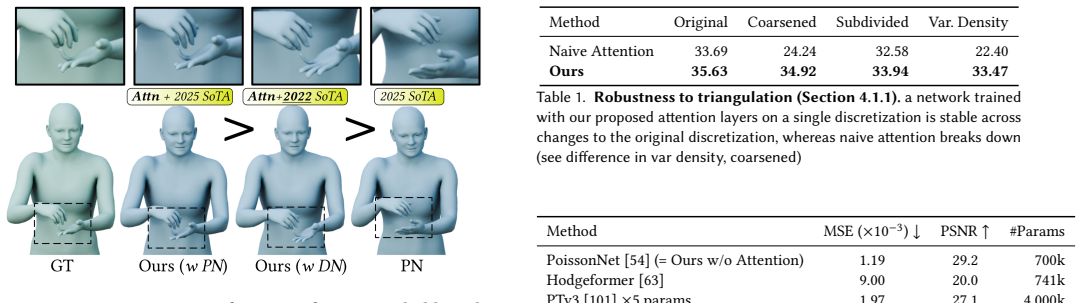
Summary. The paper adapts attention to triangle meshes by enforcing two properties: intrinsicality and triangulation-agnosticism. Queries, keys, and values are produced by an intrinsic, discretization-agnostic backbone (PoissonNet or DiffusionNet) and treated as samples of continuous fields; attention is then defined as continuous softmax-weighted integration over the surface and discretized with standard lumped-mass FEM quadrature, yielding a mass-weighted softmax attention that plugs into memory-efficient kernels. Cross-attention to discrete conditioning signals is shown to be triangulation-agnostic by construction (O(ε) error, App. A); self-attention is shown to approximate its continuous counterpart to O(h²+ε) (App. B). Empirically the authors report gains over mesh and point-cloud baselines on high-frequency eigenfunction prediction (Table 2), single- and arbitrary-source deformation including finger articulation (Tables 3–4), dense full and partial correspondence (Table 5), and HKS prediction on Thingi10K (Table 6), with runtime/memory analysis in Table 7.
Significance. If the claims hold, this is a useful and likely influential contribution to geometry processing: it closes a genuine gap (no prior intrinsic, triangulation-agnostic attention for meshes) with a minimal, easily adoptable modification. Notable strengths: formal discretization-error proofs (O(ε) cross-attention, O(h²+ε) self-attention) in Appendices A–B; well-designed internal controls (Table 1 mass-weighting ablation on coarsened/subdivided/variable-density meshes; Tables 3–4 backbone and component ablations with identical losses, including the hand-vertex loss, applied to baselines); a striking retroactive result (DiffusionNet+attention beating 2025 PoissonNet); and zero-shot transfer to external correspondence benchmarks (FAUST/SCAPE/SH19/DT4D) at 0.2 s per sample versus ~2 min for DiffuMatch. The limitation on the headline SOTA comparison (major comment 1) and missing variance reduce confidence in the breadth, not the core mechanism.
major comments (4)
- [§4.1.2, Table 2, §B.5.2] Table 2 is the sole quantitative support for the headline claim of 'exceeding point cloud transformers', but by the paper's own account (§B.5.2) two of the three transformer baselines did not converge: HodgeFormer 'fails to converge to satisfactory results' under both LR settings tried, and the parameter-matched PTV3 (5M) 'fails to converge even on the original discretization'. The only converged transformer baseline is PTV3 at 66x the parameters, trailing by 1.4 dB (33.8 vs 35.2) with no variance estimate. The comparison against PoissonNet (same backbone ±attention, 29.2→35.2 dB) is clean and convincing, but the broader SOTA claim needs repair: either (a) obtain converged HodgeFormer and parameter-matched PTV3 numbers (e.g., with author-provided configs or LR/schedule search on the regression task), or (b) scope the claim to what is demonstrated. As written, the abstract/intro overstate
- [§4, Tables 1–6; §B.3–B.5] Every table reports a single run, with 'the results of the best-performing model' (§B.3.1/B.4.1/B.5.1) and no seed variance. Several conclusions rest on margins that could be within run-to-run noise: Table 2 (1.4 dB over PTV3-46M), Table 5 (1.24 vs 1.7 on FAUST; 2.83 vs 3.4 on SH19), Table 6 (1.8 vs 2.8). Please report mean±std over at least 3 seeds for the headline tables, and clarify the checkpoint-selection protocol (best on which split — is the validation set also the test set?). This is cheap to add and materially affects the strength of the claims.
- [§3.4, Appendix B (Prop. B.1, Eq. 13)] The O(h²+ε) bound assumes (i) q,k,v ∈ C²(Ω), (ii) bounded keys/values, (iii) the quadrature estimate Eq. (13) at O(h²), and (iv) ε (the backbone's own discretization error) small. Learned features need not be C²; ε is asserted, not controlled; and Eq. (13) at O(h²) for lumped-mass vertex quadrature holds under mesh-quality assumptions (e.g., Delaunay-type triangulations) that are not stated — for obtuse meshes lumped masses can even be non-positive (the 1e-8 epsilon in §B.1 hints at this). Please state the mesh-regularity assumptions explicitly and add a numerical convergence study: you already have coarsened/subdivided variants (Table 1), so reporting attention-output error versus h on a known signal would directly validate the claimed rate, which currently is supported only qualitatively (Fig. 2).
- [§4.3, Table 5, §B.6] The correspondence model is trained only on SMPL humans (eigenfunction prediction with rotation/face-deletion augmentation, §B.6.1) and then evaluated on human-centric benchmarks (FAUST, SCAPE, SH19, DT4D) against DiffuMatch, which is category-agnostic. The 4-of-5 win is impressive as zero-shot transfer, but the domain asymmetry should be stated alongside Table 5, and the failure mode (DT4D-Intra, attributed to non-humanoid outliers) arguably illustrates the training-domain restriction rather than an anomaly. Also, baseline numbers are imported from DiffuMatch's Table 1: please confirm identical test splits and evaluation code for every imported entry (§B.6.2 says 'nearly all' reproduced — specify which entries differ).
minor comments (8)
- [§1] §1 states the discretizations have 'linearly-bounded error', but the self-attention bound is O(h²+ε). Clarify that 'linear' refers to ε only.
- [various] Typos: 'awarness' (§4.1.2), 'discretiation' (Appendix B, first line), 'feature extract' (Fig. 10 caption), 'Franccois' (ref [36]), 'learning overtriangle mesheshave' (§1).
- [§3.1, §B.1] The softmax in Eqs. (2)/(5) omits the usual 1/√d scaling. Please state whether scaling is used in practice and whether the log-mass addition (§B.1) interacts with it.
- [§3.4, Eqs. (8)–(11)] Eq. (9) defines α without M in the numerator, and Eq. (10) then re-applies M; readers may misread α as the final attention weight. Consider presenting Eq. (11) directly as 'softmax with a log-mass bias, followed by a mass-weighted value aggregation', which matches the §B.1 implementation.
- [§4.5, Table 7] Table 7 shows a 10x slowdown from self-attention at 300k faces (1039 ms vs 101 ms). A sentence on practical mesh-size limits, and whether sparse/local attention is compatible with the mass-weighted formulation, would help practitioners.
- [§B.1] Only single-head attention is used (§B.1). A brief ablation on head count (or a sentence justifying one head) would be useful.
- [Fig. 2, §4.1.1] Fig. 2: state how ground truth on the re-triangulated mesh was obtained (interpolation via closest point? recomputed eigenfunctions?), since eigenfunctions are mesh-dependent and sign/order-ambiguous at higher frequencies.
- [§4 / Supplement] Please state whether code and trained models will be released; the method's simplicity makes it easy to reimplement, but the baseline training details (Pointcept configs, HodgeFormer settings) matter for reproducibility of Table 2.
Circularity Check
No significant circularity: empirical mesh-attention method with self-contained FEM discretization and external benchmark evaluation.
full rationale
The paper's load-bearing construction is a standard continuous-to-discrete step: Q/K/V are produced by an off-the-shelf intrinsic backbone, treated as samples of continuous fields, and attention is defined via surface integrals (Eqs. 5–7) then discretized by lumped-mass quadrature (Eqs. 8–11), with O(ε) and O(h²+ε) error bounds proved in Appendices A–B from elementary analysis/FEM. That chain does not define the output in terms of the target quantity, nor fit a parameter and relabel it as a prediction. Empirical claims (high-frequency signals, deformation, correspondence, HKS) are trained and scored on held-out poses, OOD shapes, Thingi10K, and external correspondence suites (FAUST, SCAPE, etc.), so results are not forced by normalization identities. Use of PoissonNet/DiffusionNet (including author-overlapping PoissonNet) is ordinary backbone choice and ablation control (Tables 3–4), not a self-citation uniqueness theorem or ansatz that makes the central claim true by construction. No circular steps meet the quote-and-reduce standard.
Axiom & Free-Parameter Ledger
free parameters (4)
- Attention channel dims (cross 128, self 126) and single head =
128 / 126, 1 head
- Training hyperparameters (lr=0.005, 200k iters, batch 16, hand loss λ=1) =
Adam lr 0.005; λ_hand=1
- Number of predicted eigenfunctions / PE dimension (first 64) =
64
- Lumped-mass epsilon 1e-8 before log-mass in softmax =
1e-8
axioms (5)
- domain assumption Mesh functions are treated as samples of continuous fields on a manifold approximated by the triangulation; triangulation-agnosticism means F_i ≈ F(x_i).
- standard math Lumped-mass vertex quadrature approximates integrals of C² integrands with O(h²) error.
- domain assumption Q/K/V produced by PoissonNet or DiffusionNet are sufficiently intrinsic and triangulation-agnostic when inputs are.
- ad hoc to paper Keys/values bounded and fields C² so attention discretization error bounds apply to learned features.
- domain assumption SMPL correspondence and transferred Laplacian eigenfunctions define a valid multi-mesh supervised signal for intrinsic learning.
invented entities (1)
-
Mass-weighted intrinsic mesh self-attention (FEM quadrature form of continuous softmax attention)
independent evidence
read the original abstract
This work proposes an adaptation of the attention mechanism for triangle meshes. The core observation is that endowing the attention mechanism with critical properties for learning over meshes -- intrinsicality and triangulation-agnosticism -- enables it to attain state-of-the-art results over several learning-based tasks in geometry-processing. The above is achieved by modifying the attention mechanism from the bottom up based on simple principles from geometry-processing. Namely, the quantities used within attention -- queries, keys and values -- are created by an intrinsic, triangulation-agnostic network, and treated as discretizations of continuous functions. From that, we devise an appropriate attention mechanism that operates over triangle meshes through standard FEM discretization of the resulting integrals of the above functions. Surprisingly, as far as we know, this straightforward approach has not been utilized for learning over meshes. Experiments show our method exceeds current state of the art, including both mesh-based architectures as well as point cloud transformers. Namely, we show significant improvements on several common benchmarks and tasks -- predicting canonical high-frequency signals; predicting deformations; computing dense correspondences, both between full shapes and partial ones; and predicting feature descriptors.
Figures




Reference graph
Works this paper leans on
-
[1]
Ahmed Abdelreheem, Abdelrahman Eldesokey, Maks Ovsjanikov, and Peter Wonka. 2023. Zero-Shot 3D Shape Correspondence. InSIGGRAPH Asia 2023 Con- ference Papers(Sydney, NSW, Australia)(SA ’23). Association for Computing Ma- chinery, New York, NY, USA, Article 59, 11 pages. doi:10.1145/3610548.3618228
arXiv 2023
-
[2]
Noam Aigerman, Kunal Gupta, Vladimir G Kim, Siddhartha Chaudhuri, Jun Saito, and Thibault Groueix. 2022. Neural jacobian fields: Learning intrinsic mappings of arbitrary meshes.SIGGRAPH(2022)
2022
-
[3]
Noam Aigerman, Roi Poranne, and Yaron Lipman. 2014. Lifted bijections for low distortion surface mappings.ACM Trans. Graph.33, 4, Article 69 (July 2014), 12 pages. doi:10.1145/2601097.2601158
arXiv 2014
-
[4]
Dragomir Anguelov, Praveen Srinivasan, Daphne Koller, Sebastian Thrun, Jim Rodgers, and James Davis. 2005. SCAPE: Shape Completion and Animation of People. InSIGGRAPH
2005
-
[5]
Souhaib Attaiki and Maks Ovsjanikov. 2023. Shape non-rigid kinematics (snk): A zero-shot method for non-rigid shape matching via unsupervised functional map regularized reconstruction.Advances in Neural Information Processing Systems 36 (2023), 70012–70032
2023
-
[6]
Souhaib Attaiki, Gautam Pai, and Maks Ovsjanikov. 2021. Dpfm: Deep partial functional maps. In2021 International Conference on 3D Vision (3DV). IEEE, 175–185
2021
-
[7]
Stephen W Bailey, Dalton Omens, Paul Dilorenzo, and James F O’Brien. 2020. Fast and deep facial deformations.ACM Transactions on Graphics (TOG)39, 4 (2020), 94–1
2020
-
[8]
Bailey, Dave Otte, Paul Dilorenzo, and James F
Stephen W. Bailey, Dave Otte, Paul Dilorenzo, and James F. O’Brien. 2018. Fast and Deep Deformation Approximations.ACM Transactions on Graphics37, 4 (Aug. 2018), 119:1–12. doi:10.1145/3197517.3201300 Presented at SIGGRAPH 2018, Los Angeles
arXiv 2018
-
[9]
Federica Bogo, Angjoo Kanazawa, Christoph Lassner, Peter Gehler, Javier Romero, and Michael J. Black. 2016. Keep it SMPL: Automatic Estimation of 3D Human Pose and Shape from a Single Image. InComputer Vision – ECCV 2016 (Lecture Notes in Computer Science). Springer International Publishing
2016
-
[10]
Federica Bogo, Javier Romero, Matthew Loper, and Michael J. Black. 2014. FAUST: Dataset and evaluation for 3D mesh registration. InCVPR
2014
-
[11]
Davide Boscaini, Jonathan Masci, Emanuele Rodolà, and Michael Bronstein. 2016. Learning shape correspondence with anisotropic convolutional neural networks. Advances in neural information processing systems29 (2016)
2016
-
[12]
Michael M Bronstein, Joan Bruna, Yann LeCun, Arthur Szlam, and Pierre Van- dergheynst. 2017. Geometric deep learning: going beyond euclidean data.IEEE Signal Processing Magazine34, 4 (2017), 18–42
2017
-
[13]
Shuhao Cao. 2021. Choose a Transformer: Fourier or Galerkin. InAdvances in Neural Information Processing Systems (NeurIPS 2021), Vol. 34. arXiv:arXiv: 2105.14995 [cs.CL] https://openreview.net/forum?id=ssohLcmn4-r
Pith/arXiv arXiv 2021
-
[14]
Mathilde Caron, Hugo Touvron, Ishan Misra, Hervé Jégou, Julien Mairal, Piotr Bojanowski, and Armand Joulin. 2021. Emerging Properties in Self-Supervised Vision Transformers. InProceedings of the International Conference on Computer Vision (ICCV)
2021
-
[15]
Junhyeong Cho, Kim Youwang, and Tae-Hyun Oh. 2022. Cross-Attention of Disentangled Modalities for 3D Human Mesh Recovery with Transformers. In European Conference on Computer Vision (ECCV)
2022
-
[16]
Pointcept Contributors. 2023. Pointcept: A Codebase for Point Cloud Perception Research. https://github.com/Pointcept/Pointcept
2023
-
[17]
Fu, Stefano Ermon, Atri Rudra, and Christopher Ré
Tri Dao, Daniel Y. Fu, Stefano Ermon, Atri Rudra, and Christopher Ré. 2022. FlashAttention: Fast and Memory-Efficient Exact Attention with IO-Awareness. InAdvances in Neural Information Processing Systems (NeurIPS)
2022
-
[18]
Tri Dao and Albert Gu. 2024. Transformers are SSMs: Generalized Models and Efficient Algorithms Through Structured State Space Duality. InInternational Conference on Machine Learning (ICML)
2024
-
[19]
Pim De Haan, Maurice Weiler, Taco Cohen, and Max Welling. 2020. Gauge equivariant mesh cnns: Anisotropic convolutions on geometric graphs.arXiv preprint arXiv:2003.05425(2020)
Pith/arXiv arXiv 2020
-
[20]
Theo Deprelle, Thibault Groueix, Matthew Fisher, Vladimir G Kim, Bryan C Russell, and Mathieu Aubry. 2019. Learning elementary structures for 3D shape generation and matching. InNeurips
2019
-
[21]
Nicolas Donati, Abhishek Sharma, and Maks Ovsjanikov. 2020. Deep geometric functional maps: Robust feature learning for shape correspondence. InProceed- ings of the IEEE/CVF Conference on Computer Vision and Pattern Recognition. 8592–8601
2020
-
[22]
Alexey Dosovitskiy, Lucas Beyer, Alexander Kolesnikov, Dirk Weissenborn, Xiaohua Zhai, Thomas Unterthiner, Mostafa Dehghani, Matthias Minderer, Georg Heigold, Sylvain Gelly, Jakob Uszkoreit, and Neil Houlsby. 2021. An Image is Worth 16x16 Words: Transformers for Image Recognition at Scale.ICLR(2021)
2021
-
[23]
Marvin Eisenberger, Zorah Lähner, and Daniel Cremers. 2019. Smooth Shells: Multi-Scale Shape Registration with Functional Maps. doi:10.48550/arXiv.1905. 12512
-
[24]
Mohammad Farazi and Yalin Wang. 2024. A Recipe for Geometry-Aware 3D Mesh Transformers.2025 IEEE/CVF Winter Conference on Applications of Computer Vision (W ACV)(2024), 3290–3300. https://api.semanticscholar.org/CorpusID: 273798014
2024
-
[25]
Matthias Fey, Jan Eric Lenssen, Frank Weichert, and Heinrich Müller. 2018. Splinecnn: Fast geometric deep learning with continuous b-spline kernels. In Proceedings of the IEEE conference on computer vision and pattern recognition. 869–877
2018
-
[26]
Lawson Fulton, Vismay Modi, David Duvenaud, David I. W. Levin, and Alec Jacobson. 2019. Latent-space Dynamics for Reduced Deformable Simulation. Computer Graphics Forum(2019)
2019
-
[27]
Lin Gao, Jie Yang, Tong Wu, Yu-Jie Yuan, Hongbo Fu, Yu-Kun Lai, and Hao Zhang. 2019. SDM-NET: Deep generative network for structured deformable mesh.ACM Transactions on Graphics (TOG)38, 6 (2019), 1–15
2019
-
[28]
Kim, and Rana Hanocka
William Gao, Noam Aigerman, Thibault Groueix, Vladimir G. Kim, and Rana Hanocka. 2023. TextDeformer: Geometry Manipulation using Text Guidance. SIGGRAPH (Conference track)(2023)
2023
-
[29]
Oshri Halimi, Or Litany, Emanuele Rodola, Alex M Bronstein, and Ron Kimmel
-
[30]
Rana Hanocka, Amir Hertz, Noa Fish, Raja Giryes, Shachar Fleishman, and Daniel Cohen-Or. 2019. MeshCNN: a network with an edge.ACM Trans. Graph.38, 4, Article 90 (July 2019), 12 pages. doi:10.1145/3306346.3322959
arXiv 2019
-
[31]
Wenchong He, Zhe Jiang, Chengming Zhang, and Arpan Man Sainju. 2020. CurvaNet: Geometric deep learning based on directional curvature for 3D shape analysis. InProceedings of the 26th ACM SIGKDD International Conference on Knowledge Discovery & Data Mining. 2214–2224
2020
-
[32]
Daniel Holden, Jun Saito, and Taku Komura. 2015. Learning an Inverse Rig Mapping for Character Animation. InProceedings of the 14th ACM SIGGRAPH / Eurographics Symposium on Computer Animation(Los Angeles, California) (SCA ’15). Association for Computing Machinery, New York, NY, USA, 165–173. doi:10.1145/2786784.2786788
arXiv 2015
-
[33]
Alec Jacobson, Ilya Baran, Jovan Popovic, and Olga Sorkine. 2011. Bounded biharmonic weights for real-time deformation.ACM Trans. Graph.30, 4 (2011), 78
2011
-
[34]
Alec Jacobson, Zhigang Deng, Ladislav Kavan, and JP Lewis. 2014. Skinning: Real-time Shape Deformation. InACM SIGGRAPH 2014 Courses
2014
-
[35]
Tao Ju, Scott Schaefer, and Joe Warren. 2005. Mean value coordinates for closed triangular meshes.ACM Siggraph 2005 Papers(2005), 561–566
2005
-
[36]
Angelos Katharopoulos, Apoorv Vyas, Nikolaos Pappas, and Franccois Fleuret
-
[37]
Ladislav Kavan, Steven Collins, Jiří Žára, and Carol O’Sullivan. 2008. Geometric skinning with approximate dual quaternion blending.ACM Transactions on Graphics (TOG)27, 4 (2008), 1–23
2008
-
[38]
Kim, and Rana Hanocka
Hyunwoo Kim, Itai Lang, Thibault Groueix, Noam Aigerman, Vladimir G. Kim, and Rana Hanocka. 2025. MeshUp: Multi-Target Mesh Deformation via Blended Score Distillation.3DV(2025)
2025
-
[39]
Nikola Kovachki, Zongyi Li, Burigede Liu, Kamyar Azizzadenesheli, Kaushik Bhattacharya, Andrew Stuart, and Anima Anandkumar. 2023. Neural Operator: 10 Learning Maps Between Function Spaces with Applications to PDEs.JMLR24, 1, Article 89 (2023), 97 pages
2023
-
[40]
Alon Lahav and Ayellet Tal. 2020. Meshwalker: Deep mesh understanding by random walks.ACM Transactions on Graphics (TOG)39, 6 (2020), 1–13
2020
-
[41]
Barak Lenz, Opher Lieber, Alan Arazi, Amir Bergman, Avshalom Manevich, Barak Peleg, Ben Aviram, Chen Almagor, Clara Fridman, Dan Padnos, Daniel Gissin, Daniel Jannai, Dor Muhlgay, Dor Zimberg, Edden M. Gerber, Elad Dolev, Eran Krakovsky, Erez Safahi, Erez Schwartz, Gal Cohen, Gal Shachaf, Haim Rozenblum, Hofit Bata, Ido Blass, Inbal Magar, Itay Dalmedigos...
-
[42]
Peizhuo Li, Kfir Aberman, Rana Hanocka, Libin Liu, Olga Sorkine-Hornung, and Baoquan Chen. 2021. Learning Skeletal Articulations with Neural Blend Shapes. ACM Transactions on Graphics (TOG)40, 4 (2021), 1
2021
-
[43]
Xiao-Juan Li, Jie Yang, and Fang-Lue Zhang. 2022. Laplacian Mesh Transformer: Dual Attention and Topology Aware Network for 3D Mesh Classification and Segmentation. InComputer Vision – ECCV 2022: 17th European Conference, Tel A viv, Israel, October 23–27, 2022, Proceedings, Part XXIX(Tel Aviv, Israel). Springer- Verlag, Berlin, Heidelberg, 541–560. doi:10...
-
[44]
Yiming Li, Zhiding Yu, Christopher Bongsoo Choy, Chaowei Xiao, José Manuel Álvarez, Sanja Fidler, Chen Feng, and Anima Anandkumar. 2023. VoxFormer: Sparse Voxel Transformer for Camera-Based 3D Semantic Scene Completion. 2023 IEEE/CVF Conference on Computer Vision and Pattern Recognition (CVPR) (2023), 9087–9098. https://api.semanticscholar.org/CorpusID:257102923
2023
-
[45]
Yaqian Liang, Shanshan Zhao, Baosheng Yu, Jing Zhang, and Fazhi He. 2022. MeshMAE: Masked Autoencoders for 3D Mesh Data Analysis. InEuropean Conference on Computer Vision
2022
-
[46]
Kevin Lin, Lijuan Wang, and Zicheng Liu. 2021. End-to-End Human Pose and Mesh Reconstruction with Transformers. InCVPR
2021
-
[47]
Yaron Lipman, David Levin, and Daniel Cohen-Or. 2008. Green coordinates. ACM Transactions on Graphics (TOG)27, 3 (2008), 1–10
2008
-
[48]
Lipman, O
Y. Lipman, O. Sorkine, D. Cohen-Or, D. Levin, C. Rossi, and H.P. Seidel. 2004. Dif- ferential coordinates for interactive mesh editing. InProceedings Shape Modeling Applications, 2004.181–190
2004
-
[49]
Or Litany, Tal Remez, Emanuele Rodola, Alex Bronstein, and Michael Bronstein
-
[50]
Bronstein, and Michael M
Or Litany, Tal Remez, Emanuele Rodolà, Alexander M. Bronstein, and Michael M. Bronstein. 2017. Deep Functional Maps: Structured Prediction for Dense Shape Correspondence.2017 IEEE International Conference on Computer Vision (ICCV) (2017), 5660–5668. https://api.semanticscholar.org/CorpusID:4215682
2017
-
[51]
Isabella Liu, Zhan Xu, Wang Yifan, Hao Tan, Zexiang Xu, Xiaolong Wang, Hao Su, and Zifan Shi. 2025. RigAnything: Template-Free Autoregressive Rigging for Diverse 3D Assets.arXiv preprint arXiv:2502.09615(2025)
arXiv 2025
-
[52]
Minghua Liu, Chong Zeng, Xinyue Wei, Ruoxi Shi, Linghao Chen, Chao Xu, Mengqi Zhang, Zhaoning Wang, Xiaoshuai Zhang, Isabella Liu, Hongzhi Wu, and Hao Su. 2024. MeshFormer: High-Quality Mesh Generation with 3D-Guided Reconstruction Model.arXiv preprint arXiv:2408.10198(2024)
Pith/arXiv arXiv 2024
-
[53]
Wenjie Liu, Hao Wu, Xin Qiu, Yingqi Fan, Yihang Zhang, Anhao Zhao, Yunpu Ma, and Xiaoyu Shen. 2026. ViCA: Efficient Multimodal LLMs with Vision-Only Cross-Attention.ArXivabs/2602.07574 (2026). https://api.semanticscholar.org/ CorpusID:285452725
Pith/arXiv arXiv 2026
-
[54]
Arman Maesumi, Tanish Makadia, Thibault Groueix, Vladimir Kim, Daniel Ritchie, and Noam Aigerman. 2025. PoissonNet: A Local-Global Approach for Learning on Surfaces.ACM Trans. Graph.44, 6, Article 175 (Dec. 2025), 16 pages. doi:10.1145/3763298
-
[55]
Robin Magnet and Maks Ovsjanikov. 2024. Memory-Scalable and Simplified Functional Map Learning. 4041–4050. doi:10.1109/CVPR52733.2024.00387
arXiv 2024
-
[56]
Jonathan Masci, Davide Boscaini, Michael Bronstein, and Pierre Vandergheynst
-
[58]
Mitchel, Vladimir G
Thomas W. Mitchel, Vladimir G. Kim, and Michael Kazhdan. 2021. Field Convo- lutions for Surface CNNs. (October 2021), 10001–10011
2021
-
[59]
Federico Monti, Davide Boscaini, Jonathan Masci, Emanuele Rodola, Jan Svo- boda, and Michael M Bronstein. 2017. Geometric deep learning on graphs and manifolds using mixture model cnns. InProceedings of the IEEE conference on computer vision and pattern recognition. 5115–5124
2017
-
[60]
Luca Morreale, Noam Aigerman, Vladimir Kim, and Niloy Mitra. 2021. Neural Surface Maps. doi:10.1109/CVPR46437.2021.00461
arXiv 2021
-
[61]
Luca Morreale, Noam Aigerman, Vladimir Kim, and Niloy Mitra. 2024. Neural Semantic Surface Maps.Computer Graphics Forum43 (04 2024). doi:10.1111/cgf. 15005
doi:10.1111/cgf 2024
-
[62]
Sanjeev Muralikrishnan, Niladri Dutt, Siddhartha Chaudhuri, Noam Aigerman, Vladimir Kim, Matthew Fisher, and Niloy J Mitra. 2024. Temporal Residual Jacobians for Rig-Free Motion Transfer. (2024), 93–109
2024
-
[63]
Akis Nousias and Stavros Nousias. 2025. HodgeFormer: Transformers for Learn- able Operators on Triangular Meshes through Data-Driven Hodge Matrices. arXiv preprint(2025)
2025
-
[64]
Ahmed A A Osman, Timo Bolkart, and Michael J. Black. 2020. STAR: A Sparse Trained Articulated Human Body Regressor. InEuropean Conference on Computer Vision (ECCV). 598–613. https://star.is.tue.mpg.de
2020
-
[65]
Maks Ovsjanikov, Mirela Ben-Chen, Justin Solomon, Adrian Butscher, and Leonidas Guibas. 2012. Functional maps: a flexible representation of maps between shapes.ACM Transactions on Graphics (ToG)31, 4 (2012), 1–11
2012
-
[66]
Mikhail Panine, Maxime Kirgo, and Maks Ovsjanikov. 2022. Non-Isometric Shape Matching via Functional Maps on Landmark-Adapted Bases. InComputer graphics forum, Vol. 41. Wiley Online Library, 394–417
2022
-
[67]
Georgios Pavlakos, Vasileios Choutas, Nima Ghorbani, Timo Bolkart, Ahmed A. A. Osman, Dimitrios Tzionas, and Michael J. Black. 2019. Expressive Body Capture: 3D Hands, Face, and Body from a Single Image. InProceedings IEEE Conf. on Computer Vision and Pattern Recognition (CVPR). 10975–10985
2019
-
[68]
Emery Pierson, Lei Li, Angela Dai, and Maks Ovsjanikov. 2025. DiffuMatch: Category-Agnostic Spectral Diffusion Priors for Robust Non-rigid Shape Match- ing.arXiv preprint arXiv:2507.23715(2025)
Pith/arXiv arXiv 2025
-
[69]
Adrien Poulenard and Maks Ovsjanikov. 2018. Multi-directional geodesic neural networks via equivariant convolution.ACM Trans. Graph.37, 6, Article 236 (Dec. 2018), 14 pages. doi:10.1145/3272127.3275102
arXiv 2018
-
[70]
Markus Rabe and Charles Staats. 2021. Self-attention Does Not Need 𝑂(𝑛 2) Memory. doi:10.48550/arXiv.2112.05682
-
[71]
Alec Radford, Jong Wook Kim, Chris Hallacy, Aditya Ramesh, Gabriel Goh, Sandhini Agarwal, Girish Sastry, Amanda Askell, Pamela Mishkin, Jack Clark, Gretchen Krueger, and Ilya Sutskever. 2021. Learning Transferable Visual Models From Natural Language Supervision. InInternational Conference on Machine Learning. https://api.semanticscholar.org/CorpusID:231591445
2021
-
[72]
Alec Radford and Karthik Narasimhan. 2018. Improving Language Understanding by Generative Pre-Training. https://api.semanticscholar.org/CorpusID:49313245
2018
-
[73]
Jing Ren, Adrien Poulenard, Peter Wonka, and Maks Ovsjanikov. 2018. Contin- uous and orientation-preserving correspondences via functional maps.ACM Transactions on Graphics (ToG)37, 6 (2018), 1–16
2018
-
[74]
Blattmann, Dominik Lorenz, Patrick Esser, and Björn Ommer
Robin Rombach, A. Blattmann, Dominik Lorenz, Patrick Esser, and Björn Ommer
-
[75]
Cristian Romero, Dan Casas, Jesus Perez, and Miguel A. Otaduy. 2021. Learning Contact Corrections for Handle-Based Subspace Dynamics.ACM Trans. on Graphics (Proc. of ACM SIGGRAPH)40, 4 (2021). http://gmrv.es/Publications/ 2021/RCPO21
2021
-
[76]
Jean-Michel Roufosse, Abhishek Sharma, and Maks Ovsjanikov. 2019. Unsuper- vised deep learning for structured shape matching. InProceedings of the IEEE/CVF International Conference on Computer Vision. 1617–1627
2019
-
[77]
S. Rusinkiewicz and M. Levoy. 2001. Efficient variants of the ICP algorithm. In Proceedings Third International Conference on 3-D Digital Imaging and Modeling. 145–152. doi:10.1109/IM.2001.924423
arXiv 2001
-
[78]
Patrick Schmidt, Janis Born, Marcel Campen, and Leif Kobbelt. 2019. Distortion- minimizing injective maps between surfaces.ACM Trans. Graph.38, 6, Article 156 (Nov. 2019), 15 pages. doi:10.1145/3355089.3356519
arXiv 2019
-
[79]
John Schreiner, Arul Asirvatham, Emil Praun, and Hugues Hoppe. 2004. Inter- surface mapping.ACM Trans. Graph.23, 3 (Aug. 2004), 870–877. doi:10.1145/ 1015706.1015812
arXiv 2004
-
[80]
Nicholas Sharp, Souhaib Attaiki, Keenan Crane, and Maks Ovsjanikov. 2020. DiffusionNet: Discretization Agnostic Learning on Surfaces.ACM Transactions on Graphics (TOG)41 (2020), 1 – 16. https://api.semanticscholar.org/CorpusID: 233880804
2020
-
[81]
Siyuan Shen, Yin Yang, Tianjia Shao, He Wang, Chenfanfu Jiang, Lei Lan, and Kun Zhou. 2021. High-order differentiable autoencoder for nonlinear model reduction.ACM Transactions on Graphics
2021
discussion (0)
Sign in with ORCID, Apple, or X to comment. Anyone can read and Pith papers without signing in.