REVIEW 3 major objections 7 minor 79 references
Branch-local shunting beats matched additive E/I readout only when a reliable divisor kills signal-aligned gain harder than it costs signal or adds denominator noise.
Reviewed by Pith at T0; open to challenge. T0 means a machine referee read the full paper against a public rubric. the ladder, T0–T4 →
T0 review · grok-4.5
2026-07-31 04:10 UTC pith:OV4DHTDO
load-bearing objection Careful matched-resource theory that kills the “shunting is automatically better” story and replaces it with a falsifiable support–reliability rule; the surrogate is a real soft spot, the V1 transfer is thin, but the package deserves referees. the 3 major comments →
When Branch-Local Shunting Helps: A Gain-Load-Alignment Principle for Dendritic E/I Networks
The pith
A machine-rendered reading of the paper's core claim, the machinery that carries it, and where it could break.
Core claim
Neither dendritic depth nor shunting is intrinsically advantageous over a resource-matched additive E/I readout of the same nonnegative inputs. Shunting helps only under a gain–load–alignment principle: a reliable, correctly placed divisor must suppress signal-aligned multiplicative gain more than it reduces baseline signal fidelity or adds residual denominator variability. Locally, shunting cannot open a new first-order decision direction outside the positive additive cone.
What carries the argument
The gain–load–alignment margin A = (B−1) + (B−Mg)Geff − Λ, built from baseline fidelity B, surviving gain factor Mg, aligned gain strength Geff, and residual denominator load Λ. Positive A predicts a fixed-template shunting advantage; morphology and support enter by changing where divisors meet nuisances and how B, Mg, and Λ trade off.
Load-bearing premise
The finite-amplitude story treats performance as approximately separable into signal fidelity, leftover shared gain, and independent denominator noise, so that a simple signed margin predicts which rule wins.
What would settle it
Hold contacts and parameters fixed, place a reliable nuisance sensor on the branch that carries the affected excitation, then shuffle that support or corrupt the sensor: the shunting increment should appear with matched support and reliable sensing, and reverse or vanish under shuffle or corruption, as the paper’s hierarchy and V1 width/noise contrasts predict.
If this is right
- Local normalization in machine learning should help under multiplicative group gain only when a reliable, support-matched divisor acts before aggregation; global or noisy divisors can hurt.
- Dendritic morphology is best read as a routing graph that decides where nuisance estimates meet signals, not as a generic depth knob for capacity.
- Downstream decoders with narrow access can show a shunting edge that shrinks or reverses as readout width and private noise grow.
- Flexible nonlinear predictors can overtake a fixed shunting tree once labels are plentiful, so any shunting edge is an inductive-bias, small-sample effect when support is right.
Where Pith is reading between the lines
- Circuit mapping should prioritize branch-resolved inhibitory placement relative to gain-modulated excitatory pathways rather than bulk E/I ratios or depth counts.
- The same support–reliability logic may organize when LayerNorm/GroupNorm-style blocks beat plain additive readouts in non-biological models under structured multiplicative shift.
- If internal dendritic nonlinearities strongly rotate signal–nuisance geometry, the simple B/Mg/Λ bookkeeping may need Jacobian-level recalibration before it guides experiments.
Editorial analysis
A structured set of objections, weighed in public.
Referee Report
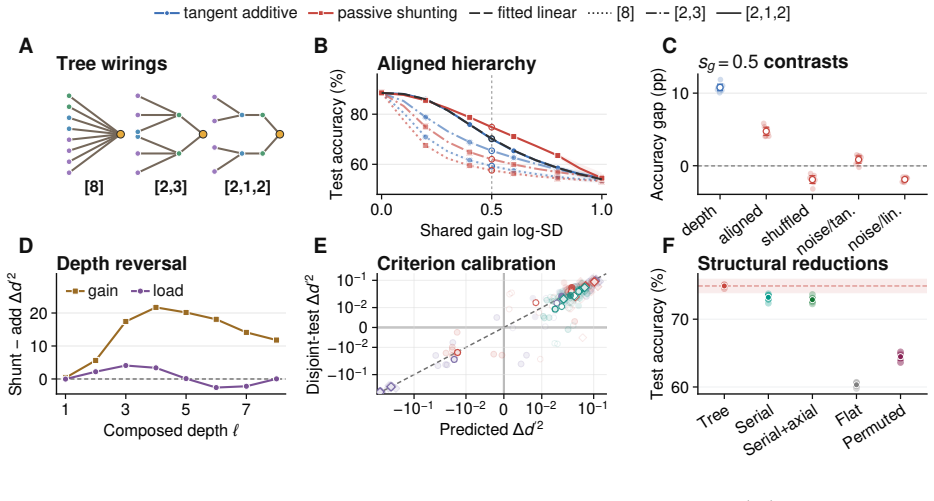
Summary. The manuscript asks when branch-local shunting (divisive) inhibition outperforms a matched additive E/I readout of the same nonnegative inputs. It makes three contributions: (i) exact local boundaries — every scalar shunting threshold is an affine additive comparator (Prop. 1), the terminal shunting Jacobian is contained in the positive additive E/I cone with equality iff an additive-optimal ray admits a positive self-consistent shunting realization (Thm. 1, with a closed-form realizability test, Alg. 2), and passive additive trees flatten exactly to linear readouts (Prop. 3); (ii) a finite-amplitude "gain–load–alignment" criterion (Eqs. 11–16) in which a signed margin A = (B−1) + (B−Mg)Geff − Λ_T predicts the sign of the shunting advantage, validated by split-sample held-out sign prediction and by support-shuffle, load, and sensor-corruption reversals in designed hierarchies and trained DendriNets; (iii) transfer tests to frozen CIFAR features and three mouse V1 sessions, where the decoder gap is largest at narrow readout and reverses under private noise at the widest. The conclusion is explicitly conditional: neither depth nor shunting is intrinsically advantageous.
Significance. If the results hold, this is a useful and unusually disciplined contribution. The local theory is exact rather than asymptotic: the threshold identity is distribution-free, cone containment comes with a constructive self-consistency test verified to numerical precision (Suppl. Fig. S1, max residual < 8×10⁻¹⁶), and the additive flattening is proved. The beyond-local principle is falsifiable — Table 1 lists regime-by-regime predictions — and is stress-tested with sign-reversing interventions (support shuffle, load, sensor noise) rather than only confirmatory fits. The comparator ladder (Table 2) cleanly separates implemented-rule, tangent, cone-capacity, and fitted-linear questions, and resource matching is operationalized (Table 3). Reproducibility is exemplary: pinned commits, per-figure manifest, seed tables, and GPU-hour accounting; the failed Allen five-mouse replication is reported rather than suppressed. The work is primarily a computational/theoretical principle with bounded neural transfer, and is appropriately scoped as such.
major comments (3)
- [§2.2, Eqs. (11)–(16); Methods A.2] The central beyond-local claim is carried by Eq. (11)'s factorization d'²_sh ≈ B d'²_0/(1 + Mg Geff + Λ_T) and the additive signed margin in Eq. (13). As the authors themselves note (§A.2), for a general ratio N/Q first-order variability contains Var(δN), r0²Var(δQ), and −2r0Cov(δN,δQ), so gain suppression, fidelity, and load need not be decoupled penalties; the shunting arm of Eq. (16) additionally assumes an isotropic, direction-preserving surrogate with c_T = 1+Λ_T and tree-level alignment equal to the input-level α. Reserving Λ for independent δL is good practice, but the main-text criterion (Eqs. 12–13) and abstract are stated without this restriction, and a tree Jacobian that rotates signal/nuisance geometry voids the α used in Geff. The empirical calibration is supportive but leaves unexplained sign structure: 33/166 held-out sign errors (Fig. 2F, conditioned on the 166/320 realiz
- [§2.3, Fig. 4E; Methods A.3.5] The tree-level calibration in Fig. 4E reports G_sh/G_a only as normalized d'²-degradation ratios and states these 'are motivated by, but do not estimate, (B, Mg, Λ_T)' (§A.3.5). Relatedly, for activated trees Eqs. (11)–(14) retain their form 'only after B, Mg, and Λ_T are recomputed from the activated representations' (§2.2), which risks making the criterion descriptive bookkeeping on the realized representation rather than an independently predictive condition. At least one demonstration is needed in which B, Mg, and Λ_T are measured directly (this is straightforward in the passive hierarchy of Fig. 4A–C, where the surrogate's quantities are all estimable), the margin is computed from those measurements alone, and its sign predicts the held-out ordering. Without it, the claim that Eq. (13) is a predictive criterion — as opposed to a consistent decomposition — is not yet shown at tree le
- [§2.5, Fig. 7; Methods A.5.4] The qualitative V1 findings — gap largest at narrow readout (Fig. 7B–C) and reversal under private noise at P_E = 64 (Fig. 7E) — rest on three sessions, and the running-state interaction is heterogeneous across those sessions (Fig. 7D); the prespecified Allen five-mouse control did not meet its replication rule (§A.5.4). The text hedges appropriately in most places, but the reversal at the widest readout is a headline prediction of the principle and is presented with mean ± SEM over n = 3. Please report session-level intervals for the sign of the P_E = 64 reversal (i.e., in how many sessions the crossing actually occurs), and soften the abstract's 'reverses under strong private noise at the widest readout' to reflect the session count. More sessions would strengthen this, but clearer quantification is the minimum.
minor comments (7)
- [Fig. 2F; Table 7] Fig. 2F: the calibration is conditioned on positive realizations (154/320 attempts had none). Please state the selection rule and whether the excluded libraries differ systematically in alignment or operating point, since this bears on how general the 133/166 sign agreement is.
- [§2.1–2.2; Table 4] Notation: T is used both for the branch tree (topology) and for total conductance T_n; the collision is flagged in Table 4 but still forces careful reading in Eqs. (4)–(14). Consider T vs. T_n or a tree symbol such as 𝒯 throughout.
- [§A.4.1; Table 5] The implementation term 'reactivation' for post-voltage activation is confusing against its biological meaning; the reader-facing rename is acknowledged in §A.4.1 but the code-facing term still appears in main-text-adjacent passages. Unify terminology.
- [§2.2 vs. Methods A.2] The caveat that α is defined at input level while tree Jacobians can rotate signal–nuisance geometry appears only in Methods A.2 ('Generic tree-induced rotations... require numerical reoptimization'). Given its importance (major comment 1), surface it in §2.2 near the definition of Geff.
- [§2.3, Fig. 4D] Fig. 4D's depth sweep 'does not match parameters or contacts across depth' and is relegated to Suppl. Fig. S5 for diagnostics; state this limitation in the main-text sentence citing the panel so the depth-reversal claim is not over-read.
- [§2.5; Methods A.3.1] The d'²-versus-information disclaimers are well handled (ILB treated as a log-loss difference, BIAWGN mapping only under Gaussian assumptions). It would help to add one sentence in §2.5 noting explicitly that ΔILB = paired log-loss gap in bits, since readers may otherwise read Fig. 7B–C as information orderings.
- [§3 Discussion] Given the debate cited (Holt & Koch 1997; Prescott & De Koninck 2003) on whether shunting is truly divisive at the soma, a short Discussion paragraph on which physiological regimes (synaptic noise, saturation) map onto the model's operating-point assumptions would help neurophysiology readers place the scope.
Circularity Check
No load-bearing circularity: local theorems are algebraic identities, and the gain–load criterion is a stated surrogate tested by held-out composition and sign-reversing interventions.
specific steps
-
fitted input called prediction
[§2.2 Eqs. (11)–(16); Methods A.2 fixed-template / direction-preserving surrogate]
"d′2_sh ≈ B(T, r)d′2_0 / (1 + Mg(T, r)Geff + ΛT(r)). ... The shunting identity additionally assumes an isotropic, direction-preserving surrogate with cT = 1 + ΛT. ... under the direction-preserving surrogate, define the surviving gain factor Mg(T, r) ... by Varg(w⊤_sh hsh)/Varind(w⊤_sh hsh) = α Mg(T, r)Γ"
Mild only: when the surrogate assumptions hold exactly, Mg and Λ are read off the same shunting representation’s variance decomposition that enters the predicted d′2, so the signed margin A is partly rearranging that decomposition rather than an independent dynamical law. This is not a full circularity because the paper treats it as a leading-order surrogate, estimates components on calibration splits, and tests combined-nuisance signs and mechanism order on held-out data (not the same cells used to define the terms), with imperfect agreement (e.g., 133/166; 56/63) showing the claim is falsifiable rather than true by definition.
full rationale
The derivation chain does not reduce the central claims to their inputs by construction. Proposition 1 is an exact threshold equivalence (Vsh>τ ⟺ E−ρτI>bτ) from algebra on the scalar shunt. Theorem 1 is local Jacobian containment in the positive additive cone, with equality only under an independently checkable self-consistent realization—not an assumption that shunting helps. The beyond-local gain–load–alignment margin (Eqs. 11–14) is derived under an explicit direction-preserving / rank-one surrogate (Methods A.2; Eq. 16’s cT=1+ΛT); B, Mg, and Λ are intermediate operational quantities, and the paper tests their composition on held-out combined corruption (Fig. 2F split-sample surrogate; Fig. 4E clean-fit / calibrate / fresh combined-test; Fig. 5D delta-method vs Monte Carlo) and predicts reversals under load, support shuffle, and sensor noise rather than refitting the conclusion. The “designed hierarchy” is an existence construction with negative controls (shuffle and noise reverse the linear comparisons), not a tautology. The only related-work self-citation ([53], same architecture for credit assignment) is explicitly scoped out of the forward-readout claims and is not used as a uniqueness or forcing premise. Residual risk is assumption validity (surrogate separability), not circular reduction.
Axiom & Free-Parameter Ledger
free parameters (6)
- Hierarchical construction gains and sensors (μ, Δ, σ_pr, s, g, s_g, sensor log-SD) =
e.g. μ=1, Δ=0.12, σ_pr=0.20, s=12, g=0.4; s_g grid 0–1
- Gain–load Monte Carlo operating point (Ē, Ī, L̄, ΔE, ΔI, σ_pr) =
(Ē,Ī,L̄)=(3,1,0.5), (ΔE,ΔI)=(0.6,-0.2), σ_pr=0.25
- Trained-network contact caps and widths (N_E, N_I, P_E, branch factors) =
V1 example N_E/N_I=40/10; contextual N_E∈{16,32}, N_I∈{4,12}; trees [8],[2,3],[2,1,2], etc.
- Shunting leak/input scale r in fixed-template V1 diagnostics =
grid r∈{0.01,0.1,1,10,100}; often prefers larger r
- CIFAR group-divisive stabilizer and group partition =
ε=0.05; 8 groups; 512×2×2 features
- Validation-selected optimizers/initializers (LR, activation policy, epoch ceilings) =
V1 selected analytical init, branch LR 3e-4, decoder 2e-3
axioms (8)
- domain assumption Steady-state passive conductance balance with pure shunting (E_I=E_L) yields the unit-leak node ratio V=N/(1+T); active NMDA/Ca spikes, strong backpropagation, and fast temporal dynamics are omitted.
- domain assumption Upstream population activity follows X=g f(θ)+ε with shared gain g (E[g]=1) and independent residual covariance, so harmful variability is low-rank and potentially signal-aligned.
- domain assumption Strict conductance readouts use nonnegative pathway activities and nonnegative synaptic weights; signed LDA is diagnostic only.
- standard math First-order linearization at a positive self-consistent operating point is valid for local d′² comparisons; curvature remainders are higher-order (delta-method bound).
- ad hoc to paper Beyond-local shunting advantage is summarized by direction-preserving surrogates where residual load rescales independent variance by c_T=1+Λ_T and surviving gain is Mg, with gain and load approximately separable in the denominator.
- standard math Passive additive trees with nonnegative transfers flatten exactly to linear somatic scores; topology changes path gains but not function class once weights are free.
- ad hoc to paper Matched comparisons (shared samples, morphology, contact/parameter budgets, or equal validation search) isolate integration rule from resource confounds.
- domain assumption V1 analyses test downstream decoder implications of shared variability/state, not biological identification of shunting circuits or cell types.
invented entities (3)
-
DendriNet
independent evidence
-
Gain–load–alignment margin A(T,r) with factors B, M_g, Λ_T
independent evidence
-
Denominator load L / residual penalty Λ
no independent evidence
read the original abstract
Biological neurons combine excitatory and inhibitory (E/I) activity on branched dendrites through shunting, in which inhibition divisively attenuates excitation. Whether this improves population readout over additive E/I integration of the same nonnegative inputs remains unclear. We introduce DendriNet, a trainable framework that varies integration rule, morphology, synaptic allocation, divisor locality, and dendritic nonlinearities. For population codes with multiplicative gain, a local linearization of any realizable shunting readout yields a decision direction within the positive additive E/I cone; matching the additive optimum requires a positive self-consistent shunting realization. Every scalar shunting threshold also has an exact affine additive realization. Beyond this local limit, performance follows a gain-load-alignment principle: branch-local shunting helps when a reliable divisor suppresses signal-aligned gain more than it attenuates signal or adds denominator variability. Passive additive trees flatten to linear readouts, whereas shunting trees compose local divisors. In a designed hierarchy, deep shunting outperforms tangent and fitted-linear controls, but flexible nonlinear predictors overtake it with enough labels. Support shuffling reverses the linear comparisons, sensor corruption reverses the fitted-linear comparison, and resource-matched activated training shows no consistent depth benefit. The same support and reliability interaction appears in frozen-feature normalization. Across three mouse V1 sessions, the shunting-over-additive decoder gap is largest for narrow readouts, reverses under strong private noise at the widest readout, and varies across running states. Morphology can determine where reliable nuisance estimates meet task-relevant signals, but neither depth nor shunting is intrinsically advantageous.
Figures




Reference graph
Works this paper leans on
-
[1]
D. J. Heeger. Normalization of cell responses in cat striate cortex.Visual Neuroscience, 9(2): 181–197, 1992. doi: 10.1017/S0952523800009640
-
[2]
J. H. Reynolds and D. J. Heeger. The normalization model of attention.Neuron, 61(2):168–185,
-
[3]
M. Carandini and D. J. Heeger. Normalization as a canonical neural computation.Nature Reviews Neuroscience, 13(1):51–62, 2012. doi: 10.1038/nrn3136
doi:10.1038/nrn3136 2012
-
[4]
F. S. Chance, L. F. Abbott, and A. D. Reyes. Gain modulation from background synaptic input.Neuron, 35(4):773–782, 2002. doi: 10.1016/S0896-6273(02)00820-6
-
[5]
S. J. Mitchell and R. A. Silver. Shunting inhibition modulates neuronal gain during synaptic excitation.Neuron, 38(3):433–445, 2003. doi: 10.1016/S0896-6273(03)00200-9
-
[6]
M. London and M. Häusser. Dendritic computation.Annual Review of Neuroscience, 28: 503–532, 2005. doi: 10.1146/annurev.neuro.28.061604.135703
arXiv 2005
-
[7]
R. A. Silver. Neuronal arithmetic.Nature Reviews Neuroscience, 11(7):474–489, 2010. doi: 10.1038/nrn2864
doi:10.1038/nrn2864 2010
-
[8]
G. R. Holt and C. Koch. Shunting inhibition does not have a divisive effect on firing rates. Neural Computation, 9(5):1001–1013, 1997. doi: 10.1162/neco.1997.9.5.1001
-
[9]
Steven A. Prescott and Yves De Koninck. Gain control of firing rate by shunting inhibition: roles of synaptic noise and dendritic saturation.Proceedings of the National Academy of Sciences, 100(4):2076–2081, 2003. doi: 10.1073/pnas.0337591100
-
[10]
Panayiota Poirazi, Terrence Brannon, and Bartlett W. Mel. Pyramidal neuron as two-layer neural network.Neuron, 37(6):989–999, 2003. doi: 10.1016/S0896-6273(03)00149-1
-
[11]
A. Polsky, B. W. Mel, and J. Schiller. Computational subunits in thin dendrites of pyramidal cells.Nature Neuroscience, 7(6):621–627, 2004. doi: 10.1038/nn1253
-
[12]
D. Beniaguev, I. Segev, and M. London. Single cortical neurons as deep artificial neural networks. Neuron, 109(17):2727–2739.e3, 2021. doi: 10.1016/j.neuron.2021.07.002
-
[13]
Chavlis and P
S. Chavlis and P. Poirazi. Dendrites endow artificial neural networks with accurate, ro- bust and parameter-efficient learning.Nature Communications, 16:943, 2025. doi: 10.1038/ s41467-025-56297-9
2025
-
[14]
Benjamin S. H. Lyo and Cristina Savin. Complex priors and flexible inference in recurrent circuits with dendritic nonlinearities. InInternational Conference on Learning Representations, 2024. 14
2024
-
[15]
Anamika Agrawal and Michael A. Buice. Bounds on the computational complexity of neu- rons due to dendritic morphology. InAdvances in Neural Information Processing Systems, volume 38, 2025. URLhttps://proceedings.neurips.cc/paper_files/paper/2025/hash/ d9e56606b1bd3095fbb4241c4e15e420-Abstract-Conference.html
2025
-
[16]
Principles governing the operation of synaptic inhibition in dendrites.Neuron, 75(2):330–341, 2012
Albert Gidon and Idan Segev. Principles governing the operation of synaptic inhibition in dendrites.Neuron, 75(2):330–341, 2012. doi: 10.1016/j.neuron.2012.05.015
-
[17]
Sarah Jarvis, Konstantin Nikolic, and Simon R. Schultz. Neuronal gain modulability is deter- mined by dendritic morphology: A computational optogenetic study.PLOS Computational Biology, 14(3):e1006027, 2018. doi: 10.1371/journal.pcbi.1006027
-
[18]
Chenfei Zhang, Omer Revah, Fred Wolf, and Andreas Neef. Dynamic gain decomposition reveals functional effects of dendrites, ion channels, and input statistics in population coding.Journal of Neuroscience, 44(13):e0799232023, 2024. doi: 10.1523/JNEUROSCI.0799-23.2023
-
[19]
Caleb C. A. Stokes, Corinne M. Teeter, and Jeffry S. Isaacson. Single dendrite-targeting interneurons generate branch-specific inhibition.Frontiers in Neural Circuits, 8:139, 2014. doi: 10.3389/fncir.2014.00139
arXiv 2014
-
[20]
Erik B. Bloss, Mark S. Cembrowski, Bill Karsh, Jennifer Colonell, Richard D. Fetter, and Nelson Spruston. Structured dendritic inhibition supports branch-selective integration in CA1 pyramidal cells.Neuron, 89(5):1016–1030, 2016. doi: 10.1016/j.neuron.2016.01.029
-
[21]
Guangyu Robert Yang, John D. Murray, and Xiao-Jing Wang. A dendritic disinhibitory circuit mechanism for pathway-specific gating.Nature Communications, 7:12815, 2016. doi: 10.1038/ncomms12815
-
[22]
Cristopher M. Niell and Michael P. Stryker. Modulation of visual responses by behavioral state in mouse visual cortex.Neuron, 65(4):472–479, 2010. doi: 10.1016/j.neuron.2010.01.033
-
[23]
Matthew J. McGinley, Stephen V. David, and David A. McCormick. Cortical membrane potential signature of optimal states for sensory signal detection.Neuron, 87(1):179–192, 2015. doi: 10.1016/j.neuron.2015.05.038
-
[24]
Robbe L. T. Goris, J. Anthony Movshon, and Eero P. Simoncelli. Partitioning neuronal variability.Nature Neuroscience, 17(6):858–865, 2014. doi: 10.1038/nn.3711
doi:10.1038/nn.3711 2014
-
[25]
Neil C. Rabinowitz, Robbe L. Goris, Marlene Cohen, and Eero P. Simoncelli. Attention stabilizes the shared gain of V4 populations.eLife, 4:e08998, 2015. doi: 10.7554/eLife.08998
-
[26]
B. B. Averbeck, P. E. Latham, and A. Pouget. Neural correlations, population coding and computation.Nature Reviews Neuroscience, 7(5):358–366, 2006. doi: 10.1038/nrn1888
doi:10.1038/nrn1888 2006
-
[27]
Marlene R. Cohen and Adam Kohn. Measuring and interpreting neuronal correlations.Nature Neuroscience, 14(7):811–819, 2011. doi: 10.1038/nn.2842
doi:10.1038/nn.2842 2011
-
[28]
R. Moreno-Bote, J. Beck, I. Kanitscheider, X. Pitkow, P. E. Latham, and A. Pouget. Information- limiting correlations.Nature Neuroscience, 17(10):1410–1417, 2014. doi: 10.1038/nn.3807
doi:10.1038/nn.3807 2014
-
[29]
MohammadMehdi Kafashan, Anna W. Jaffe, Selmaan N. Chettih, Ramon Nogueira, Iñigo Arandia-Romero, Christopher D. Harvey, Rubén Moreno-Bote, and Jan Drugowitsch. Scaling of sensory information in large neural populations shows signatures of information-limiting correlations.Nature Communications, 12(1):473, 2021. doi: 10.1038/s41467-020-20722-y. 15
-
[30]
Sophie Denève and Christian K. Machens. Efficient codes and balanced networks.Nature Neuroscience, 19(3):375–382, 2016. doi: 10.1038/nn.4243
doi:10.1038/nn.4243 2016
-
[31]
J.-M. Fellous, M. Rudolph, A. Destexhe, and T. J. Sejnowski. Synaptic background noise controls the input/output characteristics of single cells in an in vitro model of in vivo activity. Neuroscience, 122(3):811–829, 2003. doi: 10.1016/j.neuroscience.2003.08.027
-
[32]
M. Carandini, D. J. Heeger, and J. A. Movshon. Linearity and normalization in simple cells of the macaque primary visual cortex.Journal of Neuroscience, 17(21):8621–8644, 1997. doi: 10.1523/JNEUROSCI.17-21-08621.1997
arXiv 1997
-
[33]
L. Busse, A. R. Wade, and M. Carandini. Representation of concurrent stimuli by population activity in visual cortex.Neuron, 64(6):931–942, 2009. doi: 10.1016/j.neuron.2009.11.004
-
[34]
R. Coen-Cagli and S. S. Solomon. Relating divisive normalization to neuronal response variability. Journal of Neuroscience, 39(37):7344–7356, 2019. doi: 10.1523/JNEUROSCI.0126-19.2019
-
[35]
Odelia Schwartz and Eero P. Simoncelli. Natural signal statistics and sensory gain control. Nature Neuroscience, 4(8):819–825, 2001. doi: 10.1038/90526
-
[36]
Simoncelli
Johannes Ballé, Valero Laparra, and Eero P. Simoncelli. Density modeling of images using a gen- eralized normalization transformation. InInternational Conference on Learning Representations, 2016
2016
-
[37]
Bryan P. Tripp. Decorrelation of spiking variability and improved information transfer through feedforward divisive normalization.Neural Computation, 24(4):867–894, 2012. doi: 10.1162/ NECO_a_00255
2012
-
[38]
Bounds, Hillel Adesnik, and Ruben Coen-Cagli
Oren Weiss, Hayley A. Bounds, Hillel Adesnik, and Ruben Coen-Cagli. Modeling the diverse effects of divisive normalization on noise correlations.PLOS Computational Biology, 19(11): e1011667, 2023. doi: 10.1371/journal.pcbi.1011667
-
[39]
Max F. Burg, Santiago A. Cadena, George H. Denfield, Edgar Y. Walker, Andreas S. Tolias, Matthias Bethge, and Alexander S. Ecker. Learning divisive normalization in primary visual cortex.PLOS Computational Biology, 17(6):e1009028, 2021. doi: 10.1371/journal.pcbi.1009028
-
[40]
Long Ni and Johannes Burge. Feature-specific divisive normalization improves natural image encoding for depth perception.bioRxiv, 2024. doi: 10.1101/2024.09.05.611536
-
[41]
Jakob Jordan, João Sacramento, Willem A. M. Wybo, Mihai A. Petrovici, and Walter Senn. Conductance-based dendrites perform Bayes-optimal cue integration.PLOS Computational Biology, 20(6):e1012047, 2024. doi: 10.1371/journal.pcbi.1012047
-
[42]
Arefeh Farahmandi, Parisa Abedi Khoozani, and Gunnar Blohm. Beyond divisive normalization: Scalable feedforward networks for multisensory integration across reference frames.Journal of Neuroscience, 45(41):e0104252025, 2025. doi: 10.1523/JNEUROSCI.0104-25.2025
-
[43]
Wakhloo, Will Slatton, and SueYeon Chung
Albert J. Wakhloo, Will Slatton, and SueYeon Chung. Neural population geometry and optimal coding of tasks with shared latent structure.Nature Neuroscience, 29:682–692, 2026. doi: 10.1038/s41593-025-02183-y
-
[44]
Deep residual learning for image recognition
Kaiming He, Xiangyu Zhang, Shaoqing Ren, and Jian Sun. Deep residual learning for image recognition. InProceedings of the IEEE Conference on Computer Vision and Pattern Recognition, pages 770–778, 2016. doi: 10.1109/CVPR.2016.90. 16
-
[45]
Learning multiple layers of features from tiny images
Alex Krizhevsky. Learning multiple layers of features from tiny images. Techni- cal report, University of Toronto, 2009. URL https://www.cs.toronto.edu/~kriz/ learning-features-2009-TR.pdf
2009
-
[46]
Yuxin Wu and Kaiming He. Group normalization. InProceedings of the European Conference on Computer Vision, pages 3–19, 2018. doi: 10.1007/978-3-030-01261-8_1
-
[47]
C. Stringer, M. Pachitariu, N. Steinmetz, M. Carandini, and K. D. Harris. High-dimensional geometry of population responses in visual cortex.Nature, 571(7765):361–365, 2019. doi: 10.1038/s41586-019-1346-5
-
[48]
Recordings of ~20,000 neurons from V1 in response to oriented stimuli
Marius Pachitariu, Michalis Michaelos, and Carsen Stringer. Recordings of ~20,000 neurons from V1 in response to oriented stimuli. Janelia Research Campus Figshare, 2019. URL https://doi.org/10.25378/janelia.8279387.v3. Version 3; CC BY-NC 4.0
-
[49]
On variational bounds of mutual information
Ben Poole, Sherjil Ozair, Aaron van den Oord, Alex Alemi, and George Tucker. On variational bounds of mutual information. InProceedings of the 36th International Conference on Machine Learning, volume 97 ofProceedings of Machine Learning Research, pages 5171–5180. PMLR,
-
[50]
M. E. Larkum. A cellular mechanism for cortical associations: an organizing principle for the cerebral cortex.Trends in Neurosciences, 36(3):141–151, 2013. doi: 10.1016/j.tins.2012.11.006
-
[51]
Dendritic integration: 60 years of progress.Nature Neuro- science, 18(12):1713–1721, 2015
Greg Stuart and Nelson Spruston. Dendritic integration: 60 years of progress.Nature Neuro- science, 18(12):1713–1721, 2015. doi: 10.1038/nn.4157
-
[52]
Zolnik, Paweł Fidzinski, Felix Bolduan, Athanasia Papoutsi, Panayiota Poirazi, Martin Holtkamp, Imre Vida, and Matthew E
Albert Gidon, Timothy A. Zolnik, Paweł Fidzinski, Felix Bolduan, Athanasia Papoutsi, Panayiota Poirazi, Martin Holtkamp, Imre Vida, and Matthew E. Larkum. Dendritic ac- tion potentials and computation in human layer 2/3 cortical neurons.Science, 367(6473):83–87,
-
[53]
Houman Safaai, Maceo Richards, and Bernardo L. Sabatini. Shunting inhibition and dendritic branching shape local credit assignment.arXiv preprint arXiv:2607.03556, 2026. URLhttps: //arxiv.org/abs/2607.03556
Pith/arXiv arXiv 2026
-
[54]
A. Destexhe and D. Paré. Impact of network activity on the integrative properties of neocortical pyramidal neurons in vivo.Journal of Neurophysiology, 81(4):1531–1547, 1999. doi: 10.1152/jn. 1999.81.4.1531
doi:10.1152/jn 1999
-
[55]
H. Ozeki, I. M. Finn, E. S. Schaffer, K. D. Miller, and D. Ferster. Inhibitory stabilization of the cortical network underlies visual surround suppression.Neuron, 62(4):578–592, 2009. doi: 10.1016/j.neuron.2009.03.028
-
[56]
W. Rall. Theory of physiological properties of dendrites.Annals of the New York Academy of Sciences, 96(4):1071–1092, 1962. doi: 10.1111/j.1749-6632.1962.tb54120.x
arXiv 1962
-
[57]
Koch.Biophysics of Computation: Information Processing in Single Neurons
C. Koch.Biophysics of Computation: Information Processing in Single Neurons. Oxford University Press, 1999. doi: 10.1093/oso/9780195104912.001.0001
arXiv 1999
-
[58]
A. Destexhe, M. Rudolph, and D. Paré. The high-conductance state of neocortical neurons in vivo.Nature Reviews Neuroscience, 4(9):739–751, 2003. doi: 10.1038/nrn1198. 17
-
[59]
J. C. Magee and E. P. Cook. Somatic epsp amplitude is independent of synapse location in hippocampal pyramidal neurons.Nature Neuroscience, 3(9):895–903, 2000. doi: 10.1038/78800
-
[60]
S. R. Williams and G. J. Stuart. Dependence of epsp efficacy on synapse location in neocortical pyramidal neurons.Science, 295(5561):1907–1910, 2002. doi: 10.1126/science.1067903
-
[61]
A. Tran-Van-Minh, R. D. Cazé, T. Abrahamsson, L. Cathala, B. S. Gutkin, and D. A. DiGregorio. Contribution of sublinear and supralinear dendritic integration to neuronal computations. Frontiers in Cellular Neuroscience, 9:67, 2015. doi: 10.3389/fncel.2015.00067
arXiv 2015
-
[62]
R. D. Cazé, M. Humphries, and B. Gutkin. Passive dendrites enable single neurons to compute linearly non-separable functions.PLOS Computational Biology, 9(2):e1002867, 2013. doi: 10.1371/journal.pcbi.1002867
-
[63]
A. Payeur, J.-C. Béïque, and R. Naud. Classes of dendritic information processing.Current Opinion in Neurobiology, 58:78–85, 2019. doi: 10.1016/j.conb.2019.07.006
-
[64]
Kevin Jarrett, Koray Kavukcuoglu, Marc’Aurelio Ranzato, and Yann LeCun. What is the best multi-stage architecture for object recognition? In2009 IEEE 12th International Conference on Computer Vision, pages 2146–2153, 2009. doi: 10.1109/ICCV.2009.5459469
arXiv 2009
-
[65]
Alex Krizhevsky, Ilya Sutskever, and Geoffrey E. Hinton. ImageNet classification with deep convolutional neural networks. InAdvances in Neural Information Processing Systems, volume 25, pages 1097–1105, 2012
2012
-
[66]
Batch normalization: Accelerating deep network training by reducing internal covariate shift
Sergey Ioffe and Christian Szegedy. Batch normalization: Accelerating deep network training by reducing internal covariate shift. InProceedings of the 32nd International Conference on Machine Learning, volume 37 ofProceedings of Machine Learning Research, pages 448–456,
-
[67]
Jimmy Lei Ba, Jamie Ryan Kiros, and Geoffrey E. Hinton. Layer normalization.arXiv preprint arXiv:1607.06450, 2016. doi: 10.48550/arXiv.1607.06450
-
[68]
Saskia E. J. de Vries, Jerome A. Lecoq, Michael A. Buice, et al. A large-scale standardized phys- iological survey reveals functional organization of the mouse visual cortex.Nature Neuroscience, 23:138–151, 2020. doi: 10.1038/s41593-019-0550-9
-
[69]
J. Guerguiev, T. P. Lillicrap, and B. A. Richards. Towards deep learning with segregated dendrites.eLife, 6:e22901, 2017. doi: 10.7554/eLife.22901
-
[70]
Sacramento, R
J. Sacramento, R. Ponte Costa, Y. Bengio, and W. Senn. Dendritic cortical microcircuits approximate the backpropagation algorithm. InAdvances in Neural Information Processing Systems, volume 31, pages 8721–8732, 2018
2018
-
[71]
Jia Deng, Wei Dong, Richard Socher, Li-Jia Li, Kai Li, and Li Fei-Fei. ImageNet: A large-scale hierarchical image database. In2009 IEEE Conference on Computer Vision and Pattern Recognition, pages 248–255, 2009. doi: 10.1109/CVPR.2009.5206848. 18 Appendix Overview This appendix provides the theoretical derivations, experimental methods, and additional ana...
arXiv 2009
-
[76]
[2,3] [2,1,2] same branch-unit, contact, and parameter budgets A Exact-resource redistribution
-
[77]
[2,3] [2,1,2] Exact-resource morphology −0.4 −0.2 0.0 Test accuracy change from [8] (pp)B Valid policies · I-bg 0
-
[78]
[2,3] [2,1,2] Exact-resource morphology −2 −1 0 Test accuracy change from [8] (pp)C Depth effect · I-bg 3
-
[79]
[2,3] [2,1,2] Exact-resource morphology −1 0 1 Shunting − additive accuracy (pp)D Valid same-policy gap Shunting · analytical Additive · analytical Additive · occupancy Shunting · occupancy Analytical · I-bg 0 Analytical · I-bg 3 Occupancy · I-bg 3 Supplementary Fig. S10:Redistributing a fixed branch budget does not produce a generic depth benefit after s...
2000
-
[2009]
doi: 10.1016/j.neuron.2009.01.002
-
[2015]
URLhttps://proceedings.mlr.press/v37/ioffe15.html
-
[2019]
URLhttps://proceedings.mlr.press/v97/poole19a.html
-
[2020]
doi: 10.1126/science.aax6239
discussion (0)
Sign in with ORCID, Apple, or X to comment. Anyone can read and Pith papers without signing in.