REVIEW 4 major objections 7 minor 55 references
LGFNet, a CTC-guided local–global fusion framework for single-channel sleep staging, claims state-of-the-art accuracy on five public benchmarks, with N1 recall reaching 65–67%.
Reviewed by Pith at T0; open to challenge. T0 means a machine referee read the full paper against a public rubric. the ladder, T0–T4 →
T0 review · deepseek-v4-flash
2026-08-01 03:08 UTC pith:H25XCKC6
load-bearing objection A plausible architecture with internally consistent results, but the SOTA claim is unsupported until baselines are re-run under matching protocols and the reporting inconsistencies are cleaned up. the 4 major comments →
LGFNet: A CTC-Guided Local-Global Fusion Framework for Single-Channel Sleep Staging
The pith
A machine-rendered reading of the paper's core claim, the machinery that carries it, and where it could break.
Core claim
The central claim is that LGFNet consistently outperforms state-of-the-art single-channel sleep staging methods across five public datasets. The model combines a parallel local–global fusion encoder, hybrid CTC/attention training, and a three-stage decoding strategy that uses CTC-guided autoregressive inputs, fused emissions, and Viterbi smoothing with transition priors learned from training subjects. On Sleep-EDF-78, the paper reports 88.7% accuracy, 85.0% macro-F1, and a Cohen's kappa of 0.845, surpassing prior single-channel methods by roughly 1.7 points accuracy, 2.3 points macro-F1, and 0.025 kappa. Especially pronounced gains are reported for N1 and boundary/transition segments, which
What carries the argument
The load-bearing mechanism is the joint CTC–attention training scheme plus inference-time Viterbi smoothing. CTC (Connectionist Temporal Classification) supplies monotonic frame-level alignment and blank suppression to sharpen stage boundaries; the attention decoder supplies context-dependent stage ordering. At inference, temperature-normalized emissions from both heads are fused—in either probability or log domain—and Viterbi-decoded against a five-state transition prior estimated from training subjects. The LGFM-Encoder's parallel local branch (gated depthwise-convolutional MLP) and global branch (multi-head self-attention) let the model capture both fine-grained waveform detail and long-r
Load-bearing premise
The reported margins assume the comparison numbers for prior methods came from identical subject-wise splits and preprocessing; the paper reuses published numbers with different fold counts, so the gains could shrink under a strictly matched protocol.
What would settle it
Run the strongest published single-channel baselines under the exact subject-wise fold counts (10-fold for Sleep-EDF-78) and native sampling-rate preprocessing described in the paper; if the accuracy, macro-F1, and kappa gaps over the best baseline fall materially below the reported +1.7 points, +2.3 points, and +0.025, the central superiority claim does not survive.
If this is right
- If the reported results hold, a single-channel EEG model can reach accuracy and kappa levels competitive with many multichannel systems, easing wearable and low-latency deployment.
- N1-stage recall jumps to 65–67% from the typical 49–57% range, so the method specifically improves the hardest transition stage in sleep scoring.
- Ablations show CTC training and Viterbi decoding are additive, together yielding gains of roughly 6–9 points in accuracy over the minimal baseline.
- Keeping native sampling rates and montages without resampling, the model transfers across 100/125/200 Hz recordings and different electrode placements.
- The full model uses about 16.6 million parameters, suggesting the gains do not require a large capacity increase over prior single-channel methods.
Where Pith is reading between the lines
- An implication the paper leaves implicit is that the same CTC-guided decoding recipe could transfer to other epoch-level physiological sequence labeling tasks, such as apnea-hypopnea scoring or seizure boundary detection, where stage transitions are similarly ambiguous.
- The transition priors are estimated from training subjects, so they encode cohort-specific sleep architecture; a testable extension is to learn a universal or dynamically recalibrated transition matrix to improve cross-population robustness.
- The reported optimal weights (λ = 0.3, α = 0.3) show an inverted-U sensitivity, so the method's success depends on these hyperparameters; an extension would be per-subject or per-recording adaptive fusion weights.
- Because CTC provides alignment without frame-level labels, the approach could be combined with self-supervised pretraining on unlabeled overnight recordings, potentially further lifting N1 and REM without new annotations.
Editorial analysis
A structured set of objections, weighed in public.
Referee Report
Summary. This paper proposes LGFNet, a single-channel EEG sleep staging framework that combines a parallel Local-Global Fusion encoder (LFM and GFM branches) with a Transformer decoder. Training uses a hybrid CTC/attention objective with scheduled sampling, and inference uses CTC-guided autoregressive decoding followed by Viterbi smoothing with a data-driven transition prior. The authors report results on five public benchmarks and claim consistent state-of-the-art performance, e.g., 88.7% accuracy, 85.0% macro-F1, and 0.845 kappa on Sleep-EDF-78. The reported accuracy numbers are internally consistent with the confusion matrices, and the paper includes ablations for CTC, Viterbi, LFM/GFM branches, and hyperparameters. The main concern is that the SOTA comparisons are not controlled for protocol differences, and several reporting inconsistencies need correction.
Significance. If the results are substantiated, the contribution is valuable: the combination of a parallel local-global encoder, joint CTC/attention training, and Viterbi smoothing is a well-motivated architectural design, and the claimed N1 improvements and cross-dataset robustness would be notable. Strengths include the use of five public benchmarks, subject-wise splits, preservation of native sampling rates and montages, and extensive ablation and sensitivity analysis. However, the baseline protocol mismatch and the internal reporting inconsistencies described below currently prevent verification of the central SOTA claim. With controlled comparisons and consistent reporting, this could become a solid empirical contribution.
major comments (4)
- [Sec. IV-A, IV-C, Table III] The SOTA claim rests on numbers from prior publications, but the paper does not state that any baseline was re-run under LGFNet's protocol. Sec. IV-A assigns 10-fold CV to Sleep-EDF-78, yet Sec. IV-C reports both 20-fold and 78-fold results, and Table III lists a single 'ours' value (88.7%) without protocol labels. Literature baselines commonly use 20-fold splits, different montages (e.g., C3-A2 vs Fpz-Cz), and different preprocessing; LGFNet deliberately preserves native rates/channels. A fair comparison requires re-evaluation under identical splits and preprocessing, or at least explicit protocol attribution for every row. As written, the claimed gains over FlexibleSleepNet, SleepViTransformer, and others are not controlled.
- [Abstract and Sec. I] The abstract's headline claim 'surpasses DMIN by +1.27% accuracy, +1.74% macro-F1, and +1.93% kappa' is unsupported. 'DMIN' is not defined anywhere in the manuscript, and the body (Sec. I, Table III) compares LGFNet with FlexibleSleepNet on Sleep-EDF-78, reporting gains of +1.7%, +2.3%, and +0.025 kappa. These are different numbers for a different baseline. This must be corrected and unified, because as written the central quantitative claim is ambiguous.
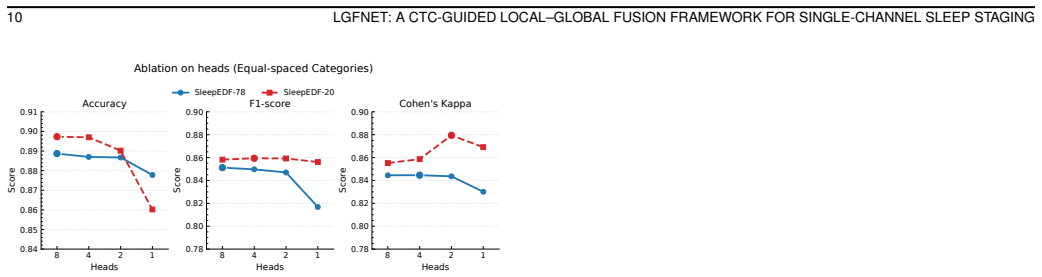
- [Sec. V-C, Table II, Fig. 6] The paper is internally inconsistent about the number of attention heads used for the main results. Table II lists 'Attention Heads 8' as the default. Sec. V-C states that increasing heads from 1 to 4 improves accuracy to 88.7–89.7%, that the gap between 4 and 8 heads is small, and that 'we adopt 4 heads by default'; the summary paragraph also names n_heads=4 as part of the default configuration. If the main results were obtained with 8 heads, the ablation conclusion and default are wrong; if with 4, Table II is wrong. This ambiguity prevents replication and weakens the sensitivity analysis.
- [Sec. IV-C, Table IV, Fig. 4] The text reports 'N1-stage recall rates of 65.0% and 67.1%' on Sleep-EDF-20/78. However, Table IV lists N1 F1-scores of 65.0 and 67.1, not recall; the confusion matrices (Fig. 4) give N1 recall of 64.2% (Sleep-EDF-20) and 67.9% (Sleep-EDF-78). The numbers either need to be labeled as F1 or the recall values need to be recomputed. Since the paper's central message emphasizes 'pronounced gains on N1', this misreporting directly affects the main narrative.
minor comments (7)
- [Section V heading] 'Ablication' should be 'Ablation'; 'Super Parameter Sensitive' should be 'Hyperparameter Sensitivity'.
- [Table II, Eqs. (11)-(17), Fig. 8] Notation is inconsistent: Table II lists 'MHA Loss Weight w' and 'Smoothing Factor α', but the loss in Eq. (11) uses only λ, and the inference equations use α for emission fusion and β for transition weight. Fig. 8 calls the transition weight 'w'. Please define all hyperparameters with a single consistent notation.
- [Fig. 5 caption] The caption mentions 'SleepViTransformer (L=21) for Subject 1 of the SleepEDF dataset', but the text above describes a representative subject (SC4041) from SleepEDF-78 and attributes the predictions to LGFNet. The caption appears stale and should be corrected.
- [Fig. 4 caption] The caption says the second and third rows show 'GFM-only, LFM-only, and LGFNet without CTC-guided decoding', but the figure contains more than three matrices. Each subfigure should be labeled with the exact configuration it displays.
- [Table III and IV] The per-class columns in Table III are not explicitly defined. In particular, the N1 column is referred to as 'recall' in Sec. IV-C, whereas Table IV reports precision, F1, and specificity but not recall. Please state explicitly whether per-class entries are recall, F1, or something else.
- [Eq. (18)] The definition of ACC using TP, TN, FP, FN is written in binary-class form. For multi-class overall accuracy, define it as (sum of diagonal entries)/(total samples) to avoid ambiguity.
- [Reference [55]] FlexibleSleepNet is described in the reference title as based on 'multi-channel polysomnography'. The paper should clarify whether the reported FlexibleSleepNet numbers are for a single-channel variant and, if so, how that variant was obtained.
Circularity Check
No circularity: LGFNet's architecture and losses are defined independently of the benchmark outputs; comparisons are empirical, not self-referential.
full rationale
The paper derives no mathematical prediction from an input that presupposes the output. The CTC loss (Eq. 5) is a standard marginal likelihood over alignments; the attention cross-entropy (Eq. 10) conditions on teacher-forced/CTC-guided labels; the Viterbi decode (Eq. 17) maximizes a fused emission plus a transition prior. The transition prior A is estimated from training-subject labels (Sec. III-D) and hyperparameters α, β, λ are chosen on validation; this is ordinary model selection, not a fitted parameter being renamed as a prediction. The reported test metrics on five datasets are external empirical results. The only self-citation (Ref. [47], the authors' own point-cloud paper) appears as an example citation for transformers in vision and is not load-bearing for any claim. The concern that Table III baselines may have been run under different folds/preprocessing is a threat to fair comparison and should be handled as an empirical/reproducibility issue, not as circularity. Therefore no circular step is exhibited and the score is 0.
Axiom & Free-Parameter Ledger
free parameters (8)
- CTC loss weight λ =
0.3
- Emission fusion weight α_fuse =
0.3
- Transition weight β =
not stated; Fig. 8 refers to 'w'
- Temperature τ_att, τ_ctc =
not stated
- CTC upsampling factor U =
optional, not stated
- Scheduled sampling γ schedule =
not stated
- Transition prior A and initial prior π =
estimated from training subjects with Laplace smoothing
- Architecture capacity (heads, d_model, layers) =
Table II: 8 heads; Sec. V-C: 4 heads; d_model=256; layers=6
axioms (4)
- domain assumption CTC with blank/repeat collapse is an appropriate model of per-epoch sleep-stage sequences after U-fold time upsampling.
- domain assumption Sleep-stage dynamics are well approximated by a first-order Markov chain with a fixed transition matrix A.
- domain assumption Published baseline numbers in Table III were obtained under comparable protocols; no baseline was re-run.
- standard math Standard mathematical machinery (STFT, softmax attention, log-sum-exp CTC dynamic programming, Viterbi dynamic programming) is correct.
read the original abstract
Sleep staging remains challenging due to long-range temporal dependencies, ambiguous stage transitions-particularly in N1-and substantial distribution shifts across subjects, sampling rates, and EEG montages. These difficulties are further amplified in single-channel, low-latency scenarios required by wearable and real-world applications. To address these issues, we propose LGFNet, a CTC-guided sequence-to-sequence framework for robust sleep staging. LGFNet introduces a Local-Global Fusion encoder that jointly models fine-grained temporal dynamics and long-range sleep structure, overcoming the limitations of conventional serial hybrid architectures. A CTC-Attention joint training paradigm is adopted to unify temporal alignment with context-dependent modeling, enabling more accurate recognition of stage boundaries and transitions. Furthermore, a three-stage decoding strategy is devised, leveraging CTC-guided decoding and Viterbi-based smoothing to reduce error accumulation and enforce physiological consistency. Extensive cross-dataset evaluations on five public benchmarks demonstrate that LGFNet consistently outperforms state-of-the-art single-channel methods. In particular, on Sleep-EDF-78, LGFNet surpasses DMIN by +1.27% accuracy, +1.74% macro-F1, and +1.93% kappa, with pronounced gains on N1 and transition segments, highlighting its robustness and strong generalization across diverse sampling rates, montages, and recording environments.
Figures


Reference graph
Works this paper leans on
-
[1]
The future of sleep health: A data-driven revolution in sleep science and medicine,
I. Perez-Pozuelo, B. Zhai, J. Palotti, R. Mall, M. Aupetit, J. M. Garcia- Gomez, S. Taheri, Y . Guan, and L. Fernandez-Luque, “The future of sleep health: A data-driven revolution in sleep science and medicine,” npj Digit. Med., vol. 3, no. 1, Art. no. 42, 2020, doi: 10.1038/s41746- 020-0255-1. CHONGJIAN WANGET AL.: LGFNET FOR SINGLE-CHANNEL SLEEP STAGING 13
doi:10.1038/s41746- 2020
-
[2]
Sleep stages classification using shallow classifiers,
E. P. Giri, A. M. Arymurthy, M. I. Fanany, and S. K. Wijaya, “Sleep stages classification using shallow classifiers,” inProc. 2015 Int. Conf. Adv. Comput. Sci. Inf. Syst. (ICACSIS), 2015, pp. 297–301
2015
-
[3]
Sleep EEG signal analysis based on correlation graph similarity coupled with an ensemble extreme machine learning algorithm,
S. Abdulla, M. Diykh, R. L. Laft, K. Saleh, and R. C. Deo, “Sleep EEG signal analysis based on correlation graph similarity coupled with an ensemble extreme machine learning algorithm,”Expert Syst. Appl., vol. 138, Art. no. 112790, 2019
2019
-
[4]
Polysomnography,
J. V . Rundo and R. Downey III, “Polysomnography,”Handb. Clin. Neurol., vol. 160, pp. 381–392, 2019
2019
-
[5]
Convolutional neural networks for sleep stage scoring on a two-channel EEG signal,
E. Fernandez-Blanco, D. Rivero, and A. Pazos, “Convolutional neural networks for sleep stage scoring on a two-channel EEG signal,”Soft Comput., vol. 24, no. 6, pp. 4067–4079, 2020
2020
-
[6]
Analysis of multichannel EEG patterns during human sleep: A novel approach,
P. Krauss, A. Schilling, J. Bauer, K. Tziridis, C. Metzner, H. Schulze, and M. Traxdorf, “Analysis of multichannel EEG patterns during human sleep: A novel approach,”Front. Hum. Neurosci., vol. 12, Art. no. 121, 2018
2018
-
[7]
Home assessment of sleep disorders by portable monitoring,
R. Broughton, J. Fleming, and J. Fleetham, “Home assessment of sleep disorders by portable monitoring,”J. Clin. Neurophysiol., vol. 13, no. 4, pp. 272–284, 1996
1996
-
[8]
A comparison of polysomnography and a portable home sleep study in the diagnosis of obstructive sleep apnea syndrome,
S. Su, F. M. Baroody, M. Kohrman, and D. Suskind, “A comparison of polysomnography and a portable home sleep study in the diagnosis of obstructive sleep apnea syndrome,”Otolaryngol.–Head Neck Surg., vol. 131, no. 6, pp. 844–850, 2004
2004
-
[9]
Comparison of decoding strategies for CTC acoustic models,
T. Zenkel, R. Sanabria, F. Metze, J. Niehues, M. Sperber, S. St ¨uker, and A. Waibel, “Comparison of decoding strategies for CTC acoustic models,”arXiv preprint arXiv:1708.04469, 2017
Pith/arXiv arXiv 2017
-
[10]
Joint CTC/attention decoding for end-to-end speech recognition,
T. Hori, S. Watanabe, and J. R. Hershey, “Joint CTC/attention decoding for end-to-end speech recognition,” inProc. 55th Annu. Meeting Assoc. Comput. Linguistics (ACL), vol. 1 (Long Papers), 2017, pp. 518–529
2017
-
[11]
The Viterbi algorithm,
M. S. Ryan and G. R. Nudd, “The Viterbi algorithm,” Dept. Comput. Sci., Univ. Warwick, Coventry, U.K., Tech. Rep., 1993
1993
-
[12]
Image restoration with the Viterbi algorithm,
C. Miller, B. R. Hunt, M. W. Marcellin, and M. A. Neifeld, “Image restoration with the Viterbi algorithm,”J. Opt. Soc. Am. A, vol. 17, no. 2, pp. 265–275, 2000
2000
-
[13]
Learning machines and sleeping brains: Au- tomatic sleep stage classification using decision-tree multi-class support vector machines,
T. Lajnef, S. Chaibi, P. Ruby, P.-E. Aguera, J.-B. Eichenlaub, M. Samet, A. Kachouri, and K. Jerbi, “Learning machines and sleeping brains: Au- tomatic sleep stage classification using decision-tree multi-class support vector machines,”J. Neurosci. Methods, vol. 250, pp. 94–105, 2015
2015
-
[14]
Sleep stages classification based on heart rate variability and random forest,
M. Xiao, H. Yan, J. Song, Y . Yang, and X. Yang, “Sleep stages classification based on heart rate variability and random forest,”Biomed. Signal Process. Control, vol. 8, no. 6, pp. 624–633, 2013
2013
-
[15]
Cardiorespi- ratory sleep stage detection using conditional random fields,
P. Fonseca, N. Den Teuling, X. Long, and R. M. Aarts, “Cardiorespi- ratory sleep stage detection using conditional random fields,”IEEE J. Biomed. Health Inform., vol. 21, no. 4, pp. 956–966, 2017
2017
-
[16]
Automatic sleep staging using support vector machines with posterior probability estimates,
S. Gudmundsson, T. P. Runarsson, and S. Sigurdsson, “Automatic sleep staging using support vector machines with posterior probability estimates,” inProc. Int. Conf. Comput. Intell. Model., Control Autom. and Int. Conf. Intell. Agents, Web Technol. Internet Commerce (CIMCA- IAWTIC), vol. 2, 2005, pp. 366–372
2005
-
[17]
R. B. Berry, R. Budhiraja, D. J. Gottlieb, D. Gozal, C. Iber, V . K. Kapur, C. L. Marcus, R. Mehra, S. Parthasarathy, S. F. Quan,et al., “Rules for scoring respiratory events in sleep: Update of the 2007 AASM manual for the scoring of sleep and associated events: Deliberations of the Sleep Apnea Definitions Task Force of the American Academy of Sleep Medi...
2007
-
[18]
A manual of standardized terminology, techniques and scoring system for sleep stages of human subjects,
E. A. Wolpert, “A manual of standardized terminology, techniques and scoring system for sleep stages of human subjects,”Arch. Gen. Psychiatry, vol. 20, no. 2, pp. 246–247, 1969
1969
-
[19]
Support vector machine,
S. Suthaharan, “Support vector machine,” inMachine Learning Models and Algorithms for Big Data Classification: Thinking with Examples for Effective Learning. Springer, 2016, pp. 207–235
2016
-
[20]
Random forests,
L. Breiman, “Random forests,”Mach. Learn., vol. 45, no. 1, pp. 5–32, 2001
2001
-
[21]
DeepSleepNet: A model for automatic sleep stage scoring based on raw single-channel EEG,
A. Supratak, H. Dong, C. Wu, and Y . Guo, “DeepSleepNet: A model for automatic sleep stage scoring based on raw single-channel EEG,” IEEE Trans. Neural Syst. Rehabil. Eng., vol. 25, no. 11, pp. 1998–2008, 2017
1998
-
[22]
TinySleepNet: An efficient deep learning model for sleep stage scoring based on raw single-channel EEG,
A. Supratak and Y . Guo, “TinySleepNet: An efficient deep learning model for sleep stage scoring based on raw single-channel EEG,” in Proc. 42nd Annu. Int. Conf. IEEE Eng. Med. Biol. Soc. (EMBC), 2020, pp. 641–644
2020
-
[23]
An attention-based deep learning approach for sleep stage classification with single-channel EEG,
E. Eldele, Z. Chen, C. Liu, M. Wu, C.-K. Kwoh, X. Li, and C. Guan, “An attention-based deep learning approach for sleep stage classification with single-channel EEG,”IEEE Trans. Neural Syst. Rehabil. Eng., vol. 29, pp. 809–818, 2021
2021
-
[24]
DilatedSleepNet: A novel EEG waveform-aware model for single-channel automatic sleep staging,
Z. Zheng, Z. Li, P. Mei, and F. Wang, “DilatedSleepNet: A novel EEG waveform-aware model for single-channel automatic sleep staging,” in Proc. Annu. Meeting Cogn. Sci. Soc., vol. 47, 2025
2025
-
[25]
SleepEEGNet: Automated sleep stage scoring with sequence to sequence deep learning approach,
S. Mousavi, F. Afghah, and U. R. Acharya, “SleepEEGNet: Automated sleep stage scoring with sequence to sequence deep learning approach,” PLOS ONE, vol. 14, no. 5, Art. no. e0216456, 2019
2019
-
[26]
MVF-SleepNet: Multi- view fusion network for sleep stage classification,
Y . Li, J. Chen, W. Ma, G. Zhao, and X. Fan, “MVF-SleepNet: Multi- view fusion network for sleep stage classification,”IEEE J. Biomed. Health Inform., vol. 28, no. 5, pp. 2485–2495, 2022
2022
-
[27]
XSleepNet: Multi-view sequential model for automatic sleep staging,
H. Phan, O. Y . Ch ´en, M. C. Tran, P. Koch, A. Mertins, and M. De V os, “XSleepNet: Multi-view sequential model for automatic sleep staging,” IEEE Trans. Pattern Anal. Mach. Intell., vol. 44, no. 9, pp. 5903–5915, 2022
2022
-
[28]
SeqSleepNet: End-to-end hierarchical recurrent neural network for sequence-to-sequence automatic sleep staging,
H. Phan, F. Andreotti, N. Cooray, O. Y . Ch ´en, and M. De V os, “SeqSleepNet: End-to-end hierarchical recurrent neural network for sequence-to-sequence automatic sleep staging,”IEEE Trans. Neural Syst. Rehabil. Eng., vol. 27, no. 3, pp. 400–410, 2019
2019
-
[29]
SleepTransformer: Automatic sleep staging with interpretability and uncertainty quantification,
H. Phan, K. Mikkelsen, O. Y . Ch´en, P. Koch, A. Mertins, and M. De V os, “SleepTransformer: Automatic sleep staging with interpretability and uncertainty quantification,”IEEE Trans. Biomed. Eng., vol. 69, no. 8, pp. 2456–2467, 2022
2022
-
[30]
SleepViTrans- former: Patch-based sleep spectrogram transformer for automatic sleep staging,
L. Peng, Y . Ren, Z. Luan, X. Chen, X. Yang, and W. Tu, “SleepViTrans- former: Patch-based sleep spectrogram transformer for automatic sleep staging,”Biomed. Signal Process. Control, vol. 86, Art. no. 105203, 2023
2023
-
[31]
SalientSleepNet: Multimodal salient wave detection network for sleep staging,
Z. Jia, Y . Lin, J. Wang, X. Wang, P. Xie, and Y . Zhang, “SalientSleepNet: Multimodal salient wave detection network for sleep staging,”arXiv preprint arXiv:2105.13864, 2021
Pith/arXiv arXiv 2021
-
[32]
Multi-view spatial-temporal graph convolutional networks with domain generalization for sleep stage classification,
Z. Jia, Y . Lin, J. Wang, X. Ning, Y . He, R. Zhou, Y . Zhou, and L.-W. H. Lehman, “Multi-view spatial-temporal graph convolutional networks with domain generalization for sleep stage classification,”IEEE Trans. Neural Syst. Rehabil. Eng., vol. 29, pp. 1977–1986, 2021
1977
-
[33]
Graph- SleepNet: Adaptive spatial-temporal graph convolutional networks for sleep stage classification,
Z. Jia, Y . Lin, J. Wang, R. Zhou, X. Ning, Y . He, and Y . Zhao, “Graph- SleepNet: Adaptive spatial-temporal graph convolutional networks for sleep stage classification,” inProc. Int. Joint Conf. Artif. Intell. (IJCAI), 2020, pp. 1324–1330
2020
-
[34]
Sensitive deep learning application on sleep stage scoring by using all PSG data,
R. S. Arslan, H. Ulutas, A. S. K ¨oksal, M. Bakir, and B. C ¸ iftc ¸i, “Sensitive deep learning application on sleep stage scoring by using all PSG data,” Neural Comput. Appl., vol. 35, no. 10, pp. 7495–7508, 2023
2023
-
[35]
A deep learning architecture for temporal sleep stage classification using multivariate and multimodal time series,
S. Chambon, M. N. Galtier, P. J. Arnal, G. Wainrib, and A. Gramfort, “A deep learning architecture for temporal sleep stage classification using multivariate and multimodal time series,”IEEE Trans. Neural Syst. Rehabil. Eng., vol. 26, no. 4, pp. 758–769, 2018
2018
-
[36]
A self-attention-based ensemble convolution neural network approach for sleep stage classification with merged spectrogram,
C.-E. Kuo, P.-Y . Liao, and Y .-S. Lin, “A self-attention-based ensemble convolution neural network approach for sleep stage classification with merged spectrogram,” inProc. Asia-Pacific Signal Inf. Process. Assoc. Annu. Summit Conf. (APSIPA ASC), 2021, pp. 1262–1268
2021
-
[37]
Automated sleep stage scoring of the Sleep Heart Health Study using deep neural networks,
L. Zhang, D. Fabbri, R. Upender, and D. Kent, “Automated sleep stage scoring of the Sleep Heart Health Study using deep neural networks,” Sleep, vol. 42, no. 11, Art. no. zsz159, 2019
2019
-
[38]
A review of approaches for sleep quality analysis,
F. Mendonc ¸a, S. S. Mostafa, F. Morgado-Dias, A. G. Ravelo-Garcia, and T. Penzel, “A review of approaches for sleep quality analysis,”IEEE Access, vol. 7, pp. 24527–24546, 2019
2019
-
[39]
An end-to-end framework for real-time automatic sleep stage classification,
A. Patanaik, J. L. Ong, J. J. Gooley, S. Ancoli-Israel, and M. W. L. Chee, “An end-to-end framework for real-time automatic sleep stage classification,”Sleep, vol. 41, no. 5, Art. no. zsy041, 2018
2018
-
[40]
A residual based attention model for EEG based sleep staging,
W. Qu, Z. Wang, H. Hong, Z. Chi, D. D. Feng, R. Grunstein, and C. Gordon, “A residual based attention model for EEG based sleep staging,”IEEE J. Biomed. Health Inform., vol. 24, no. 10, pp. 2833– 2843, 2020
2020
-
[41]
Two-dimensional deep learning based classification of sleep stages with time-frequency maps of single- lead EEG segment,
X. Fan, T. Kang, R. Luo, and D. Lai, “Two-dimensional deep learning based classification of sleep stages with time-frequency maps of single- lead EEG segment,” inProc. 3rd Int. Conf. Pattern Recognit. Mach. Learn. (PRML), 2022, pp. 211–215
2022
-
[42]
Automatic sleep-stage classification based on residual unit and attention networks using directed transfer function of electroencephalogram signals,
D. Cho and B. Lee, “Automatic sleep-stage classification based on residual unit and attention networks using directed transfer function of electroencephalogram signals,”Biomed. Signal Process. Control, vol. 88, Art. no. 105679, 2024
2024
-
[43]
The effect of placebo administration on the first-night effect in healthy young volunteers,
M. Suetsugi, Y . Mizuki, K. Yamamoto, S. Uchida, and Y . Watan- abe, “The effect of placebo administration on the first-night effect in healthy young volunteers,”Prog. Neuropsychopharmacol. Biol. Psychi- atry, vol. 31, no. 4, pp. 839–847, 2007
2007
-
[44]
Objective sleep assessments for healthy people in environmental research: A literature review,
X. Xu and Z. Lian, “Objective sleep assessments for healthy people in environmental research: A literature review,”Indoor Air, vol. 32, no. 5, Art. no. e13034, 2022
2022
-
[45]
Chriskos, C
P. Chriskos, C. A. Frantzidis, C. M. Nday, P. T. Gkivogkli, P. D. Bamidis, and C. Kourtidou-Papadeli, “A review on current trends in automatic 14 LGFNET: A CTC-GUIDED LOCAL–GLOBAL FUSION FRAMEWORK FOR SINGLE-CHANNEL SLEEP STAGING sleep staging through bio-signal recordings and future challenges,”Sleep Med. Rev., vol. 55, Art. no. 101377, 2021
2021
-
[46]
Visformer: The vision-friendly transformer,
Z. Chen, L. Xie, J. Niu, X. Liu, L. Wei, and Q. Tian, “Visformer: The vision-friendly transformer,” inProc. IEEE/CVF Int. Conf. Comput. Vis. (ICCV), 2021, pp. 589–598
2021
-
[47]
Deep- pe: A learning-based pose evaluator for point cloud registration,
J. Gao, C. Wang, Z. Ding, S. Chen, S. Xin, C. Tu, and W. Wang, “Deep- pe: A learning-based pose evaluator for point cloud registration,”arXiv preprint arXiv:2405.16085, 2024
Pith/arXiv arXiv 2024
-
[48]
AST: Audio spectrogram trans- former,
Y . Gong, Y .-A. Chung, and J. Glass, “AST: Audio spectrogram trans- former,”arXiv preprint arXiv:2104.01778, 2021
Pith/arXiv arXiv 2021
-
[49]
X. Mei, X. Liu, Q. Huang, M. D. Plumbley, and W. Wang, “Audio captioning transformer,”arXiv preprint arXiv:2107.09817, 2021
Pith/arXiv arXiv 2021
-
[50]
Deep multimodal learning: A survey on recent advances and trends,
D. Ramachandram and G. W. Taylor, “Deep multimodal learning: A survey on recent advances and trends,”IEEE Signal Process. Mag., vol. 34, no. 6, pp. 96–108, 2017
2017
-
[51]
Multimodal learning with transform- ers: A survey,
P. Xu, X. Zhu, and D. A. Clifton, “Multimodal learning with transform- ers: A survey,”IEEE Trans. Pattern Anal. Mach. Intell., vol. 45, no. 10, pp. 12113–12132, 2023
2023
-
[52]
Multimodal deep learning,
J. Ngiam, A. Khosla, M. Kim, J. Nam, H. Lee, A. Y . Ng,et al., “Multimodal deep learning,” inProc. Int. Conf. Mach. Learn. (ICML), 2011, pp. 689–696
2011
-
[53]
A CTC alignment-based non- autoregressive transformer for end-to-end automatic speech recognition,
R. Fan, W. Chu, P. Chang, and A. Alwan, “A CTC alignment-based non- autoregressive transformer for end-to-end automatic speech recognition,” IEEE/ACM Trans. Audio, Speech, Lang. Process., vol. 31, pp. 1436– 1448, 2023
2023
-
[54]
MixSleepNet: A multi-type convolution combined sleep stage classification model,
X. Ji, Y . Li, P. Wen, P. Barua, and U. R. Acharya, “MixSleepNet: A multi-type convolution combined sleep stage classification model,” Comput. Methods Programs Biomed., vol. 244, Art. no. 107992, 2024
2024
-
[55]
FlexibleSleepNet: A model for automatic sleep stage classification based on multi-channel polysomnography,
Z. Ren, J. Ma, and Y . Ding, “FlexibleSleepNet: A model for automatic sleep stage classification based on multi-channel polysomnography,” IEEE J. Biomed. Health Inform., 2025
2025
discussion (0)
Sign in with ORCID, Apple, or X to comment. Anyone can read and Pith papers without signing in.