REVIEW 4 major objections 4 minor 37 references
Everything is a Spin: The Secret Lives of SU(2)
T0 review · 4 major / 4 minor · reviewed 2026-08-01 · deepseek-v4-flash
Pith's one-line read Topological winding constrains how two-state wavefunctions connect across interfaces, and those constraints can be engineered into memory, switching, actuation, and sensing devices.
desk verdict A well-written review that unifies SU(2) winding physics and pitches topology as a device design language, but it adds no new results and leans heavily on the author's own prior work. read the letter →
The pith
A machine-rendered reading of the paper's core claim, the machinery that carries it, and where it could break.
The reading
What carries the argument
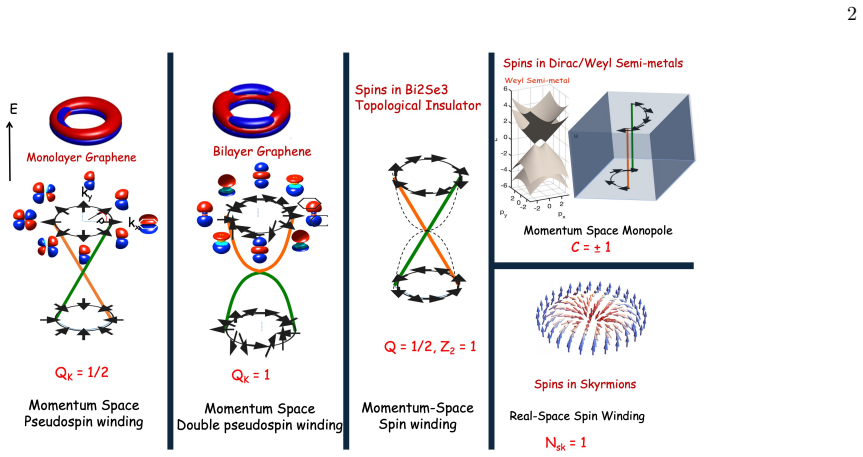
The central object is the SU(2) spinor, a two-component complex vector living on the Bloch sphere, whose winding in momentum or real space is tracked by the Berry phase, Berry curvature, and quantum geometric tensor. The paper's key move is to treat continuity of that winding as the mechanism: matching spinor textures across an interface sets transmission and reflection, and the skyrmion number or Chern number counts how many times the texture wraps the sphere. The workhorse identities are the Berry-phase formula, the skyrmion number as a real-space winding integral, the Thiele equation for skyrmion dynamics, and the Klein-tunneling transmission coefficient derived from pseudospin matching.
What would settle it
A direct test would be a Corbino-disk or split-gate graphene transistor with controlled disorder: if the predicted gate-tunable transmission gap disappears when intervalley scattering is introduced, the pseudospin-continuity mechanism would be falsified; alternatively, measuring the lifetime of isolated ~10 nm skyrmions as a function of film thickness and anisotropy would test whether topological stabilization alone provides the predicted barriers.
Extended reading notes
Core claim
The central claim is that topological winding constrains how two SU(2) states—any normalized two-component wavefunction, whether electron spin, sublattice pseudospin, valley, or photon polarization—can continuously connect across an interface. Where the symmetry that defines that quantum number is preserved, the winding number is conserved, and this conservation directly governs whether transport, torque, or optical transitions are allowed. The paper asserts that these constraints are common to graphene, topological insulators, Weyl semimetals, and magnetic skyrmions, and that they can be deliberately engineered into device functionality: a skyrmion's real-space winding stabilizes a small ma
Load-bearing premise
The engineering claims assume that the idealized interface models—ballistic Klein tunneling, clean skyrmion textures, and bulk spin-current tensors—still describe real devices with disorder, finite temperature, and contacts; if those models fail, the proposed device functions do not follow.
Editorial extensions
If this is right
- Graphene can be switched electrostatically without opening a band gap, preserving its high mobility through a gate-tunable transmission gap.
- Topological stabilization allows skyrmions at roughly 10 nm scale with long predicted lifetimes, suitable for dense memory.
- Topological insulators and Weyl semimetals can deliver gate-controlled spin currents for efficient spin-orbit-torque switching.
- Circular photogalvanic currents in topological materials provide a direct electrical readout of photon helicity, enabling chiral and polarimetric sensing.
- A common SU(2) design language lets device ideas transfer between spin, valley, and magnetic-texture platforms.
Reading between the lines
- Beyond the paper: the continuity argument should apply to other SU(2) pairs such as exciton valley-orbit or phonon pseudospin, predicting analogous gate-controlled responses.
- Beyond the paper: the transmission-gap mechanism depends on pseudospin conservation, so introducing controlled intervalley scattering or disorder should close the gap; this is a testable knob.
- Beyond the paper: the skyrmion stability-size trade-off suggests that tuning effective anisotropy via compensation points is a general strategy that may extend beyond ferrimagnets.
- Beyond the paper: the framing of topological protection as a continuity constraint implies that partially breaking the protecting symmetry could yield tunable, analog responses rather than binary on-off behavior.
Signed reviews
Editorial analysis
A structured set of objections, weighed in public.
Referee Report
Summary. This manuscript argues that spin and pseudospin degrees of freedom (including valley, polarization, and skyrmion texture) share a common SU(2) geometry and that the winding/continuity of two-component wavefunctions governs transmission, deformation, torque, and optical selection. It first reviews Berry phase and Dirac Hamiltonians, then applies the framework to graphene (Klein/anti-Klein tunneling, collimation, a 'Klein tunnel transistor'), topological insulators and Weyl semimetals (Edelstein and spin-Hall responses, circular photogalvanic effect), and magnetic skyrmions (topological barrier, Thiele dynamics, racetrack memory). The conclusion proposes topology as a design language for memory, switching, actuation, and sensing.
Significance. If the unifying picture is correct, the paper provides a useful pedagogical synthesis across fields often treated separately, and it identifies a plausible common design principle: conservation of spinor winding at interfaces constrains device responses. The textbook core is mostly sound, and the paper is honest about some limitations (e.g., CPGE is not determined by topology alone; nondestructive skyrmion readout may require a copy-and-hold architecture). However, the novel engineering claims are largely carried by the author's own prior simulations and by approximate formulas quoted without derivation or error bars. The central 'SU(2) winding' concept is also stated at a heuristic level, so the unifying claim is not yet precise enough to be evaluated as stated. The paper would be a valuable perspective/review if these claims are rebalanced and the quantitative device predictions are clearly separated from the geometric framework.
major comments (4)
- [§I, Fig. 1] The central thesis is stated as 'topological winding constrains how two SU(2) states continuously connect across an interface,' but the mathematical content is never made precise. The examples are not all governed by the same invariant: the graphene Berry phase is a U(1) holonomy (pseudospin winding around a Fermi circle), the Chern number in Haldane/Weyl models is an integral of Berry curvature over a 2D manifold, the Z2 index of a TI is a mod-2 invariant, and the skyrmion number is the degree of a map S^2→S^2. These are distinct topological notions. If the intended common thread is only the two-component spinor geometry, the paper should say so explicitly and state the precise sense in which all examples are 'SU(2) winds'; otherwise the unifying claim in the title and conclusion is unsupported.
- [§II.A(ii)–(iv), Eqs. (27)–(33)] The memory and velocity claims are load-bearing for the 'topology buys memory' section. The 10 nm, ~1 year stability estimate and the >600 m/s velocity are quoted from Refs. [9] and [14] without reproducing the calculations or giving uncertainties. Equation (29) is presented as a quantitative result but its derivation from Eq. (27) is not shown; Eq. (31) has a strong N_sk^3 scaling that underlies the topological barrier claim. The reader cannot distinguish robust topological statements (e.g., sectors in π2(S^2)) from model-dependent continuum estimates (2π-model, DMI parameter values, ferrimagnet compensation). Please either derive the key formulas in an appendix, or clearly mark them as order-of-magnitude estimates and list the assumptions and error bars.
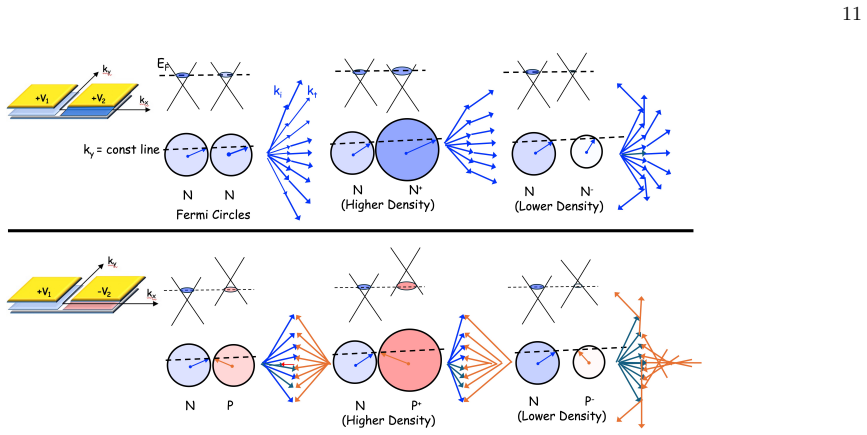
- [§II.B(iv), Eq. (43), Fig. 7(d)] The claimed gate-controlled transmission gap and ON-OFF ratio are central to the switching application. The mode-averaged transmission T̄ in Eq. (43) contains an undefined energy E, and the formula is asserted without derivation; the ON-OFF value is also ambiguous ('6−13' in the text vs '10-13' in the caption). The collimation-lobe argument assumes a coherent, ballistic, disorder-free graphene channel with no intervalley scattering or phonons. The manuscript should state these assumptions explicitly, define E, derive Eq. (43) or cite a derivation that is accessible to the reader, and separate model predictions from experimental ON-OFF values.
- [§II.C–D, Eqs. (46)–(50)] The proposals for symmetry-gated spin currents and chiral photodetection rely on clean-band zero-temperature response tensors. Equation (50) is explicitly 'schematic,' with W(k) unspecified, and the text concedes that CPGE 'is not determined by topology alone' (Section II.D). Yet the device pitch in Section II.C and Fig. 8 presents electrically selectable spin currents as established. The paper should clarify which predictions are universal (fixed by spin-momentum locking and Berry curvature) and which depend on microscopic parameters, disorder, and temperature; ideally provide at least one derivation or independent check of Eq. (47) and the CPGE kernel.
minor comments (4)
- [§I.B, Eq. (8)] The Kronecker-product structure is mentioned but not used consistently: Eq. (8) is 4×4, while later Hamiltonians are 2×2 with valley labels implicit. A consistent notation for the 2×2 vs 4×4 sectors would improve readability.
- [§II.A(i), Eq. (25)] The phase-portrait matrices A for Néel, Bloch, and antiskyrmion textures are stated without derivation. A short derivation or a reference to the specific equations in Ref. [9] would help the reader verify the claimed correspondence between DMI symmetry and texture.
- [§II.B(ii), Eq. (41)] In the transmission formula, the definitions of θ2R and θ2I should be given explicitly (e.g., the real and imaginary parts of the transmitted wavevector angle for evanescent modes). Currently they appear without explanation.
- [References [27,28]] Two key device references are arXiv preprints. If they have not yet undergone peer review, the claims based on them should be flagged as such in the text.
Circularity Check
No circular derivation chain; self-citations are used as literature support, not as a load-bearing reduction.
full rationale
The paper is explicitly a review and "postulat[es]" device applications rather than deriving new predictions. The tutorial core (Berry phase, graphene pseudospin matching, TI/WSM bulk-boundary correspondence, Thiele/LLG dynamics) is derived in-text from standard definitions and matching conditions, e.g. Eqs. (4), (8)-(10), (40)-(44). The device-specific formulas (Eqs. 26-33 skyrmion energy; Eq. 43 mode-averaged transmission; Eq. 50 CPGE) are presented with explicit ansatz or with citations to prior work, and in several places the paper itself flags where topology is insufficient: "the Edelstein response itself is not a quantized topological invariant", "the photocurrent is not determined by topology alone", and "multiple reflections turn the gap into a pseudogap". Self-citations are frequent, but they are not invoked as a uniqueness theorem or as a substitute for derivation; the cited prior results are either standard textbook material, externally testable simulations/experiments (e.g. Refs. [11], [18], [22], [26], [29]-[31]), or explicitly labeled ansatze. The engineering conclusions inherit the validity of the cited idealized models, which is a correctness/robustness concern, not a circularity concern. No equation in the paper is equal to its input by construction, and no fitted parameter is renamed as a prediction.
Assumptions & free parameters
assumptions (5)
- standard math Adiabatic theorem and Berry phase formalism (Eqs. 3-4)
- domain assumption Bulk-boundary correspondence
- domain assumption The LLG/Thiele equation models skyrmion dynamics (Eqs. 34-36)
- domain assumption Low-energy continuum Dirac Hamiltonians for graphene, TI, and Weyl materials
- domain assumption Wavefunction continuity at interfaces is the controlling constraint
Cite this review
Pith. "Pith review of Everything is a Spin: The Secret Lives of SU(2)." pith.science (2026). https://pith.science/paper/LBXBLTFL
@misc{pith2026260725212,
  author       = {Pith},
  title        = {Pith review of: Everything is a Spin: The Secret Lives of SU(2)},
  year         = {2026},
  howpublished = {\url{https://pith.science/paper/LBXBLTFL}},
  note         = {Machine review of arXiv:2607.25212}
}
read the original abstract
Spin, pseudospin, valley, polarization, and other two-component degrees of freedom share the geometry of SU(2), yet their topological manifestations are usually discussed as separate phenomena. This review develops a common geometric language for their winding in momentum and real space,beginning with Berry phase and the Dirac Hamiltonian and extending to graphene, topological insulators, Weyl semimetals, and magnetic skyrmions. We argue that the common thread is not merely topology itself, but the continuity constraints imposed on two-component wavefunctions. Whenever the relevant symmetry is preserved, winding determines which states can continuously connect across an interface or deformation, thereby governing transmission, torque generation, optical selection rules, and other physical responses. We then ask a practical question: what does topology buy an engineer? In skyrmions, winding partitions magnetic configuration space and stabilizes ultrasmall information carriers with tunable dynamics. In graphene, pseudospin matching governs Klein tunneling, enabling a gate-controlled transmission gap without sacrificing the massless Dirac dispersion. In topological insulators and Weyl semimetals, spin-momentum locking and Berry-curvature engineering generate electrically selectable spin currents, while helicity-dependent optical transitions produce circular photogalvanic responses. Together, these examples suggest that topology is not merely a classification of quantum matter, but a design language in which symmetry-protected wavefunction continuity can be engineered for memory, switching, actuation, and sensing.
Figures


Figures from the paper (6 more)




Reference graph
Works this paper leans on
-
[9]
Verma, P
N. Verma, P. J. Moll, T. Holder, and R. Queiroz, Nature Reviews Physics8, 226 (2026)
2026
-
[14]
Nagaosa and Y
N. Nagaosa and Y. Tokura, Nature Nanotechnology8, 899 (2013)
2013
-
[1]
Exchange of the A and B sublattices is represented byσ x, but at fixed momentum it must be accompanied by the corresponding spatial or valley operation
Graphene with broken sublattice symmetry Nearest-neighbor graphene has a chiral, or sublattice, symmetry{σ z, H0}= 0, which pairs energies atEand −E. Exchange of the A and B sublattices is represented byσ x, but at fixed momentum it must be accompanied by the corresponding spatial or valley operation. Time reversal exchanges the two valleys; for spinless ...
-
[2]
Haldane argued
Broken time-reversal symmetry (Chern insulators and the Haldane model) Magnetic fields break time-reversal symmetry, and we will notice the difference if we ran a film of graphene backward (up spins turn into down etc). Haldane argued
-
[3]
We can restore time-reversal symmetry by putting two identical copies of opposite Chern states on top of each other
Restored time-reversal symmetry (Topological insulators and the Kane-Mele model). We can restore time-reversal symmetry by putting two identical copies of opposite Chern states on top of each other. One way to do this is to bring in electron spin, and making the hopping spin-dependent, so that the two opposite spins have opposite Chern behaviors [6]. This...
-
[4]
protection
3D Dirac and Weyl semimetals The pseudospin of pristine graphene winds around a circle in the equatorial plane of the Bloch sphere with a Berry phaseπ, lacking anyσ z term. Weyl semimet- als reveal what happens when that winding escapes the plane and wraps the entire Bloch sphere: the Dirac point acquires the topology of a momentum-space magnetic monopole...
-
[5]
that we can break this symmetry without an external field, preserving the essence of the Peierls phase factor by making the second nearest neighbor coupling complex, picking up a phase factort 2eiϕ. The graphene tight- binding Hamiltonian in the presence of both complext 2 and fieldMat low energy is H=∓ℏv F (kxσx ±k yσy) + (M∓3 √ 3t2 sinϕ| {z } mτ )σz (15...
-
[6]
Thus, the micro- scopic symmetry of the material determines the real-space Berry-phase winding and the resulting topological texture
are also possible, although they frequently relax into lower- energy collections of unit-charge skyrmions. Thus, the micro- scopic symmetry of the material determines the real-space Berry-phase winding and the resulting topological texture. The driving field for the skyrmion’s topological tex- ture is a symmetry-breaking Dzyaloshinskii-Moriya inter- actio...
Show all 37 references
-
[7]
Bernevig and T
A. Bernevig and T. L. Hughes,Topological Insulators and Topological Superconductors(Princeton University Press, 2013)
2013
-
[8]
Vanderbilt,Berry Phases in Electronic Structure The- ory(Cambridge University Press, 2018)
D. Vanderbilt,Berry Phases in Electronic Structure The- ory(Cambridge University Press, 2018)
2018
-
[10]
A. H. Castro Neto, F. Guinea, N. M. R. Peres, K. S. Novoselov, and A. K. Geim, Reviews of Modern Physics 81, 109 (2009)
2009
-
[11]
F. D. M. Haldane, Physical Review Letters61, 2015 (1988)
2015
-
[12]
C. L. Kane and E. J. Mele, Physical Review Letters95, 146802 (2005)
2005
-
[13]
N. P. Armitage, E. J. Mele, and A. Vishwanath, Reviews of Modern Physics90, 015001 (2018)
2018
-
[15]
Vakili, J.-W
H. Vakili, J.-W. Xu, W. Zhou, M. N. Sakib, M. G. Mor- shed, T. Hartnett, Y. Quessab, K. Litzius, C. T. Ma, S. Ganguly, M. R. Stan, P. V. Balachandran, G. S. D. Beach, S. J. Poon, A. D. Kent, and A. W. Ghosh, Jour- nal of Applied Physics130, 070908 (2021)
2021
-
[16]
Vakili, M
H. Vakili, M. N. Sakib, S. Ganguly, M. R. Stan, M. W. Daniels, A. Madhavan, M. D. Stiles, and A. W. Ghosh, IEEE Journal on Exploratory Solid-State Computational Devices and Circuits6, 107 (2020)
2020
-
[17]
Caretta, M
L. Caretta, M. Mann, F. B¨ uttner, K. Ueda, B. Pfau, C. M. G¨ unther, P. Hessing, A. Churikova, C. Klose, M. Schneider, D. Engel, C. Marcus, D. Bono, K. Bagschik, S. Eisebitt, and G. S. D. Beach, Nature Nanotechnology13, 1154 (2018)
2018
-
[18]
Ghosh,Fundamentals of Electronic Materials and De- vices: A Gentle Introduction to the Quantum-Classical World, Lessons from Nanoscience: A Lecture Notes Se- ries, Vol
A. Ghosh,Fundamentals of Electronic Materials and De- vices: A Gentle Introduction to the Quantum-Classical World, Lessons from Nanoscience: A Lecture Notes Se- ries, Vol. 8 (World Scientific, 2023)
2023
-
[19]
Vakili, Y
H. Vakili, Y. Xie, and A. W. Ghosh, Physical Review B 102, 174420 (2020)
2020
-
[20]
Quessab, J.-W
Y. Quessab, J.-W. Xu, E. Cogulu, S. Finizio, J. Raabe, and A. D. Kent, Nano Letters22, 6091 (2022)
2022
-
[21]
C. O. Avci, E. Rosenberg, L. Caretta, F. B¨ uttner, M. Mann, C. Marcus, D. Bono, C. A. Ross, and G. S. D. Beach, Nature Nanotechnology14, 561 (2019)
2019
-
[22]
V. G. Veselago, Soviet Physics Uspekhi10, 509 (1968)
1968
-
[23]
V. V. Cheianov, V. I. Fal’ko, and B. L. Altshuler, Science 315, 1252 (2007)
2007
-
[24]
S. Chen, Z. Han, M. M. Elahi, K. M. M. Habib, L. Wang, B. Wen, Y. Gao, T. Taniguchi, K. Watanabe, J. Hone, A. W. Ghosh, and C. R. Dean, Science353, 1522 (2016)
2016
-
[25]
Ghosh,Nanoelectronics: A Molecular View, World Scientific Series in Nanoscience and Nanotechnology, Vol
A. Ghosh,Nanoelectronics: A Molecular View, World Scientific Series in Nanoscience and Nanotechnology, Vol. 13 (World Scientific, 2016)
2016
-
[26]
Y. Tan, M. M. Elahi, H.-Y. Tsao, K. M. M. Habib, N. S. Barker, and A. W. Ghosh, Scientific Reports7, 9714 (2017)
2017
-
[27]
R. N. Sajjad and A. W. Ghosh, ACS Nano7, 9808 (2013)
2013
-
[28]
M. M. Elahi, H. Vakili, Y. Zeng, C. R. Dean, and A. W. Ghosh, Physical Review Letters132, 146302 (2024)
2024
-
[29]
M. G. Morshed, H. Vakili, M. N. Sakib, S. Ganguly, M. R. Stan, and A. W. Ghosh, Physical Review Applied23, 014071 (2025)
2025
-
[30]
R. N. Sajjad, S. Sutar, J. Lee, and A. W. Ghosh, Physical Review B86, 155412 (2012)
2012
-
[31]
R. N. Sajjad and A. W. Ghosh, Applied Physics Letters 99, 123101 (2011)
2011
-
[32]
K. Wang, M. M. Elahi, L. Wang, K. M. M. Habib, T. Taniguchi, K. Watanabe, J. Hone, A. W. Ghosh, G.-H. Lee, and P. Kim, Proceedings of the National Academy of Sciences116, 6575 (2019)
2019
-
[33]
Sharifpour, A
H. Sharifpour, A. W. Ghosh, and G. J. de Coster, arXiv preprint (2026), arXiv:2602.00251 [cond-mat.other]
2026 arXiv
-
[34]
Y. Chen, H. Vakili, M. G. Morshed, and A. W. Ghosh, arXiv preprint (2025), arXiv:2511.03507 [cond-mat.mes- hall]
2025
-
[35]
Morimoto and N
T. Morimoto and N. Nagaosa, Science Advances2, e1501524 (2016)
2016
-
[36]
de Juan, A
F. de Juan, A. G. Grushin, T. Morimoto, and J. E. Moore, Nature Communications8, 15995 (2017)
2017
-
[37]
B. C. Connelly, P. J. Taylor, and G. J. de Coster, Proceedings of the National Academy of Sciences121, e2307425121 (2024)
2024
Reviewed August 1, 2026 · model on record in the stance chip above.
Discussion (0). Continue with ORCID to comment.