REVIEW 3 major objections 6 minor 66 references
MEDit-Bench shows that the editing message, not the editor, drives which shots get chosen, and that current AI models still lag professional human editors on precise cut placement.
Reviewed by Pith at T0; open to challenge. T0 means a machine referee read the full paper against a public rubric. the ladder, T0–T4 →
MEDit-Bench shows the same source video yields strikingly different professional edits under different narrative messages, and state-of-the-art video models still fall well short of human editors at strict cut-precision thresholds.
T0 review reviewed 2026-08-01 challenge →
load-bearing objection A useful new benchmark with a cautionary LLM-judge result, but the headline numbers rest on an unvalidated proxy and the reporting needs a cleanup. the 3 major comments →
MEDit-Bench: A Dataset for Evaluating Message-Driven Narrative Video Editing
The pith
A machine-rendered reading of the paper's core claim, the machinery that carries it, and where it could break.
The reading
Core claim
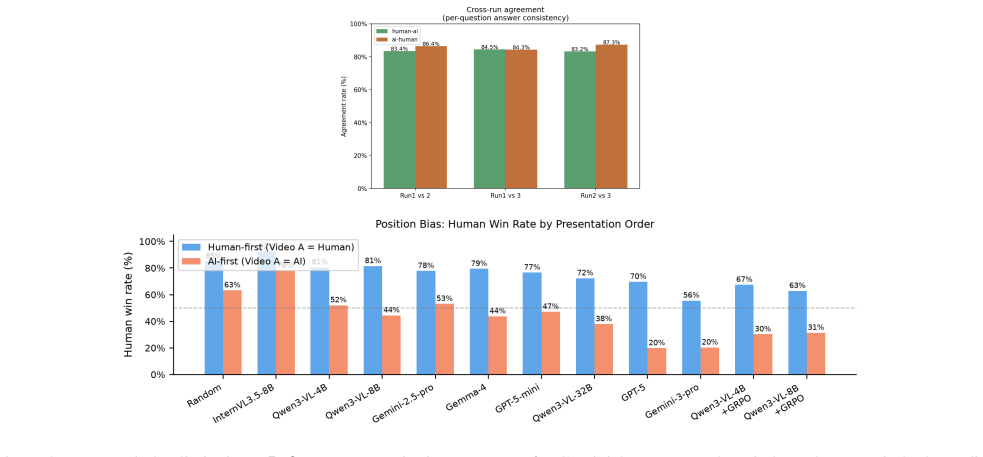
The core discovery is that message-driven editing is a real, quantifiable phenomenon and a distinct task from video summarization. By pairing each long-form video with three distinct editing messages and having three professional editors independently produce cuts for each message, the authors demonstrate that the same footage yields substantially different edits depending on the message: cross-message agreement (F1-Avg 0.15) is much lower than cross-annotator agreement (F1-Avg 0.42). The paper also establishes that an LLM-as-a-judge protocol, the natural proxy for narrative quality, is unreliable here—it exhibits severe position bias (35.4pp swing) and only fair agreement with human prefere
What carries the argument
The central machinery is the MEDit-Bench dataset itself: a triplet structure (source video, editing message, reference cut set) with multiple messages per video and multiple professional edits per message. The key identity is the contrast between cross-message agreement (F1-Avg 0.15) and cross-annotator agreement (F1-Avg 0.42), which isolates the effect of the message from editor style. The evaluation protocol uses temporal alignment metrics—union-based recall (R@θ), greedy cut-matching F1 (F1@θ), and mean temporal IoU (mIoU)—treated as the operational definition of edit quality. For training, the paper contributes MEDitor, a GRPO fine-tuned model whose reward combines a coverage term (tIoU
Load-bearing premise
The paper's quantitative conclusions equate good message-driven editing with temporal alignment to reference edits, but it never validates that alignment is actually a good proxy for human-perceived narrative quality—the human study compares models to humans but not metric rankings to human rankings.
What would settle it
A direct test would be to take a set of edits that score low on R@θ/F1@θ against the reference but that human evaluators judge as conveying the message well, and vice versa. If temporal alignment does not correlate with human preference at the per-edit level (as it did not for the LLM judge, κ=0.18), then the central benchmark numbers would need reinterpretation.
If this is right
- If the message–edit link is as strong as the 0.15 cross-message F1 suggests, then any evaluation of 'good editing' must be conditioned on the message; a single saliency score is inadequate.
- LLM-as-a-judge preference metrics, despite being a natural proxy for narrative quality, cannot be trusted for this task without careful position-bias control and human validation.
- Message ambiguity and contextfulness are measurable, meaningful difficulty factors: models perform worse on messages that are open-ended or require background inference, suggesting that benchmarks should stratify results by these dimensions.
- A reinforcement fine-tuning reward that combines coverage with cut-level F1 (as in MEDitor) improves both alignment and zero-shot transfer to video summarization, indicating that editing-specific rewards can transfer to generic summarization tasks.
Where Pith is reading between the lines
- The paper's own admission that temporal metrics alone are insufficient (Sec 3.5) implies that the headline numbers (e.g., best R@0.7 = 0.026) likely underestimate true model quality on narrative grounds; a human-perceptual evaluation of the temporal metrics themselves would be needed to know the real gap.
- The near-zero shot reordering rates of models (0–2% vs human 5.3% of cuts) suggest a qualitative gap not captured by alignment metrics: current models do not perform the temporal reordering that professional editors use, which may be a more fundamental limitation than boundary precision.
- Since MEDitor transfers zero-shot to TVSum and even exceeds human inter-annotator agreement there, the message-conditioned editing objective may be a stronger pretraining task for generic video understanding than existing summarization objectives.
- The unreliability of LLM-as-a-judge (κ=0.18) suggests that automatic narrative-quality evaluation may need a different approach entirely, such as learned preference models trained on the 1,620 human judgments, rather than prompting frontier LLMs directly.
Editorial analysis
A structured set of objections, weighed in public.
Referee Report
Summary. MEDit-Bench is a new benchmark for message-driven video editing. The authors collect 60 long-form videos, write 3 editing messages per video, and have 3 professional editors produce a cut-only edit per (video, message) pair, yielding 540 reference edits. They define automatic temporal-alignment metrics (R@θ, F1@θ, mIoU), an LLM-as-a-judge preference metric, and message-level ambiguity/contextfulness annotations. They report cross-message agreement (F1=0.15) much lower than cross-annotator agreement (F1=0.42), showing that the message substantially changes shot selection. They evaluate commercial and open-source MLLMs and a GRPO-trained model, MEDitor, which approaches humans at lenient thresholds but falls behind at strict thresholds. They also report a human perceptual study in which professional edits are preferred over Gemini-3-pro outputs, and a zero-shot transfer experiment to SumMe/TVSum. The main claim is that message-driven editing is a measurable task with a reproducible benchmark and a currently unresolved model-human gap.
Significance. If the benchmark is valid, it addresses a real gap: existing summarization benchmarks collapse editorial intent into a single saliency score, whereas MEDit-Bench explicitly conditions on a natural-language message and captures edit diversity. The dataset construction is mostly documented transparently, the cross-message/cross-annotator comparison is a useful descriptive contribution, and the careful analysis of LLM-as-a-judge position bias is a valuable cautionary result. The zero-shot transfer results, the release of cut timestamps/prompts, and the use of external human annotations (rather than self-generated references) are strengths. However, the benchmark's central quantitative conclusions all rely on temporal-alignment metrics that are never validated against human perceptual quality, and the automatic protocol ignores shot ordering even though ordering is part of narrative editing. These are fixable but load-bearing gaps.
major comments (3)
- [Sec. 3.5, Eqs. (2)-(4), Fig. 3, Table 3; Supp. D.1] The benchmark's operational definition of editing quality is temporal alignment, yet the paper itself states in Sec. 3.5 that 'Temporal metrics alone are insufficient.' This is not a minor caveat: the model-human gap in Table 3, the difficulty stratification in Fig. 3, and the MEDitor reward in Eqs. (8)-(10) all treat R@θ/F1@θ/mIoU as ground truth for narrative quality. The human study in Supp. D.1 (90 pairs, 1,620 judgments) is never used to check whether metric rankings track human preferences; the only such check is the LLM-judge correlation (κ=0.18), which is deemed unreliable. I request a per-sample comparison on the Supp. D.1 pairs between human A/B preference and the three temporal-alignment deltas, reported as agreement/rank correlation. Without this, the headline 'gap' may be an artifact of an unvalidated proxy.
- [Sec. 3.4 Eq. (1); Sec. 3.5 Eqs. (2)-(4); Supp. Table 6; Sec. 5.2] The task definition represents an edit as an ordered sequence of cuts, and the human evaluation treats 'cut order' as one of the key narrative aspects, where the human-model gap is largest. However, all three automatic metrics are invariant to the order of cuts (union coverage and greedy matching), and the paper explicitly says shot ordering is not used in the benchmark. Supp. Table 6 shows human editors reorder 5.3% of cuts while models produce almost no reordering (0–2%). Thus the automatic benchmark cannot detect a central dimension of professional narrative editing, and the temporal-alignment gap may understate the true gap. Please add an order-sensitive metric (e.g., sequence-alignment score or reordering-aware edit distance) or clearly restate the benchmark's scope as unordered shot selection in the main paper.
- [Sec. 4.2, Eq. (10); Supp. C.1] MEDitor is trained with a reward composed of the same temporal-alignment terms used for evaluation (Rcov + RF1). This is not circular, because the training pseudo-labels come from GPT-5 over MLVU rather than from MEDit-Bench, and the reward ablation in Supp. C.1 shows the combination is internally sensible. However, the method's reported advantage inherits the unvalidated-proxy problem from the first major comment: optimizing Rcov + RF1 will improve the benchmark numbers even if the reward does not track what human viewers perceive as better narrative editing. Since the authors already have a human-preference protocol, I ask them to also report human preference win rates for MEDitor (or at least for a subset) and to discuss whether the equal-weight choice in Eq. (10) was informed by human judgments or only by alignment metrics.
minor comments (6)
- [References] The reference list contains duplicates: [44] and [45] are the same CSTA paper, and [25] and [26] are the same progressive-video-summarization paper. Please consolidate.
- [Table 3 / Sec. 6] Although the paper warns that LLM-preference is unreliable, Table 3 prominently reports LLM Pref. values and Sec. 5.2 interprets them as 'broadly consistent.' Given the demonstrated 35.4pp position-bias swing and κ=0.18, I suggest moving LLM Pref. to the supplement or clearly labeling it as an exploratory diagnostic, not a benchmark metric.
- [Sec. 3.5] The mIoU metric is used in tables and figures but never defined. Please state explicitly that it is the mean union-based tIoU (or define it if it is a different aggregation).
- [Fig. 3] The correlations are computed over pooled model×video×message observations, which violates independence and likely inflates significance. Report per-model correlations or use a mixed-effects model with message as a random effect.
- [Supp. A.6] The statement 'No strictly formalized acceptance criteria were applied' to professional edits should be moved to the main-paper limitations section, since the 'professional' label is load-bearing for the human-ceiling claims. At minimum, provide inter-reviewer agreement on the quality-control decisions or a reproducible checklist.
- [Table 2] Clarify how Cross-Msg. agreement is averaged: is it per-editor then averaged, or pooled across editors? The caption says 'same video and editor,' but the reported 0.15/0.27 should be accompanied by the exact aggregation rule.
Circularity Check
Partial circularity in the message-difficulty stratification; core benchmark claims rest on independent human annotation.
specific steps
-
self definitional
[Sec. 3.3 (ambiguity definition) and Fig. 3 (mIoU correlation)]
"Ambiguity (1–5, low to high): To what extent does the message admit multiple valid interpretations? A highly ambiguous message admits multiple equally valid narrative interpretations, making it harder for any single edit to match the reference ... Figure 3 ... Both dimensions negatively correlate with mIoU (∗p <0.001)."
Ambiguity is defined partly by the predicted effect on reference matching ('making it harder for any single edit to match the reference'), while Fig. 3's dependent variable mIoU measures exactly how well one model edit matches the reference. The negative correlation is therefore partly baked into the annotation definition rather than an independent empirical discovery. The paper presents this as 'establishing message difficulty as a meaningful stratification factor,' but the difficulty is embedded in the definition of ambiguity. This does not affect the cross-message F1 or model-human gap claims, which rest on separately collected human edits.
full rationale
The core benchmark is self-contained against external data: the 540 professional edits are independently annotated, the model-human gap is computed against those human references, and the summarization transfer is scored on SumMe/TVSum. No fitted parameter is renamed as a prediction; MEDitor is trained on GPT-5-distilled pseudo-labels and evaluated on held-out human references, so training and evaluation references do not overlap. The only self-citation with any load is [34] (Otani/Nakashima, two of the present authors) for the cross-annotator/cross-message F1 protocol and the tau/rho scoring on SumMe/TVSum; this is a standard peer-reviewed evaluation protocol with external numbers, not a self-referential uniqueness theorem, so it does not make the derivation circular. The one genuine circular element is the message-difficulty stratification: Sec. 3.3 defines ambiguity in terms of how hard it is for a single edit to match the reference, and Fig. 3 then reports that ambiguity correlates negatively with reference-matching mIoU; that correlation is partially definitional. Separately, Sec. 3.5 concedes 'Temporal metrics alone are insufficient,' and the paper never validates metric rankings against human perceptual preference; this is a construct-validity limitation, not circularity. Overall score 4: one partial self-definitional step in a secondary claim, while the central benchmark claims remain independent.
Axiom & Free-Parameter Ledger
free parameters (5)
- GRPO reward weights (Rcov + RF1, equal weight) =
1:1
- GRPO training hyperparameters =
G=4, temp 1.0, KL β=0, lr 1e-6, 0.5 epoch, batch 64
- Per-model video sampling budgets =
Qwen 2fps/2048 frames; GPT-5 1fps+grid; InternVL3.5 32×448; Gemini native
- Evaluation thresholds θ =
0.3 / 0.5 / 0.7
- Summarization-transfer message ensemble =
{critical, exciting, memorable}
axioms (6)
- domain assumption Crowdsourced platform editors with informal, non-formalized quality control constitute 'professional' editors whose edits define ground truth.
- domain assumption Temporal alignment (union-IoU recall, greedy cut F1, mIoU) against 2-3 reference edits is a valid proxy for message-driven narrative quality.
- domain assumption Editing quality can be evaluated from visual content alone; audio/dialogue can be ignored.
- domain assumption GPT-5 pseudo-labels distilled over MLVU (2,931 samples) are a valid training distribution for message-driven editing.
- standard math The [34] (Otani et al.) agreement and Kendall-τ/Spearman-ρ protocols validly measure summarization quality.
- domain assumption LLM-assisted ambiguity/contextfulness annotations of the authors' own messages are accurate.
Cite this review
Pith. "Pith review of MEDit-Bench: A Dataset for Evaluating Message-Driven Narrative Video Editing." pith.science (2026). https://pith.science/paper/6GYATTY7
@misc{pith2026260725300,
  author       = {Pith},
  title        = {Pith review of: MEDit-Bench: A Dataset for Evaluating Message-Driven Narrative Video Editing},
  year         = {2026},
  howpublished = {\url{https://pith.science/paper/6GYATTY7}},
  note         = {Machine review of arXiv:2607.25300}
}
read the original abstract
Video editing is fundamentally message-driven: even from the same source footage, the selected shots change depending on the narrative the editor wishes to convey. Benchmarks for a closely related task, video summarization, reduce editorial intent to a single, message-agnostic notion of saliency and thus do not account for this diversity. For evaluating message-driven video editing, we present \textbf{MEDit-Bench}, a dataset and benchmark, which pairs long-form videos with multiple editing messages and multiple professionally produced edits per message, demonstrating that different messages yield substantially different edits from the same source. We define an automatic evaluation protocol based on temporal alignment metrics, and find that an LLM-as-a-judge preference, a natural proxy for narrative quality, is unreliable for this task due to severe position bias. We additionally annotate each message with ambiguity and contextfulness scores, and show that both dimensions negatively correlate with model performance, establishing message difficulty as a meaningful stratification factor. Experiments with state-of-the-art MLLMs and reinforcement fine-tuned baselines show that while strong models approach human temporal alignment at lenient thresholds, all models fall behind humans at stricter criteria. A human perceptual study further confirms a large quality gap, with professional human edits remaining consistently preferred over model outputs.
Figures



Reference graph
Works this paper leans on
-
[1]
Adopting self- supervised learning into unsupervised video summarization through restorative score
Mehryar Abbasi and Parvaneh Saeedi. Adopting self- supervised learning into unsupervised video summarization through restorative score. InICIP, pages 425–429, 2023. 8
2023
-
[2]
Combining global and local attention with positional encoding for video summarization
Evlampios Apostolidis, Georgios Balaouras, Vasileios Mezaris, and Ioannis Patras. Combining global and local attention with positional encoding for video summarization. InIEEE Int. Symp. Multimedia, pages 226–234, 2021. 1, 2
2021
-
[3]
Summarizing videos using con- centrated attention and considering the uniqueness and diver- sity of the video frames
Evlampios Apostolidis, Georgios Balaouras, Vasileios Mezaris, and Ioannis Patras. Summarizing videos using con- centrated attention and considering the uniqueness and diver- sity of the video frames. InInt. Conf. Multimedia Retrieval, page 407–415, 2022. 8
2022
-
[4]
Scaling up video summarization pretraining with large language models
Dawit Mureja Argaw, Seunghyun Yoon, Fabian Caba Heil- bron, Hanieh Deilamsalehy, Trung Bui, Zhaowen Wang, Franck Dernoncourt, and Joon Son Chung. Scaling up video summarization pretraining with large language models. In CVPR, pages 8332–8341, 2024. 8
2024
-
[5]
Qwen3-VL technical report.arXiv preprint arXiv:2511.21631, 2025
Shuai Bai et al. Qwen3-VL technical report.arXiv preprint arXiv:2511.21631, 2025. 3, 5, 6, 8
Pith/arXiv arXiv 2025
-
[6]
Blender studio films.https://studio
Blender Studio. Blender studio films.https://studio. blender.org/films/, 2026. Collection of open movies by Blender Studio. 3
2026
-
[7]
VSUMM: A mechanism designed to produce static video summaries and a novel evaluation method.Pattern Recog- nit
Sandra Eliza Fontes de Avila, Ana Paula Brand ˜ao Lopes, Antonio da Luz, and Arnaldo de Albuquerque Ara ´ujo. VSUMM: A mechanism designed to produce static video summaries and a novel evaluation method.Pattern Recog- nit. Lett., 32(1):56–68, 2011. 1, 2, 3
2011
-
[8]
Summarizing videos with attention
Jiri Fajtl, Hajar Sadeghi Sokeh, Vasileios Argyriou, Dorothy Monekosso, and Paolo Remagnino. Summarizing videos with attention. InAsian Conf. Comput. Vis. Workshops, pages 39–54, 2019. 2
2019
-
[9]
Video-R1: Reinforcing video reasoning in MLLMs.NeurIPS, 38:99114–99137,
Kaituo Feng, Kaixiong Gong, Bohao Li, Zonghao Guo, Yibing Wang, Tianshuo Peng, Junfei Wu, Xiaoying Zhang, Benyou Wang, and Xiangyu Yue. Video-R1: Reinforcing video reasoning in MLLMs.NeurIPS, 38:99114–99137,
-
[10]
Au- tomatic non-linear video editing transfer
Nathan Frey, Peggy Chi, Weilong Yang, and Irfan Essa. Au- tomatic non-linear video editing transfer. InCVPRW, 2021. 2
2021
-
[11]
Video-MME: The first-ever comprehensive evaluation benchmark of multi- modal LLMs in video analysis
Chaoyou Fu, Yuhan Dai, Yongdong Luo, Lei Li, Shuhuai Ren, Renrui Zhang, Zihan Wang, Chenyu Zhou, Yunhang Shen, Mengdan Zhang, Peixian Chen, Yanwei Li, Shaohui Lin, Sirui Zhao, Ke Li, Tong Xu, Xiawu Zheng, Enhong Chen, Caifeng Shan, Ran He, and Xing Sun. Video-MME: The first-ever comprehensive evaluation benchmark of multi- modal LLMs in video analysis. In...
2025
-
[12]
Training-free language-guided video summarization via multi-grained saliency scoring
Wei Ge, Yongwei Nie, Fei Ma, Keke Tang, Fei Richard Yu, Hongmin Cai, and Ping Li. Training-free language-guided video summarization via multi-grained saliency scoring. In Computational Visual Media, page 89–104, 2025. 8
2025
-
[13]
Supervised video summarization via multiple feature sets with parallel attention
Junaid Ahmed Ghauri, Sherzod Hakimov, and Ralph Ew- erth. Supervised video summarization via multiple feature sets with parallel attention. InInt. Conf. Multimedia and Expo, pages 1–6, 2021. 2
2021
-
[14]
A survey on LLM-as-a- judge.arXiv preprint arXiv:2411.15594, 2024
Jiawei Gu, Xuhui Jiang, Zhichao Shi, Hexiang Tan, Xue- hao Zhai, Chengjin Xu, Wei Li, Yinghan Shen, Shengjie Ma, Honghao Liu, Saizhuo Wang, Kun Zhang, Yuanzhuo Wang, Wen Gao, Lionel Ni, and Jian Guo. A survey on LLM-as-a- judge.arXiv preprint arXiv:2411.15594, 2024. 2, 4
Pith/arXiv arXiv 2024
-
[15]
VTG-LLM: Integrating timestamp knowledge into video LLMs for enhanced video temporal grounding
Yongxin Guo, Jingyu Liu, Mingda Li, Dingxin Cheng, Xi- aoying Tang, Dianbo Sui, Qingbin Liu, Xi Chen, and Kevin Zhao. VTG-LLM: Integrating timestamp knowledge into video LLMs for enhanced video temporal grounding. In AAAI, pages 3302–3310, 2025. 2
2025
-
[16]
Creating summaries from user videos
Michael Gygli, Helmut Grabner, Hayko Riemenschneider, and Luc Van Gool. Creating summaries from user videos. In ECCV, pages 505–520, 2014. 1, 2, 3, 6
2014
-
[17]
Align and attend: Multimodal summarization with dual contrastive losses
Bo He, Jun Wang, Jielin Qiu, Trung Bui, Abhinav Shrivas- tava, and Zhaowen Wang. Align and attend: Multimodal summarization with dual contrastive losses. InCVPR, 2023. 1, 2
2023
-
[18]
MovieNet: A holistic dataset for movie under- standing
Qingqiu Huang, Yu Xiong, Anyi Rao, Jiaze Wang, and Dahua Lin. MovieNet: A holistic dataset for movie under- standing. InECCV, 2020. 2
2020
-
[19]
Joint video summarization and moment localization by cross-task sample transfer
Hao Jiang and Yadong Mu. Joint video summarization and moment localization by cross-task sample transfer. InCVPR, pages 16367–16377, 2022. 2
2022
-
[20]
Discriminative feature learning for unsu- pervised video summarization
Yunjae Jung, Donghyeon Cho, Dahun Kim, Sanghyun Woo, and In So Kweon. Discriminative feature learning for unsu- pervised video summarization. InAAAI, 2019. 8
2019
-
[21]
Dense-captioning events in videos
Ranjay Krishna, Kenji Hata, Frederic Ren, Li Fei-Fei, and Juan Carlos Niebles. Dense-captioning events in videos. In Proceedings of the IEEE international conference on com- puter vision, pages 706–715, 2017. 3
2017
-
[22]
Computational video editing for dialogue-driven scenes.ACM Trans
Mackenzie Leake, Abe Davis, Anh Truong, and Maneesh Agrawala. Computational video editing for dialogue-driven scenes.ACM Trans. Graph., 36(4), 2017. 2
2017
-
[23]
Video sum- marization with large language models
Min Jung Lee, Dayoung Gong, and Minsu Cho. Video sum- marization with large language models. InCVPR, pages 18981–18991, 2025. 1, 2
2025
-
[24]
Detecting mo- ments and highlights in videos via natural language queries
Jie Lei, Tamara L Berg, and Mohit Bansal. Detecting mo- ments and highlights in videos via natural language queries. NeurIPS, 34:11846–11858, 2021. 2
2021
-
[25]
Progressive video summarization via multimodal self- supervised learning
Haopeng Li, Qiuhong Ke, Mingming Gong, and Tom Drum- mond. Progressive video summarization via multimodal self- supervised learning. InWACV, pages 5573–5582, 2023. 1, 2
2023
-
[26]
Progressive video summarization via multimodal self- supervised learning
Haopeng Li, Qiuhong Ke, Mingming Gong, and Tom Drum- mond. Progressive video summarization via multimodal self- supervised learning. InWACV, pages 5584–5593, 2023. 1, 2, 8
2023
-
[27]
VideoChat-R1: Enhancing spatio-temporal percep- tion via reinforcement fine-tuning.NeurIPS, 2025
Xinhao Li, Ziang Yan, Desen Meng, Lu Dong, Xiangyu Zeng, Yinan He, Yali Wang, Yu Qiao, Yi Wang, and Limin 9 Wang. VideoChat-R1: Enhancing spatio-temporal percep- tion via reinforcement fine-tuning.NeurIPS, 2025. 5
2025
-
[28]
VideoXum: cross- modal visual and textural summarization of videos.IEEE Trans
Jingyang Lin, Hang Hua, Ming Chen, Yikang Li, Jenhao Hsiao, Chiuman Ho, and Jiebo Luo. VideoXum: cross- modal visual and textural summarization of videos.IEEE Trans. Multimedia, 26:5548–5560, 2024. 2
2024
-
[29]
Visual instruction tuning.NeurIPS, 36:34892–34916, 2023
Haotian Liu, Chunyuan Li, Qingyang Wu, and Yong Jae Lee. Visual instruction tuning.NeurIPS, 36:34892–34916, 2023. 5
2023
-
[30]
G-Eval: NLG evaluation using gpt-4 with better human alignment
Yang Liu, Dan Iter, Yichong Xu, Shuohang Wang, Ruochen Xu, and Chenguang Zhu. G-Eval: NLG evaluation using gpt-4 with better human alignment. InEMNLP, pages 2511– 2522, 2023. 4
2023
-
[31]
Ye Liu, Zongyang Ma, Zhongang Qi, Yang Wu, Ying Shan, and Chang W Chen. E.T. Bench: Towards open-ended event- level video-language understanding.NeurIPS, 37:32076– 32110, 2024. 3, 5
2024
-
[32]
Chrono: A simple blueprint for representing time in MLLMs.arXiv preprint arXiv:2406.18113, 2024
Boris Meinardus, Hector Rodriguez, Anil Batra, Anna Rohrbach, and Marcus Rohrbach. Chrono: A simple blueprint for representing time in MLLMs.arXiv preprint arXiv:2406.18113, 2024. 3
arXiv 2024
-
[33]
CLIP-It! language-guided video summarization
Medhini Narasimhan, Anna Rohrbach, and Trevor Dar- rell. CLIP-It! language-guided video summarization. In NeurIPS, pages 13988–14000, 2021. 1, 2
2021
-
[34]
Rethinking the evaluation of video summaries
Mayu Otani, Yuta Nakashima, Esa Rahtu, and Janne Heikkil¨a. Rethinking the evaluation of video summaries. In CVPR, pages 7588–7596, 2019. 3, 8
2019
-
[35]
Contrastive losses are natural criteria for unsu- pervised video summarization
Zongshang Pang, Yuta Nakashima, Mayu Otani, and Hajime Nagahara. Contrastive losses are natural criteria for unsu- pervised video summarization. InWACV, pages 2010–2019,
2010
-
[36]
Mea- sure Twice, Cut Once: A semantic-oriented approach to video temporal localization with video LLMs
Zongshang Pang, Mayu Otani, and Yuta Nakashima. Mea- sure Twice, Cut Once: A semantic-oriented approach to video temporal localization with video LLMs. InICLR,
-
[37]
MovieCuts: A new dataset and benchmark for cut type recognition
Alejandro Pardo, Fabian Caba Heilbron, Juan Le ´on Alc´azar, Ali Thabet, and Bernard Ghanem. MovieCuts: A new dataset and benchmark for cut type recognition. InECCV, pages 668–685, 2022. 2
2022
-
[38]
Generative timelines for instructed visual assembly
Alejandro Pardo, Jui-Hsien Wang, Bernard Ghanem, Josef Sivic, Bryan Russell, and Fabian Caba Heilbron. Generative timelines for instructed visual assembly. InNeurIPS Work- shop, 2025. 2
2025
-
[39]
MMSum: A dataset for multimodal summarization and thumbnail gen- eration of videos
Jielin Qiu, Jiacheng Zhu, William Han, Aditesh Kumar, Karthik Mittal, Claire Jin, Zhengyuan Yang, Linjie Li, Jian- feng Wang, Ding Zhao, Bo Li, and Lijuan Wang. MMSum: A dataset for multimodal summarization and thumbnail gen- eration of videos. InCVPR, pages 21909–21921, 2024. 2
2024
-
[40]
TimeChat: A time-sensitive multimodal large language model for long video understanding
Shuhuai Ren, Linli Yao, Shicheng Li, Xu Sun, and Lu Hou. TimeChat: A time-sensitive multimodal large language model for long video understanding. InCVPR, pages 14313– 14323, 2024. 2, 5
2024
-
[41]
Zhihong Shao, Peiyi Wang, Qihao Zhu, Runxin Xu, Junx- iao Song, Mingchuan Zhang, Y .K. Li, Y . Wu, and Daya Guo. Deepseekmath: Pushing the limits of mathematical reason- ing in open language models, 2024. 5
2024
-
[42]
Judging the judges: A system- atic study of position bias in LLM-as-a-Judge
Lin Shi, Chiyu Ma, Wenhua Liang, Xingjian Diao, Weicheng Ma, and Soroush V osoughi. Judging the judges: A system- atic study of position bias in LLM-as-a-Judge. InProc. Int. Joint Conf. Nat. Lang. Process., pages 292–314, 2025. 4
2025
-
[43]
Generic event boundary de- tection: A benchmark for event segmentation
Mike Zheng Shou, Stan Weixian Lei, Weiyao Wang, Deepti Ghadiyaram, and Matt Feiszli. Generic event boundary de- tection: A benchmark for event segmentation. InICCV, pages 8055–8064, 2021. 2
2021
-
[44]
CSTA: Cnn- based spatiotemporal attention for video summarization
Jaewon Son, Jaehun Park, and Kwangsu Kim. CSTA: Cnn- based spatiotemporal attention for video summarization. In CVPR, pages 18847–18856, 2024. 1, 2
2024
-
[45]
Csta: Cnn- based spatiotemporal attention for video summarization
Jaewon Son, Jaehun Park, and Kwangsu Kim. Csta: Cnn- based spatiotemporal attention for video summarization. In Proceedings of the IEEE/CVF Conference on Computer Vi- sion and Pattern Recognition, pages 18847–18856, 2024. 8
2024
-
[46]
TVSum: Summarizing web videos using titles
Yale Song, Jordi Vallmitjana, Amanda Stent, and Alejandro Jaimes. TVSum: Summarizing web videos using titles. In CVPR, pages 5179–5187, 2015. 1, 2, 3, 6
2015
-
[47]
Language-guided self-supervised video summarization using text semantic matching considering the diversity of the video
Tomoya Sugihara, Shuntaro Masuda, Ling Xiao, and Toshi- hiko Yamasaki. Language-guided self-supervised video summarization using text semantic matching considering the diversity of the video. InACM Int. Conf. Multimedia Asia,
-
[48]
Gemini: A family of highly capable multimodal models, 2025
Gemini Team et al. Gemini: A family of highly capable multimodal models, 2025. 6
2025
-
[49]
QuickCut: An interactive tool for editing narrated video
Anh Truong, Floraine Berthouzoz, Wilmot Li, and Maneesh Agrawala. QuickCut: An interactive tool for editing narrated video. InACM Symp. User Interface Softw. Technol., page 497–507, 2016. 2
2016
-
[50]
Query Twice: Dual mixture attention meta learning for video summarization
Junyan Wang, Yang Bai, Yang Long, Bingzhang Hu, Zhen- hua Chai, Yu Guan, and Xiaolin Wei. Query Twice: Dual mixture attention meta learning for video summarization. In ACM Int. Conf. Multimedia, page 4023–4031, 2020. 1, 2
2020
-
[51]
Write-A-Video: Computational video montage from themed text.ACM Trans
Miao Wang, Guo-Wei Yang, Shi-Min Hu, Shing-Tung Yau, and Ariel Shamir. Write-A-Video: Computational video montage from themed text.ACM Trans. Graph., 38(6): 177:1–177:13, 2019. 2
2019
-
[52]
Weiyun Wang, Zhangwei Gao, Lixin Gu, Hengjun Pu, Long Cui, Xingguang Wei, Zhaoyang Liu, Linglin Jing, Shenglong Ye, Jie Shao, et al. InternVL3. 5: Advancing open-source multimodal models in versatility, reasoning, and efficiency. arXiv preprint arXiv:2508.18265, 2025. 6
Pith/arXiv arXiv 2025
-
[53]
Time-R1: Post-training large vision language model for temporal video grounding.NeurIPS, 38:83330– 83364, 2026
Ye Wang, Ziheng Wang, Boshen Xu, Yang Du, Kejun Lin, Zihan Xiao, Zihao Yue, Jianzhong Ju, Liang Zhang, Dingyi Yang, et al. Time-R1: Post-training large vision language model for temporal video grounding.NeurIPS, 38:83330– 83364, 2026. 3, 5
2026
-
[54]
LongVideoBench: a benchmark for long-context interleaved video-language understanding
Haoning Wu, Dongxu Li, Bei Chen, and Junnan Li. LongVideoBench: a benchmark for long-context interleaved video-language understanding. InNeurIPS, 2024. 3, 12, 13
2024
-
[55]
Transcript to Video: Efficient clip sequencing from texts
Yu Xiong, Fabian Caba Heilbron, and Dahua Lin. Transcript to Video: Efficient clip sequencing from texts. InACM Int. Conf. Multimedia, page 5407–5416, 2022. 2
2022
-
[56]
Vid2seq: Large-scale pretraining of a vi- sual language model for dense video captioning
Antoine Yang, Arsha Nagrani, Paul Hongsuck Seo, An- toine Miech, Jordi Pont-Tuset, Ivan Laptev, Josef Sivic, and Cordelia Schmid. Vid2seq: Large-scale pretraining of a vi- sual language model for dense video captioning. InProceed- 10 ings of the IEEE/CVF conference on computer vision and pattern recognition, pages 10714–10726, 2023. 3
2023
-
[57]
TimeLens: Rethinking video temporal grounding with multimodal LLMs
Jun Zhang, Teng Wang, Yuying Ge, Yixiao Ge, Xinhao Li, and Limin Wang. TimeLens: Rethinking video temporal grounding with multimodal LLMs. InCVPR, pages 10419– 10429, 2026. 3, 5, 13
2026
-
[58]
Gpt-4v(ision) as a generalist evalu- ator for vision-language tasks.CoRR, abs/2311.01361, 2023
Xinlu Zhang, Yujie Lu, Weizhi Wang, An Yan, Jun Yan, Lianke Qin, Heng Wang, Xifeng Yan, William Yang Wang, and Linda Ruth Petzold. Gpt-4v(ision) as a generalist evalu- ator for vision-language tasks.CoRR, abs/2311.01361, 2023. 2
Pith/arXiv arXiv 2023
-
[59]
Re- constructive sequence-graph network for video summariza- tion.IEEE Trans
Bin Zhao, Haopeng Li, Xiaoqiang Lu, and Xuelong Li. Re- constructive sequence-graph network for video summariza- tion.IEEE Trans. Pattern Anal. Mach. Intell., page 1–1,
-
[60]
Xing, Hao Zhang, Joseph E
Lianmin Zheng, Wei-Lin Chiang, Ying Sheng, Siyuan Zhuang, Zhanghao Wu, Yonghao Zhuang, Zi Lin, Zhuohan Li, Dacheng Li, Eric P. Xing, Hao Zhang, Joseph E. Gonza- lez, and Ion Stoica. Judging LLM-as-a-judge with MT-bench and Chatbot Arena. InNeurIPS, 2023. 2, 4
2023
-
[61]
Deep semantic and attentive network for unsupervised video summarization.ACM Trans
Sheng-Hua Zhong, Jingxu Lin, Jianglin Lu, Ahmed Fares, and Tongwei Ren. Deep semantic and attentive network for unsupervised video summarization.ACM Trans. Multimedia Comput. Commun. Appl., 18(2), 2022. 8
2022
-
[62]
MLVU: Benchmarking multi-task long video understanding
Junjie Zhou, Yan Shu, Bo Zhao, Boya Wu, Zhengyang Liang, Shitao Xiao, Minghao Qin, Xi Yang, Yongping Xiong, Bo Zhang, Tiejun Huang, and Zheng Liu. MLVU: Benchmarking multi-task long video understanding. In CVPR, pages 13691–13701, 2025. 5, 14
2025
-
[63]
Deep reinforce- ment learning for unsupervised video summarization with diversity-representativeness reward
Kaiyang Zhou, Yu Qiao, and Tao Xiang. Deep reinforce- ment learning for unsupervised video summarization with diversity-representativeness reward. InAAAI, 2018. 2, 8
2018
-
[64]
Edits” counts edits with at least one temporal reversal; “Cuts
Wencheng Zhu, Jiwen Lu, Jiahao Li, and Jie Zhou. DSNet: A flexible detect-to-summarize network for video summa- rization.IEEE Trans. Image Process., 30:948–962, 2020. 2 11 MEDit-Bench: A Dataset for Evaluating Message-Driven Narrative Video Editing Supplementary Material This supplementary material provides (A) dataset collec- tion details including stati...
arXiv 2020
-
[65]
First, decide on a specific MESSAGE you want to convey to viewers - What story do you want to tell? - What emotion or understanding should viewers gain? - What is the core intent behind this edit?
-
[66]
01:30:50
Then, with that MESSAGE in mind, select the clip intervals (timestamps) that will effectively communicate it - Choose clips strategically to build a coherent narrative - Each edited video should be 1-3 minutes in total length - Use timestamps in [start, end] format with MM:SS:CS (e.g., [’01:23:00’, ’02:45:50’]) - You can arrange clips in any order -- chro...
This paper was first reviewed by deepseek-v4-flash on August 1, 2026.
discussion (0)
Sign in with ORCID, Apple, or X to comment. Anyone can read and Pith papers without signing in.