REVIEW 4 major objections 3 minor 45 references
Saliency-guided prototype alignment improves diffusion-based dataset distillation by directing latent prototypes toward class-discriminative regions and refining them into hard, class-consistent examples.
Reviewed by Pith at T0; open to challenge. T0 means a machine referee read the full paper against a public rubric. the ladder, T0–T4 →
T0 review · deepseek-v4-flash
2026-08-03 01:44 UTC pith:SEAD3TRU
load-bearing objection A plausible, modest improvement to diffusion-based distillation with real gains on ImageWoof, but the saliency mechanism lacks a causal control and several headline cells are noise-level. the 4 major comments →
Dataset Distillation Based on Saliency-Driven Prototype Alignment
The pith
A machine-rendered reading of the paper's core claim, the machinery that carries it, and where it could break.
Core claim
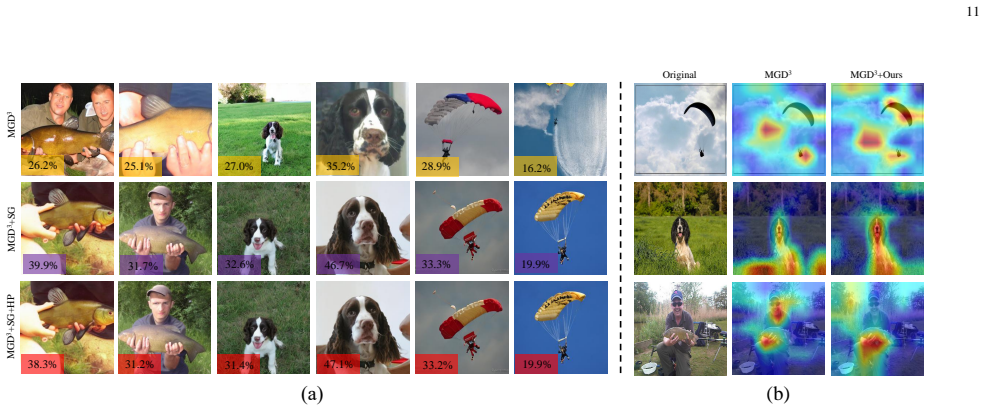
The paper's central claim is that the way latent prototypes are constructed—not the generative model—limits diffusion-based dataset distillation. By training a small ensemble of classifiers on VAE latents, aggregating binarized Grad-CAM++ maps through voting, and amplifying activations inside the resulting mask (z̃ = βz + α(z ⊙ R)) before K-Means clustering, prototypes concentrate on class-discriminative content. A second stage treats prototypes whose softmax confidence falls outside [plow, phigh] as too easy or too hard and moves them with signed gradient steps on a cross-entropy-plus-repulsion objective, yielding class-consistent but challenging prototypes. The authors report consistent ac
What carries the argument
Saliency-refined latent prototype construction (Algorithm 1): an ensemble of lightweight classifiers is trained on VAE latents; each produces a Grad-CAM++ map (a gradient-weighted heatmap of the input regions the classifier relies on) that is thresholded into a binary mask; masks are combined by majority voting into R; the latent is refined as z̃ = βz + α(z ⊙ R), amplifying class-relevant activations; K-Means on the refined latents yields prototypes. The second mechanism is hard-prototype refinement (Eqs. 5–6): prototypes whose softmax confidence lies outside [plow, phigh] are moved by signed gradient steps that mix cross-entropy with an intra-class repulsion term, making them harder without
Load-bearing premise
The load-bearing premise is that regions highlighted by classifiers trained on real-image latent codes are the right places to amplify for a different student learning from synthetic images—and that 'hard' is faithfully measured by the same ensemble's softmax confidence. The paper validates this only by benchmark accuracy, not by direct evidence about what the mask discards or what makes a prototype genuinely hard for the student.
What would settle it
A reader could settle it by generating distilled sets from three prototype constructions: saliency-amplified, random-mask-amplified, and inverted-mask-amplified, using identical compute; if the random or inverted masks match the saliency result, the saliency signal is not load-bearing. A second decisive check: rank prototypes by the ensemble confidence used in Eqs. (5)–(6) and compare with the per-prototype accuracy improvement they give a fresh student; if the rank correlation is not positive, the hard-prototype refinement mechanism is mis-specified.
If this is right
- Existing diffusion-based distillation methods (D4M, MGD3) can be upgraded with this plug-in, achieving up to +6.2% on ImageNette and +3.8% on ImageIDC with no diffusion fine-tuning.
- Distilled data produced by the method transfer better to downstream tasks, including a +5.5% gain on Flowers at IPC=10 in the transfer-learning protocol.
- The gains hold across student architectures (ConvNet-6, ResNetAP-10, ResNet-18, ResNet-50), supporting cross-architecture generalization.
- On ImageNet-1K at IPC=50, the method improves top-1 accuracy by +1.7% on ResNet-18 and +2.4% on ResNet-50 over MGD3, while matching it on ResNet-101.
- Generation quality metrics (Density, Coverage, FID) improve or remain comparable on ImageNette, indicating better diversity without losing fidelity.
Where Pith is reading between the lines
- Unlike the paper's claims: if the gain mechanism is really the saliency mask rather than extra compute, then an ablation with an inverted mask (amplify the least salient regions) should collapse the accuracy gap; this is a direct test the paper does not run.
- The paper's own limitation statement restricts evaluation to image classification plus preliminary transfer; dense tasks such as detection or segmentation, where class-discriminative texture and object localization pull in different directions, are the natural stress test for the saliency assumption.
- The threshold and ensemble-size choices are dataset-dependent (Table VIII), and low-IPC settings are the most sensitive; a testable extension is to make the confidence interval [plow, phigh] and voting threshold υ adaptive per class or per IPC, which the paper leaves as future work.
- The frozen-backbone design suggests the prototype is the only carrier of the improvement; if correct, the same prototype-construction step should transfer to other generative backbones or even to non-diffusion generators as long as a saliency signal exists.
Editorial analysis
A structured set of objections, weighed in public.
Referee Report
Summary. This paper proposes a two-stage, plug-and-play prototype-construction module for diffusion-based dataset distillation. Stage 1 (Algorithm 1) trains an ensemble of lightweight classifiers on VAE-encoded latents, obtains per-image Grad-CAM++ maps, binarizes and votes them into a saliency mask R, and applies the latent-space amplification z̃ = βz + α(z ⊙ R) before K-Means clustering per class to produce IPC prototypes. Stage 2 (Eqs. 5–6) pushes each prototype whose softmax confidence lies outside [p_low, p_high] toward the interval with a signed-gradient step plus an intra-class repulsion term. The prototypes are then fed through a frozen latent diffusion model (LDM/DiT) to synthesize training images. Experiments integrate the module into D4M and MGD3 and report accuracy on ImageNette, ImageIDC, ImageWoof, ImageNet-100, CIFAR-10/100, ImageNet-1K, and transfer-learning benchmarks. The claimed contribution is that saliency-guided prototypes are more class-discriminative and that hard-prototype refinement improves discriminability and diversity.
Significance. The evaluation protocol is genuinely external: students are trained from scratch on synthesized images and evaluated on real test sets, so the reported accuracy gains cannot be forced by construction. The strongest result, ImageWoof ResNet-18 at IPC=20 (49.4 vs. 41.9, +7.5 points), is well outside the error bars and makes the framework promising as a plug-and-play component for frozen diffusion backbones. The paper also contributes a useful ablation breakdown and sensitivity analysis. However, the mechanism-specific claim is not yet established: Table V lacks a random-mask or inverse-mask control, so the observed SG gains could in principle come from any perturbation of the K-Means input; and the refinement stage uses the same classifier ensemble as its own notion of 'hardness.' With the additional controls, the contribution would be solid.
major comments (4)
- [§IV-A, Eq. (3), Tab. V] The central causal claim is that Grad-CAM++ masks, not just any mask, are responsible for the accuracy gain. Table V only switches SG on/off; it never compares Eq. (3) with random binary masks of matched area/smoothness or inverse/anti-salient masks, nor with uniform latent amplification. Without these controls, the SG gains could be explained by the perturbation shifting K-Means centroids or increasing latent diversity rather than by class-discriminative alignment. Please add these controls and, if possible, a quantitative measure that the latent Grad-CAM++ masks overlap class-discriminative regions (e.g., IoU with a foreground/segmentation mask).
- [§V-C, Tabs. I–II] The abstract and Section V claim 'consistent performance improvements,' but many headline cells are within one standard deviation of the corresponding baseline. For example, ImageWoof ConvNet-6 at IPC=20 (40.1±1.8 vs. 39.0±3.5) and ResNetAP-10 at IPC=10 (42.1±2.5 vs. 40.4±1.9) are not significant; several ImageNette/ImageIDC cells in Table I are also within error bars. The strongest results (ResNet-18 in Table II) are convincing, but the text should quantify the proportion of settings that are statistically significant and soften the global 'consistent improvements' claim accordingly.
- [§IV-B, Eqs. (5)–(6)] The definition of 'hardness' is the softmax confidence of the same ensemble that provides the saliency signal, and the paper never validates this proxy against a direct measure of student learning value. The refinement objective J is a heuristic signed-gradient step toward [p_low, p_high] with an ad-hoc repulsion term. Since HP is a separate claimed contribution, the revision should report how many prototypes are moved, the average displacement, and at least one comparison against alternative hardness measures (e.g., nearest-class margin, ensemble disagreement, or actual student loss). As written, §VI's ablation supports that HP changes the outcome, but not that the mechanism is confidence-based boundary coverage.
- [Table III] The transfer-learning table reports 'Ours' as best on all six target datasets, but since the caption states MGD3 is the base model, the relevant comparison is Ours vs. MGD3 under the same KRR-ST protocol; no MGD3 row appears. Please add the MGD3 baseline (and ideally D4M) for transfer, or explicitly clarify why KRR-ST is the only meaningful comparator. Without this, the transfer gain attributable to the proposed module cannot be assessed.
minor comments (3)
- [Table I] The ImageIDC D4M+Ours IPC=20 cell is malformed: '64.2±0.273.6±1.5' is missing a separator between the two numbers.
- [Supp. Fig. 6] The PDA metric (percentage of discriminative areas, activation > 0.6) is used to support a qualitative claim, but it is defined only in the supplementary material. Please define it in the main text or state clearly that it is a supplementary diagnostic.
- [References] Reference [37] has an incomplete author list ('Shiming Zeng, Dan Ge' appears after the journal name is already given). Please clean up the citation formatting.
Circularity Check
No significant circularity: the central distillation-accuracy claim is evaluated externally on held-out test data, and the self-referential definitions are constructive rather than predictive.
full rationale
The paper's central claim is that saliency-guided prototype construction (Algorithm 1, Eq. 3) plus hard-prototype refinement (Eqs. 5–6) improves downstream classification accuracy. This claim is not forced by construction: distilled images are synthesized with frozen diffusion backbones, students are trained from scratch on those images, and accuracy is measured on real held-out test sets. The saliency mask and confidence-refinement procedures are defined in terms of auxiliary classifiers trained on real VAE latents, but the reported test accuracies are not fitted parameters of those procedures. Eq. 3 (z̃ = βz + α(z⊙R)) and Eqs. 5–6 are constructive definitions: saying the prototypes 'emphasize salient regions' or are 'hard' by the classifier-confidence criterion is true by definition, but the headline result—consistent accuracy gains over D4M and MGD3—is an external empirical outcome, not an analytic consequence of those definitions. The only notable self-citation is reference [22] (VLCP), cited in related work and used as a comparison baseline; it is not load-bearing for the proposed method, which builds on D4M and MGD3. The absence of a random-mask control in Table V is a legitimate experimental-design concern about causal attribution, but it does not make the derivation circular. The paper's own limitation statement concerns scope (classification and transfer learning), not a circular step. Overall, the derivation chain is self-contained with respect to the main accuracy claim.
Axiom & Free-Parameter Ledger
free parameters (6)
- τ_cam (Grad-CAM++ binarization threshold) =
0.4–0.8 per dataset (Tab. VIII)
- α (saliency amplification strength) =
0.2–0.3 per dataset (Tab. VIII)
- υ (voting threshold) =
1–3 per dataset (Tab. VIII)
- p_low, p_high (confidence target interval) =
[0.4, 0.7]
- M (classifier ensemble size) =
10 (5 for ImageWoof)
- η and T (refinement step size and iteration count) =
not reported
axioms (5)
- domain assumption Grad-CAM++ maps from classifiers trained on VAE latents localize class-discriminative regions that should be amplified for prototype construction.
- domain assumption K-Means centroids on saliency-refined latents are better prototype initializations for diffusion distillation than centroids on raw latents.
- domain assumption The classifier ensemble's softmax confidence is a valid proxy for a prototype's 'hardness' or learning value for a different student model.
- domain assumption Frozen pretrained LDM/DiT backbones synthesize useful training images when conditioned on prototype distributions shifted by saliency masking and refinement.
- ad hoc to paper The rule z̃ = βz + α(z ⊙ R) with binary masks preserves the information needed for class learning.
read the original abstract
Dataset distillation aims to synthesize compact datasets that can approximate the performance of full-data training while significantly reducing computational and storage costs. However, diffusion-based distillation methods often struggle to preserve structural coherence and generalization, especially in visually complex domains. This issue often stems from latent prototypes that are weakly aligned with class-discriminative regions and contaminated by irrelevant background, thereby degrading generation quality and generalization. To address this limitation, we propose a saliency-driven distillation framework that constructs class-discriminative latent prototypes to enhance representativeness and generalization. The framework proceeds in two stages: (1) ensemble Grad-CAM++ saliency is used to construct prototypes emphasizing class-discriminative regions, and (2) hard-prototype refinement is then applied to construct challenging yet class-consistent prototypes, thereby enhancing discriminability and diversity. Importantly, the diffusion backbones (e.g., LDM and DiT) remain frozen; only lightweight classifiers used for saliency extraction are trained. Extensive experiments across multiple benchmarks demonstrate consistent performance improvements over strong baselines. Code will be released.
Figures




Reference graph
Works this paper leans on
-
[1]
Coreset selection for object detection
Hojun Lee, Suyoung Kim, Junhoo Lee, Jaeyoung Yoo, and Nojun Kwak. Coreset selection for object detection. InProceedings of the IEEE/CVF Conference on Computer Vision and Pattern Recognition (CVPR), pages 7682–7691, 2024
2024
-
[2]
Herding dynamical weights to learn
Max Welling. Herding dynamical weights to learn. InProceedings of the International Conference on Machine Learning (ICML), pages 1121–1128, 2009
2009
-
[3]
Mariya Toneva, Alessandro Sordoni, Remi Tachet des Combes, Adam Trischler, Yoshua Bengio, and Geoffrey J Gordon. An empirical study of example forgetting during deep neural network learning.arXiv preprint arXiv:1812.05159, 2018
Pith/arXiv arXiv 2018
-
[4]
Tongzhou Wang, Jun-Yan Zhu, Antonio Torralba, and Alexei A. Efros. Dataset distillation.arXiv preprint arXiv:1811.10959, 2018
Pith/arXiv arXiv 2018
-
[5]
Data distillation: A survey
Noveen Sachdeva and Julian McAuley. Data distillation: A survey. Transactions on Machine Learning Research, 2023
2023
-
[6]
Emphasizing discriminative features for dataset distillation in complex scenarios
Kai Wang, Zekai Li, Zhi-Qi Cheng, Samir Khaki, Ahmad Sajedi, Ramakr- ishna Vedantam, Konstantinos N Plataniotis, Alexander Hauptmann, and Yang You. Emphasizing discriminative features for dataset distillation in complex scenarios. InProceedings of the IEEE/CVF Conference on Computer Vision and Pattern Recognition (CVPR), pages 30451–30461, 2025
2025
-
[7]
Ping Liu and Jiawei Du. The evolution of dataset distillation: Toward scalable and generalizable solutions.arXiv preprint arXiv:2502.05673, 2025
Pith/arXiv arXiv 2025
-
[8]
Mind the boundary: Coreset selection via reconstructing the decision boundary
Shuo Yang, Zhe Cao, Sheng Guo, Ruiheng Zhang, Ping Luo, Shengping Zhang, and Liqiang Nie. Mind the boundary: Coreset selection via reconstructing the decision boundary. InProceedings of the International Conference on Machine Learning (ICML), pages 55948–55960, 2024
2024
-
[9]
Brian B Moser, Arundhati S Shanbhag, Stanislav Frolov, Federico Raue, Joachim Folz, and Andreas Dengel. A coreset selection of coreset selection literature: Introduction and recent advances.arXiv preprint arXiv:2505.17799, 2025
arXiv 2025
-
[10]
CAFE: Learning to condense dataset by aligning features
Kai Wang, Bo Zhao, Xiangyu Peng, Zheng Zhu, Shuo Yang, Shuo Wang, Guan Huang, Hakan Bilen, Xinchao Wang, and Yang You. CAFE: Learning to condense dataset by aligning features. InProceedings of the IEEE/CVF Conference on Computer Vision and Pattern Recognition (CVPR), pages 12196–12205, 2022
2022
-
[11]
A comprehensive survey to dataset distillation.IEEE Transactions on Pattern Analysis and Machine Intelligence, 46(1):17–32, 2023
Shiye Lei and Dacheng Tao. A comprehensive survey to dataset distillation.IEEE Transactions on Pattern Analysis and Machine Intelligence, 46(1):17–32, 2023
2023
-
[12]
Teddy: Efficient large-scale dataset distillation via taylor-approximated matching
Ruonan Yu, Songhua Liu, Jingwen Ye, and Xinchao Wang. Teddy: Efficient large-scale dataset distillation via taylor-approximated matching. InProceedings of the European Conference on Computer Vision (ECCV), pages 1–17, 2024
2024
-
[13]
Squeeze, recover and relabel: Dataset condensation at imagenet scale from a new perspective
Zeyuan Yin, Eric Xing, and Zhiqiang Shen. Squeeze, recover and relabel: Dataset condensation at imagenet scale from a new perspective. In Proceedings of the Advances in Neural Information Processing Systems (NeurIPS), pages 73582–73603, 2023
2023
-
[14]
Dataset distillation via curriculum data synthesis in large data era.Transactions on Machine Learning Research, 2024
Zeyuan Yin and Zhiqiang Shen. Dataset distillation via curriculum data synthesis in large data era.Transactions on Machine Learning Research, 2024. 8
2024
-
[15]
Curriculum dataset distillation.IEEE Transactions on Image Processing, pages 4176–4187, 2025
Zhiheng Ma, Anjia Cao, Funing Yang, Yihong Gong, and Xing Wei. Curriculum dataset distillation.IEEE Transactions on Image Processing, pages 4176–4187, 2025
2025
-
[16]
Synthesizing informative training samples with gan
Bo Zhao and Hakan Bilen. Synthesizing informative training samples with gan. InProceedings of the Advances in Neural Information Processing Systems (NeurIPS), Workshop, 2022
2022
-
[17]
DiM: Distilling dataset into generative model.arXiv preprint arXiv:2303.04707, 2023
Kai Wang, Jianyang Gu, Daquan Zhou, Zheng Zhu, Wei Jiang, and Yang You. DiM: Distilling dataset into generative model.arXiv preprint arXiv:2303.04707, 2023
Pith/arXiv arXiv 2023
-
[18]
Hierarchical Features Matter: A deep exploration of gan priors for improved dataset distillation
Xinhao Zhong, Hao Fang, Bin Chen, Xulin Gu, Tao Dai, Meikang Qiu, and Shu-Tao Xia. Hierarchical Features Matter: A deep exploration of gan priors for improved dataset distillation. InProceedings of the IEEE/CVF Conference on Computer Vision and Pattern Recognition (CVPR), pages 30462–30471, 2025
2025
-
[19]
D4M: Dataset distillation via disentangled diffusion model
Duo Su, Junjie Hou, Weizhi Gao, Yingjie Tian, and Bowen Tang. D4M: Dataset distillation via disentangled diffusion model. InProceedings of the IEEE/CVF Conference on Computer Vision and Pattern Recognition (CVPR), pages 5809–5818, 2024
2024
-
[20]
Efficient dataset distillation via minimax diffusion
Jianyang Gu, Saeed Vahidian, Vyacheslav Kungurtsev, Haonan Wang, Wei Jiang, Yang You, and Yiran Chen. Efficient dataset distillation via minimax diffusion. InProceedings of the IEEE/CVF Conference on Computer Vision and Pattern Recognition (CVPR), pages 15793–15803, 2024
2024
-
[21]
Mgd 3: Mode-guided dataset distillation using diffusion models
Jeffrey A Chan Santiago, Praveen Tirupattur, Gaurav Kumar Nayak, Gaowen Liu, and Mubarak Shah. Mgd 3: Mode-guided dataset distillation using diffusion models. InInternational Conference on Machine Learning, pages 52861–52876. PMLR, 2025
2025
-
[22]
Dataset distillation via vision-language category prototype
Yawen Zou, Guang Li, Duo Su, Zi Wang, Jun Yu, and Chao Zhang. Dataset distillation via vision-language category prototype. InProceed- ings of the IEEE/CVF International Conference on Computer Vision (ICCV), pages 2941–2950, 2025
2025
-
[23]
High-resolution image synthesis with latent diffusion models
Robin Rombach, Andreas Blattmann, Dominik Lorenz, Patrick Esser, and Bj ¨orn Ommer. High-resolution image synthesis with latent diffusion models. InProceedings of the IEEE/CVF Conference on Computer Vision and Pattern Recognition (CVPR), pages 10684–10695, 2022
2022
-
[24]
Grad-cam++: Generalized gradient-based visual explanations for deep convolutional networks
Aditya Chattopadhay, Anirban Sarkar, Prantik Howlader, and Vineeth N Balasubramanian. Grad-cam++: Generalized gradient-based visual explanations for deep convolutional networks. InProceedings of the IEEE/CVF Winter Conference on Applications of Computer Vision (WACV), pages 839–847. IEEE, 2018
2018
-
[25]
Privacy for free: How does dataset condensation help privacy? InProceedings of the International Conference on Machine Learning (ICML), pages 5378–5396, 2022
Tian Dong, Bo Zhao, and Lingjuan Liu. Privacy for free: How does dataset condensation help privacy? InProceedings of the International Conference on Machine Learning (ICML), pages 5378–5396, 2022
2022
-
[26]
Improving noise efficiency in privacy-preserving dataset distillation
Runkai Zheng, Vishnu Asutosh Dasu, Yinong Oliver Wang, Haohan Wang, and Fernando De la Torre. Improving noise efficiency in privacy-preserving dataset distillation. InProceedings of the IEEE/CVF International Conference on Computer Vision (ICCV), pages 4838–4847, 2025
2025
-
[27]
Rethinking backdoor attacks on dataset distillation: A kernel method perspective
MingYu Chung, ShengYen Chou, ChiaMu Yu, PinYu Chen, SyYen Kuo, and TsungYi Ho. Rethinking backdoor attacks on dataset distillation: A kernel method perspective. InInternational Conference on Learning Representations, volume 2024, pages 7655–7666, 2024
2024
-
[28]
Medsynth: Leveraging generative model for healthcare data sharing
Renuga Kanagavelu, Madhav Walia, Yuan Wang, Huazhu Fu, Qingsong Wei, Yong Liu, and Rick Siow Mong Goh. Medsynth: Leveraging generative model for healthcare data sharing. InInternational Conference on Medical Image Computing and Computer-Assisted Intervention, pages 654–664. Springer, 2024
2024
-
[29]
Image distillation for safe data sharing in histopathology
Zhe Li and Bernhard Kainz. Image distillation for safe data sharing in histopathology. InInternational Conference on Medical Image Computing and Computer-Assisted Intervention, pages 459–469. Springer, 2024
2024
-
[30]
Federated learning via synthetic data
Jack Goetz and Ambuj Tewari. Federated learning via synthetic data. arXiv preprint arXiv:2008.04489, 2020
Pith/arXiv arXiv 2008
-
[31]
FedVCK: Non-iid robust and communication-efficient federated learning via valuable condensed knowledge for medical image analysis
Guochen Yan, Luyuan Xie, Xinyi Gao, Wentao Zhang, Qingni Shen, Yuejian Fang, and Zhonghai Wu. FedVCK: Non-iid robust and communication-efficient federated learning via valuable condensed knowledge for medical image analysis. InProceedings of the AAAI Conference on Artificial Intelligence (AAAI), pages 21904–21912, 2025
2025
-
[32]
Dataset meta- learning from kernel ridge-regression
Timothy Nguyen, Zhourong Chen, and Jaehoon Lee. Dataset meta- learning from kernel ridge-regression. InProceedings of the International Conference on Learning Representations (ICLR), pages 6900–6924, 2021
2021
-
[33]
Dataset condensation with gradient matching
Bo Zhao and Hakan Bilen. Dataset condensation with gradient matching. InProceedings of the International Conference on Learning Representations (ICLR), 2021
2021
-
[34]
Efros, and Jun-Yan Zhu
George Cazenavette, Tongzhou Wang, Antonio Torralba, Alexei A. Efros, and Jun-Yan Zhu. Dataset distillation by matching training trajectories. InProceedings of the IEEE/CVF Conference on Computer Vision and Pattern Recognition (CVPR), pages 10718–10727, 2022
2022
-
[35]
Towards stable and storage-efficient dataset distillation: Matching convexified trajectory
Wenliang Zhong, Haoyu Tang, Qinghai Zheng, Mingzhu Xu, Yupeng Hu, and Liqiang Nie. Towards stable and storage-efficient dataset distillation: Matching convexified trajectory. InProceedings of the IEEE/CVF Conference on Computer Vision and Pattern Recognition (CVPR), pages 25581–25589, 2025
2025
-
[36]
Dataset condensation with distribution matching
Bo Zhao and Hakan Bilen. Dataset condensation with distribution matching. InProceedings of the IEEE/CVF Winter Conference on Applications of Computer Vision (WACV), pages 6514–6523, 2023
2023
-
[37]
M3D: Dataset condensation by minimizing maximum mean discrepancy
Hansong Zhang, Shikun Li, Pengju Wang, and Shiming Zeng, Dan Ge. M3D: Dataset condensation by minimizing maximum mean discrepancy. InProceedings of the AAAI Conference on Artificial Intelligence (AAAI), pages 9314–9322, 2024
2024
-
[38]
Scalable diffusion models with transformers
William Peebles and Saining Xie. Scalable diffusion models with transformers. InProceedings of the IEEE/CVF international conference on computer vision (ICCV), pages 4195–4205, 2023
2023
-
[39]
Dmgd: Train-free dataset distillation with semantic-distribution matching in diffusion models
Qichao Wang, Yunhong Lu, Hengyuan Cao, Junyi Zhang, and Min Zhang. Dmgd: Train-free dataset distillation with semantic-distribution matching in diffusion models. InProceedings of the IEEE/CVF Conference on Computer Vision and Pattern Recognition, pages 12417–12427, 2026
2026
-
[40]
Self-supervised dataset distillation for transfer learning
Dong Bok Lee, Seanie Lee, Joonho Ko, Kenji Kawaguchi, Juho Lee, and Sung Ju Hwang. Self-supervised dataset distillation for transfer learning. InInternational Conference on Learning Representations, volume 2024, pages 57444–57460, 2024
2024
-
[41]
Generalizing dataset distillation via deep generative prior
George Cazenavette, Tongzhou Wang, Antonio Torralba, Alexei A Efros, and Jun-Yan Zhu. Generalizing dataset distillation via deep generative prior. InProceedings of the IEEE/CVF Conference on Computer Vision and Pattern Recognition (CVPR), pages 3739–3748, 2023
2023
-
[42]
Dataset condensation via efficient synthetic-data parameterization
Jang-Hyun Kim, Jinuk Kim, Seong Joon Oh, Sangdoo Yun, Hwanjun Song, Joonhyun Jeong, Jung-Woo Ha, and Hyun Oh Song. Dataset condensation via efficient synthetic-data parameterization. InProceedings of the International Conference on Machine Learning (ICML), pages 11102–11118, 2022
2022
-
[43]
Dataset distillation using neural feature regression
Yongchao Zhou, Ehsan Nezhadarya, and Jimmy Ba. Dataset distillation using neural feature regression. InProceedings of the Advances in Neural Information Processing Systems (NeurIPS), volume 35, pages 9813–9827, 2022
2022
-
[44]
Dataset Distillation Based on Saliency-Driven Prototype Alignment
Muhammad Ferjad Naeem, Seong Joon Oh, Youngjung Uh, Yunjey Choi, and Jaejun Yoo. Reliable fidelity and diversity metrics for generative models. InProceedings of the International Conference on Machine Learning (ICML), pages 7176–7185, 2020. 9 SUPPLEMENTARY MATERIAL This supplementary material accompanies the main manuscript “Dataset Distillation Based on ...
2020
-
[50]
However, the performance does not increase monotonically with M, and the optimal ensemble size varies across IPC settings and architectures
Compared with the single-classifier setting ( M= 1), using multiple classifiers generally improves performance across different evaluation networks, demonstrating that classifier ensembles provide complementary discriminative information and more reliable saliency guidance. However, the performance does not increase monotonically with M, and the optimal e...
discussion (0)
Sign in with ORCID, Apple, or X to comment. Anyone can read and Pith papers without signing in.