REVIEW 3 major objections 5 minor 39 references
The paper claims that a single hemisphere of reflective views is enough to recover a high-frequency environment map, with sub-5° normal error and a nearly 5 dB gain over prior reflective reconstruction methods.
Reviewed by Pith at T0; open to challenge. T0 means a machine referee read the full paper against a public rubric. the ladder, T0–T4 →
2026-08-01 02:37 UTC pith:332WDTFH
load-bearing objection A solid, honest partial-view environment map method that only works for mirror-like surfaces; the 5 dB claim rests on a small custom benchmark and no code, and the glass-facade framing overreaches. the 3 major comments →
PanoLess: Environment Reconstruction from Partial Reflective Views
The pith
A machine-rendered reading of the paper's core claim, the machinery that carries it, and where it could break.
Core claim
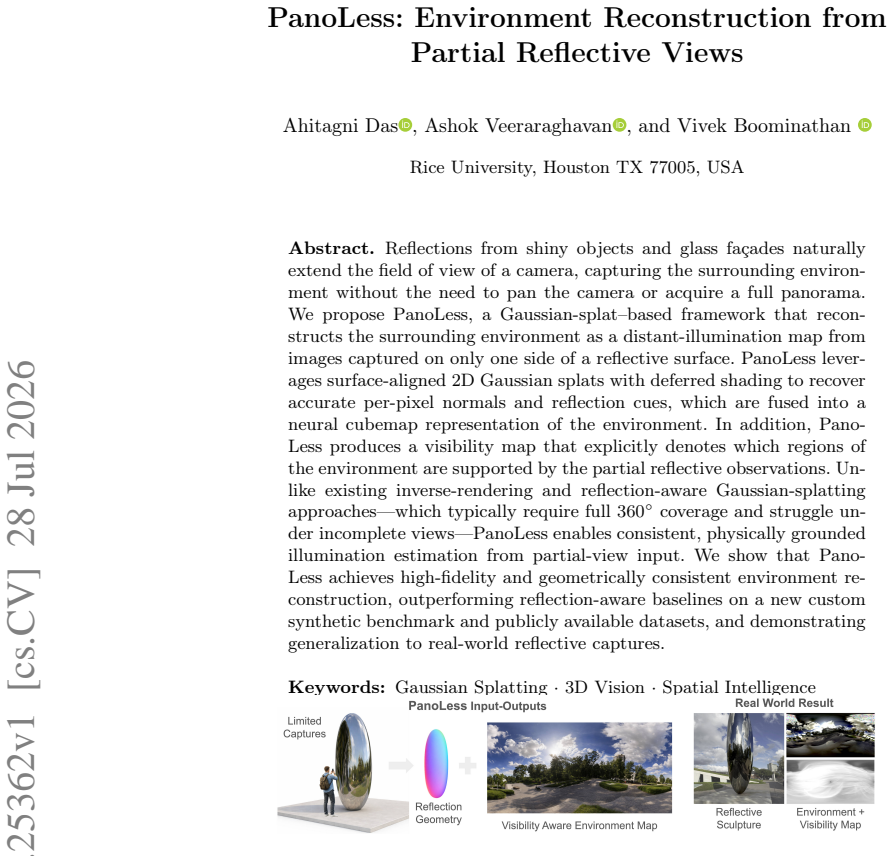
PanoLess discovers that partial reflective views can recover coherent surrounding illumination, provided the scene uses surface-aligned primitives. The environment is stored as a jointly optimized six-face neural cubemap; each pixel's mirror reflection direction, from an explicit normal, samples the cubemap directly, and rendered color is diffuse albedo plus that radiance. A visibility map marks which cubemap directions observations support. On its benchmark the method reports a nearly 5 dB environment-map PSNR gain over reflection-aware baselines, about 89% of normals within 5°, and generalization to real handheld captures. The paper argues via ablations and a pose-jitter sweep that normal
What carries the argument
The load-bearing mechanism is the direct, unattenuated coupling between a per-pixel mirror reflection direction and a learnable six-face cubemap. Surface-aligned 2D Gaussian splats give explicit normals n; the specular reflection direction is ω_r = normalize(v − 2(v·n)n), computed in screen space and used to bilinearly sample a trainable 6×3×L×L cubemap, with final color C = A + L_env(ω_r)—no roughness attenuation, no MLP blending. Two supporting mechanisms carry the geometry: a depth-normal consistency loss that stabilizes the normals, and a visibility map that accumulates per-texel evidence during training so observed and extrapolated environment directions can be distinguished.
Load-bearing premise
The entire pipeline rests on the assumption that the observed surface is mirror-like: each pixel's color is the diffuse albedo plus the environment radiance along one mirror direction, with no roughness attenuation, so on matte or rough surfaces the environment map receives almost no supervision and the central reconstruction claim weakens.
What would settle it
Render Shiny Partial Vase with a rough or matte BRDF of increasing roughness while keeping everything else fixed: if environment-map PSNR does not drop sharply even as surface geometry stays accurate, the unit-reflection assumption is not what carries the result; if it does, the assumption is confirmed as load-bearing. A complementary check is the paper's own pose-jitter sweep, which drops envmap PSNR from 18.4 to 12.0 dB at only 0.5° camera rotation.
If this is right
- Environment reconstruction no longer requires 360° or panoramic capture for mirror-like surfaces; a single hemisphere of views suffices.
- Curved reflectors act as wide-angle mirrors, illuminating large portions of the environment from limited viewpoints, while planar mirrors illuminate a narrow band—knowledge the visibility map makes explicit.
- The visibility map gives downstream relighting, AR insertion, and scene understanding a direct confidence signal for each environment direction.
- Removing roughness-dependent attenuation improves supervision of the cubemap; small roughness values otherwise starve the environment map of gradients.
- Normal accuracy is the bottleneck: mean normal error below 5° is needed to keep reflection queries coherent, and pose accuracy is a practical prerequisite.
Where Pith is reading between the lines
- The same visibility signal could gate a generative prior for unseen environment regions: only apply diffusion-based inpainting where the map flags low confidence, keeping observed directions untouched.
- The method's direct cubemap supervision suggests a general recipe: for other physically based shading terms, avoid learned multiplicative weights when the target material is near one end of the parameter range, since attenuation weakens gradients exactly where supervision is sparse.
- A natural stress test is to sweep roughness or diffuse fraction on the Shiny Partial benchmark; the expected failure boundary should track where the albedo channel absorbs the photometric signal.
- Because reflection directions compress viewpoint motion, the framework may transfer to mapping environments from moving specular objects in the wild, with the visibility map acting as an angular coverage sensor.
Editorial analysis
A structured set of objections, weighed in public.
Referee Report
Summary. The paper proposes PanoLess, a Gaussian-splatting framework that reconstructs a distant environment map from partial, single-hemisphere views of reflective surfaces. The method represents the reflector with surface-aligned 2D Gaussian splats, rasterizes per-pixel normal/albedo/roughness buffers, and defers shading through a learnable neural cubemap queried at the specular reflection direction. A visibility map records which environment directions are supported by observations, and an early silhouette loss anchors geometry. Experiments on a custom synthetic benchmark (Shiny Partial, three scenes) report a nearly 5 dB improvement over the strongest baseline in recovered environment PSNR and mean normal angular error below 5°, alongside ablations isolating normal consistency, silhouette supervision, and the direct (unattenuated) cubemap pathway. Qualitative results on real captures and a mixed-specularity subset (Partial Shiny Blender) are also presented.
Significance. If the results hold, PanoLess demonstrates a practically useful capability: recovering coherent high-frequency surrounding illumination from one-sided observations of highly specular surfaces, a setting where existing reflection-aware Gaussian-splatting methods degrade. The paper is honestly written: the ablations are informative, the matched-silhouette baseline (Table 2) improves fairness, and the pose-jitter study (S5) makes a predicted failure mode explicit. The visibility map is a potentially valuable output for downstream applications. However, the central claim is only established for the near-mirror regime; the paper's own experiments show sharp degradation outside it, and the quantitative benchmark is small and without error bars. The strengths are real but the scope of the claim needs to be reconciled with the evidence.
major comments (3)
- [Abstract; Sec. 1; Sec. 3.4, Eq. (8); Sec. 4.5; Fig. 8; S3] The abstract and introduction motivate 'glass facades', but the shading model in Eq. (8), C(p)=A(p)+L_env(ω_r(p)), assumes an opaque, perfectly specular surface with unit reflection strength and no Fresnel or transmission term. For glass, the Fresnel reflectance is well below 1 and the transmitted background is viewpoint-dependent; the constant albedo channel cannot absorb that variation, so the photometric loss will push transmitted signal into the cubemap and corrupt the recovered map. The paper's own results confirm this: Sec. 4.5 states the method 'breaks down as surfaces become more diffuse,' Fig. 8 shows the coffee cup produces no usable env signal, and S3 reports darker, less faithful maps on Partial Shiny Blender. The nearly 5 dB improvement is therefore established only for mirror-like surfaces; the abstract's 'glass facades' claim is unsupported. Either add a quantitative glass
- [Table 1; Table 3; S5] The main quantitative claim rests on a custom benchmark with only three scenes, and all numbers are single-run point estimates with no standard deviations, seeds, or significance tests. This is particularly concerning given the demonstrated sensitivity to pose error (S5: envmap PSNR drops from 18.4 to 12.0 dB under a 0.5° rotation perturbation). The 'nearly 5 dB' average is dominated by one favorable configuration. Please report repeated runs (e.g., at least 3 seeds per scene and per ablation) and state the variance, or otherwise justify stability.
- [Sec. 3.6; Sec. 4.2; S4] The visibility map is presented as a key contribution, but its only quantitative evaluation is a small post-processing gain on a single scene (Cola, S4: +0.28 dB envmap PSNR). The claim that the map is 'well-calibrated' is not supported by any calibration metric, such as correlation between V and per-texel reconstruction error. As a named contribution, it needs more direct evidence; otherwise it should be repositioned as a qualitative byproduct.
minor comments (5)
- [Sec. 3.4, Eq. (6)] The statement that the reflection-direction error is 'largest at grazing angles' appears to contradict the bound in Eq. (6), where ∥δω_r∥ ≤ 2(|v·n|+1)∥δn∥ is maximized at normal incidence (|v·n|=1) and minimized at grazing. Please check the direction of this remark.
- [Sec. 4.4] The observation that albedo maps are 'low-energy and nearly uniform' is presented as validation of Eq. (8), but it only shows that the optimizer exploits the direct cubemap pathway; it does not establish physical correctness. Consider tempering this claim.
- [Sec. 4.3; Fig. 6] The Shiny Real results are qualitative only; no ground-truth environment map or quantitative metric is reported. The main text should state this explicitly to avoid implying quantitative validation on real data.
- [Fig. 3] The visibility map panels lack a color scale or legend. Please add one so the reader can interpret the confidence values.
- [Sec. 4.1] The per-scene gains over MaterialRefGS range from about 2.5 dB (Cola) to 7.5 dB (Mirror), so 'nearly 5 dB' is an average over three scenes. Reporting per-scene deltas alongside the average would give a clearer picture.
Circularity Check
No significant circularity: the environment map is optimized from images and evaluated against held-out ground truth; Eq. 6 is a derived bound, not a fitted prediction.
full rationale
PanoLess's derivation chain is self-contained. The environment map E is a free parameter optimized through the photometric loss (Eqs. 9-14) against training images; no term in the objective supervises E directly with the ground-truth cubemap, and the reported environment-map metrics are evaluated on held-out test views and against ground-truth environment maps (Table 1). Eq. (6) is a first-order error-propagation bound obtained algebraically from the reflection equation (Eq. 5), not a fitted quantity, and the pose-jitter experiment (S5) is an independent empirical probe. The visibility map is explicitly defined as accumulated evidence (Sec. 3.6) and is used as a confidence diagnostic, not disguised as an independent prediction. All load-bearing building blocks (2DGS [10], 3DGS [16], normal propagation [36], Ref-NeRF [30]) are cited external works with no author overlap; there is no self-citation chain, imported uniqueness theorem, or ansatz smuggled via self-citation. The admitted limitation in Sec. 4.5—that the unit-reflectance model breaks down as surfaces become more diffuse—is an external-validity boundary, not a circular step. The abstract's glass-facade generalization is likewise a validation gap rather than a derivation that reduces to its own inputs. Therefore no step reduces to its own inputs by construction, and the circularity score is 0.
Axiom & Free-Parameter Ledger
free parameters (6)
- lambda_d =
0.5
- lambda_s =
0.2
- lambda_nd =
not reported
- silhouette_loss_window =
3000 iterations
- visibility_threshold_tau =
not reported
- cubemap_resolution_L =
not reported
axioms (5)
- domain assumption Environment radiance depends only on direction (far-field/distant illumination); the reflector is small relative to scene distance.
- ad hoc to paper Additive shading with unit reflection strength and negligible roughness: C = A + L_env(omega_r), with no full BRDF integral.
- domain assumption Surface-aligned 2DGS normals, after depth-normal regularization, are accurate enough to index the cubemap.
- domain assumption Camera poses from COLMAP and object masks from SAM are accurate; the scene is static.
- standard math Standard alpha compositing, bilinear cubemap sampling, and the reflection law.
Cite this review
Pith. "Pith review of PanoLess: Environment Reconstruction from Partial Reflective Views." pith.science (2026). https://pith.science/paper/332WDTFH
@misc{pith2026260725362,
  author       = {Pith},
  title        = {Pith review of: PanoLess: Environment Reconstruction from Partial Reflective Views},
  year         = {2026},
  howpublished = {\url{https://pith.science/paper/332WDTFH}},
  note         = {Machine review of arXiv:2607.25362}
}
read the original abstract
Reflections from shiny objects and glass facades naturally extend the field of view of a camera, capturing the surrounding environment without the need to pan the camera or acquire a full panorama. We propose PanoLess, a Gaussian-splat-based framework that reconstructs the surrounding environment as a distant illumination map from images captured on only one side of a reflective surface. PanoLess leverages surface-aligned 2D Gaussian splats with deferred shading to recover accurate per-pixel normals and reflection cues, which are fused into a neural cubemap representation of the environment. In addition, PanoLess produces a visibility map that explicitly denotes which regions of the environment are supported by the partial reflective observations. Unlike existing inverse-rendering and reflection-aware Gaussian-splatting approaches, which typically require full 360-degree coverage and struggle under incomplete views, PanoLess enables consistent, physically grounded illumination estimation from partial-view input. We show that PanoLess achieves high-fidelity and geometrically consistent environment reconstruction, outperforming reflection-aware baselines on a new custom synthetic benchmark and publicly available datasets, and demonstrating generalization to real-world reflective captures.
Figures


Reference graph
Works this paper leans on
-
[1]
IEEE TPAMI25(2), 218–233 (2003)
Basri, R., Jacobs, D.W.: Lambertian reflectance and linear subspaces. IEEE TPAMI25(2), 218–233 (2003)
2003
-
[2]
Communications of the ACM19(10), 542–547 (1976) 16 Ahitagni Das , Ashok Veeraraghavan, and Vivek Boominathan
Blinn, J.F., Newell, M.E.: Texture and reflection in computer generated images. Communications of the ACM19(10), 542–547 (1976) 16 Ahitagni Das , Ashok Veeraraghavan, and Vivek Boominathan
1976
-
[3]
IEEE Transactions on Visualization and Computer Graphics (2025)
Chen, D., Li, H., Ye, W., Wang, Y., Xie, W., Zhai, S., Wang, N., Liu, H., Bao, H., Zhang, G.: Pgsr: Planar-based gaussian splatting for efficient and high-fidelity sur- face reconstruction. IEEE Transactions on Visualization and Computer Graphics (2025)
2025
-
[4]
In: SIGGRAPH (2024)
Dai, P., Xu, J., Xie, W., Liu, X., Wang, H., Xu, W.: High-quality surface recon- struction using gaussian surfels. In: SIGGRAPH (2024)
2024
-
[5]
In: SIGGRAPH
Debevec, P.: Rendering synthetic objects into real scenes: global illumination and hdr photography. In: SIGGRAPH. pp. 189–198 (1998)
1998
-
[6]
In: SIGGRAPH
Debevec, P., Hawkins, T., Tchou, C., Duiker, H.P., Sarokin, W., Sagar, M.: Ac- quiring the reflectance field of a human face. In: SIGGRAPH. pp. 145–156 (2000)
2000
-
[7]
In: ECCV (2024)
Gao, J., Gu, C., Lin, Y., Li, Z., Zhu, H., Cao, X., Zhang, L., Yao, Y.: Relightable 3d gaussians: Realistic point cloud relighting with brdf decomposition and ray tracing. In: ECCV (2024)
2024
-
[8]
In: Proceedings of the IEEE/CVF Conference on Computer Vision and Pattern Recognition (CVPR) (2025)
Gu, C., Wei, X., Zeng, Z., Yao, Y., Zhang, L.: Irgs: Inter-reflective gaussian splat- ting with 2d gaussian ray tracing. In: Proceedings of the IEEE/CVF Conference on Computer Vision and Pattern Recognition (CVPR) (2025)
2025
-
[9]
ACM Transactions on Graph- ics40(6), 1–11 (2021)
Hadadan, S., Chen, S., Zwicker, M.: Neural radiosity. ACM Transactions on Graph- ics40(6), 1–11 (2021)
2021
-
[10]
In: SIGGRAPH (2024)
Huang, B., Yu, Z., Chen, A., Geiger, A., Gao, S.: 2d gaussian splatting for geo- metrically accurate radiance fields. In: SIGGRAPH (2024)
2024
-
[11]
IEEE Transactions on Pattern Analysis and Machine IntelligencePAMI-3(6), 661–669 (1981)
Ikeuchi, K.: Determining surface orientations of specular surfaces by using the photometric stereo method. IEEE Transactions on Pattern Analysis and Machine IntelligencePAMI-3(6), 661–669 (1981)
1981
-
[12]
In: CVPR
Jensen, R., Dahl, A., Vogiatzis, G., Tola, E., Aanæs, H.: Large scale multi-view stereopsis evaluation. In: CVPR. pp. 406–413 (2014)
2014
-
[13]
In: European Conference on Computer Vision (ECCV) (2024)
Ji, C., Li, Y., Liao, Y.: Reframe: Reflective surface real-time rendering for mobile devices. In: European Conference on Computer Vision (ECCV) (2024)
2024
-
[14]
In: CVPR (2024)
Jiang, Y., Tu, J., Liu, Y., Gao, X., Long, X., Wang, W., Ma, Y.: Gaussianshader: 3d gaussian splatting with shading functions for reflective surfaces. In: CVPR (2024)
2024
-
[15]
In: Eurographics Workshop on Rendering
Kautz, J., Sloan, P.P., Snyder, J.: Fast, arbitrary brdf shading for low-frequency lighting using spherical harmonics. In: Eurographics Workshop on Rendering. pp. 291–296 (2002)
2002
-
[16]
In: SIGGRAPH (2023)
Kerbl, B., Kopanas, G., Leimkühler, T., Drettakis, G.: 3d gaussian splatting for real-time radiance field rendering. In: SIGGRAPH (2023)
2023
-
[17]
In: SIGGRAPH Asia (2018)
Li,Z.,Xu,Z.,Ramamoorthi,R.,Sunkavalli,K.,Chandraker,M.:Learningtorecon- struct shape and spatially-varying reflectance from a single image. In: SIGGRAPH Asia (2018)
2018
-
[18]
In: ICCV
Liang, R., Chen, H., Li, C., Chen, F., Panneer, S., Vijaykumar, N.: Envidr: Im- plicit differentiable renderer with neural environment lighting. In: ICCV. pp. 79–89 (2023)
2023
-
[19]
In: CVPR (2024)
Liang, Z., Zhang, Q., Feng, Y., Shan, Y., Jia, K.: Gs-ir: 3d gaussian splatting for inverse rendering. In: CVPR (2024)
2024
-
[20]
In: ACM SIGGRAPH 2023 Conference Proceedings (2023)
Liu, Y., Wang, P., Lin, C., Long, X., Wang, J., Liu, L., Komura, T., Wang, W.: Nero: Neural geometry and brdf reconstruction of reflective objects from multiview images. In: ACM SIGGRAPH 2023 Conference Proceedings (2023)
2023
-
[21]
arXiv preprint arXiv:2404.01168 (2024)
Meng, J., Li, H., Wu, Y., Gao, Q., Yang, S., Zhang, J., Ma, S.: Mirror- 3dgs: Incorporating mirror reflections into 3d gaussian splatting. arXiv preprint arXiv:2404.01168 (2024)
Pith/arXiv arXiv 2024
-
[22]
In: CVPR (2022) PanoLess: Environment Reconstruction from Partial Reflective Views 17
Munkberg, J., et al.: Extracting triangular 3d models, materials, and lighting from images. In: CVPR (2022) PanoLess: Environment Reconstruction from Partial Reflective Views 17
2022
-
[23]
In: CVPR (2014)
Oxholm, G., Nishino, K.: Multiview shape and reflectance from natural illumina- tion. In: CVPR (2014)
2014
-
[24]
In: Proceedings of the IEEE/CVF Conference on Computer Vision and Pattern Recognition (CVPR) (2024)
Phongthawee, P., Chinchuthakun, W., Sinsunthithet, N., Jampani, V., Raj, A., Khungurn, P., Suwajanakorn, S.: Diffusionlight: Light probes for free by painting a chrome ball. In: Proceedings of the IEEE/CVF Conference on Computer Vision and Pattern Recognition (CVPR) (2024)
2024
-
[25]
In: SIGGRAPH
Ramamoorthi, R., Hanrahan, P.: A signal-processing framework for inverse ren- dering. In: SIGGRAPH. pp. 117–128 (2001)
2001
-
[26]
In: SIGGRAPH
Sloan, P.P., Kautz, J., Snyder, J.: Precomputed radiance transfer for real-time rendering in dynamic, low-frequency lighting environments. In: SIGGRAPH. pp. 527–536 (2002)
2002
-
[27]
In: CVPR (2021)
Somanath, G., Kurz, D.: Hdr environment map estimation for real-time augmented reality. In: CVPR (2021)
2021
-
[28]
Springer (2010)
Szeliski, R.: Computer Vision: Algorithms and Applications. Springer (2010)
2010
-
[29]
arXiv preprint arXiv:2403.17822 (2024)
Turkulainen, M., Ren, X., Melekhov, I., Seiskari, O., Rahtu, E., Kannala, J.: Dn-splatter: Depth and normal priors for gaussian splatting and meshing. arXiv preprint arXiv:2403.17822 (2024)
Pith/arXiv arXiv 2024
-
[30]
In: CVPR
Verbin, D., Hedman, P., Mildenhall, B., Zickler, T., Barron, J.T., Srinivasan, P.P.: Ref-nerf: Structured view-dependent appearance for neural radiance fields. In: CVPR. pp. 5481–5490 (2022)
2022
-
[31]
In: IEEE International Conference on Robotics and Automation (ICRA) (2025)
Xiang, H., Li, X., Cheng, K., Lai, X., Zhang, W., Liao, Z., Zeng, L., Liu, X.: Gaus- sianroom: Improving 3d gaussian splatting with sdf guidance and monocular cues for indoor scene reconstruction. In: IEEE International Conference on Robotics and Automation (ICRA) (2025)
2025
-
[32]
In: Proceedings of the IEEE/CVF Conference on Computer Vision and Pattern Recog- nition (CVPR) (2025)
Xie, T., Chen, X., Xu, Z., Xie, Y., Jin, Y., Shen, Y., Peng, S., Bao, H., Zhou, X.: Envgs: Modeling view-dependent appearance with environment gaussian. In: Proceedings of the IEEE/CVF Conference on Computer Vision and Pattern Recog- nition (CVPR) (2025)
2025
-
[33]
In: ECCV (2024)
Yan, Y., et al.: Street gaussians: Modeling dynamic urban scenes with gaussian splatting. In: ECCV (2024)
2024
-
[34]
In: NeurIPS (2024)
Yang, Z., Gao, X., Sun, Y., Huang, Y., Lyu, X., Zhou, W., Jiao, S., Qi, X., Jin, X.: Spec-gaussian: Anisotropic view-dependent appearance for 3d gaussian splatting. In: NeurIPS (2024)
2024
-
[35]
In: International Conference on Learning Representations (ICLR) (2025)
Yao, Y., Zeng, Z., Gu, C., Zhu, X., Zhang, L.: Reflective gaussian splatting. In: International Conference on Learning Representations (ICLR) (2025)
2025
-
[36]
In: SIG- GRAPH (2024)
Ye, K., Hou, Q., Zhou, K.: 3d gaussian splatting with deferred reflection. In: SIG- GRAPH (2024)
2024
-
[37]
ACM Transactions on Graphics (TOG) (2024)
Yu, Z., Sattler, T., Geiger, A.: Gaussian opacity fields: Efficient adaptive surface reconstruction in unbounded scenes. ACM Transactions on Graphics (TOG) (2024)
2024
-
[38]
NeurIPS (2025)
Zhang, W., Tang, J., Zhang, W., Fang, Y., Liu, Y.S., Han, Z.: Materialrefgs: Re- flective gaussian splatting with multi-view consistent material inference. NeurIPS (2025)
2025
-
[39]
Zhang, Y., Chen, A., Wan, Y., Song, Z., Yu, J., Luo, Y., Yang, W.: Ref-gs: Direc- tional factorization for 2d gaussian splatting. In: CVPR (2025) 18 Ahitagni Das , Ashok Veeraraghavan, and Vivek Boominathan S1 Shiny Real Capture Details Capture pipeline.Each scene is recorded as a handheld video with the operator walking in an arc around one side of the r...
2025
This paper was first reviewed by deepseek-v4-flash on August 1, 2026.
discussion (0)
Sign in with ORCID, Apple, or X to comment. Anyone can read and Pith papers without signing in.