REVIEW 4 major objections 5 minor 47 references
RGB-D video saliency gets a 29,077-frame benchmark and a top-performing SAM2 baseline
Reviewed by Pith at T0; open to challenge. T0 means a machine referee read the full paper against a public rubric. the ladder, T0–T4 →
T0 review · deepseek-v4-flash
2026-08-01 02:33 UTC pith:ZEARXEOG
load-bearing objection RDVSv2 is a genuinely larger RGB-D VSOD benchmark with a reasonable SAM2 baseline, but the unvalidated stereo-flow depth proxy is the weak link and the dataset isn't released yet. the 4 major comments →
RDVSv2: A Large-scale Benchmark for RGB-D Video Salient Object Detection
The pith
A machine-rendered reading of the paper's core claim, the machinery that carries it, and where it could break.
Core claim
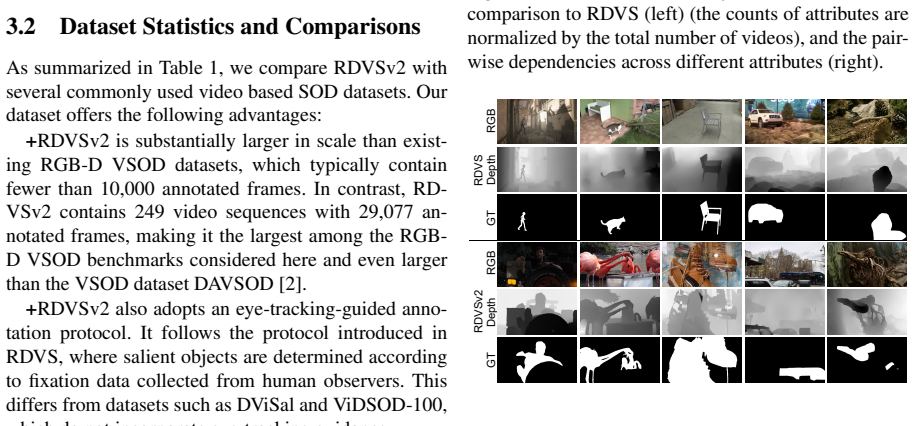
RDVSv2 is claimed to be the largest RGB-D video salient object detection benchmark, with 29,077 densely annotated frames across 249 sequences, all sourced from stereoscopic videos. Depth is obtained by running RAFT on each stereo pair and taking the horizontal flow component as a disparity proxy, then min-max normalizing it into a grayscale map. The salient-object ground truth is produced by a semi-automatic pipeline: eye-tracking fixation data from 22 viewers guide the selection of salient objects, SAM2 generates initial masks, and annotators refine boundaries. The benchmark's balanced 7:3 training/test split and per-frame annotations are intended to support temporally consistent evaluation
What carries the argument
The load-bearing machinery has two parts. For the data, it is the stereo-disparity proxy: RAFT's horizontal flow component between the left and right views, min-max normalized to a grayscale depth image. This is what converts ordinary 3D videos into the 'D' of RGB-D, and the benchmark's claimed geometric consistency depends on it. For the baseline, it is the PEFT adaptation of SAM2: three parallel LoRA modules—low-rank weight adaptations inserted into the MLP of each encoder block, one per modality—capture modality-specific cues, while a shared cross-modal prompting (CP) bottleneck adapter, inserted before multi-head attention and residual-connected, transfers shared representations among RG
Load-bearing premise
The whole benchmark rests on treating the horizontal component of RAFT stereo flow, min-max normalized to a grayscale image, as a faithful depth signal; if this proxy does not preserve the true depth ordering between salient objects and their backgrounds, every RGB-D evaluation built on RDVSv2 is weakened.
What would settle it
Take a sample of RDVSv2 frames, compute actual disparity with calibrated stereo matching, and measure the rank correlation between the proxy grayscale depth and true disparity inside and around the salient-object masks. If the proxy inverts depth order or compresses relative depth differences so that salient objects are no longer separated from background, the benchmark's depth modality fails its purpose.
If this is right
- Training and evaluation on RDVSv2 gives RGB-D VSOD methods a substantially more challenging test: average S-measure of existing VSOD and RGB-D VSOD models drops by about 8 percentage points compared with RDVS.
- Fine-tuning on RDVSv2's balanced training split improves all 11 tested methods, with temporal-cue-based VSOD models gaining about 3 S-measure points, suggesting the benchmark provides effective supervision.
- The attribute analysis identifies scale variation (SV) as the hardest attribute, so future datasets should add more SV-heavy sequences to increase difficulty.
- CPSAM's design—frozen SAM2 encoder plus LoRA adapters and a cross-modal prompting adapter, with optical flow as an auxiliary modality—yields top results on RDVSv2 and on three existing RGB-D VSOD benchmarks, and can be trained in roughly 24 hours on a single GPU.
- The balanced 7:3 training/test split with matched categories and attributes offers a fairer protocol than earlier RGB-D VSOD datasets that lack principled splits.
Where Pith is reading between the lines
- If the stereo-disparity proxy is validated, the same pipeline could cheaply create RGB-D video benchmarks from any large stereoscopic video archive, potentially scaling far beyond 249 sequences.
- The performance drop for motion-only methods on RDVSv2 suggests motion cues alone are less discriminative; a natural test is whether depth helps more on RDVSv2 than on RDVS by comparing RGB+flow against RGB+depth+flow variants.
- Because CPSAM drops SAM2's memory mechanism in favor of optical flow, an extension could test whether re-adding temporal memory improves consistency on the attention-shift sequences that RDVSv2 emphasizes.
- The shared cross-modal prompting adapter could be probed to see whether it genuinely transfers information across modalities or mainly acts as a regularizer, for example by measuring per-modality gradient contributions during fine-tuning.
Editorial analysis
A structured set of objections, weighed in public.
Referee Report
Summary. RDVSv2 is a proposed large-scale RGB-D video salient object detection (RGB-D VSOD) benchmark containing 249 video sequences with 29,077 densely annotated frames. Depth maps are derived from stereoscopic videos by taking the horizontal component of RAFT optical flow as a disparity proxy and min-max normalizing it to grayscale. Ground-truth masks are obtained via eye-tracking-guided identification followed by SAM2-initialized, manually refined video object segmentation. The paper also proposes CPSAM, a SAM2-L-based baseline that fuses RGB, depth, and optical flow using parallel LoRA modules and a shared cross-modal prompting adapter. Experiments evaluate 11 existing methods on RDVSv2 under zero-shot and fine-tuning protocols and compare CPSAM against state-of-the-art methods on RDVSv2 and three existing RGB-D VSOD datasets, reporting SOTA performance. The paper claims that RDVSv2 is much larger, more diverse, and more challenging than prior benchmarks and provides geometry-consistent depth with high-quality annotations.
Significance. If the validation concerns are addressed, RDVSv2 would be a valuable community resource: it is substantially larger than prior RGB-D VSOD datasets, provides dense annotations, includes attention-shift scenarios, and is planned for public release. The attribute analysis and category distribution are useful, and the proposed CPSAM baseline is a reasonable parameter-efficient adaptation of SAM2. However, the benchmark's central quality claims rest on two currently unsupported pillars: the depth proxy and the annotation protocol. The reported experimental improvements are also not accompanied by uncertainty estimates. The contribution is therefore promising but conditional on additional validation.
major comments (4)
- [Section 3.1 (Dataset Construction)] The depth modality is load-bearing and unvalidated. The paper takes the horizontal component of RAFT optical flow between stereo views as a disparity proxy and min-max normalizes it into a grayscale depth image. It does not show that the source videos are rectified, gives no error analysis for occlusions, vertical flow, or textureless regions, and provides no comparison to a true stereo method (e.g., RAFT-Stereo) or to ground-truth disparity on a subset. There is also no ablation demonstrating that this proxy helps saliency detection more than monocular depth (e.g., DPT). Because every RGB-D experiment in Tables 2-4 trains or evaluates on these maps, a systematic depth-ordering error would propagate through all benchmark evaluations and the claimed SOTA results. Please add a validation subset with known disparity, report correlation/error metrics, and compare models trained with proxy de
- [Section 3.1 (Dataset Annotation)] The 'high-quality annotation' claim is not quantified. Ground-truth masks are initialized by SAM2 and manually refined, but the paper reports no inter-annotator agreement metrics (e.g., IoU between independent annotators), no summary of how much refinement changed the SAM2 outputs, and no quality-control statistics. Since the proposed CPSAM is built on SAM2-L, the evaluation of SAM2-based methods may inherit a self-consistency bias if final GT remains close to SAM2 outputs. Please report an annotation study (e.g., IoU between initial SAM2 masks and final GT, and independent human annotation on a sample) to quantify quality and the residual circularity.
- [Section 5.1 (Straightforward evaluation on the full RDVSv2 dataset)] The zero-shot comparison is confounded by training data. CPSAM is trained on DAVIS, DAVSOD, FBMS, plus DUTS (with DPT depth), while the 11 existing baselines use their original training sets; no control is made for training-data size or composition. Thus the statement that 'CPSAM achieves the best overall performance' in Table 2 may reflect a data advantage rather than model superiority. Please either train all methods on the same external data, or report each method's training data and restrict CPSAM to the same data as the comparison set.
- [Tables 2-5 (Experimental uncertainty)] All results are from single training runs, with no error bars, confidence intervals, or significance tests. Several reported margins are small—for example, Table 4 on ViDSOD-100 shows Fmax 0.897 vs 0.896 for Samba and identical MAE 0.014. Because the SOTA claim rests on such margins, please repeat experiments with multiple seeds (or otherwise report statistical significance) for CPSAM and its closest competitors.
minor comments (5)
- [Table 1] The formatting is broken: the SegTrack-V2 row appears to lack the check-mark columns and resolution separator; please verify the table renders correctly.
- [Table 4] In the ViDSOD-100 column, '0.8960.014' is missing a space; should be '0.896 0.014'.
- [Figures 2 and 3] Subfigures are referred to as 'left' and 'right' without subfigure labels; adding (a)/(b) labels would improve clarity.
- [Notation] The dataset name is written both as 'DA VIS' (Table 1, Section 5.1) and 'DAVIS' (Section 2); please unify.
- [Supplementary material] The paper repeatedly references the supplementary material for annotation details, attribute definitions, and split comparisons. Since the supplementary was not provided for review, please ensure these details are included in the final submission.
Circularity Check
No significant circularity: the benchmark construction and baseline evaluation are not self-referential in a way that reduces predictions to inputs.
full rationale
The paper's derivation chain is: (i) stereoscopic videos are processed by RAFT to obtain horizontal flow as a disparity proxy (§3.1); (ii) GT masks are produced by eye-tracking-guided annotation with SAM2 initialization and manual refinement (§3.1); (iii) the CPSAM baseline adapts SAM2-L with LoRA and a cross-modal adapter (§4); (iv) models are evaluated on the new benchmark and existing datasets (§5). None of these steps equates a predicted quantity to a fitted input. The depth maps are a constructed data modality, not a prediction; the horizontal-flow proxy is a stated assumption, not a circular derivation. The GT masks are not defined as SAM2 outputs: the paper explicitly says SAM2 generates only initial masks that are 'manually refined to obtain accurate object boundaries' (§3.1, Dataset Annotation), and the salient objects are first identified from fixation heatmaps. Thus the evaluation of SAM2-based CPSAM against this GT is not statistically forced by construction. The paper's self-citations (RDVS, DCTNet+, JLDCF, etc.) are used as prior methods/datasets for comparison or as sources of an annotation protocol; they do not supply an unverified uniqueness theorem or a load-bearing premise that already contains the claimed result. The lack of validation for the depth proxy is a correctness/robustness concern, not circularity, because the paper does not claim to have derived depth from first principles or to have predicted an outcome from the same data. Consequently, no circular step meeting the required evidentiary standard is present.
Axiom & Free-Parameter Ledger
free parameters (3)
- LoRA rank
- Cross-modal prompting adapter bottleneck width
- Optical flow estimator =
unspecified (RAFT or FlowFormer++)
axioms (5)
- domain assumption Horizontal RAFT flow component after min-max normalization is a valid proxy for stereo disparity and preserves depth ordering for saliency.
- domain assumption Eye-tracking heatmaps from 22 free-viewing participants reliably identify the salient object(s) in each frame, including attention shifts.
- domain assumption SAM2-generated initial masks, after manual refinement, yield accurate ground-truth boundaries.
- domain assumption SAM2-L pre-trained on RGB transfers to RGB-depth-flow video input through LoRA and adapters without modifying the frozen encoder.
- domain assumption Synthetic monocular depth (DPT) on training videos is a reasonable surrogate for stereo-derived depth when zero-shot evaluating on RDVSv2.
Cite this review
Pith. "Pith review of RDVSv2: A Large-scale Benchmark for RGB-D Video Salient Object Detection." pith.science (2026). https://pith.science/paper/ZEARXEOG
@misc{pith2026260725392,
  author       = {Pith},
  title        = {Pith review of: RDVSv2: A Large-scale Benchmark for RGB-D Video Salient Object Detection},
  year         = {2026},
  howpublished = {\url{https://pith.science/paper/ZEARXEOG}},
  note         = {Machine review of arXiv:2607.25392}
}
read the original abstract
We introduce RDVSv2, a large-scale benchmark for RGB-D video salient object detection (RGB-D VSOD) with dense frame-level annotations. Existing datasets in this emerging field are often limited in scale and annotation quality, while also relying on less geometry-consistent depth cues. To address these limitations, RDVSv2 is built from publicly accessible stereoscopic online videos and contains 249 video sequences with 29,077 annotated frames. It includes depth maps derived from stereoscopic videos, together with frame-wise salient object masks annotated with eye-tracking guidance. Compared with existing datasets, RDVSv2 is much larger in scale and covers more diverse and challenging scenarios. In addition, we establish a strong baseline for RGB-D VSOD based on Segment Anything Model 2 (SAM2). Specifically, we employ a parameter-efficient fine-tuning (PEFT) strategy to adapt the SAM2 encoder to jointly encode RGB, depth, and optical flow cues. Extensive experiments show that RDVSv2 is substantially more challenging for existing RGB-D VSOD methods. Meanwhile, the proposed baseline achieves state-of-the-art results on RDVSv2 and existing RGB-D VSOD benchmarks. We hope that RDVSv2 and the provided baseline will serve as useful resources for future research on RGB-D VSOD and related multi-modal video understanding tasks. Our dataset and code will be available at https://github.com/ltynick/RDVSv2.
Figures




Reference graph
Works this paper leans on
-
[1]
Salient object detection in the deep learning era: An in- depth survey.IEEE Transactions on Pattern Anal- ysis and Machine Intelligence, 44(6):3239–3259, 2021
Wenguan Wang, Qiuxia Lai, Huazhu Fu, Jianbing Shen, Haibin Ling, and Ruigang Yang. Salient object detection in the deep learning era: An in- depth survey.IEEE Transactions on Pattern Anal- ysis and Machine Intelligence, 44(6):3239–3259, 2021
2021
-
[2]
Shifting more attention to video salient object detection
Deng-Ping Fan, Wenguan Wang, Ming-Ming Cheng, and Jianbing Shen. Shifting more attention to video salient object detection. InProceedings of the IEEE/CVF conference on computer vision and pattern recognition, pages 8554–8564, 2019
2019
-
[3]
Salient object detec- tion in rgb-d videos.IEEE Transactions on Image Processing, 33:6660–6675, 2024
Ao Mou, Yukang Lu, Jiahao He, Dingyao Min, Keren Fu, and Qijun Zhao. Salient object detec- tion in rgb-d videos.IEEE Transactions on Image Processing, 33:6660–6675, 2024
2024
-
[4]
Dvsod: Rgb-d video salient object detection.Ad- vances in Neural Information Processing Systems, 36:8774–8787, 2023
Jingjing Li, Wei Ji, Size Wang, Wenbo Li, et al. Dvsod: Rgb-d video salient object detection.Ad- vances in Neural Information Processing Systems, 36:8774–8787, 2023
2023
-
[5]
Vidsod-100: A new dataset and a baseline model for rgb-d video salient object detection.International Journal of Computer Vision, 132(11):5173–5191, 2024
Junhao Lin, Lei Zhu, Jiaxing Shen, Huazhu Fu, Qing Zhang, and Liansheng Wang. Vidsod-100: A new dataset and a baseline model for rgb-d video salient object detection.International Journal of Computer Vision, 132(11):5173–5191, 2024
2024
-
[6]
Segment anything
Alexander Kirillov, Eric Mintun, Nikhila Ravi, Hanzi Mao, Chloe Rolland, Laura Gustafson, Tete Xiao, Spencer Whitehead, Alexander C Berg, Wan-Yen Lo, et al. Segment anything. InProceed- ings of the IEEE/CVF international conference on computer vision, pages 4015–4026, 2023
2023
-
[7]
Sam 2: Segment any- thing in images and videos.arXiv preprint arXiv:2408.00714, 2024
Nikhila Ravi, Valentin Gabeur, Yuan-Ting Hu, Ronghang Hu, Chaitanya Ryali, Tengyu Ma, Haitham Khedr, Roman R ¨adle, Chloe Rolland, Laura Gustafson, et al. Sam 2: Segment any- thing in images and videos.arXiv preprint arXiv:2408.00714, 2024. 8
Pith/arXiv arXiv 2024
-
[8]
Lora: Low-rank adaptation of large language models.Iclr, 1(2):3, 2022
Edward J Hu, Yelong Shen, Phillip Wallis, Zeyuan Allen-Zhu, Yuanzhi Li, Shean Wang, Liang Wang, Weizhu Chen, et al. Lora: Low-rank adaptation of large language models.Iclr, 1(2):3, 2022
2022
-
[9]
Jl-dcf: Joint learning and densely- cooperative fusion framework for rgb-d salient ob- ject detection
Keren Fu, Deng-Ping Fan, Ge-Peng Ji, and Qi- jun Zhao. Jl-dcf: Joint learning and densely- cooperative fusion framework for rgb-d salient ob- ject detection. InProceedings of the IEEE/CVF conference on computer vision and pattern recog- nition, pages 3052–3062, 2020
2020
-
[10]
Calibrated rgb-d salient object detection
Wei Ji, Jingjing Li, Shuang Yu, Miao Zhang, Yon- gri Piao, Shunyu Yao, Qi Bi, Kai Ma, Yefeng Zheng, Huchuan Lu, et al. Calibrated rgb-d salient object detection. InProceedings of the IEEE/CVF conference on computer vision and pattern recog- nition, pages 9471–9481, 2021
2021
-
[11]
Cross-modal fusion and pro- gressive decoding network for rgb-d salient object detection.International Journal of Computer Vi- sion, 132(8):3067–3085, 2024
Xihang Hu, Fuming Sun, Jing Sun, Fasheng Wang, and Haojie Li. Cross-modal fusion and pro- gressive decoding network for rgb-d salient object detection.International Journal of Computer Vi- sion, 132(8):3067–3085, 2024
2024
-
[12]
Catnet: A cascaded and ag- gregated transformer network for rgb-d salient ob- ject detection.IEEE Transactions on Multimedia, 26:2249–2262, 2023
Fuming Sun, Peng Ren, Bowen Yin, Fasheng Wang, and Haojie Li. Catnet: A cascaded and ag- gregated transformer network for rgb-d salient ob- ject detection.IEEE Transactions on Multimedia, 26:2249–2262, 2023
2023
-
[13]
Flow guided recurrent neural en- coder for video salient object detection
Guanbin Li, Yuan Xie, Tianhao Wei, Keze Wang, and Liang Lin. Flow guided recurrent neural en- coder for video salient object detection. InPro- ceedings of the IEEE conference on computer vi- sion and pattern recognition, pages 3243–3252, 2018
2018
-
[14]
Motion guided attention for video salient object detection
Haofeng Li, Guanqi Chen, Guanbin Li, and Yizhou Yu. Motion guided attention for video salient object detection. InProceedings of the IEEE/CVF international conference on computer vision, pages 7274–7283, 2019
2019
-
[15]
Video object segmentation using space-time memory networks
Seoung Wug Oh, Joon-Young Lee, Ning Xu, and Seon Joo Kim. Video object segmentation using space-time memory networks. InProceedings of the IEEE/CVF international conference on com- puter vision, pages 9226–9235, 2019
2019
-
[16]
Xmem: Long-term video object segmentation with an atkinson-shiffrin memory model
Ho Kei Cheng and Alexander G Schwing. Xmem: Long-term video object segmentation with an atkinson-shiffrin memory model. InEuropean conference on computer vision, pages 640–658. Springer, 2022
2022
-
[17]
Look before you match: Instance understanding matters in video object segmentation
Junke Wang, Dongdong Chen, Zuxuan Wu, Chong Luo, Chuanxin Tang, Xiyang Dai, Yucheng Zhao, Yujia Xie, Lu Yuan, and Yu-Gang Jiang. Look before you match: Instance understanding matters in video object segmentation. InProceedings of the IEEE/CVF conference on computer vision and pattern recognition, pages 2268–2278, 2023
2023
-
[18]
Learning better video query with sam for video instance segmentation.IEEE Transac- tions on Circuits and Systems for Video Technol- ogy, 35(4):2963–2974, 2024
Hao Fang, Tong Zhang, Xiaofei Zhou, and Xinxin Zhang. Learning better video query with sam for video instance segmentation.IEEE Transac- tions on Circuits and Systems for Video Technol- ogy, 35(4):2963–2974, 2024
2024
-
[19]
Depth-cooperated trimodal network for video salient object detection
Yukang Lu, Dingyao Min, Keren Fu, and Qijun Zhao. Depth-cooperated trimodal network for video salient object detection. In2022 IEEE inter- national conference on image processing (ICIP), pages 116–120. IEEE, 2022
2022
-
[20]
Samba: A unified mamba-based framework for general salient object detection
Jiahao He, Keren Fu, Xiaohong Liu, and Qijun Zhao. Samba: A unified mamba-based framework for general salient object detection. InProceed- ings of the Computer Vision and Pattern Recogni- tion Conference, pages 25314–25324, 2025
2025
-
[21]
Lightweight multi-frequency enhancement net- work for rgb-d video salient object detection
Daerji Suolang, Jiahao He, Wangchuk Tser- ing, Keren Fu, Xiaofeng Li, and Qijun Zhao. Lightweight multi-frequency enhancement net- work for rgb-d video salient object detection. In ICASSP 2025-2025 IEEE International Confer- ence on Acoustics, Speech and Signal Processing (ICASSP), pages 1–5. IEEE, 2025
2025
-
[22]
Multi-scale and detail-enhanced segment anything model for salient object detec- tion
Shixuan Gao, Pingping Zhang, Tianyu Yan, and Huchuan Lu. Multi-scale and detail-enhanced segment anything model for salient object detec- tion. InProceedings of the 32nd ACM inter- national conference on multimedia, pages 9894– 9903, 2024
2024
-
[23]
Kunpeng Wang, Danying Lin, Chenglong Li, Zhengzheng Tu, and Bin Luo. Adapting seg- ment anything model to multi-modal salient object detection with semantic feature fusion guidance. arXiv preprint arXiv:2408.15063, 2024
Pith/arXiv arXiv 2024
-
[24]
Samsod: Re- thinking sam optimization for rgb-t salient ob- ject detection.IEEE Transactions on Multimedia, 2026
Zhengyi Liu, Xinrui Wang, Xianyong Fang, Zhengzheng Tu, and Linbo Wang. Samsod: Re- thinking sam optimization for rgb-t salient ob- ject detection.IEEE Transactions on Multimedia, 2026
2026
-
[25]
Kan-sam: Kolmogorov-arnold net- work guided segment anything model for rgb- t salient object detection
Xingyuan Li, Ruichao Hou, Tongwei Ren, and Gangshan Wu. Kan-sam: Kolmogorov-arnold net- work guided segment anything model for rgb- t salient object detection. In2025 IEEE In- ternational Conference on Multimedia and Expo (ICME), pages 1–6. IEEE, 2025
2025
-
[26]
Jia Lin, Xiaofei Zhou, Jiyuan Liu, Runmin Cong, Guodao Zhang, Zhi Liu, and Jiyong Zhang. Sam- daq: Segment anything model with depth-guided adaptive queries for rgb-d video salient object de- tection.arXiv preprint arXiv:2511.09870, 2025. 9
arXiv 2025
-
[27]
Raft: Recurrent all- pairs field transforms for optical flow
Zachary Teed and Jia Deng. Raft: Recurrent all- pairs field transforms for optical flow. InEuro- pean conference on computer vision, pages 402–
-
[28]
Video segmenta- tion by tracking many figure-ground segments
Fuxin Li, Taeyoung Kim, Ahmad Humayun, David Tsai, and James M Rehg. Video segmenta- tion by tracking many figure-ground segments. In Proceedings of the IEEE international conference on computer vision, pages 2192–2199, 2013
2013
-
[29]
Segmentation of moving objects by long term video analysis.IEEE transactions on pattern anal- ysis and machine intelligence, 36(6):1187–1200, 2013
Peter Ochs, Jitendra Malik, and Thomas Brox. Segmentation of moving objects by long term video analysis.IEEE transactions on pattern anal- ysis and machine intelligence, 36(6):1187–1200, 2013
2013
-
[30]
Consistent video saliency using local gradient flow optimization and global refinement.IEEE Transactions on Image Processing, 24(11):4185– 4196, 2015
Wenguan Wang, Jianbing Shen, and Ling Shao. Consistent video saliency using local gradient flow optimization and global refinement.IEEE Transactions on Image Processing, 24(11):4185– 4196, 2015
2015
-
[31]
A benchmark dataset and evaluation methodology for video object segmentation
Federico Perazzi, Jordi Pont-Tuset, Brian McWilliams, Luc Van Gool, Markus Gross, and Alexander Sorkine-Hornung. A benchmark dataset and evaluation methodology for video object segmentation. InProceedings of the IEEE conference on computer vision and pattern recognition, pages 724–732, 2016
2016
-
[32]
A benchmark dataset and saliency-guided stacked autoencoders for video-based salient object detec- tion.IEEE Transactions on Image Processing, 27(1):349–364, 2017
Jia Li, Changqun Xia, and Xiaowu Chen. A benchmark dataset and saliency-guided stacked autoencoders for video-based salient object detec- tion.IEEE Transactions on Image Processing, 27(1):349–364, 2017
2017
-
[33]
Revisiting video saliency prediction in the deep learning era.IEEE transactions on pattern anal- ysis and machine intelligence, 43(1):220–237, 2019
Wenguan Wang, Jianbing Shen, Jianwen Xie, Ming-Ming Cheng, Haibin Ling, and Ali Borji. Revisiting video saliency prediction in the deep learning era.IEEE transactions on pattern anal- ysis and machine intelligence, 43(1):220–237, 2019
2019
-
[34]
Flowformer++: Masked cost volume autoencod- ing for pretraining optical flow estimation
Xiaoyu Shi, Zhaoyang Huang, Dasong Li, Manyuan Zhang, Ka Chun Cheung, Simon See, Hongwei Qin, Jifeng Dai, and Hongsheng Li. Flowformer++: Masked cost volume autoencod- ing for pretraining optical flow estimation. In Proceedings of the IEEE/CVF Conference on Computer Vision and Pattern Recognition, pages 1599–1610, 2023
2023
-
[35]
Cpal: Cross-prompting adapter with loras for rgb+ x semantic segmentation.IEEE Trans- actions on Circuits and Systems for Video Tech- nology, 35(6):5858–5871, 2025
Ye Liu, Pengfei Wu, Miaohui Wang, and Jun Liu. Cpal: Cross-prompting adapter with loras for rgb+ x semantic segmentation.IEEE Trans- actions on Circuits and Systems for Video Tech- nology, 35(6):5858–5871, 2025
2025
-
[36]
Vision transformers for dense predic- tion
Ren ´e Ranftl, Alexey Bochkovskiy, and Vladlen Koltun. Vision transformers for dense predic- tion. InProceedings of the IEEE/CVF inter- national conference on computer vision, pages 12179–12188, 2021
2021
-
[37]
Learning to detect salient objects with image-level supervision
Lijun Wang, Huchuan Lu, Yifan Wang, Mengyang Feng, Dong Wang, Baocai Yin, and Xiang Ruan. Learning to detect salient objects with image-level supervision. InProceedings of the IEEE confer- ence on computer vision and pattern recognition, pages 136–145, 2017
2017
-
[38]
Structure-measure: A new way to evaluate foreground maps
Deng-Ping Fan, Ming-Ming Cheng, Yun Liu, Tao Li, and Ali Borji. Structure-measure: A new way to evaluate foreground maps. InProceedings of the IEEE international conference on computer vi- sion, pages 4548–4557, 2017
2017
-
[39]
Salient object detection: A bench- mark.IEEE transactions on image processing, 24(12):5706–5722, 2015
Ali Borji, Ming-Ming Cheng, Huaizu Jiang, and Jia Li. Salient object detection: A bench- mark.IEEE transactions on image processing, 24(12):5706–5722, 2015
2015
-
[40]
Frequency-tuned salient region detection
Radhakrishna Achanta, Sheila Hemami, Francisco Estrada, and Sabine Susstrunk. Frequency-tuned salient region detection. In2009 IEEE conference on computer vision and pattern recognition, pages 1597–1604. IEEE, 2009
2009
-
[41]
Saliency filters: Contrast based filtering for salient region detection
Federico Perazzi, Philipp Kr ¨ahenb¨uhl, Yael Pritch, and Alexander Hornung. Saliency filters: Contrast based filtering for salient region detection. In2012 IEEE conference on computer vision and pattern recognition, pages 733–740. IEEE, 2012
2012
-
[42]
Bbs-net: Rgb-d salient ob- ject detection with a bifurcated backbone strategy network
Deng-Ping Fan, Yingjie Zhai, Ali Borji, Jufeng Yang, and Ling Shao. Bbs-net: Rgb-d salient ob- ject detection with a bifurcated backbone strategy network. InEuropean conference on computer vi- sion, pages 275–292. Springer, 2020
2020
-
[43]
Specificity- preserving rgb-d saliency detection
Tao Zhou, Huazhu Fu, Geng Chen, Yi Zhou, Deng-Ping Fan, and Ling Shao. Specificity- preserving rgb-d saliency detection. InProceed- ings of the IEEE/CVF international conference on computer vision, pages 4681–4691, 2021
2021
-
[44]
3-d convolutional neural net- works for rgb-d salient object detection and be- yond.IEEE Transactions on Neural Networks and Learning Systems, 35(3):4309–4323, 2022
Qian Chen, Zhenxi Zhang, Yanye Lu, Keren Fu, and Qijun Zhao. 3-d convolutional neural net- works for rgb-d salient object detection and be- yond.IEEE Transactions on Neural Networks and Learning Systems, 35(3):4309–4323, 2022
2022
-
[45]
Point-aware interaction and cnn-induced refine- ment network for rgb-d salient object detection
Runmin Cong, Hongyu Liu, Chen Zhang, Wei Zhang, Feng Zheng, Ran Song, and Sam Kwong. Point-aware interaction and cnn-induced refine- ment network for rgb-d salient object detection. In Proceedings of the 31st ACM international confer- ence on multimedia, pages 406–416, 2023
2023
-
[46]
Full-duplex strat- egy for video object segmentation
Ge-Peng Ji, Keren Fu, Zhe Wu, Deng-Ping Fan, Jianbing Shen, and Ling Shao. Full-duplex strat- egy for video object segmentation. InProceed- ings of the IEEE/CVF international conference on computer vision, pages 4922–4933, 2021. 10
2021
-
[47]
Dynamic context-sensitive filter- ing network for video salient object detection
Miao Zhang, Jie Liu, Yifei Wang, Yongri Piao, Shunyu Yao, Wei Ji, Jingjing Li, Huchuan Lu, and Zhongxuan Luo. Dynamic context-sensitive filter- ing network for video salient object detection. In Proceedings of the IEEE/CVF international con- ference on computer vision, pages 1553–1563, 2021. 11
2021
discussion (0)
Sign in with ORCID, Apple, or X to comment. Anyone can read and Pith papers without signing in.