REVIEW 3 major objections 4 minor 104 references
Nonlocal Majorana polarization in non-Hermitian topological superconductors
T0 review · 3 major / 4 minor · reviewed 2026-08-01 · deepseek-v4-flash
Pith's one-line read In non-Hermitian superconductors, the biorthogonal nonlocal Majorana polarization is a reliable real-space indicator that takes the value -1 for true Majorana zero modes, near 0 for trivial zero-energy states, and ±∞ or NaN at exceptional p
desk verdict Useful extension of the Majorana polarization to non-Hermitian chains, but the central indicator is normalization-dependent as written. read the letter →
The pith
A machine-rendered reading of the paper's core claim, the machinery that carries it, and where it could break.
The reading
What carries the argument
The central object is the biorthogonal nonlocal Majorana polarization: for each half of the chain one sums, over sites, the expectation value of the particle-hole operator C taken between a left (L) and right (R) eigenvector of the lowest-energy state (Eq. (1)), then multiplies the left-half and right-half sums (Eq. (3)). Because non-Hermitian Hamiltonians have distinct left and right eigenvectors, the off-diagonal components P^{LR}, P^{RL} carry the non-Hermitian information; the sensitivity R = det(P) then quantifies how much of the polarization is of non-Hermitian origin. The paper's main use is as a classifier: P^{LR}=-1 indicates a fully nonlocal, non-overlapping Majorana zero mode; P^{
What would settle it
Compute P^{LR} at the two-site HNK sweet spot t=sqrt(Γ²+Δ²) for a range of Γ using two different normalizations of the left eigenvectors (e.g., ⟨Ψ^L|Ψ^L⟩=1 versus ⟨Ψ^L|Ψ^R⟩=1); if P^{LR} does not stay exactly -1, the claimed universal value is a convention artifact rather than a property of the zero mode.
Extended reading notes
Core claim
At the paper's core is the claim that the biorthogonal nonlocal Majorana polarization P^{ab} (a≠b), defined as the product of the particle-hole expectation values in the left and right halves of the system, functions as a topological indicator in non-Hermitian superconductors. In the sweet spot of the Hatano-Nelson-Kitaev model with zero chemical potential, fully nonlocal Majorana zero modes satisfy P^{ab}=-1 when Γ≠0 and a≠b, while the orthogonal components P^{aa} deviate from -1; the paper also provides analytic expressions for two- and three-site minimal chains showing that non-Hermiticity drives P^{LR} and R toward -1, restoring Majorana robustness degraded by a chemical potential. Away
Load-bearing premise
The load-bearing premise is that the off-diagonal polarization P^{LR}, computed with a particular normalization of the left eigenvectors, is a genuine state property whose value -1 for Majorana zero modes is independent of that normalization; if the value changes when the left eigenvectors are rescaled, the classification would be an artifact of the convention.
Editorial extensions
If this is right
- In the sweet spot of the HNK model, fully nonlocal MZMs are characterized by P^{ab}=-1 (a≠b) for any finite Γ, making the biorthogonal component a direct real-space signature of non-Hermitian Majorana physics.
- The sensitivity R detects the proportion of non-Hermitian contribution to the Majorana polarization, with R=-1 in the pure non-Hermitian limit and R=0 in the Hermitian limit; this gives a quantitative measure of how much non-Hermiticity stabilizes a zero mode.
- Non-Hermiticity restores Majorana zero modes degraded by a finite chemical potential in few-site Kitaev chains (two- and three-site), as captured by P^{LR} and R approaching -1 for large Γ.
- In superconductor-normal junctions, P^{LR} distinguishes MZMs from spatially confined trivial zero-energy states that appear in the normal region, while exceptional points produce a distinct divergent or NaN signature.
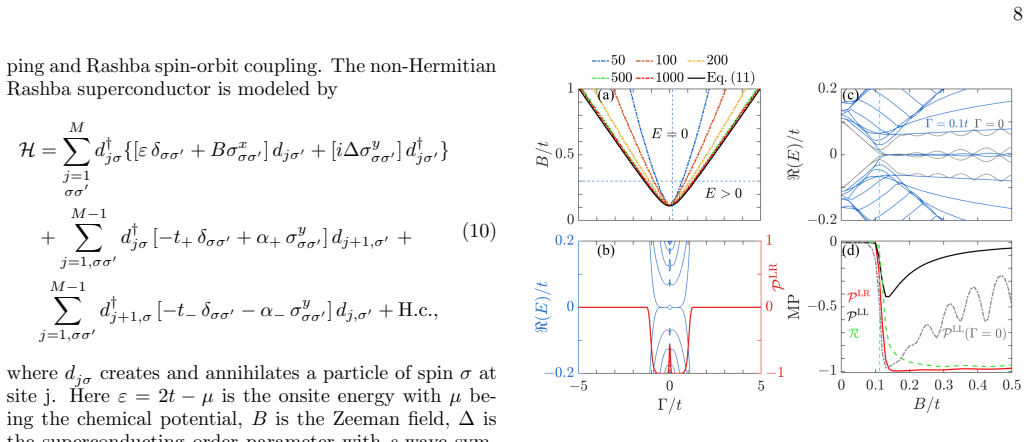
- In the non-Hermitian Rashba superconductor, the topological critical field is renormalized to sqrt(μ²+4(αΓ/t)²+Δ²), and nonreciprocity lowers the Majorana splitting and drives P and R toward -1.
Reading between the lines
- If P^{LR}=-1 is indeed universal for non-overlapping Majorana zero modes under any form of non-Hermiticity (not just nonreciprocal hopping), the indicator could also diagnose Majorana modes in open-driven or dissipative systems where biorthogonality is the natural language—a direction the paper does not pursue.
- The analytic treatment covers only minimal few-site chains; the numerics suggest the -1 signature persists for longer chains, so testing the diagnostic on disordered or multi-channel wires would be a natural next step.
- Because the polarization is built from the lowest-energy eigenvector only, it may be possible to convert it into a post-selection-free measurement if the particle-hole expectation can be read out via local density-of-states or tunneling probes; the paper does not address the measurement protocol but the definition points to local observables.
- The denominator in the polarization uses the diagonal overlap rather than the biorthogonal overlap; checking whether the -1 value is invariant under left-eigenvector normalization would test how robust the claimed universal value is.
Editorial analysis
A structured set of objections, weighed in public.
Referee Report
Summary. The manuscript generalizes the nonlocal Majorana polarization (MP) to non-Hermitian topological superconductors. It defines biorthogonal MP components P^{ab} (a,b=L,R) in Eqs. (1)-(3), a nonlocal MP sensitivity R in Eqs. (4)-(5), and applies these to Hatano-Nelson-Kitaev chains (few-site, 16-site, and SN junctions) and to non-Hermitian Rashba chains. The main claim is that the off-diagonal component P^{LR} equals -1 for fully nonlocal Majorana zero modes, is approximately 0 for trivial zero-energy states, and becomes ±∞ or NaN at exceptional points; it also claims that non-Hermiticity enhances MZM robustness. Analytic few-site expressions are provided for HNK sweet spots.
Significance. If the proposed indicator were well defined, it would be a useful addition to the non-Hermitian Majorana toolbox, and the numerical exploration across several models is a positive feature. The paper also reproduces the Hermitian limit and provides analytic few-site expressions, which are helpful. However, the central observable P^{LR} is not invariant under the normalization freedom of left and right eigenvectors, so the quantitative signature P^{LR}=-1 is not yet established as a state property. The determinant R is better behaved under the reciprocal rescaling, but the paper's primary claims rely on P^{LR}.
major comments (3)
- [Sec. II, Eq. (1)] The off-diagonal MP in Eq. (1) is not invariant under the normalization freedom left by the only stated condition, biorthogonality ⟨Ψ^L_n|Ψ^R_m⟩=δ_nm. If |Ψ^R⟩→λ|Ψ^R⟩ and |Ψ^L⟩→λ^{-1}|Ψ^L⟩, the biorthogonality condition is preserved, but p_j^{LR}→λ²p_j^{LR} and therefore P^{LR}→|λ|^4P^{LR}. A real rescaling λ=2 changes the claimed value -1 to -16. The determinant R in Eq. (4) is invariant under this coupled rescaling, but the paper's primary diagnostic and the analytic values in Eqs. (7)-(9) are not. The text never states how left and right eigenvectors are normalized in the numerics or in the analytic derivations. Please specify a normalization convention or replace Eq. (1) by the standard biorthogonal expectation value ⟨L|C|R⟩/⟨L|R⟩, and recompute the affected results.
- [Sec. III A, Eqs. (7)-(9)] The two-site and three-site sweet-spot conditions in Sec. III A (t=√(Γ²+Δ²+μ²) and t=√(Γ²+Δ²+μ²/2), and their μ=0 limit) are asserted without derivation, and the resulting exact forms in Eqs. (7)-(9) are used as the analytic anchor for the numerical phase diagrams. A derivation of these conditions and the stated eigenvector normalizations should be included (or, at minimum, an explicit verification that the Hamiltonian has a zero eigenvalue at these parameters). The same applies to Eq. (11) for the Rashba critical field.
- [Sec. III A and Sec. V] The conclusion that 'non-Hermiticity enhances MZM robustness' is inferred from P^{LR} moving toward -1 and P^{aa} toward 0 as Γ increases. Since P^{LR} is normalization-dependent, this inference is not yet supported: a different normalization can produce the same trend by construction. Please base the robustness claim on a normalization-independent quantity (e.g., R, or a separately defined invariant) and state the criterion explicitly.
minor comments (4)
- [Abstract; Fig. 2 caption] Typographical errors: 'sensitiviy' in the abstract, 'biothorgonal' in the Fig. 2 caption, and 'Hemitian' elsewhere.
- [Eq. (3)] The identity P^{ab}=P_l^{ab}(P_r^{ab})^*=(P_l^{ab})^*P_r^{ab} holds only when the product is real. Please clarify whether P_l^{ab} and P_r^{ab} are real by construction, or define P^{ab} with a definite ordering.
- [Sec. III B and footnote [94]] The text says P^{LR} jumps around Γ/t=1, and footnote [94] says the value is shown as a jump to zero in Fig. 1(c,d) for clarity, but the relevant panels are in Fig. 3. This is confusing and should be corrected.
- [Sec. II, Eq. (5)] The phrase 'aa=ab contributions (Hermitian)' in the R-mapping is vague. Please spell out the conditions under which R=0 in terms of the actual MP matrix entries, especially since the off-diagonal entries can be normalization-dependent.
Circularity Check
The headline signature P^{LR}=-1 is not invariant under the only biorthogonality normalization stated; the central 'MZM detector' value is a normalization artifact, though R and the spectral evidence provide independent content.
-
other
[Eq. (1) and Eq. (7); Sections II and III.A]
"we define the MP at each site j as the expectation value of the particle-hole operator as p^{ab}_j = Σ_σ ⟨Ψ^a_{jσ}|C|Ψ^b_{jσ}⟩ / Σ_σ ⟨Ψ^a_{jσ}|Ψ^a_{jσ}⟩ , (1) ... fully nonlocal MZMs localized at each edge are characterized by P^{ab}=−1 in the NH case when Γ≠0, provided a≠b."
The only normalization stated is biorthogonality, ⟨Ψ^L_{n'}|Ψ^R_n⟩=δ_{n'n}. For a real rescaling λ, |Ψ^R⟩→λ|Ψ^R⟩ and |Ψ^L⟩→λ^{-1}|Ψ^L⟩ preserve this condition. Under that rescaling, the numerator of p^{LR}_j in Eq. (1) is unchanged while the denominator ⟨Ψ^L|Ψ^L⟩ scales as λ^{-2}, so p^{LR}_j→λ^2 p^{LR}_j. Since P^{LR} is the product of the left- and right-half sums, it scales as λ^4. Hence the exact value −1 in Eq. (7) can be turned into any positive multiple (e.g. −1/16 or −16) by an allowed choice of left-vector normalization. The paper never fixes this gauge, so the claimed signature of a robust nonlocal MZM is not a Hamiltonian-determined state property; it is an artifact of the arbitrary denominator in Eq. (1).
full rationale
The paper is mostly an application of an existing real-space indicator to specific non-Hermitian models, and most of the concrete calculations — sweet-spot conditions, two- and three-site analytic expressions, re-entrant phase diagrams, SN junctions, and the Rashba critical field — are not fitted to the desired classification. Ref. [9] is a self-citation by two of the present authors, but the analytic expressions and direct spectral comparisons give independent content, so the self-citation alone is not load-bearing circularity. The serious issue is different: Eq. (1) defines the biorthogonal MP with a denominator ⟨Ψ^L|Ψ^L⟩ while the only stated normalization is the biorthogonal overlap ⟨Ψ^L|Ψ^R⟩=δ. That leaves P^{LR}, and hence the central assertion P^{LR}=−1 for fully nonlocal MZMs, dependent on an unspecified rescaling of the left and right eigenvectors. This makes the headline quantitative prediction partially definitional rather than a robust derived invariant. The determinant R is better behaved (P^{LR}P^{RL} is gauge-invariant), and the energy spectra provide independent support, so the circularity is partial rather than total.
Assumptions & free parameters
assumptions (5)
- domain assumption Non-Hermitian BdG Hamiltonians are diagonalizable and biorthogonal eigenstates exist away from exceptional points.
- ad hoc to paper The biorthogonal normalization ⟨Ψ^L_n|Ψ^R_m⟩=δ_nm fixes the scale of left eigenvectors, making P^{LR} in Eq. (1) well-defined.
- domain assumption The Hermitian interpretation P^{aa}=-1 ↔ robust nonlocal MZMs (Ref [9]) carries over to the NH biorthogonal components P^{LR}.
- ad hoc to paper Sweet-spot conditions (e.g., t=√(Γ²+Δ²+μ²) for two-site HNK, t=√(Γ²+Δ²+μ²/2) for three-site) produce exact zero-energy MZMs.
- ad hoc to paper The determinant R with regime mapping Eq. (5) captures the fraction of non-Hermitian contribution to MP.
invented entities (2)
-
Nonlocal biorthogonal Majorana polarization P^{ab} (a≠b)
-
Nonlocal MP sensitivity R
Cite this review
Pith. "Pith review of Nonlocal Majorana polarization in non-Hermitian topological superconductors." pith.science (2026). https://pith.science/paper/HDLCTTK3
@misc{pith2026260725424,
  author       = {Pith},
  title        = {Pith review of: Nonlocal Majorana polarization in non-Hermitian topological superconductors},
  year         = {2026},
  howpublished = {\url{https://pith.science/paper/HDLCTTK3}},
  note         = {Machine review of arXiv:2607.25424}
}
read the original abstract
The nonlocal Majorana polarization, defined as the product of the expectation values of the particle-hole operator at opposite halves of the system, has been shown to be a reliable topological indicator that determines the presence and quality of Majorana zero modes in Hermitian topological superconducting setups. In this work, we extend the concept of nonlocal Majorana polarization to the non-Hermitian realm by taking into account the biorthogonal eigenstates and demonstrate its utility by exploring distinct non-Hermitian superconducting systems. In particular, we show that the Majorana polarization can distinguish between Majorana zero modes, trivial zero-energy states, and exceptional points in non-Hermitian superconductors. Also, we introduce the concept of nonlocal Majorana polarization sensitiviy for characterizing the contribution of non-Hermiticity to Majorana polarization. As a byproduct, we find that non-Hermiticity enhances Majorana zero modes robustness, a property captured by the nonlocal Majorana polarization.
Figures


Figures from the paper (3 more)


Reference graph
Works this paper leans on
-
[9]
Tanaka, S
Y. Tanaka, S. Tamura, and J. Cayao, Theory of Ma- jorana zero modes in unconventional superconductors, Prog. Theor. Exp. Phys.2024, 08C105 (2024)
2024
-
[1]
This condition is global and system size independent
Zero chemical potential Atµ= 0, the sweet spot condition for MZMs is t=± √ Γ2 + ∆2. This condition is global and system size independent. Using this sweet spot condition in the definitions in Eq. (1)–(3) we obtain, P ab = − ∆2 Γ2 + ∆2 , a=b −1, a̸=b R=−1 + ∆2 Γ2 + ∆2 2 . (7) These general results demonstrate that fully nonlocal MZMs localized at eac...
-
[2]
As the system size grows, the an- alytical tractability becomes challenging
Finite chemical potential: Minimal chains At finite chemical potential,µ̸= 0, the condition for the emergence of zero-energy becomes sensitive to the size of the system [25]. As the system size grows, the an- alytical tractability becomes challenging. Therefore, we focus on experimentally accessible minimal chains [71– 75]. Two-site HNK chain.In this mode...
-
[3]
After the re-entering the topological phase the quality of the MZMs reduces, −1<P LR,R ≪0
with further increase in Γ. After the re-entering the topological phase the quality of the MZMs reduces, −1<P LR,R ≪0. Still, Fig. 3(b) shows that the non-Hermitian topological phase is still favorable over the Hermitian counterpart in this parameter regime. We note that in the vicinity of|Γ/t|= 1,P LR,R → ∞or NaN numerically (but undefined or indetermina...
2021
-
[4]
Sato and S
M. Sato and S. Fujimoto, Majorana fermions and topol- ogy in superconductors, J. Phys. Soc. Jpn.85, 072001 (2016). 10
2016
-
[5]
Aguado, Majorana quasiparticles in condensed mat- ter, Riv
R. Aguado, Majorana quasiparticles in condensed mat- ter, Riv. Nuovo Cimento40, 523 (2017)
2017
-
[6]
Sato and Y
M. Sato and Y. Ando, Topological superconductors: A review, Rep. Prog. Phys.80, 076501 (2017)
2017
-
[7]
Flensberg, F
K. Flensberg, F. von Oppen, and A. Stern, Engineered platforms for topological superconductivity and Majo- rana zero modes, Nat. Rev. Mater.6, 944 (2021)
2021
Show all 104 references
-
[8]
Marra, Majorana nanowires for topological quantum computation, J
P. Marra, Majorana nanowires for topological quantum computation, J. Appl. Phys.132, 231101 (2022)
2022
-
[10]
Fukaya, B
Y. Fukaya, B. Lu, K. Yada, Y. Tanaka, and J. Cayao, Superconducting phenomena in systems with unconven- tional magnets, J. Phys.: Condens. Matter37, 313003 (2025)
2025
-
[11]
A. Y. Kitaev, Unpaired Majorana fermions in quantum wires, Phys.-Usp.44, 131 (2001)
2001
-
[12]
O. A. Awoga and J. Cayao, Identifying trivial and Ma- jorana zero-energy modes using the Majorana polariza- tion, Phys. Rev. B110, 165404 (2024)
2024
-
[13]
Ashida, Z
Y. Ashida, Z. Gong, and M. Ueda, Non-Hermitian physics, Adv. Phys.69, 249 (2020)
2020
-
[14]
Okuma and M
N. Okuma and M. Sato, Non-Hermitian topological phe- nomena: A review, Annu. Rev. Condens. Matter Phys. , 83 (2023)
2023
-
[15]
Bessho, K
T. Bessho, K. Kawabata, and M. Sato, Topological classificaton of non-Hermitian gapless phases: Excep- tional points and bulk Fermi arcs, inProc. Int. Conf. on Strongly Correlated Electron Systems (SCES2019) (Physical Society of Japan, 2019) Chap. 30, p. 011098
2019
-
[16]
E. J. Bergholtz, J. C. Budich, and F. K. Kunst, Excep- tional topology of non-Hermitian systems, Rev. Mod. Phys.93, 015005 (2021)
2021
-
[17]
San-Jos´ e, J
P. San-Jos´ e, J. Cayao, E. Prada, and R. Aguado, Ma- jorana bound states from exceptional points in non- topological superconductors, Sci. Rep.6, 21427 (2016)
2016
-
[18]
Cayao and A
J. Cayao and A. M. Black-Schaffer, Exceptional odd- frequency pairing in non-Hermitian superconducting systems, Phys. Rev. B105, 094502 (2022)
2022
-
[19]
Cayao and A
J. Cayao and A. M. Black-Schaffer, Bulk Bogoliubov Fermi arcs in non-Hermitian superconducting systems, Phys. Rev. B107, 104515 (2023)
2023
-
[20]
A. A. Zyuzin and P. Simon, Disorder-induced excep- tional points and nodal lines in Dirac superconductors, Phys. Rev. B99, 165145 (2019)
2019
-
[21]
Okuma and M
N. Okuma and M. Sato, Topological phase transition driven by infinitesimal instability: Majorana fermions in non-Hermitian spintronics, Phys. Rev. Lett.123, 097701 (2019)
2019
-
[22]
S. Jana, D. Chowdhury, and A. Saha, Emergence of ex- ceptional points and their spectroscopic signature in a Dirac semimetal–dirty superconductor heterojunction, Phys. Rev. B103, 235438 (2021)
2021
-
[23]
Kornich and B
V. Kornich and B. Trauzettel, Signature ofPT- symmetric non-Hermitian superconductivity in angle- resolved photoelectron fluctuation spectroscopy, Phys. Rev. Research4, L022018 (2022)
2022
-
[24]
Cayao, Non-Hermitian zero-energy pinning of An- dreev and Majorana bound states in superconductor- semiconductor systems, Phys
J. Cayao, Non-Hermitian zero-energy pinning of An- dreev and Majorana bound states in superconductor- semiconductor systems, Phys. Rev. B110, 085414 (2024)
2024
-
[25]
Cayao and M
J. Cayao and M. Sato, Non-Hermitian phase-biased Josephson junctions, Phys. Rev. B110, L201403 (2024)
2024
-
[26]
Li, H.-P
C.-A. Li, H.-P. Sun, and B. Trauzettel, Anomalous An- dreev spectrum and transport in non-Hermitian Joseph- son junctions, Phys. Rev. B109, 214514 (2024)
2024
-
[27]
Avila, F
J. Avila, F. Pe˜ naranda, E. Prada, P. San-Jose, and R. Aguado, Non-Hermitian topology as a unifying framework for the Andreev versus Majorana states con- troversy, Commun. Phys.2, 133 (2019)
2019
-
[28]
Arouca, J
R. Arouca, J. Cayao, and A. M. Black-Schaffer, Topological superconductivity enhanced by exceptional points, Phys. Rev. B108, L060506 (2023)
2023
-
[29]
P.-X. Shen, Z. Lu, J. L. Lado, and M. Trif, Non- Hermitian Fermi-Dirac distribution in persistent cur- rent transport, Phys. Rev. Lett.133, 086301 (2024)
2024
-
[30]
D. M. Pino, Y. Meir, and R. Aguado, Thermodynamics of non-Hermitian Josephson junctions with exceptional points, Phys. Rev. B111, L140503 (2025)
2025
-
[31]
D. C. Ohnmacht, V. Wilhelm, H. Weisbrich, and W. Belzig, Non-Hermitian topology in multiterminal su- perconducting junctions, Phys. Rev. Lett.134, 156601 (2025)
2025
-
[32]
Cayao and M
J. Cayao and M. Sato, Non-Hermitian multiterminal phase-biased Josephson junctions, Phys. Rev. B110, 235426 (2024)
2024
-
[33]
Li and B
C.-A. Li and B. Trauzettel, Exceptional Andreev spec- trum and supercurrent inp-wave non-Hermitian Joseph- son junctions, Phys. Rev. B112, 184504 (2025)
2025
-
[34]
Capecelatro, M
R. Capecelatro, M. Marciani, G. Campagnano, and P. Lucignano, Andreev non-Hermitian Hamiltonian for open Josephson junctions from Green’s functions, Phys. Rev. B111, 064517 (2025)
2025
-
[35]
Ogino and S
R. Ogino and S. Uchino, Anomalous supercurrents in the presence of particle losses, arXiv:2505.21085 (2025)
2025 arXiv
-
[36]
Solow and K
O. Solow and K. Flensberg, Signatures of exceptional points in multiterminal superconductor–normal metal junctions, Phys. Rev. B112, L161402 (2025)
2025
-
[37]
J. Qi, M. Lu, J. Liu, C.-Z. Chen, and X. C. Xie, Non- Hermitian superconducting diode effect, Phys. Rev. B 112, L060502 (2025)
2025
-
[38]
Cayao and M
J. Cayao and M. Sato, Non-Hermitian Josephson junc- tions with four Majorana zero modes, J. Phys. Soc. Jpn. 95, 014705 (2026)
2026
-
[39]
Cayao and R
J. Cayao and R. Aguado, Non-Hermitian minimal Ki- taev chains, Phys. Rev. B111, 205432 (2025)
2025
-
[40]
Ezawa, Even-odd effect on robustness of Majorana edge states in short Kitaev chains, Phys
M. Ezawa, Even-odd effect on robustness of Majorana edge states in short Kitaev chains, Phys. Rev. B109, L161404 (2024)
2024
-
[41]
Pay´ a, O
C. Pay´ a, O. Solow, E. Prada, R. Aguado, and K. Flens- berg, Non-Hermitian skin effect and electronic nonlocal transport, Phys. Rev. B113, L161405 (2026)
2026
-
[42]
Kawabata, K
K. Kawabata, K. Shiozaki, M. Ueda, and M. Sato, Sym- metry and topology in non-Hermitian physics, Phys. Rev. X9, 041015 (2019)
2019
-
[43]
Z. Gong, Y. Ashida, K. Kawabata, K. Takasan, S. Hi- gashikawa, and M. Ueda, Topological phases of non- Hermitian systems, Phys. Rev. X8, 031079 (2018)
2018
-
[44]
Kobia lka, O
A. Kobia lka, O. A. Awoga, M. Leijnse, T. Doma´ nski, P. Holmvall, and A. M. Black-Schaffer, Topological su- perconductivity in Fibonacci quasicrystal, Phys. Rev. B 110, 134508 (2024)
2024
-
[45]
Sticlet, C
D. Sticlet, C. Bena, and P. Simon, Spin and Majorana polarization in topological superconducting wires, Phys. Rev. Lett.108, 096802 (2012)
2012
-
[46]
Sedlmayr and C
N. Sedlmayr and C. Bena, Visualizing Majorana bound states in one and two dimensions using the generalized 11 Majorana polarization, Phys. Rev. B92, 115115 (2015)
2015
-
[47]
Sedlmayr, J
N. Sedlmayr, J. M. Aguiar-Hualde, and C. Bena, Ma- jorana bound states in open quasi-one-dimensional and two-dimensional systems with transverse Rashba cou- pling, Phys. Rev. B93, 155425 (2016)
2016
-
[48]
Bena, Testing the formation of Majorana states using Majorana polarization, Comptes Rendus
C. Bena, Testing the formation of Majorana states using Majorana polarization, Comptes Rendus. Physique18, 349 (2017)
2017
-
[49]
Sedlmayr, V
N. Sedlmayr, V. Kaladzhyan, C. Dutreix, and C. Bena, Bulk boundary correspondence and the existence of Ma- jorana bound states on the edges of 2d topological su- perconductors, Phys. Rev. B96, 184516 (2017)
2017
-
[50]
O. A. Awoga, I. Ioannidis, A. Mishra, M. Leijnse, M. Trif, and T. Posske, Controlling Majorana hybridiza- tion in magnetic chain-superconductor systems, Phys. Rev. Res.6, 033154 (2024)
2024
-
[51]
R. S. Souto, A. Tsintzis, M. Leijnse, and J. Danon, Probing Majorana localization in minimal Kitaev chains through a quantum dot, Phys. Rev. Res.5, 043182 (2023)
2023
-
[52]
Samuelson, V
W. Samuelson, V. Svensson, and M. Leijnse, Minimal quantum dot based Kitaev chain with only local super- conducting proximity effect, Phys. Rev. B109, 035415 (2024)
2024
-
[53]
He, X.-L
S.-R. He, X.-L. Bi, J. Fan, Z.-H. Wang, L. Li, and D.-H. Xu, Manipulating and braiding Majorana corner modes on a agome lattice, Phys. Rev. B111, 144506 (2025)
2025
-
[54]
Karoliya, S
S. Karoliya, S. Tewari, and G. Sharma, Majorana modes in graphene strips: polarization, wavefunctions, disor- der, and Andreev states, ArXiv
-
[55]
This leaves the nonlocal MP in NH systems unexplored
We note that the MP has already been studied in NH systems [101] but still as a local spatial topological in- dicator. This leaves the nonlocal MP in NH systems unexplored
-
[56]
Moiseyev,Non-Hermitian Quantum Mechanics (Cambridge University Press, 2011)
N. Moiseyev,Non-Hermitian Quantum Mechanics (Cambridge University Press, 2011)
2011
-
[57]
F. K. Kunst, E. Edvardsson, J. C. Budich, and E. J. Bergholtz, Biorthogonal bulk-boundary correspondence in non-Hermitian systems, Phys. Rev. Lett.121, 026808 (2018)
2018
-
[58]
This is a trivial solu- tion since the superconductor does not contain MZMs or EPs in this case
Another scenario withR= 0 occurs whenP RR = P LL =P LR =P RL = 0 for any Γ. This is a trivial solu- tion since the superconductor does not contain MZMs or EPs in this case
-
[59]
L. N. Trefethen and M. Embree,Spectra and Pseu- dospectra: The Behavior of Nonnormal Matrices and Operators(Princeton University Press, 2005)
2005
-
[60]
Hatano and D
N. Hatano and D. R. Nelson, Localization transitions in non-Hermitian quantum mechanics, Phys. Rev. Lett. 77, 570 (1996)
1996
-
[61]
Ekman, E
C. Ekman, E. J. Bergholtz, and P. Molignini, Symmetry-fractionalized skin effects in non-Hermitian Luttinger liquids, arXiv2603.28849(2026)
2026 arXiv
-
[62]
This is applicable to non-Hermitian Kitaev models with other types of non-Hermiticity [11, 22, 39]
-
[63]
Leijnse and K
M. Leijnse and K. Flensberg, Parity qubits and poor man’s Majorana bound states in double quantum dots, Phys. Rev. B86, 134528 (2012)
2012
-
[64]
J. D. Sau and S. D. Sarma, Realizing a robust prac- tical Majorana chain in a quantum-dot-superconductor linear array, Nat. Commun.3, 964 (2012)
2012
-
[65]
Cayao, Emergent pair symmetries in systems with poor man’s Majorana modes, Phys
J. Cayao, Emergent pair symmetries in systems with poor man’s Majorana modes, Phys. Rev. B110, 125408 (2024)
2024
-
[66]
Tsintzis, R
A. Tsintzis, R. S. Souto, and M. Leijnse, Creating and detecting poor man’s Majorana bound states in in- teracting quantum dots, Phys. Rev. B106, L201404 (2022)
2022
-
[67]
Alvarado, A
M. Alvarado, A. L. Yeyati, R. Aguado, and R. S. Souto, Interplay between Majorana and Shiba states in a min- imal Kitaev chain coupled to a superconductor, Phys. Rev. B110, 245144 (2024)
2024
-
[68]
Luethi, H
M. Luethi, H. F. Legg, D. Loss, and J. Klinovaja, From perfect to imperfect poor man’s Majoranas in minimal Kitaev chains, Phys. Rev. B110, 245412 (2024)
2024
-
[69]
Kotetes, M
P. Kotetes, M. Roig, and B. M. Andersen, Nonrecipro- cal equilibrium 4π-periodic Josephson effect from poor man’s Majorana zero modes, arXiv:2409.13027 (2024)
2024 arXiv
-
[70]
V. K. Vimal and J. Cayao, Entanglement dynamics in minimal Kitaev chains, arXiv: 2507.17586 (2025)
2025 arXiv
-
[71]
Luethi, H
M. Luethi, H. F. Legg, D. Loss, and J. Klinovaja, Fate of poor man’s Majoranas in the long Kitaev chain limit, Phys. Rev. B111, 115419 (2025)
2025
-
[72]
Cayao and M
J. Cayao and M. Sato, Nonlocal Josephson diode effect in minimal Kitaev chains, Phys. Rev. Res.8, 013326 (2026)
2026
-
[73]
Cayao and M
J. Cayao and M. Sato, Andreev exceptional points in Josephson junctions formed by minimal Kitaev chains, arXiv:2606.23956 (2026)
2026 arXiv
-
[74]
T. Dvir, G. Wang, N. van Loo, C.-X. Liu, G. P. Mazur, A. Bordin, S. L. Ten Haaf, J.-Y. Wang, D. van Driel, F. Zatelli, X. Li, F. K. Malinowski, S. Gazibegovic, G. Badawy, E. P. A. M. Bakkers, M. Wimmer, and L. P. Kouwenhoven, Realization of a minimal Kitaev chain in coupled qu...
2023
-
[75]
S. L. D. ten Haaf, Q. Wang, A. M. Bozkurt, C.-X. Liu, I. Kulesh, P. Kim, D. Xiao, C. Thomas, M. J. Man- fra, T. Dvir, M. Wimmer, and S. Goswami, A two-site Kitaev chain in a two-dimensional electron gas, Nature 630, 329 (2024)
2024
-
[76]
Zatelli, D
F. Zatelli, D. van Driel, D. Xu, G. Wang, C.-X. Liu, A. Bordin, B. Roovers, G. P. Mazur, N. van Loo, J. C. Wolff, A. M. Bozkurt, G. Badawy, S. Gazibegovic, E. P. A. M. Bakkers, M. Wimmer, L. P. Kouwenhoven, and T. Dvir, Robust poor man’s Majorana zero modes us- ing Yu-Shiba-Ru...
2024
-
[77]
Bordin, C.-X
A. Bordin, C.-X. Liu, T. Dvir, F. Zatelli, S. L. Ten Haaf, D. van Driel, G. Wang, N. Van Loo, Y. Zhang, J. C. Wolff, T. V. Caekenberghe, G. Badawy, S. Gazibegovic, E. P. A. M. Bakkers, M. Wimmer, L. P. Kouwenhoven, and G. P. Mazur, Enhanced Majorana stability in a three-site K...
2025
-
[78]
Kulesh, S
I. Kulesh, S. L. D. ten Haaf, Q. Wang, V. P. M. Siet- ses, Y. Zhang, S. R. Roelofs, C. G. Prosko, D. Xiao, C. Thomas, M. J. Manfra, and S. Goswami, Flux- controlled two-site Kitaev chain, Phys. Rev. Lett.135, 056301 (2025)
2025
-
[79]
R. A. Dourado, M. Leijnse, and R. S. Souto, Majorana sweet spots in three-site Kitaev chains, Phys. Rev. B 111, 235409 (2025)
2025
-
[80]
X. Yang, Z. Lyu, X. Wang, E. Zhuo, Y. Zhang, D. Wang, Y. Shi, Y. Huang, B. Li, X. Song, P. Li, B. Tong, Z. Dou, J. Shen, G. Liu, F. Qu, and L. Lu, Procedure to tune a three-site artificial Kitaev chain to host Ma- jorana bound states based on transmon measurements, Phys. Rev. ...
2025
-
[81]
S. L. D. ten Haaf, Y. Zhang, Q. Wang, A. Bordin, C.-X. Liu, I. Kulesh, V. P. M. Sietses, C. G. Prosko, D. Xiao, C. Thomas, M. J. Manfra, M. Wimmer, and S. Goswami, Observation of edge and bulk states in a three-site Kitaev chain, Nature641, 890–895 (2025)
2025
-
[82]
Bordin, F
A. Bordin, F. J. Bennebroek Evertsz’, B. Roovers, J. D. Torres Luna, W. D. Huisman, F. Zatelli, G. P. Mazur, S. L. Ten Haaf, G. Badawy, E. P. Bakkers,et al., Prob- ing Majorana localization of a phase-controlled three- site Kitaev chain with an additional quantum dot, Nat. Com...
2026 doi
-
[83]
Solving Eqs
For example, the four-site model has two sweet spot con- ditions, namelyt=± q Γ2 + ∆2 + 1 2 √ 5 + 3 µ2 and t=± q Γ2 + ∆2 + 1 2 √ 5−3 µ2. Solving Eqs. (1)-(4) for either of these sweet spots yields expressions forP ab andRwhich are complicated and do not provide intu- itive ins...
-
[84]
O. A. Awoga, K. Bj¨ ornson, and A. M. Black-Schaffer, Disorder robustness and protection of Majorana bound states in ferromagnetic chains on conventional super- conductors, Phys. Rev. B95, 184511 (2017)
2017
-
[85]
O. A. Awoga, J. Cayao, and A. M. Black-Schaffer, Su- percurrent detection of topologically trivial zero-energy states in nanowire junctions, Phys. Rev. Lett.123, 117001 (2019)
2019
-
[86]
Prada, P
E. Prada, P. San-Jose, and R. Aguado, Transport spectroscopy of NS nanowire junctions with Majorana fermions, Phys. Rev. B86, 180503 (2012)
2012
-
[87]
Cayao, E
J. Cayao, E. Prada, P. San-Jose, and R. Aguado, Sns junctions in nanowires with spin-orbit coupling: Role of confinement and helicity on the subgap spectrum, Phys. Rev. B91, 024514 (2015)
2015
-
[88]
Cayao, P
J. Cayao, P. San-Jose, A. M. Black-Schaffer, R. Aguado, and E. Prada, Majorana splitting from critical currents in Josephson junctions, Phys. Rev. B96, 205425 (2017)
2017
-
[89]
C. Reeg, O. Dmytruk, D. Chevallier, D. Loss, and J. Kli- novaja, Zero-energy Andreev bound states from quan- tum dots in proximitized Rashba nanowires, Phys. Rev. B98, 245407 (2018)
2018
-
[90]
Cayao and A
J. Cayao and A. M. Black-Schaffer, Distinguishing triv- ial and topological zero-energy states in long nanowire junctions, Phys. Rev. B104, L020501 (2021)
2021
-
[91]
O. A. Awoga, J. Cayao, and A. M. Black-Schaffer, Ro- bust topological superconductivity in weakly coupled nanowire-superconductor hybrid structures, Phys. Rev. B105, 144509 (2022)
2022
-
[92]
O. A. Awoga, M. Leijnse, A. M. Black-Schaffer, and J. Cayao, Mitigating disorder-induced zero-energy states in weakly coupled superconductor-semiconductor hybrid systems, Phys. Rev. B107, 184519 (2023)
2023
-
[93]
Cayao and P
J. Cayao and P. Burset, Confinement-induced zero-bias peaks in conventional superconductor hybrids, Phys. Rev. B104, 134507 (2021)
2021
-
[94]
R. Hess, H. F. Legg, D. Loss, and J. Klinovaja, Triv- ial Andreev band mimicking topological bulk gap re- opening in the nonlocal conductance of long Rashba nanowires, Phys. Rev. Lett.130, 207001 (2023)
2023
-
[95]
Ahmed, S
E. Ahmed, S. Tamura, Y. Tanaka, and J. Cayao, Odd- frequency pairing due to Majorana and trivial Andreev bound states, Phys. Rev. B111, 224508 (2025)
2025
-
[96]
Prada, P
E. Prada, P. San-Jose, M. W. de Moor, A. Geresdi, E. J. Lee, J. Klinovaja, D. Loss, J. Nyg ˚ ard, R. Aguado, and L. P. Kouwenhoven, From Andreev to Majorana bound states in hybrid superconductor–semiconductor nanowires, Nat. Rev. Phys.2, 575 (2020)
2020
-
[97]
1(c,d) for clarity
The value numerically jumps to infinity but we have shown it as a jump to zero in Fig. 1(c,d) for clarity
-
[98]
M. T. Deng, S. Vaitiek˙ enas, E. B. Hansen, J. Danon, M. Leijnse, K. Flensberg, J. Nyg ˚ ard, P. Krogstrup, and C. M. Marcus, Majorana bound state in a coupled quantum-dot hybrid-nanowire system, Science354, 1557 (2016)
2016
-
[99]
M. Sato, Y. Takahashi, and S. Fujimoto, Non-abelian topological order ins-wave superfluids of ultracold fermionic atoms, Phys. Rev. Lett.103, 020401 (2009)
2009
-
[100]
M. Sato, Y. Takahashi, and S. Fujimoto, Non-abelian topological orders and Majorana fermions in spin-singlet superconductors, Phys. Rev. B82, 134521 (2010)
2010
-
[101]
Y. Oreg, G. Refael, and F. von Oppen, Helical liquids and Majorana bound states in quantum wires, Phys. Rev. Lett.105, 177002 (2010)
2010
-
[102]
R. M. Lutchyn, J. D. Sau, and S. Das Sarma, Ma- jorana fermions and a topological phase transition in semiconductor-superconductor heterostructures, Phys. Rev. Lett.105, 077001 (2010)
2010
-
[103]
R. M. Lutchyn, E. P. A. M. Bakkers, L. P. Kouwen- hoven, P. Krogstrup, C. M. Marcus, and Y. Oreg, Majo- rana zero modes in superconductor-semiconductor het- erostructures, Nat. Rev. Mater.3, 52 (2018)
2018
-
[104]
Z.-H. Wang, F. Xu, L. Li, D.-H. Xu, W.-Q. Chen, and B. Wang, Majorana polarization in non-Hermitian topological superconductors, Phys. Rev. B103, 134507 (2021)
2021
Reviewed August 1, 2026 · model on record in the stance chip above.
Discussion (0). Sign in to comment.