REVIEW 4 major objections 6 minor 14 references
Localized Adaptation Reveals Distinct Learning Signatures in Transformers
T0 review · 4 major / 6 minor · reviewed 2026-08-01 · deepseek-v4-flash
Pith's one-line read Adaptation site—early, middle, or late transformer layers—shapes what a model learns, how well it transfers, and how tightly it stays bounded; each of five learning objectives has its own 'adaptation geometry.'
desk verdict Careful empirical study showing adaptation site shapes what models learn, but three seeds and an untested task-distinctness assumption keep it from being definitive. read the letter →
The pith
A machine-rendered reading of the paper's core claim, the machinery that carries it, and where it could break.
The reading
What carries the argument
The paper's central object is the 'adaptation geometry' of a learning objective: the triple (acquisition, transfer, boundedness) measured when the same objective is adapted with LoRA confined to early, middle, late, or all layers. Acquisition is the mean of in-distribution and paraphrase accuracy; transfer is accuracy on held-out generalization examples; boundedness is accuracy on negative controls, scored per objective (e.g., policy-withholding for behavioral learning, null-effect accuracy for causal mapping, incomplete-procedure accuracy for procedural reasoning). The benchmark generates examples from latent specifications so that the same rule is tested across surface forms, and training
What would settle it
Take the five latent rules, keep each rule identical, and systematically swap the prompt templates and answer-label distributions across objectives (for example, give lexical binding the behavioral policy's yes/no format and label set). If an objective's depth signature follows the surface format rather than the latent rule, the claimed geometry is a formatting artifact; if each rule keeps its signature regardless of surface format, the claim is supported.
Extended reading notes
Core claim
On a controlled benchmark with five learning objectives, each generated from latent specifications that include in-distribution, paraphrase, generalization, and negative-control examples, the authors show that adapting a large language model with LoRA in early, middle, late, or full-stack windows produces qualitatively distinct profiles of acquisition, transfer, and boundedness. Lexical binding is early-localized: early adapters nearly preserve acquisition and improve boundedness relative to full-stack adaptation but transfer poorly. Factual association is late-localized among constrained adapters. Behavioral policy splits action acquisition (favored by late layers) from policy gating (favor
Load-bearing premise
The five synthetic tasks are assumed to isolate distinct computational learning objectives rather than differing in surface features such as prompt wording, answer-label distributions, or per-objective calibration budgets; if those surface factors drive the observed profiles, the 'signatures' are artifacts of task formatting rather than of learning type.
Editorial extensions
If this is right
- Practitioners can choose adaptation depth to favor boundedness over transfer, or vice versa, for the same objective.
- A small depth sweep before full adaptation can diagnose which component of learning a model fails to support.
- Mislocated adapters fail in specific, predictable ways—acquiring labels without transferring, or appearing bounded only by becoming overly conservative—rather than failing uniformly.
- Most directional contrasts replicate across model families, so the phenomenon is not a single-model artifact, though model identity and budget still contribute substantially to the variation.
- The three-way decomposition makes adaptation site a functional design variable, not merely an efficiency choice.
Reading between the lines
- If the geometry signatures are stable, a natural next step is compositional adaptation: separate adapters placed in different depth regions to independently target acquisition, transfer, and boundedness—an idea the paper lists as future work but does not test.
- The depth-profile method could be repurposed as a behavioral interpretability probe: instead of reading representations, one adapts at each depth and reads the failure signature to infer the functional role of layers.
- Model identity explains a large share of profile variation (~34% vs 25% for objective), so practical 'where to adapt' recipes will likely need recalibration per model family rather than a single universal mapping.
- Because only LoRA is tested, whether the same geometries appear under full fine-tuning or other adapter mechanisms remains open; if they vanish, the signatures may belong to the LoRA mechanism rather than the transformer itself.
Editorial analysis
A structured set of objections, weighed in public.
Referee Report
Summary. The paper asks whether the depth location of a LoRA adaptation site in a transformer changes not just how much is learned but what is learned, how well it generalizes, and how narrowly it applies. It constructs a synthetic benchmark of five objectives — lexical binding, factual association, behavioral policy, causal mapping, and procedural reasoning — each generated from latent specifications with in-distribution, paraphrase, generalization, and negative-control splits. After per-objective budget calibration on Llama-3.1-8B, full-stack and early/middle/late localized LoRA adapters are trained with per-layer matched rank, and acquisition, transfer, and boundedness are measured. The paper reports distinct 'adaptation geometries' for the five objectives, shows that directional contrasts mostly survive parameter-matched controls, includes null-label audits to rule out trivial collapse to the null label, and reports partial cross-family replication across four additional models using transferred budgets.
Significance. The study is a serious and mostly well-executed empirical contribution. Its strengths include the controlled generation of examples from latent specifications, explicit budget calibration before localization, planned contrasts rather than post-hoc pairwise tests, bootstrap CIs on paired seed differences, two parameter-matched control designs, null-label audits, a cross-model robustness analysis with screening diagnostics, and a public code release. If the central claim survives scrutiny, the paper would be a valuable step beyond aggregate fine-tuning metrics by treating adaptation site as a behavioral design variable. However, the load-bearing assumption that the five tasks differ in the computational object rather than in surface format is not directly tested, and the statistical basis — three seeds for the primary experiments — is thin for an 'establish' claim in the abstract. The cross-model sign tests are also weak for two of the five contrasts. These concerns are addressable, but they require additional analyses or a substantially tempered interpretation.
major comments (4)
- [Benchmark Construction / Appendix A, Table 1] The central claim that the five objectives exhibit 'distinct learning signatures' rests on the assumption that the five tasks instantiate distinct computational objects. However, the operationalizations differ simultaneously in output vocabulary (concrete concepts, entity names, discrete actions, effect labels, procedure-completion labels), prompt templates, and negative-control scoring rules. The omnibus permutation test in 'Further Evidence' permutes objective labels across seed-level geometry profiles; since each label encodes all these surface attributes, a significant result does not establish that the latent learning type drives the geometry. A direct manipulation check is needed: for example, construct a lexical-binding task and a factual-association task with identical prompt templates and a shared multiple-choice label format, and show that the geometry tracks the latent rule ra
- [Statistical Analysis / Results, Table 8] Only three seeds underlie every primary contrast. The bootstrap CIs in Table 8 are computed from three paired seed differences; intervals such as [17.2, 23.6] are inherently unstable with n=3, and the paper itself labels the p-values as descriptive. Yet the abstract states that the findings 'establish adaptation site as a key design variable.' With three seeds, a single seed can reverse a headline contrast, and the cross-model sign tests in Table 13 give p=.188 for the 4/5-model agreements on lexical binding and causal mapping. The recommendation is to increase the number of seeds substantially (or to resample over latent specifications as an additional level), and to soften 'establish' to 'provide evidence for' unless the statistical basis is materially strengthened.
- [Evaluation Metrics, Eq. (1)-(3)] Boundedness is measured with a different construct in each objective: strict negative-control accuracy for lexical/factual, policy-withholding accuracy for behavioral, null-effect accuracy for causal, and incomplete-procedure accuracy for procedural. Table 7 and Fig. 1 compare these boundedness numbers across objectives, but they are not on a common scale. The null-label audits in Table 9 show that procedural boundedness partly reflects conservative rejection (8.3% procedure_incomplete predictions on positive examples under late adaptation), while the causal audit shows zero null-label predictions. The paper acknowledges the different scoring rule, but the cross-objective comparison of boundedness geometries is still interpretively loaded. Please either adopt a common evaluation format for negative controls (e.g., all tasks use the same 'not applicable' label option) or explicitly restri
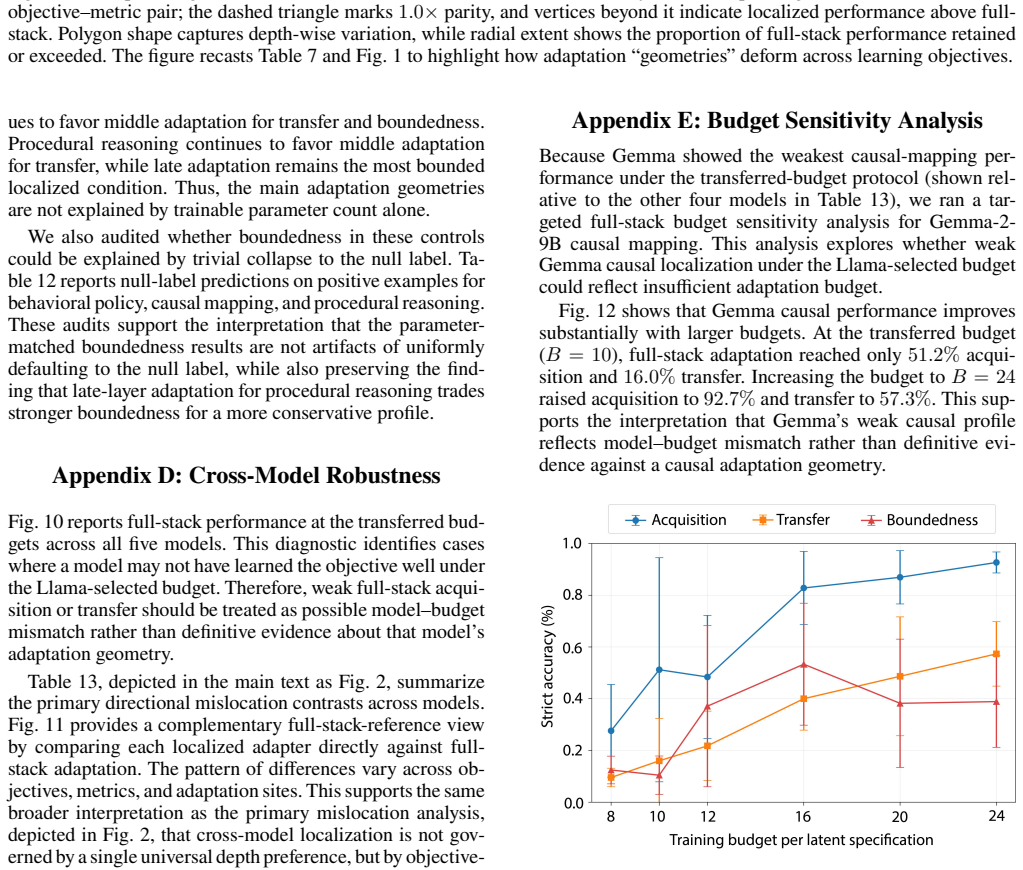
- [Cross-Model Robustness / Calibration, Fig. 10 and Table 13] Transferring Llama-calibrated budgets without recalibration is a reasonable robustness protocol, but the replication tally in Table 13 includes model–objective pairs that Fig. 10 flags as possible model–budget mismatches. For example, Gemma causal mapping has acquisition 51.2% and transfer 16.0% at the transferred budget, and its middle-over-early transfer contrast is 0.0; Appendix E shows that at larger budgets Gemma's causal performance improves substantially. Including such flagged cells in the sign test conflates actual replication with budget artifacts. Please report replication counts both with and without flagged model–objective pairs, or pre-register an exclusion rule. This issue is acknowledged in the text but is not handled in the quantified replication claims.
minor comments (6)
- [Abstract / Discussion] The abstract says the findings 'establish adaptation site as a key design variable,' while the Discussion says they 'suggest' it. Align the strength of the wording with the evidence actually presented.
- [Fig. 1 caption] With only three seeds, error bars showing standard deviations are noisy and can imply more stability than exists. Consider plotting individual seed points or explicitly noting n=3.
- ['Further Evidence' paragraph] The omnibus permutation statistic is reported as 0.238 without a definition of the dispersion measure. Define the heterogeneity statistic in the text or in Appendix C.
- [Appendix B calibration figures] The captions for Fig. 3–8 mention '95% CIs over seeds and latent specifications,' but the main-text CIs are over seeds only. Clarify the resampling scheme (e.g., bootstrap over seeds, over specifications, or both) in a methods note.
- [Tables 9 and 12] For causal mapping, all null-label counts are zero and shown as '—'. Consider using explicit 0s for the causal rows to make it clear the audit was run and returned zero.
- [Introduction, footnote 1] The footnote marker appears after 'layers' in the first paragraph, but the footnote number '1' also appears at the end of the sentence in the supplied text. Fix the formatting so the reference is unambiguous.
Circularity Check
No circularity: the geometry profiles are measured outcomes, budgets are calibrated before localization, and the central contrasts are tested against permutation and bootstrap nulls rather than assumed.
full rationale
The paper's derivation chain is empirical and self-contained. Each objective's adaptation geometry is defined directly as a measured profile G_T(s) = (A_T(s), R_T(s), B_T(s)) of acquisition, transfer, and boundedness accuracies after localized LoRA, so no fitted parameter is relabeled as a prediction and no equation makes the result equal to an input. Per-objective training budgets are calibrated on full-stack LoRA before the localization experiments and then held fixed, so calibration does not encode the localization outcome. The planned contrasts were specified in Appendix A and tested with seed-level bootstrap intervals, and the omnibus permutation test compares observed between-objective dispersion of ΔG_T profiles against a null obtained by permuting objective labels, so the null distribution does not assume the result. There are no self-citations by the present authors, no imported uniqueness theorem, and no ansatz smuggled in through a citation. The main non-circular risk is construct validity: the five tasks differ in surface format, output label spaces, and objective-specific boundedness scoring, so the 'distinct geometries' could partly reflect measurement artifacts rather than abstract learning types. That concern is a correctness/validity threat, not a circularity of derivation, and the paper partly acknowledges it in the Limitations section ('the benchmark is synthetic and isolates five operational learning objectives'). Therefore the appropriate circularity score is 0.
Assumptions & free parameters
free parameters (4)
- training_budget_per_objective =
B=10 for lexical binding, behavioral policy, causal mapping; B=8 for factual association, procedural reasoning
- calibration_selection_criterion =
within 95% of best observed mean; boundedness treated as diagnostic, not selection threshold
- localization_window_definitions =
early/middle/late = normalized depth thirds for Llama; quarter-depth windows for cross-model analyses
- LoRA_rank_and_capacity_controls =
base rank 8 per layer; expanded-localized 32x8 vs. full 8x32; reduced-full 2x32 vs. local 8x8
assumptions (5)
- domain assumption The five synthetic latent-specification tasks are operationally distinct learning objectives, not surface-format artifacts.
- domain assumption Localized LoRA inserted into transformer projection modules is a faithful probe of where functional learning is supported.
- domain assumption Normalized depth windows are commensurable across model families.
- domain assumption Negative-control accuracy measures boundedness rather than label priors or conservative response collapse.
- standard math Bootstrap and permutation inference with seed-level profiles is valid despite only three seeds.
Cite this review
Pith. "Pith review of Localized Adaptation Reveals Distinct Learning Signatures in Transformers." pith.science (2026). https://pith.science/paper/22QOYOYS
@misc{pith2026260725663,
  author       = {Pith},
  title        = {Pith review of: Localized Adaptation Reveals Distinct Learning Signatures in Transformers},
  year         = {2026},
  howpublished = {\url{https://pith.science/paper/22QOYOYS}},
  note         = {Machine review of arXiv:2607.25663}
}
read the original abstract
Transformer adaptation is typically distributed across model depth, even when the intended change is narrow. We investigate how adaptation site shapes what a model learns, how well that learning generalizes, and how selectively it is applied. We introduce a controlled benchmark spanning five objectives (lexical binding, factual association, behavioral policy learning, causal mapping, and procedural reasoning) and define each objective's "adaptation geometry" as its profile of acquisition, transfer, and boundedness under full-stack and early-, middle-, or late-layer LoRA. The objectives exhibit distinct geometries. Lexical binding favors early-layer adaptation for acquisition and boundedness but requires broader updates for transfer; factual association favors later layers among localized adapters; behavioral learning separates late-layer action acquisition from middle-layer policy gating; and causal and procedural transfer benefit most from middle- or full-stack adaptation. These patterns largely persist under parameter-matched controls, and most corresponding directional contrasts replicate across five model families. These findings establish adaptation site as a key design variable for controlling what models learn, generalize, and leave unchanged.
Figures


Figures from the paper (8 more)




Reference graph
Works this paper leans on
-
[1]
2022.Knowledgeneuronsinpretrainedtransformers.InPro- ceedings of the 60th Annual Meeting of the Association for Computational Linguistics (Volume 1: Long Papers), 8493–
Dai, D.; Dong, L.; Hao, Y.; Sui, Z.; Chang, B.; and Wei, F. 2022.Knowledgeneuronsinpretrainedtransformers.InPro- ceedings of the 60th Annual Meeting of the Association for Computational Linguistics (Volume 1: Long Papers), 8493–
2022
-
[4]
InFindingsoftheAssociationforComputationalLinguistics: ACL 2024, 15202–15232
Model editing at scale leads to gradual and catastrophic forgetting. InFindingsoftheAssociationforComputationalLinguistics: ACL 2024, 15202–15232. Hu,E.J.;Shen,Y.;Wallis,P.;Allen-Zhu,Z.;Li,Y.;Wang,S.; Wang, L.; Chen, W.; et al
2024
-
[5]
InProceedings of the 2021 ACM conference on fairness, accountability, and transparency, 375–385
Measurement and fairness. InProceedings of the 2021 ACM conference on fairness, accountability, and transparency, 375–385. Jiang, A. Q.; Sablayrolles, A.; Mensch, A.; Bamford, C.; Chaplot, D. S.; de las Casas, D.; Bressand, F.; Lengyel, G.; Lample, G.; Saulnier, L.; Lavaud, L. R.; Lachaux, M.-A.; Stock, P.; Scao, T. L.; Lavril, T.; Wang, T.; Lacroix, T.; ...
2021
-
[7]
Meng, K.; Bau, D.; Andonian, A.; and Belinkov, Y
Should we really edit language models? on the evaluation of edited language models.Advances in Neural Information Processing Systems, 37: 30850–30885. Meng, K.; Bau, D.; Andonian, A.; and Belinkov, Y. 2022a. Locatingandeditingfactualassociationsingpt.Advancesin neural information processing systems, 35: 17359–17372. Meng, K.; Sharma, A. S.; Andonian, A.; ...
-
[8]
Mitchell,E.;Lin,C.;Bosselut,A.;Manning,C.D.;andFinn, C
Fast model editing at scale.arXiv preprint arXiv:2110.11309. Mitchell,E.;Lin,C.;Bosselut,A.;Manning,C.D.;andFinn, C
-
[9]
2OLMo2Furious.arXivpreprintarXiv:2501.00656. Raji, I. D.; Bender, E. M.; Paullada, A.; Denton, E.; and Hanna, A
-
[10]
Rücklé, A.; Geigle, G.; Glockner, M.; Beck, T.; Pfeiffer, J.; Reimers, N.; and Gurevych, I
AI and the everything in the whole wide world benchmark.arXiv preprint arXiv:2111.15366. Rücklé, A.; Geigle, G.; Glockner, M.; Beck, T.; Pfeiffer, J.; Reimers, N.; and Gurevych, I
-
[11]
InProceedings of the 2021 conference on empirical methods in natural language processing, 7930–7946
Adapterdrop: On the efficiency of adapters in transformers. InProceedings of the 2021 conference on empirical methods in natural language processing, 7930–7946. Team, G.; Riviere, M.; Pathak, S.; Sessa, P. G.; Hardin, C.; Bhupatiraju, S.; Hussenot, L.; Mesnard, T.; Shahriari, B.; Ramé, A.; et al
2021
Show all 14 references
-
[12]
Tenney, I.; Das, D.; and Pavlick, E
Gemma 2: Improving open language modelsatapracticalsize.arXivpreprintarXiv:2408.00118. Tenney, I.; Das, D.; and Pavlick, E
-
[13]
Yang,A.;Yang,B.;Hui,B.;Zheng,B.;Yu,B.;Zhou,C.;Li, C.; Li, C.; Liu, D.; Huang, F.; et al
Knowledge editing for large language models: A survey.ACM Computing Surveys, 57(3): 1–37. Yang,A.;Yang,B.;Hui,B.;Zheng,B.;Yu,B.;Zhou,C.;Li, C.; Li, C.; Liu, D.; Huang, F.; et al. 2024a. Qwen2 technical report.arXiv preprint arXiv:2407.10671. Yang, W.; Sun, F.; Ma, X.; Liu, X.;...
2024 arXiv
-
[14]
arXiv preprint arXiv:2303.10512
Adalora: Adap- tive budget allocation for parameter-efficient fine-tuning. arXiv preprint arXiv:2303.10512. Appendix A: Tasks and Hypotheses Table 1 summarizes the five learning objectives used in the benchmark. Each objective is designed to isolate a different kindoflearning:...
-
[2021]
InProceedings of the 2021 conference on empirical methods in natural language pro- cessing, 6491–6506
Editing factual knowledge in language models. InProceedings of the 2021 conference on empirical methods in natural language pro- cessing, 6491–6506. Grattafiori, A.; Dubey, A.; Jauhri, A.; Pandey, A.; Kadian, A.; Al-Dahle, A.; Letman, A.; Mathur, A.; Schelten, A.; Vaughan,A.;e...
2021 arXiv
-
[2023]
arXiv:2310.06825
Mistral 7B. arXiv:2310.06825. Li, Q.; Liu, X.; Tang, Z.; Dong, P.; Li, Z.; Pan, X.; and Chu, X
-
[2024]
InProceedings of the 2024 Conference on Empirical Methods in Natural Language Processing, 16801–16819
Model editing harms general abilitiesoflargelanguagemodels:Regularizationtotheres- cue. InProceedings of the 2024 Conference on Empirical Methods in Natural Language Processing, 16801–16819. Gupta, A.; Rao, A.; and Anumanchipalli, G
2024
Reviewed August 1, 2026 · model on record in the stance chip above.
Discussion (0). Sign in to comment.