REVIEW 4 major objections 5 minor 17 references
Optimization with Dynamic Constraint Learning (DCL)
T0 review · 4 major / 5 minor · reviewed 2026-08-01 · deepseek-v4-flash
Pith's one-line read Unknown constraints can be handled by learning a fresh local surrogate at every optimization step.
desk verdict The core idea is worth engaging with, but the evidence doesn't back the central claim: DCL's output is undefined and the good-looking results come from post-hoc selection of iterates. read the letter →
The pith
A machine-rendered reading of the paper's core claim, the machinery that carries it, and where it could break.
The reading
What carries the argument
The core mechanism is a per-iteration loop: select the nearest-neighbor data subset D_k, fit polynomial or decision-tree models of increasing complexity until validation error stops improving, define the trust region C_k as the convex hull of D_k, then solve a small constrained subproblem (with a penalty for infeasibility) to produce the next iterate. The convex hull trust region is what keeps the local model in a region the data supports, and the dynamic data/model selection is what lets simple local models achieve the accuracy that would require a complex global model.
What would settle it
Run DCL on a problem where the known true optimum is deliberately placed outside the convex hull of the available data; if DCL's returned solution stays far from the true optimum (or the algorithm terminates early), the convex-hull trust region is the cause. Conversely, a data set whose hull contains the optimum but is sparse in between should still work, isolating the support assumption.
Extended reading notes
Core claim
DCL's central claim is that the location and timing of surrogate learning matter as much as the surrogate itself. By restricting each learned constraint model to a data-supported neighborhood of the current iterate, the method avoids fitting accurate models over regions the optimizer never visits. The trust region is defined as the convex hull of the local training data, so the optimizer cannot extrapolate beyond the data's support. The paper reports that on a synthetic problem DCL reaches near-feasible points where a global surrogate returns a highly infeasible point, and on two real-world case studies it matches global-surrogate solution quality while solving noticeably smaller subproblems
Load-bearing premise
The true optimum must lie inside the convex hull of the data points used around the iterates; if the data does not cover the region around the optimum, DCL's step constraint prevents it from getting there.
Editorial extensions
If this is right
- Optimization over unqueryable constraints no longer requires a separate, expensive global training phase; the surrogate is updated as the optimizer moves.
- Simple model classes (linear polynomials, shallow trees) can suffice when data density is adequate near the iterates, shrinking MIP subproblems.
- The data-supported trust region gives a natural notion of where the learned constraint is trustworthy, preventing the optimizer from exploiting unsupported regions.
- DCL can operate in online settings where new data arrives during optimization, since there is no global model to retrain.
Reading between the lines
- DCL's reliance on a convex hull trust region means it will fail when the true optimum lies outside the region covered by the data; a testable implication is that performance degrades sharply as data coverage near the optimum thins.
- The ensemble of local models generated along the optimization path could itself serve as a global surrogate, a possibility the paper raises but does not test.
- Switching the trust region to a Mahalanobis ellipsoid or a depth-based region, as the paper suggests, could reduce subproblem size and improve performance on irregular data, but the trade-off is untested.
Editorial analysis
A structured set of objections, weighed in public.
Referee Report
Summary. The paper proposes Dynamic Constraint Learning (DCL), an iterative framework for constrained optimization when one constraint function is unknown and unqueryable. At each outer iteration, DCL selects a nearest-neighbor subset of fixed labeled data, fits a local surrogate (whose degree/complexity is chosen by validation), defines a trust region as the convex hull of that subset, and solves a subproblem that minimizes the known objective subject to known analytic constraints, the learned surrogate, and membership in the convex hull. The authors argue that this local, data-adaptive approach can match the solution quality of offline global constraint learning while using simpler models and smaller subproblems, and they report experiments on a synthetic Rosenbrock problem, a palatable diet problem, and a concrete-strength design problem.
Significance. If the central claim were established, DCL would be a practically attractive alternative to the two-phase estimate-then-optimize paradigm for problems with unknown constraints and fixed data. The paper has clear strengths: it engages with relevant literature (global constraint learning, model-based DFO, E2ECO), reuses external baselines [MWB+25], and in the synthetic example the true constraint is known, allowing direct feasibility assessment. The reported local models are indeed simpler (low-degree polynomials, shallow decision trees) and the MIP subproblems are much smaller. However, the empirical evidence as presented does not substantiate the claim that DCL as an algorithm reliably produces the reported solution quality: the termination criterion is acknowledged to be unreliable, and the experiments rely on experimenter-selected iterates or 'regions of attraction' rather than the output of Algorithm 1. No convergence analysis is provided. These gaps are load-bearing for the central claim.
major comments (4)
- [§4 (Termination criteria) and §3.1–§3.3] The central claim — that DCL 'can achieve solution quality comparable to that of global models' — is not supported by the experiments because the algorithm's output is not well-defined. Section 4 admits that the termination rule of Algorithm 1 'proved difficult to trigger' and proposes only future criteria. Yet the experiments do not report the final iterate returned by Algorithm 1. In §3.1, Table 1 shows the last iterate (iter 29) has true constraint value 18.9, i.e., infeasible; the paper instead plots 'the last 20 iterates with relatively small test error' as a 'region of attraction' (Figure 3). In §3.2, Table 4 shows the objective oscillating between 3431 and 3683 with no stated selection rule for the reported best value. In §3.3, the comparison is explicitly against a 'region of attraction' rather than a single solution. Thus the empirical evidence demonstrates the existence of favo
- [§2.3, Eq. (1) and (2)] The trust region C_k is defined as the convex hull of the local data subset D_k. Therefore every iterate and the final output lie in conv(D), the convex hull of the entire dataset. If the true optimum lies outside the sampled region — a common situation when optima occur at bounds or in sparse-data regions — DCL cannot reach it. The paper does not analyze how often the data hull covers the relevant optimum, nor does it test any instance where the optimum is near a boundary. This is a structural limitation of the proposed framework that should be explicitly quantified or mitigated (e.g., by alternative trust regions like the Mahalanobis ellipsoid mentioned in §2.3) before the general claim of comparable solution quality can be accepted.
- [§4 (Convergence analysis) and §1.2] There is no convergence or termination analysis. Section 4 correctly identifies this as open, but it is not merely a theoretical nicety: the empirical behavior shows oscillating iterates and no monotone progress, so the reader cannot infer that DCL converges to a feasible or optimal point even in the limit. Without a convergence guarantee or at least a rigorous characterization of when the step size triggers termination, the algorithm's status as an optimization method is incomplete. A convergence analysis for a simplified setting (e.g., known noise bounds, fixed model class) would strengthen the paper; at minimum, the experiments should demonstrate that some well-defined output rule produces a solution.
- [§3 (Experiments)] All experiments are single runs with no error bars, no multiple random seeds, and no sensitivity analysis. Given that the local data selection, train/test splits, and model selection have stochastic components, the reported iterates and timings could be idiosyncratic. This is especially important for the diet problem (§3.2), where the DCL output exactly matches the global-surrogate solution; the reader cannot tell whether this is typical or a single favorable draw. Providing multiple seeds with ranges (or at least a clear statement that results are deterministic up to the solver) is needed to support the comparative claims.
minor comments (5)
- [§2.1, Algorithm 1] The requirement line says 'Initial point x0 ∈ X' but the text states that the initial point is 'chosen as a random point within the convex hull of D.' This selection rule should be made explicit in the algorithm or requirement list.
- [§2.3] There is a notation inconsistency: the text defines D_k = {i : (z_i, y_i) is in training or test set ...}, using k as both the outer iteration and a set index, while earlier D_k is a set of data points. Clarify the index notation.
- [References] The reference [BYcA26] is given as 'arXiv preprint arXiv:2112.06251, 2026.' The arXiv identifier suggests a 2021 submission; please verify the year and version.
- [§3.2, Table 4] The table reports a single DCL trajectory. Consider adding the number of runs or seeds used, and whether the reported objective values are the best over runs or a single run.
- [General] The phrase 'region of attraction' is used in both §3.1 and §3.3 but is never formally defined. Since it is central to the evaluation, a precise definition (e.g., set of iterates with test error below a threshold) should be given.
Circularity Check
One local comparison is partly tautological (DCL constraint value at iterates is zero by construction), but the central solution-quality comparisons retain independent content.
-
self definitional
[Section 3.1, paragraph after Table 1 and Figure 4 discussion]
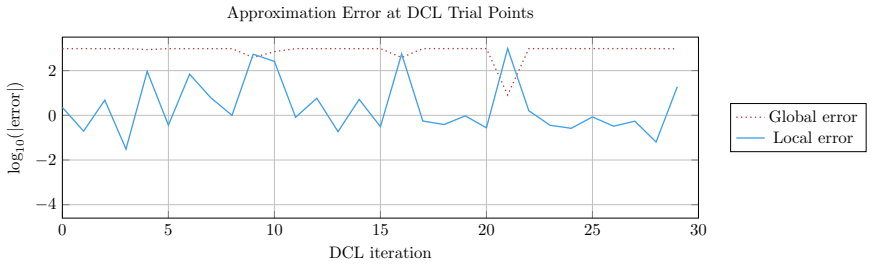
"It is possible to observe that the local DCL model value is close to zero at all iterates. This is expected since these points are minimizers of the local model and the constraint of the problem is active at that point by the construction of the problem. ... The true g(x) value is not very far from the local model predictions of DCL as long as the test error is no larger than 0.15."
In subproblem (1)/(2), the trial point is required to satisfy \hat g_k(x) <= 0, or \hat g_k(x) <= s with s penalized, and the paper states the constraint is active at the minimizer by construction. Therefore \hat g_k(x_k) = 0 is imposed by the optimization, not produced as an independent surrogate prediction. Using this value to claim that the true g(x) is close to the 'local model predictions' and plotting |\hat g_k(x_k) - g(x_k)| as 'local error' reduces to measuring the true constraint violation at the iterate, not the surrogate's approximation error. The local-vs-global error comparison is thus partly tautological.
full rationale
The genuine circularity is localized to the synthetic Rosenbrock analysis: the DCL model column is forced to zero by an active constraint in each subproblem, so Figure 4's local-error comparison is not an independent measure of surrogate accuracy. However, this does not reduce the paper's central claim. The diet-problem result is checked against an external implementation from [MWB+25] and DCL reproduces the same mixed-integer solution; the concrete problem uses external data; and the synthetic problem has a known true constraint, with true g values reported. Section 4 contains important admissions: the termination rule 'proved difficult to trigger' and a principled solution-quality assessment is left open because 'neither the true constraint function nor a ground-truth optimal solution is available.' Those are experimental-validity limitations, not circular derivation. The post-hoc selection of a 'region of attraction' from low test-RMSE iterates also weakens the empirical support but is not a fit-renamed-as-prediction in the strict sense. Self-citations [BYcA26], [MBB+24], and [MWB+25] are future work, application motivation, and baseline comparison, respectively; none is load-bearing. Score 4 reflects a partial tautology in a supporting comparison while the core algorithmic idea and its main solution-quality comparisons retain independent content.
Assumptions & free parameters
free parameters (5)
- Initial sample size N_1^k and growth rule for N_t^k
- Accuracy threshold ε_model
- Step tolerance ε_step
- Maximum degree d_max
- Penalty weight ρ_k for relaxation in subproblem (2)
assumptions (5)
- domain assumption The unknown constraint g is a fixed function and each label y_i is a noisy evaluation of g(z_i); the goal is to satisfy g(x) ≤ 0 for the population.
- ad hoc to paper Held-out validation error of the local surrogate is a reliable proxy for true constraint error in the trust region.
- domain assumption The optimum lies within the convex hull of the data used (and hence of the whole dataset).
- domain assumption The objective f and known constraints c are analytically available and cheaply evaluable.
- domain assumption Iterates can be initiated at a random point in the convex hull of D; x0 must be data-supported.
Cite this review
Pith. "Pith review of Optimization with Dynamic Constraint Learning (DCL)." pith.science (2026). https://pith.science/paper/VG36S35U
@misc{pith2026260725719,
  author       = {Pith},
  title        = {Pith review of: Optimization with Dynamic Constraint Learning (DCL)},
  year         = {2026},
  howpublished = {\url{https://pith.science/paper/VG36S35U}},
  note         = {Machine review of arXiv:2607.25719}
}
read the original abstract
We propose Dynamic Constraint Learning (DCL), a data-driven framework for constrained optimization when constraint functions are unknown and cannot be queried during optimization. At each iteration, the method learns a local surrogate from nearby data and solves a subproblem within a data-supported trust region. Compared with offline global constraint learning, the approach uses local surrogates that adapt to the data distribution during optimization and can achieve solution quality comparable to that of global models while using simpler local models and smaller optimization subproblems. We demonstrate the performance of DCL on a synthetic test problem and two case studies from the literature.
Figures


Figures from the paper (1 more)
Reference graph
Works this paper leans on
-
[1]
Mathematical Programming Computation , volume=
PyEPO: a PyTorch-based end-to-end predict-then-optimize library for linear and integer programming , author=. Mathematical Programming Computation , volume=. 2024 , publisher=
2024
-
[2]
AIChE Journal , volume=
Learning surrogate models for simulation-based optimization , author=. AIChE Journal , volume=. 2014 , publisher=
2014
-
[3]
2008 , publisher=
Engineering design via surrogate modelling: a practical guide , author=. 2008 , publisher=
2008
-
[4]
2009 , publisher=
Introduction to derivative-free optimization , author=. 2009 , publisher=
2009
-
[5]
2009 , publisher=
The elements of statistical learning: Data mining, inference, and prediction , author=. 2009 , publisher=
2009
-
[6]
Operations Research , volume=
Mixed-integer optimization with constraint learning , author=. Operations Research , volume=. 2025 , publisher=
2025
-
[7]
European Journal of Operational Research , year=
Optimization with constraint learning: a framework and survey , author=. European Journal of Operational Research , year=
-
[8]
The Journal of Machine Learning Research , volume=
OMLT: Optimization & machine learning toolkit , author=. The Journal of Machine Learning Research , volume=. 2022 , publisher=
2022
Show all 17 references
-
[9]
INFORMS Journal on Computing , volume=
JANOS: an integrated predictive and prescriptive modeling framework , author=. INFORMS Journal on Computing , volume=. 2022 , publisher=
2022
-
[10]
Computational Optimization and Applications , volume=
Modeling design and control problems involving neural network surrogates , author=. Computational Optimization and Applications , volume=. 2022 , publisher=
2022
-
[11]
SIAM Journal on Optimization , volume=
Global convergence of radial basis function trust region derivative-free algorithms , author=. SIAM Journal on Optimization , volume=. 2011 , publisher=
2011
-
[12]
Applied mathematical modelling , volume=
On data-driven chance constraint learning for mixed-integer optimization problems , author=. Applied mathematical modelling , volume=. 2023 , publisher=
2023
-
[13]
Mathematics of Operations Research , volume=
Stochastic optimization with decision-dependent distributions , author=. Mathematics of Operations Research , volume=. 2023 , publisher=
2023
-
[14]
arXiv preprint arXiv:2103.16378 , year =
Kotary, James and Fioretto, Ferdinando and Van Hentenryck, Pascal and Wilder, Bryan , title =. arXiv preprint arXiv:2103.16378 , year =
-
[15]
INFORMS Journal on Computing , year =
Shi, Chenbo and Emadikhiav, Mohsen and Lozano, Leonardo and Bergman, David , title =. INFORMS Journal on Computing , year =
-
[16]
İlker and Liao, Zhongxing and Bortfeld, Thomas and den Hertog, Dick and Ajdari, Ali , title =
Maragno, Donato and Buti, Gregory and Birbil, Ş. İlker and Liao, Zhongxing and Bortfeld, Thomas and den Hertog, Dick and Ajdari, Ali , title =. 2024 , publisher =
2024
-
[17]
arXiv preprint arXiv:2112.06251 , year=
Learning with subset stacking , author=. arXiv preprint arXiv:2112.06251 , year=
Reviewed August 1, 2026 · model on record in the stance chip above.
Discussion (0). Continue with ORCID to comment.