REVIEW 4 major objections 4 minor 39 references
In the spherical Sherrington-Kirkpatrick model, any amount of non-reciprocity suppresses aging but still leaves the fluctuation-dissipation theorem violated in the stationary state.
Reviewed by Pith at T0; open to challenge. T0 means a machine referee read the full paper against a public rubric. the ladder, T0–T4 →
T0 review · deepseek-v4-flash
2026-08-01 01:29 UTC pith:3EZ52GBZ
load-bearing objection New finite-T analytic solutions for the asymmetric sSK; the FDT-violation-without-aging picture is plausible, but TTI stability is asserted not proven. the 4 major comments →
Fluctuation-dissipation violations in mean-field non-reciprocal spin glasses
The pith
A machine-rendered reading of the paper's core claim, the machinery that carries it, and where it could break.
Core claim
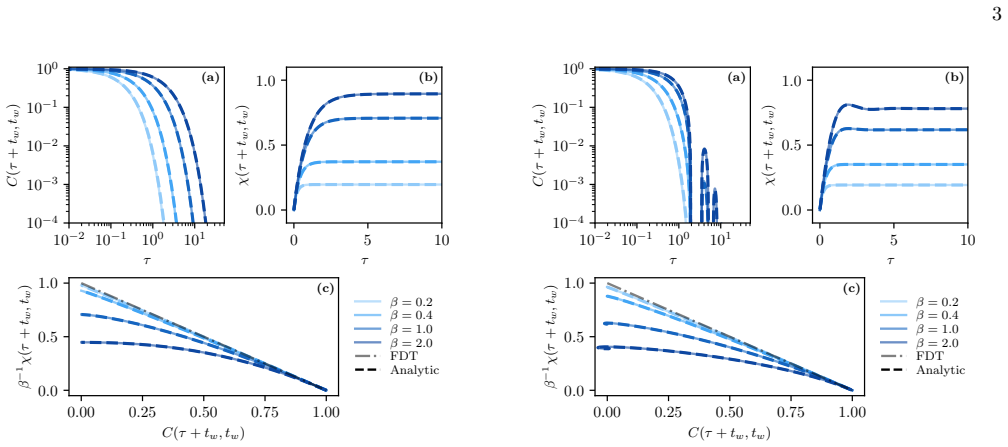
The paper studies the dynamics of the spherical Sherrington-Kirkpatrick model with random asymmetric couplings, parametrized by Γ∈[-1,1]. It derives the full dynamical mean-field (Cugliandolo–Kurchan) equations and shows, in the time-translational invariant (TTI) regime, that the FDT is satisfied if and only if Γ=1. At Γ=0 the correlation and response are exact exponentials, C(τ)=e^{-β^{-1}τ} and G(τ)=e^{-bλτ} with bλ=√(β^{-2}+g^2), and the fluctuation-dissipation ratio decays as e^{(β^{-1}-bλ)τ}, vanishing at long times. At Γ=-1 both functions are Bessel-damped, e^{-β^{-1}τ}J1(2gτ)/(gτ), producing oscillations and a static susceptibility that stays analytic at all temperatures. In both limi
What carries the argument
The central object is the pair of Schwinger–Dyson (Cugliandolo–Kurchan) dynamical mean-field equations for the two-time correlation C(t,t') and response G(t,t') of soft spins with a spherical constraint, parametrized by Γ. In the TTI limit these reduce to closed Laplace-space equations for the response and correlation transforms; a key identity (E5) shows that FDT holds in TTI regimes exactly when Γ=1. The Lagrange multiplier λ(t) that enforces the spherical constraint plays the role of an effective damping, and its asymptotic value bλ is fixed by analyticity and pole-removability of the Laplace-space solutions, which also selects the stable physical branch.
Load-bearing premise
The long-time dynamics is assumed to converge to time-translational invariant solutions for any Γ<1 at all finite temperatures; this is supported by the analytic structure of the Laplace-space equations and by numerics only up to waiting times of order 30–40, not by an explicit linear-stability proof.
What would settle it
Run long-time numerical integration of the full two-time DMFT equations with waiting times much larger than a few hundred and check whether the Γ=0 or Γ=-1 solutions lose stability at any finite β, or an explicit linear-stability analysis of the TTI ansatz in the Cugliandolo–Kurchan equations; if aging or two-time scaling reappears at large tw, the central claim fails.
If this is right
- At Γ=0 the FDT violation is captured by a single exponential timescale: correlation decays as e^{-β^{-1}τ}, response as e^{-bλτ} with bλ>β^{-1}, and the FDR vanishes as e^{(β^{-1}-bλ)τ}.
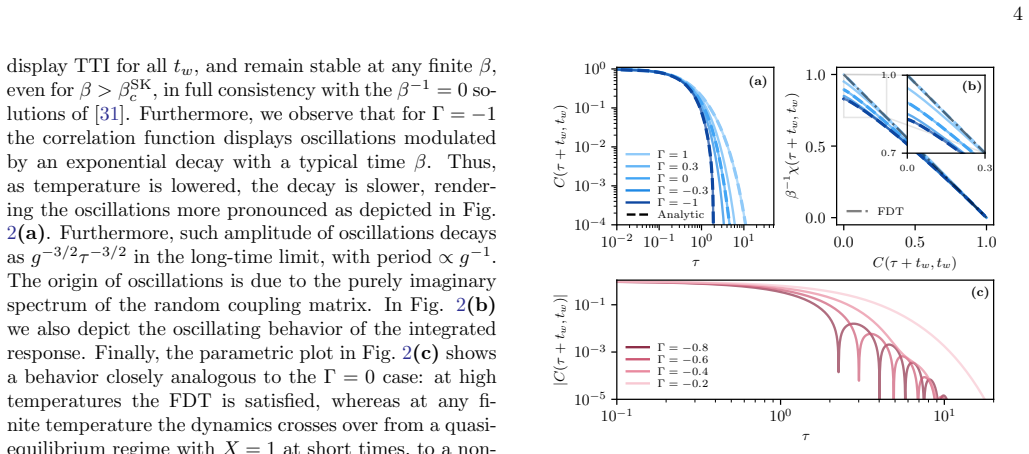
- At Γ=-1 the dynamics are oscillatory with period ∝1/g and an algebraic envelope τ^{-3/2}; the static susceptibility remains finite and analytic at all temperatures, signalling the absence of an aging transition.
- For any Γ<1 the spin-glass transition at β_c=1/g disappears in the sense that TTI solutions remain stable at all finite temperatures (for Γ≤0), or become TTI transiently for 0<Γ<1 after a frozen transient.
- These exact solutions give a quantitative benchmark to distinguish FDT violations due to aging from those due to broken detailed balance in disordered non-reciprocal systems.
- At high temperature (β→0), the FDT is recovered in all cases, so non-reciprocity only matters when interactions are strong enough to push the system away from equilibrium.
Where Pith is reading between the lines
- If this picture holds, FDT ratios measured in non-reciprocal active or neural systems may often be misread as aging when they are actually steady-state signatures of broken detailed balance; the model suggests checking whether relaxation is single-exponential as a first discriminator.
- The exact Γ=0/Γ=-1 formulas imply that the time-dependence of the FDR—or the oscillation frequency at Γ<0—could serve as a quantitative probe of the degree of non-reciprocity in an otherwise disordered system.
- The claim that TTI stability holds at all finite β for Γ≤0 could be tested by simulating non-fully-connected or diluted versions of the model: one would predict that FDT violation persists even when translational invariance is restored by asymmetric couplings.
Editorial analysis
A structured set of objections, weighed in public.
Referee Report
Summary. The manuscript studies the out-of-equilibrium Langevin dynamics of the spherical Sherrington-Kirkpatrick model with asymmetric couplings, whose symmetric and antisymmetric parts are weighted by Γ ∈ [−1,1]. Using dynamical mean-field theory (the Cugliandolo–Kurchan equations), the authors derive time-translational-invariant (TTI) reductions, obtain analytic closed forms for the correlation and response functions in the symmetric (Γ=1), uncorrelated (Γ=0), and purely antisymmetric (Γ=−1) limits, and claim that for Γ<1 these TTI solutions are stable at all finite temperatures. Consequently, they argue, the fluctuation-dissipation theorem (FDT) is generically violated in a stationary, ergodic, exponentially relaxing state, with the violation arising from broken detailed balance rather than from aging. Numerical integration of the full two-time CK equations is presented as corroboration, and intermediate Γ values are interpolated numerically.
Significance. The analytic results are elegant and, conditional on the TTI ansatz, explicit: at Γ=0 the correlation and response decay as C(τ)=e^{-β^{-1}τ} and G(τ)=e^{-bλτ}, while at Γ=−1 they are Bessel-function forms. The derivation is self-contained, involves no fitted parameters, and the analytic expressions match the numerical integration shown in Figs. 1 and 2. If the central stability claim is correct, the paper provides a valuable solvable framework that separates FDT violations of dynamical origin (aging) from those of thermodynamic origin (broken detailed balance), with potential implications for neural-network, ecological, and active-matter models. The main weakness is that the stability of the TTI solutions for Γ≤0 is asserted rather than proven, and the zero-temperature limit is not reconciled with the existing literature.
major comments (4)
- [§usSK model Γ=0; End Matter Eqs. (E1)–(E3)] The paper's central claim is that for Γ≤0 (and transiently for 0<Γ<1 above β_c^SK) the long-time dynamics converges to the TTI solutions. However, the support provided is (i) the absence of poles in the Laplace-space solutions of (E2)–(E3) and (ii) DMFT numerics at t_w=30–40. Neither constitutes a stability proof for the full two-time nonlinear CK equations. In particular, the statement on page 3 that 'the structure of the solutions ... reveals no instability' is not backed by a linearization of the two-time equations around the TTI state. Since the entire conclusion 'non-reciprocity restores TTI as soon as Γ<1' rests on this stability, please provide a rigorous argument or an explicit linear-stability analysis, or substantially soften the claim.
- [Introduction vs. §usSK model Γ=0 and §asSK model Γ=−1] The Introduction states that at β^{-1}=0 the asymmetric sSK dynamics 'retain[s] an explicit two-time dependence' [31]. Yet the Γ=0 and Γ=−1 sections claim that β^{-1}→0 recovers the results of [31] from TTI solutions, with C(τ)=1 at Γ=0 and the Bessel form at Γ=−1. If [31] describes aging, these statements are inconsistent: a TTI solution with C(τ)=1 is not an aging solution. Please reconcile this and clarify whether the convergence to the finite-temperature TTI state is singular as β→∞. The numerics at β≤2, t_w=40 do not probe this limit.
- [End Matter, Γ=0 branch selection] The closed form for Γ=0 is obtained by requiring that the rightmost pole ω_+ of eC+(s) be removable, i.e., Res(eC+(s), s=ω_+)=0, which fixes bλ=sqrt(β^{-2}+g^2). This is presented as an admissibility condition, but it is not derived from the causal dynamical equations. Since a different branch choice would change the quantitative results, please justify that the full two-time dynamics selects this branch — for example, by showing that it follows from the spherical constraint C(t,t)=1 and boundedness |C(τ)|≤1, or from the long-time limit of the numerical solution.
- [§asSK model Γ=−1; 'Fluctuation dissipation ratio' in End Matter] The analytic evidence for FDT violation in the antisymmetric case is based entirely on the Laplace-space object X_L(s)= eG(s)/β(1−s eC+(s)), which the authors acknowledge is not related to the time-domain FDR X(t,t') by an inverse Laplace transform. The physical interpretation of X_L(s) is therefore unclear, and X_L(0)<1 is not by itself a proof that the standard FDR X(τ)≠1 at long times. Since the central claim for Γ<0 relies on this, please provide the actual time-domain FDR for the Bessel solutions or show explicitly how X_L connects to the slope of the β^{-1}χ vs C plot.
minor comments (4)
- [Introduction] Typo: 'non-reciprociprocity' should be 'non-reciprocity'.
- [Fig. 2 caption] The caption states 'TTI is observed for all t_w (here t_w=30)', but only t_w=30 is shown. Please state which t_w values were tested and specify the range over which TTI holds.
- [Eq. (E7)] The term eC+(bλ) evaluates the Laplace transform at a point that itself depends on bλ. This is unusual and should be explicitly explained, as it is central to the Γ=0 self-consistency.
- [End Matter, X_L definition] Consider renaming X_L(s) to avoid confusion with the standard time-domain FDR X(t,t'), e.g., 'Laplace-space response ratio', and clearly state in the main text that it is a diagnostic, not the physical FDR.
Circularity Check
No significant circularity; the derivation is self-contained. TTI stability is asserted rather than proved, but that is a rigor gap, not a circular reduction.
full rationale
The central results are obtained by solving the DMFT/CK equations (3) in the TTI regime, via the Laplace-space equations (E2)-(E3), with parameters fixed by self-consistency and analyticity rather than fitted to the numerical data. At Γ=0, bλ is fixed by the admissibility condition Res(eC+(s), s=ω+)=0 in the End Matter; at Γ=-1, bλ=β^-1 follows directly from the exact equation for λ(t). The analytic expressions are subsequently compared with numerical integration, not used to set constants. The FDT-violation statement follows algebraically from eq. (E5), which shows FDT holds iff Γ=1. Self-citations [16,18] are background references on active matter and do not carry the derivation. The main caveat is that the claimed stability of TTI solutions for Γ≤0 is supported by the absence of poles in the Laplace-space structure and by finite-t_w numerics, without an explicit linear-stability proof; this is a correctness/rigor concern, not circularity. Similarly, the Laplace-space diagnostic X_L(s) is explicitly noted not to be the inverse Laplace transform of the time-domain FDR, so its use is a definition/approximation rather than a disguised fit. No quantity is fitted to a subset of data and then renamed a prediction, and no load-bearing self-citation or imported uniqueness theorem is present.
Axiom & Free-Parameter Ledger
axioms (5)
- domain assumption The dynamical mean-field (Cugliandolo-Kurchan) equations (3) are exact for the spherical Sherrington-Kirkpatrick model in the N→∞ limit.
- domain assumption The physical long-time solution is the TTI one: two-time functions depend only on τ as t_w→∞ with τ/t_w≪1.
- ad hoc to paper The physical branch of eG(s) is selected by analyticity and eG(s)∼1/s as |s|→∞; for Γ=0 the rightmost pole of eC+(s) is required to be removable.
- standard math Spherical constraint enforced by Lagrange multiplier λ(t); its equation closes through the correlation-response identities in eq. (3).
- standard math Tauberian theorems relate small-s expansions of Laplace transforms to long-time tails.
read the original abstract
We study the out-of-equilibrium dynamics of the spherical Sherrington-Kirkpatrick model with non-reciprocal asymmetric couplings. Rather than assuming stationarity, we derive the conditions under which the dynamical mean-field equations admit stable time-translational invariant solutions. We analytically solve the asymptotics of the correlation and response functions in the symmetric, uncorrelated and antisymmetric limits, showing that the fluctuation-dissipation theorem is generically violated in the presence of non-reciprocity despite exponential relaxation, due to broken detailed balance rather than aging. Numerical results for generic asymmetry allow us to interpolate between these solvable limit cases, revealing faster dynamics as the asymmetry increases, together with oscillatory dynamics driven by antisymmetric couplings. These results provide a reference framework for understanding the dynamics of disordered, non-reciprocal systems, disentangling two distinct origins of fluctuation-dissipation violations.
Figures
Reference graph
Works this paper leans on
-
[1]
Hertz, G
J. Hertz, G. Grinstein, and S. Solla, inAIP Conference Proceedings, Vol. 151 (American Institute of Physics,
-
[2]
Sompolinsky, A
H. Sompolinsky, A. Crisanti, and H. J. Sommers, Phys. Rev. Lett.61, 259 (1988)
1988
-
[3]
Crisanti and H
A. Crisanti and H. Sompolinsky, Phys. Rev. E98, 062120 (2018)
2018
-
[4]
Martorell, R
C. Martorell, R. Calvo, A. Annibale, and M. A. Mu˜ noz, Chaos Solit. Fract.182, 114809 (2024)
2024
-
[5]
S. J. Fournier, A. Pacco, V. Ros, and P. Urbani, Phys. Rev. E113, 044139 (2026)
2026
-
[6]
Bunin, Phys
G. Bunin, Phys. Rev. E95, 042414 (2017)
2017
-
[7]
Altieri, F
A. Altieri, F. Roy, C. Cammarota, and G. Biroli, Phys. Rev. Lett.126, 258301 (2021)
2021
-
[8]
V. Ros, F. Roy, G. Biroli, G. Bunin, and A. M. Turner, Phys. Rev. Lett.130, 257401 (2023)
2023
-
[9]
Altieri, arXiv preprint arXiv:2503.02792 (2025)
A. Altieri, arXiv preprint arXiv:2503.02792 (2025)
Pith/arXiv arXiv 2025
-
[10]
Galla and J
T. Galla and J. D. Farmer, Proc. Natl. Acad. Sci. U.S.A. 110, 1232 (2013)
2013
-
[11]
Garnier-Brun, M
J. Garnier-Brun, M. Benzaquen, and J.-P. Bouchaud, Phys. Rev. X14, 021039 (2024)
2024
-
[12]
Agudo-Canalejo and R
J. Agudo-Canalejo and R. Golestanian, Phys. Rev. Lett. 123, 018101 (2019)
2019
-
[13]
Fruchart, R
M. Fruchart, R. Hanai, P. B. Littlewood, and V. Vitelli, Nature592, 363 (2021)
2021
-
[14]
Dinelli, J
A. Dinelli, J. O’Byrne, A. Curatolo, Y. Zhao, P. Sollich, and J. Tailleur, Nat. Commun.14, 7035 (2023)
2023
-
[15]
Golestanian, Europhys
R. Golestanian, Europhys. News55, 12 (2024)
2024
-
[16]
Paoluzzi, D
M. Paoluzzi, D. Levis, and I. Pagonabarraga, Commun. Phys.7, 57 (2024)
2024
- [17]
-
[18]
M. Akritidis, A. Garc´ es, A. Vasilopoulos, M. Carosi, D. Levis, and N. Fytas, arXiv preprint arXiv:2606.06981 (2026)
Pith/arXiv arXiv 2026
-
[19]
J. U. Klamser and L. Berthier, arXiv preprint arXiv:2510.04575 (2025)
arXiv 2025
-
[20]
Sompolinsky and A
H. Sompolinsky and A. Zippelius, Phys. Rev. B25, 6860 (1982)
1982
-
[21]
L. F. Cugliandolo and J. Kurchan, J. Phys. A: Math. Gen.27, 5749 (1994)
1994
-
[22]
L. F. Cugliandolo and D. S. Dean, J. Phys. A: Math. Gen.28, 4213 (1995)
1995
-
[23]
Crisanti and H
A. Crisanti and H. Sompolinsky, Phys. Rev. A36, 4922 (1987)
1987
-
[24]
Crisanti and H
A. Crisanti and H. Sompolinsky, Phys. Rev. A37, 4865 (1988)
1988
-
[25]
L. F. Cugliandolo, J. Kurchan, P. Le Doussal, and L. Peliti, Phys. Rev. Lett.78, 350 (1997)
1997
-
[26]
Iori and E
G. Iori and E. Marinari, J. Phys. A: Math. Gen.30, 4489 (1997)
1997
-
[27]
Berthier, J.-L
L. Berthier, J.-L. Barrat, and J. Kurchan, Phys. Rev. E 63, 016105 (2000)
2000
-
[28]
Berthier, J.-L
L. Berthier, J.-L. Barrat, and J. Kurchan, Phys. Rev. E 61, 5464 (2000)
2000
-
[29]
Garcia Lorenzana, A
G. Garcia Lorenzana, A. Altieri, G. Biroli, M. Fruchart, and V. Vitelli, Phys. Rev. Lett.135, 187402 (2025)
2025
-
[30]
Garcia Lorenzana, A
G. Garcia Lorenzana, A. Altieri, G. Biroli, M. Fruchart, and V. Vitelli, Phys. Rev. E112, 044154 (2025)
2025
-
[31]
and in a disordered Ising model in two-dimensions, it has been found that non-reciprociprocity suppresses order [32]. Despite these advances, a fundamental aspect of the dynamics has remained unexplored: once DB is broken, violations of the fluctuation-dissipation theorem (FDT) might appear, even in the absence of aging. In glassy sys- tems FDT violations...
Pith/arXiv arXiv 2026
-
[32]
D. A. Stariolo and F. L. Metz, J. Stat. Mech.2026, 033301 (2026)
2026
-
[33]
N. Grodzinski, R. L. Jack, and S. A. Loos, arXiv preprint arXiv:2606.21582 (2026)
Pith/arXiv arXiv 2026
-
[34]
L. F. Cugliandolo, Annu. Rev. Condens. Matter Phys.15 (2023)
2023
-
[35]
L. F. Cugliandolo and J. Kurchan, Phys. Rev. Lett.71, 173 (1993)
1993
-
[36]
Y. V. Fyodorov, E. Gudowska-Nowak, M. A. Nowak, and W. Tarnowski, Phys. Rev. Lett.134, 087102 (2025)
2025
-
[37]
L. F. Cugliandolo, G. S. Lozano, N. Nessi, M. Picco, and A. Tartaglia, J. Stat. Mech.2018, 063206 (2018)
2018
-
[38]
Potters and J.-P
M. Potters and J.-P. Bouchaud,A First Course in Ran- dom Matrix Theory: for Physicists, Engineers and Data Scientists(Cambridge University Press, 2020)
2020
-
[39]
Feller,An introduction to probability theory and its applications, Volume 2, Vol
W. Feller,An introduction to probability theory and its applications, Volume 2, Vol. 2 (John Wiley & Sons, 1991). 6 END MA TTER CK equations in the TTI regime. Starting from the CK equations eq. (3), we summa- rize the structure of the analytic solutions given in the main text. We focus on the time-translational and steady regimes, settingt ′ =t w,t=τ+t w...
1991
discussion (0)
Sign in with ORCID, Apple, or X to comment. Anyone can read and Pith papers without signing in.