REVIEW 4 major objections 5 minor 293 references
The paper argues that the non-polar m-plane of ZnO is the only facet that preserves WS2's direct gap and type-I alignment, and that a quadruply charged sulfur–zinc vacancy pair, with a formation energy of 2.61 eV, then becomes the dominant
Reviewed by Pith at T0; open to challenge. T0 means a machine referee read the full paper against a public rubric. the ladder, T0–T4 →
T0 review · deepseek-v4-flash
2026-08-01 00:52 UTC pith:TN3TCV52
load-bearing objection The m-plane facet screening is worth reading, but the defect-pair centerpiece is contradicted by the paper's own formation energies. the 4 major comments →
Facet-Dependent Electronic Properties and Interfacial Point Defect Interactions in WS₂/ZnO Heterostructures
The pith
A machine-rendered reading of the paper's core claim, the machinery that carries it, and where it could break.
Core claim
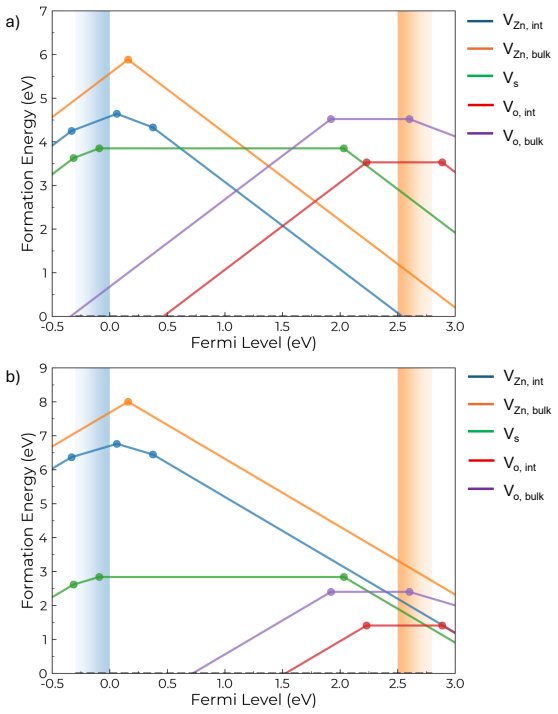
The central discovery is that the WS2/ZnO interface behaves as a thermodynamic sink for vacancies, and under n-type conditions the dominant defect is not an isolated vacancy but the quadruply charged (VS−VZn)'''' pair. Although the Coulomb repulsion between two negatively charged vacancies weakens their mutual binding (−0.22 eV at the interface), the strong qE_F term at the conduction-band edge lowers the pair's formation energy to 2.61 eV under anion-poor conditions, below all competing neutral and charged pairs. This makes the −4 cluster the most abundant source of deep in-gap states at the junction, and hence the primary non-radiative recombination center. The paper additionally finds tha
What carries the argument
The key machinery is the defect formation energy formalism combined with binding-energy decomposition, evaluated in a large 3×3×1 supercell of the sandwiched ZnO/WS2/ZnO interface with a hybrid density functional and an electrostatic finite-size correction for charged defects. The binding energy separates the thermodynamic stability of a pair into the formation energies of its isolated constituents, exposing how the qE_F term and inter-defect Coulomb repulsion compete. The paper's main object is the (VS−VZn)'''' pair—a quadruply charged sulfur vacancy in WS2 paired with a zinc vacancy at the ZnO interface—whose low formation energy (2.61 eV) and deep levels make it the decisive defect cluste
Load-bearing premise
The entire defect ranking assumes that a single ~270-atom supercell with a 2×2×1 k-mesh, no spin-orbit coupling, and electrostatic corrections gives formation and binding energies converged to well below the roughly one electron-volt differences that decide which vacancy pair dominates, yet no convergence tests are reported and the tables show unexplained energy inconsistencies.
What would settle it
Compute the formation energy of the (VS−VZn)'''' pair in a larger supercell (e.g., 4×4×1) and with a denser k-mesh; if its formation energy shifts by more than ~0.5 eV or becomes higher than the neutral (VS−VO) pair, the paper's central claim that the −4 cluster is the most abundant defect pair collapses.
If this is right
- m-plane is the preferred substrate for WS2/ZnO LEDs; a-plane and hydroxylated c-plane destroy the direct gap or shift to type-II alignment.
- Sulfur and interfacial oxygen vacancies are the main non-radiative traps; suppressing them (e.g., by oxygen substitution on sulfur sites) should raise internal quantum efficiency.
- The (VS−VZn)'''' pair dominates under n-type conditions, so LED designs that push the Fermi level toward the conduction band will automatically populate this killer defect; passivation must target both vacancies.
- Oxygen self-passivation is exothermic by 0.91 eV, converting sulfur vacancies to OS plus an interfacial oxygen vacancy—a built-in healing path that trades electron traps for hole traps.
- Hydrogen acts as a shallow donor, but in the presence of zinc vacancies it compensates rather than dopes, meaning hydrogenation cannot raise the electron density unless VZn is suppressed.
Where Pith is reading between the lines
- If the formation-energy ranking holds, growth under anion-rich conditions (which raises the formation energy of VS and thus of the −4 pair) could suppress the dominant trap, at the cost of favoring OS substitution—a trade-off the paper does not quantify.
- The trend reversal for charged pairs—stronger binding in bulk ZnO than at the interface—suggests that under heavy n-type doping, the killer defects may prefer the ZnO transport layer rather than the 2D channel, which would change where passivation is needed.
- The paper's binding-energy analysis implies that strain or a different dielectric spacer that changes the van der Waals gap width should alter both the Coulomb repulsion and the qE_F stabilization; this is a testable prediction for engineering the interface.
- The oxygen-transfer self-passivation reaction suggests that post-growth annealing in an oxygen-containing atmosphere might convert sulfur vacancies into OS while leaving VO-inter hole traps; whether this net-reduces recombination depends on the relative capture cross-sections, which the paper does not compute.
Editorial analysis
A structured set of objections, weighed in public.
Referee Report
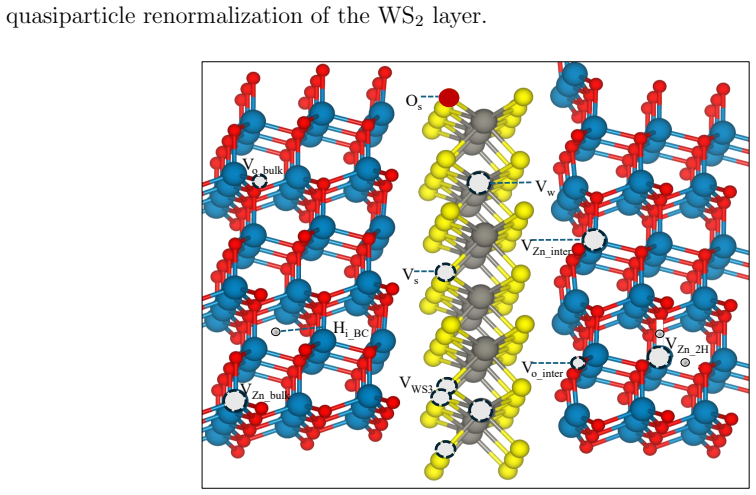
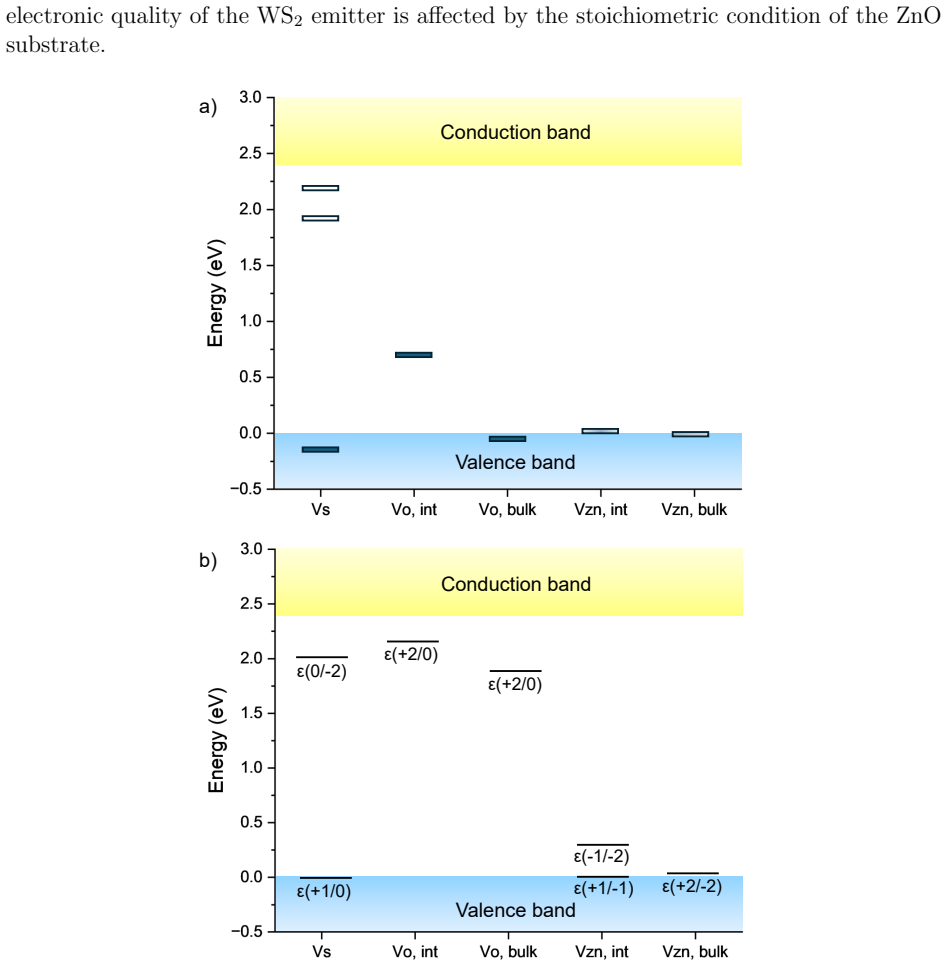
Summary. The paper uses hybrid DFT to screen WS2/ZnO heterostructures on three ZnO facets, concluding that the non-polar m-plane is optimal (direct 2.42 eV bandgap, type-I alignment), and then studies isolated native point defects and defect pairs in a sandwiched model. The central defect-related claims are that neutral vacancies cluster across the van der Waals gap because of negative binding energies, that under n-type conditions the (VS−VZn)'''' pair with formation energy 2.61 eV is the most thermodynamically abundant defect pair, and that interstitial hydrogen is compensated by zinc vacancies without shifting band edges.
Significance. If the results held, the work would provide a useful microscopic framework for substrate selection and defect engineering in 2D/3D hybrid LEDs. The study is broad in scope: it includes three facets, ten defect species, charged defect corrections (FNV), a secondary-phase stability diagram, and a hydrogen-compensation analysis. These are genuine strengths and the computational setup is largely state-of-the-art. However, the central defect-pair conclusion is contradicted by the paper's own tables, which makes the main advance unreliable.
major comments (4)
- [Interaction of Point Defects, Eq. (2) and Table 3] Applying Eq. (2), Eb = Ef(pair) − [Ef(A)+Ef(B)], to the neutral pair formation energies in Table 3 and the neutral single-defect formation energies in Table 2 gives positive binding energies for every neutral pair under anion-poor conditions. For example, (VS−VO,int)^0: 4.81 − (2.84 + 1.41) = +0.56 eV, not −0.58 eV; (VS−VO,bulk)^0 = +0.55 eV; (VS−VZn,int)^0 = +0.10 eV; (VS−VZn,bulk)^0 = +0.53 eV. Thus the Abstract and Conclusion statements that 'neutral vacancies cluster across the van der Waals gap due to favorable negative binding energies' are not supported by the reported data. The SI total-energy derivation (Eqs. 3–5) cannot rescue this: if both the pair and single-defect formation energies in Tables 2 and 3 were produced with the same definition, the chemical potentials cancel identically and the two formulations must agree. The discrepancy of ~0.7–1.6 eV is far too large to be att
- [Interaction of Point Defects, Table 3 and Fig. 5] The claim that (VS−VZn,int)'''' has formation energy 2.61 eV under anion-poor conditions and is 'the most thermodynamically abundant defect pair' cannot be checked from the reported data. The isolated charged formation energies at EF = 2.3 eV are not given anywhere in the paper; Table 2 only reports neutral formation energies. Without Ef(VS^{−2}) and Ef(VZn,int^{−2}) at the same Fermi level, the reader cannot evaluate Eq. (2) for the charged pair, nor verify the quoted binding energy (−0.22 eV), nor compare the pair's abundance against competing charged species. This traceability gap undermines the main quantitative conclusion.
- [Methods, Interfacial Defect Calculations] The defect calculations use a single 3×3×1 (~270-atom) supercell, a 2×2×1 k-mesh, no spin-orbit coupling, and a no-vacuum cell with FNV corrections. No convergence tests are reported for supercell size, k-mesh density, or the FNV correction scheme. The energy differences that decide the sign of the binding energy and the relative abundance of defect pairs are on the order of 0.1–1.0 eV; the internal inconsistency in Table 3 indicates that the energy accounting is not reliable at this level. Systematic convergence checks are essential before the defect-pair conclusions can be accepted.
- [Methods, hybrid functional and facet screening] The hybrid mixing fraction α = 0.375 is a hand-tuned parameter. The paper states that even with this choice the band gaps are underestimated relative to G0W0 (2.9 eV for ZnO, 2.3 eV for WS2), yet no sensitivity analysis is reported. Because the Fermi-level position EF = 2.3 eV used for charged pairs is tied to the computed CBM, and because defect transition levels depend on band alignment, the charge-state assignments underlying the pair analysis are sensitive to α. A robustness check (e.g., α = 0.25 and α = 0.40) is needed to establish that the qualitative conclusions do not depend on this free parameter.
minor comments (5)
- [Results, a-plane] The phrase 'direct optical band gap is 0.1X eV larger' contains a placeholder 'X'; presumably a numerical value is intended.
- [Introduction] Typos: 'an high exciton binding energy', 'intrinisc', 'looses two electrons', 'can be explaining by'. These should be corrected.
- [Table 2] The row for VS–W1 lists '2.31 −4.6' without a clear separator; the table formatting makes it hard to distinguish bond distance from percentage deviation.
- [References] Reference 4 and reference 6 are the same paper (Kim et al., ACS Nano 2016). Please consolidate.
- [Supporting Information, Table S1] The chemical potentials in Table S1 are given as absolute values (eV) but the notation μ_i is used for both the absolute and relative chemical potential; clarify that Δμ_i are the relative values used in the formation-energy expressions.
Circularity Check
No significant circularity; internal Table 3 binding-energy inconsistency is a correctness concern, not a circular derivation.
full rationale
The paper's derivation chain is largely self-contained. Interface facet selection is a direct DFT total-energy/band-structure comparison; defect formation and binding energies are computed from total-energy differences (Eq. 1, SI Eqs. 3–5) in which chemical potentials and Fermi-level terms cancel for Eb. The hybrid mixing fraction α=0.375 is stated as a method choice and benchmarked against G0W0; there is no evidence that the defect-pair conclusions are fitted to that parameter. The only self-citation (Ref. 38, a prior paper by Sutarma/Kratzer) is used alongside Ref. 37 to characterize VS states as persistent electron traps; this is a side remark, not a load-bearing premise. A separate internal-consistency problem exists: applying Eq. (2) to Tables 2 and 3 yields positive neutral-pair Eb values (e.g., (VS−VO,int)^0 anion-poor: 4.81−(2.84+1.41)=+0.56 eV), contradicting the tabulated −0.58 eV. This is a serious correctness/reproducibility issue for the central clustering claim, but it is a numerical inconsistency rather than a circular reduction of the prediction to its input. Therefore, no circular step meeting the required evidence standard is identified.
Axiom & Free-Parameter Ledger
free parameters (3)
- HSE exact-exchange fraction α =
0.375
- Fermi level for charged defect pairs =
2.3 eV
- Growth regime endpoints =
anion-poor: Δμ_W=Δμ_Zn=0; anion-rich: Δμ_S=Δμ_O=0
axioms (5)
- domain assumption Hybrid HSE(α=0.375)+DFT-D3 accurately describes electronic structure and defect energetics of the WS2/ZnO vdW interface.
- domain assumption A 6-layer ZnO slab with pseudo-hydrogen passivation and a 20 Å vacuum represents the semi-infinite substrate for facet screening.
- domain assumption A 3×3×1 (~270-atom) supercell with a 2×2×1 k-grid and no SOC gives converged defect formation energies and pair binding energies.
- domain assumption FNV correction is valid for charged defects in a no-vacuum periodic sandwich geometry.
- domain assumption Chemical potentials are bounded by bulk formation enthalpies and secondary-phase limits, and the two growth endpoints bracket realistic synthesis.
read the original abstract
Aiming at two-dimensional materials for high-efficiency optoelectronics, WS$2$/ZnO heterostructures are computationally screened for their facet-dependent electronic properties and interfacial defect thermodynamics using first-principles hybrid functional calculations. Interface comparison identifies the non-polar ($10\overline{1}0$) $m$-plane as the optimal substrate facet, maintaining a direct 2.42~eV bandgap and a robust type-I band alignment. Isolated sulfur ($\mathrm{V_S}$) and interfacial oxygen ($\mathrm{V_O}$) vacancies introduce deep non-radiative recombination centers. Conversely, zinc vacancies ($\mathrm{V{Zn}}$) act as shallow acceptors near the valence band edge, contributing to unintentional $p$-type behavior. Analysis of defect pairs reveals that neutral vacancies cluster across the van der Waals gap due to favorable binding energies. Under $n$-type conditions, defects stabilize as charged species. Although inter-layer Coulomb repulsion weakens the binding energy of $(\mathrm{V_S} - \mathrm{V_{Zn}})''''$ pairs, their formation energy drops to 2.61~eV under anion-poor conditions, making the $-4$ cluster the most thermodynamically abundant defect pair at the interface. Furthermore, native $\mathrm{V_{Zn}}$ prevents the Fermi level rise typically induced by interstitial hydrogen ($\mathrm{H_i}$), distributing donated electrons into shallow acceptor states and preserving host band edge rigidity. These findings establish a microscopic framework for substrate selection and defect engineering in 2D/3D hybrid light-emitting diodes.
Figures




Reference graph
Works this paper leans on
-
[1]
Federico Gallino and Gianfranco Pacchioni and Cristina. Transition levels of defect centers in ZnO by hrbrid functionals and localized basis set approach , journal =. doi:10.1063/1.3491271 , year =
-
[2]
Hong, Jinhua and Hu, Zhixin and Probert, Matt and Li, Kun and Lv, Danhui and Yang, Xinan and Gu, Lin and Mao, Nannan and Feng, Qingliang and Xie, Liming and Zhang, Jin and Wu, Dianzhong and Zhang, Zhiyong and Jin, Chuanhong and Ji, Wei and Zhang, Xixiang and Yuan, Jun and Zhang, Ze , title =. Nat. Commun. , doi =. 2015 , volume =
2015
-
[3]
Physical Review Materials , volume=
Insights into oxygen vacancies from high-throughput first-principles calculations , author=. Physical Review Materials , volume=. 2021 , publisher=
2021
-
[4]
A Hybrid-Density Functional Theory Study of Intrinsic Point Defects in
Alaa Akkoush and Yair Litman and Mariana Rossi , journal =. A Hybrid-Density Functional Theory Study of Intrinsic Point Defects in. 2025 , publisher =
2025
-
[5]
Komsa, Hannu-Pekka and Krasheninnikov, Arkady V. , journal =. Native defects in bulk and monolayer. 2015 , month =. doi:10.1103/PhysRevB.91.125304 , url =
-
[6]
Naik, Mit H. and Jain, Manish , journal =. Substrate screening effects on the quasiparticle band gap and defect charge transition levels in. 2018 , month =. doi:10.1103/PhysRevMaterials.2.084002 , url =
-
[7]
and Freysoldt, Christoph and Hennig, Richard G
Tan, Anne Marie Z. and Freysoldt, Christoph and Hennig, Richard G. , journal =. Stability of charged sulfur vacancies in 2D and bulk. 2020 , month =. doi:10.1103/PhysRevMaterials.4.064004 , url =
-
[8]
Bertoldo, Fabian and Ali, Sajid and Manti, Simone and Thygesen, Kristian S. , date =. Quantum point defects in 2D materials - the QPOD database , url =. npj Computational Materials , number =. 2022 , bdsk-url-1 =. doi:10.1038/s41524-022-00730-w , id =
-
[9]
Visualizing electron delocalization in contorted polycyclic aromatic hydrocarbons , volume =. Chemical Science , author =. 2021 , pages =. doi:10.1039/D1SC03368A , abstract =
-
[10]
Theory of. ACS Nano , author =. 2016 , pages =. doi:10.1021/acsnano.5b07676 , abstract =
-
[11]
Dispersion-. Chemical Reviews , author =. 2016 , pages =. doi:10.1021/acs.chemrev.5b00533 , abstract =
-
[12]
Theory of double-resonant. Physical Review B , author =. 2011 , pages =. doi:10.1103/PhysRevB.84.035433 , language =
-
[13]
Simulation of the
Sun, Shuai , pages =. Simulation of the
-
[14]
The Journal of Chemical Physics , author =
The momentum of models , volume =. The Journal of Chemical Physics , author =. 2021 , pages =. doi:10.1063/5.0023891 , abstract =
-
[15]
Nature Communications , author =
Optical separation of mechanical strain from charge doping in graphene , volume =. Nature Communications , author =. 2012 , pages =. doi:10.1038/ncomms2022 , language =
-
[16]
ACS Central Science , author =
Raman. ACS Central Science , author =. 2015 , pages =. doi:10.1021/acscentsci.5b00021 , abstract =
-
[17]
Density. ChemPhysChem , author =. 2006 , pages =. doi:10.1002/cphc.200500673 , language =
-
[18]
Journal of Nuclear Materials , author =
Weak and strong hydrogen interactions on porous carbon materials in high-temperature systems , volume =. Journal of Nuclear Materials , author =. 2019 , pages =. doi:10.1016/j.jnucmat.2019.03.036 , abstract =
-
[19]
What. ACS Catalysis , author =. 2019 , pages =. doi:10.1021/acscatal.8b04317 , abstract =
-
[20]
Applied Catalysis A: General , author =
Dehydroaromatization of methane over. Applied Catalysis A: General , author =. 2015 , pages =. doi:10.1016/j.apcata.2015.06.035 , abstract =
-
[21]
Journal of Catalysis , author =
Hydrodeoxygenation of m-cresol over gallium-modified beta zeolite catalysts , volume =. Journal of Catalysis , author =. 2012 , pages =. doi:10.1016/j.jcat.2012.03.003 , abstract =
-
[22]
Journal of Catalysis , author =
The crystal structure of the zeolite hydrogen faujasite , volume =. Journal of Catalysis , author =. 1969 , pages =. doi:10.1016/0021-9517(69)90395-9 , language =
-
[23]
Recent. Chemical Reviews , author =. 2015 , pages =. doi:10.1021/cr500486u , language =
-
[24]
Nature Reviews Methods Primers , author =
Solid-state. Nature Reviews Methods Primers , author =. 2021 , pages =. doi:10.1038/s43586-020-00002-1 , abstract =
-
[25]
Journal of Electron Microscopy , author =
Optimizing the environment for sub-0.2 nm scanning transmission electron microscopy , volume =. Journal of Electron Microscopy , author =. 2001 , pages =. doi:10.1093/jmicro/50.3.219 , abstract =
-
[26]
Journal of Electron Microscopy Technique , author =
High-. Journal of Electron Microscopy Technique , author =. 1991 , pages =. doi:10.1002/jemt.1060170209 , abstract =
-
[27]
Proceedings of the Geologists' Association , author =
Laser ablation. Proceedings of the Geologists' Association , author =. 2007 , pages =. doi:10.1016/S0016-7878(07)80043-5 , language =
-
[28]
Clinical Biochemist Reviews , author =
Inductively. Clinical Biochemist Reviews , author =. 2019 , pages =. doi:10.33176/AACB-19-00024 , abstract =
-
[29]
Surface. Sensors , author =. 2006 , pages =. doi:10.3390/s6101345 , abstract =
-
[30]
Liu, P.S. and Chen, G.F. , editor =. Chapter. 2014 , keywords =. doi:10.1016/B978-0-12-407788-1.00010-1 , booktitle =
-
[31]
Schwartz, Lyle H. and Cohen, Jerome B. , year =. Diffraction from. doi:10.1007/978-3-642-82927-7 , language =
-
[32]
Epp, J. , year =. X-ray diffraction (. Materials. doi:10.1016/B978-0-08-100040-3.00004-3 , language =
-
[33]
Tutorial on. ACS Nano , author =. 2019 , pages =. doi:10.1021/acsnano.9b05157 , language =
-
[34]
Chronicles of Young Scientists , author =
Methods for the determination of limit of detection and limit of quantitation of the analytical methods , volume =. Chronicles of Young Scientists , author =. 2011 , pages =. doi:10.4103/2229-5186.79345 , abstract =
arXiv 2011
-
[35]
Chemistry Central Journal , author =
Limit of detection and limit of quantification development procedures for organochlorine pesticides analysis in water and sediment matrices , volume =. Chemistry Central Journal , author =. 2013 , pages =. doi:10.1186/1752-153X-7-63 , abstract =
-
[36]
Pharmeuropa scientific notes , author =
Evaporative light scattering detection (. Pharmeuropa scientific notes , author =. 2006 , note =
2006
-
[37]
Liquid chromatography–mass spectrometry-based metabolomics for authenticity assessment of fruit juices , volume =. Metabolomics , author =. 2012 , pages =. doi:10.1007/s11306-011-0371-7 , abstract =
-
[38]
Lozano-Sánchez, Jesús and Borrás-Linares, Isabel and Sass-Kiss, Agnes and Segura-Carretero, Antonio , year =. Chromatographic. Modern. doi:10.1016/B978-0-12-814264-6.00013-X , language =
-
[39]
The Journal of Physical Chemistry B , author =
Computational. The Journal of Physical Chemistry B , author =. 2010 , pages =. doi:10.1021/jp101418f , language =
-
[40]
Proceedings of the National Academy of Sciences , author =
Guest–host interactions of a rigid organic molecule in porous silica frameworks , volume =. Proceedings of the National Academy of Sciences , author =. 2014 , pages =. doi:10.1073/pnas.1323989111 , abstract =
-
[41]
Phenomena. ACS Catalysis , author =. 2016 , pages =. doi:10.1021/acscatal.6b02532 , abstract =
-
[42]
Gamma-valerolactone, a sustainable platform molecule derived from lignocellulosic biomass , volume =. Green Chemistry , author =. 2013 , pages =. doi:10.1039/c3gc37065h , language =
-
[43]
Carbohydrate Research , author =
Complete. Carbohydrate Research , author =. 2022 , pages =. doi:10.1016/j.carres.2021.108477 , abstract =
arXiv 2022
-
[44]
Journal of the American Chemical Society , author =
Detailed tautomeric equilibrium of aqueous. Journal of the American Chemical Society , author =. 1987 , pages =. doi:10.1021/ja00244a063 , language =
-
[45]
The Journal of Organic Chemistry , author =
Prediction of the ^. The Journal of Organic Chemistry , author =. 2007 , pages =. doi:10.1021/jo071129v , language =
-
[46]
Operando. ACS Catalysis , author =. 2017 , pages =. doi:10.1021/acscatal.7b01045 , abstract =
-
[47]
Proceedings of the National Academy of Sciences , author =
Metalloenzyme-like catalyzed isomerizations of sugars by. Proceedings of the National Academy of Sciences , author =. 2012 , pages =. doi:10.1073/pnas.1206708109 , abstract =
-
[48]
Solid-state. Scientific Reports , author =. 2016 , pages =. doi:10.1038/srep37350 , language =
-
[49]
Nature Communications , author =
Sn-. Nature Communications , author =. 2012 , pages =. doi:10.1038/ncomms2122 , language =
-
[50]
The Journal of Physical Chemistry , author =
Determination of gallium in. The Journal of Physical Chemistry , author =. 1992 , pages =. doi:10.1021/j100181a047 , language =
-
[51]
MATERIALS TRANSACTIONS , author =
Reduction of. MATERIALS TRANSACTIONS , author =. 2011 , pages =. doi:10.2320/matertrans.M2011118 , language =
-
[52]
Influence of particle agglomeration on the catalytic activity of carbon-supported. Phys. Chem. Chem. Phys. , author =. 2005 , pages =. doi:10.1039/B411377B , language =
-
[53]
Price, Geoffrey L , pages =. Ga203/
-
[54]
Journal of the American Chemical Society , author =. 1930 , pages =. doi:10.1021/ja01374a023 , language =
-
[55]
Organic & Biomolecular Chemistry , author =
Pd/. Organic & Biomolecular Chemistry , author =. 2011 , pages =. doi:10.1039/c0ob00985g , language =
-
[56]
The. Organometallics , author =. 2016 , pages =. doi:10.1021/acs.organomet.6b00660 , abstract =
-
[57]
Catalytic performance of gallium oxide based-catalysts for the propane dehydrogenation reaction: effects of support and loading amount , volume =. RSC Advances , author =. 2017 , pages =. doi:10.1039/C6RA27204E , abstract =
-
[58]
Investigation of zeolites by photoelectron and ion scattering spectroscopy , language =
Wark, M , pages =. Investigation of zeolites by photoelectron and ion scattering spectroscopy , language =
-
[59]
The Journal of Physical Chemistry B , author =
The. The Journal of Physical Chemistry B , author =. 2003 , pages =. doi:10.1021/jp021948d , language =
-
[60]
Validity of the. Langmuir , author =. 2014 , pages =. doi:10.1021/la5026679 , abstract =
-
[61]
Phase. Langmuir , author =. 2019 , pages =. doi:10.1021/acs.langmuir.9b01748 , abstract =
-
[62]
Aromatization of ethane over gallium-promoted. Applied Catalysis , author =. 1991 , pages =. doi:10.1016/0166-9834(91)80086-C , abstract =
-
[63]
Catalytic
Jun, Ki-Won and Lee, Hye-Soon and Roh, Hyun-Seog , pages =. Catalytic
-
[64]
Nature Nanotechnology , author =
The. Nature Nanotechnology , author =. 2011 , pages =. doi:10.1038/nnano.2011.145 , language =
-
[65]
Metallic ion leaching from heterogeneous catalysts: an overlooked effect in the study of catalytic ozonation processes , volume =. Environ. Sci.: Water Res. Technol. , author =. 2017 , pages =. doi:10.1039/C7EW00273D , abstract =
-
[66]
Selective. ACS Catalysis , author =. 2019 , pages =. doi:10.1021/acscatal.8b05145 , abstract =
-
[67]
Wolff. Organic Letters , author =. 2006 , pages =. doi:10.1021/ol052981w , language =
-
[68]
Catalysis Today , author =. 2014 , pages =. doi:10.1016/j.cattod.2013.11.018 , language =
-
[69]
Current Opinion in Chemical Engineering , author =
Carbohydrate dehydration using porous catalysts , volume =. Current Opinion in Chemical Engineering , author =. 2012 , pages =. doi:10.1016/j.coche.2012.06.003 , language =
-
[70]
The Journal of Physical Chemistry C , author =
Full. The Journal of Physical Chemistry C , author =. 2011 , pages =. doi:10.1021/jp201671s , abstract =
-
[71]
Desilication: on the controlled generation of mesoporosity in. J. Mater. Chem. , author =. 2006 , pages =. doi:10.1039/B517510K , language =
-
[72]
Materials Chemistry and Physics , author =
Preparation of organic-functionalized mesoporous. Materials Chemistry and Physics , author =. 2011 , pages =. doi:10.1016/j.matchemphys.2011.02.003 , abstract =
-
[73]
Journal of Catalysis , author =
Interdependence between porosity, acidity, and catalytic performance in hierarchical. Journal of Catalysis , author =. 2013 , pages =. doi:10.1016/j.jcat.2013.08.020 , abstract =
-
[74]
Advanced Functional Materials , author =
Hierarchically. Advanced Functional Materials , author =. 2012 , pages =. doi:10.1002/adfm.201103120 , language =
-
[75]
Crystal Growth & Design , author =
Hierarchical. Crystal Growth & Design , author =. 2013 , pages =. doi:10.1021/cg4010483 , abstract =
-
[76]
Advanced Functional Materials , author =
Hierarchical. Advanced Functional Materials , author =. 2013 , pages =. doi:10.1002/adfm.201202320 , language =
-
[77]
Journal of Non-Crystalline Solids , author =
Hydrolysis and condensation of silicates:. Journal of Non-Crystalline Solids , author =. 1988 , pages =. doi:10.1016/0022-3093(88)90005-1 , language =
-
[78]
Templating route for synthesizing mesoporous zeolites with improved catalytic properties , volume =. Nano Today , author =. 2009 , pages =. doi:10.1016/j.nantod.2009.06.002 , abstract =
-
[79]
Synthesis and characterization of nanocrystalline and mesoporous zeolites , url =
Petushkov, Anton , month = may, year =. Synthesis and characterization of nanocrystalline and mesoporous zeolites , url =. doi:10.17077/etd.exwgzpaa , abstract =
-
[80]
Synergy between. Catal. Sci. Technol. , author =. 2014 , pages =. doi:10.1039/C4CY00186A , language =
discussion (0)
Sign in with ORCID, Apple, or X to comment. Anyone can read and Pith papers without signing in.