REVIEW 4 major objections 4 minor 51 references
Zero-shot multimodal graph transfer succeeds when raw nodes are replaced by hierarchical graph contexts that carry multimodal semantics and cross-modal relations into a frozen LLM.
Reviewed by Pith at T0; open to challenge. T0 means a machine referee read the full paper against a public rubric. the ladder, T0–T4 →
CHARM improves zero-shot transfer on multimodal product graphs by replacing raw nodes with hierarchical semantic contexts and modality-complementary bridges that are encoded as LLM-readable tokens.
T0 review reviewed 2026-08-01 challenge →
load-bearing objection Solid recipe paper with consistent wins, but the 'zero-shot' claim is transductive—the target's unlabeled text shapes the anchors used in source training, and that deserves an ablation before publication. the 4 major comments →
CHARM: A Multimodal Graph Foundation Model with Hierarchical Context Modeling for Zero-Shot Transfer
The pith
A machine-rendered reading of the paper's core claim, the machinery that carries it, and where it could break.
The reading
Core claim
CHARM establishes that on multimodal graphs, direct instance-level matching of raw nodes is dominated by domain- and modality-specific detail, so zero-shot transfer requires lifting nodes into a multi-level semantic hierarchy. The paper shows that a model which retrieves a compact context containing structural neighbors, Layer-1/Layer-2/global anchors, and modality-complementary bridges, encodes it with reliability-aware fusion and two layers of propagation, and feeds the resulting continuous tokens to a frozen LLM, can classify nodes and predict links in completely unseen domains without target-domain labels or parameter adaptation. This design consistently outperforms existing graph founda
What carries the argument
The synthetic hierarchical graph is the central mechanism: raw nodes are clustered layer by layer into Layer-1, Layer-2, and global anchors using only frozen text features, and each synthetic anchor gets a label-free TF-IDF textual summary plus a text-guided aggregated visual feature. Together with modality-complementary bridges, which are pairs that are strongly similar in exactly one modality and supported by structural overlap, these units form a compact per-query context. A graph context encoder fuses text and image states with a node-wise reliability gate, propagates over the union of original, hierarchical, and bridge edges, protects the center-node identity, and serializes the result
Load-bearing premise
That frozen text embeddings of product titles and descriptions align across source and target domains, so clusters built from source text remain meaningful reference points for unseen target nodes; if text embeddings are domain-mismatched, the anchors lose their transfer value and the reported gains should collapse.
What would settle it
Take a held-out target domain whose text vocabulary is deliberately disjoint from every source domain, for example machine-translated product descriptions or domain-specific jargon, while keeping images and graph structure unchanged. If zero-shot accuracy with CHARM falls to the level of the center-only baseline, the text-cluster hierarchy is not actually transporting shared concepts across domains.
If this is right
- If the central claim is correct, zero-shot transfer on multimodal graphs no longer requires target-domain labels, task-specific heads, or adaptation: one checkpoint trained on source domains handles both node classification and link prediction in a new domain directly.
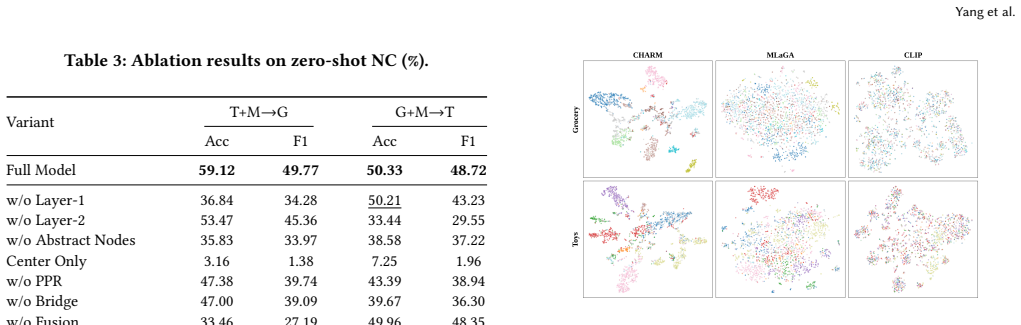
- Hierarchical abstraction is the operative ingredient: removing all abstract nodes cuts accuracy by 23.29 points on one domain and 11.75 on another, and retrieval moves from a domain-bias ratio of 0.995 at raw level to much lower bias with higher semantic relevance at anchor levels.
- Modality asymmetry is a usable signal: many structurally relevant pairs are similar in one modality but not the other, so per-node reliability-aware fusion and bridge edges contribute beyond simple averaging, with ablations removing bridges costing roughly 12 and 10.7 accuracy points on two targets.
- Context propagation matters as much as retrieval: removing it costs more than 11 accuracy points on both tested targets, meaning the LLM needs relations among context items, not just a bag of retrieved nodes.
- The frozen-LLM scoring interface handles open-vocabulary classification and binary link prediction with the same graph tokens, so new label sets or Yes/No questions require no retraining of the backbone.
Where Pith is reading between the lines
- The paper suggests a testable recipe for any multimodal graph: lift nodes into a text-defined hierarchy, add one-modality bridge edges, and feed compact contexts to a frozen LLM. A direct extension would apply the same pipeline to non-product domains such as social or biological graphs and check whether the hierarchy still supplies transferable references.
- Because the hierarchy is built entirely from frozen text embeddings, the pipeline inherits the transfer properties of that encoder; swapping in a domain-specialized text encoder or adapting cluster assignment to per-domain vocabulary statistics is a natural extension the paper does not explore.
- The center-protection gate points to a broader design principle: when context is rich, the model must preserve the query node's own identity; this may generalize to other retrieval-augmented LLM pipelines where the target can get diluted by retrieved evidence.
- The paper leaves open whether anchor counts and hierarchy depth could be learned or made adaptive per domain rather than fixed, which would clarify how much manual calibration the reported gains depend on.
Editorial analysis
A structured set of objections, weighed in public.
Referee Report
Summary. The paper presents CHARM, a multimodal graph foundation model for zero-shot transfer on node classification and link prediction. CHARM constructs a synthetic hierarchy of semantic anchors by K-means clustering of frozen CLIP text features within and across domains, builds modality-complementary bridges from asymmetric text/image similarities restricted by PPR neighborhoods, and retrieves compact per-node contexts containing PPR neighbors, hierarchical anchors, and bridge neighbors. A graph context encoder performs reliability-aware modality gating and two propagation layers, then emits continuous graph tokens consumed by a frozen LLM that scores candidate answers. Experiments on six Amazon product graphs across five target transfer settings report that CHARM achieves the highest accuracy in every node classification and link prediction setting, with ablations showing that the hierarchical anchors, PPR context, bridge relations, fusion, and context propagation each contribute to the result.
Significance. If the empirical claims hold, CHARM makes a useful contribution: it offers a concrete mechanism for lifting domain-specific raw nodes into semantics that can be shared across graphs, and it demonstrates that a frozen LLM can perform open-vocabulary prediction from graph tokens without target labels or parameter adaptation. The paper is clearly written, includes an explicit algorithm and a complexity analysis, and the ablation study is informative. However, the central zero-shot claim is currently supported only by single-run experiments on one family of product co-purchase graphs, and the evaluation protocol uses unlabeled target-domain inputs during preprocessing that precedes source training. The contribution could become solid after repositioning the setting as transductive zero-shot or demonstrating an inductive variant, and after adding error bars and broader graph families.
major comments (4)
- [Section 3.1 / Algorithm 1 / Appendix B.1] The protocol is transductive at training time, not inductive. Algorithm 1 constructs the hierarchy (lines 5-15), PPR caches, and bridge relations over every domain d in D, and Appendix B.1 states that the target graph's unlabeled text, images, and topology are used to build the semantic hierarchy, cache PPR neighborhoods, and discover bridge relations. Thus target-domain distributional information enters the anchors and bridge sets that are later injected into source-training contexts. The paper's 'unseen target domains' claim is therefore not established. Please either reposition the paper as transductive zero-shot transfer and discuss the implications, or add an inductive variant that builds hierarchy, bridges, and PPR lists from source domains only and show that the reported gains persist. The 'w/o Abstract Nodes' ablation does not isolate this issue because all variants keep anchors
- [Section 4 / Tables 1-3] All results are single-run with no standard deviations, confidence intervals, or significance tests. The 'consistent improvements' claim rests partly on very small gaps (e.g., 0.34 and 0.35 percentage points for Arts and CD in Table 2), which may be within run-to-run noise. Please report mean and standard deviation over at least multiple seeds and perform paired significance tests where possible. Additionally, all six datasets are Amazon co-purchase product graphs; the 'graph foundation model' claim needs at least one additional graph family (e.g., social, citation, or knowledge graphs) to demonstrate that the mechanism generalizes beyond product metadata.
- [Section 3.1, Eq. (1)] The transfer mechanism rests on the assumption that frozen CLIP text features encode category-level semantics that are aligned across domains, while visual features are too instance-specific to be used for clustering. The retrieval analysis in Figure 1 supports this for the Grocery/Toys pair, but no quantitative validation is provided for the other transfers or for the ABC group. Please add a direct test of cross-domain anchor alignment (e.g., nearest-anchor label purity or a variant that includes visual features in clustering) so that the hierarchy's transferability is not an untested assumption for the harder transfers.
- [Appendix B.4 / Eq. (6)] The method depends on many hand-set hyperparameters: Layer-1 cluster size 64, Layer-2 grouping size 8, 24 global anchors, top-m=3, K_p=8, K_b=4, PPR teleport probability, and the 75th/35th percentile thresholds. The high/low thresholds are estimated from 200,000 sampled pairs per domain, including the target domain, so they are another route by which target statistics influence training-time contexts. No sensitivity analysis is provided for any of these values. Please include a sensitivity study for the most influential parameters and state which ones are robust across the five transfers.
minor comments (4)
- [Section 3.3, Eq. (8)] The order of items in the context C(v_c) affects the final token sequence, yet the main text does not specify the ordering until Appendix B.4. Please state the deterministic ordering in the main text and confirm that the same ordering is used at training and inference time.
- [Figure 3] The t-SNE comparison is qualitative only. Consider adding quantitative cluster-quality metrics (e.g., silhouette score or kNN accuracy) on the same sampled nodes so that the visual claim of 'clearer separation' is supported numerically.
- [Table 4] The ABC graphs are much denser than the GMT graphs (e.g., CD has 7,168,792 edges while Toys has 66,680). The effect of this density difference on PPR context, bridge discovery, and the reported gains is not discussed.
- [Introduction] The phrase 'unseen target domains' is used in Section 1 before the exact protocol is specified. Since the target graph's unlabeled attributes are visible during preprocessing, consider using 'unlabeled target domains' or 'unseen target labels' to avoid a mismatch between the claim and the protocol.
Circularity Check
No significant circularity: the hierarchy and contexts are unsupervised, label-free inputs, and no predicted quantity reduces to a fitted target value.
full rationale
CHARM's derivation chain is self-contained. The synthetic hierarchy is built by K-means on frozen CLIP text features (Eq. 1, Algorithm 1 lines 5-15), and anchor summaries and visual aggregations are deterministic, label-free functions of unlabeled node attributes (Eqs. 3-4). Target labels never enter clustering, anchor construction, bridge discovery, or training (Sections 3.1-3.5); Appendix B.1 states: 'Target labels are never used for clustering, anchor assignment, global-anchor construction or bridge discovery.' The graph context encoder and LLM are trained only on source-domain NC and LP examples (Eq. 18), and the same checkpoint is evaluated on the target without parameter updates. The only arguable concern is that Algorithm 1 constructs global anchors from all domains in D, including the target, before source training, so unlabeled target text features influence the anchor tokens that appear in source contexts. This is a transductive-protocol issue, not circularity: the anchors are unsupervised summary statistics, not target labels or target answers, and the paper explicitly defines the setting as one where 'the unlabeled target graph is visible, but no target supervision is available.' No prediction in Tables 1-2 is equivalent by construction to an anchor assignment, a fitted threshold, or a cached bridge. There is no load-bearing self-citation, no imported uniqueness theorem, and no ansatz smuggled in via citation. The central zero-shot claim is therefore not reduced to its inputs.
Axiom & Free-Parameter Ledger
free parameters (10)
- Layer-1 cluster size =
~64 raw nodes per cluster
- Layer-2 grouping size =
~8 Layer-1 anchors per Layer-2 anchor
- Number of global anchors =
24
- Global anchor links per Layer-2 anchor =
m = 3
- PPR cache size / teleport probability =
R = 128, alpha = 0.15
- Text/image threshold percentiles =
75th / 35th percentiles from 200K pairs
- Minimum PPR-overlap threshold =
unspecified
- Context budget sizes =
K_p = 8, K_b = 4, at most 18 items
- Visual aggregation temperature tau =
unspecified
- Number of propagation layers =
L = 2
axioms (6)
- domain assumption Frozen CLIP text features are sufficiently aligned across domains for K-means clustering to produce semantically meaningful, transferable anchors.
- domain assumption Pairs with asymmetric text/image similarity plus sufficient PPR overlap correspond to meaningful graph relations.
- domain assumption A frozen LLM can perform zero-shot classification and link prediction from continuous graph tokens after training only the graph encoder on source tasks.
- domain assumption PPR neighborhoods approximate structural relevance and are useful for both local context and bridge filtering.
- domain assumption TF-IDF summaries preserve the semantic identity of clusters well enough to serve as textual features for synthetic anchors.
- standard math Standard mathematical tools (K-means, PPR, TF-IDF, GNN propagation) behave as expected on these graphs.
invented entities (2)
-
Synthetic hierarchical anchors (Layer-1, Layer-2, global)
no independent evidence
-
Modality-complementary bridges
no independent evidence
Cite this review
Pith. "Pith review of CHARM: A Multimodal Graph Foundation Model with Hierarchical Context Modeling for Zero-Shot Transfer." pith.science (2026). https://pith.science/paper/TU5LVGDS
@misc{pith2026260726023,
  author       = {Pith},
  title        = {Pith review of: CHARM: A Multimodal Graph Foundation Model with Hierarchical Context Modeling for Zero-Shot Transfer},
  year         = {2026},
  howpublished = {\url{https://pith.science/paper/TU5LVGDS}},
  note         = {Machine review of arXiv:2607.26023}
}
read the original abstract
Graph foundation models (GFMs) have emerged as a promising paradigm for transferring knowledge across graph domains and tasks. Real-world graphs associate nodes with text, images, and other modalities, making multimodal graphs essential for representing complex entities and relations. Moreover, collecting labels and adapting models for every new graph domain is costly and often infeasible, motivating zero-shot transfer. Unfortunately, zero-shot transfer on multimodal graphs remains underexplored. Existing GNN-based graph foundation models typically require downstream adaptation, whereas LLM-based graph methods mainly address unimodal graphs or tasks within a single domain. This setting presents two key challenges. First, models must generalize knowledge from individual modalities while capturing transferable cross-modal relations. Second, without target-domain fine-tuning, node representations remain entangled with domain-specific structures and modality-specific characteristics, obscuring shared concepts in unseen domains. To address these challenges, we propose CHARM, a multimodal graph foundation model with hierarchical context modeling for zero-shot transfer. CHARM replaces isolated raw nodes with hierarchical graph contexts that capture multimodal semantics and cross-modal relations. These contexts map domain-specific node patterns to shared high-level concepts, reducing reliance on target-domain supervision or adaptation. A modality-aware graph context encoder integrates multimodal information with graph structure and converts the resulting representations into graph tokens for a large language model . Experiments show consistent improvements on zero-shot multimodal graph tasks.
Figures




Reference graph
Works this paper leans on
-
[1]
Runjin Chen, Tong Zhao, Ajay Kumar Jaiswal, Neil Shah, and Zhangyang Wang
-
[2]
Zhikai Chen, Haitao Mao, Hongzhi Wen, Haoyu Han, Wei Jin, Haiyang Zhang, Hui Liu, and Jiliang Tang. 2024. Label-free Node Classification on Graphs with Large Language Models (LLMs). InThe Twelfth International Conference on Learn- ing Representations, ICLR 2024, Vienna, Austria, May 7-11, 2024. OpenReview.net. https://openreview.net/forum?id=hESD2NJFg8
2024
-
[3]
Yasha Ektefaie, George Dasoulas, Ayush Noori, Maha Farhat, and Marinka Zitnik
-
[4]
Dongzhe Fan, Yi Fang, Jiajin Liu, Djellel Difallah, and Qiaoyu Tan. 2025. MLaGA: Multimodal Large Language and Graph Assistant.CoRRabs/2506.02568 (2025). arXiv:2506.02568 doi:10.48550/ARXIV.2506.02568
-
[5]
Justin Gilmer, Samuel S Schoenholz, Patrick F Riley, Oriol Vinyals, and George E Dahl. 2017. Neural message passing for quantum chemistry. InInternational conference on machine learning. Pmlr, 1263–1272
2017
-
[6]
Hamilton, Zhitao Ying, and Jure Leskovec
William L. Hamilton, Zhitao Ying, and Jure Leskovec. 2017. Inductive Represen- tation Learning on Large Graphs. InAdvances in Neural Information Processing Systems 30: Annual Conference on Neural Information Processing Systems 2017, December 4-9, 2017, Long Beach, CA, USA, Isabelle Guyon, Ulrike von Luxburg, Samy Bengio, Hanna M. Wallach, Rob Fergus, S. V...
2017
-
[7]
Yufei He, Yuan Sui, Xiaoxin He, and Bryan Hooi. 2025. UniGraph: Learning a Uni- fied Cross-Domain Foundation Model for Text-Attributed Graphs. InProceedings of the 31st ACM SIGKDD Conference on Knowledge Discovery and Data Mining, V.1, KDD 2025, Toronto, ON, Canada, August 3-7, 2025, Yizhou Sun, Flavio Chierichetti, Hady W. Lauw, Claudia Perlich, Wee Hyon...
arXiv 2025
-
[9]
Zhenyu Hou, Yufei He, Yukuo Cen, Xiao Liu, Yuxiao Dong, Evgeny Kharlamov, and Jie Tang. 2023. GraphMAE2: A Decoding-Enhanced Masked Self-Supervised Graph Learner. InProceedings of the ACM Web Conference 2023, WWW 2023, Austin, TX, USA, 30 April 2023 - 4 May 2023, Ying Ding, Jie Tang, Juan F. Sequeda, Lora Aroyo, Carlos Castillo, and Geert-Jan Houben (Eds....
arXiv 2023
-
[10]
Zhenyu Hou, Xiao Liu, Yukuo Cen, Yuxiao Dong, Hongxia Yang, Chunjie Wang, and Jie Tang. 2022. GraphMAE: Self-Supervised Masked Graph Autoencoders. InKDD ’22: The 28th ACM SIGKDD Conference on Knowledge Discovery and Data Mining, Washington, DC, USA, August 14 - 18, 2022. ACM, 594–604. https: //doi.org/10.1145/3534678.3539321
arXiv 2022
-
[11]
Kipf and Max Welling
Thomas N. Kipf and Max Welling. 2017. Semi-Supervised Classification with Graph Convolutional Networks. In5th International Conference on Learning Representations, ICLR 2017, Toulon, France, April 24-26, 2017, Conference Track Proceedings. OpenReview.net. https://openreview.net/forum?id=SJU4ayYgl
2017
-
[12]
Johannes Klicpera, Aleksandar Bojchevski, and Stephan Günnemann. 2019. Pre- dict then Propagate: Graph Neural Networks meet Personalized PageRank. In 7th International Conference on Learning Representations, ICLR 2019, New Orleans, LA, USA, May 6-9, 2019. OpenReview.net
2019
-
[13]
Lecheng Kong, Jiarui Feng, Hao Liu, Chengsong Huang, Jiaxin Huang, Yixin Chen, and Muhan Zhang. 2025. GOFA: A Generative One-For-All Model for Joint Graph Language Modeling. InThe Thirteenth International Conference on Learning Representations, ICLR 2025, Singapore, April 24-28, 2025. OpenReview.net. https://openreview.net/forum?id=mIjblC9hfm
2025
-
[15]
Hao Liu, Jiarui Feng, Lecheng Kong, Ningyue Liang, Dacheng Tao, Yixin Chen, and Muhan Zhang. 2024. One For All: Towards Training One Graph Model For All Classification Tasks. InThe Twelfth International Conference on Learning Representations, ICLR 2024, Vienna, Austria, May 7-11, 2024. OpenReview.net. https://openreview.net/forum?id=4IT2pgc9v6
2024
-
[16]
Yixin Liu, Ming Jin, Shirui Pan, Chuan Zhou, Yu Zheng, Feng Xia, and Philip S. Yu. 2023. Graph Self-Supervised Learning: A Survey.IEEE Trans. Knowl. Data Eng.35, 6 (2023), 5879–5900. doi:10.1109/TKDE.2022.3172903
arXiv 2023
-
[17]
Haitao Mao, Zhikai Chen, Wenzhuo Tang, Jianan Zhao, Yao Ma, Tong Zhao, Neil Shah, Mikhail Galkin, and Jiliang Tang. 2024. Position: Graph Foundation Models Are Already Here. InForty-first International Conference on Machine Learning, ICML 2024, Vienna, Austria, July 21-27, 2024. OpenReview.net. https: //openreview.net/forum?id=Edz0QXKKAo
2024
-
[18]
McAuley, Christopher Targett, Qinfeng Shi, and Anton van den Hengel
Julian J. McAuley, Christopher Targett, Qinfeng Shi, and Anton van den Hengel
-
[19]
James B McQueen. 1967. Some methods of classification and analysis of multi- variate observations. InProc. of 5th Berkeley Symposium on Math. Stat. and Prob. 281–297
1967
-
[20]
Xuying Ning, Dongqi Fu, Tianxin Wei, Wujiang Xu, and Jingrui He. 2025. Graph4MM: Weaving Multimodal Learning with Structural Information. InForty- second International Conference on Machine Learning, ICML 2025, Vancouver, BC, Canada, July 13-19, 2025 (Proceedings of Machine Learning Research, Vol. 267), Aarti Singh, Maryam Fazel, Daniel Hsu, Simon Lacoste...
2025
-
[21]
1999.The PageRank citation ranking: Bringing order to the web.Technical Report
Lawrence Page, Sergey Brin, Rajeev Motwani, and Terry Winograd. 1999.The PageRank citation ranking: Bringing order to the web.Technical Report. Stanford infolab
1999
-
[22]
Karl Pearson. 1901. LIII. On lines and planes of closest fit to systems of points in space.The London, Edinburgh, and Dublin philosophical magazine and journal of science2, 11 (1901), 559–572
1901
-
[23]
Liang Peng, Songyue Cai, Zongqian Wu, Huifang Shang, Xiaofeng Zhu, and Xiaoxiao Li. 2024. Mmgpl: Multimodal medical data analysis with graph prompt learning.Medical Image Analysis97 (2024), 103225
2024
-
[24]
Karen Sparck Jones. 1972. A statistical interpretation of term specificity and its application in retrieval.Journal of documentation28, 1 (1972), 11–21
1972
-
[25]
Li Sun, Zhenhao Huang, Suyang Zhou, Qiqi Wan, Hao Peng, and Philip S. Yu
-
[26]
Yuanfu Sun, Kang Li, Pengkang Guo, Jiajin Liu, and Qiaoyu Tan. 2026. Mario: Multimodal Graph Reasoning with Large Language Models.CoRRabs/2603.05181 (2026). arXiv:2603.05181 doi:10.48550/ARXIV.2603.05181
-
[27]
Jie Tang, Jimeng Sun, Chi Wang, and Zi Yang. 2009. Social influence analysis in large-scale networks. InProceedings of the 15th ACM SIGKDD International Conference on Knowledge Discovery and Data Mining, Paris, France, June 28 - July 1, 2009, John F. Elder IV, Françoise Fogelman-Soulié, Peter A. Flach, and Mohammed Javeed Zaki (Eds.). ACM, 807–816. doi:10...
arXiv 2009
-
[28]
Jiabin Tang, Yuhao Yang, Wei Wei, Lei Shi, Lixin Su, Suqi Cheng, Dawei Yin, and Chao Huang. 2024. GraphGPT: Graph Instruction Tuning for Large Language Models. InProceedings of the 47th International ACM SIGIR Conference on Research and Development in Information Retrieval, SIGIR 2024, Washington DC, USA, July 14-18, 2024, Grace Hui Yang, Hongning Wang, S...
arXiv 2024
-
[29]
Jiabin Tang, Yuhao Yang, Wei Wei, Lei Shi, Long Xia, Dawei Yin, and Chao Huang
-
[30]
Zhulin Tao, Yinwei Wei, Xiang Wang, Xiangnan He, Xianglin Huang, and Tat- Seng Chua. 2020. MGAT: Multimodal Graph Attention Network for Recommen- dation.Inf. Process. Manag.57, 5 (2020), 102277. doi:10.1016/J.IPM.2020.102277
arXiv 2020
-
[31]
Shantanu Thakoor, Corentin Tallec, Mohammad Gheshlaghi Azar, Rémi Munos, Petar Veličković, and Michal Valko. 2021. Bootstrapped representation learning on graphs. InICLR 2021 Workshop on Geometrical and Topological Representation Learning
2021
-
[32]
Laurens Van der Maaten and Geoffrey Hinton. 2008. Visualizing data using t-SNE.Journal of machine learning research9, 11 (2008)
2008
-
[33]
Gomez, Lukasz Kaiser, and Illia Polosukhin
Ashish Vaswani, Noam Shazeer, Niki Parmar, Jakob Uszkoreit, Llion Jones, Aidan N. Gomez, Lukasz Kaiser, and Illia Polosukhin. 2017. Attention is All you Need. InAdvances in Neural Information Processing Systems 30: An- nual Conference on Neural Information Processing Systems 2017, December 4- 9, 2017, Long Beach, CA, USA, Isabelle Guyon, Ulrike von Luxbur...
2017
-
[35]
Hamilton, Pietro Liò, Yoshua Bengio, and R
Petar Velickovic, William Fedus, William L. Hamilton, Pietro Liò, Yoshua Bengio, and R. Devon Hjelm. 2019. Deep Graph Infomax. In7th International Conference 9 Yang et al. on Learning Representations, ICLR 2019, New Orleans, LA, USA, May 6-9, 2019. OpenReview.net. https://openreview.net/forum?id=rklz9iAcKQ
2019
-
[36]
Duo Wang, Yuan Zuo, Fengzhi Li, and Junjie Wu. 2024. LLMs as Zero- shot Graph Learners: Alignment of GNN Representations with LLM Token Embeddings. InAdvances in Neural Information Processing Systems 38: An- nual Conference on Neural Information Processing Systems 2024, NeurIPS 2024, Vancouver, BC, Canada, December 10 - 15, 2024, Amir Globersons, Lester M...
2024
-
[37]
Haoyu Peter Wang, Shikun Liu, Rongzhe Wei, and Pan Li. 2025. General- ization Principles for Inference over Text-Attributed Graphs with Large Lan- guage Models. InForty-second International Conference on Machine Learning. https://openreview.net/forum?id=dfOqiHuklY
2025
-
[38]
Jinguang Wang, Jun Hu, Shengsheng Qian, Quan Fang, and Changsheng Xu. 2020. Multimodal graph convolutional networks for high quality content recognition. Neurocomputing412 (2020), 42–51. doi:10.1016/J.NEUCOM.2020.04.145
-
[39]
Petar Velickovic, Guillem Cucurull, Arantxa Casanova, Adriana Romero, Pietro Liò, and Yoshua Bengio. 2018. Graph Attention Networks. In6th Interna- tional Conference on Learning Representations, ICLR 2018, Vancouver, BC, Canada, April 30 - May 3, 2018, Conference Track Proceedings. OpenReview.net. https: //openreview.net/forum?id=rJXMpikCZ
2018
-
[40]
Chawla, Chuxu Zhang, and Yan- fang Ye
Zehong Wang, Zheyuan Zhang, Nitesh V. Chawla, Chuxu Zhang, and Yan- fang Ye. 2024. GFT: Graph Foundation Model with Transferable Tree Vocabulary. InAdvances in Neural Information Processing Systems 38: An- nual Conference on Neural Information Processing Systems 2024, NeurIPS 2024, Vancouver, BC, Canada, December 10 - 15, 2024, Amir Globersons, Lester Mac...
2024
-
[41]
Zonghan Wu, Shirui Pan, Fengwen Chen, Guodong Long, Chengqi Zhang, and Philip S. Yu. 2021. A Comprehensive Survey on Graph Neural Networks.IEEE Trans. Neural Networks Learn. Syst.32, 1 (2021), 4–24. doi:10.1109/TNNLS.2020. 2978386
-
[42]
Lianghao Xia and Chao Huang. 2024. AnyGraph: Graph Foundation Model in the Wild.CoRRabs/2408.10700 (2024). arXiv:2408.10700 doi:10.48550/ARXIV. 2408.10700
-
[43]
Lianghao Xia, Ben Kao, and Chao Huang. 2024. OpenGraph: Towards Open Graph Foundation Models. InFindings of the Association for Computational Linguistics: EMNLP 2024, Miami, Florida, USA, November 12-16, 2024, Yaser Al-Onaizan, Mohit Bansal, and Yun-Nung Chen (Eds.). Association for Computational Linguistics, 2365–2379. doi:10.18653/V1/2024.FINDINGS-EMNLP.132
-
[44]
Zehong Wang, Zheyuan Liu, Tianyi Ma, Jiazheng Li, Zheyuan Zhang, Xingbo Fu, Yiyang Li, Zhengqing Yuan, Wei Song, Yijun Ma, et al. 2025. Graph Foundation Models: A Comprehensive Survey.arXiv preprint arXiv:2505.15116(2025)
Pith/arXiv arXiv 2025
-
[45]
Hao Yan, Chaozhuo Li, Jun Yin, Zhigang Yu, Weihao Han, Mingzheng Li, Zhengxin Zeng, Hao Sun, and Senzhang Wang. 2025. When Graph Meets Multi- modal: Benchmarking and Meditating on Multimodal Attributed Graph Learning. InProceedings of the 31st ACM SIGKDD Conference on Knowledge Discovery and Data Mining, V.2, KDD 2025, Toronto ON, Canada, August 3-7, 2025...
arXiv 2025
-
[47]
Xinmiao Yu, Meng Qu, Xiaocheng Feng, and Bing Qin. 2024. GraphAgent: Exploit- ing Large Language Models for Interpretable Learning on Text-attributed Graphs. OpenReview preprint(2024). https://openreview.net/forum?id=L3jATpVEGv
2024
-
[48]
Xingtong Yu, Chang Zhou, Yuan Fang, and Xinming Zhang. 2024. Text-Free Multi-domain Graph Pre-training: Toward Graph Foundation Models.CoRR abs/2405.13934 (2024). arXiv:2405.13934 doi:10.48550/ARXIV.2405.13934
-
[49]
Keyulu Xu, Weihua Hu, Jure Leskovec, and Stefanie Jegelka. 2019. How Powerful are Graph Neural Networks?. In7th International Conference on Learning Rep- resentations, ICLR 2019, New Orleans, LA, USA, May 6-9, 2019. OpenReview.net. https://openreview.net/forum?id=ryGs6iA5Km
2019
-
[50]
Yun Zhu, Haizhou Shi, Xiaotang Wang, Yongchao Liu, Yaoke Wang, Boci Peng, Chuntao Hong, and Siliang Tang. 2025. GraphCLIP: Enhancing Transferability in Graph Foundation Models for Text-Attributed Graphs. InProceedings of the ACM on Web Conference 2025, WWW 2025, Sydney, NSW, Australia, 28 April 2025- 2 May 2025, Guodong Long, Michale Blumestein, Yi Chang,...
arXiv 2025
-
[54]
Haihong Zhao, Aochuan Chen, Xiangguo Sun, Hong Cheng, and Jia Li. 2024. All in One and One for All: A Simple yet Effective Method towards Cross- domain Graph Pretraining. InProceedings of the 30th ACM SIGKDD Conference on Knowledge Discovery and Data Mining, KDD 2024, Barcelona, Spain, August 25-29, 2024, Ricardo Baeza-Yates and Francesco Bonchi (Eds.). A...
arXiv 2024
-
[2015]
Image-Based Recommendations on Styles and Substitutes. InProceedings of the 38th International ACM SIGIR Conference on Research and Development in Information Retrieval, Santiago, Chile, August 9-13, 2015. ACM, 43–52. https: //doi.org/10.1145/2766462.2767755
arXiv 2015
-
[2023]
Multimodal learning with graphs.Nature Machine Intelligence5, 4 (2023), 340–350
2023
-
[2024]
InForty-first International Conference on Machine Learning, ICML 2024, Vienna, Austria, July 21-27, 2024
LLaGA: Large Language and Graph Assistant. InForty-first International Conference on Machine Learning, ICML 2024, Vienna, Austria, July 21-27, 2024. OpenReview.net. https://openreview.net/forum?id=B48Pzc4oKi
2024
-
[2025]
RiemannGFM: Learning a Graph Foundation Model from Riemannian Geometry. InProceedings of the ACM on Web Conference 2025, WWW 2025, Sydney, NSW, Australia, 28 April 2025- 2 May 2025, Guodong Long, Michale Blumestein, Yi Chang, Liane Lewin-Eytan, Zi Helen Huang, and Elad Yom-Tov (Eds.). ACM, 1154–1165. doi:10.1145/3696410.3714952
arXiv 2025
This paper was first reviewed by deepseek-v4-flash on August 1, 2026.
discussion (0)
Sign in with ORCID, Apple, or X to comment. Anyone can read and Pith papers without signing in.