REVIEW 3 major objections 4 minor 7 references
The spin axis of the S-star S301 should precess in discrete periapsis steps under general relativity plus tidal torque, shifting its projected rotational velocity by a detectable 3–46 km/s over 40 years, a new time-domain test of the Schwar
Reviewed by Pith at T0; open to challenge. T0 means a machine referee read the full paper against a public rubric. the ladder, T0–T4 →
T0 review · deepseek-v4-flash
2026-08-01 00:41 UTC pith:D5EFDB5E
load-bearing objection A clean application of standard spin-transport physics to the newly discovered S301, with sound scaling relations but an overclaimed current-instrument detectability and a missing exceedance fraction. the 3 major comments →
Stellar rotation of S301 as a macroscopic gyroscope to test general relativity
The pith
A machine-rendered reading of the paper's core claim, the machinery that carries it, and where it could break.
Core claim
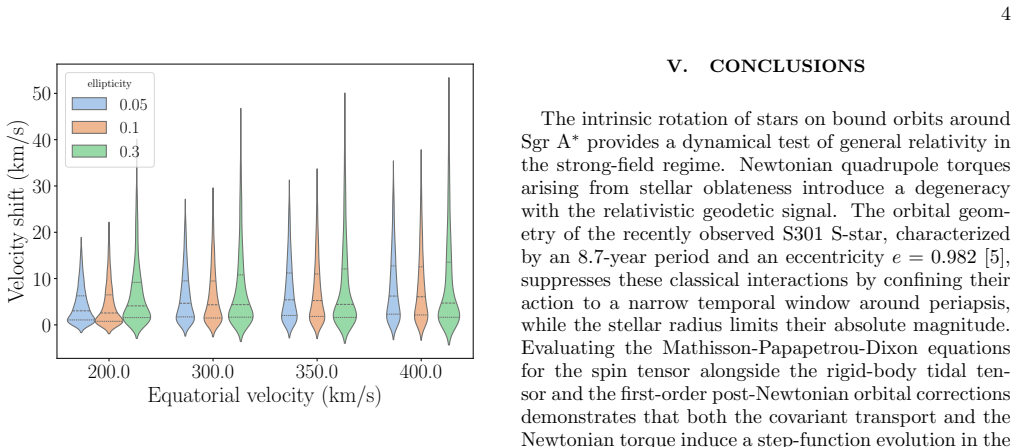
The rotational axis of the S-star S301 is governed by the combined action of geodetic precession (a relativistic effect described by Fermi-Walker transport in the Schwarzschild metric) and a Newtonian quadrupole torque from the star's oblateness. The star's extreme eccentricity confines both torques to a short interval around periapsis, turning the evolution of its projected rotational velocity v sin i into a discrete step function. Monte Carlo sampling over isotropic spin orientations and viewing geometries yields absolute shifts in v sin i with medians between 3 and 6.3 km/s and a maximum of 46.1 km/s for the fastest, most oblate models. Because the geodetic shift scales linearly with the
What carries the argument
The central mechanism is the evolution equation ds/dt = (Ω_geod − Ω_quad) × s for the unit spin vector s, derived from the Mathisson-Papapetrou-Dixon covariant transport equations together with a rigid-body tidal torque. Ω_geod, the geodetic precession vector, is proportional to (n × v)/r², while Ω_quad, the quadrupole precession vector, is proportional to (q/ω_rot)(n·s)n/r³. The high eccentricity e = 0.982 makes both precession rates act as sharp impulses at periapsis, converting continuous spin-axis drift into a step-function observable in v sin i.
Load-bearing premise
The spin of S301 is assumed to evolve only under geodetic precession plus a rigid-body quadrupole torque; any additional comparable torque—from differential rotation, magnetic braking, tidal interaction with a companion, or internal angular-momentum transport—would erase the sharp step signal.
What would settle it
A 40-year spectroscopic campaign measuring S301's line broadening: if no periapsis-step in |Δv sin i| appears across four to five passages, or if the steps occur at amplitudes and epochs inconsistent with the geodetic-plus-quadrupole prediction for the star's known orbit, the hypothesis is falsified. Additionally, if future observations fix S301's v_rot and q outside the modeled ranges (200–400 km/s and 0.05–0.3), the predicted shift magnitudes must be recomputed, and the claimed detectability may fail.
If this is right
- If the predicted steps in |Δv sin i| are observed, they would constitute a direct measurement of Fermi-Walker spin transport (spin-curvature coupling) in the strong gravitational field of a supermassive black hole, complementing tests based on orbital astrometry and redshift.
- The opposite scaling of geodetic and quadrupole contributions with v_rot provides a clean observational handle to separate relativistic spin precession from classical tidal effects, even without a priori knowledge of the star's rotation speed and ellipticity.
- Post-Newtonian orbital precession modulates the amplitude of the periapsis step across successive orbits, yielding a time-domain signature that can be identified even with sparse sampling over several orbital periods.
- Next-generation infrared spectrographs with velocity resolutions near 3 km/s should be able to detect the median shifts for typical configurations, making S301 a practical target for testing the Schwarzschild metric.
- A null detection of the periapsis step would challenge either the assumption of isolated spin-axis evolution or the applicability of the Schwarzschild metric at the orbital scale of S301.
Where Pith is reading between the lines
- Editorial: The same step-function analysis could be applied to other highly eccentric S-stars discovered in the future; any star whose periapsis is close enough to make geodetic precession comparable to measurement precision becomes a potential spin gyroscope.
- Editorial: If the spin-axis precession is measured, it may constrain the internal structure of the star (through the ellipticity q), offering a rare probe of stellar interiors in an extreme environment.
- Editorial: A dedicated monitoring campaign timed around periapsis passages—rather than continuous coverage—might suffice to detect the step, since the signal is localized; this could make the test observationally cheaper than it first appears.
- Editorial: Combining the spin-precession measurement with orbital precession and redshift measurements of S301 would provide a triple constraint on the spacetime geometry, potentially tightening limits on deviations from general relativity.
Editorial analysis
A structured set of objections, weighed in public.
Referee Report
Summary. The paper proposes using the S-star S301, recently discovered near Sgr A* with an 8.7-year period and eccentricity e=0.982, as a macroscopic gyroscope to test general relativity. The authors argue that the star's rotational axis undergoes geodetic precession plus a Newtonian quadrupole torque, both concentrated near periapsis, producing step-function-like changes in the projected rotational velocity |Δv sin i|. They integrate the spin transport equations with first-order post-Newtonian orbital kinematics, sample an isotropic distribution of orientations and viewing geometries over a 40-year baseline, and report median absolute shifts of 3–6.3 km/s and a maximum of 46.1 km/s across a grid of equatorial velocities (200–400 km/s) and ellipticities (0.05–0.3). They conclude that S301 can serve as a target for current and next-generation infrared spectrographs to test the Schwarzschild metric and Fermi-Walker transport.
Significance. The idea is novel and potentially important: spin precession of a stellar gyroscope around Sgr A* would provide a direct test of spin-curvature coupling, complementing orbital astrometry and redshift tests. The appendix derivation of the quadrupole torque is consistent with standard rigid-body tidal theory, and the scaling relations—geodetic shift ∝ v_rot, quadrupole shift ∝ q—are clearly derived and physically transparent. The Monte Carlo study is systematic and the paper is appropriately cautious about unconstrained parameters. However, the observability chain has a quantitative gap: the reported maximum shift lies below the paper's own current-instrument resolution, and the fraction of realizations exceeding the next-generation threshold is not reported. These issues are fixable but currently weaken the central claim.
major comments (3)
- [Section IV, Figs. 1–2] The observability claim for current instruments is internally inconsistent. The text states that current near-infrared spectrographs have a 50 km/s velocity resolution limit and that shifts exceeding this threshold require upper parameter bounds, yet the maximum |Δv sin i| reported anywhere in the grid is 46.1 km/s (q=0.3, v_rot=400 km/s). No simulated realization reaches 50 km/s, so the conclusion that S301 constitutes a target for current spectrographs is not supported by the presented data. Please either report the exact exceedance fraction at 50 km/s (which appears to be zero), restrict the claim to next-generation instruments, or justify a different current-instrument resolution with a quantitative source.
- [Section IV, Fig. 2] For the next-generation threshold of 3 km/s, the paper quotes only the median absolute shift (3–6.3 km/s). Since the initial spin orientation and viewing geometry are unconstrained, as the paper itself acknowledges, a median over an isotropic sample does not establish the probability that a given realization is detectable. Report the fraction of the 2000 Monte Carlo realizations per grid point with |Δv sin i| > 3 km/s, and ideally the cumulative distribution. If the exceedance fraction is small, the statistical case for S301 as a practical test target must be correspondingly weakened.
- [Eq. (5) and Appendix A] The entire predicted signal rests on treating S301 as a rigid axisymmetric rotor with constant q and no spin torques other than geodetic and Newtonian quadrupole terms. The paper does not quantify whether differential rotation, magnetic braking, tidal interaction with a companion, or internal angular-momentum transport could produce precession rates comparable to Ω_geod over a 40-year baseline. An order-of-magnitude estimate or a cited bound for these effects is needed to justify the 'clean step-function' claim; otherwise the predicted shift should be presented as an upper-envelope signal under an idealized model.
minor comments (4)
- [General] There are several typos: 'geodtic' (Eq. 7), 'projcted' (Section V), 'threeholds' (Introduction), and 'threhsolds' (Introduction).
- [Figure 1] The KDE smoothing visually extends the distributions to negative values, as noted in the caption. This is misleading; a histogram or a log-scale plot of the strictly non-negative data would be clearer.
- [Section IV] The 'Einstein-Infeld-Hoffmann acceleration' terminology is usually reserved for N-body post-Newtonian equations; for a test particle in Schwarzschild, 'first-order post-Newtonian Schwarzschild acceleration' is more precise.
- [Abstract/Conclusions] The abstract and conclusion state that S301 is a target for 'current and next-generation' spectrographs. The current-instrument part is not supported by the numbers in Section IV (see major comment 1) and should be revised.
Circularity Check
No circular derivation: the spin-precession signal is a forward model from first-principles equations with no fitted target. Minor self-citations supply inputs, not the predicted result.
full rationale
The paper's observable |Δv sin i| is obtained by numerically integrating Eq. (5), ds/dt = (Ω_geod − Ω_quad) × s, with Ω_geod from Eq. (4) and Ω_quad from Eq. (6), the latter derived in Appendix A from the tidal tensor and an assumed axisymmetric inertia tensor (Eq. A3). The only data inputs are the S301 orbital elements (period, eccentricity) taken from ref. [5], which are external observational inputs; no parameter of the model is fit to the predicted line-broadening shift. The claimed scalings (geodetic shift ∝ v_rot, quadrupole shift ∝ q) are algebraic consequences of Eqs. (4)–(6) and are consistent with the Monte Carlo output, not imposed by fitting. Self-citations exist — ref. [5] is a GRAVITY+ discovery paper and ref. [8] shares two authors — but they supply the orbit and motivate the explorative grid (v_rot ∈ {200,...,400} km/s, q ∈ {0.05,0.1,0.3}); they do not assert the spin-precession result, so they are not load-bearing circularity. The observability limitation quoted in Sec. IV — 'Current near-infrared spectrographs operate with a velocity resolution limit of 50 km/s. To produce a shift exceeding this threshold, the physical parameters of S301 must occupy the upper bounds of their modeled intervals' — while the reported maximum is 46.1 km/s, is an internal-consistency/correctness concern, not a circular step. Likewise the use of medians rather than exceedance fractions is a statistical reporting weakness, not circularity. Hence score 2 only for the minor non-load-bearing self-citations.
Axiom & Free-Parameter Ledger
free parameters (3)
- v_rot =
grid {200,300,350,400} km/s
- q =
grid {0.05,0.1,0.3}
- R_* =
1.5 R_sun
axioms (6)
- standard math First-order post-Newtonian equations of motion for a test particle in Schwarzschild (Eq. 1)
- standard math Mathisson-Papapetrou-Dixon spin transport with Tulczyjew-Dixon supplementary condition (Eq. 2)
- domain assumption Geodesic motion of the center of mass
- domain assumption Rigid axisymmetric body with I_ij = I1 δ_ij + (I3-I1)s_i s_j (Eq. A3)
- domain assumption Only geodetic and quadrupole torques act on the spin (Eq. 5); Lense-Thirring omitted
- domain assumption S301 orbital elements from ref [5] (P=8.7 yr, e=0.982, M=4.3e6 M_sun)
read the original abstract
Stellar trajectories around the Galactic Center provide a testing environment for general relativity. The intrinsic rotation of these stars evolves under covariant transport in curved spacetime and classical Newtonian quadrupole torques. We analyze the recently observed S301 S-star to quantify the relativistic precession of its rotational axis. Its 8.7-year period and eccentricity of $e = 0.982$ localize geodetic precession and Newtonian quadrupole torques to a step function at periapsis. We incorporate first-order post-Newtonian corrections into the orbital kinematics to calculate the spatial trajectory. Sampling an isotropic distribution of initial orientations and viewing geometries over a 40-year period across a grid of equatorial velocities and rotational ellipticities, we calculate the statistical likelihood of an absolute shift in the projected rotational line broadening, $|\Delta v \sin i|$. The relativistic geodetic shift scales linearly with $v_{\rm rot}$ and the classical quadrupole shift is independent of rotation speed, scaling with $q$. The absolute maximum velocity shift saturates at $46.1\,\kms$ for oblate stars. The absolute median shifts, driven by geodetic precession, range from $3\,\kms$ to $6.3\,\kms$. We calculate the time-domain observable $|\Delta v \sin i|$ to provide a target for infrared spectrographs testing the Schwarzschild metric around Sgr~A$^\ast$. The spin of S301 acts as a flying gyroscope whose drift, if measured, can test Einstein's theory in a regime that has not previously been accessible.
Figures

Reference graph
Works this paper leans on
-
[1]
Barker, A. J. 2020, Tidal dissipation in evolving low- mass and solar-type stars with predictions for planetary orbital decay, Mon. Not. R. Astron. Soc., 498, 2270, doi: 10.1093/mnras/staa2405
-
[2]
Bolmont, E., & Mathis, S. 2016, Effect of the rotation and tidal dissipation history of stars on the evolution of close-in planets, Celestial Mechanics and Dynamical Astronomy, 126, 275, doi: 10.1007/s10569-016-9690-3
-
[3]
Davies, R., H¨ ormann, V., Rabien, S., et al. 2021, MI- CADO: The Multi-Adaptive Optics Camera for Deep Ob- servations, The Messenger, 182, 17, doi: 10.18727/0722- 6691/5217
-
[4]
Do, T., Hees, A., Ghez, A., et al. 2019, Relativistic redshift of the star S0-2 orbiting the Galactic Center supermassive black hole, Science, 365, 664, doi: 10.1126/science.aav8137
-
[5]
A., Abuter, R., Aimar, N., et al
El Dayem, K. A., Abuter, R., Aimar, N., et al. 2026, Discovery of a star sensitive to the spin of Sgr A*, arXiv e-prints, arXiv:2607.12664. https://arxiv.org/abs/2607.12664
Pith/arXiv arXiv 2026
-
[7]
GRA VITY Collaboration, Abuter, R., Amorim, A., et al. 2020, Detection of the Schwarzschild precession in the or- bit of the star S2 near the Galactic centre massive black hole, Astron. Astrophys., 636, L5, doi: 10.1051/0004- 6361/202037813
doi:10.1051/0004- 2020
-
[8]
Xu, R., Torres-Orjuela, A., & Amaro Seoane, P. 2025, The I-Love Universal Relation for Polytropic Stars Under Newtonian Gravity, Galaxies, 13, 75, doi: 10.3390/galax- ies13040075 END MA TTER Appendix A: Detailed Derivation of Equation (6) To calculate the classical rigid-body torque, we eval- uate the spatial gradient of the central potential Φ = −M/r. Th...
doi:10.3390/galax- 2025
discussion (0)
Sign in with ORCID, Apple, or X to comment. Anyone can read and Pith papers without signing in.