REVIEW 3 major objections 6 minor 39 references
Round-robin MoE dispatch causes exponential incast; normalizing the traffic matrix prevents it by construction.
Reviewed by Pith at T0; open to challenge. T0 means a machine referee read the full paper against a public rubric. the ladder, T0–T4 →
T0 review · deepseek-v4-flash
2026-08-01 00:07 UTC pith:T7TYALTO
load-bearing objection The exponential incast model is the real contribution; the rate-normalization fix is sound but simple, and the paper overstates its incast-free guarantee outside the exact fluid model. the 3 major comments →
Incast-Free MoE Rate-Based Scheduling
The pith
A machine-rendered reading of the paper's core claim, the machinery that carries it, and where it could break.
Core claim
Under round-robin scheduling with Zipfian MoE traffic, the number of destinations a sender still services decays as k(t)=N^{1-t/T}, so the aggregate arrival rate at the most popular receiver grows as λ1(t)=N^{t/T} and peaks at N at the end of the epoch. This creates a lower bound on total network backlog of roughly NT(1-(ln ln N+1)/ln N), which tends to NT at large N—meaning nearly the entire workload volume becomes clogged inside the fabric despite sufficient bisection bandwidth. The paper then shows that dividing the demand matrix by M, the maximum of the worst-case row sum and worst-case column sum, yields rates R_{ij}=D_{ij}/M such that every sender's egress and every receiver's ingress
What carries the argument
The central mechanism is the round-robin queue-depletion boundary: under RR each flow drains at rate 1/k(τ), so the boundary of remaining active flows satisfies an integral equation that yields exponential decay k(t)=N e^{-α t/T}. This feeds the hot-receiver arrival rate λ1(t)=N^{1-?} growth. The proposed fix is the normalization R=D/M with M=max(max_i Σ_j D_{ij}, max_j Σ_i D_{ij}), a simple row/column bound that guarantees every normalized row and column sum≤1. The work also relies on a programmable-NIC rate-limiting interface to enforce these rates with sub-10μs updates.
Load-bearing premise
The incast-free guarantee depends on knowing the complete global traffic matrix before each dispatch epoch and on each NIC being able to reprogram its per-flow rates precisely within tens of microseconds; the paper does not measure the latency of the global gather or the accuracy of rate enforcement.
What would settle it
Instrument an MoE dispatch under round-robin and measure the hot receiver's arrival rate over time: if it does not follow the N^{t/T}-like rise (or if the growth is merely linear), the exponential-incast claim fails. Alternatively, run the proposed rate-based scheduler with a stale or partially known traffic matrix and check whether incast reappears when the matrix drifts during the epoch.
If this is right
- If per-flow rates are enforced as specified, the fabric is provably collision-free during the dispatch epoch, so reactive congestion control no longer needs to throttle and link utilization stays near 100%.
- MoE collective completion time is reduced relative to round-robin with reactive congestion control, with the gap growing under stronger skewness.
- Switch buffers can be provisioned for normalized demand rather than worst-case incast, potentially lowering silicon cost and power in future high-speed fabrics.
- The normalization automatically adapts to asymmetric clusters, since M is set by the slowest bottleneck port, so mixed-speed NICs can coexist without incast.
Where Pith is reading between the lines
- The same normalization applies to any synchronized all-to-all dispatch with a known demand matrix (e.g., gradient all-reduce or TopK token routing), not just MoE, so the result may generalize to a broader class of collective communication workloads.
- A testable extension is to perturb the demand matrix mid-epoch: the paper's resilience to initial jitter may not cover matrix changes during the dispatch, so measuring how often rate tables must be refreshed under dynamic routing would clarify real-world applicability.
- If a NIC replaced strict round-robin with weighted fair queueing that accounts for flow sizes, the synchronization might break and the exponential incast could vanish; comparing that scheduler against the proposed rate-based one would reveal whether the benefit comes from pacing or from weighing.
Editorial analysis
A structured set of objections, weighed in public.
Referee Report
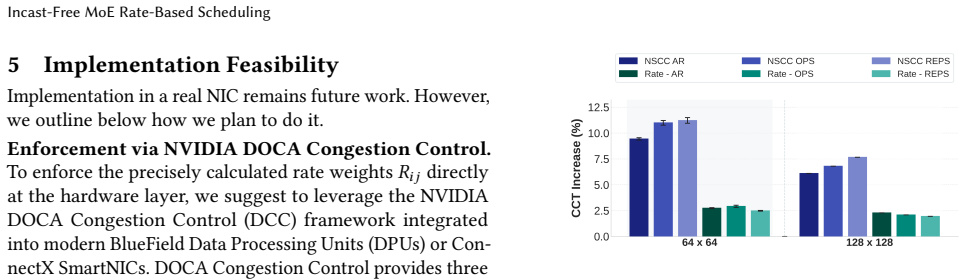
Summary. The paper studies all-to-all MoE token dispatch in datacenter networks. It claims that conventional round-robin (RR) scheduling with Zipfian-skewed MoE traffic produces a previously undiscovered 'exponential incast': as light flows finish, senders synchronously converge on hot receivers, making the hot receiver's aggregate arrival rate grow exponentially. It derives a fluid ODE for the number of active destinations k(t), the resulting arrival rate, and a lower bound on total backlog. It then proposes a proactive rate-allocation framework: normalize the demand matrix D by M, the maximum row or column sum, so every sender/receiver port has ingress rate at most 1. The framework is evaluated in htsim simulations against a round-robin plus UEC NSCC baseline on real Qwen traces and synthetic Zipfian workloads, reporting lower CCT and higher link utilization. An implementation sketch based on NVIDIA DOCA congestion control is outlined as future work.
Significance. If the results hold, the paper makes a useful conceptual contribution: it gives a simple, parameter-free fluid explanation of a practically important MoE incast failure mode, and it proposes an elegant sufficient condition for port-level oversubscription avoidance. Strengths of the manuscript include an explicit ODE derivation with no fitted constants, a clean normalization construction, and evaluation with both real and synthetic workloads against a credible baseline. The main weaknesses are that the exponential incast derivation is specific to Zipfian exponent s=1 while the synthetic evaluation uses s=0.25 and s=0.5, and that the 'incast-free by construction' guarantee relies on exact global knowledge of D and exact hardware rate enforcement, neither of which is demonstrated. These issues are substantial but addressable; I do not see a fatal internal inconsistency in the mathematical core.
major comments (3)
- [§3 vs. §6] The derivation of k(t)=N exp(-alpha t/T), and hence the exponential incast law lambda_1(t)=N^{t/T}, is explicitly for the Zipfian exponent s=1 in Eq. (1). For s≠1, the same fluid argument gives dk/dt = -(H_N^{(s)}/(sT)) k^s, which yields polynomial, not exponential, decay. Yet §6 evaluates synthetic workloads with s=0.25 and s=0.5, i.e., outside the regime analyzed in §3. Figure 1 uses one real 128×128 trace, but its effective skewness exponent is not reported. This means the paper's central qualitative claim, 'exponential incast', is not validated for the workloads used in the main evaluation. Please either extend the fluid analysis to general s, or restrict the exponential claim to s=1 and evaluate that case, or report the measured skewness of the real trace.
- [§4 and §5] The guarantee that R=D/M eliminates incast depends on two unstated conditions: (i) D is the exact, complete traffic matrix for the epoch and is available to every sender before dispatch; (ii) every NIC enforces each rate R_ij exactly. Section 5 concedes that implementation is future work, and §2.3's assertion that the full matrix can be propagated 'with minimal additional control-plane overhead' is not supported by measurement. Moreover, finite-precision rate limiting can break the column-sum bound: if each R_ij is quantized to the nearest 1/Q, a column sum can exceed 1 by up to N/(2Q); for N=512, Q=64 this is an excess of 4, i.e., a 5x oversubscribed column. The paper provides no quantization analysis or safety margin. Please analyze these implementation errors, propose a corrective normalization, or explicitly state that the guarantee is for an idealized fluid model only.
- [§6] The evaluation supports the claims about CCT and link utilization, but it never directly reports the central metric implied by the title: incast. There are no per-scenario maximum queue-occupancy or packet-drop counts for the proposed scheduler versus the RR-NSCC baseline. Since the paper's headline claim is that the framework 'eliminates incast', please add a direct incast metric (e.g., maximum queue depth at receiver ports, number of dropped packets) across the evaluated matrices. This would also clarify whether the CCT gains come from incast avoidance or from other properties of rate pacing.
minor comments (6)
- [Abstract] Typo: 'previous-undiscovered' should be 'previously undiscovered'.
- [§5] Acronym inconsistency: the section title and body mention DOCA Congestion Control (DCC), while the introduction and abstract refer to DOCA Programmable Congestion Control (PCC). Use one name consistently.
- [§3] The sentence 'Under RR, nearly 100% of the entire workload volume becomes completely clogged' is an asymptotic statement. For the evaluated scales the formula gives values well below 100% (e.g., about 55% for N=512). Please qualify the statement as an asymptotic limit rather than a finite-N prediction.
- [Fig. 1] The axes are not labeled with units. Please state whether queue size is in packets or bytes, and clarify the time axis (simulated microseconds vs. normalized epoch time).
- [§6] The synthetic workloads are described as 'parameterized directly from the DeepSeek-V3 architecture', but the relationship between DeepSeek-V3's top-1/2/4/8 routing and the Zipfian s=0.25/0.5 parameterization is not explained. Please clarify how the Zipfian model maps to the cited architecture.
- [§2.3] The claim that the full global traffic matrix can be propagated with 'minimal additional control-plane overhead' is a key practical assumption, but no reference or measurement is provided. Please support this with data or soften the claim.
Circularity Check
No significant circularity: the RR incast derivation is a parameter-free fluid model; the scheduler guarantee is explicitly by construction and the only self-citation is non-load-bearing.
full rationale
The central theoretical claim (§3) is a self-contained fluid derivation. Starting from the stated Zipfian demand D_ij = T/(j α) with α≈ln N and the round-robin service-rate assumption that each active flow receives 1/k(t), the paper solves dk/dt = -αk/T to obtain k(t)=N^{1-t/T} and λ1(t)=N^{t/T}; the backlog bound Q_total(T)≈NT(1-(ln ln N+1)/ln N) is a direct integral of these rates. No fitted parameters, no use of the proposed scheduler R, and no author-self citation appear in this chain, so the exponential-incast result is not circular. The proposed scheduler (§4) defines M = max(row sums, column sums) and sets R=D/M; it then states that row and column sums of R are ≤1 'by construction' and that enforcing R_ij prevents port oversubscription. This is an explicit construction guarantee, not a hidden fitted prediction: the paper does not claim to empirically discover the no-incast property, it defines the normalization to achieve it. The subsequent simulations are therefore a consistency check of the implementation rather than an independent test of a predicted phenomenon, which is at most a mild evaluation limitation and not a circular derivation. The only author-overlapping citation is [15] (Gerstein, Silberstein, Keslassy) in §6, used to credit an existing htsim implementation of transport and load-balancing protocols; it is not load-bearing for the paper's claims. No uniqueness theorem, ansatz, or renamed known result is imported from the authors' prior work. Concerns about exact global matrix availability and NIC rate-enforcement precision are implementation assumptions (correctness risks), not circularity.
Axiom & Free-Parameter Ledger
free parameters (1)
- Zipfian skewness index s =
s=1 (theory); s=0.25 and 0.5 (simulations)
axioms (5)
- domain assumption All N senders have the identical Zipfian demand vector and are synchronized at epoch start.
- domain assumption Round-robin scheduling gives each active flow exactly 1/k of the sender's link rate.
- ad hoc to paper The full global traffic matrix D is available to all senders (or a control point) before each MoE epoch.
- ad hoc to paper Per-flow rates can be enforced and updated in hardware in under 10 μs.
- domain assumption The network is a non-blocking high-radix fat tree where edge ports are the only bottlenecks.
read the original abstract
Mixture of Experts (MoE) architectures have become key to large language models; however, their typical round-robin (RR) scheduling introduces significant bottlenecks. In this paper, we demonstrate that RR causes a previously-undiscovered exponential incast phenomenon with MoE traffic. We propose an alternative proactive fair scheduling framework tailored for MoE workloads, which effectively prevents fabric oversubscription. We also outline how it can be implemented in NICs. Finally, through extensive simulations with real and synthetic workloads, we demonstrate that this framework consistently eliminates incast, maintains a near-100% link utilization, and reduces Collective Completion Time (CCT).
Figures



Reference graph
Works this paper leans on
-
[1]
[n. d.]. Megatron-DeepSpeed. https://github.com/microsoft/Megatron- DeepSpeed
-
[2]
https://github.com/smcclure20/csg-htsim
2025.htsim fork. https://github.com/smcclure20/csg-htsim
2025
-
[3]
NVIDIA Collective Communications Library (NCCL)
2026. NVIDIA Collective Communications Library (NCCL). https: //developer.nvidia.com/nccl
2026
-
[4]
ROCm Communication Collectives Library (RCCL)
2026. ROCm Communication Collectives Library (RCCL). https: //github.com/ROCm/rccl
2026
-
[5]
Ultra Ethernet Consortium
2026. Ultra Ethernet Consortium. https://ultraethernet.org/
2026
-
[6]
Hamdy Abdelkhalik, Yehia Arafa, Nandakishore Santhi, and Abdel- Hameed Badawy. 2022. Demystifying the Nvidia Ampere Architecture through Microbenchmarking and Instruction-level Analysis. InarXiv preprint arXiv:2208.11174
Pith/arXiv arXiv 2022
-
[7]
Abts and J
D. Abts and J. Kim. 2022.High Performance Datacenter Networks. Springer International Publishing
2022
-
[8]
Garrett Birkhoff. 1946. Three observations on linear algebra.Uni- versidad Nacional de Tucumán. Revista. Serie A: Matemáticas y Física Teórica5 (1946), 147–151
1946
-
[9]
T. Bonato, A. Kabbani, A. Ghalayini, M. Papamichael, M. Dohadwala, L. Gianinazzi, M. Khalilov, E. Achermann, D. D. Sensi, and T. Hoefler. 2025. REPS: Recycled entropy packet spraying for adaptive load balancing and failure mitigation. arXiv:2407.21625 [cs.NI] https://arxiv.org/abs/2407 .21625
arXiv 2025
-
[10]
ByteDance / Volcengine. 2026. veScale: Volcengine e-commerce Scale LLM Training Framework. https://github.com/volcengine/veScale. Accessed: July 2026
2026
-
[11]
Ultra Ethernet Consortium. 2026. Ultra Ethernet Specification v1.0.2. https://ultraethernet.org/wp-content/uploads/sites/20/2026/01/UE- Specification-1.0.2-1.pdf
2026
-
[12]
DeepSeek-AI. 2026. DeepEP: High-Performance MoE Communication Library. https://github.com/deepseek-ai/DeepEP
2026
-
[13]
Dixit, P
A. Dixit, P. Prakash, Y. C. Hu, and R. R. Kompella. 2013. On the impact of packet spraying in data center networks. InIEEE INFOCOM. 2130–2138
2013
-
[14]
Adithya Gangidi, Rui Miao, Shengbao Zheng, Sai Jayesh Bondu, Guilherme Goes, Hany Morsy, Rohit Puri, Mohammad Riftadi, Ashmitha Jeevaraj Shetty, Jingyi Yang, et al. 2024. RDMA over Ethernet for distributed training at Meta scale. InACM SIGCOMM. 57–70
2024
-
[15]
Barak Gerstein, Mark Silberstein, and Isaac Keslassy. 2025. Making congestion control robust to per-packet load balancing in datacenters. https://arxiv.org/abs/2509.07907 arXiv:2509.07907
arXiv 2025
-
[16]
J. Hu, J. Huang, W. Lv, Y. Zhou, J. Wang, and T. He. 2019. CAPS: Coding-based adaptive packet spraying to reduce flow completion time in data center.IEEE/ACM Transactions on Networking27, 6 (2019), 2338–2353
2019
-
[17]
Albert Q Jiang, Alexandre Sablayrolles, Antoine Roux, Arthur Mensch, Blanche Savary, Chris Bamford, Devendra Singh Chaplot, Diego de las Casas, Emma Bou Hanna, Florian Bressand, et al . 2024. Mixtral of experts.arXiv preprint arXiv:2401.04088(2024)
Pith/arXiv arXiv 2024
-
[18]
Zewen Jin, Shengnan Wang, Jiaan Zhu, Hongrui Zhan, Youhui Bai, Lin Zhang, Zhenyu Ming, and Cheng Li. 2025. BigMac: A Communication- Efficient Mixture-of-Experts Model Structure for Fast Training and Inference. arXiv:2502.16927 [cs.LG] https://arxiv.org/abs/2502.16927
Pith/arXiv arXiv 2025
-
[19]
Y. Le, R. Pan, P. Newman, J. Blendin, A. Kabbani, V. Jain, R. Sivaramu, and F. Matus. 2024. STrack: A reliable multipath transport for ai/ml clusters.arXiv preprint arXiv:2407.15266(2024)
Pith/arXiv arXiv 2024
-
[20]
Yiran Lei, Dongjoo Lee, Liangyu Zhao, Daniar Kurniawan, Chan- myeong Kim, Heetaek block Jeong, Changsu Kim, Hyeonseong Choi, Liangcheng Yu, Arvind Krishnamurthy, Justine Sherry, and Eriko Nurvitadhi. 2026. FAST: An Efficient Scheduler for All-to-All GPU Communication. InProceedings of the 23rd USENIX Symposium on Networked Systems Design and Implementatio...
2026
-
[21]
Xudong Liao, Yijun Sun, Han Tian, Xinchen Wan, Yilun Jin, Zilong Wang, Zhenghang Ren, Xinyang Huang, Wenxue Li, Kin Fai Tse, et al
-
[22]
Xinyi Liu, Yujie Wang, Fangcheng Fu, Xupeng Miao, Shenhan Zhu, Xiaonan Nie, and Bin Cui. 2025. NetMoE: Accelerating MoE training through dynamic sample placement. InICML
2025
-
[23]
J. Lu, J. Gao, F. Feng, Z. He, M. Zheng, K. Liu, J. He, B. Liao, S. Xu, K. Sun, et al. 2025. Alibaba Stellar: A new generation RDMA network for cloud AI. InACM SIGCOMM. 453–466
2025
-
[24]
NVIDIA. 2023. NVIDIA InfiniBand Adaptive Routing Technol- ogy—Accelerating HPC and AI Applications. https://www.amax .com/content/files/2023/12/NVIDIA-InfiniBand-Adaptive-Routing- Technology-Insights-Whitepaper.pdf
2023
-
[25]
NVIDIA. 2024. NVIDIA Spectrum-X Network Platform Architecture. https://resources.nvidia.com/en-us-networking-ai/nvidia-spectrum- x
2024
-
[26]
NVIDIA. 2026. Megatron-LM: Training Large Language Models with Model Parallelism. https://github.com/NVIDIA/Megatron-LM. Accessed: July 2026
2026
-
[27]
2026.CUDA C++ Programming Guide (Release 13.3)
NVIDIA Corporation. 2026.CUDA C++ Programming Guide (Release 13.3). NVIDIA Corporation. Published: June 25, 2026
2026
-
[28]
2026.NVIDIA DOCA Software Framework Docu- mentation
NVIDIA Corporation. 2026.NVIDIA DOCA Software Framework Docu- mentation. NVIDIA. https://docs.nvidia.com/doca/ Accessed: July 2026
2026
-
[29]
NVIDIA Corporation. 2026. NVIDIA NVLink and NVLink Switch. https://www.nvidia.com/en-eu/data-center/nvlink/. 7 E. Cohenet al
2026
-
[30]
Sundararajan Renganathan and Nick McKeown. 2025. Chronos: Prescheduled circuit switching for LLM training. InProceedings of the 2nd Workshop on Networks for AI Computing. ACM, 89–97
2025
-
[31]
P. Rizk. 2023. Turbocharging Generative AI Workloads with NVIDIA Spectrum-X Networking Platform. https://developer.nvidia.com/blog/ turbocharging-ai-workloads-with-nvidia-spectrum-x-networking- platform/
2023
-
[32]
Chenchen Shou, Guyue Liu, Hao Nie, Huaiyu Meng, Yu Zhou, Yimin Jiang, Wenqing Lv, Yelong Xu, Yuanwei Lu, Zhang Chen, et al. 2025. InfiniteHBD: Building datacenter-scale high-bandwidth domain for LLM with optical circuit switching transceivers. InACM SIGCOMM. 1–23
2025
-
[33]
Ultra Ethernet Consortium. 2025. Ultra Ethernet Specification. https: //ultraethernet.org/
2025
-
[34]
Ultra Ethernet Consortium. 2025. Ultra Ethernet™Specification v1.0. https://ultraethernet.org/wp-content/uploads/sites/20/2025/06/UE- Specification-6.11.25.pdf
2025
-
[35]
Voloshin
M. Voloshin. 2023.Introduction to Congestion Control for RoCE. Tech. Rep. Broadcom Inc. https://docs.broadcom.com/doc/NCC-WP1XX
2023
-
[36]
John von Neumann. 1953. A certain zero-sum two-person game equiv- alent to the optimal assignment problem. InContributions to the Theory of Games (AM-28), Volume II. Princeton University Press, 5–12
1953
-
[37]
Yen-Chieh Wu, Cheng-Shang Chang, Duan-Shin Lee, and H Jonathan Chao. 2026. Dynamic Hierarchical Birkhoff-von Neumann De- composition for All-to-All GPU Communication.arXiv preprint arXiv:2602.22756(2026)
arXiv 2026
-
[38]
Zhang, D
J. Zhang, D. Zhang, and K. Huang. 2015. Improving datacenter through- put and robustness with Lazy TCP over packet spraying.Computer Communications62 (2015), 23–33. 8
2015
-
[2025]
InACM SIGCOMM
MixNet: A Runtime Reconfigurable Optical-Electrical Fabric for Distributed Mixture-of-Experts Training. InACM SIGCOMM. 554–574
discussion (0)
Sign in with ORCID, Apple, or X to comment. Anyone can read and Pith papers without signing in.