REVIEW 2 major objections 4 minor 84 references
This paper argues that the sequence of intermediate states a vision encoder computes for each image — the representation trajectory — carries reliability evidence that the final representation discards, and that an in-distribution-only 'tra
Reviewed by Pith at T0; open to challenge. T0 means a machine referee read the full paper against a public rubric. the ladder, T0–T4 →
Recording how an image's representation evolves block-by-block, relative to learned class routes, improves OOD detection in 131/152 comparisons and clean classification in 71/72 model–dataset cases.
T0 review reviewed 2026-08-01 challenge →
load-bearing objection OOD trajectory surprise is a solid, well-controlled result; clean classification gains are real but likely generic ensembling more than trajectory-specific. the 2 major comments →
Representation Trajectories Matters: Complementary Evidence for OOD Detection and Image Classification
The pith
A machine-rendered reading of the paper's core claim, the machinery that carries it, and where it could break.
The reading
Core claim
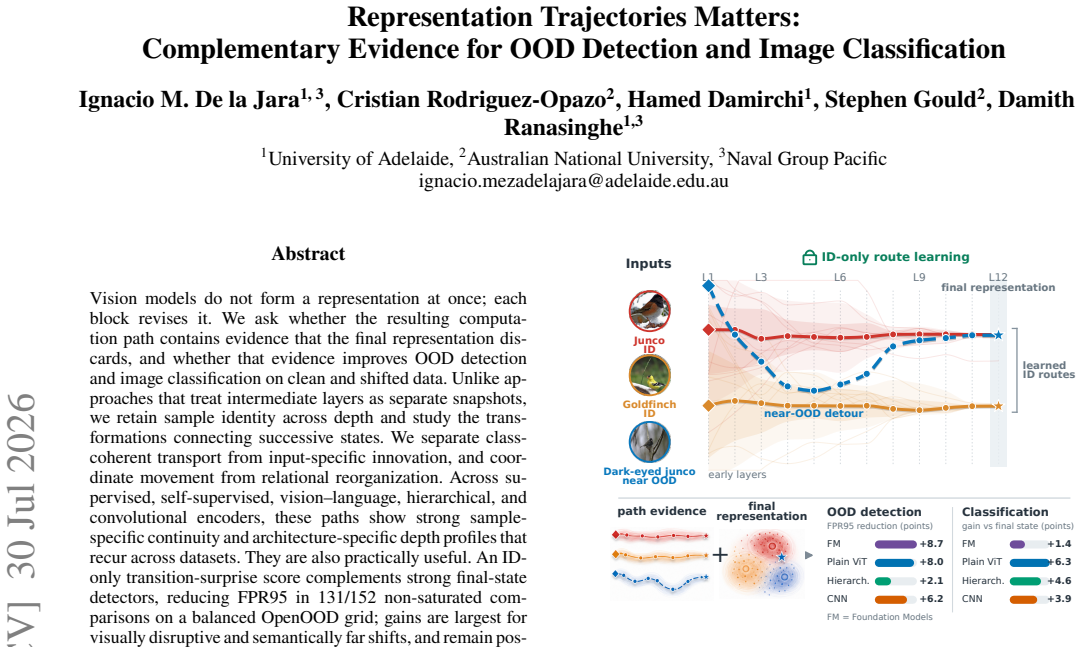
The central claim is that computation paths contain evidence not present in the final representation. The paper separates each update into class-coherent transport and sample-specific innovation, models residual transitions with a shared depth-conditioned MLP, and defines a transition-surprise score D(x) as the summed, per-component-scaled prediction error over depth. Conditioning on the final state leaves a non-negative conditional-divergence term, so any route evidence must appear after conditioning on the endpoint; the experiments show it does, and that it is complementary rather than redundant with strong final-state detectors: path surprise still helps after Relative Mahalanobis is alre
What carries the argument
The central object is the representation trajectory τ(x) = (z1(x), …, zL(x)) together with the class route µ^c_l = E[z_l(X) | Y=c]. Subtracting the class route yields residual trajectories r_l(x) whose cross-depth continuity is validated by paired and identity-shuffled controls. The decisive mechanism is the transition-surprise score D(x): a shared MLP with a depth embedding predicts the next residual state from the current one; per-component error scales are estimated on in-distribution data; and D sums squared prediction errors across depth and dimensions. After ID-only standardisation and residualisation, a fixed small fraction of D is added to the final-state score, which lets the detect
Load-bearing premise
The trajectory-surprise score assumes a one-step Markov model: a finite-capacity MLP, conditioned on depth, can predict the next class-residual state from the current one, with per-component error scales estimated on in-distribution data; if residual transitions are higher-order or those Gaussian scales misestimate out-of-distribution transitions, the score adds noise rather than signal.
What would settle it
Run the same ID-only protocol on a frozen encoder whose layer order has been randomly permuted at test time, or pair each residual state with a different image's previous state to break the identity link; if the trajectory-surprise score still reduces FPR95 by a similar amount, the claimed sample-specific cross-depth continuity is not the operative mechanism, while a vanishing gain would support it.
If this is right
- If correct, any frozen vision encoder exposes a reliability signal that can be extracted without retraining the backbone, using only labelled in-distribution data and about 0.3 ms extra latency per image.
- OOD gains are largest on visually disruptive and semantically far shifts, and remain positive on near-OOD for Mahalanobis++, Relative Mahalanobis, and kNN; the residual limitation concentrates in the hardest ImageNet near splits.
- Linear probes on native block updates recover class evidence that the final state compresses, with the largest clean-classification gains on fine-grained datasets and for plain Vision Transformers.
- There is no universal best layer or monotonic refinement curve: movement, relational deformation, class-evidence gain, and residual share peak at different depths per architecture, so trajectory analysis must be performed in each model's native block sequence.
- Under label-preserving shift, trajectory fusion improves 169 of 180 CIFAR-100-C conditions and most PACS and Office-Home folds, though the benefit depends on architecture and corruption type.
Where Pith is reading between the lines
- If the trajectory signal is a genuine route-typicality measure, then a test-time estimator with access to the full path should be able to flag images whose intermediate states are unusual even when their final embeddings are typical; one could test this directly by matching shifted and in-distribution samples for final-state distance and comparing their transition surprise.
- The paper's global image-level scope suggests a natural extension to patch-level or spatial trajectories, where per-location route surprise could localise anomalous regions rather than only flag the whole image.
- Because the fusion rule residualises path evidence against the final-state score, the same transition-surprise score may complement other families of final-state detectors, not just the density-based scorers tested here.
- If architecture-specific depth schedules are stable across scales and datasets, trajectory fingerprints could serve as a diagnostic for comparing encoders without probing downstream task performance.
Editorial analysis
A structured set of objections, weighed in public.
Referee Report
Summary. The paper studies whether the sequence of intermediate representations (the 'trajectory') of an image through a frozen vision encoder contains evidence beyond the final representation. It decomposes layer-to-layer updates into class-coherent transport and sample-specific innovation, then uses the innovation residual for two tasks: an ID-only transition-surprise score fused with final-state OOD detectors, and a fusion of linear probes on native updates with a final-state probe for classification. Across OpenOOD v1.5 and 38 checkpoints the surprise score lowers FPR95 in 131/152 non-saturated backbone–benchmark pairs; on 12 clean datasets the update-probe fusion improves 71/72 model–dataset cells by +4.41 points on average; shifted-data gains are more mixed. Extensive controls (identity shuffling, random-score partners, sequential complementarity, fixed-weight audits, exact checkpoint identifiers) support the OOD side.
Significance. If the results hold, the paper provides a broadly useful and cheap reliability signal: it shows that the recorded computation path contains information that final representations compress away, and that this information can be exploited without OOD data. The empirical protocol is unusually strong for a vision paper: 42 exact public checkpoints, ID-only fitting, a fixed a priori fusion weight, random-noise and matched-state controls, full appendix tables, executable pseudocode, and frank limitation statements. The OOD-detection results are convincing. The clean-recognition contribution, however, is currently not isolated from generic ensembling, and the update-specific contribution is small for several architectures; this is the main gap.
major comments (2)
- [Section 5.3, Table 1] The headline clean-recognition result (+4.41 points, 71/72 cases) compares the path fusion against a single final-state linear probe, not against the matched final-state ensemble that Section 4.2 promises as the control for generic ensembling. That control is reported for PACS/Office-Home and CIFAR-100-C (Appendices K and O) but not for the clean 72-cell table. Without Δctl for Table 1, the recognition gains cannot be attributed to the trajectory/update representation: independently seeded final-state probes are well known to give ensemble gains, and the state-probe ablation does not separate ensembling from representation. Please add the matched final-state ensemble column to Table 1 (or an equivalent appendix table) and restate the recognition claim based on the control-adjusted gains.
- [Section 5.3, state-probe ablation] The ablation replacing update probes with state probes shows that Swin and ConvNeXt remain within 0.25 points, and only four of six backbones gain more than 0.63 points from representing updates explicitly. This substantially narrows what the recognition experiments establish about trajectories as transitions. The abstract's 'Frozen update probes improve 71/72 clean model–dataset cases' is technically true, but the mechanism claim should be softened to reflect that for hierarchical/CNN families the improvement is essentially obtainable from intermediate states, and the unique update/transition contribution is small. If the authors intend 'trajectory' to include states, this should be stated explicitly.
minor comments (4)
- [Equation (5)] Typo: 'It does not does not assert' should read 'It does not assert'.
- [Table 1 / Appendix I] The clean-recognition gains are reported as three-seed means without standard deviations or error bars. Given that some cells are small (+0.21 to +0.65), please provide seed-level spread or paired confidence intervals so the reader can judge which gains are beyond noise.
- [Figure P2 / Section 5.2] The term 'non-saturated' is used for the 152-count denominator, but its definition (MNIST FPR95 near zero) appears only in the appendix. Please define it in the main text and state explicitly how the 38 MNIST cases (28 exact ties, 10 tiny gains) are handled in the headline count.
- [Section 4.1, Eq. (7)] The residualization of D against S0 is linear. A nonlinear dependence of D on the final-state score could remain; the random-score control rules out the fusion rule itself, but not this specific nonlinearity. Consider adding a nonlinear residualization control or discussing this limitation.
Circularity Check
No load-bearing circularity: the trajectory score and probe fusion are fitted on ID data only, validated on held-out OpenOOD/test splits with explicit controls, and the paper's identities are labeled as non-assertive.
full rationale
The paper's derivation chain contains no step where a prediction reduces to its inputs by construction. Section 3.2 explicitly disclaims the KL decomposition as mere localization: "This is an identity: the residual term is non-negative by construction... It does not assert that a computation path carries additional evidence; it specifies where such evidence would have to reside." Equation 4 is likewise a definitional decomposition of the update into class transport and innovation; it is not used to force any empirical gain. The OOD score (Eq. 6) and fusion rule (Eq. 7) are fitted exclusively on ID data: "The method is fitted using labelled ID data only with three random seeds and no OOD exposure" (Sec. 5.1), and "The coefficient 0.3 is fixed a priori and never adjusted per checkpoint, benchmark, or split" (Sec. 4.1). Residualizing D against S0 on ID data leaves an orthogonal component whose OOD value is genuinely uncertain, and the paper's controls show the combination rule does not mechanically help: random noise improves no cell (Appendix H, "Random noise improves no cell and worsens both benchmarks, ruling out the combination rule itself as the source of improvement"); sequential addition of Relative Mahalanobis and path surprise in both orders reaches the same total reduction, demonstrating complementarity rather than forced gain. The 131/152 FPR95 result is an out-of-sample measurement on OpenOOD splits never used in fitting. The recognition branch (Eqs. 8-9) trains probes on source labels, selects fusion weights and gate on a disjoint validation split, and reports test-set accuracy; the +4.41 gain is thus a genuine holdout prediction. The skeptic's point that clean classification gains lack a matched final-state-ensemble control is a comparison/rigor limitation (addressed for shift experiments via the matched control in Appendix I.2), not circularity: no reported accuracy is equivalent to a fitted quantity by construction. Self-citations (Damirchi et al. 2026; M. De la Jara et al. 2025; M. De la Jara et al. 2023; Rodriguez-Opazo et al. 2025) appear only in Related Work and positioning, are not used to justify any load-bearing premise, uniqueness claim, or ansatz, and do not inject the target result into the derivation. The central claims are externally benchmark-validated and supported by the paper's own identity-shuffled, random-noise, and matched-ensemble controls, so no circular step can be exhibited from the paper's equations.
Axiom & Free-Parameter Ledger
free parameters (5)
- Fusion weight w =
0.3
- Transition error scales sigma^2_{l,d} =
mean squared ID fitting residuals + 1e-6 per component and transition
- Residualization coefficients (a,b) in Eq. 7 =
least squares on held-out ID data
- Transition MLP hyperparameters =
hidden 1024, lr 3e-4, batch 512, 80 epochs
- Seed-0 Gaussian common-width stage projection =
seed-0 random matrix
axioms (5)
- standard math KL chain rule, data-processing inequality, and conditional-expectation projection identities used in Eq. 5 and Eqs. 10–13.
- domain assumption Vision encoders are frozen and deterministic; states at each native block are recorded in block order.
- ad hoc to paper The class-conditional mean trajectory is a sufficient anchor; subtracting it isolates sample-specific innovation.
- ad hoc to paper One-step Markov assumption: next residual is predictable from current residual plus depth embedding, with per-component Gaussian error scale.
- domain assumption OpenOOD v1.5 splits and the balanced 38-checkpoint grid are representative of OOD detection practice.
Cite this review
Pith. "Pith review of Representation Trajectories Matters: Complementary Evidence for OOD Detection and Image Classification." pith.science (2026). https://pith.science/paper/VYDZ5CKG
@misc{pith2026260726565,
  author       = {Pith},
  title        = {Pith review of: Representation Trajectories Matters: Complementary Evidence for OOD Detection and Image Classification},
  year         = {2026},
  howpublished = {\url{https://pith.science/paper/VYDZ5CKG}},
  note         = {Machine review of arXiv:2607.26565}
}
read the original abstract
Vision models do not form a representation at once; each block revises it. We ask whether the resulting computation path contains evidence that the final representation discards, and whether that evidence improves OOD detection and image classification on clean and shifted data. Unlike approaches that treat intermediate layers as separate snapshots, we retain sample identity across depth and study the transformations connecting successive states. We separate class-coherent transport from input-specific innovation, and coordinate movement from relational reorganization. Across supervised, self-supervised, vision--language, hierarchical, and convolutional encoders, these paths show strong sample-specific continuity and architecture-specific depth profiles that recur across datasets. They are also practically useful. An ID-only transition-surprise score complements strong final-state detectors, reducing FPR95 in 131/152 non-saturated comparisons on a balanced OpenOOD grid; gains are largest for visually disruptive and semantically far shifts, and remain positive on near-OOD for most detectors. Frozen update probes improve 71/72 clean model--dataset cases, while shifted-data gains vary with architecture and corruption type. Computation paths therefore provide a broadly useful reliability signal whose value is determined jointly by model organization and the shift encountered.
Figures


Reference graph
Works this paper leans on
-
[1]
International Conference on Learning Representations (ICLR) , year =
A Baseline for Detecting Misclassified and Out-of-Distribution Examples in Neural Networks , author =. International Conference on Learning Representations (ICLR) , year =. 1610.02136 , archivePrefix =
-
[2]
International Conference on Learning Representations (ICLR) , year =
Enhancing The Reliability of Out-of-distribution Image Detection in Neural Networks , author =. International Conference on Learning Representations (ICLR) , year =. 1706.02690 , archivePrefix =
-
[3]
Advances in Neural Information Processing Systems (NeurIPS) , year =
Energy-based Out-of-distribution Detection , author =. Advances in Neural Information Processing Systems (NeurIPS) , year =. 2010.03759 , archivePrefix =
Pith/arXiv arXiv 2010
-
[4]
International Conference on Machine Learning (ICML) , year =
Scaling Out-of-Distribution Detection for Real-World Settings , author =. International Conference on Machine Learning (ICML) , year =. 1911.11132 , archivePrefix =
Pith/arXiv arXiv 1911
-
[5]
Advances in Neural Information Processing Systems (NeurIPS) , year =
On the Importance of Gradients for Detecting Distributional Shifts in the Wild , author =. Advances in Neural Information Processing Systems (NeurIPS) , year =. 2110.00218 , archivePrefix =
-
[6]
2021 , eprint =
Sun, Yiyou and Guo, Chuan and Li, Yixuan , booktitle =. 2021 , eprint =
2021
-
[7]
International Conference on Learning Representations (ICLR) , year =
Extremely Simple Activation Shaping for Out-of-Distribution Detection , author =. International Conference on Learning Representations (ICLR) , year =. 2209.09858 , archivePrefix =
-
[8]
Advances in Neural Information Processing Systems (NeurIPS) , year =
A Simple Unified Framework for Detecting Out-of-Distribution Samples and Adversarial Attacks , author =. Advances in Neural Information Processing Systems (NeurIPS) , year =. 1807.03888 , archivePrefix =
-
[9]
International Conference on Machine Learning (ICML) , year =
Out-of-Distribution Detection with Deep Nearest Neighbors , author =. International Conference on Machine Learning (ICML) , year =. 2204.06507 , archivePrefix =
-
[10]
2022 , eprint =
Wang, Haoqi and Li, Zhizhong and Feng, Litong and Zhang, Wayne , booktitle =. 2022 , eprint =
2022
-
[11]
International Conference on Learning Representations (ICLR) , year =
An Image Is Worth 16x16 Words: Transformers for Image Recognition at Scale , author =. International Conference on Learning Representations (ICLR) , year =
-
[12]
IEEE/CVF Conference on Computer Vision and Pattern Recognition (CVPR) , pages =
Masked Autoencoders Are Scalable Vision Learners , author =. IEEE/CVF Conference on Computer Vision and Pattern Recognition (CVPR) , pages =
-
[13]
Bao, Hangbo and Dong, Li and Piao, Songhao and Wei, Furu , booktitle =
-
[14]
Peng, Zhiliang and Dong, Li and Bao, Hangbo and Ye, Qixiang and Wei, Furu , journal =
-
[15]
European Conference on Computer Vision (ECCV) , pages =
Touvron, Hugo and Cord, Matthieu and J. European Conference on Computer Vision (ECCV) , pages =
-
[16]
Fang, Yuxin and Sun, Quan and Wang, Xinggang and Huang, Tiejun and Wang, Xinlong and Cao, Yue , journal =
-
[17]
IEEE/CVF International Conference on Computer Vision (ICCV) , pages =
Swin Transformer: Hierarchical Vision Transformer Using Shifted Windows , author =. IEEE/CVF International Conference on Computer Vision (ICCV) , pages =
-
[18]
IEEE/CVF Conference on Computer Vision and Pattern Recognition (CVPR) , pages =
Swin Transformer V2: Scaling Up Capacity and Resolution , author =. IEEE/CVF Conference on Computer Vision and Pattern Recognition (CVPR) , pages =
-
[19]
IEEE Conference on Computer Vision and Pattern Recognition (CVPR) , pages =
Deep Residual Learning for Image Recognition , author =. IEEE Conference on Computer Vision and Pattern Recognition (CVPR) , pages =
-
[20]
European Conference on Computer Vision (ECCV) , pages =
Identity Mappings in Deep Residual Networks , author =. European Conference on Computer Vision (ECCV) , pages =
-
[21]
British Machine Vision Conference (BMVC) , pages =
Wide Residual Networks , author =. British Machine Vision Conference (BMVC) , pages =
-
[22]
IEEE Conference on Computer Vision and Pattern Recognition (CVPR) , pages =
Densely Connected Convolutional Networks , author =. IEEE Conference on Computer Vision and Pattern Recognition (CVPR) , pages =
-
[23]
, booktitle =
Tan, Mingxing and Le, Quoc V. , booktitle =
-
[24]
IEEE/CVF Conference on Computer Vision and Pattern Recognition (CVPR) , pages =
Designing Network Design Spaces , author =. IEEE/CVF Conference on Computer Vision and Pattern Recognition (CVPR) , pages =
-
[25]
IEEE/CVF Conference on Computer Vision and Pattern Recognition (CVPR) , pages =
A ConvNet for the 2020s , author =. IEEE/CVF Conference on Computer Vision and Pattern Recognition (CVPR) , pages =
-
[26]
Woo, Sanghyun and Debnath, Shoubhik and Hu, Ronghang and Chen, Xinlei and Liu, Zhuang and Kweon, In So and Xie, Saining , booktitle =
-
[27]
International Conference on Machine Learning (ICML) , year =
Learning Transferable Visual Models from Natural Language Supervision , author =. International Conference on Machine Learning (ICML) , year =. 2103.00020 , archivePrefix =
-
[28]
IEEE/CVF International Conference on Computer Vision (ICCV) , year =
Sigmoid Loss for Language Image Pre-Training , author =. IEEE/CVF International Conference on Computer Vision (ICCV) , year =. 2303.15343 , archivePrefix =
-
[29]
arXiv preprint arXiv:2502.14786 , year =
Tschannen, Michael and Gritsenko, Alexey and Wang, Xiao and Naeem, Muhammad Ferjad and Alabdulmohsin, Ibrahim and Parthasarathy, Nikhil and Evans, Talfan and Beyer, Lucas and Xia, Ye and Mustafa, Basil and H. arXiv preprint arXiv:2502.14786 , year =
-
[30]
Transactions on Machine Learning Research (TMLR) , year =
Oquab, Maxime and Darcet, Timoth. Transactions on Machine Learning Research (TMLR) , year =
-
[31]
arXiv preprint arXiv:2508.10104 , year =
Sim. arXiv preprint arXiv:2508.10104 , year =
-
[32]
Advances in Neural Information Processing Systems (NeurIPS) , year =
Perception Encoder: The Best Visual Embeddings Are Not at the Output of the Network , author =. Advances in Neural Information Processing Systems (NeurIPS) , year =. 2504.13181 , archivePrefix =
-
[33]
Advances in Neural Information Processing Systems (NeurIPS) , year =
Delving into Out-of-Distribution Detection with Vision-Language Representations , author =. Advances in Neural Information Processing Systems (NeurIPS) , year =. 2211.13445 , archivePrefix =
-
[34]
Philosophical Transactions of the Royal Society of London
On the problem of the most efficient tests of statistical hypotheses , author =. Philosophical Transactions of the Royal Society of London. Series A , volume =. 1933 , publisher =
1933
-
[35]
arXiv preprint arXiv:2603.01326 , year =
Truth as a Trajectory: What Internal Representations Reveal About Large Language Model Reasoning , author =. arXiv preprint arXiv:2603.01326 , year =
-
[36]
Zero-Shot Out-of-Distribution Detection Based on the Pre-trained Model
Esmaeilpour, Sepideh and Liu, Bing and Robertson, Eric and Shu, Lei , booktitle =. Zero-Shot Out-of-Distribution Detection Based on the Pre-trained Model. 2022 , eprint =
2022
-
[37]
2023 , eprint =
Wang, Hualiang and Li, Yi and Yao, Huifeng and Li, Xiaomeng , booktitle =. 2023 , eprint =
2023
-
[38]
Jiang, Xue and Liu, Feng and Fang, Zhen and Chen, Hong and Liu, Tongliang and Zheng, Feng and Han, Bo , booktitle =. Negative Label Guided. 2024 , note =. 2403.20078 , archivePrefix =
Pith/arXiv arXiv 2024
-
[39]
Conjugated Semantic Pool Improves
Chen, Mengyuan and Gao, Junyu and Xu, Changsheng , booktitle =. Conjugated Semantic Pool Improves. 2024 , eprint =
2024
-
[40]
International Conference on Machine Learning (ICML) , year =
Envisioning Outlier Exposure by Large Language Models for Out-of-Distribution Detection , author =. International Conference on Machine Learning (ICML) , year =. 2406.00806 , archivePrefix =
-
[41]
2024 , eprint =
Zhang, Yabin and Zhang, Lei , booktitle =. 2024 , eprint =
2024
-
[42]
2023 , eprint =
Miyai, Atsuyuki and Yu, Qing and Irie, Go and Aizawa, Kiyoharu , booktitle =. 2023 , eprint =
2023
-
[43]
IEEE/CVF Conference on Computer Vision and Pattern Recognition (CVPR) , year =
Learning Transferable Negative Prompts for Out-of-Distribution Detection , author =. IEEE/CVF Conference on Computer Vision and Pattern Recognition (CVPR) , year =. 2404.03248 , archivePrefix =
-
[44]
2024 , eprint =
Bai, Yichen and Han, Zongbo and Cao, Bing and Jiang, Xiaoheng and Hu, Qinghua and Zhang, Changqing , booktitle =. 2024 , eprint =
2024
-
[45]
2024 , eprint =
Zhang, Yabin and Zhu, Wenjie and He, Chenhang and Zhang, Lei , booktitle =. 2024 , eprint =
2024
-
[46]
2024 , eprint =
Li, Yixia and Xiong, Boya and Chen, Guanhua and Chen, Yun , booktitle =. 2024 , eprint =
2024
-
[47]
2025 , publisher =
Miyai, Atsuyuki and Yu, Qing and Irie, Go and Aizawa, Kiyoharu , journal =. 2025 , publisher =
2025
-
[48]
Advances in Neural Information Processing Systems (NeurIPS) , year =
Mysteries of the Deep: Role of Intermediate Representations in Out-of-Distribution Detection , author =. Advances in Neural Information Processing Systems (NeurIPS) , year =. 2510.05782 , archivePrefix =
-
[49]
International Conference on Learning Representations (ICLR) , year =
Out-of-Distribution Detection by Leveraging Between-Layer Transformation Smoothness , author =. International Conference on Learning Representations (ICLR) , year =. 2310.02832 , archivePrefix =
-
[50]
Wei, Tong and Wang, Bo-Lin and Shi, Jiang-Xin and Li, Yu-Feng and Zhang, Min-Ling , booktitle =
-
[51]
Proceedings of the 42nd International Conference on Machine Learning , pages =
M. Proceedings of the 42nd International Conference on Machine Learning , pages =. 2025 , volume =
2025
-
[52]
Advances in Neural Information Processing Systems (NeurIPS) , year =
Recurrent World Models Facilitate Policy Evolution , author =. Advances in Neural Information Processing Systems (NeurIPS) , year =. 1809.01999 , archivePrefix =
-
[53]
arXiv preprint arXiv:1803.10122 , year =
World Models , author =. arXiv preprint arXiv:1803.10122 , year =
-
[54]
International Conference on Learning Representations (ICLR) , year =
Do Deep Generative Models Know What They Don't Know? , author =. International Conference on Learning Representations (ICLR) , year =. 1810.09136 , archivePrefix =
-
[55]
Advances in Neural Information Processing Systems (NeurIPS) , year =
Likelihood Ratios for Out-of-Distribution Detection , author =. Advances in Neural Information Processing Systems (NeurIPS) , year =
-
[56]
International Conference on Learning Representations (ICLR) , year =
Deep Anomaly Detection with Outlier Exposure , author =. International Conference on Learning Representations (ICLR) , year =. 1812.04606 , archivePrefix =
-
[57]
2022 , eprint =
Yang, Jingkang and Wang, Pengyun and Zou, Dejian and Zhou, Zitang and Ding, Kunyuan and Peng, Wenxuan and Wang, Haoqi and Chen, Guangyao and Li, Bo and Sun, Yiyou and Du, Xuefeng and Zhou, Kaiyang and Zhang, Wayne and Hendrycks, Dan and Li, Yixuan and Liu, Ziwei , booktitle =. 2022 , eprint =
2022
-
[58]
2024 , note =
Zhang, Jingyang and Yang, Jingkang and Wang, Pengyun and Wang, Haoqi and Lin, Yueqian and Zhang, Haoran and Sun, Yiyou and Du, Xuefeng and Zhou, Kaiyang and Zhang, Wayne and Li, Yixuan and Liu, Ziwei and Chen, Yiran and Li, Hai , journal =. 2024 , note =
2024
-
[59]
Bardes, Adrien and Ponce, Jean and LeCun, Yann , booktitle =
-
[60]
Open Review , year =
A Path Towards Autonomous Machine Intelligence , author =. Open Review , year =
-
[61]
IEEE/CVF Conference on Computer Vision and Pattern Recognition (CVPR) , year =
Self-Supervised Learning from Images with a Joint-Embedding Predictive Architecture , author =. IEEE/CVF Conference on Computer Vision and Pattern Recognition (CVPR) , year =
-
[62]
A Simple Fix to
Ren, Jie and Fort, Stanislav and Liu, Jeremiah and Roy, Abhijit Guha and Padhy, Shreyas and Lakshminarayanan, Balaji , journal =. A Simple Fix to
-
[63]
arXiv preprint arXiv:2206.09387 , year =
Out-of-Distribution Detection with Dual Representation Learning , author =. arXiv preprint arXiv:2206.09387 , year =
-
[64]
Du, Xuefeng and Gozum, Gabriel and Ming, Yifei and Li, Yixuan , booktitle =
-
[65]
International Conference on Learning Representations (ICLR) , year =
How to Exploit Hyperspherical Embeddings for Out-of-Distribution Detection? , author =. International Conference on Learning Representations (ICLR) , year =
-
[66]
Advances in Neural Information Processing Systems (NeurIPS) , year =
Embedding Trajectory for Out-of-Distribution Detection in Mathematical Reasoning , author =. Advances in Neural Information Processing Systems (NeurIPS) , year =
-
[67]
Gaussian Embeddings: How
Balestriero, Randall and Ballas, Nicolas and Rabbat, Michael and LeCun, Yann , journal =. Gaussian Embeddings: How
-
[68]
IEEE/CVF International Conference on Computer Vision (ICCV) , year =
Nearest Neighbor Guidance for Out-of-Distribution Detection , author =. IEEE/CVF International Conference on Computer Vision (ICCV) , year =
-
[69]
How to Solve It: A New Aspect of Mathematical Method , author =
-
[70]
International Conference on Machine Learning (ICML) , year =
Similarity of Neural Network Representations Revisited , author =. International Conference on Machine Learning (ICML) , year =
-
[71]
International Conference on Learning Representations Workshop , note =
Understanding Intermediate Layers Using Linear Classifier Probes , author =. International Conference on Learning Representations Workshop , note =
-
[72]
European Conference on Computer Vision (ECCV) , pages =
Visualizing and Understanding Convolutional Networks , author =. European Conference on Computer Vision (ECCV) , pages =
-
[73]
Advances in Neural Information Processing Systems (NeurIPS) , volume =
How Transferable Are Features in Deep Neural Networks? , author =. Advances in Neural Information Processing Systems (NeurIPS) , volume =
-
[74]
IEEE Conference on Computer Vision and Pattern Recognition (CVPR) , pages =
Network Dissection: Quantifying Interpretability of Deep Visual Representations , author =. IEEE Conference on Computer Vision and Pattern Recognition (CVPR) , pages =
-
[75]
Advances in Neural Information Processing Systems (NeurIPS) , volume =
Do Vision Transformers See Like Convolutional Neural Networks? , author =. Advances in Neural Information Processing Systems (NeurIPS) , volume =
-
[76]
arXiv preprint arXiv:2502.02013 , year =
Layer by Layer: Uncovering Hidden Representations in Language Models , author =. arXiv preprint arXiv:2502.02013 , year =
-
[77]
Contributions to the Theory of Games II , editor =
A Value for n -Person Games , author =. Contributions to the Theory of Games II , editor =
-
[78]
Contemporary Mathematics , volume=
Extensions of Lipschitz mappings into a Hilbert space , author=. Contemporary Mathematics , volume=
-
[79]
Random Structures & Algorithms , year=
An Elementary Proof of the Johnson-Lindenstrauss Lemma , author=. Random Structures & Algorithms , year=
-
[80]
arXiv preprint arXiv:2504.05461 , year =
Intermediate Layer Classifiers for OOD Generalization , author =. arXiv preprint arXiv:2504.05461 , year =. doi:10.48550/arXiv.2504.05461 , eprint =
This paper was first reviewed by deepseek-v4-flash on August 1, 2026.
discussion (0)
Sign in with ORCID, Apple, or X to comment. Anyone can read and Pith papers without signing in.