REVIEW 5 major objections 5 minor 41 references
A single 360° photograph of a room can yield a full, freely walkable 3D scene in one feed-forward pass — no multi-view capture, no per-scene optimization, no server cluster.
Reviewed by Pith at T0; open to challenge. T0 means a machine referee read the full paper against a public rubric. the ladder, T0–T4 →
T0 review · deepseek-v4-flash
2026-08-01 11:35 UTC pith:2F46FNZR
load-bearing objection A genuinely useful two-stage pipeline that likely works as a system, but the 'metric' claim is not actually verified and the baselines are not entirely fair. the 5 major comments →
Genie Sim PanoWorld: An Infinite Indoor 3D World Generation Pipeline via Panoramic Scene Modeling and Simulation
The pith
A machine-rendered reading of the paper's core claim, the machinery that carries it, and where it could break.
Core claim
On the paper's own terms, the discovery is that single-panorama-to-3D need not be one monolithic mapping. The pipeline bridges generation and reconstruction with an explicit, trajectory-controllable panoramic video: a latent video diffusion model hallucinates walking-camera views, conditioned on geometry-warped frames and disocclusion masks along a navigation-mesh-planned path; a feed-forward panoramic reconstructor estimates poses and depth from that video, and a voxel-aligned Gaussian decoder fuses them into a real-time renderable 3D Gaussian scene. The full run takes about 147 seconds on one consumer GPU in four guidance-free denoising steps, beating geometry-conditioned baselines and gen
What carries the argument
The load-bearing object is the explicit, trajectory-controllable panoramic video: equirectangular frames synthesized along a navigation-mesh-planned path, turning one static view into wide-baseline multi-view evidence. Two mechanisms make it practical. In generation, long–short mixed training anchors fidelity on short warps and supervises disocclusion inpainting on long clips, and a shortcut-model self-consistency objective (student matches a two-half-step teacher's velocity) removes classifier-free guidance, cutting sampling to four steps. In reconstruction, an equirectangular visual-geometry transformer estimates poses and depth, and a voxel-aligned Gaussian head fuses RGB, depth, and ray
Load-bearing premise
The load-bearing premise is that the feed-forward pose-and-depth estimator, run on the generator's synthetic frames, is accurate enough to fuse into a metric scene; the paper's own tables (7 and 8) show that estimator's trajectory error is several times higher than classical bundle adjustment on the same frames, so any systematic drift passes straight into the reconstructed geometry.
What would settle it
Run the full pipeline from one panorama of a room whose true 3D model is known, then register the output Gaussian scene to the ground-truth model at the far end of the traversal. The paper's own numbers set the threshold: its feed-forward estimator's absolute trajectory error is roughly an order of magnitude above classical bundle adjustment on the same frames, so if that offset propagates, far-side geometry should drift by more than the voxel size used for fusion — a measurable misalignment anyone could check against the true model.
If this is right
- One panorama per room — the format real-estate listings and VR tours already capture — becomes enough for a space a user can actually walk through, removing the multi-camera capture burden.
- A complete scene costs about two and a half minutes on one consumer GPU, making on-demand world generation practical for individual users and small studios rather than multi-GPU clusters.
- Because trajectories are planned on a collision-free navigation mesh with metric poses, the output is simulation-ready: an embodied agent can practice navigating the reconstructed room along paths that respect walls and furniture.
- The same scene can seed a longer per-scene-optimized refinement later, so users start from the fast feed-forward result and spend extra compute only when they need more fidelity.
- Zero-shot results on unseen indoor scenes indicate the two stages transfer without retuning, a necessary property for treating the pipeline as a general indoor world generator.
Where Pith is reading between the lines
- Editorial extension: the paper's own measurements suggest the bottleneck is the pose-and-depth estimator, not the video generator — its trajectory error is roughly an order of magnitude above classical bundle adjustment on identical frames; fine-tuning that estimator on generated video with known trajectories could improve reconstruction more than further video-fidelity gains.
- Editorial extension: the two-stage recipe — an explicitly planned, metrically grounded intermediate video between a generative model and a reconstruction model — is transferable. The paper tests it only indoors; under outdoor or unbounded settings the trajectory planner, depth scale, and disocclusion regime all change, and failures would likely surface in the reconstruction stage first.
- Editorial extension: the shortcut-model self-consistency loss via low-rank adapters on a frozen backbone looks like a cheap route to few-step, guidance-free sampling; other video-diffusion-based 3D pipelines could adopt the same trick without retraining from scratch.
- Editorial extension: the paper's ablations show reconstruction quality drops as more context views are fused into the voxel grid, hinting that adaptive view selection before fusion is a cheap, testable improvement over naively feeding every generated frame.
Editorial analysis
A structured set of objections, weighed in public.
Referee Report
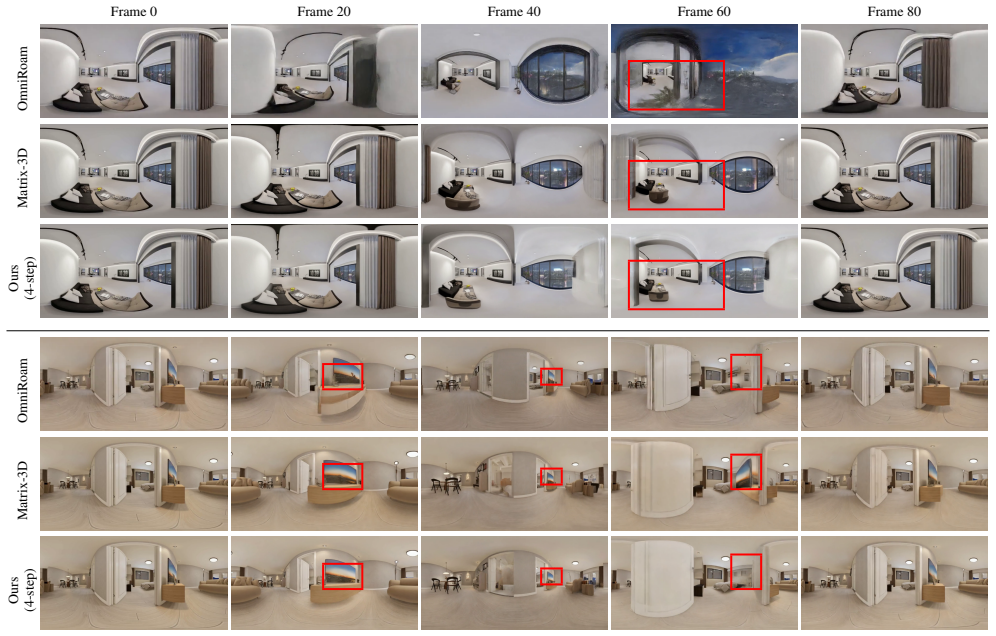
Summary. The paper proposes Genie Sim PanoWorld, a two-stage feed-forward pipeline that turns a single equirectangular (ERP) panorama into a freely roamable 3D Gaussian scene without per-scene optimization. Stage 1 plans a collision-free SE(3) trajectory on a NavMesh derived from monocular depth, then injects geometry-warped rendering and disocclusion masks into a latent rectified-flow video diffusion model (Wan2.2-TI2V-5B + LoRA). The model is trained with long–short trajectory mixed supervision and a shortcut-model self-consistency objective, enabling 4 CFG-free denoising steps. Stage 2 applies a panoramic VGGT-style estimator (PanoVGGT) to the generated video, fuses multi-view features into a voxel grid, and decodes 3D Gaussian primitives for real-time rendering. Experiments on InteriorGS and RealSee3D compare against Matrix-3D, OmniRoam, and feed-forward reconstruction baselines, with ablations of training components, decoder modules, and pose estimators.
Significance. If the central claim holds, this is a substantial advance: an end-to-end, single-panorama-to-3D pipeline with explicit metric trajectory control, no per-scene optimization, and practical single-GPU runtime (~147 s). The paper's strengths are the clear two-stage factorization, the component-wise ablations that convincingly attribute gains to mixed training and self-consistency, the NFE reduction, and the introduction of the PanoHome dataset. However, the evidence for the 'metric 3D scene' part of the claim is incomplete: pose-error and scale-alignment gaps are not isolated, and one headline baseline is evaluated at a reduced sampling schedule. These issues prevent the stated contribution from being fully established as presented.
major comments (5)
- [§4.2, §4.7, Tables 7–9] All pose errors are reported after Sim(3) Umeyama alignment (Sec. 4.2), which removes global scale, rotation, and translation. The 3DGS decoder consumes PanoVGGT poses via Eqs. (8)–(9), so any scale or global drift in those poses propagates directly into the reconstructed scene. Table 7 shows VGGT ATE 0.029–0.035 on generated frames versus COLMAP 0.0035–0.022, yet no experiment isolates whether this ~10× larger pose error affects the final 3DGS output. The central 'metric 3D scene' claim is therefore not verified. Please add an end-to-end ablation using COLMAP poses as input to the same decoder on generated frames, and report metric-scale errors without Sim(3) scale alignment.
- [§4.3–4.4, Table 2] Matrix-3D is evaluated at 10 guided steps instead of its full 50-step schedule. This is a deliberate protocol choice (Sec. 4.3), but it reduces NFE from 100 to 20 and may handicap the baseline. Since the headline claim is that the method 'outperforms Matrix-3D at every trajectory stride,' please also report Matrix-3D at its default 50-step schedule and/or at matched NFE, and justify 10 steps as the baseline's intended configuration.
- [Tables 2, 4, 6, 7, 9] No error bars, multiple seeds, or significance tests are reported. Ablation deltas are small (e.g., 0.80 dB novel-view PSNR in Table 6; FVD changes of ~1.4 in Table 4), so it is unclear whether the observed differences are meaningful beyond noise. Please provide at least 3 seeds with standard deviations for the headline tables and a significance test for the main comparisons.
- [§4.4.3, Table 3] The RealSee3D zero-shot evaluation has no ground-truth video or trajectory; pose metrics are computed against a planned ring trajectory that derives from the same input depth used for generation. This is close to self-referential for assessing trajectory controllability and says nothing about 3D reconstruction accuracy on unseen scenes. Please clarify that zero-shot generalization is limited to appearance/consistency metrics, or add a real-scene benchmark with measured 3D geometry.
- [§3.2.1, Abstract/Sec. 5] The NavMesh is built from monocular Depth Anything 360 depth; if that depth has an unknown global scale, the planned SE(3) trajectory is only defined up to scale, which would contradict the 'metric' claim in the abstract and Sec. 5. The paper should either state how absolute scale is recovered or normalized, or explicitly scope the metric claim to domains with known scale (e.g., the PanoHome-trained distribution).
minor comments (5)
- [§4.3] Typo: 'Feed-forawrd' should be 'Feed-forward'.
- [§2.2.1 vs §3.2.1] Related Work discusses 'Depth Anything V3', while Method uses 'Depth Anything 360'; clarify whether these refer to the same model family and which specific version is used in the pipeline.
- [Tables 7 and 8] Notation is inconsistent: Table 7 uses 'VGGT (ours)' and Table 8 additionally uses 'PanoVGGT'. Define whether PanoVGGT is identical to VGGT (ours) and why both names appear.
- [Table 2] The 'GT track (ref.)' rows leave fidelity columns blank. Mark them clearly as pose-reference only, or fill with applicable values.
- [Eq. (6), §3.2.2] The text says samples are 'routed with probability ρ=0.75 to the flow-matching loss', and Eq. (6) uses b∼Bernoulli(ρ). Make the Bernoulli convention explicit (e.g., b=1 with probability 0.75) to avoid ambiguity.
Circularity Check
Minor self-referential zero-shot trajectory metric; core pipeline is independently trained and benchmarked.
specific steps
-
self definitional
[Sec. 4.2 Metrics; Sec. 4.4.3 Zero-Shot Generalization (Table 3)]
"On RealSee3D, which has no roaming-video ground truth, we drive inference with our own collision-free ring trajectories and report FID, a loop-closure score (following OmniRoam [21]), first/last-frame LPIPS-Loop, and the same pose metrics against the planned trajectory."
On RealSee3D, 'trajectory accuracy' (ATE/RRE/RTE) is defined as the disagreement between poses re-estimated from the generated video and the planned trajectory T. But T is the SE(3) conditioning input to the generator in Eq. (2), and the geometry-warped conditioning frames are rendered from the scene mesh along exactly that T. Thus the pose metric measures how closely the video reproduces its own conditioning trajectory, not agreement with an external scene-motion ground truth. The paper additionally reports this as zero-shot pose-drift evidence ('It also substantially reduces pose drift ... verified via COLMAP on the generated frames'), so the zero-shot controllability claim is partly self-referential. This is an evaluation-loop issue, not a derivation of the 3D-scene content, and it does
full rationale
No significant central circularity. The single-panorama-to-3D claim is not derived from fitted constants or from the authors' own prior publications. The video generator is trained on InteriorGS ground-truth tracks with flow-matching and shortcut-model losses (Eqs. 4-6); the reconstructor is trained in two stages with ground-truth camera, depth, and RGB losses (Eqs. 12-13) on RealSee3D, InteriorGS, Structured3D, and the procedurally generated PanoHome, where depth and pose are rendered from the same geometry. The reconstruction decoder is deliberately isolated from the generative stage by evaluating it on real captured videos (Table 5), which is an externally grounded benchmark rather than a self-citation. The one identified circular step is the zero-shot RealSee3D trajectory metric being measured against the planned trajectory that is itself the conditioning input; this is a self-referential evaluation of pose controllability but does not by itself establish the central scene-generation claim. Separately, all pose metrics are Sim(3)-aligned, so the 'metric' claim is not directly verified by those numbers, and VGGT pose error on generated frames is not isolated end-to-end; these are correctness/validation risks, not circular reductions. Overall, the pipeline is self-contained against external data and benchmarks, so the score is low.
Axiom & Free-Parameter Ledger
free parameters (6)
- Voxel cell size epsilon in voxel fusion
- Number of Gaussians per voxel K
- Self-consistency loss sampling probability rho =
0.75
- Video sequence length N =
81
- Number of denoising steps at inference =
4
- LoRA rank and alpha =
rank 48, alpha 48
axioms (4)
- domain assumption A navigation mesh built from monocular depth is a reliable free-space prior for collision-free trajectory planning.
- domain assumption The generated panoramic video is geometrically consistent enough for a feed-forward VGGT-style pose/depth estimator to recover metric poses.
- domain assumption Shortcut-model self-consistency objectives permit CFG-free 4-step sampling without a quality penalty.
- domain assumption Equirectangular projection eliminates the need for per-view intrinsic estimation and improves pose accuracy.
invented entities (1)
-
PanoHome dataset
no independent evidence
read the original abstract
We address the problem of reconstructing a high-fidelity, freely navigable 3D scene from a single $360^\circ$ panorama, without per-scene optimization or multi-view capture. Existing methods either lack metric trajectory control, which hinders reliable downstream 3D reconstruction, or struggle with large disocclusions under long-range camera motion while requiring high-end multi-GPU servers.We present Genie Sim PanoWorld, a two-stage feed-forward pipeline that bridges generation and reconstruction via an explicit, trajectory-controllable panoramic video. A NavMesh-planned $\mathrm{SE}(3)$ roaming trajectory is injected into a latent video diffusion model through dense geometry-warped conditioning; long--short trajectory mixed training and a self-consistency objective based on shortcut models together yield high-fidelity video in four CFG-free denoising steps. A feed-forward panoramic reconstructor then lifts the generated video into a high-fidelity 3D Gaussian scene that supports real-time, free-viewpoint roaming and can be directly used as a simulation-ready asset for embodied AI applications. Experiments show that Genie Sim PanoWorld outperforms geometry-conditioned baselines in both panoramic video generation and downstream 3D reconstruction, while generalizing zero-shot to unseen indoor scenes.
Figures



Reference graph
Works this paper leans on
-
[1]
Pano3D: A holistic benchmark and a solid baseline for 360 ◦ depth estimation
Georgios Albanis, Nikolaos Zioulis, Petros Drakoulis, Vasileios Gkitsas, Vladimiros Sterzentsenko, Fed- erico Alvarez, Dimitrios Zarpalas, and Petros Daras. Pano3D: A holistic benchmark and a solid baseline for 360 ◦ depth estimation. InProceedings of the IEEE/CVF Conference on Computer Vision and Pat- tern Recognition, pages 3727–3737, 2021. 7, 8
2021
-
[2]
Joint 2D-3D-Semantic data for indoor scene understanding.arXiv preprint arXiv:1702.01105,
Iro Armeni, Sasha Sax, Amir R Zamir, and Silvio Savarese. Joint 2D-3D-Semantic data for indoor scene understanding.arXiv preprint arXiv:1702.01105,
-
[3]
Matterport3D: Learning from RGB-D data in indoor environments
Angel Chang, Angela Dai, Thomas Funkhouser, Ma- ciej Halber, Matthias Niessner, Manolis Savva, Shuran Song, Andy Zeng, and Yinda Zhang. Matterport3D: Learning from RGB-D data in indoor environments. arXiv preprint arXiv:1709.06158, 2017. 7, 8
Pith/arXiv arXiv 2017
-
[4]
ViewPoint: Panoramic video generation with pretrained diffusion models
Zixun Fang, Kai Zhu, Zhiheng Liu, Yu Liu, Wei Zhai, Yang Cao, and Zheng-Jun Zha. ViewPoint: Panoramic video generation with pretrained diffusion models. In Advances in Neural Information Processing Systems, pages 12486–12508. Curran Associates, Inc., 2025. 2
2025
-
[5]
One step diffusion via shortcut models
Kevin Frans, Danijar Hafner, Sergey Levine, and Pieter Abbeel. One step diffusion via shortcut models. InInternational Conference on Learning Representa- tions (ICLR), 2025. 2, 5
2025
-
[6]
Hu, Yelong Shen, Phillip Wallis, Zeyuan Allen-Zhu, Yuanzhi Li, Shean Wang, Lu Wang, and Weizhu Chen
Edward J. Hu, Yelong Shen, Phillip Wallis, Zeyuan Allen-Zhu, Yuanzhi Li, Shean Wang, Lu Wang, and Weizhu Chen. LoRA: Low-Rank Adaptation of Large Language Models. InInternational Conference on Learning Representations (ICLR), 2022. 4, 8
2022
-
[7]
360Loc: A dataset and benchmark for omnidirectional visual localization with cross-device queries
Huajian Huang, Changkun Liu, Yipeng Zhu, Hui Cheng, Tristan Braud, and Sai-Kit Yeung. 360Loc: A dataset and benchmark for omnidirectional visual localization with cross-device queries. InProceedings of the IEEE/CVF Conference on Computer Vision and Pattern Recognition, pages 22314–22324, 2024. 7, 8
2024
-
[8]
V oyager: Long-Range and World-Consistent Video Diffusion for Explorable 3D Scene Generation.ACM Transactions on Graphics, 44(6):1–15, 2025
Tianyu Huang, Wangguandong Zheng, Tengfei Wang, Yuhao Liu, Zhenwei Wang, Junta Wu, Jie Jiang, Hui Li, Rynson Lau, Wangmeng Zuo, and Chunchao Guo. V oyager: Long-Range and World-Consistent Video Diffusion for Explorable 3D Scene Generation.ACM Transactions on Graphics, 44(6):1–15, 2025. 2
2025
-
[9]
HY-World 2.0: A Multi-Modal World Model for Re- constructing, Generating, and Simulating 3D Worlds,
Team HY-World, Chenjie Cao, Xuhui Zuo, Zhenwei Wang, Yisu Zhang, Junta Wu, Zhenyang Liu, Yuning Gong, Yang Liu, Bo Yuan, Chao Zhang, Coopers Li, Dongyuan Guo, Fan Yang, Haiyu Zhang, Hang Cao, Jianchen Zhu, Jiaxin Lin, Jie Xiao, Jihong Zhang, Jun- lin Yu, Lei Wang, Lifu Wang, Lilin Wang, Linus, Minghui Chen, Peng He, Penghao Zhao, Qi Chen, Rui Chen, Rui Sh...
-
[10]
PanoWorld: A Generative Spatial World Model for Consistent Whole-House Panorama Synthesis, 2026
Jinrang Jia, Zhenjia Li, Yijiang Hu, and Yifeng Shi. PanoWorld: A Generative Spatial World Model for Consistent Whole-House Panorama Synthesis, 2026. 2, 10
2026
-
[11]
Depth Anything in 360◦: Towards scale invariance in the wild, 2025
Hualie Jiang, Ziyang Song, Zhiqiang Lou, Rui Xu, and Minglang Tan. Depth Anything in 360◦: Towards scale invariance in the wild, 2025. 4
2025
-
[12]
PanoWorld: Geometry-Consistent Panoramic Video World Modeling, 2026
Le Jiang, Xiangyu Bai, Bishoy Galoaa, Shayda Moezzi, Caleb James Lee, Tooba Imtiaz, Edmund Yeh, Jennifer Dy, Yanzhi Wang, and Sarah Ostad- abbas. PanoWorld: Geometry-Consistent Panoramic Video World Modeling, 2026. 2
2026
-
[13]
3D Gaussian Splatting for Real-Time Radiance Field Rendering
Bernhard Kerbl, Georgios Kopanas, Thomas Leimk¨uhler, and George Drettakis. 3D Gaussian Splatting for Real-Time Radiance Field Rendering. ACM Transactions on Graphics (TOG), 42(4), 2023. 1
2023
-
[14]
RealSee3D: 14 A Large-Scale Multi-View RGB-D Dataset of Indoor Scenes (Version 1.0), 2025
Linyuan Li, Yan Wu, Xi Li, Lingli Wang, Tong Rao, Jie Zhou, Cihui Pan, and Xinchen Hui. RealSee3D: 14 A Large-Scale Multi-View RGB-D Dataset of Indoor Scenes (Version 1.0), 2025. 7, 8
2025
-
[15]
CubeComposer: Spatio-temporal autoregres- sive 4K 360◦ video generation from perspective video
Lingen Li, Guangzhi Wang, Xiaoyu Li, Zhaoyang Zhang, Qi Dou, Jinwei Gu, Tianfan Xue, and Ying Shan. CubeComposer: Spatio-temporal autoregres- sive 4K 360◦ video generation from perspective video. InProceedings of the IEEE/CVF Conference on Com- puter Vision and Pattern Recognition (CVPR), pages 32625–32635, 2026. 2
2026
-
[16]
4K4DGen: Panoramic 4D generation at 4K resolution
Renjie Li, Panwang Pan, Bangbang Yang, Dejia Xu, Shijie Zhou, zhang xuanyang, Zeming Li, Achuta Kadambi, Zhangyang Wang, Zhengzhong Tu, and Zhiwen Fan. 4K4DGen: Panoramic 4D generation at 4K resolution. InInternational Conference on Learn- ing Representations, pages 100692–100713, 2025. 2
2025
-
[17]
Chen, Zhenyu Li, Guang Shi, Jiashi Feng, and Bingyi Kang
Haotong Lin, Sili Chen, Jun Hao Liew, Donny Y . Chen, Zhenyu Li, Guang Shi, Jiashi Feng, and Bingyi Kang. Depth Anything 3: Recovering the visual space from any views.arXiv preprint arXiv:2511.10647,
-
[18]
Yaron Lipman, Ricky T. Q. Chen, Heli Ben-Hamu, Maximilian Nickel, and Matt Le. Flow matching for generative modeling. InInternational Conference on Learning Representations (ICLR), 2023. 5
2023
-
[19]
Aoming Liu, Zhong Li, Zhang Chen, Nannan Li, Yi Xu, and Bryan A. Plummer. PanoFree: Tuning-Free Holistic Multi-view Image Generation with Cross- View Self-guidance. InComputer Vision – ECCV 2024, pages 146–164. Springer Nature Switzerland, Cham, 2025. 2
2024
-
[20]
DynamicScaler: Seamless and scalable video generation for panoramic scenes
Jinxiu Liu, Shaoheng Lin, Yinxiao Li, and Ming- Hsuan Yang. DynamicScaler: Seamless and scalable video generation for panoramic scenes. InProceed- ings of the IEEE/CVF Conference on Computer Vision and Pattern Recognition (CVPR), pages 6144–6153,
-
[21]
OmniRoam: World Wandering via Long- Horizon Panoramic Video Generation, 2026
Yuheng Liu, Xin Lin, Xinke Li, Baihan Yang, Chen Wang, Kalyan Sunkavalli, Yannick Hold-Geoffroy, Hao Tan, Kai Zhang, Xiaohui Xie, Zifan Shi, and Yi- wei Hu. OmniRoam: World Wandering via Long- Horizon Panoramic Video Generation, 2026. 2, 3, 4, 8, 9, 10
2026
-
[22]
GenEx: Generating an explorable world
TaiMing Lu, Tianmin Shu, Alan Yuille, Daniel Khashabi, and Jieneng Chen. GenEx: Generating an explorable world. InInternational Conference on Learning Representations, pages 52310–52335, 2025. 2
2025
-
[23]
Lars Mescheder, Wei Dong, Shiwei Li, Xuyang Bai, Marcel Santos, Peiyun Hu, Bruno Lecouat, Ming- min Zhen, Ama¨el Delaunoy, Tian Fang, Yanghai Tsin, Stephan R. Richter, and Vladlen Koltun. SHARP: Sharp monocular view synthesis in less than a second. arXiv preprint arXiv:2512.10685, 2025. 3
arXiv 2025
-
[24]
Towards phys- ically executable 3D Gaussian for embodied naviga- tion, 2025
Bingchen Miao, Rong Wei, Zhiqi Ge, Xiaoquan Sun, Shiqi Gao, Jingzhe Zhu, Renhan Wang, Siliang Tang, Jun Xiao, Rui Tang, and Juncheng Li. Towards phys- ically executable 3D Gaussian for embodied naviga- tion, 2025. 7, 8
2025
-
[25]
Srinivasan, Matthew Tan- cik, Jonathan T
Ben Mildenhall, Pratul P. Srinivasan, Matthew Tan- cik, Jonathan T. Barron, Ravi Ramamoorthi, and Ren Ng. NeRF: Representing Scenes as Neural Radiance Fields for View Synthesis. InEuropean Conference on Computer Vision (ECCV), pages 405–421, 2020. 1
2020
-
[26]
Infinite photorealistic worlds using procedu- ral generation
Alexander Raistrick, Lahav Lipson, Zeyu Ma, Lingjie Mei, Mingzhe Wang, Yiming Zuo, Karhan Kayan, Hongyu Wen, Beining Han, Yihan Wang, Alejandro Newell, Hei Law, Ankit Goyal, Kaiyu Yang, and Jia Deng. Infinite photorealistic worlds using procedu- ral generation. InProceedings of the IEEE/CVF Con- ference on Computer Vision and Pattern Recognition, pages 12...
2023
-
[27]
Infinigen Indoors: Photorealistic indoor scenes using procedural gener- ation
Alexander Raistrick, Lingjie Mei, Karhan Kayan, David Yan, Yiming Zuo, Beining Han, Hongyu Wen, Meenal Parakh, Stamatis Alexandropoulos, Lahav Lipson, Zeyu Ma, and Jia Deng. Infinigen Indoors: Photorealistic indoor scenes using procedural gener- ation. InProceedings of the IEEE/CVF Conference on Computer Vision and Pattern Recognition (CVPR), pages 21783–...
2024
-
[28]
Lyra 2.0: Explorable Generative 3D Worlds, 2026
Tianchang Shen, Sherwin Bahmani, Kai He, Sangeetha Grama Srinivasan, Tianshi Cao, Jiawei Ren, Ruilong Li, Zian Wang, Nicholas Sharp, Zan Gojcic, Sanja Fidler, Jiahui Huang, Huan Ling, Jun Gao, and Xuanchi Ren. Lyra 2.0: Explorable Generative 3D Worlds, 2026. 2, 3
2026
-
[29]
InteriorGS: A 3D Gaussian Splatting Dataset of Semantically Labeled Indoor Scenes
SpatialVerse Research Team, Manycore Tech Inc. InteriorGS: A 3D Gaussian Splatting Dataset of Semantically Labeled Indoor Scenes. https : / / huggingface . co / datasets / spatialverse/InteriorGS, 2025. 7
2025
-
[30]
Wan: Open and Advanced Large-Scale Video Generative Models, 2025
Wan Team. Wan: Open and Advanced Large-Scale Video Generative Models, 2025. 4, 8
2025
-
[31]
PanoWorld: Towards Spatial Supersensing in360 ◦ Panorama World, 2026
Changpeng Wang, Xin Lin, Junhan Liu, Yuheng Liu, Zhen Wang, Donglian Qi, Yunfeng Yan, and Xi Chen. PanoWorld: Towards Spatial Supersensing in360 ◦ Panorama World, 2026. 2
2026
-
[32]
Self-supervised learning of depth and camera motion from 360 ◦ videos
Fu-En Wang, Hou-Ning Hu, Hsien-Tzu Cheng, Juan- Ting Lin, Shang-Ta Yang, Meng-Li Shih, Hung-Kuo Chu, and Min Sun. Self-supervised learning of depth and camera motion from 360 ◦ videos. InAsian Con- ference on Computer Vision, pages 53–68. Springer,
-
[33]
VGGT: Visual Geometry Grounded Trans- former, 2025
Jianyuan Wang, Minghao Chen, Nikita Karaev, Andrea Vedaldi, Christian Rupprecht, and David Novotny. VGGT: Visual Geometry Grounded Trans- former, 2025. 3, 7, 8 15
2025
-
[34]
VGGT-Ω, 2026
Jianyuan Wang, Minghao Chen, Shangzhan Zhang, Nikita Karaev, Johannes Sch ¨onberger, Patrick La- batut, Piotr Bojanowski, David Novotny, Andrea Vedaldi, and Christian Rupprecht. VGGT-Ω, 2026. 3
2026
-
[35]
Real-ESRGAN: Training Real-World Blind Super-Resolution with Pure Synthetic Data
Xintao Wang, Liangbin Xie, Chao Dong, and Ying Shan. Real-ESRGAN: Training Real-World Blind Super-Resolution with Pure Synthetic Data. InInter- national Conference on Computer Vision Workshops (ICCVW), 2021. 5
2021
-
[36]
PanoWan: Lifting diffusion video gen- eration models to 360 ◦ with latitude/longitude-aware mechanisms
Yifei Xia, Shuchen Weng, Siqi Yang, Jingqi Liu, Chengxuan Zhu, Minggui Teng, Zijian Jia, Han Jiang, and Boxin Shi. PanoWan: Lifting diffusion video gen- eration models to 360 ◦ with latitude/longitude-aware mechanisms. InAdvances in Neural Information Pro- cessing Systems, pages 148027–148046. Curran Asso- ciates, Inc., 2025. 2
2025
-
[37]
Matrix-3D: Omnidirec- tional Explorable 3D World Generation, 2025
Zhongqi Yang, Wenhang Ge, Yuqi Li, Jiaqi Chen, Haoyuan Li, Mengyin An, Fei Kang, Hua Xue, Baixin Xu, Yuyang Yin, Eric Li, Yang Liu, Yikai Wang, Hao- Xiang Guo, and Yahui Zhou. Matrix-3D: Omnidirec- tional Explorable 3D World Generation, 2025. 2, 4, 8
2025
-
[38]
PanoWorld-X: Generating Explorable Panoramic Worlds via Sphere- Aware Video Diffusion, 2025
Yuyang Yin, HaoXiang Guo, Fangfu Liu, Mengyu Wang, Hanwen Liang, Eric Li, Yikai Wang, Xiao- jie Jin, Yao Zhao, and Yunchao Wei. PanoWorld-X: Generating Explorable Panoramic Worlds via Sphere- Aware Video Diffusion, 2025. 2
2025
-
[39]
Chen, Qianyi Wu, Konstantinos N
Cheng Zhang, Hanwen Liang, Donny Y . Chen, Qianyi Wu, Konstantinos N. Plataniotis, Camilo Cruz Gam- bardella, and Jianfei Cai. PanFlow: Decoupled Mo- tion Control for Panoramic Video Generation.Pro- ceedings of the AAAI Conference on Artificial Intelli- gence, 40(15):12385–12393, 2026. 2
2026
-
[40]
World- Stereo: Bridging camera-guided video generation and scene reconstruction via 3D geometric memories
Yisu Zhang, Chenjie Cao, Tengfei Wang, Xuhui Zuo, Junta Wu, Jianke Zhu, and Chunchao Guo. World- Stereo: Bridging camera-guided video generation and scene reconstruction via 3D geometric memories. In Proceedings of the IEEE/CVF Conference on Com- puter Vision and Pattern Recognition (CVPR), pages 40327–40339, 2026. 2, 3
2026
-
[41]
Structured3D: A large photo- realistic dataset for structured 3D modeling
Jia Zheng, Junfei Zhang, Jing Li, Rui Tang, Shenghua Gao, and Zihan Zhou. Structured3D: A large photo- realistic dataset for structured 3D modeling. InEuro- pean Conference on Computer Vision, pages 519–535. Springer, 2020. 7, 8 16
2020
discussion (0)
Sign in with ORCID, Apple, or X to comment. Anyone can read and Pith papers without signing in.