REVIEW 3 major objections 5 minor 62 references
Text-to-video models lock onto the opening scene and suppress later events; a training-free lower-bound on guidance can restore them.
Reviewed by Pith at T0; open to challenge. T0 means a machine referee read the full paper against a public rubric. the ladder, T0–T4 →
T0 review · grok-4.5
2026-07-30 23:26 UTC pith:ZHRTXUMF
load-bearing objection Clean restorative dual to subtractive CFG feasibility work; real failure mode, solid ablations on Mochi, but backbone-agnostic gains are still mostly an argument plus qualitative frames. the 3 major comments →
TPD: Temporal Prior Decoupling for Text-to-Video Diffusion Models
The pith
A machine-rendered reading of the paper's core claim, the machinery that carries it, and where it could break.
Core claim
Temporal Prior Suppression is a recurring failure of current text-to-video diffusion models: an early-scene prior dominates the guidance trajectory and under-expresses a requested late event in its intended frames. The paper shows this omission can be corrected at sampling time by enforcing a lower-bound feasibility constraint on the guidance update along the full-prompt versus early-only counterfactual direction, scheduled over both diffusion timestep and frame index.
What carries the argument
Temporal Prior Decoupling (TPD): the suppressed direction a_τ = ε_text − ε_counter (full prompt minus early-segment-only conditioning), with a minimal-energy projection that enforces a_τᵀ δ ≥ c(τ, i) via a two-dimensional (timestep × frame) lower-bound schedule—restorative rather than subtractive guidance correction.
Load-bearing premise
The method depends on a one-shot language-model split of the prompt into early and late parts plus estimates of transition point and prior strengths, none of which have ground truth; if those estimates are wrong, restoration is mis-timed or under-scaled.
What would settle it
On prompts that specify a persisting early scene and a genuine late emergence, run the same frozen backbone with and without TPD and check whether late-window frames realize the late concept (coverage and violation rate) while early frames and overall fidelity stay intact; if late realization does not improve, or improves only by discarding the early scene, the central claim fails.
If this is right
- Upper-bound suppression, drift removal, and lower-bound restoration form one feasibility family for semantic guidance correction; the temporal case was the missing member.
- Position-resolved emergence—not only whole-clip text similarity—becomes a measurable evaluation target for video generators.
- Because the fix lives purely in classifier-free guidance space, the same restoration recipe can transfer across video backbones without retraining.
- Attribute-morph and pre-segmented multi-prompt methods do not cover single-prompt emergence over a persisting scene; TPD addresses that gap at inference time.
Where Pith is reading between the lines
- Image generators with spatial concept neglect may admit an analogous lower-bound restoration if a ‘where’ axis replaces the video-frame axis.
- Multi-event or overlapping timelines would need several simultaneous lower bounds rather than one early/late split.
- If decomposition parameters were estimated from the backbone’s own predictions instead of an external language model, the pipeline would become fully self-contained at inference.
Editorial analysis
A structured set of objections, weighed in public.
Referee Report
Summary. The paper identifies Temporal Prior Suppression (TPS): in text-to-video diffusion, an early-scene prior can dominate the CFG trajectory so that a late emergent event specified in a single unsegmented prompt fails to appear in the intended frames. It proposes Temporal Prior Decoupling (TPD), a training-free method that builds a temporal counterfactual by conditioning on the early segment alone, defines a_τ = ε_text − ε_counter as the suppressed direction, and restores it via a minimal-energy lower-bound projection a_τ^⊤ δ ≥ c(τ,i) with a joint (diffusion-timestep × video-frame) schedule. The formulation is cast as the restorative dual of subtractive feasibility methods (NEGATE, DCR), with closed-form KKT solution. Evaluation uses a new 400-prompt emergence suite and reports gains on CLIP-early, TCS, and TVR on Mochi, with qualitative recurrence of TPS on HunyuanVideo and CogVideoX.
Significance. If the claims hold, the work makes three useful contributions: (1) a crisp formalization of a failure mode that standard clip–text metrics miss and that is specific to temporal placement rather than negation or attribute morphs; (2) a clean, architecture-neutral correction entirely in CFG space, with a closed-form projection and ablations that isolate frame axis, timestep schedule, and ρ-adaptive strength; (3) an evaluation suite organized by emergence mechanism rather than surface scene type. Completing the upper-bound / drift-removal / lower-bound family is a coherent conceptual advance. The training-free, backbone-agnostic design is practically valuable if quantitative transfer is demonstrated.
major comments (3)
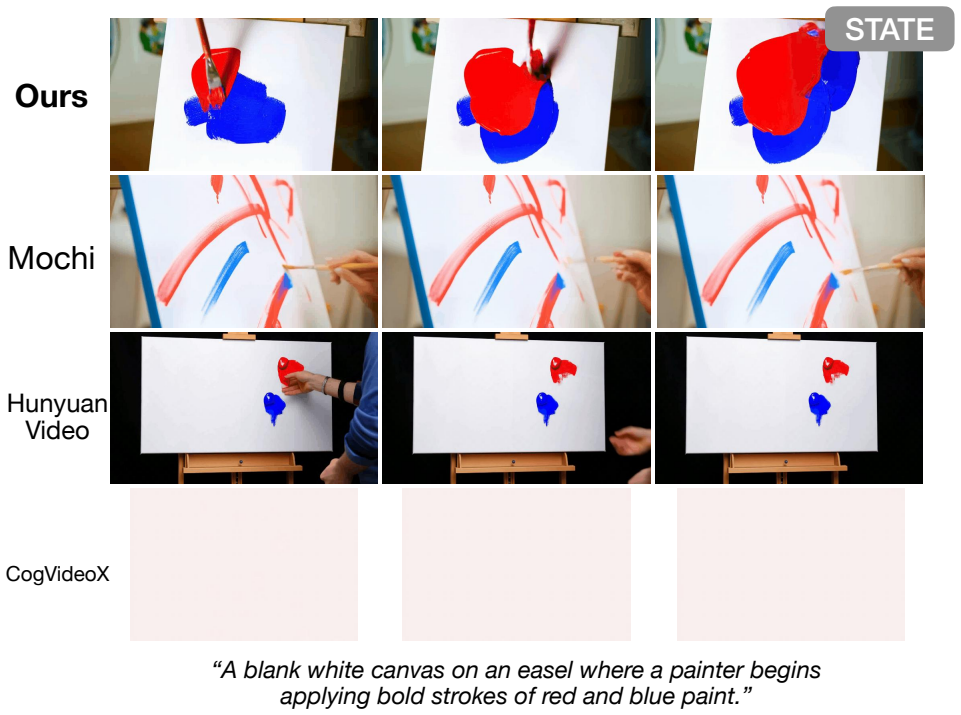
- [Abstract; Table 1; Appendix H] Abstract, Introduction, and §Experiments claim backbone-agnostic improvement and that TPS/TPD transfer across distinct T2V systems. Table 1 reports standard-CFG baselines for HunyuanVideo and CogVideoX, and Appendix D shows qualitative recurrence of TPS, but every controlled TPD result—main metrics, Always-Add vs projection, and the three schedule ablations (Tables 1–3, Fig. 3, App. F)—is on Mochi only. Appendix H explicitly defers quantitative transfer and calls retuning (w, α0, β, q) “engineering rather than formulation.” For a central claim of backbone-agnostic restoration defined purely in CFG space, at least one other backbone needs full TPD numbers (TCS/TVR/CLIP-early ± ablations), or the claim must be narrowed to “failure recurs; method validated on one backbone.”
- [Appendix E; Appendix G; Table 1] GPT-4o is used both for D(p) = {p_early, p_late, γ, ρ_early, ρ_late} (App. G) and for the primary judged metrics TCS/TVR/EPS (App. E), with only protocol mitigations (temperature 0, separate queries, fixed rubric). Appendix A admits these scalars have no ground truth and that poor estimates cause under-correction. Because generation localization (frame sigmoid, α ∝ max(0, ρ_early−ρ_late)) and the headline compliance scores share the same model family, circularity risk is load-bearing. A human study on a subset ranking methods on late-concept realization, and/or an open/local decomposer ablation with frozen judge, is needed to support that gains are not judge–decomposer agreement.
- [Table 3; Appendix A; Conclusion] On CAUSAL (Table 3), TPD reaches TCS 2.36 and TVR 0.80—still very low absolute realization—consistent with Appendix A’s admission that guidance-space restoration cannot force trajectories the backbone will not follow. The paper’s strongest qualitative examples (e.g., sandcastle) work, but the claim “significantly improves late-concept realization” should be qualified by mechanism: large gains on ONSET/ENTRY/SCENE, limited mitigation on causal collapse. Without that stratification in the abstract/conclusion, the aggregate TCS/TVR can overstate reliability on the hardest and most distinctive regime the dataset was built to stress.
minor comments (5)
- [Figure 2; Appendix D] Figure 2 and Appendix D figures are informative, but several multi-panel sets (Figs. 4–6) are hard to read at print scale; consider fewer frames per row or higher-resolution crops of the late window only.
- [Method] Notation switches between t and τ for the diffusion step (Eqs. 1–13); unify to one symbol in the main method section.
- [Related Work] Related Work cites several 2025–2026 arXiv preprints appropriately, but a short explicit comparison table (segmented supervision vs morph vs TPD input assumptions) would help readers place the setting faster.
- [Appendix J; Implementation Details] Table 4 runtime: full TPD is ~2.2× Mochi (248s vs 114s). Stating this cost clearly in the main Experiments paragraph, not only Appendix J, would set expectations.
- [Appendix D figures] Typos/formatting: “CASUAL” appears in figure labels where “CAUSAL” is meant (Figs. 4–6, 11, 19, 27); “acrossh categories” in Fig. 6 caption; occasional missing spaces in compound words from PDF extraction should be checked in source.
Circularity Check
Core TPD derivation is independent; only mild self-citation props up judge metrics, not the method itself.
specific steps
-
self citation load bearing
[Appendix E, On the Reliability of Automated Judging; also Experiments/Quantitative Evaluation]
"Prior work on constrained video generation has found that judge-based compliance scores and human perceptual rankings agree on method ordering for closely related tasks (Kang and Lin 2026), supporting the use of these scores as a proxy for human assessment of temporal faithfulness."
TCS/TVR/EPS carry the main quantitative claim of late-concept restoration. Their human validity is justified primarily by a citation to overlapping-author work (NEGATE, Kang & Lin 2026) on related constrained-generation tasks, not by a fresh human study in this paper. This is load-bearing for trusting the judged metrics, not for the math of the projection; the derivation of δ* remains independent. Mild, pattern-3 only.
full rationale
Walking the claimed chain—TPS as early-prior dominance of CFG, aτ := ε_text − ε_counter from a temporal counterfactual, lower-bound half-space aτ⊤δ ≥ c(τ,i), closed-form KKT projection, 2-D (timestep × frame) schedule—shows no step that is true by definition of its inputs. aτ is an empirical denoiser difference, not a quantity fitted to the reported metrics; µ is zero when the constraint already holds; ablations (frame axis, timestep schedule, ρ-adaptive α, Always-Add) change distinct metrics in distinct ways, which would be impossible if success were tautological. The dual framing with NEGATE/DCR is conceptual scaffolding from overlapping-author preprints, not a uniqueness theorem that forces TPD. Shared use of GPT-4o for decomposition and TCS/TVR/EPS, and reuse of the same γ for schedule and late-frame partition, are methodological confounds and evaluation alignment choices, not derivation circularity: late-concept content must still appear in pixels. The only pattern that lightly matches is self-citation used to underwrite automated-judge reliability (Kang & Lin 2026). That supports confidence in the scores, not the projection formula. Backbone-agnostic transfer is under-demonstrated empirically (Mochi-only controlled tables) but that is a scope/evidence gap, not circularity. Score 2.
Axiom & Free-Parameter Ledger
free parameters (5)
- α0 (global restoration strength) =
1.0
- β (frame-sigmoid sharpness) =
10.0
- q (timestep schedule exponent) =
2.0
- ρearly, ρlate, γ (per-prompt LLM estimates) =
per-prompt GPT-4o outputs in [0,1]
- CFG scale w and backbone defaults =
backbone defaults (scale-up ablation uses 9.0)
axioms (5)
- domain assumption Classifier-free guidance update δ_ref = w(ε_text − ε_uncond) is the right locus for semantic temporal correction.
- domain assumption a_τ = ε_text − ε_counter isolates the suppressed late-segment contribution rather than mere magnitude rescaling of δ_ref.
- standard math Minimal-energy projection onto the half-space a_τ^⊤ δ ≥ c(τ,i) restores omitted signal without harming reverse-time ODE stability.
- ad hoc to paper Prompts are essentially two-part (one persisting scene + one emergent event); multi-event overlap is out of scope.
- domain assumption GPT-4o vision-language judgments with fixed rubric are a valid proxy for human temporal faithfulness rankings.
invented entities (3)
-
Temporal Prior Suppression (TPS)
independent evidence
-
Suppressed signal direction a_τ from temporal counterfactual
no independent evidence
-
Two-dimensional lower-bound schedule c(τ,i)
no independent evidence
read the original abstract
Text-to-video diffusion models generate temporally coherent content from natural language, yet when a prompt describes an early scene that persists while a new event emerges on top of it---such as "a tall sandcastle standing on a beach where a wave rushes in and washes it away"---generation frequently fails to realize the late-segment event in the corresponding frames. We identify this failure as Temporal Prior Suppression (TPS): the dominant prior of the early segment captures the cross-attention trajectory across the temporal axis and suppresses the guidance signal needed for late-segment realization, a competing tendency existing guidance mechanisms do not model. We introduce Temporal Prior Decoupling (TPD), a training-free framework that restores suppressed late-segment signals during diffusion sampling. TPD constructs a temporal counterfactual by conditioning on the early segment alone, and defines the discrepancy between the full-prompt and counterfactual trajectories as a suppressed signal direction. Rather than removing this direction as in prior subtractive projection methods, TPD restores it through a frame-selective lower-bound constraint resolved jointly over diffusion timestep and video frame, realizing the suppressed event in the late frames without disrupting early-segment coherence: where prior work enforces upper-bound feasibility to remove unwanted semantics, TPD enforces lower-bound feasibility to guarantee suppressed-signal contribution. TPD runs entirely within standard diffusion sampling without retraining, and is defined purely in classifier-free guidance space, making it backbone-agnostic by construction. Experiments show that TPD significantly improves late-concept realization while preserving temporal coherence and visual fidelity, and that the targeted suppression recurs across distinct text-to-video backbones.
Figures




Reference graph
Works this paper leans on
-
[1]
Proceedings of the Computer Vision and Pattern Recognition Conference , pages=
Ditctrl: Exploring attention control in multi-modal diffusion transformer for tuning-free multi-prompt longer video generation , author=. Proceedings of the Computer Vision and Pattern Recognition Conference , pages=
-
[2]
Proceedings of the Computer Vision and Pattern Recognition Conference , pages=
Mind the time: Temporally-controlled multi-event video generation , author=. Proceedings of the Computer Vision and Pattern Recognition Conference , pages=
-
[3]
Proceedings of the IEEE/CVF International Conference on Computer Vision , pages=
From Prompt to Progression: Taming Video Diffusion Models for Seamless Attribute Transition , author=. Proceedings of the IEEE/CVF International Conference on Computer Vision , pages=
-
[4]
arXiv preprint arXiv:2604.10030 , year=
Prompt Relay: Inference-Time Temporal Control for Multi-Event Video Generation , author=. arXiv preprint arXiv:2604.10030 , year=
-
[5]
Advances in Neural Information Processing Systems , volume=
Sega: Instructing text-to-image models using semantic guidance , author=. Advances in Neural Information Processing Systems , volume=
-
[6]
arXiv preprint arXiv:2312.15964 , year=
Semantic guidance tuning for text-to-image diffusion models , author=. arXiv preprint arXiv:2312.15964 , year=
-
[7]
Proceedings of the IEEE/CVF Conference on Computer Vision and Pattern Recognition , pages=
Rethinking the spatial inconsistency in classifier-free diffusion guidance , author=. Proceedings of the IEEE/CVF Conference on Computer Vision and Pattern Recognition , pages=
-
[8]
arXiv preprint arXiv:2605.06512 , year=
DCR: Counterfactual Attractor Guidance for Rare Compositional Generation , author=. arXiv preprint arXiv:2605.06512 , year=
-
[9]
arXiv preprint arXiv:2603.06533 , year=
NEGATE: Constrained Semantic Guidance for Linguistic Negation in Text-to-Video Diffusion , author=. arXiv preprint arXiv:2603.06533 , year=
-
[10]
arXiv preprint arXiv:2503.06310 , year=
Text2story: Advancing video storytelling with text guidance , author=. arXiv preprint arXiv:2503.06310 , year=
-
[11]
Proceedings of the IEEE/CVF Conference on Computer Vision and Pattern Recognition , pages=
Frequency-Aware Flow Matching for High-Quality Image Generation , author=. Proceedings of the IEEE/CVF Conference on Computer Vision and Pattern Recognition , pages=
-
[12]
Proceedings of the IEEE/CVF Conference on Computer Vision and Pattern Recognition , pages=
Bias Is a Subspace, Not a Coordinate: A Geometric Rethinking of Post-hoc Debiasing in Vision-Language Models , author=. Proceedings of the IEEE/CVF Conference on Computer Vision and Pattern Recognition , pages=
-
[13]
Proceedings of the IEEE/CVF Conference on Computer Vision and Pattern Recognition , pages=
TempoControl: Temporal Attention Guidance for Text-to-Video Models , author=. Proceedings of the IEEE/CVF Conference on Computer Vision and Pattern Recognition , pages=
-
[14]
Proceedings of the IEEE/CVF Conference on Computer Vision and Pattern Recognition , pages=
Image generation from contextually-contradictory prompts , author=. Proceedings of the IEEE/CVF Conference on Computer Vision and Pattern Recognition , pages=
-
[15]
Proceedings of the IEEE/CVF Conference on Computer Vision and Pattern Recognition , pages=
Make it SING: Analyzing Semantic Invariants in Classifiers , author=. Proceedings of the IEEE/CVF Conference on Computer Vision and Pattern Recognition , pages=
-
[16]
Proceedings of the IEEE/CVF Conference on Computer Vision and Pattern Recognition , pages=
Clip is shortsighted: Paying attention beyond the first sentence , author=. Proceedings of the IEEE/CVF Conference on Computer Vision and Pattern Recognition , pages=
-
[17]
arXiv preprint arXiv:2207.12598 , year=
Classifier-free diffusion guidance , author=. arXiv preprint arXiv:2207.12598 , year=
-
[18]
Advances in neural information processing systems , volume=
Denoising diffusion probabilistic models , author=. Advances in neural information processing systems , volume=
-
[19]
Proceedings of the IEEE/CVF conference on computer vision and pattern recognition , pages=
High-resolution image synthesis with latent diffusion models , author=. Proceedings of the IEEE/CVF conference on computer vision and pattern recognition , pages=
-
[20]
Advances in neural information processing systems , volume=
Photorealistic text-to-image diffusion models with deep language understanding , author=. Advances in neural information processing systems , volume=
-
[21]
ACM transactions on Graphics (TOG) , volume=
Attend-and-excite: Attention-based semantic guidance for text-to-image diffusion models , author=. ACM transactions on Graphics (TOG) , volume=. 2023 , publisher=
2023
-
[22]
European conference on computer vision , pages=
Compositional visual generation with composable diffusion models , author=. European conference on computer vision , pages=. 2022 , organization=
2022
-
[23]
Advances in neural information processing systems , volume=
Video diffusion models , author=. Advances in neural information processing systems , volume=
-
[24]
Proceedings of the IEEE/CVF conference on computer vision and pattern recognition , pages=
Align your latents: High-resolution video synthesis with latent diffusion models , author=. Proceedings of the IEEE/CVF conference on computer vision and pattern recognition , pages=
-
[25]
arXiv preprint arXiv:2406.08070 , year=
Cfg++: Manifold-constrained classifier free guidance for diffusion models , author=. arXiv preprint arXiv:2406.08070 , year=
-
[26]
arXiv preprint arXiv:2212.05032 , year=
Training-free structured diffusion guidance for compositional text-to-image synthesis , author=. arXiv preprint arXiv:2212.05032 , year=
-
[27]
Proceedings of the IEEE/CVF conference on computer vision and pattern recognition , pages=
Freeu: Free lunch in diffusion u-net , author=. Proceedings of the IEEE/CVF conference on computer vision and pattern recognition , pages=
-
[28]
Proceedings of the IEEE/CVF conference on computer vision and pattern recognition , pages=
Universal guidance for diffusion models , author=. Proceedings of the IEEE/CVF conference on computer vision and pattern recognition , pages=
-
[29]
International Conference on Learning Representations , volume=
Cogvideox: Text-to-video diffusion models with an expert transformer , author=. International Conference on Learning Representations , volume=
-
[30]
arXiv preprint arXiv:2511.18870 , year=
Hunyuanvideo 1.5 technical report , author=. arXiv preprint arXiv:2511.18870 , year=
-
[31]
2024 , month =
Genmo AI , title =. 2024 , month =
2024
-
[32]
Proceedings of the Computer Vision and Pattern Recognition Conference , pages=
Dymo: Training-free diffusion model alignment with dynamic multi-objective scheduling , author=. Proceedings of the Computer Vision and Pattern Recognition Conference , pages=
-
[33]
arXiv preprint arXiv:2502.05625 , year=
Training-free constrained generation with stable diffusion models , author=. arXiv preprint arXiv:2502.05625 , year=
-
[34]
Proceedings of the IEEE/CVF Conference on Computer Vision and Pattern Recognition , pages=
Winoground: Probing vision and language models for visio-linguistic compositionality , author=. Proceedings of the IEEE/CVF Conference on Computer Vision and Pattern Recognition , pages=
-
[35]
arXiv preprint arXiv:2210.01936 , year=
When and why vision-language models behave like bags-of-words, and what to do about it? , author=. arXiv preprint arXiv:2210.01936 , year=
-
[36]
Advances in neural information processing systems , volume=
Sugarcrepe: Fixing hackable benchmarks for vision-language compositionality , author=. Advances in neural information processing systems , volume=
-
[37]
Advances in Neural Information Processing Systems , volume=
Linguistic binding in diffusion models: Enhancing attribute correspondence through attention map alignment , author=. Advances in Neural Information Processing Systems , volume=
-
[38]
Proceedings of the Computer Vision and Pattern Recognition Conference , pages=
Vision-language models do not understand negation , author=. Proceedings of the Computer Vision and Pattern Recognition Conference , pages=
-
[39]
Findings of the Association for Computational Linguistics: ACL 2025 , pages=
NegVQA: Can vision language models understand negation? , author=. Findings of the Association for Computational Linguistics: ACL 2025 , pages=
2025
-
[40]
Learn" no" to say" yes" better: Improving vision-language models via negations , author=. arXiv preprint arXiv:2403.20312 , year=
-
[41]
Proceedings of the AAAI Conference on Artificial Intelligence (AAAI 2026) , year=
Not Just What's There: Enabling CLIP to Comprehend Negated Visual Descriptions Without Fine-Tuning , author=. Proceedings of the AAAI Conference on Artificial Intelligence (AAAI 2026) , year=
2026
-
[42]
Proceedings of the IEEE/CVF international conference on computer vision , pages=
Erasing concepts from diffusion models , author=. Proceedings of the IEEE/CVF international conference on computer vision , pages=
-
[43]
Proceedings of the IEEE/CVF winter conference on applications of computer vision , pages=
Unified concept editing in diffusion models , author=. Proceedings of the IEEE/CVF winter conference on applications of computer vision , pages=
-
[44]
arXiv preprint arXiv:2311.15127 , year=
Stable video diffusion: Scaling latent video diffusion models to large datasets , author=. arXiv preprint arXiv:2311.15127 , year=
-
[45]
arXiv preprint arXiv:2210.02303 , year=
Imagen video: High definition video generation with diffusion models , author=. arXiv preprint arXiv:2210.02303 , year=
-
[46]
arXiv preprint arXiv:2209.14792 , year=
Make-a-video: Text-to-video generation without text-video data , author=. arXiv preprint arXiv:2209.14792 , year=
-
[47]
SIGGRAPH Asia 2024 Conference Papers , pages=
Lumiere: A space-time diffusion model for video generation , author=. SIGGRAPH Asia 2024 Conference Papers , pages=
2024
-
[48]
arXiv preprint arXiv:2311.10709 , year=
Emu video: Factorizing text-to-video generation by explicit image conditioning , author=. arXiv preprint arXiv:2311.10709 , year=
-
[49]
arXiv preprint arXiv:2309.17444 , year=
Llm-grounded video diffusion models , author=. arXiv preprint arXiv:2309.17444 , year=
-
[50]
2024 , month=
OpenAI , title=. 2024 , month=
2024
-
[51]
arXiv preprint arXiv:2412.03603 , year=
Hunyuanvideo: A systematic framework for large video generative models , author=. arXiv preprint arXiv:2412.03603 , year=
-
[52]
2025 , eprint=
Movie Gen: A Cast of Media Foundation Models , author=. 2025 , eprint=
2025
-
[53]
arXiv preprint arXiv:2308.06571 , year=
Modelscope text-to-video technical report , author=. arXiv preprint arXiv:2308.06571 , year=
-
[54]
arXiv preprint arXiv:2305.18264 , year=
Gen-l-video: Multi-text to long video generation via temporal co-denoising , author=. arXiv preprint arXiv:2305.18264 , year=
-
[55]
arXiv preprint arXiv:2403.14773 , year=
Streamingt2v: Consistent, dynamic, and extendable long video generation from text , author=. arXiv preprint arXiv:2403.14773 , year=
-
[56]
arXiv preprint arXiv:2310.15169 , year=
Freenoise: Tuning-free longer video diffusion via noise rescheduling , author=. arXiv preprint arXiv:2310.15169 , year=
-
[57]
arXiv preprint arXiv:2211.13221 , year=
Latent video diffusion models for high-fidelity long video generation , author=. arXiv preprint arXiv:2211.13221 , year=
-
[58]
arXiv preprint arXiv:2205.15868 , year=
Cogvideo: Large-scale pretraining for text-to-video generation via transformers , author=. arXiv preprint arXiv:2205.15868 , year=
-
[59]
arXiv preprint arXiv:2210.02399 , year=
Phenaki: Variable length video generation from open domain textual description , author=. arXiv preprint arXiv:2210.02399 , year=
-
[60]
Proceedings of the IEEE/CVF International Conference on Computer Vision , pages=
Preserve your own correlation: A noise prior for video diffusion models , author=. Proceedings of the IEEE/CVF International Conference on Computer Vision , pages=
-
[61]
International Journal of Computer Vision , pages=
Lavie: High-quality video generation with cascaded latent diffusion models , author=. International Journal of Computer Vision , pages=. 2024 , publisher=
2024
-
[62]
arXiv preprint arXiv:2506.12544 , year=
Constrained diffusers for safe planning and control , author=. arXiv preprint arXiv:2506.12544 , year=
discussion (0)
Sign in with ORCID, Apple, or X to comment. Anyone can read and Pith papers without signing in.