Multiagent Systems · arXiv:2607.26722 v2 · submitted 29 Jul 2026
DREvo: Distilling Recalibrated Historical Experience for Harness Self-Evolution
The paper says
“Harness plays a critical role in large language model agent performance, and building a high-performing harness requires substantial expert effort. Therefore, recent research has increasingly explored harness self-evolution, which iteratively proposes, evaluates, and improves harnesses using historical trial experience.”
more of the abstract
However, accumulated historical experience does not always translate into stable search guidance, and performance often fluctuates substantially across evolution iterations, making it difficult to reliably discover high-performing harnesses under a limited evolution budget. We identify two limitations in how existing harness self-evolution methods leverage historical experience: (1) Lack of dynamic reassessment of whether historical experience remains valid for the current harness, and (2) Lack of explicit mechanisms for translating valid historical experience into actionable search directions. To address these limitations, we propose a new harness self-evolution method, named DREvo, which integrates function-level evidence anchoring, state-dependent evidence recalibration, and role-conditioned search intent distillation to determine which historical evidence remains valid and where the harness should evolve next. Under limited evolution budgets, DREvo exhibits smoother evolution trajectories, achieves the highest accuracy on all five benchmarks, and delivers average gains of 16.2% and 14.2% over the evaluated baselines on domain reasoning and agentic tasks, respectively.
from the abstract
Pith says
Machine review · grok-4.5 · 30 Jul 2026 · of version 1 of the paper; version 2 is newer · what was read was not recorded · not checked by a person
It can be wrong. Challenge this review or reply to it.
Holds up, with conditions. Solid systems fix for non-stationary harness evolution; agentic headline numbers are same-suite adaptation, not held-out discovery. This line is wrong
4 major objections · 7 minor
How often objections from reviews like this one are right: not yet measured
Not checked: figures, code, what the references say.
The paper says, at Experimental Setups; Table 1; Abstract
The review did not quote this passage.
Pith says: Objection 1 of 4 · major
Experimental Setups (Agentic Tasks) and the paper’s own caveat: harness self-evolution and evaluation are performed on the original TB2 and SWE-Bench Verified suites “without additional splits,” with the proposer receiving structured evidence extracted from those same logs. Domain reasoning uses val/test splits; agentic results do not.
more of objection 1
The abstract and Table 1 still fold agentic gains (~14%) into the central claim of reliably discovering high-performing harnesses under limited budgets. Same-suite propose–evaluate–recalibrate loops can reward benchmark-specific adaptation. Please either (i) hold out a disjoint agentic evaluation split or external transfer suite never used in the evolution loop, or (ii) substantially reframe the agentic claim as in-suite adaptation and report headline averages primarily on held-out domain reasoning, with agentic results clearly labeled as non-transfer.
The paper says, at Tables 1–3; Figure 3
The review did not quote this passage.
Pith says: Objection 2 of 4 · major
Tables 1–3 and Figures 3–4 report only single-run point estimates. Evolution depends on stochastic proposer sampling, environment rollouts, and evidence updates, yet there are no multi-seed means, standard deviations, or confidence intervals, and no statistical comparison against Meta-harness/AHE. Several reported margins are modest (e.g., S2D +2.4 over Meta-harness; SWE-Bench +0.8 over Mini-SWE-Agent).
more of objection 2
Without variance, it is hard to support “highest accuracy on all five benchmarks” or the averaged percentage gains as stable findings. Please add multi-seed evolution runs (or at least repeated final evaluations) for DREvo and the main evolution baselines on all five tasks.
The paper says, at Function-Level Evidence Anchoring; Eq. (2)
The review did not quote this passage.
Pith says: Objection 3 of 4 · major
Function-Level Evidence Anchoring assigns polarity ρ_e from trial-level Δt = J_E(h_t)−J_E(h_{t−1}) and down-weights multi-component edits to w_e=0.5 (Eq. 2 and following text). This is load-bearing for all later recalibration and role selection. Harness components interact (prompt, retrieval, tool parsing, agent loop); a global score change need not be caused by the edited function, and “encourage single-component edits” is a soft preference, not a guarantee.
more of objection 3
Please quantify how often multi-component edits occur, report sensitivity when polarity is withheld or randomized for multi-edit trials, and/or provide a stronger attribution check (e.g., counterfactual replay of δ_{t,c} on h_{t−1}).
The paper says, at State-Dependent Evidence Recalibration; Eqs. (5)–(6); Figure 4
The review did not quote this passage.
Pith says: Objection 4 of 4 · major
State-Dependent Evidence Recalibration uses normalized AST TED after lexical normalization as structural compatibility q_t(e) (Eq. 5), then combines it with reliability via a harmonic-like weight (Eq. 6). The paper correctly calls this a “lightweight structural proxy rather than a proof of semantic equivalence,” but the central mechanism still treats low TED as evidence that historical experience remains applicable.
more of objection 4
Semantic drift (prompt wording, tool contracts, control logic with similar AST shape) can preserve structure while invalidating the lesson, and vice versa. Figure 4 helps but still operates inside the same evolution setting. Please add sensitivity analysis over the compatibility term (disable q_t, replace TED with embedding/diff similarity, or inject semantics-preserving refactors) and discuss failure cases where high q_t retains harmful evidence.
7 minor objections
The paper says, at Abstract; Introduction
Pith says: minor objection 1 of 7
Abstract inconsistency: one abstract block reports average agentic gains of 14.2%, another 13.8%. Align the abstract, introduction contribution bullet, and any computed averages from Table 1.
The paper says, at Figure 1; Figure 3
Pith says: minor objection 2 of 7
Figure 1 and Figure 3 are informative, but axis labels/units for context size and the exact compression method for Meta-harness should be stated in the caption or main text so the non-stationarity comparison is reproducible.
show 5 more
The paper says, at Role-Conditioned Search Intent Distillation; Algorithm 1
Pith says: minor objection 3 of 7
Free parameters (θ=0.5, freshness base 0.9, initial w_e ∈ {1.0,0.5}, role priority in Algorithm 1) are fixed with little sensitivity analysis. A short appendix sweep would strengthen confidence that gains are not brittle to these choices.
The paper says, at Table 1
Pith says: minor objection 4 of 7
AHE is missing TB2 numbers in Table 1 (“– –”). Either run the baseline under the same budget or explain the omission so the agentic comparison set is clear.
The paper says, at Abstract; Table 1
Pith says: minor objection 5 of 7
Clarify whether “average gains of 16.2% and 14.2%” are absolute percentage points averaged over baselines/tasks or relative improvements; Table 1’s Δ columns look like absolute points, which should be stated explicitly.
The paper says, at Throughout
Pith says: minor objection 6 of 7
Minor prose/spacing artifacts appear throughout (e.g., “Harnessplays”, “doesnotalways”, “DREvoexhibitssmoother”). A full copy-edit pass is needed.
The paper says, at Related Work
Pith says: minor objection 7 of 7
Related Work could more sharply separate context-only evolution (ACE/MCE) from full-harness evolution and state what DREvo adds beyond trajectory distillation in AHE/Meta-harness beyond the three named modules.
What would settle it
Hold out a fixed agentic subset (e.g., 20–30% of TB2 tasks and SWE-Bench Verified instances, stratified by difficulty/repo) never seen during the 10 evolution iterations. Re-run DREvo and Meta-harness/AHE from the same Terminus-KIRA init; report test-only accuracy of the selected h★. If DREvo’s held-out margin over the strongest baseline falls below ~5 points or loses the “highest on both agentic benchmarks” claim, the headline agentic gains do not support reliable discovery beyond the evolution suite.
from the skeptic's reading
How the review went
4 readings by grok-4.5 · 30 Jul 2026
- Reader holds up, with conditions
- Skeptic partly agrees
- Editor wrote the verdict above
- Referee major revision: 4 major objections, 7 minor
Not run on this paper: the simulated authors' defence.
Pith did not check this review's objections against the paper.
The review in full
The review in brief, machine-written
The useful core here is not another end-to-end harness loop. It is a concrete answer to why history-driven evolution thrashs: evidence goes stale as the harness changes, and “what to edit next” stays implicit in the proposer. DREvo’s package—function-anchored trial units, reliability×AST-compatibility weights, and an Exploit/Avoid/Retest/Explore intent before the next propose—is the real increment over Meta-harness/AHE/ACE-style history dump or compression.
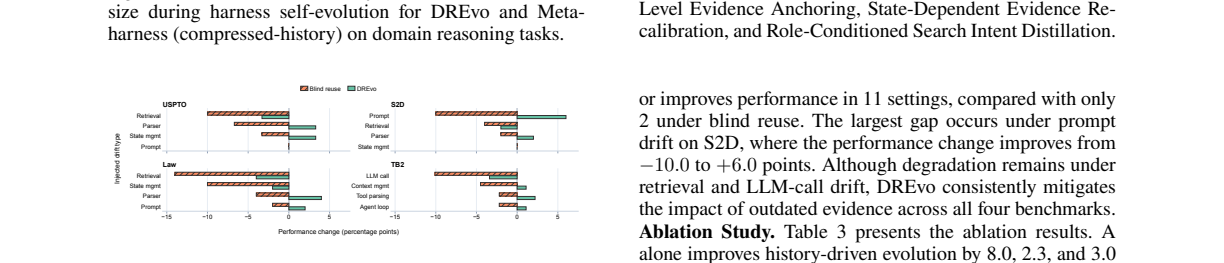
What they do well: the diagnosis matches Figure 1’s non-stationary baselines; the three modules are coherent and ablate in the right direction (Table 3); trajectories are smoother with a bounded ~3K proposer context (Figure 3); the controlled drift study (Figure 4) is the right kind of stress test and favors recalibration over blind reuse. Domain reasoning has a proper val/test split, and evolving a terminal seed into competitive SWE-Bench numbers is a practical result people in this subfield will care about.
Soft spots, in proportion. The load-bearing one is protocol, not the AST/polarity proxies: agentic evolution and evaluation run on the same original suites with no held-out split, and the paper itself says the gains are benchmark-specific adaptation. So the ~14% agentic average and the “highest on all five” claim should be read as better fit under a fixed budget on those suites, not as reliable discovery of general harnesses. Secondary: single-run point estimates, no seeds/error bars, no artifacts, and attribution still leans on trial-level Δ plus a single-component preference—fine as engineering, weak as causal isolation. Minor manuscript slip: abstract agentic gain flips between 13.8% and 14.2%.
Math is lightweight bookkeeping (const, freshness, TED, harmonic-style weight), not deep theory; citations cover the right harness and self-evolution lines. For anyone building coding/terminal agents or history-driven search under API budgets, this is worth a careful read. I would send it to peer review; I would not treat the agentic averages as transferable without a held-out protocol and variance.
The strongest objection
The strongest claim is that under limited budgets DREvo yields smoother trajectories and the highest accuracy on all five benchmarks (avg +16.2% domain reasoning, +14.2% agentic). Domain reasoning uses validation for evolution and a held-out test set. Agentic tasks do not: “we perform harness self-evolution and evaluation on the original agentic benchmark suites without additional splits” (Experimental Setups), with the proposer receiving structured harness-level evidence from those same logs. The paper itself notes gains “reflect benchmark-specific harness adaptation rather than generalizable improvement on unseen tasks.” So the agentic half of the headline (TB2 42.7, SWE-Bench Verified 67.6, and the ~14% average) is measured on the same suite used to drive propose–evaluate–recalibrate loops. Ablations and the Figure 4 drift test still operate inside that loop; they do not separate search stabilization from suite-specific overfitting. If the central claim is read as reliable discovery of high-performing harnesses (not just better fit to the evolution suite), same-suite agentic protocol is the least secure condition—more decisive for the reported averages than whether Δt polarity or AST TED (Eqs. 2–6) is a perfect causal proxy.
The reader correctly flags unreproducible LLM-agent empirics, missing variance, and the Δt/single-edit + AST compatibility proxies (Eqs. 2–6) as reasons for CONDITIONAL/MODERATE. Those proxies are real limitations: multi-component edits get w_e=0.5, polarity is trial-global, and TED is only a structural proxy. But the paper already stress-tests state drift (Figure 4) and ablations (Table 3), and domain reasoning does use a val/test split. The more load-bearing threat to the strongest claim as stated—highest on all five, with ~14% agentic average under limited budgets—is the explicit same-suite agentic protocol. Without a held-out agentic check, smoother trajectories and ablations can still reflect tighter adaptation to the suite being optimized rather than stable, transferable harness search. That keeps the verdict CONDITIONAL (artifacts, multi-seed variance, and especially a clear held-out agentic protocol) rather than pushing to REJECT or ACCEPT. Agreement with the reader is partial: same family of concerns (causal attribution + eval hygiene), but the single most decisive soft spot for the headline numbers is same-suite agentic eval, not the AST/polarity mechanism in isolation.
The referee's report
If the claims hold under stronger evaluation, the work is a useful contribution to agent harness engineering and automated agent design. It cleanly frames a practical failure mode—unstable history-driven search under limited budgets—and proposes an operational pipeline that makes evidence locality, validity, and next-step intent explicit rather than leaving them to the proposer’s implicit reasoning. Strengths include a coherent three-part design, ablations that attribute gains to anchoring, recalibration, and distillation, a controlled drift study (Figure 4), and held-out test evaluation on the domain-reasoning suite. The agentic results are practically interesting because evolution starts from a terminal-oriented harness and reaches competitive SWE-Bench numbers. The significance is tempered by evaluation and statistical gaps that currently limit how far the headline averages can be trusted as evidence of reliable harness discovery rather than suite-specific adaptation.
Pith's reading of the paper (a machine's summary, not the authors')
LLM agents depend heavily on their harness—the code and scaffolding that manages context, tools, memory, and output—but designing a strong harness by hand is expensive. Prior self-evolution methods keep stacking trial logs or summaries and hope the proposer will invent better harnesses from that pile. This paper argues that raw accumulation is unstable: old evidence can become stale as the harness changes, and history rarely says which component to touch next. DREvo fixes both problems by anchoring feedback to functions, reweighting each piece of evidence by how reliable and structurally compatible it still is, and distilling the surviving evidence into a role-conditioned search intent (exploit, avoid, retest, or explore). Under tight iteration budgets, that pipeline yields smoother trajectories and the best reported accuracy on five domain-reasoning and agentic benchmarks.
What carries the argument. DREvo: three linked steps—(1) function-level evidence anchoring that turns trial logs into component-scoped evidence units with polarity and weight, (2) state-dependent recalibration that multiplies historical reliability (consistency × freshness) with AST structural compatibility of the anchored function, and (3) role-conditioned search intent distillation that partitions evidence into exploit/avoid/retest/explore and tells the proposer where and how to evolve next.
Core claim. Under limited evolution budgets, history-driven harness self-evolution fails mainly because experience is treated as statically valid and because search direction stays implicit. DREvo shows that function-level evidence anchoring, state-dependent recalibration of that evidence, and role-conditioned distillation into an explicit search intent produce smoother evolution and the highest accuracy on all five evaluated benchmarks, with average gains of 16.2% on domain reasoning and about 14% on agentic tasks over the baselines tested.
The premise it rests on. A trial’s overall score change plus a preference for single-function edits, together with AST tree-edit distance on that function, is enough to decide whether past evidence still applies and how strongly it should steer the next change.
If the paper is right (Pith's inferences, not the authors')
Harness self-evolution should treat historical trials as state-dependent evidence, not as a growing static context dump.
Explicit search roles (exploit, avoid, retest, explore) can replace leaving component choice and edit direction entirely to the proposer’s implicit reasoning.
Under fixed iteration budgets, smoother non-regressing trajectories become a practical success criterion alongside final accuracy.
A terminal-oriented starting harness can be evolved into a competitive code-repair harness without manual task-specific redesign if evidence is recalibrated and targeted.
Future systems can extend the same loop to cross-component calibration and adaptive role policies over longer horizons.
The same validity-plus-intent pattern may transfer to other expensive iterative agent design loops (tool APIs, memory policies, multi-agent protocols) where rollouts are costly.
If semantic drift often outruns AST similarity, richer behavioral fingerprints of functions could become the next bottleneck for recalibration.
Bounded proposer context (~3K tokens) with structured intent suggests gains come from better search policy, not from simply feeding more history.
Check this review
Pith stored no record of this review's passes and took no fingerprint of it. Reviews made by code from 13 Nov 2026 on carry both.
How often reviews like this one are right
Reviews like this one: written by grok-4.5, where what was read was not recorded.
How often objections from reviews like this one are right: not yet measured
Reviews by people
This review was written by a machine. No person has reviewed this paper on Pith yet. A scientist listed on Pith can review it for a fee, and their review is published here whatever it concludes.
The paper
Abstract
Harness plays a critical role in large language model agent performance, and building a high-performing harness requires substantial expert effort. Therefore, recent research has increasingly explored harness self-evolution, which iteratively proposes, evaluates, and improves harnesses using historical trial experience. However, accumulated historical experience does not always translate into stable search guidance, and performance often fluctuates substantially across evolution iterations, making it difficult to reliably discover high-performing harnesses under a limited evolution budget. We identify two limitations in how existing harness self-evolution methods leverage historical experience: (1) Lack of dynamic reassessment of whether historical experience remains valid for the current harness, and (2) Lack of explicit mechanisms for translating valid historical experience into actionable search directions. To address these limitations, we propose a new harness self-evolution method, named DREvo, which integrates function-level evidence anchoring, state-dependent evidence recalibration, and role-conditioned search intent distillation to determine which historical evidence remains valid and where the harness should evolve next. Under limited evolution budgets, DREvo exhibits smoother evolution trajectories, achieves the highest accuracy on all five benchmarks, and delivers average gains of 16.2% and 14.2% over the evaluated baselines on domain reasoning and agentic tasks, respectively.
The paper's own sentences, arranged, kept beside the review and separate from it. Each label is drawn from a closed vocabulary; the number beside it is the probability the classifier gave that label. No sentence in this record was written by a model.
abstract compiled · 2026-09-23
The authors' main claim, as the classifier picked it out 1.00
“Under limited evolution budgets, DREvo exhibits smoother evolution trajectories, achieves the highest accuracy on all five benchmarks, and delivers average gains of 16.2% and 14.2% over the evaluated baselines on domain reasoning and agentic tasks, respectively.”
How the main claim is stated: asserted 1.00
What the abstract itself states, as probabilities: claims first 0.05 · states limitation 0.08 · human participants 0.03 · controlled comparison 0.89 · randomized assignment 0.01 · states quantitative result 0.99 · compares with prior results 0.98 · mentions code or data availability 0.02
The abstract, sentence by sentence
This table labels the abstract only (arXiv listing abstract v2). The number is the probability the classifier gave the label.
| Sentence | Role | The authors' own work | States the main conclusion | Strength |
|---|---|---|---|---|
| Harness plays a critical role in large language model agent performance, and building a high-performing harness requires substantial expert effort. | background 1.00 | 0.06 | 0.02 | asserted 1.00 |
| Therefore, recent research has increasingly explored harness self-evolution, which iteratively proposes, evaluates, and improves harnesses using historical trial experience. | background 1.00 | 0.04 | 0.03 | asserted 0.98 |
| However, accumulated historical experience does not always translate into stable search guidance, and performance often fluctuates substantially across evolution iterations, making it difficult to reliably discover high-performing harnesses under a limited evolution budget. | gap 0.58 | 0.19 | 0.04 | asserted 0.92 |
| We identify two limitations in how existing harness self-evolution methods leverage historical experience: (1) Lack of dynamic reassessment of whether historical experience remains valid for the current harness, and (2) Lack of explicit mechanisms for translating valid historical experience into actionable search directions. | gap 0.98 | 0.59 | 0.04 | asserted 1.00 |
| To address these limitations, we propose a new harness self-evolution method, named DREvo, which integrates function-level evidence anchoring, state-dependent evidence recalibration, and role-conditioned search intent distillation to determine which historical evidence remains valid and where the harness should evolve next. | method 0.53 | 0.87 | 0.11 | asserted 1.00 |
| Under limited evolution budgets, DREvo exhibits smoother evolution trajectories, achieves the highest accuracy on all five benchmarks, and delivers average gains of 16.2% and 14.2% over the evaluated baselines on domain reasoning and agentic tasks, respectively. | result 1.00 | 0.96 | 0.84 | asserted 1.00 |
What kind of paper the classifier reports this is: method or tool 1.00 · evidence from observation or experiment 0.92
What was examined, and what was not
Sources read
- arXiv listing abstract v2
Not examined
- full text
- figures and tables
- references and citing sentences
- relations to other papers
Levels run
- P abstract
Not run
- S sections
- T body sentences
- C citations
- R cross-paper relations
How the labels were made
Compiled by classifier-1.13.0 via TypeSafe API, question bank abstract-p1-20260923, 2026-09-23: 1 request, 5,195 input tokens.
Every quoted sentence on this record is the authors'. Every label is from Pith's closed vocabulary, with the probability shown beside it. This record as JSON
Figures (4)


Figures are the authors', reproduced from the paper.
Cited by 5 Pith papers
Reviewed papers on Pith that cite this one. OpenAlex reports about 6 citations worldwide. The full citation record
- ActiveSaddler: Automated Curriculum Learning for Agent Harness Optimization cs.AI · Oct 2026
- Mixture of Self-Improving Branches For Agent Harness Optimization cs.AI · Sep 2026
- AutoSaddler: Automatic Harness Optimization with Durable Updates from Agent Execution Traces cs.AI · Aug 2026
- Task-CoEvolve: Efficient Harness Optimization via Adaptive Validation Task Selection cs.CL · Aug 2026
- RSIV-Harness: A Recursive Self-Improvement Harness Framework for Open-Domain Conversational Text-to-Visualization cs.AI · Oct 2026
How the literature uses it
2 arXiv papers cite this in 2 sentences
Papers citing it
Cites it as background 2 papers
-
Recently, automated harness optimization has begun to attract considerable attention, where a meta-level agent iteratively rewrites the harness code, evaluates the resulting candidates on a benchmark, and retains changes that improve performance [ref] .
Task-CoEvolve: Efficient Harness Optimization via Adaptive Validation Task Selection · Introduction · 0.82
-
Recent contemporaneous studies [These works appeared during the final stage of this work preparation or the subsequent peer-review period.] have further expanded automatic harness optimization through observability-driven evolution [ref] , diagnosis- and weakness-guided repair [ref] , Bayesian configuration search [ref] , historical-experience recalibration [ref] , self-supervised retrospective optimization [ref] , generalization-oriented constrained evolution [ref] , experience-driven test-time adaptation [ref] , and joint optimization of harnesses and model weights [ref] .
AutoSaddler: Automatic Harness Optimization with Durable Updates from Agent Execution Traces · Related Work · 0.85
What it cites · 7 sentences without a confident label
Cites as background 6 papers
-
Existing harness self-evolution methods, such as Meta-harness [ref] , AHE [ref] , and ACE [ref] , typically follow a history-driven paradigm.
Agentic Context Engineering: Evolving Contexts for Self-Improving Language Models · Introduction · 0.90
-
Existing harness self-evolution methods, such as Meta-harness [ref] , AHE [ref] , and ACE [ref] , typically follow a history-driven paradigm.
Meta-Harness: End-to-End Optimization of Model Harnesses · Introduction · 0.90
-
Existing harness self-evolution methods, such as Meta-harness [ref] , AHE [ref] , and ACE [ref] , typically follow a history-driven paradigm.
Agentic Harness Engineering: Observability-Driven Automatic Evolution of Coding-Agent Harnesses · Introduction · 0.90
Challenges and discussion
Disagree with the review, or know something it missed? Leave a comment, or challenge this review formally: a challenge becomes a permanent entry in this paper's record, and its decision is published here.
Come back by email
A short list of the week's newly reviewed papers. Nothing is sent until you confirm from your inbox, and every email has a link that stops it. No account.
No comments yet.
Sign in to comment