REVIEW 2 major objections 6 minor 33 references
Two-state generator extraction: property currents and a two-layer arrow of time in pre- and post-selected quantum dynamics
T0 review · 2 major / 6 minor · reviewed 2026-07-30 · grok-4.5
Pith's one-line read Conditioning on past and future splits measured friction into a reversible boundary arrow and an irreversible inference artifact, so the arrow of time has two layers.
desk verdict Clean theorem-plus-numerics paper: the γ_A/γ_S split is real and useful; the portable “both layers reverse under exact derivative” claim is only fully checked for the involution-preserving ensemble at N=8. read the letter →
The pith
A machine-rendered reading of the paper's core claim, the machinery that carries it, and where it could break.
The reading
What carries the argument
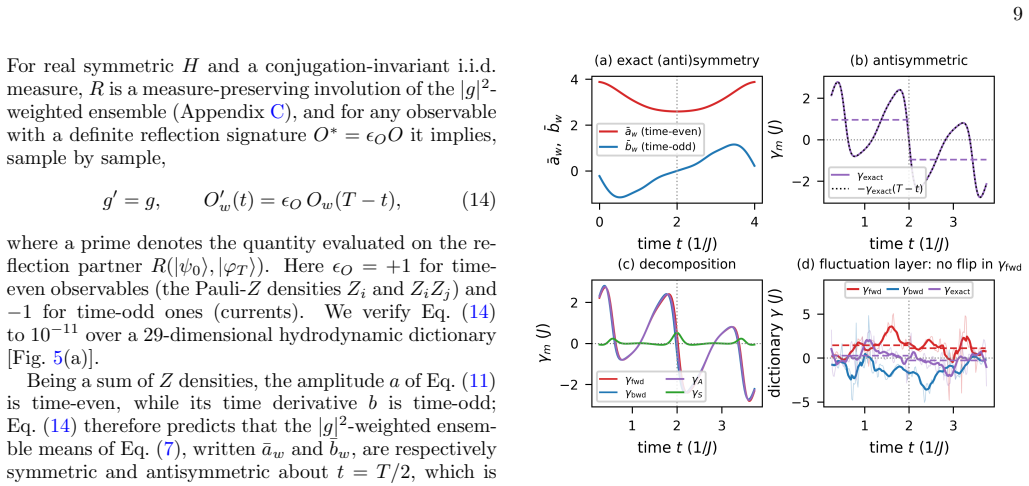
Two-state gEDMD plus the reflection involution: because weak values obey dA_w/dt = i⟨[H,A]⟩_w exactly, generator regression applies unchanged and supplies an exact-derivative baseline; the involution then forces the unique split γ_fwd = γ_A + γ_S and makes the physical and inferential arrows operationally separable.
What would settle it
On a reflection-paired ensemble with independent conditioning, check whether the half-window mode friction reverses while the dictionary-layer forward friction stays positive at the stated coarse-graining interval, and whether both reverse when the exact derivative replaces finite differences; failure of the sample-level identity O'_w(t) = ε_O O_w(T−t) to machine precision would kill the theorem.
Extended reading notes
Core claim
A reflection involution on the pre-/post-selected ensemble forces every window-fitted friction to decompose uniquely as γ_fwd = γ_A + γ_S, with γ_A antisymmetric about the midpoint and carrying the boundary-condition physics of coherent modes, and γ_S symmetric and generated by the differencing scheme; both are obtained from the same data as (γ_fwd ± γ_bwd)/2. At fixed inference resolution the arrow of time therefore has two layers: modes reverse, fluctuations do not, because γ_S is roughly 34 times larger at the fluctuation layer—yet with the exact derivative both reverse. Independently, port-only conditioning on a lattice interferometer produces unimposed Cheshire-cat property currents, wi
Load-bearing premise
The exact symmetry proof needs a real-symmetric Hamiltonian and independently drawn, conjugation-invariant boundary seeds; a complex Hamiltonian or a post-selection built from the evolved state breaks the argument as written.
Editorial extensions
If this is right
- Whether a conditioned observer sees a reversing arrow is decided by the measurable inequality |γ_A| ≷ γ_S at that layer and resolution, not by interpretation.
- The brightest post-selection class sharing the same boundary modulation can be used at large N without changing the physics, removing the exponential overlap obstruction.
- Cheshire-cat separation is a dynamical pair of conservation laws readable from trajectories, not only a single-instant assignment.
- Apparent friction that scales with the differencing interval and vanishes under the exact derivative is an estimator artifact, not a property of the ensemble.
- The same decomposition applies wherever effective dynamics is inferred from trajectories with both-end boundary conditions, including classical fluctuation paths.
Reading between the lines
- Experiments that report friction or dissipation under pre- and post-selection should publish both forward and backward estimators so readers can separate γ_A from γ_S.
- The factor-of-two phase response to a local field is a clean weak-measurement signature that could be sought in existing Cheshire-cat neutron or photon setups.
- If the sketched time-reversal extension for complex Hamiltonians holds, the two-layer split would apply to systems with magnetic fluxes and driven interferometers.
- Self-averaging at large dimension suggests that boundary modulation design matters more than fine subspace structure for scalable two-state inference.
Editorial analysis
A structured set of objections, weighed in public.
Referee Report
Summary. The manuscript introduces two-state gEDMD, transferring generator extraction to complex weak-value trajectories via the exact identity dA_w/dt = i⟨[H,A]⟩_w. Two main results follow. First, a reflection involution on pre-/post-selected ensembles forces every window-fitted friction to split uniquely as γ_fwd = γ_A + γ_S (antisymmetric boundary-condition part plus symmetric differencing artifact), both measurable as (γ_fwd ± γ_bwd)/2; at fixed inference resolution coherent modes reverse about the midpoint while the fluctuation layer does not, because γ_S is ~34× larger there, yet both reverse under the exact derivative. Second, in a port-conditioned lattice interferometer the Cheshire-cat structure emerges unimposed as separate continuity equations for particle and polarization, with a local field rotating only the polarization phase at exactly 2B and appearing as a rigid imaginary generator shift. The involution identity and two-layer structure are verified from D=2^8 to 2^20, with self-averaging removing the 2^{-N/2} brightness obstruction among classes sharing a boundary modulation.
Significance. If the claims hold, the paper supplies an operational, measurable criterion (|γ_A| ≷ γ_S) for when a time-symmetric description exhibits a reversing arrow, separating boundary-condition physics from estimator artifacts. The Appendix C lemma/theorem chain is clean under stated hypotheses; sample-level identities at 10^{-14}–10^{-13} up to D=2^{20}, machine-precision interferometer responses (exact 2B precession, particle density invariant to ~10^{-16}), and the self-averaging route around the overlap obstruction are genuine strengths. The portable methodological half—decompose measured friction before interpreting it as physics—extends beyond the specific models to smoothed estimation and classical fluctuation-path settings. Code availability and labelled numerical checks further raise the evidentiary standard.
major comments (2)
- [Sec. IV D, Sec. VI E, Table II, Abstract] The headline claim that fluctuation-layer immunity is a property of the inference (not the ensemble) rests on exact-derivative dictionary-layer friction reversing about the midpoint (Sec. IV D: antisymmetric to 9.6×10^{-13}, half-window averages ±0.274). That control is reported only for the independent, involution-preserving class at N=8. Appendix C and Sec. VI E state that guaranteed antisymmetry of γ_exact requires independent conjugation-invariant seeds and real-symmetric H. The scalable N=20 results (Table II, Fig. 11) use bright classes built from |ψ(T)⟩ that break measure preservation. Sec. IV E already flags that “the dictionary layer of a class that breaks the involution” is “the one place where conditioning leaves no trace of reversal at all,” yet no exact-derivative dictionary-layer run is given for any involution-breaking class at either size (fifth limitation, Sec. VI E). Ei
- [Appendix B, Table IV, Table II, Sec. V B] At N=20 the quoted mode-layer reversal depths depend strongly on the post-hoc ill-conditioned-window threshold q. Appendix B, Table IV shows the second-half γ_exact for mask X f=1/16 moving from −0.030 at q=0 to −0.198 at the adopted q=0.15 (and to −0.605 at q=0.30); depths in Table II are therefore convention-dependent summaries even though the sign is stable. The paper already reports threshold-insensitive residuals ρ_A/ρ_S, which is the right diagnostic. The main-text and Table II emphasis should be shifted onto those residuals (and onto P(flip)), with half-window depths clearly labelled as convention-dependent, so that magnitude comparisons across classes and sizes are not over-read.
minor comments (6)
- [Sec. IV D, Appendix B] The factor-of-34 comparison of γ_S between layers (Sec. IV D) is quoted at a single Δt_cg=0.04; Appendix B shows γ_S ∝ Δt_cg, so the numerical factor should be stated together with the resolution, as is done for the no-flip inequality elsewhere.
- [Fig. 5, Fig. 11] Fig. 5(c)–(d) and Fig. 11 would benefit from an explicit panel or inset of |γ_A|/γ_S versus window center (or versus Δt_cg) so the dominance claim is visible without reading off dashed levels from the text.
- [Sec. I] The companion paper [1] is cited as under review (arXiv:2605.05604). For stand-alone readability, a one-paragraph restatement of what causal gEDMD returns (positive forward friction, vanishing time-symmetric friction) would help readers who lack [1].
- [Sec. I, Sec. II D] Notation: A_w, (A)_w and ⟨A⟩_w are declared interchangeable, but the text also uses overlines for |g|^2-weighted ensemble means; a short notation table in Appendix A would reduce load.
- [Sec. III B] In Sec. III B point 2, P_x is introduced in the same sentence as a warning not to confuse it with the overlap g; breaking that sentence and defining P_x in a displayed equation would help.
- [Table III] Table III lists C(Δt_cg) inconsistently across columns (40 / 20 / 10) while physical Δt_cg is 0.4 / 0.04 / 0.04; stating Δt_cg in time units in the table header would avoid misreading.
Circularity Check
No load-bearing circularity: equivariance is proved from the involution; the γ_A/γ_S split is then the standard even/odd decomposition, and companion [1] is not required for the new claims.
-
self definitional
[Sec. IV C, Eqs. (3),(16); Appendix C Theorem (unique decomposition)]
"Consequently every measured friction splits uniquely as in Eq. (3), with γ_A = 1/2 (γ_fwd + γ_bwd), γ_S = 1/2 (γ_fwd − γ_bwd), where γ_A(t) = −γ_A(T−t) agrees with the exact-derivative friction ... while γ_S(t) = +γ_S(T−t) is the coarse-graining artifact"
After Lemma 3 establishes γ_fwd(t)=−γ_bwd(T−t), the quoted split is exactly the unique decomposition of any function into antisymmetric plus symmetric parts under t↔T−t. No further dynamical content enters Eqs. (3)/(16). The paper does prove equivariance from the involution rather than assuming the split; the mild circularity is only presentational—treating the automatic even/odd decomposition as a substantive uniqueness theorem beyond the symmetry already shown.
full rationale
The central derivation chain is self-contained. Appendix C proves the reflection involution from stated hypotheses (real-symmetric H, conjugation-invariant independent seeds), then estimator equivariance under that involution, then the unique split γ_fwd = γ_A + γ_S. The only mild self-definitional note is that once γ_fwd(t) = −γ_bwd(T−t) holds, γ_A = (γ_fwd+γ_bwd)/2 and γ_S = (γ_fwd−γ_bwd)/2 are the unique antisymmetric/symmetric parts by linear algebra—not an extra physical input. That is ordinary mathematics, not a fitted or smuggled premise. The exact-derivative identity dA_w/dt = i⟨[H,A]⟩_w is a standard two-state consequence used as a baseline, not fitted. Companion [1] supplies the causal gEDMD/friction backdrop; the involution, two-layer comparison under post-selection, Cheshire continuity/response, and N=20 scaling do not reduce to it or to any fitted parameter renamed as prediction. Cheshire structure and the 2B spectral shift are direct numerical consequences of the port-conditioned dynamics, not ansatz imports. Score 1 only for the presentational elevation of the automatic even/odd split; no step forces the headline physics by construction.
Assumptions & free parameters
free parameters (5)
- boundary modulation strength ε =
0.35 (main); scanned 0.15–0.80
- coarse-graining interval Δt_cg =
0.04 (chains); 0.4 (interferometer Table I)
- ill-conditioned window threshold q =
0.15
- dictionary content and size =
29 / 77 elements
- ensemble size M and |g| rejection =
M=160 (N=8 paired); 128–320 per class at N=20
assumptions (6)
- standard math Weak values of time-independent A under shared unitary evolution obey dA_w/dt = i⟨[H,A]⟩_w exactly with constant overlap g.
- domain assumption Hamiltonian is real symmetric in the computational basis (H^*=H=H^T), so propagators satisfy U(t)^T=U(t).
- domain assumption Pre- and post-selection seeds are i.i.d. from a conjugation-invariant measure; independent class draws φ_T independently of ψ.
- standard math Window-fitting estimators (mode OLS and truncated POD least squares) are fixed linear-algebraic maps of the trajectory segment, equivariant under time reversal of the segment.
- domain assumption Markovian truncation of Mori–Zwanzig / finite dictionary gEDMD yields a meaningful reduced generator for the chosen observables.
- domain assumption Observables in the dictionary have definite reflection signatures O^*=ε_O O (time-even densities, time-odd currents).
invented entities (2)
-
two-state gEDMD
independent evidence
-
two-layer arrow of time (γ_A vs γ_S dominance)
independent evidence
Cite this review
Pith. "Pith review of Two-state generator extraction: property currents and a two-layer arrow of time in pre- and post-selected quantum dynamics." pith.science (2026). https://pith.science/paper/OD74H7ZH
@misc{pith2026260726999,
  author       = {Pith},
  title        = {Pith review of: Two-state generator extraction: property currents and a two-layer arrow of time in pre- and post-selected quantum dynamics},
  year         = {2026},
  howpublished = {\url{https://pith.science/paper/OD74H7ZH}},
  note         = {Machine review of arXiv:2607.26999}
}
abstract
Conditioning on both past and future assigns intermediate-time properties a causal observer does not; these time-symmetric assignments obey exact symmetry theorems and are measurable from trajectories. We use two-state generator extended dynamic mode decomposition (gEDMD): because weak values obey $dA_w/dt=i\langle[H,A]\rangle_w$ exactly, generator extraction, with an exact-derivative baseline, applies unchanged to them. First, a reflection involution on the pre-/post-selected ensemble splits every window-fitted friction uniquely as $\gamma_{fwd}=\gamma_A+\gamma_S$: $\gamma_A$, antisymmetric about the midpoint, carries the modes' boundary-condition physics; $\gamma_S$, symmetric, comes from the differencing scheme; both follow from the same data as $(\gamma_{fwd}\pm\gamma_{bwd})/2$. At a fixed inference resolution the arrow of time has two layers: the coherent-mode arrow reverses at the midpoint, the fluctuation-level one does not, $\gamma_S$ dominating $\gamma_A$ at every size and class. The difference is one of degree: $\gamma_S$ is 34 times larger there than at the mode layer, and with the exact derivative both layers reverse: immunity belongs to the inference, not the ensemble. Second, in a lattice interferometer conditioned only at its ports, the quantum Cheshire-cat structure emerges unimposed: particle and polarization obey separate continuity equations, and a local field in the polarization-carrying arm rotates that phase alone, at exactly twice the field strength, entering the generator as a rigid imaginary shift, while the particle's weak density stays invariant to machine precision. We verify the sample-level identity and the two layers from $2^8$ to $2^{20}$ dimensions: $|\gamma_A|/\gamma_S=0.09$ to $0.27$ across five classes; self-averaging makes it insensitive to class among those sharing a boundary modulation, removing the $2^{-N/2}$ overlap obstruction for $N$ qubits.
Figures


Figures from the paper (6 more)


Reference graph
Works this paper leans on
-
[1]
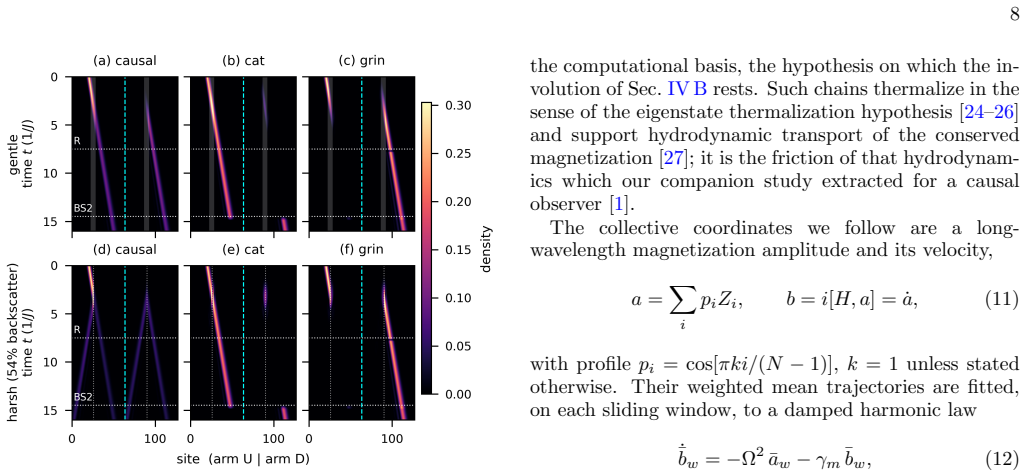
The particle’s weak density is unchanged to 2.2× 10⁻¹⁶
-
[2]
(1), the total polarization amplitude in arm D, advances at rate exactly 2B(measured +0.30000 forB= 0.15)
The polarization’s phaseθ≡argP x, withP x =P i∈D (σxni)w, not to be confused with the overlap gof Eq. (1), the total polarization amplitude in arm D, advances at rate exactly 2B(measured +0.30000 forB= 0.15). The factor of two is a two-state effect:|ψ⟩and|φ⟩carry oppositeσ z eigenvalues on rail D and accumulate the phase from both the past and the future boundary
-
[3]
The rate encodes the present field, the offset the future one
Before the field is switched on, the phase is already offset by−BW; with the field in arm U the offset is +BWand the rate is exactly zero (−1.6×10 −17). The rate encodes the present field, the offset the future one
-
[4]
cat”) density, confined to arm U. (d) Conditioned polarization (“grin
The response is invisible in the causal description (3.1×10 −15) and in the post-selection probability |g|2. In the language of Sec. II B, the field enters as a source in theproperty’s ownconservation law, d dt (σxni)w =−∇·(j σx )w −2B(σ yni)w ,(9) where (jσx )w is the polarization current, i.e. Eq. (4) with S=σ x, and∇ ·the lattice divergence− P j of Eq....
2001
-
[5]
S. Saito, Temporal coarse-graining as the origin of macro- scopic friction in quantum spin chains via data-driven liouvillian extraction (2026), under review at Physical Review Research, arXiv:2605.05604 [quant-ph]
arXiv 2026
-
[6]
Aharonov, P
Y. Aharonov, P. G. Bergmann, and J. L. Lebowitz, Phys. Rev.134, B1410 (1964)
1964
-
[7]
Aharonov, D
Y. Aharonov, D. Z. Albert, and L. Vaidman, Phys. Rev. Lett.60, 1351 (1988)
1988
-
[8]
Tsang, Phys
M. Tsang, Phys. Rev. Lett.102, 250403 (2009)
2009
Show all 33 references
-
[9]
Gammelmark, B
S. Gammelmark, B. Julsgaard, and K. Mølmer, Phys. Rev. Lett.111, 160401 (2013)
2013
-
[10]
Chantasri, I
A. Chantasri, I. Guevara, K. T. Laverick, and H. M. Wiseman, Phys. Rep.930, 1 (2021)
2021
-
[11]
Aharonov, S
Y. Aharonov, S. Popescu, D. Rohrlich, and P. Skrzypczyk, New J. Phys.15, 113015 (2013)
2013
-
[12]
Denkmayr, H
T. Denkmayr, H. Geppert, S. Sponar, H. Lemmel, A. Matzkin, J. Tollaksen, and Y. Hasegawa, Nat. Com- mun.5, 4492 (2014)
2014
-
[13]
Aharonov, E
Y. Aharonov, E. Cohen, and S. Popescu, A current of the cheshire cat’s smile: Dynamical analysis of weak values (2015), arXiv:1510.03087 [quant-ph]
2015 arXiv
-
[14]
Aharonov, E
Y. Aharonov, E. Cohen, and S. Popescu, Nat. Commun. 12, 4770 (2021)
2021
-
[15]
Corrˆ ea, M
R. Corrˆ ea, M. F. Santos, C. H. Monken, and P. L. Sal- 21 danha, New J. Phys.17, 053042 (2015)
2015
-
[16]
Duprey, S
Q. Duprey, S. Kanjilal, U. Sinha, D. Home, and A. Matzkin, Ann. Phys.391, 1 (2018)
2018
-
[17]
J. R. Hance, J. Ladyman, and J. Rarity, New J. Phys. 26, 073038 (2024)
2024
-
[18]
J. R. Hance, M. Ji, and H. F. Hofmann, New J. Phys. 25, 113028 (2023)
2023
-
[19]
Liu, W.-W
Z.-H. Liu, W.-W. Pan, X.-Y. Xu, M. Yang, J. Zhou, Z.- Y. Luo, K. Sun, J.-L. Chen, J.-S. Xu, C.-F. Li, and G.-C. Guo, Nat. Commun.11, 3006 (2020)
2020
-
[20]
Waegell, J
M. Waegell, J. Tollaksen, and Y. Aharonov, Quantum8, 1536 (2024)
2024
-
[21]
M. O. Williams, I. G. Kevrekidis, and C. W. Rowley, J. Nonlinear Sci.25, 1307 (2015)
2015
-
[22]
S. Klus, F. N¨ uske, P. Koltai, H. Wu, I. Kevrekidis, C. Sch¨ utte, and F. No´ e, J. Nonlinear Sci.28, 985 (2018)
2018
-
[23]
S. Klus, F. N¨ uske, S. Peitz, J.-H. Niemann, C. Clementi, and C. Sch¨ utte, Physica D406, 132416 (2020)
2020
-
[24]
Mori, Prog
H. Mori, Prog. Theor. Phys.33, 423 (1965)
1965
-
[25]
Zwanzig, J
R. Zwanzig, J. Stat. Phys.9, 215 (1973)
1973
-
[26]
H. M. Wiseman, New J. Phys.9, 165 (2007)
2007
-
[27]
Kocsis, B
S. Kocsis, B. Braverman, S. Ravets, M. J. Stevens, R. P. Mirin, L. K. Shalm, and A. M. Steinberg, Science332, 1170 (2011)
2011
-
[28]
J. M. Deutsch, Phys. Rev. A43, 2046 (1991)
-
[29]
Srednicki, Phys
M. Srednicki, Phys. Rev. E50, 888 (1994)
1994
-
[30]
Rigol, V
M. Rigol, V. Dunjko, and M. Olshanii, Nature452, 854 (2008)
2008
-
[31]
Bertini, F
B. Bertini, F. Heidrich-Meisner, C. Karrasch, T. Prosen, R. Steinigeweg, and M. ˇZnidariˇ c, Rev. Mod. Phys.93, 025003 (2021)
2021
-
[32]
T. Guff, C. U. Shastry, and A. Rocco, Sci. Rep.15, 3658 (2025)
2025
-
[33]
Onsager and S
L. Onsager and S. Machlup, Phys. Rev.91, 1505 (1953)
1953
Reviewed July 30, 2026 · model on record in the stance chip above.
Discussion (0). Continue with ORCID to comment.