REVIEW 49 references
Modular quantum processors can run fault-tolerant logical CNOTs across links an order of magnitude noisier than local gates, with only a small drop in the error threshold.
Reviewed by Pith at T0; open to challenge. T0 means a machine referee read the full paper against a public rubric. the ladder, T0–T4 →
T0 review · grok-4.5
2026-07-30 10:53 UTC pith:WK3WXJK7
load-bearing objection Solid systems-QEC paper: circuit-level distributed lattice-surgery CNOT thresholds hold up under a simple interface model, plus a clean vertex-cover reduction for GHZ ancillas; the α≃20 headline is only half-derived.
Fault-Tolerant Logical Operations and Efficient State Preparation in Modular Quantum Architectures with Noisy Interfaces
The pith
A machine-rendered reading of the paper's core claim, the machinery that carries it, and where it could break.
Core claim
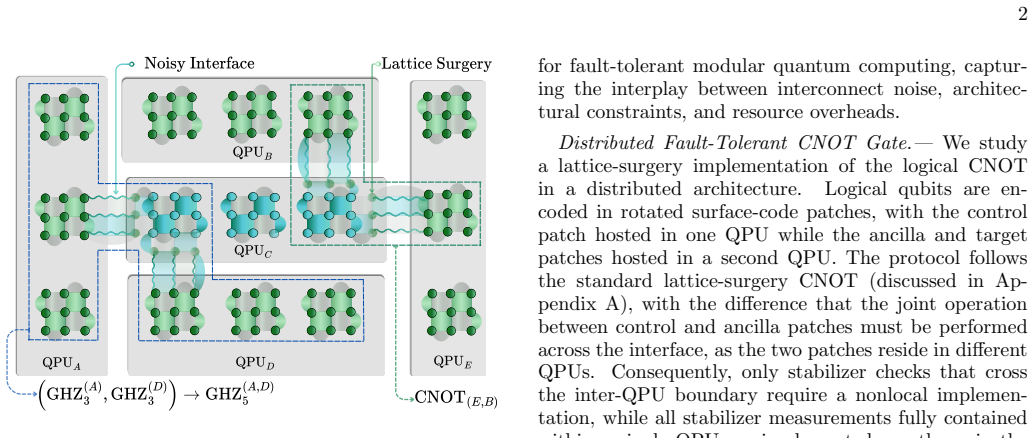
Circuit-level simulations of lattice-surgery CNOTs between rotated surface-code patches on different QPUs show that raising the inter-QPU two-qubit error rate to about twenty times the local rate (α ≈ 20) lowers the fault-tolerance threshold by only about 2–3 × 10⁻³ relative to the fully local case. Threshold behavior is dominated by local gates because the nonlocality ratio stays small. The same nonlocal CNOT is then used to fuse local logical GHZ states into a global one, with ancilla placement reduced to a minimum vertex cover on a spanning tree of the QPU graph.
What carries the argument
Nonlocal lattice-surgery CNOT mediated by noisy Bell pairs (interface noise parameter α), together with the nonlocality ratio N_nl/N_l that explains why local noise still sets the threshold; ancilla minimization cast as minimum vertex cover on a spanning tree, solved by a greedy Star-Search heuristic.
Load-bearing premise
Interface noise is treated as a fixed depolarizing multiplier α ≈ 20 obtained by counting extra fault locations and assuming Bell-pair infidelity of order 10ε, without a hardware-specific entanglement model or correlated/biased errors.
What would settle it
Repeat the same circuit-level surface-code CNOT simulations (or a hardware experiment) with a realistic Bell-pair generation channel whose effective error is far above 20× local depolarizing noise or is strongly correlated; if the distributed–monolithic threshold gap then grows large or the threshold disappears, the resilience claim fails.
If this is right
- Modular surface-code architectures need not demand interconnect fidelity comparable to local gates to stay below threshold for logical CNOTs.
- Logical multipartite entanglement (GHZ) across modules can be prepared with only n−1 nonlocal fusions and a minimized ancilla footprint given by a tree vertex cover.
- Star-like network layouts minimize ancilla count at the cost of sequential fusion depth O(n); more branched trees trade ancillas for near-logarithmic depth.
- Resource estimates and compilers for modular FTQC can treat noisy interfaces as a secondary error budget once the nonlocality ratio is kept small.
Where Pith is reading between the lines
- If the nonlocality-ratio argument generalizes, other lattice-surgery primitives (multi-target CNOTs, magic-state injection across modules) may inherit similar interface tolerance without new threshold analyses for every gate.
- The vertex-cover framing suggests network topology itself becomes a first-class design knob: choosing QPU connectivity to admit low-cover spanning trees could cut physical ancilla overhead more than improving Bell-pair fidelity alone.
- Latency and classical communication rounds from gate teleportation are left outside the noise model; including them could reintroduce a time–error trade-off that the static α model hides.
Editorial analysis
A structured set of objections, weighed in public.
Circularity Check
No significant circularity: thresholds come from independent circuit-level Monte Carlo, and the ancilla–vertex-cover link is a proved reduction, not a restatement of inputs.
full rationale
The load-bearing quantitative claim—that inter-QPU two-qubit noise at α≈20 yields only a ~2–3×10⁻³ drop in the lattice-surgery CNOT threshold relative to the monolithic α=1 case—is obtained from circuit-level Stim/LOOM Monte Carlo under an explicit depolarizing model (Eq. 1), not by fitting α or the threshold gap to data. Appendix C sets α≃20 by a first-order fault-location count (α_TeleGate≃10ε from the teleportation circuit plus a stipulated α_Bell≃10ε); that is a modeling choice, not a fitted input renamed as a prediction, and the simulations then report outcomes under that choice. The nonlocality-ratio bounds in Appendix B are gate-count identities used to interpret why local noise dominates; they do not force the simulated logical error rates. On the GHZ side, Theorem 1 proves that ancilla minimization under Algorithm 1 equals min_T τ(T) (and τ(T)=ν(T) on trees by König); this is a standard graph-theoretic reduction from the protocol’s merge constraints, not a circular self-definition. The protocol is inspired by Ref. [48] (overlapping first author), but that citation supplies a prior unencoded fusion idea; the surface-code embedding, resource trade-offs, vertex-cover theorem, and Star-Search heuristic are developed and evidenced in this paper. No uniqueness theorem is imported to forbid alternatives, and no ansatz is smuggled in as a derived law. Overall the derivation chain is self-contained against its stated noise model and graph setup.
Axiom & Free-Parameter Ledger
free parameters (2)
- interface noise factor α =
20 (simulations); α=1 monolithic baseline
- Erdős–Rényi edge probability p in ancilla numerics =
p=0.3
axioms (6)
- domain assumption Circuit-level independent depolarizing noise after each 1q/2q gate, with nonlocal 2q gates using error probability α·ε
- domain assumption Logical CNOT realized by lattice surgery (ZZ then XX merges/splits plus ancilla Z measurement) on rotated surface-code patches
- domain assumption Nonlocal physical CNOTs implemented by gate teleportation on noisy Bell pairs whose imperfections are absorbed into α
- ad hoc to paper Under Algorithm 1, every fusion edge needs an ancilla-enabled endpoint, so feasible ancilla sets are vertex covers of the fusion spanning tree
- standard math König’s theorem: on bipartite graphs (hence trees), minimum vertex cover equals maximum matching
- domain assumption Identical noise for data/syndrome and control/ancilla/target qubits; decoding by minimum-weight matching (PyMatching)
invented entities (1)
-
Star-Search spanning-tree heuristic (Algorithm 2)
no independent evidence
read the original abstract
Modular quantum computing is a leading paradigm for scaling quantum computation beyond the resource limitations of monolithic devices. In this architecture, multiple quantum processing units (QPUs), employing identical or distinct qubit modalities, are interconnected via shared entanglement. Here, we investigate how errors at module interfaces and within individual QPUs affect fault-tolerant computation when qubits are encoded using the rotated surface code. Going beyond the logical-memory benchmark, we perform circuit-level simulations of fault-tolerant nonlocal CNOT gates implemented via lattice surgery between QPUs connected by noisy Bell pairs, and analyze the resulting logical error rates. Our results show that interfaces can tolerate noise up to an order of magnitude higher than intra-QPU noise, with only a minor reduction in the fault-tolerance threshold. We further develop an efficient protocol for preparing distributed fault-tolerant logical GHZ states, reducing ancilla overhead, time, and nonlocal Bell-pair consumption. We show that ancilla minimization in this setting is equivalent to a vertex-cover problem on an associated graph, and introduce a polynomial-time heuristic algorithm for finding low-overhead solutions. Our results provide quantitative evidence that distributed quantum error correction can enable scalable, fault-tolerant quantum computation in modular architectures.
Figures


Reference graph
Works this paper leans on
-
[1]
Caleffi, M
M. Caleffi, M. Amoretti, D. Ferrari, J. Illiano, A. Man- zalini, and A. S. Cacciapuoti, Distributed quantum com- puting: A survey, Computer Networks254, 110672 (2024)
2024
-
[2]
Barralet al., Review of Distributed Quantum Com- puting: From single QPU to High Performance Quan- tum Computing, Computer Science Review57, 100747 (2025)
D. Barralet al., Review of Distributed Quantum Com- puting: From single QPU to High Performance Quan- tum Computing, Computer Science Review57, 100747 (2025)
2025
-
[3]
Diamanti and J
E. Diamanti and J. Laurat, Quantum connectivity for scale, Opt. Photon. News37, 24 (2026)
2026
-
[4]
J. I. Cirac, A. K. Ekert, S. F. Huelga, and C. Mac- chiavello, Distributed quantum computation over noisy channels, Physical Review A59, 4249 (1999)
1999
-
[5]
Monroe, R
C. Monroe, R. Raussendorf, A. Ruthven, K. R. Brown, P. Maunz, L.-M. Duan, and J. Kim, Large-scale mod- ular quantum-computer architecture with atomic mem- ory and photonic interconnects, Physical Review A89, 022317 (2014)
2014
-
[6]
N. H. Nickerson, J. F. Fitzsimons, and S. C. Benjamin, Freely scalable quantum technologies using cells of 5-to- 50 qubits with very lossy and noisy photonic links, Phys- ical Review X4, 041041 (2014)
2014
-
[7]
Sunami, S
S. Sunami, S. Tamiya, R. Inoue, H. Yamasaki, and A. Goban, Scalable networking of neutral-atom qubits: Nanofiber-based approach for multiprocessor fault-tolerant quantum computers, PRX Quantum6, 010101 (2025)
2025
-
[8]
Gottesman and I
D. Gottesman and I. L. Chuang, Demonstrating the via- bility of universal quantum computation using teleporta- tion and single-qubit operations, Nature402, 390 (1999)
1999
-
[9]
Eisert, K
J. Eisert, K. Jacobs, P. Papadopoulos, and M. B. Ple- nio, Optimal local implementation of nonlocal quantum gates, Physical Review A62, 052317 (2000)
2000
-
[10]
Andr´ es-Mart ´ ınez and C
P. Andr´ es-Mart ´ ınez and C. Heunen, Automated distri- bution of quantum circuits via hypergraph partitioning, Physical Review A100, 032308 (2019)
2019
-
[11]
Mengoni, W
R. Mengoni, W. Nadalin, M. Rennela, J. Rotureau, T. Darras, J. Laurat, E. Diamanti, and I. Lavdas, Effi- cient gate reordering for distributed quantum compiling in data centers, EPJ Quantum Technology13, 65 (2026)
2026
-
[12]
de Bone, P
S. de Bone, P. M¨ oller, C. E. Bradley, T. H. Taminiau, and D. Elkouss, Thresholds for the distributed surface code in the presence of memory decoherence, A VS Quantum Science6, 033801 (2024)
2024
-
[13]
J. Sinclair, J. Ramette, B. Grinkemeyer, D. Bluvstein, M. Lukin, and V. Vuleti´ c, Fault-tolerant optical intercon- nects for neutral-atom arrays (2024), arXiv:2408.08955 [quant-ph]
Pith/arXiv arXiv 2024
-
[14]
Jacinto, ´E
H. Jacinto, ´E. Gouzien, and N. Sangouard, Network re- quirements for distributed quantum computation, Phys- 6 ical Review Research8, 013205 (2026)
2026
-
[15]
Sutcliffe, B
E. Sutcliffe, B. Jonnadula, C. Le Gall, A. E. Moylett, and C. M. Westoby, Distributed quantum error correc- tion based on hyperbolic floquet codes, in2025 IEEE In- ternational Conference on Quantum Computing and En- gineering (QCE)(IEEE, 2025) p. 649–657
2025
-
[16]
A. E. Moylett and B. Jonnadula, Logical gates on flo- quet codes via folds and twists (2026), arXiv:2512.17999 [quant-ph]
arXiv 2026
-
[17]
Eastin and E
B. Eastin and E. Knill, Restrictions on transversal en- coded quantum gate sets, Physical Review Letters102, 110502 (2009)
2009
-
[18]
Horsman, A
D. Horsman, A. G. Fowler, S. Devitt, and R. Van Meter, Surface code quantum computing by lattice surgery, New Journal of Physics14, 123011 (2012)
2012
-
[19]
Litinski and F
D. Litinski and F. v. Oppen, Lattice surgery with a twist: Simplifying clifford gates of surface codes, Quantum2, 62 (2018)
2018
-
[21]
Chamberland and E
C. Chamberland and E. T. Campbell, Universal quantum computing with twist-free and temporally encoded lattice surgery, PRX Quantum3, 010331 (2022)
2022
-
[22]
Kitaev, Fault-tolerant quantum computation by anyons, Annals of Physics303, 2 (2003)
A. Kitaev, Fault-tolerant quantum computation by anyons, Annals of Physics303, 2 (2003)
2003
-
[23]
Litinski, A game of surface codes: Large-scale quan- tum computing with lattice surgery, Quantum3, 128 (2019)
D. Litinski, A game of surface codes: Large-scale quan- tum computing with lattice surgery, Quantum3, 128 (2019)
2019
-
[24]
T. H. Haug, T. Hillmann, A. F. Kockum, and R. V. Laer, Lattice surgery with bell measurements: Modular fault- tolerant quantum computation at low entanglement cost (2025), arXiv:2510.13541 [quant-ph]
arXiv 2025
-
[25]
G. Q. AI and Collaborators, Quantum error correction below the surface code threshold, Nature638, 920–926 (2024)
2024
-
[26]
Acharyaet al., Suppressing quantum errors by scaling a surface code logical qubit, Nature614, 676 (2023)
R. Acharyaet al., Suppressing quantum errors by scaling a surface code logical qubit, Nature614, 676 (2023)
2023
-
[27]
Bluvstein, S
D. Bluvstein, S. J. Evered, A. A. Geim, S. H. Li, H. Zhou, T. Manovitz, S. Ebadi, M. Cain, M. Kali- nowski, D. Hangleiter, J. P. Bonilla Ataides, N. Maskara, I. Cong, X. Gao, P. Sales Rodriguez, T. Karolyshyn, G. Semeghini, M. J. Gullans, M. Greiner, V. Vuleti´ c, and M. D. Lukin, Logical quantum processor based on reconfigurable atom arrays, Nature626, 58 (2023)
2023
-
[28]
L. Weipinget al., Surface code logical operations on a superconducting quantum processor (2026), arXiv:2607.01473 [quant-ph]
Pith/arXiv arXiv 2026
-
[29]
J. E. Bourassa, R. N. Alexander, M. Vasmer, A. Patil, I. Tzitrin, T. Matsuura, D. Su, B. Q. Baragiola, S. Guha, G. Dauphinais, K. K. Sabapathy, N. C. Menicucci, and I. Dhand, Blueprint for a scalable photonic fault-tolerant quantum computer, Quantum5, 392 (2021)
2021
-
[30]
Awschalomet al., Development of quantum intercon- nects (quics) for next-generation information technolo- gies, PRX Quantum2, 017002 (2021)
D. Awschalomet al., Development of quantum intercon- nects (quics) for next-generation information technolo- gies, PRX Quantum2, 017002 (2021)
2021
-
[31]
J. P. Covey, H. Weinfurter, and H. Bernien, Quantum networks with neutral atom processing nodes, npj Quan- tum Information9, 90 (2023)
2023
-
[32]
Aghaee Radet al., Scaling and networking a modular photonic quantum computer, Nature638, 912 (2025)
H. Aghaee Radet al., Scaling and networking a modular photonic quantum computer, Nature638, 912 (2025)
2025
-
[33]
Bombin and M
H. Bombin and M. A. Martin-Delgado, Optimal resources for topological two-dimensional stabilizer codes: Com- parative study, Phys. Rev. A76, 012305 (2007)
2007
-
[34]
A. G. Fowler, A. C. Whiteside, and L. C. L. Hollen- berg, Towards practical classical processing for the sur- face code, Phys. Rev. Lett.108, 180501 (2012)
2012
-
[35]
Van Meter, K
R. Van Meter, K. Nemoto, W. Munro, and K. Itoh, Distributed arithmetic on a quantum multicomputer, in 33rd International Symposium on Computer Architecture (ISCA’06)(2006) pp. 354–365
2006
-
[36]
Entropica Labs, EL Loom (2026)
2026
-
[37]
Gidney, Stim: a fast stabilizer circuit simulator, Quan- tum5, 497 (2021)
C. Gidney, Stim: a fast stabilizer circuit simulator, Quan- tum5, 497 (2021)
2021
-
[38]
Higgott and C
O. Higgott and C. Gidney, Sparse Blossom: correcting a million errors per core second with minimum-weight matching, Quantum9, 1600 (2025)
2025
-
[39]
Hyllus, W
P. Hyllus, W. Laskowski, R. Krischek, C. Schwem- mer, W. Wieczorek, H. Weinfurter, L. Pezz´ e, and A. Smerzi, Fisher information and multiparticle entan- glement, Physical Review A85, 022321 (2012)
2012
-
[40]
Kielinski, P
T. Kielinski, P. O. Schmidt, and K. Hammerer, Ghz pro- tocols enhance frequency metrology despite spontaneous decay, Science Advances10, eadr1439 (2024)
2024
-
[41]
D. Main, P. Drmota, D. P. Nadlinger, E. M. Ainley, A. Agrawal, B. C. Nichol, R. Srinivas, G. Araneda, and D. M. Lucas, Distributed quantum computing across an optical network link, Nature638, 383–388 (2025)
2025
-
[42]
S. A. Moseset al., A race-track trapped-ion quantum processor, Physical Review X13, 041052 (2023)
2023
-
[43]
Baoet al., Creating and controlling global greenberger- horne-zeilinger entanglement on quantum processors, Na- ture Communications15, 8823 (2024)
Z. Baoet al., Creating and controlling global greenberger- horne-zeilinger entanglement on quantum processors, Na- ture Communications15, 8823 (2024)
2024
-
[44]
D. Cruz, R. Fournier, F. Gremion, A. Jeannerot, K. Komagata, T. Tosic, J. Thiesbrummel, C. L. Chan, N. Macris, M.-A. Dupertuis, and C. Javerzac-Galy, Effi- cient quantum algorithms for ghz and w states, and im- plementation on the ibm quantum computer, Advanced Quantum Technologies2, 1900015 (2019)
2019
-
[45]
K.-C. Chen, Short-depth circuits and error mitigation for large-scale ghz-state preparation, and benchmarking on ibm’s 127-qubit system, in2023 IEEE International Con- ference on Quantum Computing and Engineering (QCE), Vol. 02 (2023) pp. 207–210
2023
-
[46]
A. Javadi-Abhari, S. Martiel, A. Seif, M. Takita, and K. X. Wei, Big cats: entanglement in 120 qubits and beyond (2025), arXiv:2510.09520 [quant-ph]
arXiv 2025
-
[47]
S. S. Chelluri, S. Schuster, Sumeet, and R. Roma, Shallow-depth ghz state generation on nisq devices (2025), arXiv:2507.19145 [quant-ph]
Pith/arXiv arXiv 2025
-
[48]
S. S. Chelluri, S. Khatri, and P. van Loock, A resource- and computationally-efficient protocol for multipartite entanglement distribution in bell-pair networks, npj Quantum Information12, 101 (2026)
2026
-
[49]
R. M. Karp, Reducibility among combinatorial prob- lems, inComplexity of Computer Computations, edited by R. E. Miller and J. W. Thatcher (Plenum Press, New York, 1972) pp. 85–103
1972
-
[50]
Newman,Networks: An Introduction(Oxford Uni- versity Press, Oxford, 2010)
M. Newman,Networks: An Introduction(Oxford Uni- versity Press, Oxford, 2010). 7 SUPPLEMENT AR Y MA TERIAL Appendix A: Local F ault-T olerant CNOT Logical Clifford operations admit a complete descrip- tion in the framework of stabilizer theory, acting by au- tomorphisms of the Pauli group. Given a unitary ˆUits action is fully specified by its symplectic a...
2010
discussion (0)
Sign in with ORCID, Apple, or X to comment. Anyone can read and Pith papers without signing in.