REVIEW 3 major objections 5 minor 47 references
The anti-commuting ghost of the Faddeev–Popov procedure is not a bookkeeping artifact: it is the connection one-form on the bundle of gauge potentials over the physical quotient, and BRST is the vertical exterior derivative along gauge orbi
Reviewed by Pith at T0; open to challenge. T0 means a machine referee read the full paper against a public rubric. the ladder, T0–T4 →
T0 review · deepseek-v4-flash
2026-08-01 10:01 UTC pith:DSDGHFQC
load-bearing objection A philosophically ambitious and mostly sound paper, but the central identification of the ghost with the full field-space connection overreaches; the ghost is the vertical shadow of the connection, not the connection itself. the 3 major comments →
Ghosts that Connect
The pith
A machine-rendered reading of the paper's core claim, the machinery that carries it, and where it could break.
Core claim
On this account, the ghost η is literally the connection one-form ϖ on the principal bundle A→A/G: at each gauge potential A, ϖ reads off the vertical (pure-gauge) component of any tangent vector, so the ghost encodes how much of a field variation is just a change of gauge. The BRST operator s is the vertical exterior derivative along the gauge orbits, and the two BRST transformation laws—sA=Dη and sη=−½[η,η]—are the vertical projection of the Cartan structure equation satisfied by any principal connection. Because the vertical distribution is involutive, s²=0 follows from geometry. The Faddeev–Popov determinant uses only ϖ's vertical content, which is why the older algebraic reading capture
What carries the argument
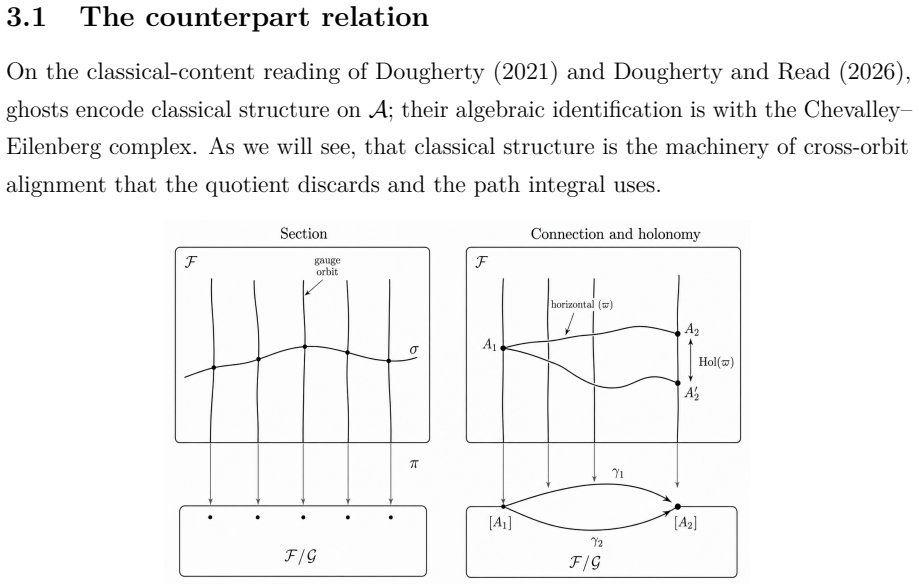
The central object is a principal connection ϖ on the infinite-dimensional principal bundle A→A/G, defined by ϖ(X#)=X and equivariance R_g^*ϖ=Ad_{g^{-1}}ϖ; its kernel is the horizontal complement to the gauge orbits. The load-bearing identity is η↔ϖ, which transposes the anticommutativity of wedge products of field-space one-forms to the Grassmann algebra of spacetime fields, and the identification s↔δ_V of the BRST operator with the leafwise exterior derivative. The vertical Cartan structure equation δ_V ϖ = −½[ϖ,ϖ] yields the Maurer–Cartan equation sη=−½[η,η]; nilpotency follows from involutivity of the vertical distribution. The canonical example is the ultralocal orthogonal-projection co
Load-bearing premise
The identification of the ghost with the full connection depends on treating a spacetime Grassmann field as a field-space one-form, i.e., transferring the wedge anticommutativity of forms onto the field's anticommutation; if the ghost is only the vertical shadow of the connection rather than the whole connection, the central claim collapses.
What would settle it
Modify the horizontal part of the field-space connection while keeping its vertical projection fixed. If the Faddeev–Popov determinant, BRST transformations, and all gauge-invariant amplitudes remain identical while the holonomy changes, then the ghost is only the vertical content, not the full connection; if some amplitude tracks the holonomy, the identification is supported.
If this is right
- The Faddeev–Popov ghost encodes a real classical structure—the vertical/horizontal splitting of field space—so the quotient A/G is genuinely less structured than A for quantisation purposes.
- BRST is a rigid vertical symmetry, not a gauge symmetry; its survival after gauge-fixing is expected and unproblematic, which removes the apparent tension of Puzzle (2).
- The horizontal content of the connection, invisible to the algebraic reading and to the Faddeev–Popov determinant, is what makes possible cross-orbit comparisons in path-integral quantisation, dressing constructions, and counterfactual reasoning.
- In non-Abelian theories the global Gribov obstruction forbids a flat connection, so the counterpart relation must be path-dependent, realized by parallel transport and measured by holonomy, connecting the gauge-fixing problem to best-matching relational dynamics.
- The gauge-fixing sector (antighost and Nakanishi–Lautrup field) is BRST-exact and belongs to the slice, not to the bundle; this explains why physical amplitudes are gauge-fixing independent.
Where Pith is reading between the lines
- Inference: if the ghost is truly the full field-space connection, ghosts may acquire additional roles beyond the vertical sector—for instance, in anomalies, where the relevant cohomology could be the non-flat cohomology of ϖ rather than ordinary Lie-algebra cohomology; the paper leaves this as an open question.
- Inference: the same geometric move may transfer to diffeomorphism-invariant theories such as general relativity, where the field-space connection would encode a relational alignment between metrics and generalise best-matching; the paper hints at this but does not develop it.
- Inference: a concrete extension would be to construct observables that depend on the horizontal Wilson line of ϖ and test whether they are gauge-fixing independent; if they are, the horizontal content is physically measurable even though absent from the standard Faddeev–Popov determinant.
- Inference: because a particular connection is conventional but some connection is not, different gauge-fixings are not merely different coordinate choices but different counterpart relations; this could sharpen the debate about sophistication about symmetries, which typically treats quotient individuation as sufficient.
Editorial analysis
A structured set of objections, weighed in public.
Referee Report
Summary. The paper proposes a geometric interpretation of the Faddeev–Popov ghost in Yang–Mills theory. The central claim is that the ghost field η is the principal connection ϖ on the infinite-dimensional bundle A → A/G of gauge potentials over physical configurations; the BRST operator s is the vertical (leafwise) exterior derivative δ_V along gauge orbits; and the Maurer–Cartan equation sη = −½[η,η] is the vertical Cartan structure equation. On this reading the paper claims to dissolve two puzzles: (Puzzle 1) ghosts encode the vertical/horizontal splitting—and thereby the cross-orbit pairing—that the quotient A/G discards, and (Puzzle 2) BRST survives gauge-fixing because it is the rigid, vertical symmetry that preserves that pairing. The paper further connects this picture to the Gribov–Singer obstruction to global flatness, the Vilkovisky–DeWitt programme, best-matching relationalism, and debates about sophistication about symmetries. The antighost and Nakanishi–Lautrup field are explicitly scoped to the gauge-fixing slice in Appendix A.
Significance. The paper is clearly written and displays a genuine command of the geometric material. The derivation of the BRST laws from the vertical Cartan structure equation is mathematically clean, and the distinction between the ghost sector and the gauge-fixing doublet (Appendix A) is a useful clarification. If the central identification η ↔ ϖ were fully valid, the paper would provide a unified geometric account that connects the algebraic treatment of ghosts (Chevalley–Eilenberg) with the Vilkovisky–DeWitt programme and the Gribov obstruction. The paper is also honest about its scope and open questions. However, as argued below, the central identification is stronger than the derivations support: the BRST algebra uses only the vertical part of ϖ, so the ghost cannot, as stated, encode the vertical/horizontal splitting or the cross-orbit pairing. This weakens the claimed dissolution of Puzzle (1) and the associated philosophical conclusions. The underlying geometry is sound, and the paper could be revised to a more defensible claim, but the present formulation is overreaching.
major comments (3)
- [§4.1, Eqs. (22)–(23), (26)] The identification η ↔ ϖ is not supported by the derivations that follow. The BRST operator is defined as the leafwise exterior derivative δ_V along gauge orbits (Eq. 22), and Eq. (26) is obtained by restricting the Cartan structure equation to vertical arguments, where the curvature F vanishes. On vertical tangent vectors the value of ϖ is fixed by the fundamental-field condition (18) and is independent of the horizontal complement ker ϖ. Consequently the BRST transformations (8) and the Faddeev–Popov operator M[A] (Eq. 31) depend only on the vertical restriction of ϖ; two connections with identical vertical parts but different horizontal distributions give the same BRST algebra. The paper's own abstract concedes this: 'the Faddeev–Popov calculus draws only on ϖ's vertical content.' Thus the ghost is at most the vertical part of ϖ—the Maurer–Cartan form on the gauge group—not the full c
- [§4.1, Eq. (23), type correspondence] The transposition of wedge anticommutativity on A to Grassmann anticommutativity on spacetime is asserted, not proven. Eq. (24) shows that both η and ϖ take values in LieG ≅ Ω^0(M,g), but this is a type-level matching. A one-form on A evaluates on tangent vectors, while a spacetime field has pointwise values. The claim that η(x)η(y) = −η(y)η(x) is the same statement as the anticommutativity of ϖ under the wedge product requires a precise map between forms on field space and fields on spacetime; the paper does not supply such a map. This matters particularly because the horizontal part of ϖ, if included, would not have a direct spacetime field counterpart. The paper should either provide a rigorous correspondence or weaken the identification to the vertical restriction.
- [§5.1, 'economy' argument] The claim that the connection reading is more economical because it 'derives rigidity and the Maurer–Cartan equation from the single identification η = ϖ' is undermined by the previous two points. The derivation of Eq. (26) uses only the vertical part of ϖ, which is already present in the algebraic (Chevalley–Eilenberg) reading. The additional horizontal content that distinguishes the connection reading is not used by the BRST algebra. Therefore the economy argument does not favour the connection reading over the algebraic reading unless the identification is made precise and shown to involve the full connection, which the paper does not do.
minor comments (5)
- [Footnote 21] The isomorphism LieG ≅ Ω^0(M,g) is only valid for a trivial principal bundle. The footnote acknowledges this, but since the ghost is a section of the adjoint bundle in the non-trivial case, it would be clearer to use Γ(adP) throughout the main text rather than relegating this to a footnote.
- [§2.2 and Appendix A] The sign and factor conventions for the Nakanishi–Lautrup field B are confusing: Eq. (8) has sη̄ = iB and sB = 0, while Appendix A works with B replaced by iB. A single consistent convention, stated before Eq. (8), would improve readability.
- [§3.2] The term 'rigid' is used in two senses: ε is a Grassmann scalar (no spacetime dependence), and η is configuration-independent as an integration field. The paper distinguishes these, but the repeated use of 'rigid' without a glossary may mislead readers. A short clarification or a different term for one of the two senses would help.
- [Figures] Figures 1 and 2 are schematic. Figure 2 in particular would benefit from a caption that explicitly states the analogy between the spacetime principal bundle P → M and the field-space bundle A → A/G, since the paper's argument relies on that analogy.
- [§4.1, text before Eq. (23)] The sentence 'η as a field and ϖ as a one-form are the same object' is too quick, especially in light of the major comments. At minimum, the qualification 'in its vertical restriction' should be added, or the sentence should be removed and replaced with a careful statement of what is being identified.
Circularity Check
No significant circularity; the ghost–connection identification is an interpretive mapping with an explicitly acknowledged scope caveat.
full rationale
The paper's central move is to interpret the ghost η as a functional connection ϖ on A→A/G (Eq. 23) and the BRST operator as the leafwise vertical exterior derivative δ_V (Eq. 22). The subsequent derivation of the BRST laws is a genuine formal consistency check, not a circular reduction: the geometric input is the connection axioms (18)–(19), from which the vertical Cartan structure equation δ_Vϖ = −½[ϖ,ϖ] and δ_V A = Dϖ follow; these reproduce, rather than presuppose, the independently stated BRST algebra (8). The identification itself is stipulated as an interpretation, and the paper expressly concedes that the Faddeev–Popov calculus uses only ϖ's vertical content — a scope limitation that weakens the strength of the philosophical claim but does not make the derivation equivalent to its inputs. The self-citations (Gomes and Riello 2017; Gomes 2025, 2026) supply constructive machinery and prior interpretive framing, but the load-bearing mathematical facts — principal-bundle geometry, the Maurer–Cartan structure equation, nilpotency from involutivity of the vertical distribution, and the Gribov–Singer obstruction — are independently established or externally checkable (Singer 1978; Diez and Rudolph 2019). No fitted parameter is renamed as a prediction, no uniqueness theorem is imported from the authors' own work, and no central result collapses by definition into its assumptions. Under the stated rules, there is no established circular step, so the appropriate finding is no significant circularity.
Axiom & Free-Parameter Ledger
free parameters (1)
- Choice of functional connection ϖ (equivalently, a G-invariant supermetric for the Singer–DeWitt connection)
axioms (5)
- domain assumption Field space A→A/G is a principal G-bundle on the irreducible stratum.
- ad hoc to paper Identifying the ghost field η with the connection one-form ϖ (with LieG ≅ Ω^0(M,g)) is legitimate.
- domain assumption Gauge-fixing provides a counterpart relation across orbits; the quotient alone does not.
- standard math Singer's theorems (no global section; no flat connection for SU(N) on S^4/S^3).
- standard math Standard Cartan structure equation and Frobenius theorem for principal connections.
read the original abstract
The Faddeev--Popov procedure poses two conceptual puzzles. \emph{Puzzle~(1)}: if gauge-equivalent configurations represent the same physics, the quotient $\F/\G$ should suffice to compute physical amplitudes --- yet the procedure requires anti-commuting auxiliary fields, the ghosts, with no analogue on the quotient. What structure of $\F$ do they encode? \emph{Puzzle~(2)}: gauge-fixing was supposed to eliminate local gauge symmetry, yet the gauge-fixed theory retains BRST --- a residual symmetry that acts on the gauge potential as an infinitesimal gauge transformation. Why does it survive? Both puzzles dissolve together. Following \textcite{Dougherty2021} and \textcite{DoughertyRead2026}, I take ghosts to encode classical content of $\F \to \F/\G$, but identify a different structure: a principal connection $\varpi$ on this bundle. The ghost is $\varpi$; the BRST operator is the vertical exterior derivative on field space; the Maurer--Cartan equation is its vertical Cartan structure equation. The Faddeev--Popov calculus draws only on $\varpi$'s vertical content, which the algebraic reading also captures; $\varpi$'s horizontal content, on which the Vilkovisky--DeWitt programme rests, supplies the cross-orbit pairing that gauge-fixing, dressing-based quantisation, and counterfactual comparison require and the quotient discards. BRST is the rigid, vertical symmetry that preserves this pairing; this is why it survives gauge-fixing.
Figures


Reference graph
Works this paper leans on
-
[1]
and Viallet, C
Babelon, O. and Viallet, C. M. (1979). The Geometric Interpretation of the Faddeev--Popov Determinant. Physics Letters B 85, 246--248
1979
-
[2]
and Viallet, C
Babelon, O. and Viallet, C. M. (1981). The Riemannian Geometry of the Configuration Space of Gauge Theories. Communications in Mathematical Physics 81, 515--525
1981
-
[3]
Barbour, J. (2003). Scale-Invariant Gravity: Particle Dynamics. Classical and Quantum Gravity 20, 1543--1570
2003
-
[4]
and Bertotti, B
Barbour, J. and Bertotti, B. (1982). Mach's Principle and the Structure of Dynamical Theories. Proceedings of the Royal Society A 382, 295--306
1982
-
[5]
Batalin, I. A. and Vilkovisky, G. A. (1981). Gauge Algebra and Quantization. Physics Letters B 102, 27--31
1981
-
[6]
and Stora, R
Becchi, C., Rouet, A. and Stora, R. (1976). Renormalization of Gauge Theories. Annals of Physics 98, 287--321
1976
-
[7]
Belot, G. (2003). Notes on Symmetries. In K. Brading and E. Castellani (eds.), Symmetries in Physics: Philosophical Reflections, 393--412. Cambridge University Press
2003
-
[8]
Bertlmann, R. A. (2000). Anomalies in Quantum Field Theory. Oxford University Press
2000
-
[9]
and Cotta-Ramusino, P
Bonora, L. and Cotta-Ramusino, P. (1983). Some Remarks on BRS Transformations, Anomalies and the Cohomology of the Lie Algebra of the Group of Gauge Transformations. Communications in Mathematical Physics 87, 589--603
1983
-
[10]
and Verch, R
Brunetti, R., Fredenhagen, K. and Verch, R. (2003). The Generally Covariant Locality Principle---A New Paradigm for Local Quantum Field Theory. Communications in Mathematical Physics 237(1--2), 31--68
2003
-
[11]
and H\"ohn, P
Carrozza, S. and H\"ohn, P. A. (2022). Edge Modes as Reference Frames and Boundary Actions from Post-Selection. Journal of High Energy Physics 2022(2)
2022
-
[12]
S., Mnev, P
Cattaneo, A. S., Mnev, P. and Reshetikhin, N. (2014). Classical BV Theories on Manifolds with Boundary. Communications in Mathematical Physics 332, 535--603
2014
-
[13]
Caulton, A. (2015). The Role of Symmetry in the Interpretation of Physical Theories. Studies in History and Philosophy of Modern Physics 52, 153--162
2015
-
[14]
Dai, X. and Freed, D. S. (1994). -Invariants and Determinant Lines. Journal of Mathematical Physics 35(10), 5155--5194. arXiv:hep-th/9405012
Pith/arXiv arXiv 1994
-
[15]
Dewar, N. (2017). Sophistication about Symmetries. British Journal for the Philosophy of Science 70(2), 485--521
2017
-
[16]
DeWitt, B. S. (2003). The Global Approach to Quantum Field Theory. Oxford University Press
2003
-
[17]
and Rudolph, G
Diez, T. and Rudolph, G. (2019). Slice Theorem and Orbit Type Stratification in Infinite Dimensions. Differential Geometry and its Applications 65, 176--211
2019
-
[18]
Donkin, I. and Pawlowski, J. M. (2012). The Phase Diagram of Quantum Gravity from Diffeomorphism-Invariant RG Flows. arXiv:1203.4207
Pith/arXiv arXiv 2012
-
[19]
and Freidel, L
Donnelly, W. and Freidel, L. (2016). Local Subsystems in Gauge Theory and Gravity. Journal of High Energy Physics 2016(9), 102
2016
-
[20]
Dougherty, J. (2021). I Ain't Afraid of No Ghost. Studies in History and Philosophy of Science 88, 70--84
2021
-
[21]
and Read, J
Dougherty, J. and Read, J. (2026). Conceptual Aspects of Non-Positive Quantization. Manuscript
2026
-
[22]
Ebin, D. (1970). The Manifold of Riemannian Metrics. In Proceedings of Symposia in Pure Mathematics 15, 11--40. American Mathematical Society
1970
-
[23]
Faddeev, L. D. and Popov, V. N. (1967). Feynman Diagrams for the Yang--Mills Field. Physics Letters B 25, 29--30
1967
-
[24]
Goeller, C., H\"ohn, P. A. and Kirklin, J. (2022). Diffeomorphism-Invariant Observables and Dynamical Frames in Gravity: Reconciling Bulk Locality with General Covariance. arXiv:2206.01193
Pith/arXiv arXiv 2022
-
[25]
Gomes, H. (2025). Representational Schemes for Theories with Symmetry. Synthese 206(1)
2025
-
[26]
Gomes, H. (2026). Background-Relative Sophistication. Manuscript, arXiv:2602.13708
arXiv 2026
-
[27]
and Riello, A
Gomes, H. and Riello, A. (2017). The Observer's Ghost: Notes on a Field Space Connection. Journal of High Energy Physics 2017(5), 017
2017
-
[28]
and Riello, A
Gomes, H., Hopfm\"uller, F. and Riello, A. (2019). A Unified Geometric Framework for Boundary Charges and Dressings: Non-Abelian Theory and Matter. Nuclear Physics B 941, 249--315
2019
-
[29]
Gribov, V. N. (1978). Quantization of Nonabelian Gauge Theories. Nuclear Physics B 139, 1--19
1978
-
[30]
and Gomes, H
Gryb, S. and Gomes, H. (2021). Turbo-Charging Relationalism. Studies in History and Philosophy of Modern Physics
2021
-
[31]
Healey, R. (2007). Gauging What's Real: The Conceptual Foundations of Gauge Theories. Oxford University Press
2007
-
[32]
and Marsden, J
Isenberg, J. and Marsden, J. E. (1982). A Slice Theorem for the Space of Solutions of Einstein's Equations. Physics Reports 89, 179--222
1982
-
[33]
Kment, B. (2012). Haecceitism, Chance, and Counterfactuals. Philosophical Review 121(4), 573--609
2012
-
[34]
and Rogulski, J
Kondracki, W. and Rogulski, J. (1983). On the Stratification of the Orbit Space for the Action of Automorphisms on Connections. Polish Academy of Sciences, Institute of Mathematics
1983
-
[35]
Leinaas, J. M. and Olaussen, K. (1981). Ghosts and Geometry. CERN Preprint TH-3061
1981
-
[36]
and Read, J
March, E. and Read, J. (2025). What is this sophistication thing anyway? Manuscript
2025
-
[37]
Mitter, P. K. and Viallet, C. M. (1981). On the Bundle of Connections and the Gauge Orbit Manifold in Yang--Mills Theory. Communications in Mathematical Physics 79, 457--472
1981
-
[38]
Pawlowski, J. M. (2003). Geometrical Effective Action and Wilsonian Flows. arXiv:hep-th/0310018
Pith/arXiv arXiv 2003
-
[39]
Peskin, M. E. and Schroeder, D. V. (1995). An Introduction to Quantum Field Theory. Addison-Wesley
1995
-
[40]
and Sorella, S
Piguet, O. and Sorella, S. P. (1995). Algebraic Renormalization: Perturbative Renormalization, Symmetries and Anomalies. Springer
1995
-
[41]
Roberts, A. (2026). Speaking for Haecceitists. Philosophers' Imprint 26(10)
2026
-
[42]
Saunders, S. (2003). Indiscernibles, General Covariance, and Other Symmetries: The Case for Non-Reductive Relationalism. In A. Ashtekar, R. S. Cohen, D. Howard, J. Renn, S. Sarkar and A. Shimony (eds.), Revisiting the Foundations of Relativistic Physics: Festschrift in Honour of John Stachel. Kluwer
2003
-
[43]
Singer, I. M. (1978). Some Remarks on the Gribov Ambiguity. Communications in Mathematical Physics 60, 7--12
1978
-
[44]
Thierry-Mieg, J. (1980). Geometrical Reinterpretation of Faddeev--Popov Ghost Particles and BRS Transformations. Journal of Mathematical Physics 21, 2834--2838
1980
-
[45]
Tyutin, I. V. (1975). Gauge Invariance in Field Theory and Statistical Physics in Operator Formalism. Lebedev Physics Institute preprint 39
1975
-
[46]
and Zwanziger, D
Vandersickel, N. and Zwanziger, D. (2012). The Gribov Problem and QCD Dynamics. Physics Reports 520, 175--251
2012
-
[47]
Vilkovisky, G. A. (1984). The Gospel According to DeWitt. In S. M. Christensen (ed.), Quantum Theory of Gravity: Essays in Honor of the 60th Birthday of Bryce S. DeWitt. Adam Hilger
1984
discussion (0)
Sign in with ORCID, Apple, or X to comment. Anyone can read and Pith papers without signing in.