REVIEW 3 major objections 5 minor 61 references
A quarter-filled Mott-Thouless pump transports exactly one charge per cycle even when initialized in a spin-incoherent state with entropy approaching ln 2 per particle, protected by an exponentially suppressed spin-charge coupling.
Reviewed by Pith at T0; open to challenge. T0 means a machine referee read the full paper against a public rubric. the ladder, T0–T4 →
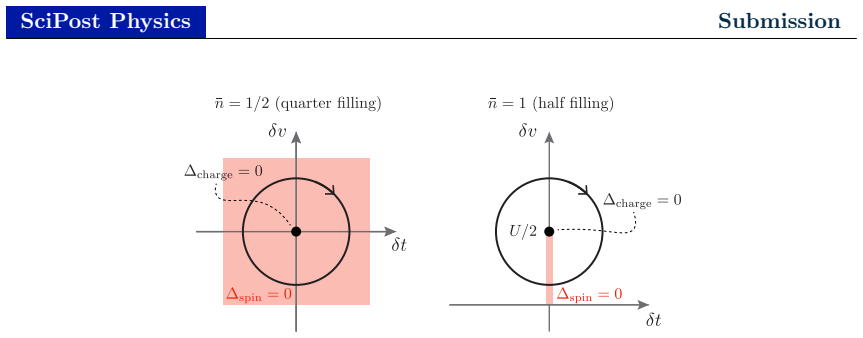
Quarter-filled Mott-Thouless pumps remain quantized in highly entropic spin-incoherent states, while half-filled versions break down because spin excitations convert into charge excitations.
T0 review reviewed 2026-08-01 challenge →
load-bearing objection A clean U=∞ construction and a convincing half-filled breakdown story, but the headline exponential-in-U protection only holds for U < t0^2/ω; beyond that direct Floquet heating dominates. the 3 major comments →
Spin-incoherent Mott-Thouless pumps
The pith
A machine-rendered reading of the paper's core claim, the machinery that carries it, and where it could break.
The reading
Core claim
The central claim is that exponentially protected quantum charge pumping does not require a low-entropy ground state: a quarter-filled Rice-Mele Mott insulator, initialized in a spin-incoherent state with extensive entropy, still pumps exactly one charge per unit cell per cycle in the large-U limit. The protection relies on a dynamical decoupling of the gapped charge sector from the gapless, hot spin sector; energy conservation forces any spin-to-charge conversion to be a many-particle process of order N_cs ≈ Δ_c/J̄₁, giving a rate Γ_cs ~ e^{−α′N_cs}. The paper also identifies the half-filled Mott-Thouless pump as the opposite case, where spin-charge coupling is strong and spin excitations a
What carries the argument
The load-bearing mechanism is the exponential suppression of spin-charge conversion in the quarter-filled pump. At U→∞, the charge dynamics is exactly described by spinless fermions while the spins are frozen and decoupled (H_s = 0); for large but finite U, the spin sector acquires dynamics governed by a Heisenberg model with J̄₁ ~ t₀²/U and δJ ~ t₀³/U², while the charge gap Δ_c remains of order t₀. The spin-charge coupling term can only transfer energy of order Δ_c from the hot spins to the charge sector through a high-order process of order N_cs ~ Δ_c/J̄₁, producing an exponentially small rate. In contrast, at half filling the single-particle backscattering term couples charge and spin fie
Load-bearing premise
The exponential protection rests on the premise that spin-to-charge conversion at quarter filling requires a high-order many-particle process of order N_cs ~ Δ_c/J̄₁, with an exponentially small rate; this premise is borrowed from doublon-lifetime physics in Mott insulators and is asserted, not derived, for the driven spin-incoherent setting.
What would settle it
Compute the per-cycle pumped-charge deviation |ΔQ − 1| for the quarter-filled Rice-Mele pump as a function of U/t₀ at fixed drive frequency. Exponential protection predicts |ΔQ − 1| ~ e^{−c U/t₀}; observing a power-law decay in t₀/U, or the appearance of doubly occupied sites at a rate not exponentially small in U/t₀, would falsify the central claim.
If this is right
- Quantized transport in the quarter-filled pump survives over parametrically large system sizes L ≪ ℓ_h^charge, with ℓ_h^charge growing as exp(c U/t₀) in the large-U, finite-frequency regime.
- The spin sector can heat to temperatures comparable to the charge gap without degrading the pumped charge, as long as spin-charge equilibration remains exponentially slow.
- Ultracold-atom experiments with fermionic atoms in an optical superlattice can realize a quantum pump without preparing low-entropy states, provided the filling is one particle per two-site unit cell.
- The half-filled interacting Thouless pump is predicted to lose quantization after one cycle, consistent with recent experimental observations, and can be restored only by opening a spin gap (e.g., a staggered magnetic field or a strong Ising coupling).
- Direct heating of the charge sector from absorbing Floquet quanta is also exponentially suppressed, so the relevant heating time scale is set by the slower of direct charge heating, spin-mediated charge heating, and spin-sector heating.
Where Pith is reading between the lines
- The spin-charge decoupling at quarter filling suggests a general design principle: topological transport can survive in high-entropy states whenever the transported quantity resides in a gapped sector weakly coupled to the entropic sector. One could test this principle in partially filled Chern bands or fractional quantum Hall states with extensive entropy.
- A concrete experimental test would be to ramp a quarter-filled Rice-Mele pump in a cold-atom system with entropy per particle near ln 2 and measure the pumped charge per cycle; the deviation from one should fall exponentially with U/t₀. If it falls instead as a power law, the protection mechanism fails.
- The analysis borrows the exponential suppression estimate from doublon-lifetime physics in Mott insulators; a microscopic derivation of the spin-charge matrix elements in the driven setting would put the protection on firmer ground and would sharpen the predicted exponential coefficient.
Editorial analysis
A structured set of objections, weighed in public.
Referee Report
Summary. The paper studies charge pumping in strongly interacting one-dimensional fermionic systems in the spin-incoherent regime. For a quarter-filled interacting Rice-Mele model and a continuum sliding-lattice model, the authors show that at U=∞ the system maps to non-interacting spinless fermions, yielding a quantized Mott-Thouless pump even though the spin sector carries entropy ln 2 per particle. At large but finite U, the spin sector is shown to be governed by a time-dependent Heisenberg model with J1 ~ t0^2/U and J2 ~ t0^3/U^2, and the paper argues that charge excitations remain suppressed because i) spin-sector heating is slow, ii) spin-to-charge conversion is exponentially small, N_cs ~ Δ_c/J1, and iii) direct Floquet heating of the charge sector is also exponentially small. The central quantitative claim is that in the quarter-filled case charge transport stays exponentially protected despite an extensively hot spin sector, whereas in the half-filled pump of recent experiments spin excitations efficiently convert into charge excitations and destroy quantization. The analytical scaling estimates are complemented by exact diagonalization and real-time evolution on small chains.
Significance. The question addressed is timely and important: can topologically quantized transport survive in states with extensive entropy, as relevant to ultracold-atom experiments that cannot reach low-entropy initial states? The paper has clear strengths: the U=∞ limit is solved exactly via the spinless-fermion mapping; the Schrieffer-Wolff analysis in Appendix A is careful and the numerical extraction of J1 and J2 confirms the parametric scalings; the qualitative contrast with the half-filled pump, including the bosonization argument and comparison to Ref. [9], is convincing and likely of independent interest. If the exponential-protection claim could be established as stated, the paper would represent a conceptual advance in the theory of topological transport. However, as detailed in the major comments, the headline large-U exponential-in-U statement is valid only in an intermediate regime and is not supported by the paper's own equations once direct Floquet heating is included; the finite-size analysis omits this channel entirely. The qualitative statement that hot spins need not destroy pumping is plausible and likely correct, but the quantitative novelty requires substantial qualifica
major comments (3)
- [§3.2, Eq. (23)] The central estimate τ_charge^h ~ e^{c U/t0} is derived under the condition ω < Jbar1, stated just before Eq. (23), which makes N_cs < N_cc so that the spin-charge channel dominates. Since Jbar1 ~ t0^2/U, this condition is equivalent to U < t0^2/ω. For fixed ω, the deep-Mott limit U → ∞ violates the condition. In that regime Eq. (20) gives Γ_cc ~ e^{-α'' Δ_c/ω}, which is independent of U, and Eq. (21) therefore predicts τ_charge^h ~ 1/Γ_cc rather than e^{c U/t0}. Thus the exponential-in-U protection is not a large-U property; it holds only for U below t0^2/ω. Above that scale the protection is the conventional adiabatic suppression e^{-Δ_c/ω}, unrelated to the spin-charge decoupling that the abstract advertises as the mechanism. The abstract, Sec. 3.2, and the conclusion should be reworded to state this regime qualification explicitly.
- [§3.3, Eqs. (30)-(31)] The finite-size analysis defines ℓ_charge^h as max(ℓ_spin^h, ℓ_cs) and states that charge-sector heating requires both a hot spin sector and spin-charge equilibration. This omits the direct Floquet heating channel Γ_cc introduced in Eq. (20) and included in the bulk rate Eq. (21). Direct charge heating creates charge excitations without any prior spin heating, so the condition preceding Eq. (31) is not necessary. For U > t0^2/ω, Γ_cc is the dominant rate and a term of order a ω/Γ_cc should appear in ℓ_charge^h. Without such a term, the statement that for large U one has ℓ_charge^h ~ e^{c U/t0} does not follow from the paper's own equations. This is load-bearing for the claim that a finite pump between reservoirs operates with exponential precision for L ≪ ℓ_charge^h.
- [§3.2, Eq. (18)] The exponential suppression Γ_cs ~ e^{-α' N_cs}, with N_cs ~ Δ_c/Jbar1, is the central ingredient of the spin-charge decoupling mechanism. It is asserted by analogy with doublon lifetimes in undriven Mott insulators (Ref. [44]), but no derivation or numerical test is provided for the driven spin-incoherent system. The text itself introduces the spin-charge coupling H_sc in Eq. (16) only as an expectation ('We can expect'). Because a low-order coupling between the spin and charge sectors, e.g., from band curvature, the periodic drive, or higher-order terms in the strong-coupling expansion, would invalidate the protection, this step should be either substantiated with a microscopic estimate of the relevant matrix elements or explicitly labeled as a scaling assumption, with the strength of the abstract's claims adjusted accordingly.
minor comments (5)
- [Abstract] Typo: 'W e show' should be 'We show'.
- [Eqs. (14), (18), (20), (23)] The constants α, α', α'', and c are stated to be of order one or dependent logarithmically on parameters, but the text does not specify which expressions inherit these constants. A short remark that only exponential dependences are predicted, not prefactors, would help the reader calibrate the scaling claims.
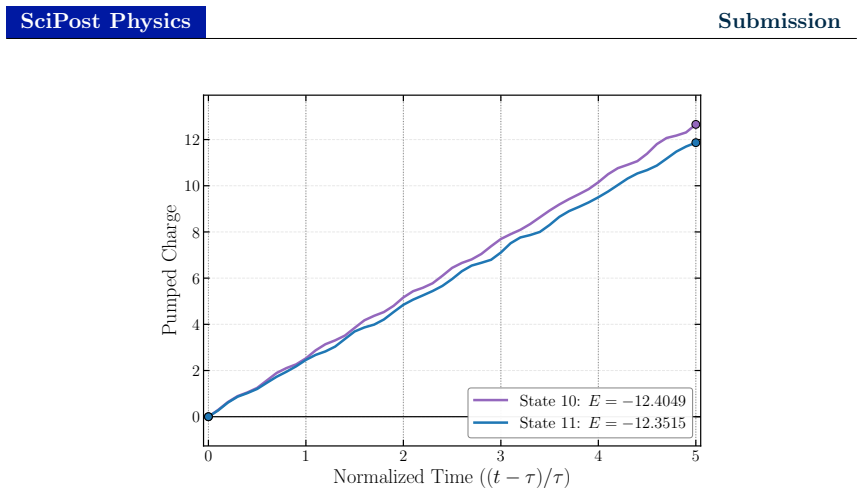
- [Fig. 2] The inset legend 'Eigenstate index' with curves labeled 0,2,4,6,8 is difficult to read and the relationship between the colors in the main panel and the eigenstate index is not explained. Please clarify how the initial states are selected and what exactly is plotted on the inset axes.
- [Sec. 3.2, Eq. (19)] The inequality t ≪ max(1/Γ_cs, τ_spin^h) is correct only once the spin sector has reached T ~ Δ_c; stating this precondition next to Eq. (19) would remove a possible source of confusion.
- [Appendix A, Eq. (62)] The notation J_s and J_w is introduced but the relation to the main-text J1 and J2 is implicit. A sentence connecting the two notations would improve readability.
Circularity Check
No significant circularity: exponential-protection estimate is an external analogy plus independent numerics, not a self-referential fit.
full rationale
The paper's central claim—exponentially protected charge pumping in spin-incoherent quarter-filled Mott pumps—is built from (i) the U=∞ exact mapping to spinless fermions (Ref. [40]), (ii) a strong-coupling spin Hamiltonian with J1 ~ t0^2/U and J2, δJ ~ t0^3/U^2 derived via a Schrieffer-Wolff expansion in App. A and checked numerically by ED, (iii) perturbative spin-heating estimate Eq. (14), and (iv) the spin-to-charge conversion rate Γcs ~ e^{-α' Δc/Jbar1} (Eq. 18) imported from the external doublon-lifetime literature (Ref. [44]). The last step is an assumption/analogy rather than a derivation, and one could question its validity in the driven spin-incoherent setting; this is a correctness/evidence concern, not circularity, because Ref. [44] is external and the paper's conclusion is not used to define or fit Γcs. The exponential form of τ_charge^h in Eq. (23) is a direct rearrangement of Eq. (18) with Jbar1 ~ t0^2/U; this is a consequence of the assumed rate, not a separate prediction fitted from the same data. The only numerical fit in App. A (first-harmonic fit of J2) characterizes the spin model and does not enter the quantization claim. Self-citations (Refs. [33,34,41,47]) support auxiliary points (integrability-breaking, diffusion constant) and are independent published results, not used to forbid alternatives or define the target effect. Real-time ED simulations (Figs. 2, 9–13) provide independent support for robust quantization at large U and for breakdown at half filling. I therefore find no step in which a predicted quantity reduces by construction to an input.
Axiom & Free-Parameter Ledger
free parameters (1)
- alpha, alpha', alpha'', and logarithmic prefactor c
axioms (7)
- domain assumption U=infinity Hubbard model maps exactly onto spinless fermions that describe charge dynamics, with completely frozen spins.
- domain assumption The spin sector thermalizes and can be described by a high-temperature state on the timescales of interest, so heating can be computed from the retarded susceptibility of a thermal state.
- domain assumption The spin spectral function is smooth with bandwidth set by J_bar1, giving Im chi(omega) ~ (1/T)(omega/J_bar1) for small omega.
- domain assumption Spin-to-charge conversion in the quarter-filled model requires a high-order many-particle process of order N_cs ~ Delta_c / J_bar1, with exponentially small rate.
- domain assumption At quarter filling, single-particle backscattering is forbidden by momentum conservation, leaving only a time-dependent Umklapp term that does not couple spin and charge.
- domain assumption A finite-size pump between two reservoirs can be described by a drift-diffusion equation for the spin energy density.
- domain assumption The simplified half-filled model H_s captures the qualitative defect dynamics of the full Rice-Mele model, despite some artifacts.
Cite this review
Pith. "Pith review of Spin-incoherent Mott-Thouless pumps." pith.science (2026). https://pith.science/paper/IISKMOUU
@misc{pith2026260727321,
  author       = {Pith},
  title        = {Pith review of: Spin-incoherent Mott-Thouless pumps},
  year         = {2026},
  howpublished = {\url{https://pith.science/paper/IISKMOUU}},
  note         = {Machine review of arXiv:2607.27321}
}
read the original abstract
A Thouless pump describes a system in which a quantized amount of charge is transported by one lattice spacing per cycle when the parameters of a Hamiltonian are varied slowly and periodically. In the standard case, this quantization requires the system to remain in its ground state with vanishing thermodynamic entropy throughout the pumping process. Here, we introduce a class of Mott-Thouless pumps, which operate in highly entropic, spin-incoherent Mott states. We show analytically that these states exhibit exponentially protected quantized transport despite their extensive entropy, because the pumped charge resides in a gapped sector that remains dynamically decoupled from the hot spin degrees of freedom. By contrast, motivated by a recent experimental realization, we identify other classes of Mott-Thouless pumps that lack this protection. In these systems, spin excitations can efficiently generate charge excitations, leading to a rapid breakdown of quantized transport. Our analytical results are supported by numerically exact real-time simulations of finite systems.
Figures






Reference graph
Works this paper leans on
-
[1]
D. J. Thouless,Quantization of particle transport, Phys. Rev. B27, 6083 (1983), doi:10.1103/PhysRevB.27.6083
-
[2]
R. Citro and M. Aidelsburger,Thouless pumping and topology, Nature Reviews Physics5(2), 87 (2023), doi:10.1038/s42254-022-00545-0
-
[3]
Q. Niu and D. J. Thouless,Quantised adiabatic charge transport in the presence of substrate disorder and many-body interaction, Journal of Physics A: Mathematical and General17(12), 2453 (1984), doi:10.1088/0305-4470/17/12/016
-
[4]
E. Berg, M. Levin and E. Altman,Quantized pumping and topology of the phase diagram for a system of interacting bosons, Phys. Rev. Lett.106, 110405 (2011), doi:10.1103/PhysRevLett.106.110405
-
[5]
R. Shindou,Quantum spin pump in s=1/2 antiferromagnetic chains –holonomy of phase operators in sine-gordon theory–, Journal of the Physical Society of Japan 74(4), 1214 (2005), doi:10.1143/JPSJ.74.1214,https://doi.org/10.1143/JPSJ. 74.1214
-
[6]
S. Ohyama, K. Shiozaki and M. Sato,Generalized thouless pumps in(1 + 1)- dimensional interacting fermionic systems, Phys. Rev. B106, 165115 (2022), doi:10.1103/PhysRevB.106.165115
-
[7]
J. Arg¨ uello-Luengo, M. J. Mark, F. Ferlaino, M. Lewenstein, L. Barbiero and S. Juli` a- Farr´ e,Stabilization of Hubbard-Thouless pumps through nonlocal fermionic repulsion, Quantum8, 1285 (2024), doi:10.22331/q-2024-03-14-1285
-
[8]
A.-S. Walter, Z. Zhu, M. G¨ achter, J. Minguzzi, S. Roschinski, K. Sandholzer, K. Viebahn and T. Esslinger,Quantization and its breakdown in a hubbard–thouless pump, Nature Physics19(10), 1471 (2023), doi:10.1038/s41567-023-02145-w
-
[9]
K. Viebahn, A.-S. Walter, E. Bertok, Z. Zhu, M. G¨ achter, A. A. Aligia, F. Heidrich- Meisner and T. Esslinger,Interactions enable thouless pumping in a nonsliding lattice, Phys. Rev. X14, 021049 (2024), doi:10.1103/PhysRevX.14.021049
-
[10]
M. Lohse, C. Schweizer, O. Zilberberg, M. Aidelsburger and I. Bloch,A thouless quantum pump with ultracold bosonic atoms in an optical superlattice, Nature Physics 12(4), 350 (2016), doi:10.1038/nphys3584
-
[11]
S. Nakajima, T. Tomita, S. Taie, T. Ichinose, H. Ozawa, L. Wang, M. Troyer and Y. Takahashi,Topological thouless pumping of ultracold fermions, Nature Physics 12(4), 296 (2016), doi:10.1038/nphys3622
-
[12]
C. Schweizer, M. Lohse, R. Citro and I. Bloch,Spin pumping and measurement of spin currents in optical superlattices, Phys. Rev. Lett.117, 170405 (2016), doi:10.1103/PhysRevLett.117.170405
-
[13]
Y. E. Kraus, Y. Lahini, Z. Ringel, M. Verbin and O. Zilberberg,Topological states and adiabatic pumping in quasicrystals, Phys. Rev. Lett.109, 106402 (2012), doi:10.1103/PhysRevLett.109.106402
-
[14]
M. Verbin, O. Zilberberg, Y. E. Kraus, Y. Lahini and Y. Silberberg,Observation of topological phase transitions in photonic quasicrystals, Phys. Rev. Lett.110, 076403 (2013), doi:10.1103/PhysRevLett.110.076403. 19 SciPost Physics Submission
-
[15]
M. J¨ urgensen, S. Mukherjee and M. C. Rechtsman,Quantized nonlinear thouless pumping, Nature596(7870), 63 (2021), doi:10.1038/s41586-021-03688-9
-
[16]
I. H. Grinberg, M. Lin, C. Harris, W. A. Benalcazar, C. W. Peterson, T. L. Hughes and G. Bahl,Robust temporal pumping in a magneto-mechanical topological insulator, Nature Communications11(1), 974 (2020), doi:10.1038/s41467-020-14804-0
-
[17]
J. Brun-Picard, S. Djordjevic, D. Leprat, F. Schopfer and W. Poirier,Practical quantum realization of the ampere from the elementary charge, Phys. Rev. X6, 041051 (2016), doi:10.1103/PhysRevX.6.041051
-
[18]
F. Zhou, B. Spivak and B. Altshuler,Mesoscopic mechanism of adiabatic charge transport, Phys. Rev. Lett.82, 608 (1999), doi:10.1103/PhysRevLett.82.608
-
[19]
M. Moskalets and M. B¨ uttiker,Effect of inelastic scattering on parametric pumping, Phys. Rev. B64, 201305 (2001), doi:10.1103/PhysRevB.64.201305
-
[20]
M. Moskalets and M. B¨ uttiker,Dissipation and noise in adiabatic quantum pumps, Phys. Rev. B66, 035306 (2002), doi:10.1103/PhysRevB.66.035306
-
[21]
J. N. H. J. Cremers and P. W. Brouwer,Dephasing in a quantum pump, Phys. Rev. B65, 115333 (2002), doi:10.1103/PhysRevB.65.115333
-
[22]
J. E. Avron, A. Elgart, G. M. Graf, L. Sadun and K. Schnee,Adiabatic charge pumping in open quantum systems, Communications on Pure and Applied Mathematics57(4), 528 (2004), doi:https://doi.org/10.1002/cpa.3051
-
[23]
S. Rahav, J. Horowitz and C. Jarzynski,Directed flow in nonadiabatic stochastic pumps, Phys. Rev. Lett.101, 140602 (2008), doi:10.1103/PhysRevLett.101.140602
-
[24]
S. Mondal, E. Bertok and F. Heidrich-Meisner,Phonon-induced breakdown of thou- less pumping in the rice-mele-holstein model, Phys. Rev. B106, 235118 (2022), doi:10.1103/PhysRevB.106.235118
-
[25]
L. Arceci, L. Kohn, A. Russomanno and G. E. Santoro,Dissipation assisted thou- less pumping in the rice–mele model, Journal of Statistical Mechanics: Theory and Experiment2020(4), 043101 (2020), doi:10.1088/1742-5468/ab7a25
-
[26]
C.-E. Bardyn, L. Wawer, A. Altland, M. Fleischhauer and S. Diehl,Prob- ing the topology of density matrices, Phys. Rev. X8, 011035 (2018), doi:10.1103/PhysRevX.8.011035
-
[27]
R. Ma, J.-H. Zhang, Z. Bi, M. Cheng and C. Wang,Topological phases with average symmetries: The decohered, the disordered, and the intrinsic, Phys. Rev. X15, 021062 (2025), doi:10.1103/PhysRevX.15.021062
-
[28]
Y. Guo, J.-H. Zhang, H.-R. Zhang, S. Yang and Z. Bi,Locally purified density operators for symmetry-protected topological phases in mixed states, Phys. Rev. X 15, 021060 (2025), doi:10.1103/PhysRevX.15.021060
-
[29]
H. Xue, J. Y. Lee and Y. Bao,Tensor network formulation of symmetry protected topological phases in mixed states(2024),2403.17069
Pith/arXiv arXiv 2024
-
[30]
L. Wawer and M. Fleischhauer,Chern number and berry curvature for gaussian mixed states of fermions, Phys. Rev. B104, 094104 (2021), doi:10.1103/PhysRevB.104.094104. 20 SciPost Physics Submission
-
[31]
M. Xu, L. H. Kendrick, A. Kale, Y. Gang, C. Feng, S. Zhang, A. W. Young, M. Lebrat and M. Greiner,A neutral-atom hubbard quantum simulator in the cryogenic regime, Nature642(8069), 909 (2025), doi:10.1038/s41586-025-09112-w
-
[32]
D. A. Abanin, W. De Roeck, W. W. Ho and F. m. c. Huveneers,Effective hamiltoni- ans, prethermalization, and slow energy absorption in periodically driven many-body systems, Phys. Rev. B95, 014112 (2017), doi:10.1103/PhysRevB.95.014112
-
[33]
F. Lange, Z. Lenarcicand A. Rosch,Pumping approximately integrable systems, Nature Communications8(1), 15767 (2017), doi:10.1038/ncomms15767
-
[34]
F. Lange, Z. Lenarcicand A. Rosch,Time-dependent generalized gibbs ensembles in open quantum systems, Phys. Rev. B97, 165138 (2018), doi:10.1103/PhysRevB.97.165138
-
[35]
G. A. Fiete,Colloquium: The spin-incoherent luttinger liquid, Rev. Mod. Phys.79, 801 (2007), doi:10.1103/RevModPhys.79.801
-
[36]
K. A. Matveev,Conductance of a quantum wire in the wigner-crystal regime, Phys. Rev. Lett.92, 106801 (2004), doi:10.1103/PhysRevLett.92.106801
-
[37]
G. A. Fiete and L. Balents,Green ’s function for magnetically incoherent in- teracting electrons in one dimension, Phys. Rev. Lett.93, 226401 (2004), doi:10.1103/PhysRevLett.93.226401
-
[38]
A. E. Feiguin and G. A. Fiete,Spectral properties of a spin-incoherent luttinger liquid, Phys. Rev. B81, 075108 (2010), doi:10.1103/PhysRevB.81.075108
-
[39]
M. J. Rice and E. J. Mele,Elementary excitations of a linearly conjugated diatomic polymer, Phys. Rev. Lett.49, 1455 (1982), doi:10.1103/PhysRevLett.49.1455
-
[40]
M. Ogata and H. Shiba,Bethe-ansatz wave function, momentum distribution, and spin correlation in the one-dimensional strongly correlated hubbard model, Phys. Rev. B41, 2326 (1990), doi:10.1103/PhysRevB.41.2326
-
[41]
M. Genske and A. Rosch,Floquet-boltzmann equation for periodically driven fermi systems, Phys. Rev. A92, 062108 (2015), doi:10.1103/PhysRevA.92.062108
-
[42]
A. Matthies, M. Rudner, A. Rosch and E. Berg,Programmable adiabatic demagneti- zation for systems with trivial and topological excitations, Quantum8, 1505 (2024), doi:10.22331/q-2024-10-23-1505
-
[43]
F. D. M. Haldane,’luttinger liquid theory’ of one-dimensional quantum fluids. i. properties of the luttinger model and their extension to the general 1d interacting spinless fermi gas, Journal of Physics C: Solid State Physics14(19), 2585 (1981), doi:10.1088/0022-3719/14/19/010
-
[44]
R. Sensarma, D. Pekker, E. Altman, E. Demler, N. Strohmaier, D. Greif, R. J¨ ordens, L. Tarruell, H. Moritz and T. Esslinger,Lifetime of double occupancies in the fermi- hubbard model, Phys. Rev. B82, 224302 (2010), doi:10.1103/PhysRevB.82.224302
-
[45]
F. Ares, P. Calabrese and S. Murciano,The quantum mpemba effects, Nature Reviews Physics7(8), 451 (2025), doi:10.1038/s42254-025-00838-0
-
[46]
X. Zotos, F. Naef and P. Prelovsek,Transport and conservation laws, Phys. Rev. B 55, 11029 (1997), doi:10.1103/PhysRevB.55.11029. 21 SciPost Physics Submission
-
[47]
P. Jung, R. W. Helmes and A. Rosch,Transport in almost integrable models: Perturbed heisenberg chains, Phys. Rev. Lett.96, 067202 (2006), doi:10.1103/PhysRevLett.96.067202
-
[48]
C. De Grandi, V. Gritsev and A. Polkovnikov,Quench dynamics near a quantum critical point: Application to the sine-gordon model, Phys. Rev. B81, 224301 (2010), doi:10.1103/PhysRevB.81.224301
-
[49]
Giamarchi,Quantum Physics in One Dimension, vol
T. Giamarchi,Quantum Physics in One Dimension, vol. 121 ofInternational Series of Monographs on Physics, Oxford University Press, Oxford, ISBN 978-0-19-852500-4 (2004)
2004
-
[50]
A. Rosch and N. Andrei,Conductivity of a clean one-dimensional wire, Phys. Rev. Lett.85, 1092 (2000), doi:10.1103/PhysRevLett.85.1092
-
[51]
K. Haule, A. Rosch, J. Kroha and P. W¨ olfle,Pseudogaps in an incoherent metal, Phys. Rev. Lett.89, 236402 (2002), doi:10.1103/PhysRevLett.89.236402
-
[52]
K. Haule, A. Rosch, J. Kroha and P. W¨ olfle,Pseudogaps in thet−jmodel: An extended dynamical mean-field theory study, Phys. Rev. B68, 155119 (2003), doi:10.1103/PhysRevB.68.155119
-
[53]
S. A. Hartnoll,Theory of universal incoherent metallic transport, Nature Physics11, 54 (2015)
2015
-
[54]
D. Chowdhury, A. Georges, O. Parcollet and S. Sachdev,Sachdev-ye-kitaev models and beyond: Window into non-fermi liquids, Rev. Mod. Phys.94, 035004 (2022), doi:10.1103/RevModPhys.94.035004
-
[55]
N. H. Lindner, E. Berg and M. S. Rudner,Universal chiral quasisteady states in periodically driven many-body systems, Phys. Rev. X7, 011018 (2017), doi:10.1103/PhysRevX.7.011018
-
[56]
T. Gulden, E. Berg, M. S. Rudner and N. Lindner,Exponentially long lifetime of universal quasi-steady states in topological floquet pumps, SciPost Phys.9, 015 (2020), doi:10.21468/SciPostPhys.9.1.015
-
[57]
Aidelsburger, M
M. Aidelsburger, M. Lohse, C. Schweizer, M. Atala, J. T. Barreiro, S. Nascimb` ene, N. Cooper, I. Bloch and N. Goldman,Measuring the chern number of hofstadter bands with ultracold bosonic atoms, Nature Physics11(2), 162 (2015)
2015
-
[58]
A. H. MacDonald, S. M. Girvin and D. Yoshioka, t U expansion for the hubbard model, Phys. Rev. B37, 9753 (1988), doi:10.1103/PhysRevB.37.9753
-
[59]
P. Weinberg and M. Bukov,Quspin: a python package for dynamics and exact diag- onalisation of quantum many body systems part i: spin chains, SciPost Phys.2, 003 (2017), doi:10.21468/SciPostPhys.2.1.003
-
[60]
P. Weinberg and M. Bukov,Quspin: a python package for dynamics and exact diago- nalisation of quantum many body systems. part ii: bosons, fermions and higher spins, SciPost Phys.7, 020 (2019), doi:10.21468/SciPostPhys.7.2.020. 22 SciPost Physics Submission A Effective Heisenberg model for spin degrees of freedom This section discusses the effective Heisen...
-
[61]
Our objective is to decouple the low-energy manifoldV ∆ from the high-energy sectors by systematically eliminating the transition operators Π1 and Π2
Additionally, there are terms that create two orbital excitations: Π2 =−J w sin2 θ 4 Si,+− ·S i+1,+− (52) With the subleading contributions established, we proceed to the second stage of the SW transformation. Our objective is to decouple the low-energy manifoldV ∆ from the high-energy sectors by systematically eliminating the transition operators Π1 and ...
This paper was first reviewed by deepseek-v4-flash on August 1, 2026.
discussion (0)
Sign in with ORCID, Apple, or X to comment. Anyone can read and Pith papers without signing in.