REVIEW 2 major objections 4 minor 85 references
The paper argues that doping AB-stacked twisted SnSe2 away from its antiferromagnetic half-filled state produces an intravalley, extended s-wave superconducting state mediated by valley-selective spin fluctuations, establishing M-point moir
Reviewed by Pith at T0; open to challenge. T0 means a machine referee read the full paper against a public rubric. the ladder, T0–T4 →
T0 review · deepseek-v4-flash
2026-08-01 06:54 UTC pith:G2LOASNA
load-bearing objection First FRG prediction of superconductivity in an M-point moiré material — internally consistent and well-documented, but the extended s-wave mechanism's robustness to twist-angle tuning is untested. the 2 major comments →
Extended s-wave superconductivity in M-point twisted bilayer SnSe2
The pith
A machine-rendered reading of the paper's core claim, the machinery that carries it, and where it could break.
Core claim
The central claim is that the phase diagram of 6.01-degree AB-stacked twisted SnSe2, computed with the functional renormalization group, contains an intravalley extended s-wave superconducting phase flanking an antiferromagnetic dome. At half filling (three electrons per moiré cell) the leading instability is a quasi-one-dimensional antiferromagnetic stripe order; doping to roughly two or four electrons turns the same spin fluctuations into pairing glue. The extended s-wave gap benefits from off-shell scattering: the leading magnetic fluctuations connect particle and hole states detuned from the Fermi level, and the sign change required for attractive pairing takes place away from the Fermi
What carries the argument
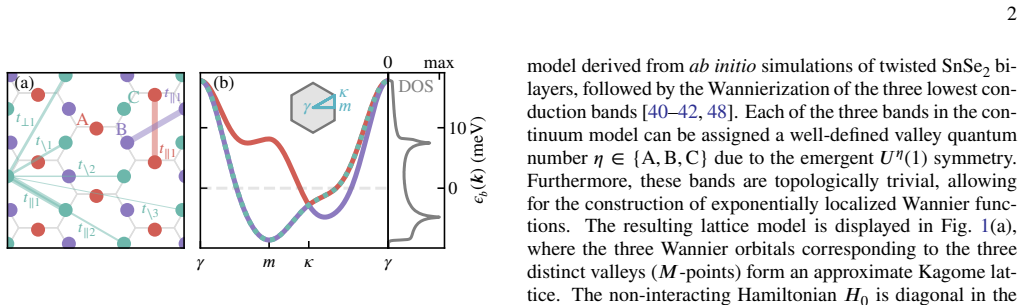
The argument rests on a multi-orbital Wannier model of AB-stacked twisted SnSe2 in which the three M-valley bands map onto an approximate Kagome lattice with strong kinetic anisotropy (about 0.19 at 6.01 degrees). The carrier of the mechanism is the banded, quasi-one-dimensional Fermi surface: line-shaped Fermi surfaces keep the antiferromagnetic spin-fluctuation vertex large along an entire strip of transfer momenta parallel to the Fermi surface, not just at a single nesting vector. The functional renormalization group flow with a truncated-unity basis resolves competing particle-particle and particle-hole channels, and a linearized gap equation built from the renormalized magnetic vertex i
Load-bearing premise
The predictions stand or fall on the quasi-one-dimensional, line-shaped Fermi surface of the non-interacting Wannier model at 6.01 degrees (kinetic anisotropy about 0.19); if lattice relaxation, strain, or correlation-driven reconstruction turns those lines into two-dimensional pockets, the extended s-wave phase would move or disappear.
What would settle it
Measure the Fermi surface and pairing gap of gated AB-stacked twisted SnSe2 around fillings two and four electrons per moiré cell using quantum oscillations, angle-resolved photoemission, or tunneling spectroscopy: if the Fermi surface is made of two-dimensional pockets rather than one-dimensional lines, or if the gap shows nodes on the Fermi surface, the predicted off-shell extended s-wave mechanism is falsified. A sharp companion test: the antiferromagnetic fluctuation vector near the m point should remain the dominant magnetic channel, and the superconducting dome should track it as the die
If this is right
- Gate-tuning a twisted SnSe2 device from half filling toward two or four electrons per moiré cell should reveal superconductivity emerging next to an antiferromagnetic insulating state, with critical scales large enough to be experimentally relevant.
- The superconducting gap should appear nearly nodeless in probes that sample the Fermi surface, unlike the nodal p- or d-wave states found at lower filling.
- Because the three valleys are kinetically decoupled, the superconducting state behaves as three weakly Josephson-coupled, highly anisotropic condensates within one sample.
- The same off-shell pairing mechanism is expected to carry over to other M-valley materials and to systems in the dimensional-crossover regime.
- The phase diagram gives a concrete route to test spin-fluctuation-mediated pairing: the magnetic dome and the adjacent s-wave superconducting domes should move together as the dielectric environment is varied.
Where Pith is reading between the lines
- Because the mechanism relies on kinetic anisotropy, varying the twist angle should tune between banded one-dimensional Fermi surfaces and two-dimensional pockets; a testable extension is that the extended s-wave dome shrinks or changes symmetry as the anisotropy decreases.
- The off-shell sign change implies that energy-resolved spectroscopies might reveal a sign change away from the Fermi level even when the Fermi-surface gap looks nodeless, a distinguishing signature not tested in the paper.
- The three decoupled intravalley superconductors invite experiments on inter-valley Josephson coupling and collective modes, a direction the authors only hint at.
- The paper itself flags that the FRG starts from a two-dimensional limit yet predicts quasi-one-dimensional physics; benchmarking against strictly one-dimensional methods such as coupled-wire or sign-problem-free quantum Monte Carlo simulations would settle whether the s-wave phase survives beyond the ladder-type approximation.
Editorial analysis
A structured set of objections, weighed in public.
Referee Report
Summary. The paper studies a first-principles Wannier model of AB-stacked twisted SnSe2 at θ = 6.01°, with dual-gated Coulomb interactions, using truncated-unity functional renormalization group (TUFRG). The resulting phase diagram as a function of filling ν and dielectric constant ε shows an intravalley antiferromagnetic stripe state at half-filling ν = 3, extended s-wave superconductivity at ν ≈ 2 and ν ≈ 4 flanking the AFM dome, and competing s-, p-, and d-wave states near the lower Van Hove filling. The authors attribute the extended s-wave pairing to valley-selective spin fluctuations with a quasi-one-dimensional, banded character and to off-shell particle-hole states detuned from the Fermi level, drawing an explicit analogy to iron-pnictide superconductors. The Supplemental Material documents the Wannier model, TUFRG implementation, the intraorbital bilinear approximation (IOBI), and the linearized gap equation.
Significance. If robust, the result would extend moiré superconductivity to M-valley systems with intravalley pairing and would provide a concrete, falsifiable prediction for gate-screened twisted SnSe2. The paper has real strengths: the FRG phase diagram is internally consistent, the IOBI treatment reproduces the extended s-wave result on both sides of the dSC region, convergence with rmax was checked, and the simulation code and model data are made available. No superconducting order parameter is fitted to experiment; the phases emerge from the microscopic model. The main significance depends, however, on the claim that the quasi-one-dimensional Fermi surface is essential for the off-shell s-wave mechanism, and this claim has not yet been tested across twist angles or against the static-vertex approximation. The platform-level generalization to all M-point moiré materials therefore rests on an unquantified robustness assumption.
major comments (2)
- [Microscopic Pairing Mechanism; Tables S1.1/S1.2] The central mechanistic claim is that the quasi-one-dimensional, banded Fermi surface is essential for the extended s-wave state (main text: 'the quasi-one-dimensional character of AB-stacked tSnSe2 is essential'), but all FRG results are for a single twist angle, θ = 6.01°, where α = |t⧵1/t∥1| ≈ 0.19. Table S1.2 shows that α varies dramatically with θ in the same model: α ≈ 2.01 at 3.89°, 0.48 at 5.09°, and 0.026 at 7.34°. No calculation is presented at any other angle, nor a controlled scan in α with fixed Wannier orbitals. If the sSC dome at ν ≈ 2,4 disappears for α ≈ 0.48 or α ≈ 0.026, the proposed iron-pnictide analogy and the 'quantum simulation platform' statement would apply only in a narrow parameter window. This is a load-bearing robustness gap, not a stylistic issue. I request at least one FRG run at a neighboring angle (e.g., 5.09° or 7.34°) or an explicit α-tuning within the
- [Functional renormalization group analysis; Summary & Outlook] The off-shell extended s-wave mechanism is inferred from a frequency-independent, static-vertex FRG flow. The paper argues that at relatively large Λc, pairing receives decisive contributions from virtual states detuned from the Fermi level, with the order parameter changing sign off the Fermi surface. These energy-sensitive processes are exactly where the static approximation is least controlled: the vertex carries no frequency structure, and particle-hole and particle-particle bubbles are evaluated with static propagators. The paper itself acknowledges in the Summary & Outlook that benchmarking against strictly one-dimensional or quantum Monte Carlo methods remains necessary. As it stands, the statement that the system 'overcomes the algebraic energetic penalty for off-shell sign changes' is an inference from a static truncation. A concrete, minimal test would be to verify that the sSC
minor comments (4)
- [Footnote [74]; Fig. 2] The sampling range is stated as (ν,ε) ∈ [0,6]×[12,16], but the Fig. 2 ε-axis runs to 60 and the text describes superconducting domes extending to 'large ε (weak coupling)'. Either the axis label or the footnote should be corrected; the discrepancy makes reproducibility unnecessarily confusing.
- [Fig. 4 caption] The labels '80 meV' and '180 meV' are not explained in the caption or main text, and the band-structure energy axis in the same panel spans only −14 to 14 meV. Please clarify what these quantities are or remove them.
- [Model section; Eq. (1)] The valley-resolved hopping parameters are obtained via Eq. (S1.1) from a continuum model whose detailed derivation is delegated to the in-press Ref. [49]. Since the entire phase diagram depends on those hoppings, it would be helpful to state explicitly in the main text which parts of the Wannier model are independently reproduced in this paper and which are taken from Ref. [49].
- [Fig. 2] The labels 'golden circles' and 'purple stars' are used repeatedly in the text, but the figure legend identifies the symbol colors only implicitly. A short legend entry would improve readability.
Circularity Check
No circular derivation: the sSC phase is an emergent FRG output, not a refit or self-citation consequence.
full rationale
The derivation chain starts from a non-interacting Wannier model (Eq. 1) whose hoppings are obtained by Wannier projection of an ab initio continuum model (Eq. S1.1), and an interaction (Eq. 2) from a dual-gated Coulomb potential projected to the Wannier basis; neither contains the sSC state. The TUFRG flow (Eqs. S2.13-S2.16) is run with divERGe (public code, Refs. 81-83), with epsilon and nu scanned as control parameters; the leading vertex divergence in Fig. 2 is the output, not an input. The gap equation (3) uses the FRG-generated spin-fluctuation vertex and so is a diagnostic of the same theory, not a separate fit. The self-citations (Ref. 49 for the Wannier model, Refs. 82-83 for the code) overlap with the author list, but the cited model is first-principles-derived, code-reproducible, and makes no assumption of the target superconducting phase; the ~2% density-density truncation is a stated approximation. The authors' own caveats (single twist angle theta=6.01 degrees, kinetic anisotropy alpha~0.19 in Table S1.2, and the need to benchmark FRG against one-dimensional techniques) are robustness concerns, not circularity. No equation reduces to its own output, and no fitted parameter is renamed as a prediction.
Axiom & Free-Parameter Ledger
free parameters (3)
- dielectric constant ε =
scanned 12–16, baseline 12
- gate screening length ξ =
10 nm
- FRG divergence threshold =
30 W
axioms (4)
- domain assumption Truncation to three low-energy conduction bands (one per valley) of the continuum model captures the relevant low-energy physics of AB-stacked tSnSe2.
- domain assumption Non-density-density interaction terms from Wannier projection are negligible (≲2% of Hubbard U).
- domain assumption Static (frequency-independent) two-particle vertex and TUFRG bond truncation provide quantitatively reliable FRG flow.
- domain assumption Λc is a proxy for transition temperature Tc.
read the original abstract
We investigate the emergence of electronic order and unconventional superconductivity in M-valley moir\'e materials. Starting from a first-principles Wannier model of AB-stacked twisted SnSe2, we tackle the (gate-screened) long-ranged Coulomb interaction with functional renormalization group simulations resolving the momentum structure and energy scales of the leading Fermi surface instabilities. Upon doping an antiferromagnetic stripe state at half-filling ($\nu=3$ electrons per moir\'e unit cell) of the moir\'e flat bands, magnetic order gives way to unconventional superconductivity mediated by valley-selective spin fluctuations: Large hole doping ($\nu\approx1$) leads to weak-coupling superconductors with various pairing symmetries, while slight electron- and hole-doping ($\nu\approx2,4$) stabilizes a spin-singlet, extended s-wave state that benefits from scattering between virtual particle and hole states that are detuned from the Fermi level. These findings establish M-point moir\'e materials as a quantum simulation platform with phenomenological parallels to the class of iron pnictide superconductors.
Figures


Reference graph
Works this paper leans on
-
[1]
Y.Cao,V.Fatemi,S.Fang,K.Watanabe,T.Taniguchi,E.Kaxi- ras,andP.Jarillo-Herrero,Unconventionalsuperconductivityin magic-angle graphene superlattices, Nature556, 43 (2018)
2018
-
[2]
J. G. Bednorz and K. A. Müller, Possible highTc superconduc- 6 tivity in the Ba-La-Cu-O system, Zeitschrift für Physik B Con- densed Matter64, 189 (1986)
1986
-
[3]
Steglich, J
F. Steglich, J. Aarts, C. D. Bredl, W. Lieke, D. Meschede, W. Franz, and H. Schäfer, Superconductivity in the Presence of Strong Pauli Paramagnetism: CeCu2Si2, Physical Review Let- ters43, 1892 (1979)
1979
-
[4]
Kamihara, T
Y. Kamihara, T. Watanabe, M. Hirano, and H. Hosono, Iron- Based Layered Superconductor La[O1-xFx]FeAs (x = 0.05- 0.12) with Tc = 26 K, Journal of the American Chemical So- ciety130, 3296 (2008)
2008
-
[5]
D. M. Kennes, M. Claassen, L. Xian, A. Georges, A. J. Mil- lis, J. Hone, C. R. Dean, D. N. Basov, A. N. Pasupathy, and A. Rubio, Moiré heterostructures as a condensed-matter quan- tum simulator, Nature Physics17, 155 (2021)
2021
-
[6]
Yankowitz, S
M. Yankowitz, S. Chen, H. Polshyn, Y. Zhang, K. Watanabe, T.Taniguchi,D.Graf,A.F.Young,andC.R.Dean,Tuningsu- perconductivity in twisted bilayer graphene, Science363, 1059 (2019)
2019
-
[7]
X. Lu, P. Stepanov, W. Yang, M. Xie, M. A. Aamir, I. Das, C. Urgell, K. Watanabe, T. Taniguchi, G. Zhang, A. Bachtold, A. H. MacDonald, and D. K. Efetov, Superconductors, orbital magnets and correlated states in magic-angle bilayer graphene, Nature574, 653 (2019)
2019
-
[8]
Stepanov, I
P. Stepanov, I. Das, X. Lu, A. Fahimniya, K. Watanabe, T. Taniguchi, F. H. L. Koppens, J. Lischner, L. Levitov, and D.K.Efetov,Untyingtheinsulatingandsuperconductingorders in magic-angle graphene, Nature583, 375 (2020)
2020
-
[9]
Y.Saito,J.Ge,K.Watanabe,T.Taniguchi,andA.F.Young,In- dependent superconductors and correlated insulators in twisted bilayer graphene, Nature Physics16, 926 (2020)
2020
-
[10]
F. K. de Vries, E. Portolés, G. Zheng, T. Taniguchi, K. Watan- abe,T.Ihn,K.Ensslin,andP.Rickhaus,Gate-definedJosephson junctionsinmagic-angletwistedbilayergraphene,NatureNan- otechnology16, 760 (2021)
2021
-
[11]
M. Oh, K. P. Nuckolls, D. Wong, R. L. Lee, X. Liu, K. Watan- abe,T.Taniguchi,andA.Yazdani,Evidenceforunconventional superconductivity in twisted bilayer graphene, Nature600, 240 (2021)
2021
-
[12]
Bockrath, Evidence for Dirac flat band superconductivity en- abled by quantum geometry, Nature614, 440 (2023)
H.Tian,X.Gao,Y.Zhang,S.Che,T.Xu,P.Cheung,K.Watan- abe,T.Taniguchi,M.Randeria,F.Zhang,C.N.Lau,andM.W. Bockrath, Evidence for Dirac flat band superconductivity en- abled by quantum geometry, Nature614, 440 (2023)
2023
-
[13]
Di Battista, P
G. Di Battista, P. Seifert, K. Watanabe, T. Taniguchi, K. C. Fong, A. Principi, and D. K. Efetov, Revealing the Thermal Properties of Superconducting Magic-Angle Twisted Bilayer Graphene, Nano Letters22, 6465 (2022)
2022
-
[14]
Călugăru, N
D. Călugăru, N. Regnault, M. Oh, K. P. Nuckolls, D. Wong, R. L. Lee, A. Yazdani, O. Vafek, and B. A. Bernevig, Spec- troscopy of Twisted Bilayer Graphene Correlated Insulators, Physical Review Letters129, 117602 (2022)
2022
-
[15]
G. Chen, A. L. Sharpe, P. Gallagher, I. T. Rosen, E. J. Fox, L. Jiang, B. Lyu, H. Li, K. Watanabe, T. Taniguchi, J. Jung, Z. Shi, D. Goldhaber-Gordon, Y. Zhang, and F. Wang, Signa- tures of tunable superconductivity in a trilayer graphene moiré superlattice, Nature572, 215 (2019)
2019
-
[16]
J. M. Park, Y. Cao, K. Watanabe, T. Taniguchi, and P. Jarillo- Herrero, Tunable strongly coupled superconductivity in magic- angle twisted trilayer graphene, Nature590, 249 (2021)
2021
-
[17]
Z. Hao, A. M. Zimmerman, P. Ledwith, E. Khalaf, D. H. Najafabadi, K. Watanabe, T. Taniguchi, A. Vishwanath, and P. Kim, Electric field–tunable superconductivity in alternating- twist magic-angle trilayer graphene, Science371, 1133 (2021)
2021
-
[18]
Y. Cao, J. M. Park, K. Watanabe, T. Taniguchi, and P. Jarillo- Herrero, Pauli-limit violation and re-entrant superconductivity in moiré graphene, Nature595, 526 (2021)
2021
-
[19]
X. Liu, N. J. Zhang, K. Watanabe, T. Taniguchi, and J. I. A. Li, Isospin order in superconducting magic-angle twisted trilayer graphene, Nature Physics18, 522 (2022)
2022
-
[20]
H. Kim, Y. Choi, C. Lewandowski, A. Thomson, Y. Zhang, R. Polski, K. Watanabe, T. Taniguchi, J. Alicea, and S. Nadj-Perge, Evidence for unconventional superconductivity in twisted trilayer graphene, Nature606, 494 (2022)
2022
-
[21]
Zhang, R
Y. Zhang, R. Polski, C. Lewandowski, A. Thomson, Y. Peng, Y. Choi, H. Kim, K. Watanabe, T. Taniguchi, J. Alicea, F. von Oppen, G. Refael, and S. Nadj-Perge, Promotion of supercon- ductivity in magic-angle graphene multilayers, Science377, 1538 (2022)
2022
-
[22]
H. Zhou, T. Xie, T. Taniguchi, K. Watanabe, and A. F. Young, Superconductivity in rhombohedral trilayer graphene, Nature 598, 434 (2021)
2021
-
[23]
H. Zhou, L. Holleis, Y. Saito, L. Cohen, W. Huynh, C. L. Patterson, F. Yang, T. Taniguchi, K. Watanabe, and A. F. Young, Isospin magnetism and spin-polarized superconductiv- ity in Bernal bilayer graphene, Science375, 774 (2022)
2022
-
[24]
Zhang, R
Y. Zhang, R. Polski, A. Thomson, É. Lantagne-Hurtubise, C. Lewandowski, H. Zhou, K. Watanabe, T. Taniguchi, J. Al- icea, and S. Nadj-Perge, Enhanced superconductivity in spin– orbit proximitized bilayer graphene, Nature613, 268 (2023)
2023
-
[25]
T. Han, Z. Lu, Z. Hadjri, L. Shi, Z. Wu, W. Xu, Y. Yao, A. A. Cotten,O.SharifiSedeh,H.Weldeyesus,J.Yang,J.Seo,S.Ye, M. Zhou, H. Liu, G. Shi, Z. Hua, K. Watanabe, T. Taniguchi, P.Xiong,D.M.Zumbühl, L.Fu,andL.Ju,Signaturesofchiral superconductivity in rhombohedral graphene, Nature643, 654 (2025)
2025
-
[26]
Y.Choi,Y.Choi,M.Valentini,C.L.Patterson,L.F.W.Holleis, O. I. Sheekey, H. Stoyanov, X. Cheng, T. Taniguchi, K. Watan- abe,andA.F.Young,Superconductivityandquantizedanoma- lous Hall effect in rhombohedral graphene, Nature639, 342 (2025)
2025
-
[27]
Y. Xia, Z. Han, K. Watanabe, T. Taniguchi, J. Shan, and K. F. Mak, Superconductivity in twisted bilayer WSe2, Nature637, 833 (2025)
2025
-
[28]
Taniguchi, D
Y.Guo,J.Pack,J.Swann,L.Holtzman,M.Cothrine,K.Watan- abe, T. Taniguchi, D. G. Mandrus, K. Barmak, J. Hone, A. J. Millis,A.Pasupathy,andC.R.Dean,Superconductivityin5.0 ◦ twisted bilayer WSe2, Nature637, 839 (2025)
2025
-
[29]
Y. Xia, Z. Han, J. Zhu, Y. Zhang, P. Knüppel, K. Watanabe, T. Taniguchi, K. F. Mak, and J. Shan, Bandwidth-tuned Mott transition and superconductivity in moiré WSe2, Nature650, 585 (2026)
2026
-
[30]
Y. Guo, J. Cenker, A. Fischer, D. Muñoz-Segovia, J. Pack, L. Holtzman, L. Klebl, K. Watanabe, T. Taniguchi, K. Barmak, J. Hone, A. Rubio, D. M. Kennes, A. J. Millis, A. Pasupathy, and C. R. Dean, Angle evolution of the superconducting phase diagram in twisted bilayer WSe2, Nature652, 622 (2026)
2026
-
[31]
F. Xu, Z. Sun, J. Li, C. Zheng, C. Xu, J. Gao, T. Jia, K. Watan- abe, T. Taniguchi, B. Tong, L. Lu, J. Jia, Z. Shi, S. Jiang, Y. Zhang, Y. Zhang, S. Lei, X. Liu, and T. Li, Signatures of unconventional superconductivity near reentrant and fractional quantumanomalousHallinsulators,arXiv:2504.06972 (2025)
Pith/arXiv arXiv 2025
-
[32]
Z. Sun, F. Xu, J. Li, Y. Jiang, J. Gao, C. Xu, T. Jia, K. Cheng, J. Zhang, W. Tian, K. Watanabe, T. Taniguchi, J. Jia, S. Jiang, Y. Zhang, Y. Zhang, S. Lei, X. Liu, and T. Li, Twist-angle evolutionfromvalley-polarizedfractionaltopologicalphasesto valley-degenerate superconductivity in twisted bilayer mote2, arXiv:2603.16412 (2026)
arXiv 2026
-
[33]
X. Liu, Z. Wang, K. Watanabe, T. Taniguchi, O. Vafek, and J. I. A. Li, Tuning electron correlation in magic-angle twisted 7 bilayer graphene using Coulomb screening, Science371, 1261 (2021)
2021
-
[34]
C. Chen, K. P. Nuckolls, S. Ding, W. Miao, D. Wong, M. Oh, R. L. Lee, S. He, C. Peng, D. Pei, Y. Li, C. Hao, H. Yan, H. Xiao, H. Gao, Q. Li, S. Zhang, J. Liu, L. He, K. Watan- abe,T.Taniguchi,C.Jozwiak,A.Bostwick,E.Rotenberg,C.Li, X.Han,D.Pan,Z.Liu,X.Dai,C.Liu,B.A.Bernevig,Y.Wang, A. Yazdani, and Y. Chen, Strong electron–phonon coupling in magic-angle twi...
2024
-
[35]
Wang, G.-D
Y.-J. Wang, G.-D. Zhou, S.-Y. Peng, B. Lian, and Z.-D. Song, Molecular Pairing in Twisted Bilayer Graphene Superconduc- tivity, Physical Review Letters133, 146001 (2024)
2024
-
[36]
Klebl, A
L. Klebl, A. Fischer, L. Classen, M. M. Scherer, and D. M. Kennes, Competition of density waves and superconductivity in twisted tungsten diselenide, Physical Review Research5, L012034 (2023)
2023
-
[37]
Wehling, A
A.Fischer,L.Klebl,V.Crépel,S.Ryee,A.Rubio,L.Xian,T.O. Wehling, A. Georges, D. M. Kennes, and A. J. Millis, Theory ofIntervalley-CoherentAFMOrderandTopologicalSupercon- ductivity in tWSe2, Physical Review X15, 041055 (2025)
2025
-
[38]
A. V. Chubukov and C. M. Varma, Quantum criticality and superconductivity in twisted transition metal dichalcogenides, Physical Review B111, 014507 (2025)
2025
-
[39]
Qin, W.-X
W. Qin, W.-X. Qiu, and F. Wu, Topological Chiral Supercon- ductivity Mediated by Intervalley Antiferromagnetic Fluctua- tions in Twisted Bilayer WSe2, Physical Review Letters135, 246002 (2025)
2025
-
[40]
Călugăru, Y
D. Călugăru, Y. Jiang, H. Hu, H. Pi, J. Yu, M. G. Vergniory, J. Shan, C. Felser, L. M. Schoop, D. K. Efetov, K. F. Mak, and B.A.Bernevig,MoirématerialsbasedonM-pointtwisting,Na- ture643, 376 (2025)
2025
-
[41]
C.Lei,P.T.Mahon,andA.H.MacDonald,MoiréBandTheory forM-ValleyTwistedTransitionMetalDichalcogenides,Physi- cal Review Letters135, 196402 (2025)
2025
-
[42]
K. Bao, H. Wang, Z. Liu, and J. Wang, Anisotropic moiré band flatteningintwistedbilayersofM-valleyMXenes,PhysicalRe- view B112, L041406 (2025)
2025
-
[43]
J. Ingham, M. S. Scheurer, and H. D. Scammell, Moiré 𝑀-valley bilayers: Quasi-one-dimensional physics, uncon- ventional spin textures and twisted van Hove singularities, arXiv:2503.11754 (2025)
Pith/arXiv arXiv 2025
-
[44]
Y. Jiang, U. Petralanda, G. Skorupskii, Q. Xu, H. Pi, D. Călugăru, H. Hu, J. Xie, R. A. Mustaf, P. Höhn, V. Haase, M. G. Vergniory, M. Claassen, L. Elcoro, N. Regnault, J. Shan, K. F. Mak, D. K. Efetov, E. Morosan, D. M. Kennes, A. Ru- bio, L. Xian, C. Felser, L. M. Schoop, and B. A. Bernevig, 2D Theoretically Twistable Material Database, arXiv:2411.09741 (2024)
Pith/arXiv arXiv 2024
-
[45]
Q. Xu, Y. Gao, T. Zhang, A. Fischer, Y. Jiang, H. Pi, Z. Fan, D. An, K. Zhou, Y. Li, Y. Li, Y. Fu, L. Wang, L. Zhang, B. A. Bernevig,D.M.Kennes,E.Wang,A.Rubio,andL.Xian,Orga- nizing principles for moiré quantum matter, arXiv:2607.24944 (2026)
Pith/arXiv arXiv 2026
-
[46]
Kariyado and A
T. Kariyado and A. Vishwanath, Flat band in twisted bilayer Bravais lattices, Physical Review Research1, 033076 (2019)
2019
-
[47]
Fujimoto, T
M. Fujimoto, T. Kawakami, and M. Koshino, Perfect one- dimensional interface states in a twisted stack of three- dimensional topological insulators, Physical Review Research 4, 043209 (2022)
2022
-
[48]
Kariyado, Twisted bilayer BC3: Valley interlocked anisotropic flat bands, Physical Review B107, 085127 (2023)
T. Kariyado, Twisted bilayer BC3: Valley interlocked anisotropic flat bands, Physical Review B107, 085127 (2023)
2023
-
[49]
Klebl, Z
M.-R.Li,D.Calugaru,Y.Jiang,H.Pi,A.Fischer,H.Schlömer, L. Klebl, Z. Xia, M. G. Vergniory, D. M. Kennes, K. F. Mak, J. Shan, S. A. Parameswaran, H. Yao, B. A. Bernevig, and H.Hu,Emergentinteractingphasesinthestrong-couplinglimit of twisted𝑚-valley moiré systems: Application to snse2, Phys. Rev. B (2026)
2026
-
[50]
C. D. Beule, L. Peng, E. J. Mele, and S. Adam, Role of electron-electron interactions in 𝑀-valley twisted transition metal dichalcogenides, arXiv:2508.14283 (2025)
arXiv 2025
-
[51]
J. Park, L. Classen, and M. S. Scheurer, Intervalley coher- ence and flavor polarization in three-valley moiré systems, arXiv:2606.16622 (2026)
arXiv 2026
-
[52]
G. R. Stewart, Superconductivity in iron compounds, Reviews of Modern Physics83, 1589 (2011)
2011
-
[53]
Q.Si,R.Yu,andE.Abrahams,High-temperaturesuperconduc- tivity in iron pnictides and chalcogenides, Nature Reviews Ma- terials 1, 16017 (2016)
2016
-
[54]
I. I. Mazin, D. J. Singh, M. D. Johannes, and M. H. Du, Un- conventional Superconductivity with a Sign Reversal in the Or- der Parameter of LaFeAsO1-xFx, Physical Review Letters101, 057003 (2008)
2008
-
[55]
Kuroki, H
K. Kuroki, H. Usui, S. Onari, R. Arita, and H. Aoki, Pnictogen height as a possible switch between high-Tc nodeless and low- Tc nodal pairings in the iron-based superconductors, Physical Review B79, 224511 (2009)
2009
-
[56]
P. J. Hirschfeld, M. M. Korshunov, and I. I. Mazin, Gap sym- metry and structure of Fe-based superconductors, Reports on Progress in Physics74, 124508 (2011)
2011
-
[57]
Chubukov, Pairing Mechanism in Fe-Based Superconduc- tors,AnnualReviewofCondensedMatterPhysics 3,57(2012)
A. Chubukov, Pairing Mechanism in Fe-Based Superconduc- tors,AnnualReviewofCondensedMatterPhysics 3,57(2012)
2012
-
[58]
Thomale, C
R. Thomale, C. Platt, W. Hanke, and B. A. Bernevig, Mech- anism for Explaining Differences in the Order Parameters of FeAs-BasedandFeP-BasedPnictideSuperconductors,Physical Review Letters106, 187003 (2011)
2011
-
[59]
Platt, R
C. Platt, R. Thomale, and W. Hanke, Superconducting state of the iron pnictide LiFeAs: A combined density-functional and functional-renormalization-groupstudy,PhysicalReviewB 84, 235121 (2011)
2011
-
[60]
Xiang, F
Y.-Y. Xiang, F. Wang, D. Wang, Q.-H. Wang, and D.-H. Lee, High-temperature superconductivity at the FeSe/SrTiO3 inter- face, Physical Review B86, 134508 (2012)
2012
-
[61]
R.Thomale,C.Platt,J.Hu,C.Honerkamp,andB.A.Bernevig, Functional renormalization-group study of the doping depen- denceofpairingsymmetryintheironpnictidesuperconductors, Physical Review B80, 180505 (2009)
2009
-
[62]
Song and B
Z.-D. Song and B. A. Bernevig, Magic-Angle Twisted Bilayer Graphene as a Topological Heavy Fermion Problem, Physical Review Letters129, 047601 (2022)
2022
-
[63]
Datta, M
A. Datta, M. J. Calderón, A. Camjayi, and E. Bascones, Heavy quasiparticles and cascades without symmetry breaking in twisted bilayer graphene, Nature Communications14, 5036 (2023)
2023
-
[64]
Georges, B
G.Rai,L.Crippa,D.Călugăru,H.Hu,F.Paoletti,L.de’Medici, A. Georges, B. A. Bernevig, R. Valentí, G. Sangiovanni, and T. Wehling, Dynamical correlations and order in magic-angle twisted bilayer graphene, Phys. Rev. X14, 031045 (2024)
2024
-
[65]
J. B. Profe, J. Vučičević, P. P. Stavropoulos, M. Rösner, R. Va- lentí, and L. Klebl, Exact downfolding and its perturbative ap- proximation, Phys. Rev. Res.8, 023091 (2026)
2026
-
[66]
Metzner, M
W. Metzner, M. Salmhofer, C. Honerkamp, V. Meden, and K. Schönhammer, Functional renormalization group approach to correlated fermion systems, Reviews of Modern Physics84, 299 (2012)
2012
-
[67]
C.Platt,W.Hanke,andR.Thomale,Functionalrenormalization group for multi-orbital Fermi surface instabilities, Advances in Physics62, 453 (2013)
2013
-
[68]
Tissier, and N
N.Dupuis,L.Canet,A.Eichhorn,W.Metzner,J.M.Pawlowski, 8 M. Tissier, and N. Wschebor, The nonperturbative functional renormalizationgroupanditsapplications,PhysicsReportsThe NonperturbativeFunctionalRenormalizationGroupandItsAp- plications,910, 1 (2021)
2021
-
[69]
Husemann and M
C. Husemann and M. Salmhofer, Efficient parametrization of the vertex function,Ω scheme, and the𝑡,𝑡′ Hubbard model at van Hove filling, Physical Review B79, 195125 (2009)
2009
-
[70]
Lichtenstein, D
J. Lichtenstein, D. Sánchez de la Peña, D. Rohe, E. Di Napoli, C. Honerkamp, and S. A. Maier, High-performance functional Renormalization Group calculations for interacting fermions, Computer Physics Communications213, 100 (2017)
2017
-
[71]
J.Beyer,J.B.Profe,andL.Klebl,Referenceresultsforthemo- mentumspacefunctionalrenormalizationgroup,TheEuropean Physical Journal B95, 65 (2022)
2022
-
[72]
J. B. Profe and D. M. Kennes, TU2FRG: A scalable approach for truncated unity functional renormalization group in generic fermionic models, The European Physical Journal B95, 60 (2022)
2022
-
[73]
Fischer, L
A. Fischer, L. Klebl, J. B. Profe, A. Rothstein, L. Waldecker, B. Beschoten, T. O. Wehling, and D. M. Kennes, Spin and chargefluctuationinducedpairinginABCBtetralayergraphene, Physical Review Research6, L012003 (2024)
2024
-
[74]
The initial (minimal) scale is set to Λini = 103𝑊 (Λmin = 10−4𝑊)
Wesample(𝜈,𝜖)∈[0 ,6]×[12,16]onaregular 51×49meshand usethedivERGelibrary[82,83]fortheFRGflow.Themodel’s dispersion (vertex) is sampled on a regular540×540(36×36) momentum mesh in the primitive zone, and the TU cutoff dis- tance is set to𝑟max = 2.01 lattice constants; convergence was checked with𝑟max = 8.01. The initial (minimal) scale is set to Λini = 103...
-
[75]
W.Cho,R.Thomale,S.Raghu,andS.A.Kivelson,Bandstruc- ture effects on the superconductivity in Hubbard models, Phys- ical Review B88, 064505 (2013)
2013
-
[76]
Schollwöck, The density-matrix renormalization group, Re- views of Modern Physics77, 259 (2005)
U. Schollwöck, The density-matrix renormalization group, Re- views of Modern Physics77, 259 (2005)
2005
-
[77]
A.SzaszandJ.Motruk,Phasediagramoftheanisotropictrian- gular lattice hubbard model, Phys. Rev. B103, 235132 (2021)
2021
-
[78]
Li and H
Z.-X. Li and H. Yao, Sign-Problem-Free Fermionic Quantum Monte Carlo: Developments and Applications, Annual Review of Condensed Matter Physics10, 337 (2019)
2019
-
[79]
D.Călugăru,K.Vasiliou,H.Hu,B.A.Bernevig,W.Krauth,and S. A. Parameswaran, Mixed-dimensional quantum monte carlo studies of m-point moiré materials, arXiv:2606.12508 (2026)
Pith/arXiv arXiv 2026
-
[80]
K. Vasiliou, D. Călugăru, J. S. Hofmann, and S. A. Parameswaran, Hidden antiferromagnetism, persistent val- ley fluctuations, and 𝑢(6) crossovers in triangular-lattice m- point moiré materials via determinantal quantum monte carlo, arXiv:2606.12530 (2026)
Pith/arXiv arXiv 2026
discussion (0)
Sign in with ORCID, Apple, or X to comment. Anyone can read and Pith papers without signing in.