REVIEW 3 major objections 4 minor 53 references
Floquet Abelian multicycle codes convert compact qLDPC memories into periodic schedules of two-qubit XX and ZZ measurements, with no direct measurement of the original weight-six stabilizers.
Reviewed by Pith at T0; open to challenge. T0 means a machine referee read the full paper against a public rubric. the ladder, T0–T4 →
T0 review · deepseek-v4-flash
2026-08-01 06:20 UTC pith:TF6ON4H2
load-bearing objection Solid new construction, but headline distances are unproven upper bounds because MILP only covers integer time cuts; worth refereeing, needs revision. the 3 major comments →
Floquet Abelian Multicycle Codes
The pith
A machine-rendered reading of the paper's core claim, the machinery that carries it, and where it could break.
Core claim
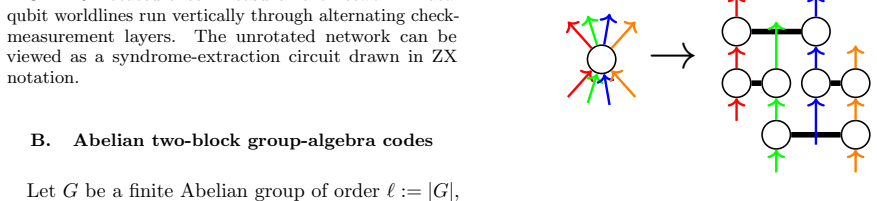
Starting from an AMC complex specified by commuting group-algebra elements over a finite Abelian group algebra, the paper derives a quotient-lattice unit cell in which X- and Z-checks and the data qubits live at the vertices of L/Λ. It lifts this lattice to spacetime Z^{d+1}, chooses the rotated-time covector t=(2,1,...,1), and doubles the periodicity lattice to Λ' so that time is well-defined on the quotient and no closed timelike curves appear. With a time-oriented local port matching on even-valence spiders, matched legs trace out physical-qubit worldlines, and every spider decomposes into two-qubit XX/ZZ parity measurements. For the specific weight-two cyclic AMC4 matching considered, wo
What carries the argument
The quotient lattice L/Λ with typed directions for every non-identity support element, lifted to the spacetime lattice Z^{d+1} with rotated-time covector t=(2,1,...,1) and doubled periodicity lattice Λ' = {v' : v'·t = 0}. The load-bearing mechanism is the port matching: a bijection between incoming and outgoing legs of each even-valence ZX spider. Tracing matched ports through adjacent half-cells defines qubit worldlines; applying the even-legged spider decomposition turns each spider into pairwise XX/ZZ parity measurements. The combined choice of matching, periodicity lattice, and time covector fixes the number of physical qubits, the instantaneous stabilizer group, and the embedded distanc
Load-bearing premise
The whole construction works only if every check and data spider has even valence and there exists a time-oriented port matching whose traced worldline displacement is compatible with the periodicity lattice; the paper verifies this for its specific weight-two matchings but does not prove it for general AMC complexes.
What would settle it
Run the same construction on an AMC complex with an odd-valence spider (for example, a weight-three generator). If a closed periodic schedule of two-qubit measurements still appears, the even-valence condition is unnecessary; if it fails, the condition is load-bearing. A second check: for an even-valence complex, enumerate port matchings and verify that at least one produces worldline displacements compatible with the periodicity lattice; if none do, the construction collapses for that complex.
If this is right
- Floquet AMC codes exist for every AMC complex whose spiders are even-valence and admit a time-oriented port matching; the resulting schedule is a periodic sequence of native two-qubit XX and ZZ measurements.
- The three AMC4 examples locally equivalent to four-dimensional toric codes realize the same homological redundancy in compact physical registers, without measuring weight-six stabilizers.
- Local Pauli-web detector templates and beam-search decoding under EM3 noise give strongly suppressed logical error rates below the crossing, with an estimated pseudothreshold near 1.2%.
- The [[144,6,8]] code achieves error suppression at physical error rate 10^-3 comparable to larger high-rate Floquet constructions, but with a smaller physical register.
- The finite-size values of k d_emb^2/n exceed the honeycomb-code value of 1/3, showing stronger distance-per-physical-qubit overhead for these compact Floquet memories.
Where Pith is reading between the lines
- The rotated-time recipe is likely to work for any AMC complex with even-valence spiders, not just the weight-two cyclic examples; testing non-cyclic Abelian group algebras would reveal whether the matching step becomes the bottleneck.
- The estimated 1.2% pseudothreshold is tied to one detector-template set and one decoder configuration, so the number is probably decoder-dependent; independent decoding runs could shift it.
- Because the instantaneous stabilizer ranks and distances are independent of the integer time cut in the tabulated examples, a time-translation-invariant logical description may exist, which could simplify decoding or suggest time-dependent matching schedules.
- A systematic search over periodicity lattices and port matchings—left open by the paper—is the natural route to shorter global periods and larger distance-per-overhead than the reported examples.
Editorial analysis
A structured set of objections, weighed in public.
Referee Report
Summary. This paper introduces Floquet Abelian multicycle (AMC) codes. It starts from static AMC qLDPC codes over finite Abelian group algebras, derives a quotient-lattice unit-cell description, lifts the syndrome-extraction network to a spacetime lattice with a rotated time covector, and, when the ZX spiders have even valence and admit a time-oriented port matching, rewrites the network into a periodic schedule of native two-qubit XX and ZZ measurements. Explicit GB and weight-two AMC4 examples are constructed; instantaneous stabilizer groups and embedded distances are computed by MILP, yielding reported parameters [[108,6,5]], [[144,6,8]], [[324,6,10]], each with six logical qubits. Local Pauli-web detectors and EM3-noise simulations lead to an estimated pseudothreshold of about 1.2%.
Significance. The quotient-lattice construction is a useful extension of the Stairway approach to higher-dimensional multiblock chain complexes, and the explicit matching rules and trajectory tables are a strength: the schedule is not left unspecified. If the reported distances are correct, the finite-size parameters are competitive and the four-dimensional homological redundancy is realized through two-qubit measurements. The main quantitative claims, however, are not fully substantiated: the MILP distances are computed only at integer time cuts, the existence of the required matching is verified only for examples, and no code or data are provided for independent verification. There is also an arithmetic inconsistency in Table III. The paper is likely a solid contribution after these issues are addressed.
major comments (3)
- [Sec. VI.A, Eq. (121); Tables I and III] Eq. (121) defines d_emb = min_t min{d_X(t), d_Z(t)}, i.e., a minimum over all circuit time cuts. The MILP computations in Tables I and III are performed only at integer values of the rotated time T, and the captions state that 'at fractional times, the ranks and distances may change and, at certain cuts, interchange between the X and Z sectors.' Consequently, the reported values (5, 8, 10 for the three AMC4 codes) are upper bounds on d_emb, not necessarily the true embedded distances. If a fractional cut admits a lower-weight logical representative, the headline parameters [[108,6,5]], [[144,6,8]], [[324,6,10]] are incorrect, and the EM3 simulations in Fig. 7, which set r_mem = d_emb, use the wrong number of noisy rounds. The authors should either compute d_X(t), d_Z(t) at all inequivalent fractional cuts (a finite set in a periodic quotient), prove cut independence for these matchings a
- [Sec. VI.B, Fig. 7] Section VI.B and Fig. 7 report a pseudothreshold of approximately 1.2% from EM3 simulations, but the manuscript provides no Stim circuits, no detector templates, no decoder settings, no shot counts, and no code or data release. The MILP distance computations are similarly not reproducible. Because the central deliverable is a set of finite-size parameters and a threshold, please provide the code and data, or a detailed appendix with the exact circuit, detector definitions, and per-cut distance tables. If the distance computation in the first comment is corrected, the simulations must be rerun with the corrected r_mem.
- [Sec. IV, steps 1-6; Sec. V.B] The Floquet schedule is valid only if every spider has even valence and admits a time-oriented local port matching whose worldline displacement is compatible with the periodic identifications generated by Lambda'. The paper states this condition but does not prove a general existence criterion; it is verified only for the GB and weight-two cyclic AMC4 examples (Eq. (116) and Table II). The conclusions refer to a 'general framework' for arbitrary finite Abelian group algebras, which is stronger than what has been shown. Please either prove the condition for the AMC families considered or state it as an explicit standing assumption and restrict the generality claims accordingly. For the reported examples, an explicit certificate (all edges positively time-oriented; displacement modulo Lambda' consistent) would help.
minor comments (4)
- [Table III, row (12,1,3,5,7)] The BPT column lists k d_emb^2 / n = 1.34, but 6*25/108 = 1.39. Please check the formula or the listed n/d values.
- [Sec. V.B, Eq. (116)] The cycle notation (tau I2 I1) and (tau K1 K2) is used without specifying the composition convention (left-to-right vs right-to-left). This matters for reproducing Table II and the schedule.
- [Sec. VI.B, Fig. 7] The threshold estimate and the comparison with the Stairway and semi-hyperbolic codes would benefit from statistical error bars and a statement of equal noise-model/decoder settings; the current crossing estimate has no uncertainty quantification.
- [Throughout] Please add a code/data availability statement. Several supporting references are preprints; a note on their verification status would be helpful.
Circularity Check
No significant circularity: the Floquet AMC construction is derived from static AMC data via ZX-network rewrites, with distances and pseudothreshold obtained by external MILP and simulation.
full rationale
No circular step is exhibited. The paper derives Floquet schedules from the static AMC quotient-lattice data in Secs. III-IV, then computes instantaneous stabilizer groups, distances via MILP, and logical error rates via Stim/Sinter/Tesseract simulations. No parameter is fitted to the reported distances or to the pseudothreshold. The static AMC family is imported from Ref. [22], which shares an author, but that is a published, independently checkable construction of static codes and is not invoked as an unverified premise that already contains the Floquet results; the Floquet parameters, ISG ranks, and distances are recomputed here. Two stated caveats are genuine correctness/completeness risks rather than circularity: the port-matching condition is asserted ('A valid matching must ensure that each retained geometric edge has positive time orientation under t and that the resulting worldline displacement is compatible with the periodic identifications generated by Λ′') without a general existence proof; and Table III admits 'At fractional times, the ranks and distances may change and, at certain cuts, interchange between the X and Z sectors,' so the MILP integer-cut distances may overestimate the true embedded distance. These caveats do not equate the claimed outputs with the inputs by construction; the central derivation chain is self-contained.
Axiom & Free-Parameter Ledger
free parameters (4)
- Group-algebra generator weights r_J = wt(a_J)-1 =
r_J = 1 for all J (weight-two elements, Sec. V.B)
- Cyclic shifts (s_A, s_B, s_C, s_D) =
(1,2,3,4), (1,3,5,7), (2,5,8,9), etc.
- Spacetime periodicity lattice Λ′ =
Basis rows chosen per (ℓ, shifts); e.g., the BΛ′ shown for ℓ=10 in Sec. V.B
- Port matching μ_data for AMC4 =
Eq. (116): μ_data^X(p)=(τ I2 I1), μ_data^Z(p)=(τ K1 K2)
axioms (4)
- standard math Regular representation of F2[G] for Abelian G gives commuting matrices A_i, so the AMC chain complex satisfies Q_i Q_{i+1}=0.
- domain assumption An even-legged spider can be decomposed into two-qubit parity measurements that implement the same external projector for a fixed outcome configuration.
- ad hoc to paper For the constructed Floquet schedules, a time-oriented port matching exists that makes the worldline displacement compatible with periodic identifications.
- domain assumption The EM3 noise channel is implemented by five independent binary fault components with 2p_ind = 1-(1-p)^(1/(2N_e-1)).
read the original abstract
Abelian multicycle (AMC) codes are compact quantum low-density parity-check codes whose multiblock chain-complex structure provides redundant low-weight stabilizers and supports single-shot error correction. We introduce Floquet AMC codes by deriving a quotient-lattice representation of a general level-$j$, $D$-dimensional AMC complex over a finite Abelian group algebra, lifting this lattice to spacetime, and rotating the circuit-time direction in the associated ZX network. When the check and data spiders have even valence and admit a time-oriented local port matching, the network decomposes into a periodic schedule of native two-qubit $XX$ and $ZZ$ measurements. We construct generalized-bicycle and level-$2$ AMC4 examples, determine their instantaneous stabilizer groups, and compute their embedded distances by minimizing over all inequivalent circuit cuts. For AMC4 instances locally equivalent to four-dimensional toric codes, we obtain Floquet memories with parameters $[[108,6,5]]$, $[[144,6,8]]$, and $[[324,6,10]]$. Local Pauli-web detector templates and beam-search decoding under the measurement-native EM3 noise model yield an estimated pseudothreshold of approximately $1.2\%$. These results provide compact measurement-only realizations of higher-dimensional homological redundancy without directly measuring the original weight-six stabilizers.
Figures




Reference graph
Works this paper leans on
-
[1]
Use the opposite assignment in the Z half-cell
Assign X spiders to the X checks and Z spiders to the qX I data nodes within the X half-cell. Use the opposite assignment in the Z half-cell
-
[2]
Orient each incident leg as incoming or outgo- ing according to the sign of its rotated-time displacement, and add τin and τout ports to each data qubit
-
[3]
Require equal numbers of incoming and outgo- ing legs at every spider
-
[4]
Choose a bijection (port matching) from the incoming legs to the outgoing legs of each spi- der
-
[5]
Trace the matched ports through adjacent half- cells to obtain physical-qubit worldlines
-
[6]
Decompose each even-legged spider into two- qubit XX or ZZ parity measurements along the chosen matching. We note that different matchings produce different worldline cycles and potentially different finite Flo- quet codes, even when the static matrices and peri- odicity lattice are fixed. The number of half-cells in the T = 0 layer deter- mines the numbe...
-
[7]
A. Y. Kitaev, Ann. Phys.303, 2 (2003). [2] E. Dennis, A. Kitaev, A. Landahl, and J. Preskill, J. 17 Math. Phys.43, 4452 (2002)
2003
-
[8]
Preskill, Proc
J. Preskill, Proc. R. Soc. Lond. A454, 385 (1998)
1998
-
[9]
B. M. Terhal, Rev. Mod. Phys.87, 307 (2015)
2015
-
[10]
Bravyi, D
S. Bravyi, D. Poulin, and B. Terhal, Phys. Rev. Lett. 104, 050503 (2010)
2010
-
[11]
N. P. Breuckmann and J. N. Eberhardt, PRX Quan- tum2, 040101 (2021)
2021
-
[12]
A. A. Kovalev and L. P. Pryadko, Phys. Rev. A88, 012311 (2013)
2013
-
[13]
D. J. C. MacKay, G. Mitchison, and P. L. McFadden, IEEE Trans. Inf. Theory50, 2315 (2004)
2004
-
[14]
Wang and L
R. Wang and L. P. Pryadko, Symmetry14, 1348 (2022)
2022
-
[15]
Wang, H.-K
R. Wang, H.-K. Lin, and L. P. Pryadko, in2023 12th International Symposium on Topics in Coding (ISTC)(IEEE, 2023) pp. 1–5
2023
-
[16]
Lin and L
H.-K. Lin and L. P. Pryadko, Phys. Rev. A109, 022407 (2024)
2024
-
[17]
Bravyi, A
S. Bravyi, A. W. Cross, J. M. Gambetta, D. Maslov, P. Rall, and T. J. Yoder, Nature627, 778 (2024)
2024
-
[18]
Bomb ´ ın, Phys
H. Bomb ´ ın, Phys. Rev. X5, 031043 (2015)
2015
-
[19]
B. J. Brown, N. H. Nickerson, and D. E. Browne, Nat. Commun.7, 12302 (2016)
2016
-
[20]
E. T. Campbell, Quantum Sci. Technol.4, 025006 (2019)
2019
-
[21]
Tillich and G
J.-P. Tillich and G. Z´ emor, IEEE Trans. Inf. Theory 60, 1193 (2014)
2014
-
[22]
A. A. Kovalev and L. P. Pryadko, in2012 IEEE In- ternational Symposium on Information Theory Pro- ceedings(IEEE, Cambridge, MA, USA, 2012) pp. 348–352
2012
-
[23]
Zeng and L
W. Zeng and L. P. Pryadko, Phys. Rev. Lett.122, 230501 (2019)
2019
-
[24]
Zeng and L
W. Zeng and L. P. Pryadko, Phys. Rev. A102, 062402 (2020)
2020
-
[25]
A. O. Quintavalle, M. Vasmer, J. Roffe, and E. T. Campbell, PRX Quantum2, 020340 (2021)
2021
-
[26]
Higgott and N
O. Higgott and N. P. Breuckmann, PRX Quantum 4, 020332 (2023)
2023
-
[27]
H.-K. Lin, P. K. Lim, A. A. Kovalev, and L. P. Pryadko, PRX Quantum7, 020326 (2026)
2026
-
[28]
D. Aasen, J. Haah, M. B. Hastings, and Z. Wang, Geometrically enhanced topological quantum codes (2025), arXiv:2505.10403 [quant-ph]
Pith/arXiv arXiv 2025
-
[29]
D. Aasen, M. B. Hastings, V. Kliuchnikov, J. M. Bello-Rivas, A. Paetznick, R. Chao, B. W. Reichardt, M. Zanner, M. P. da Silva, Z. Wang, and K. M. Svore, A topologically fault-tolerant quantum com- puter with four dimensional geometric codes (2025), arXiv:2506.15130 [quant-ph]
Pith/arXiv arXiv 2025
-
[30]
M. B. Hastings and J. Haah, Quantum5, 564 (2021)
2021
-
[31]
Davydova, N
M. Davydova, N. Tantivasadakarn, and S. Balasub- ramanian, PRX Quantum4, 020341 (2023)
2023
-
[32]
E. X. Fu and D. Gottesman, Quantum9, 1886 (2025)
2025
-
[33]
Gidney, M
C. Gidney, M. Newman, A. G. Fowler, and M. Broughton, Quantum5, 605 (2021)
2021
-
[34]
Higgott and N
O. Higgott and N. P. Breuckmann, PRX Quantum 5, 040327 (2024)
2024
-
[35]
Fahimniya, H
A. Fahimniya, H. Dehghani, K. Bharti, S. Mathew, A. J. Koll´ ar, A. V. Gorshkov, and M. J. Gullans, Quantum9, 1849 (2025)
2025
-
[36]
R. Chao, M. E. Beverland, N. Delfosse, and J. Haah, Quantum4, 352 (2020)
2020
-
[37]
Gidney, Quantum7, 1156 (2023)
C. Gidney, Quantum7, 1156 (2023)
2023
-
[38]
B. Rodatz, B. Po´ or, and A. Kissinger, Floquetifying stabiliser codes with distance-preserving rewrites (2024), arXiv:2410.17240 [quant-ph]
Pith/arXiv arXiv 2024
-
[39]
Bomb ´ ın, D
H. Bomb ´ ın, D. Litinski, N. Nickerson, F. Pastawski, and S. Roberts, Quantum8, 1379 (2024)
2024
-
[40]
Backens, New J
M. Backens, New J. Phys.16, 093021 (2014)
2014
-
[41]
J. van de Wetering, ZX-calculus for the working quan- tum computer scientist (2020), arXiv:2012.13966 [quant-ph]
Pith/arXiv arXiv 2020
- [42]
-
[43]
Coecke and R
B. Coecke and R. Duncan, New J. Phys.13, 043016 (2011)
2011
-
[44]
A. R. Calderbank and P. W. Shor, Phys. Rev. A54, 1098 (1996)
1996
-
[45]
A. M. Steane, Phys. Rev. Lett.77, 793 (1996)
1996
-
[46]
Arnault, P
F. Arnault, P. Gaborit, W. Rozendaal, N. Saussay, and G. Z´ emor, IEEE Trans. Inf. Theory72, 437 (2026)
2026
-
[47]
A. J. Landahl, J. T. Anderson, and P. R. Rice, Fault- tolerant quantum computing with color codes (2011), arXiv:1108.5738 [quant-ph]
Pith/arXiv arXiv 2011
-
[48]
Gidney, Quantum5, 497 (2021)
C. Gidney, Quantum5, 497 (2021)
2021
-
[49]
Gidney and contributors, Sinter: Sampling in tasks for estimating rates, Software package dis- tributed with Stim (2021)
C. Gidney and contributors, Sinter: Sampling in tasks for estimating rates, Software package dis- tributed with Stim (2021)
2021
-
[50]
QuantumLib contributors, Tesseract decoder, Soft- ware repository (2025)
2025
-
[51]
M. Ye, D. Wecker, and N. Delfosse, PRX Quantum 7, 033002 (2026)
2026
-
[52]
Jiang, I
Y. Jiang, I. Dumer, A. A. Kovalev, and L. P. Pryadko, J. Math. Phys.60, 083302 (2019)
2019
-
[53]
Delfosse, in2013 IEEE International Symposium on Information Theory(IEEE, 2013) pp
N. Delfosse, in2013 IEEE International Symposium on Information Theory(IEEE, 2013) pp. 917–921
2013
discussion (0)
Sign in with ORCID, Apple, or X to comment. Anyone can read and Pith papers without signing in.